


Animal health and livestock production programme in Afghanistan (AGF/93/004)
Animal health and production improvement module - PIHAM (TCP/AFG/4553)
"I understand this is a good programme. If a minister writes a programme while sitting behind the table it will not be implemented, but if if is designed in the field, if will be implemented "xv
Almost all government institutions in Afghanistan, including the Veterinary Department, had effectively ceased functioning as a result of the war. In mid-1994, UNDP amalgamated two livestock programmes and established a single FAO executed programme, "Animal Health and Livestock Production Programme in Afghanistan (AFG/93/004) ".3 The aim of the project was to "restore and improve the productive capacity of the national livestock composite owned by smallholder farmers and nomadic and semi-nomadic pastoralists."
3FAO had a "sister" project to the livestock programme, entitled, "Integrated Crops and Food Production in Afghanistan (AFG/94/002)". This project has recently begun a new phase.
The project identified rural women as a key beneficiary group and recognised their capacities as animal production and health "specialists". In turn, it considered development activities that were deemed "appropriate" for their participation. The operation of Veterinary Field Units (VFUs) by women was seen to be unrealistic given their restricted movement in the districts. However, the project felt that women farmers could act as Basic Veterinary Workers (BVWs) in their village, supporting disease investigation and diagnosis and possibly earn a supplementary income. BVW training for women attempted to "avoid old pattern(s)"of only men talking to men about the problems of rehabilitation, and to involve women in animal health and livestock production activities."xvi
The project set training targets of 60-80 additional paravets and 200-250 Basic Veterinary Workers, including at least 75 women. Poultry breeding farms, hatcheries, and chicken rearing facilities were to be established to facilitate, among other things, the hand out of two month old chicks to women participating in poultry management training. The BVW training together with the poultry management courses were collectively referred to as "the Women's Programme".
Generally speaking, the delivery of animal health services in Afghanistan had improved through FAO and other UN, bilateral, and NGO assistance using a package of animal health services against "an historically accepted repertoire of animal diseases"xvii It is said that mortality was reduced in young (26%) and adult (43%) animals.xviii However, one study suggested that the relative impact on mortality of vaccinations versus parasite prevention versus clinical treatment had not been considered.xix The project assumed that anti-parasite treatments accounted for the majority of benefits. In addition, it was thought that poor animal management and nutrition as well as reproductive inefficiency and neo-natal mortality posed considerable constraints to improving livestock productivity.xx If this were the case, the project extension services would have to change their approach.
Additionally, the livestock project identified several constraints to self-sustaining Veterinary Field Units. The greatest constraint was felt to be the poor relationship between the veterinary staff and the farmers. Poor VFU-farrner relationships not only limited the ability of veterinarians to work effectively on a cost-recovery basis, but also hindered attempts to improve overall small-holder livestock production. To some extent, it appeared that veterinary staff were not aware of the livestock problems faced by farmersxxi. There was clearly the need for a training programme, previously omitted from the project, to promote the principles of farmers' participation in identifying their own needs and local decision-making, as well as in building closer farmer-veterinary staff relationships.
The project looked to examples elsewhere in Asia for possible appropriate methodologies for changing its extension approach. As a result, AHPIM (later changed to PIHAM) was adapted and tested for use in Afghanistan.
Diagram 1: Foundations or "Pillars" of PIHAM
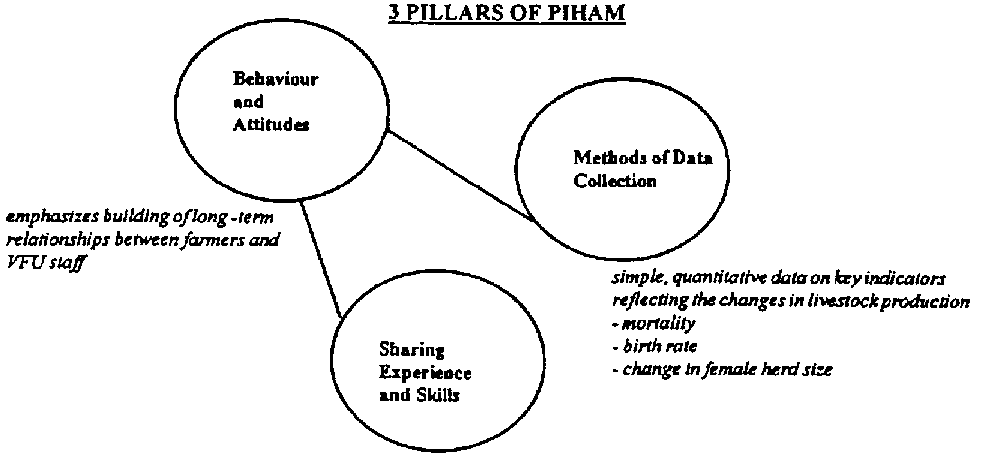
PIHAM is a herd health and production programme that aims to improve the quality and delivery of livestock services in Afghanistan.xxii It promotes the use of participatory approaches that are based on gaining greater understanding of, and formulating appropriate responses to, farmers' identified needs. Through this approach, it facilitates the process of identification of animal health and husbandry constraints, the planning and implementation of interventions, and the monitoring of results by farmers and local veterinary teams.
The participatory approaches used in PIHAM are developed on three foundations, or "pillars" (see Diagram 1 above). One of the key strengths of PIHAM is the recognition of the need to maintain continuous contact between farmer and VFU staff to build farmer confidence and facilitate the collection of information essential for responding to the needs of farmers. From other experiences, it was recognised that as the relationship between the two improves, so does the potential to respond to the problems identified by farmers.
Since its inception, PIHAM has acted as one of the key "vehicles for change" for the livestock project and its sub-activities, including the Women* Programme, driving the processes of exchange, reflection, analysis, and correction. Through the encouragement of participatory methodologies, it has created a "safe space" necessary for all project staff from the lowest to highest levels to discuss problems and share successes, both across horizontal and vertical organisational levels.
