


The following section looks at the lessons learned through project implementation vis a vis what did and did not work in terms of both community participation in general, and the participation of village women and women trainers/initiators. It highlights those areas that helped improve project planning processes at all levels in terms of raising the level of participation of rural men and women in needs identification, constraints analysis, diagnosis, and problem solving related to their livestock.
It also highlights those constraints that hindered effective participation, particularly of women, both at the village level and at the project staff level. As already noted, recent Taliban restrictions on women's mobility have posed great constraints to village women in conducting their daily activities. They have also hampered the efforts of projects wanting to employ and work with women. These restrictions increasingly frustrate UN (and other) efforts to ensure the participation of women as actors and beneficiaries, and subsequently effective implementation of all rehabilitation and development interventions in Afghanistan.
Overall, it can be said that through the introduction of a consistent participatory approach both with veterinary and other project staff, and with women and men villagers, actors at all levels have come to recognise the important role which rural women play in livestock management and health. It is important to keep in mind, in measuring the lessons learned, that neither the overall project nor its components were, or are "gender projects" per se. The project was intended to "restore and improve the productive capacity of the national livestock composite owned by smallholder farmers and nomadic and semi-nomadic pastoralists. " However, project staff at all levels recognised that such a goal could not be met without the involvement of both women and men farmers as well as women and men initiators.
Early on, the identification and planning of activities both in the overall FAO livestock project and in the Women's Programme in particular tended to come from a more central base. While this is clearly an overly simplistic description of project decision-making processes, it gives a general sense of the decision-making patterns. However, according to project management, wherever possible, they tried to incorporate community-based needs identified during their field visits in overall planning processes.xxiii
While some field-level staff had experience using participatory approaches to their work others did not. The lack of a consistent participatory approach to needs identification and planning hindered the building of relationships between Veterinary Field Unit staff, Women's Programme trainers, and farmers. Approaches were based, to a great extent, on the transfer of skills and knowledge as well as service support from the project to farmers. For the most part, staff talked to village men and women, not with them. While some discussion may have been held with villagers, it is questionable to what extent they truly participated in the decision-making processes related to project implementation.
Given socio-cultural and more recent political decisions to increase women's seclusion, it might have been easier for the project to direct its interventions only to male villagers through male staff However, project management and staff have realised that such a male-centric approach could not, by itself, improve small-holder livestock production in Afghanistan. Without women's participation, and at the very least, their knowledge about livestock management, any proposed solutions would not be sustainable over the long term.
With the introduction of the PIHAM methodology several changes were visible, both in the overall livestock project, and in the Women's Programme. Perhaps most dramatic was the changed attitudes of staff at all levels to women and men farmers, for whom they were supposed to be working. In the past, many of the decisions were made by project staff. With the introduction of PIHAM, a greater number of decisions are now being made by staff in conjunction with women and men villagers based on their identification of the problems, needs, and possible solutions.6 This in turn is feeding into the overall planning processes, even at the highest level of the project.
6PIHAM, however, is not yet operating in all areas of the country where the overall livestock project is active. a consistent approach to working with farmers to monitor, with them, changes in animal production. The lack of participatory monitoring approaches was felt to be a great constraint to improving livestock production.
It could be said that the overall livestock project has, since 1994, gradually evolved to decision-making processes that resemble more of a "cyclical" rather than "bottom-up" or "top-down" model. PIHAM has the potential to move these processes to a point where decisions can feed from the farmer to planner, and back in a continuous repeating loop.
Lessons Learned: Transforming a project using more participatory approaches can support the recognition and validation of both women and men* different roles and responsibilities in, and knowledge of agricultural production systems. Involving different actors - both male and female, rich and poor - in decision-making (identifying problems, analysing causes, proposing solutions, and monitoring changes in production), can improve overall planning processes.
Before the introduction of PIHAM, both the Women's Programme and the overall livestock project implemented an "acceptable repertoire" of services focused on improved livestock production throughout Afghanistan. While some veterinarians and agriculturalists attached to the project had limited experience with participatory methodologies, there was no overall consistent participatory approach for working with women and men farmers. To paraphrase the views of senior management and agreed by many of the project staff, "Veterinarians waited in their offices for farmers to come to them". In early PIHAM exercises, initiators themselves noted that veterinarians' attitudes to farmers were ones of superiority. They gave little recognition to either women or men farmers' knowledge of their own animals or their capacity to identify potential causes and suggest appropriate solutions. Nor was there
Using a "banking model"7 approach, the Women's Programme delivered a series of skills related to animal production and poultry management to rural women. According to the WP trainers, "there was no participation" of women farmers. Nor was there a participatory assessment of women farmers' present livestock management skills, nor an assessment of their particular livestock (or other) needs. The Women's Programme monitored activities using a formal interview form.xxiv
7In the field of adult learning," banking model" refers to a one-way system of learning whereby the 'pupil' is lectured to by the 'teacher'.
Similarly, the overall livestock project (which worked primarily via male staff to male farmer for reasons already noted), also applied a "banking model" delivery of services. Veterinary Field Unit staff did not necessarily understand, or even recognise, the need to sit with farmers on an ongoing basis to work together on disease diagnosis and patterns, and identification of possible appropriate solutions.
The PIHAM training, conducted by consultants from Livestock in Development (U.K.), was first conducted for 10 male "initiators" in 1995. Adult learning and PRA approaches were used in combination to highlight the importance of listening to, respecting, and learning from farmers, and finding appropriate solutions with them. The participatory approaches used include:
- group discussion |
- pair discussion |
- problem ranking |
- general discussion - questions and answers |
- problem picture |
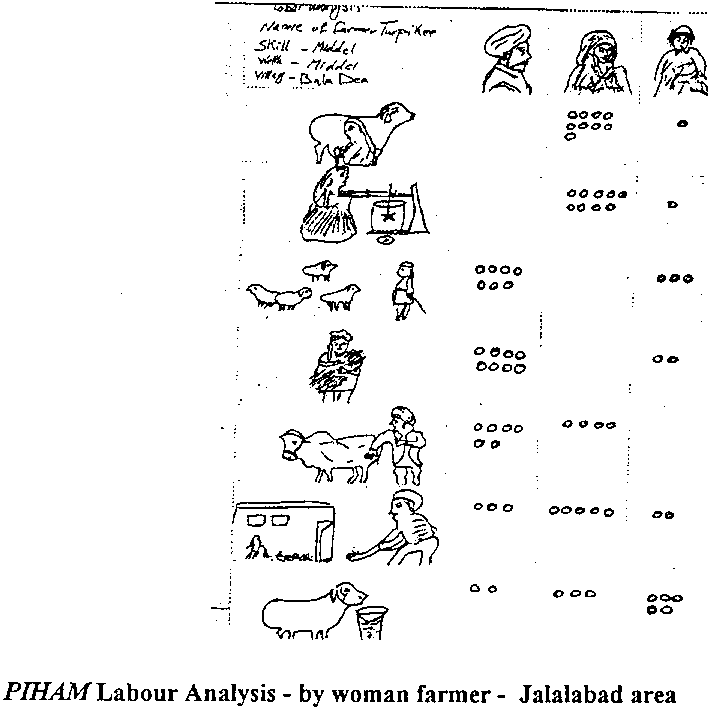
- labour analysis |
- practical skill lessons |
- seasonal calendars |
- "sitting point exercise" |
- life status ranking |
- skills ranking |
- participatory monitoring (see sample reporting forms in Diagram 2) |
Through their practice of participatory appraisal and monitoring in the field and in the classroom, participants (including project management) realised how essential it was to have women trainees participate with them. They realised that it was women who can often best provide the diagnosis for a sick animal through their intimate knowledge and observation on a daily basis. The addition of two women initiators to the initial PIHAM training, and their subsequent addition to the Women's' Programme, led to a revision of methodologies in that programme as well.
Diagram 2 - Two examples of PIHAM participatory reporting forms used by women and men farmers to monitor changes in their livestock
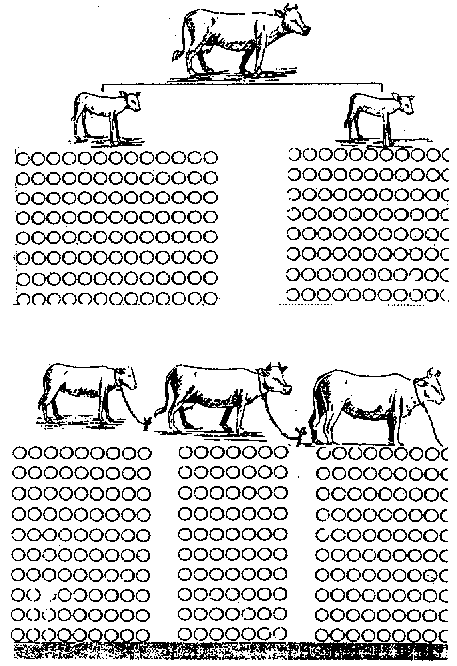
Several reporting forms have been developed under PIHAM for use by women and men farmers to assist in their own processes of monitoring changes in livestock production. The fop form is used to record births; farmers fill in a circle to record the birth of each calf.
The bottom form is used to monitor the sale of livestock; farmers mark the sale of a calf, a cow, or a bull. Other forms are also used in monitoring livestock mortality and acquisition. Forms are also used for goats and sheep. If has been suggested that similar forms to monitor women's poultry would also be useful.
In early 1997, project staff visited 35 households in the Jalalabad area that had been trained in poultry management using the pre-PIHAM methods. They discovered that women had not built any chicken houses as the training had hoped. However, PIHAM provided the tools of analysis to enable the Women's Programme staff to modify the poultry training course based on inputs and feedback from women villagers Staff decided to find ways to ensure that the course is more participatory and practical, and so more meaningful to illiterate women. They also recognised the need to promote the use of local feedstuffs and construction materials. In reviewing the women's BVW activities, which are temporarily suspended, staff felt training should be reviewed in terms of content and methodology and that it should be more participatory and practical. xxv
The women trainers thus clearly recognised the importance of using participatory methodologies in their own programme, both in identifying the livestock management concerns of village women, as well as finding appropriate solutions to problems. The previous "banking model/lecture" format began slowly to evolve into a learning process both for the village women and the project staff. Their relationship has changed. Staff now have more respect for rural women's knowledge, and are actively integrating it in planning out the subsequent activities. Staff realise the need to include all members of the household in constraint analysis and problem solving related to livestock production.
Lessons Learned:
· Using participatory appraisal approaches can lead to a revelation, by villagers themselves, as well as by project staff of the important roles which different household members play in different aspects of agricultural production.
· It is important to make training as relevant as possible to real life situations, i.e. need to address the particular needs of different household members
· Socio-cultural contexts are not static-they are constantly changing depending on the socio-political and economic contexts Tools and methodologies should be flexible enough to meet the changing needs and priorities of farm household members. For example, with current Taliban restrictions on women * mobility, training methods and modules have had to change in order to continue to respond to women's, as well as men * needs and priorities
· Tools must be modified to meet the socio-political context if necessary, e.g. in cases where a country is in conflict, "mapping" may not be a suitable exercise. Rather, using a "sitting point" exercise where the villagers work outwards from where they sit, explaining important features, etc. may be more appropriate.
· The discomfort of certain household members to some PRA exercises may show more about the socio-cultural/socio-economic context, access to and control over resources, etc. For example, women in a village insisted that their husbands' names be used in the wealth-ranking exercise, their reason being that "their husbands would not like it if women's names were used regarding discussions of 'wealth "'.
· Undertaking PRA exercises with Afghan women farmers is far more time-consuming given their restricted mobility. While men can meet in groups, it is often necessary for female project staff to meet women in their house. In some areas, this means that only a few women can be met compared to the number of men. If projects are serious about working with women farmers and using female staff they must plan for extra costs - both in terms of time resources Patience is also required with female staff in this difficult situation.
Various PRA exercises undertaken within the context of the initial PIHAM training sessions as well as those under the replication phase highlight the fact that livestock and other related agricultural production activities are, to a great extent, differentiated. Recognition of the different roles and responsibilities both along gender and age lines, as well as along lines of socio-economic status and ability is critical to ensuring more effective planning of livestock interventions and developing appropriate solutions.
Participants in the initial training exercises highlighted the importance of talking to the family member who knows most about the animals, and noted that this is not necessarily the (male) head of household. They also indicated that any (male) head of household, while not necessarily the person implementing the solution, needs to be completely informed in order to approve any suggested changes in husbandry.
The main findings from the participatory appraisal exercises conducted under PIHAM8 showed the following:
8 These findings cannot be said to be country-wide.
· Women and men generally have different roles in livestock production. Women typically are responsible for milking (children also). They take care of the new born and sick animals and are critical in diagnosis. Women (and older children) are responsible for those activities closest to the house itself i.e. cleaning, cooking, and caring for the children. Men may be responsible for ensuring that animals are properly watered and fed, i.e. they are typically responsible for grazing, watering.
· Most of the final household decision-making is done by men (if they are present).
· The socio-economic status (wealth) and ability ranking of a farm household seems to have a positive correlation with women and men farmers' capacity to manage their animals and implement appropriate solutions.
· Both men and women are capable of using the participatory monitoring forms provided by the project to monitor changes in their livestock production.
Lesson Learned: Women have an important role to play in participatory livestock management and monitoring and can influence their husbands (or other male household members) to change their livestock practices.
Diagram 3 - Examples of PIHAM PRA Tools Used In Project (A)
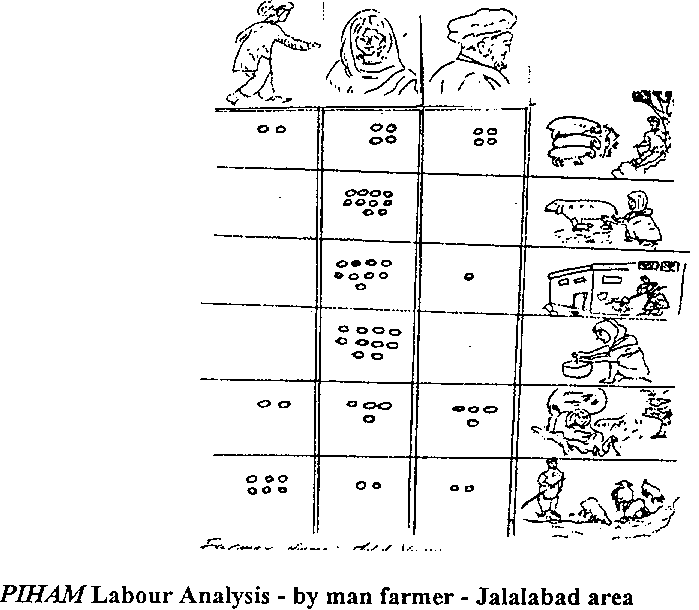
Diagram 3 - Examples of PIHAM PRA Tools Used In Project (B)
Although introduced to support the move to self-sustaining Veterinary Field Units throughout project areas in Afghanistan, PIHAM strengthened capacities at several different levels -- from farmer to field staff, and beyond to project management. In particular, it supported vertical capacity building processes through:
· pilot phase training of selected male and female field-level staff in PRA methods and participatory livestock monitoring approaches for use with client farmers;
· training a core group of trainers (TOT) in the basics of adult education and participatory learning approaches. This group is now qualified to train other Veterinary Field Unit staff in participatory livestock production monitoring and other PRA approaches for use with client farmers.
· replication of PIHAM training for other Veterinary Field Unit staff.
· introduction of PIHAM approaches and analyses to the project's Women's Programme (through pilot phase training of female initiators). planned expansion of training for women staff in PIHAM.
· sensitization of project management and other project staff of the need to incorporate participatory planning approaches.
Importantly, horizontal capacity building was supported amongst VFU staff (and to some degree, between male and female staff) from various areas of the country through training together and sharing experiences and lessons learned. Women and men farmers themselves gained enormous capacity, particularly in terms of trusting their own abilities to recognise and resolve livestock production constraints themselves, or with the support of Veterinary Field Unit staff. PIHAM provided space for both women and men farmers to validate both their own knowledge of livestock management and to recognise the roles and responsibilities, as well as the contributions, of other family members.
The specific capacities strengthened at levels associated with, and outside the livestock project, through the introduction of participatory, and subsequently, gender-aware methodologies, are summarised below (see Table 2). These are based on discussions with project staff specifically associated with monitoring the implementation and impact of PIHAM training and the Women's Programme.
While the capacities of the male and female staff were strengthened, several problems remain in terms of continuing support to the professional women on staff, and to the women farmers involved in the activities of the Women's Programme. Because of restrictions on women's mobility in Taliban-controlled areas, women staff can no longer enter government or other (i.e. project/FAO) offices or travel in project vehicles. It is also difficult for male staff to visit women farmers. Thus, the issue of professional support to, and monitoring of, the Women's Programme remains problematic. Senior project management, most of whom are male, cannot monitor female staff while they work with rural women and thus cannot correct problems or identify areas requiring attention.
Table 2 - Capacities Built at Each Level After the Introduction of PIHAM
ACTOR |
CAPACITIES BUILT |
VILLAGE WOMEN |
Exchange of experience between women farmers; women realised responsibility of keeping livestock, e.g. mating time; increased ability to record/monitor changes (reporting forms); could record disease patterns and see vaccination time (seasonal calendars); learned importance of talking to experienced women, also that they had a bigger role in livestock management than they thought (labour analysis); were able to identify many causes of problems; solutions based on resources at hand; easier, cheaper, more effective (input/output charts). |
VILLAGE MEN |
Learned how much women are involved in livestock (labour analysis, seasonal calendars, etc.) and the importance of discussing with them the problems, finding diagnosis, etc. (discuss with wife); relationship between villagers/staff improved; (see also above under village women for similar capacities gained). |
PIHAM INITIATORS9 |
Attitude, behaviours changed towards farmer ("no longer proud"); learned how to talk with people and listen; learned how to give others a chance to talk; worked now from the bottom-up rather than top-down; learned that farmers have important knowledge (all through adult learning methods and PRA methods - listening exercises, role plays, etc.) |
VFUs |
Overall improved capacity to understand importance of participatory approaches; learned from initiators (through staff discussions, sharing). |
PROJECT MANAGEMENT/STAFF10 |
Participatory training skills for key project management (participation in initial training modules); use participatory methods for monitoring and project design (transfer of skills from PIHAM training, e.g. Women's Programme revisions); learned from mistakes and can work with trainers to correct; planning capacity improved overall (through improved understanding of community needs through direct contact and continuous monitoring of PIHAM Pilot and Replication phases); recognise that without the involvement of women, key livestock information is incomplete (through participating in early PIHAM training and analysis). |
NGOs |
Through exchange related to PIHAM processes, became more aware of the farming systems in their area as well as elsewhere; could provide modifications to training (manuals). |
UN AGENCIES IN AFGHANISTAN |
Through sharing of PIHAM experiences with other UN agencies, awareness raised of importance of community participation in planning; future potential for sharing of methods with other projects/programmes. |
9 includes both men and women initiators trained to date
10 includes to varying extent - CTA; National Assistant Manager, Livestock Production; National Manager, AHS;
'Do not make any promises and you must follow up' (Woman PIHAM trainee's observation)
The use of the PIHAM approach facilitated the broader awareness raising of two key issues that have the potential to change planning processes throughout the project in terms of gender and participation:
· the recognition by project staff at all levels of the need for women's participation both at the village level and on staff; and,
· the recognition of the need to introduce participatory approaches to needs identification and training development in the Women's Programme.
Exactly how this awareness was raised was discussed under previous sections of Lessons Learned. While to some extent, project management may have already been aware of these important "revelations", it appears that PIHAM has started to facilitate a broader internalisation of them at all levels (refer back to Table 2 for levels) - from farmer through Veterinary Field Unit staff and Women's Programme trainers up to project staff. More importantly, it has introduced a consistent participatory approach, i.e. the "how to" that is important for the collection of comparable data throughout project areas and for the sharing of experiences within and between all levels.
Diagram 4: Flow of PIHAM Linkages
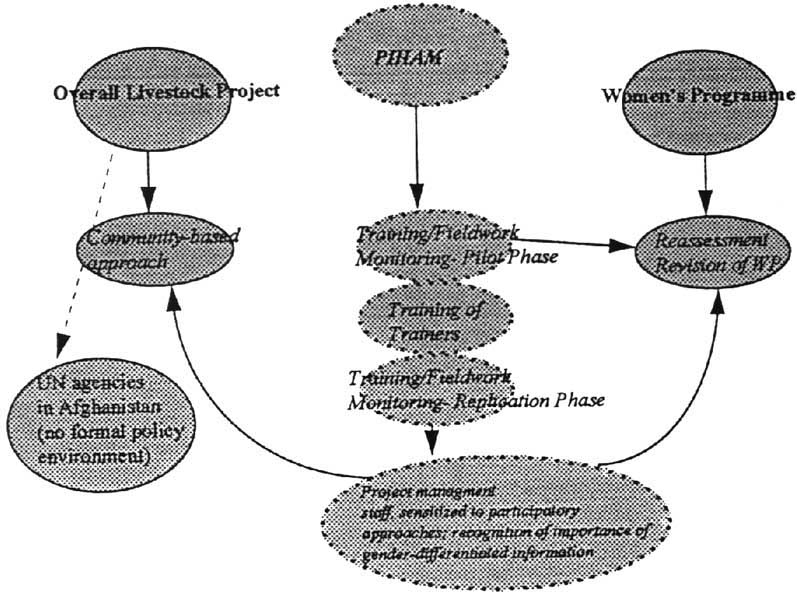
n.b. PIHAM raised the awareness of the need for participatory approaches in the Women's Programme and the need for participatory approaches that recognised gender-differentiated knowledge and experience in the overall project.
In fact, it seems to have led to a linking of approaches (see Diagram 4 above) between many Veterinary Field Unit activities, where the current focus is on creating better farmer-technician relationships and the Women's Programme, which is focused on village-level training in animal health and management.
At the village level, measuring the extent to which women and men farmers have increased communication between themselves regarding livestock management will require closer monitoring over time. It is clear that men farmers, through participating in labour analysis exercises, realise that women play very important roles in livestock management and health care. As noted earlier, it is difficult for project management, all of whom are men, to monitor women staff while they conduct their work with village women. For the time being, it seems that male staff at all levels cannot meet directly with rural women to discuss issues and concerns. Likewise for female staff with rural men in most areas. It is therefore critical that female staff and male staff continuously share experiences and findings from the field.
In the absence of a functioning national infrastructure, the project has no direct links to agricultural or other ministries. It does, however, work with ex-government and NGO extensionists to institutionalise participatory approaches with them. In using PIHAM's participatory approaches, gender issues are also raised, particularly through such tools as labour analysis and input/output charts.
As a consistent participatory approach begins to spread out to other VETERINARY FIELD UNIT staff throughout the country, and as the Women's Programme grows, comparative socio-economic and technical information on livestock management and production constraints should become available. The wider use of life status ranking, skill ranking, and labour analysis together with participatory livestock monitoring will lead to a better understanding of the socio-economic, gender, and technical factors in livestock production systems across a number of socio-cultural groups in Afghanistan. This will, in turn, support the improved planning of veterinary and livestock services at an levels.
When the time comes to re-establish national infrastructures, participatory approaches highlighting socio-economic, gender and technical information will, to some extent, already have been "institutionalized" with animal health and production services. As more quantitative and qualitative information is gathered over the next few years through working with women and men farmers, the greater the likelihood that the development of any future agricultural/livestock policy11 will respond more effectively to the needs and priorities of rural communities.
11 policy in the sense of future UN/donor planning, or with future national and regional government policy. any level, from the grassroots to policy, to fully institutionalise approaches that are both "gender-responsive and participatory".
Until that time comes, the UN and its various agencies, donors, and NGOs will continue to play a major role in giving "policy direction" and planning interventions. Awareness-raising workshops such as that conducted by FAO for other agencies is one way to provide opportunities for cross-sectoral exchange of experiences -- both in terms of supporting women's participation in rehabilitation and development interventions, and in using participatory approaches to planning. However, until restrictions on women's mobility and access to services are lifted, it will be difficult at Lesson Learned: Internalisation can lead to institutionalisation. While some project staff or even management may already recognise the need for change, participatory' approaches can facilitate the broader internalisation of issues and concerns across various levels that is so essential to institutionalising a "different, perhaps more effective way of doing things".
