

Markets and market channels
Farm Household
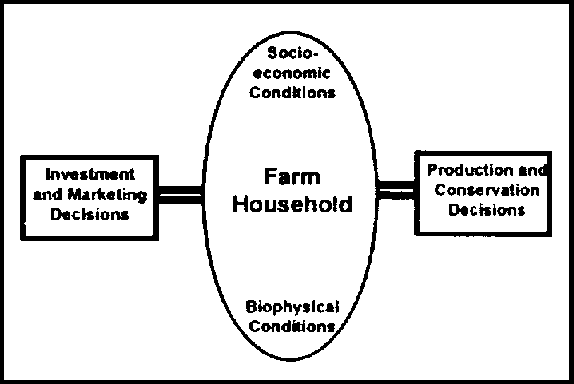
Farm families need market information for making investment and marketing decisions. Even though not all farmers do detailed cost-benefit analyses, they usually make a budget "in heads." Often they also make rough budgets on paper before making a decision. Box 5 presents some of the market options that farmers have.
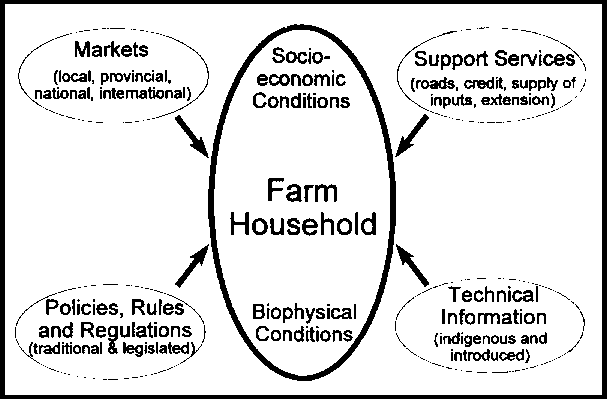
Box 5: Markets and channels Local · middlemen · producers associations · local industry Provincial and National · brokers and traders · large-scale industries International · commodities exchanges · multinational corporations |
Farmers seek market information from other farmers, middlemen, and, if possible, producers associations, retailers, wholesalers, processors, and manufacturers. Unfortunately, access of a small farmer to market information is poor. A competitive market is not always present. Having said this, there is usually great opportunity to improve access to market information and, by doing so, allow farmers to tap into domestic, if not international markets.
Small farmers who are not organized into groups will find it difficult to achieve the scale of production that is demanded by more up-scale markets. Group organization under these conditions, therefore, becomes a key element.
Policies, rules and regulations
Household decisions are also affected by policies, rules, and regulations that are enforced by the state and community. Examples are given in Box 6. These may be implemented either at the local or the national level. For example, teak in most countries requires a permit to be felled and transported. This is a constraint for teak producing farmers who are exploited by unscrupulous officials. Transportation of fuelwood and charcoal is subject to stringent regulations in some places. These laws are, however, necessary to protect public forest resources.
Apart from formal legislation and policies, there are traditional customs and practices that govern management of agricultural lands. User rights are particularly important for farmers who live on the fringes of state forests and have a ready supply of fuelwood.
Box 6: Policies, rules and regulations Traditional laws and common practices · social norms · customs Written legislation · local · national |
Support services
External support services are often needed to take advantage of market and production opportunities. Lack of roads for purchase of production material and transport of farm produce to the market is a clear constraint in some locations.
Other factors such as those highlighted in Box 7, however, are also important. Depending on the extension strategy and readiness of the farm household to respond to market forces, different support services will play varying roles. In some instances, farmers associations and cooperatives have played an instrumental role. In other cases direct subsidies for tree planting and management have had an impact.
Box 7: Support services · Roads and transport · Cooperatives · Credit institutions · Extension services · Farmers associations · Supply of seed/planting material and pesticides/fertilizer · Middlemen, brokers and contracting industry · Market information services |
Technical information
Issues covered under this heading include information on different aspects of growing crops such as propagation techniques, plant protection, nutrient requirements and harvesting technologies. Information can be provided from sources such as successful farmers, researchers, extension workers and private industry (Box 8).
Especially when a farm family is willing to adopt a new production commodity, technical information is essential to prevent failure.
Box 8: Technical information · Other farmers Research · Extension · Industry · Middlemen |
Farm Household
For example: When a farmer decides to produce his own tree seedlings, technical information on how to select seed and seedling is necessary, since usually farmers are used to growing crops with a short rotation. If a plant does not flourish as well as its neighbors' only a little production is lost, since the harvest takes place within a short time-span of only a few months. This way of thinking makes him very conservative in seedling selection, if he applies selection at all. Depending on seed-source an average of two thirds of the seedling many have to thrown away due to poor growing performance. If a less productive seedling is planted for production, time required to produce a harvestable product can be increased by as much as five times. All this time the tree occupies space which could be used for wood production.
Also a lot of production capacity is lost in fruit production, when a farm family uses fruit seeds for their trees instead of grafts. Much rural fruit has an average taste, and comes from average producing trees.
Also techniques developed by neighboring farmers will also be adopted if they proof to be successful. These techniques are designed by people with the same cultural setting as the surrounding farmers, so the process of diffusion will be shorter. An example: in Central Java mango seedlings die on poor soil with a pronounced dry season. An experienced farmer named Pak Maryono found a technique for increasing the survival rate. To avoid superficial root growth he suggests digging a hole 1 x 1 x 1 meter, removing the poor soil and replacing it with fertile soil and organic manure. The next year, he suggests digging 4 to 6 one-meter deep drills around the young tree and adding organic manure. Roots that are enriched with manure from the drills grow downwards and outwards seeking nutrients at deeper soil levels. In this way he could harvest his first mangos in four years. Now many farmers in this area use this rather labour intensive method for their mango trees as well.
In Summary
The interaction between all the of factors discussed above is presented in the following figure. This may be used as a framework for selection of extension strategies or to guide unstructured interviews with farmers to learn how they go about making agroforestry decisions.
Farm Ho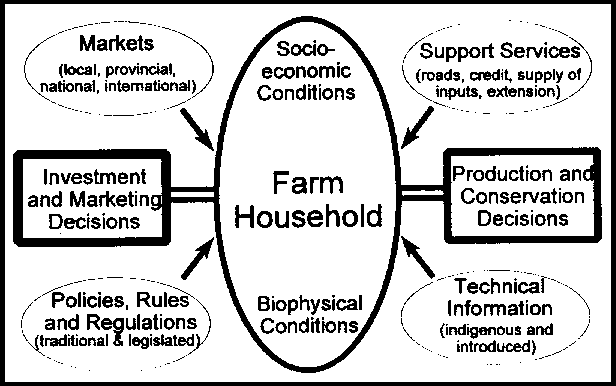 usehold
