


Our voices, our words and our pictures
Plans, truths and videotapes from Ngorongoro Conservation Area
by Geoff Taylor & Lars Johansson
Translations by Francis ole Ikayo
You have probably heard of the Serengeti, Africa's endless plain. You may also have heard of the Ngorongoro Crater, the spectacular caldera at the Serengeti's edge. But have you heard of Ramaf? Ramat is what the Maasai of northern Tanzania call the entire Serengeti/Ngorongoro highlands complex. It means "care-taker of all" (animals and people). Then there are two names for one place, are they describing the same reality? Or are the different words just the superficial expressions of fundamentally different representations of reality? Who has the right to define a landscape and its values? And who should determine what kinds of human activities can be carried out most harmoniously in a given landscape?
This is the story of how we began to use video to explore the complex questions of representation and management in the Ngorongoro Conservation Area.
Brief background to the new management plan
"For the first time in 30 years, the government and people of Ngorongoro have come together to create a fair management plan. Now that plan and the future of Ngorongoro are in jeopardy" (IUCN 1996)
The Ngorongoro Conservation Area (NCA) is valued for many different reasons. A famous safari destination for international tourists, a haven of biodiversity for conservationists, a much needed source of income for Tanzania, and home for about 40,000 pastoralists. Presumably, it would be in the best interest of all parties to protect Ngorongoro from overexploitation, for their own long-term benefit. But when it comes to deciding what to protect and how to do it, conflicts arise between the different groups. The factors determining the outcome of these conflicts are power, communication, and money - and each of these factors interacts with the others.
In the fifties the colonial regime in what was then Tanganyika became concerned about the future of the Serengeti with its vast herds of migratory animals. This was glorious nature unsullied by humankind. A wilderness to be protected from exploitation and degradation for posterity. But the Serengeti was occupied by pastoralist Maasai who had lived there for hundreds of years. In a deal reminiscent of the treaties made and broken with the indigenous peoples of North America a hundred years earlier, the colonialists persuaded the Maasai to evacuate the Serengeti. By way of compensation they were offered refuge in the Ngorongoro highlands, already occupied by fellow Maasai, where they would be provided with water supply works.
The Governor of Tanganyika said in a speech to the Maasai Federal Council in 1959:
"I should like to make it clear to you all that it is the intention of the Government to develop the Crater in the interests of the people who use it. At the same time, the Government intends to protect the game animals in the area, but should there be any conflict between the interests of the game and the human inhabitants, those of the latter must take precedence" (URT 1990:5)
The Ngorongoro Conservation Area ( NCA) was a consolation for the Maasai for having lost the Serengeti. But it was also an interesting experiment, somewhat ahead of its time, foreshadowing today's buffer zones around protected areas. The intention was to manage the NCA as a multiple use area with the dual objective of conserving wildlife and preserving the Maasai's pastoral way of life. Administration of the NCA was in 1975 assigned to an autonomous parastatal, the Ngorongoro Conservation Area Authority (NCAA), with sweeping powers to manage and regulate land use in the NCA. The dual mandate to both preserve nature and at the same time service the residents' interests is established in law since 1975 by way of an amendment to the original Ordinances stipulating that the NCAA shall be obliged "to safeguard and promote the interests of Masai citizens".
Conservation values The Ngorongoro Conservation Area (NCA) covers over 8,000 square kilometers on the Southeastern margins of the Serengeti National Park. It can be divided into five regions: The crater highlands rising to over 3,000 meters: the gently undulating Salei plains and the Gol mountains to the North; a portion of the Serengeti's 'short grass' plains in the West: and the Kakesio hills and Eyasi escarpment to the South. Rainfall varies greatly giving rise to many different types of vegetation, from montane forest and grassland on the highland to dry woodland on the escarpment and semi-arid grassland on the plains. Ngorongoro sustains the highest concentration of wildlife on earth during the annual migration when over a million wildebeest, half a million gazelles and a quarter of a million zebra come in from the Serengeti. The crater itself has a particularly high concentration of prey and predator species including lions and cheetah. It also provides a refuge for elephant and one of the last remaining wild populations of black rhinocerous in East Africa. The NCA includes sites of archaeological importance: Olduvai Gorge and the Laetoli site, providing evidence of human occupation for nearly four million years. Pastoralism has been practiced in Ngorongoro for at least 7,000 years and the Maasai have lived there for two centuries. Today there are over 40,000 residents with 150,000 livestock units (cattle, sheep and goats) which move between dry and wet season grazing areas. In addition to the Maasai, small populations of Tatoga pastoralists and Hadza hunter-gatherers live east of lake Eyasi in the south of the NCA. The conservation area was established in 1959. It is a World Heritage site since 1979 and has been classified as a Biosphere Reserve by UNESCO. (Source: Charles Lane, 'Ngorongoro Voices', forthcoming from FTPP) |
Ngorongoro conservation area
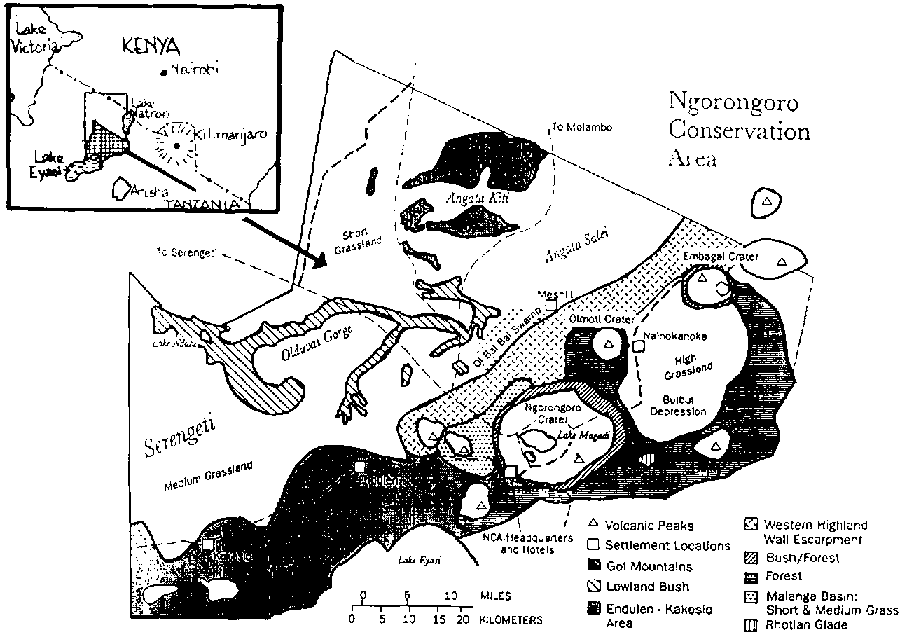
Source: 'Food security and the role of conservation in the Ngorongoro Conservation Area' by J. T. McCabe et. al draft 1995
But the Maasai way of life has been deteriorating in Ngorongoro. There has been a steady decrease in livestock numbers per capita over the past decades, partly due to tick-borne diseases, and partly due to an increase in livestock sales. Residents have coped through subsistence cultivation, which has caused irritation among the conservationists who have wanted to prohibit cultivation in the conservation area. Tourism has expanded rapidly but is not seen to benefit the residents. The misbalance between goals of conservation and community development has caused concerns at times when residents have suffered from undernourishment. A management plan prepared in 1982 attempted to increase resident's influence in the conservation area but was rejected by the NCAA Board. A ministerial commission in 1990 confirmed the misbalance and stated that while "NCA's principal conservation values have been well preserved .... little progress has been made in achieving human development objectives".
In 1994 a new management planning exercise started supported by IUCN consultants. A commentary to the planning process by IUCN describes the problems that were to be addressed:
"Today, significant threats to Ngorongoro include increased cultivation, erosion, livestock die-off, poaching of endangered species, deterioration of cultural heritage sites, lack of water resources, illegal harvesting of the forest reserve and serious breakdown of the social services owed to the residents. The people and wildlife of Ngorongoro are under increasing strain to live from day to day, development and conservation have been put to odds. and the area's status as an International Biosphere Reserve and World Heritage Site is at risk." (IUCN 1996)
This time the planning should be carried out in a participatory fashion:
" We realised that the traditional top-down approach to protected area management was not going to work. Since 1965, two management plans were formulated for the area but did not take off because the rights and obligations of the local people were not addressed." (Paul Mshanga, Chief Manager, NCAA Tourism Department)
In a recent article NCAA's Conservator, Emmanuel Chausi, describes the planning process as follows:
"Throughout the planning process a broad range of stakeholders was invited to be involved: politicians, ward leaders, representatives of all 13 villages within NCA and five on the boundaries as well as traditional leaders and NGOs in the area. The process involved extensive public meetings and training workshops led by the NCAA 's extension team. " ( Swara 1 996)
In his article, Mr Chausi quotes the Pastoral Council Chairman, Francis ole Siapa:
"At the beginning we were wary because of our experience with the past management plans. Are they going to give us real voice this time? Are they going to respect our culture? Our fears disappeared when we realised that NCAA was serious and all our concerns were seriously addressed."
He also quotes one of the two traditional leaders who took part in the planning team, Matingoi ole Tauwo:
" The previous plan separated us from our land, our wildlife and our forests. This one its bringing US together again and involves us in the management. If the NCAA continues in the same way during the next phase, the plan will be successful. "
A draft management plan was presented for public comment in November 1995. The text boasted of "an intensive participatory process" leading up to the plan. From now on NCAA was to rule in partnership with the Maasai. The NCAA extension team visited all the villages and distributed copies of a summary in Swahili to the local leaders, and people were encouraged to submit their comments. The NCAA reported that "overall the comments received from the village meetings were positive" ( NCAA 1996 ).
Previous management plans There have been four attempts to produce management plans for the NCA over the years. The Foosbroke-Eggeling Management Plan of 1962; the Dirschl Management Plan of 1966; the BRALUP (Dar Es Salaam University) Management Plan of 1982, and; the ad hoc Ministerial Commission set up 1990. The plans from 1962 and 1966 did not make any formal provision for community Participation. The BRALUP plan, however, recommended an elected council of village leaders to liaise with the NCAA, but the plan was rejected by the NCAA board. The Ministerial Commission in 1990 drew on 14 technical studies produced by IUCN and its report was adopted as a guideline for management. At that time it was clear that the Maasai way of life was deteriorating in NCA. The law in 1975 had placed a ban on cultivation in NCA and in 1989 a survey showed that 19% of the children were malnourished and 38% undernourished. The commission confirmed an inbalance between goals of community development and conservation, stating that while 'NCA's principal conservation values have been well preserved .... little progress has been made in achieving human development objectives". (Source: Charles Lane, 'Ngorongoro Voices', forthcoming from FTPP) |
A few weeks later, videotapes recorded in traditional meetings in the NCAA were to reveal a totally different story about protest and resistance to the management plan.
The video recordings
For the past several years, FTPP has been exploring the potential of video as a means of bringing local perspectives into natural resource management. Together with the International Institute for Environment and Development (IIED) FTPP has also been collaborating with pastoralist organizations in northern Tanzania. In early 1995 Francis ole Ikayo began working with video to record a process of community mobilization in the Ngorongoro highlands. His interest in trying this approach was based on the perception that the Maasai were at a disadvantage because they were not effectively represented in their dealings with authorities. The solution, it was felt, was to convene traditional meetings to discuss the issue of representation. Several meetings were recorded, and the initial indications were that the residents of NCA were reluctant to allow themselves to be represented by newly forming NGOs. There was a general consensus that the Maasai should only be represented by their own highly-developed traditional institutions. Midway through the recording the video equipment was stolen.
In November 1995, after Tanzania's national elections, we resumed the recording, expecting to follow up the mobilization efforts. But as it turned out, our agenda with regard to subject matter was hijacked by the residents. The new draft General Management Plan for the conservation area was just then being circulated for public comment. Within weeks, the draft plan was to be submitted to NCAA's Board of Directors for approval. People wanted to discuss the meaning of this plan and since NCAA had asked for the residents comments to it, we thought that collecting such comments on video was an excellent idea, perfectly consistent with the participatory nature of the planning process.
The meetings were conducted in the Maa language and organised by local leaders according to a traditional meeting form known as Enkigwana. Six such meetings with between 50 and 200 participants each were recorded on video. In every meeting Francis, who comes from one of the villages and is well known in the area, introduced the purpose of the exercise by explaining that he had come to collect residents' comments on the draft management plan for presentation to NCAA's Board and its donors. There were no interviews, no specific questions asked, and no selection of whose views to record. Participants just asked for the word and spoke out of their own free will as the custom prescribes. The meetings were recorded almost in totality until we ran out of video tape.
Twenty hours of recordings were brought to Sweden where Francis made a first selection of about three hours and translated these statements to English. Out of these three hours, the fifty minute video "Enkigwana Fe Ramat" with English subtitles was compiled in a great hurry over the Christmas weekend. Transcripts of the statements in the film were sent to NCAA and IUCN consultants who had supported the planning. Francis returned to Ngorongoro shortly before the board meeting with copies of the video for the six villages, the District authorities and NCAA. Six of the traditional leaders and elders who appear in the film had an opportunity to look at the video and approve it before it was given to NCAA. The intention was that the six should together present the tape to the board meeting, but NCAA did not find that necessary. But the video was shown to NCAA's Conservator and the Pastoral Council, which has an advisory function to NCAA, and we assume that the board members also saw it.
From the videotapes
Only the cow that cries gets to drink water (Maasai proverb)
"Are we not part of that international thing?"
The views expressed on the videotapes are overwhelmingly negative. The contrast to the official reports is so striking that one wonders how such fundamentally different views are possible to obtain from the same people. This statement of a young man, a warrior, from Endulen summarizes the themes that reoccur throughout the video material:
Here's what we say about this plan: When it came we said it's singing a song to celebrate our demise. We say it is like condolences, because they have finished us.
We have never received any help, even if people have been coming and going. The NCAA hasn't helped us. And if you look way back, our livestock problems were less severe. We can't eat grass like cows. Since cultivation was banned they haven't known what we've been eating. They only care what the wildlife eat. They banned cultivation because they needed more pastures for wildlife. Now that the ban has been lifted, we still don't believe it will be sustained. It was just a decision by one person from Dar es Salaam, for a limited time only. What will happen when that time is over? They let us taste that it's delicious but we can't keep it to eat.
If they say the NCA is internationally valuable - are we not part of it? Are we not part of that international thing? We are illiterate and our few educated ones cannot do much to help us although they are sons of the soil and aware of all these problems, because they are weak before the mighty power of NCAA. Their voices aren't heard beyond the NCA because there are many others as far away as America, whose children are being fed from the value of this land.
The people feel that they don't count, that they are worth less than the wild animals. They cants get land titles, have no decision making power in NCA management, and don't see much of the revenue from tourism. The cattle economy is in decline and people now depend on cultivation, but the management plan does not say that subsistence cultivation will be allowed. Only non-residents benefit from the conservation activities. The possibility of relocating people was discussed in the planning process. The Maasai fear that all this points in the direction of a secret plan to evacuate them from the highlands, just as they were once evacuated from the Serengeti.
Participation in planning: "They took our voices, our words and our pictures"
Sikai ole Sereb from Endulen took part in the planning team. This is how he looks upon his role in the planning today:
All of us are blind. The only people who now have open eyes are you sons who went to school. When some of us look at this document, it's like a nightmare. I participated in this since we took part in NCAA meetings. They took our voices, our words and our pictures. We are given this document but we can't tell what's in it. The only thing I can understand is my own photograph. Since we are illiterate we cannot discern any tricks that might be there (...)
People don't normally give away their land. but when you're in a meeting you don't always discuss what you're going to say in advance. You just stand up and speak your heart. There's no chance to make corrections. You are in a group, and you are among enemies. They will pursue any slip of the tongue, saying "he has spoken the truth". But if you really articulate the issues you are discredited. The one who can understand and read between the lines is sidelined. (...)
These outsiders are very cunning: When you say something inconvenient to them they don't write it, but what is favorable to them they write. Then they praise you with good names. But anyone who knows enough to challenge them is not recorded I know because I joined the ad hoc planning team. They are working for our eviction. I see two things here. One: the banning of cultivation so that people will starve and abandon the place. Two: evicting us from this land.
Sikai ole Sereb is one of the Ilaigwanak, traditional leaders of great respect in the Maasai community. Two such traditional leaders were selected by the NCAA to participate in the planning team that took part in the preparation of the management plan, the other being Matingoi who was quoted in Mr Chausi's article. A third traditional leader, Ole Lerrug from Oloirobi, suggest in the video that these two were picked because they were more moderate than those who represent the actual highlands, and that their presence was used only to provide legitimacy to the plan.
"One thing we were able to disclose and refute was how they selected the members of the ad hoc planning team. Though they picked Ole Sikai and Matingoi, who are respected Ilaigwunak, the selection left a lot to be desired Why were Ole Runguna and l excluded? We are of equal stature and represent the controversial highlands. We two are the ones who best know the trends and the struggles of the highlands from the colonial time up to now.
They took them, innocent as they are, and used them like spoons. Both of the chosen come from the periphery of the NCA. Now they go around saying that traditional leaders and Ward
Councillors participated and that what is written in the document has been agreed upon. They found a group of elders seated at a meeting at Albalbal and took their picture and printed it in the plan, claiming they were involved.
When they came to collect comments 01? the plan, they pointed only to their endless promises, excluding the contentious issues. These are nothing but political tricks!"
Parmitoro Kassiaro from Oloirobi goes even further when he suggests that it is the international donors who have actually made the plan, and that even the NCAA has been marginalized:
When the draft plan was circulated it was not really to solicit public comment. It was already approved. They just said: "Let's take this plan to the communities so that we can say that they blessed it" They only consult their handpicked leaders, and not the whole community . They only bring it to the community when it's already approved. Even the leaders we are blaming are being used, even the NCAA.
There are big-shots behind these things. It is these white people who are destroying us. They are behind everything that concerns these national parks. These white men's organizations like Frankfurt Zoological Society, IUCN, the Friends of the Serengeti - it is they who are destroying. They finance these conservation projects. If they wanted they could stop the destruction. NCAA couldn't resist. There are those who are sympathetic to us, too, but if you look at the conservationists like Frankfurt do they ever help? I low many cars to they donate to the NCAA? As many as this grass. And the IUCN? The white man who wrote this plan, from the beginning to the end was from the International Union for Conservation of Nature. Why are they the ones with authority to write this plan when they are clearly biased towards wildlife?
Others, like Ole Kiludie Nasotumboyo from Esere, came in contact with the planners when asked to contribute information:
The NCAA approached me, wanting to know about cultivation and wildlife populations. They wanted to be fed with information. But they always approach us as individuals, in isolation.
We talked about pastoralist issues and wildlife. I told them we have been living together with wildlife since our ancestors' days. We talked about cultivation. They call it food security, not cultivation. We told them the godowns don't help us at all. Like the one at Osinoni, isn't the price there equal to the private market price? Now most people don't have enough goats or cows, and if you just wait for the relief food, you are waiting for death. We don't want this relief assistance, we want to continue with our subsistence cultivation, the only thing that saves us.
They asked how many buffaloes were in this land. Well, there weren't any before. They came recently. And rhinos? There were plenty, but more recently we haven't seen any. I think they should ask themselves these questions. A cattle owner always knows where his herd is. If the animals have disappeared the owner should know what has happened to them.
Revenue sharing Information on incomes and expenses of NCAA is not made public, but it is clear that the local people are not receiving anything like a proportionate share of the substantial revenues. Annual income is estimated by Tanzania Tourist Organisation to be over 10 million US dollars annually from visitor's fees alone. Yet according to a recent report of the Danida-funded Economic Recovery Programme for NCA pastoralists, NCAA has in the last three years only constructed three grain stores, built two water systems (one defunct, the other incomplete) constructed a single cattle dip (in disrepair), built one dispensary and one primary school, that together would likely require the investment of only proportion of a single year's revenue (Source: Charles Lane, Ngorongoro Voices', forthcoming from FTPP) |
The fate of the rhinos in the crater floor kept coming up in the discussions. The background is that in spite of a 24-hour guard several rhinos had recently been shot in the crater. The carcasses had been found not by rangers but by tourists, and the case was under police investigation at the time of the video recordings. The residents' point is that there were many rhinos in Ngorongoro until the NCAA took over the management from the Maasai. Sikai ole Sereb put it more bluntly:
"In one of the planning meetings I told them about the name of this place Ramat. And "Ramat" means that it is a healthy habitat for people and animals. They said it should he called "Crater". I told them there were 125 rhinos when you arrived here and now they are all gone and it is you who are consuming them."
Mistrust: "The maps used to say Maasailand..."
The mistrust between the residents and the authorities has roots in a time when their relationship with the NCAA was really tense. Ole Moinga Olonyokie from Endulen:
"There were times wine" the NCA rangers shot us like cows, and there was no follow-up because nothing of value was killed. They just equate us with cows because in this place cows are nothing special. If one is attacked by a lion the rangers just walk back into their house and say 'Oh, so and so has been killed by a lion: as if it was nothing more than a slaughtered goat. If there were NCA staff here I would tell them the number of people they shot, and those killed by wild animals. They don 't like those wild animals to be disturbed because they are more precious than our sacred Maasai blood."
A statement from an elder in Esere captures how the Maasai assess the management plan against a long historical perspective:
This is like our legend of 'Alaringol'. As the saying goes: "Always close a goat's eyes before slitting its throat". This is similar to what has been happening to us. We have died not just by violence but by ignorance.
I remember in 1949 when I was a boy of nine years old. We were cultivating at Embakkai and Korongoro. A sign on the Olerai tree said "Serengeti National Park No Shooting". This was when we were being evicted from Serengeti. People and cows were living in Korongoro crater. Now they say "let's go back to the house of cowards and get rid of these Maasai". They started labelling Melenda, Embakkai, Korongoro as Conservation Area. Again, we became landless. The Serengeti agreement said we could move to the highlands and have water supplies. Now that they have succeeded in removing us from Serengeti they enclose the craters. This is the trend that is threatening us.
We approve of absolutely nothing in this plan. This land is our land. The maps used to say "Maasailand", not United Nations land. No one can be disinherited from the soil and the trees of his birth. We are not interested in this relief food. It is neither enough nor sustainable. They only smear a little oil on your lips, then they let you go and die. What we demand for the health of our children is subsistence cultivation. This plan is just being brought to us for approval, like the trick played on Ole Nakurroi to approve the ban of cultivation In truth he never accepted it. He was fooled. The same thing is being done to us now. They propose something and ask "do you like it' Yes? Sign here!"
If anything is unclear, don't agree. Refuse, even if they threaten to shoot you. Even if they bribe you, don't accept. That money is neither your father nor mother. You should only agree to what is healthy to your people's livelihood.
Money has spoiled the whole world.
Participation in decision making: "The world should come here to learn from us..."
The decision-making power in NCA is concentrated to NCAA's Board of Directors. They conduct closed meetings, and the agenda and minutes are confidential. Although NCAA is a parastatal which should be accountable to the public all matters of income and expenditure are also secret.
Residents claim that they can protect the natural resources of Ngorongoro on their own. Shinana ole Moinga from Endulen makes a strong point by contrasting the Maasai's record as conservationists with the professional experts'.
One thing amazes me. It seems the whole world is lacking sense and there's no one to point it out. Just look around - the parts of the world left with wildlife have pastoral people. Why do the "experts" and "guardians of the wild" come here after having failed to conserve trees and wildlife in their places of origin? They come here to support themselves. Do you really think they have come to these pastoral lands to protect something?
The world should come here to learn from us Maasai how we take care of our land. Come and see that there are trees, there are cows and wildlife. They shouldn't come and say that they are managing us. Which world in the whole universe was created without trees or wild animals? Why should we, who have always had everything, be shown how to conserve? There is no need to pay government employees to protect this land. It is the residents themselves who are most capable.
All this money could have been used to help the rest of the world For example, since the Maasai came out of the Serengeti, the place is now full of snares and traps to catch wildlife. Look at the Korongoro highlands - the rhinos were uncountable. But since the eviction of the Maasai from the crater they have virtually disappeared
The world should know that we are not people who eat the soil until it is finished The world should learn from us how we Maasai manage our lands. They shouldn't see us as destroyers of the land.
Land rights and cultivation: "Are we not the owners and lovers of this land?"
The residents cannot even assert title to the land on which their houses are built, while foreigners get titles for building new tourist hotels on the crater rim. The management plan states that NCA is "the homeland for Maasai pastoralists as well as Datoga and Hadzabe people". On the other hand it regards clarification of why residents can't have secure land rights beyond its scope and does not propose any change. The residents wonder why.
Are we not the owners and lovers of this land?
(Monte Osokoni, Esere)
We don't want the soil of any other land. We just want this land
(Olendooki Raphael, Albalbal Ward Secretory)
Cultivation is vital for their survival. Naarmakati-ene-Lekinyot from Albalbal:
"We won't move from this land because nowadays we depend on cultivating. We have no place else to go. This is where our parents died. We don't have enough cattle. We now depend on the soil of these highlands. There's a saying "A belly cannot be carried around like an empty pot". I have borne many children and without cattle we are all virtual widows because in the past we were fed by our cattle. When we no longer have cattle we dig the soil. Having borne so many children I cannot let them go astray like guinea-fowl chicks. I must scratch the soil like a guinea-hen to feed them"
The Pastoral Council The management plan attempts to provide for community participation through the Pastoral Council. This includes six Ward Council Chairmen, thirteen Village Council Chairmen, two non-Maasai representatives (Tatoga and Hadza), three traditional leaders, and two women alongside six senior NCAA staff and the Ngorongoro District Council Chairman. But the Council has only an advisory role to the NCAA Board of Directors, in which the residents are not represented at all. The seven representatives of traditional community institutions are not elected by their constituencies but appointed by the NCAA. The council is actually given decisive influence over marginal issues only, such as in managing the "cultural bomas" supposed to display Maasai culture to the tourists. Otherwise the residents are to relate to the NCAA through the Ward Development Committees, but they are dealing only with community development projects and not with the management of NCAA as the whole. The management plan thus does not adequately provide for community involvement in decisions on natural resource management. The residents are mentioned as subjects of research and monitoring and as recipients of an education programme on conservation. (Source: Charles Lane. 'Ngorongoro Voices', forthcoming from FTPP) |
The ban on cultivation was enforced in a campaign in the late eighties which lead to widespread child malnourishment in the entire NCA. Residents prompted the Prime Minister to lift the ban in 1992.
"When the former Prime Minister John Malecela, came and the bun on cultivation was lifted, we were told to use only hand hoes and not even oxploughs or tractors..Since then child malnutrition huts decreased and as a community we have agreed umanimously that we shoula limit the scale of cultivation so as not to disturb other fund uses" (Ole Lerrug, traditional leader)
Ole Posse, Sub-Village Chairman from Oloirobi:
We demanded that low which bans cultivation be repealed. It is old and overdue for review. We don't want to be fed like pigs. This law was enacted in colonial times. It's a white man's law. Can't a white man's law be repealed? Aren't we bright enough by now to enact our own laws?
The management plan proposes to permit cultivation only until such time it can be phased out. This is to be achieved by promoting conservation and pastoralism as a substitute. and encouraging those residents who wish to cultivate to do so outside the NCA. It is not realistic to expect that the Maasai will be able to survive on herding alone in the future. Therefore they would either have to grow their food perhaps hundreds of kilometers away from home, or depend on food aid chanelled by the NCAA.
"If you go around this whole urea and ask the residents about the banning of cultivation you will hear one word and not two - No! Nothing will stop us from cultivating our land, not even the point of a spear" (Ole Kiludie Nasotumboyo, Esere)
When extension staff presented the draft management plan to the residents they didn't want to talk about cultivation, land rights and community involvement in NCA management. Instead they emphasised the planned investments in community development projects. Having heard such promises for decades the Maasai are wary. Many argue that these commitments are made only to make them agree to the plan as a whole. In the video, one of the few NCA residents with higher education, Tepilit ole Saitoti, warns against selling out the land.
Some of you look at this document and think: "Oh this is good - they are constructing a dam for us". But is it constructed to lure us away from the highlands? "Oh a cattle dip!"... to lure us away from the highlands? These are things they lure us with. Like these few of us who are given a little money and sell the highlands for the price of a bull while forgetting all the other bulls. They let you lick and then you become a palm licker. Then you congratulate yourself proudly: They are building a dam! A dip! Is this the price for our highlands?
Cultivation The largest farms in NCA belong to nonindigenous people, including NCAA employees, where crops ore grown for profit, not subsistence. These forms ore mostly cultivated by hired labour. This type of cultivation is expanding most rapidly. The small-score subsistence cultivation by the Maasai is not regarded as having on adverse impact on the environment. "It is small in scale, depends on hand labour, has relatively low yields...and hod minimal impact on wildlife". The quoted study, which was commissioned for the management planning process, concluded that the Maasai have traditional institutions in place that control cultivation so that is does not disturb cottle or wildlife movements. The Ministerial Commission in 1990 also proposed that permanent, controlled, small-scale cultivation should be allowed for indigenous residents, as did the management planning team which wanted to recommend lifting the cultivation bon. But the NCAA Board of Directors felt that a recommendation to allow cultivation would go beyond its scope since it would require "a change in legislation and policy directives from Porliament and the Ministry". (Source: Charles Lane, 'Ngorongoro Voices', forthcoming from FTPP) |
Reactions to the video
During the recording it was clear to all participants that the video was to be shown to the NCAA and the donors with a purpose of influencing the planning process before the board approved the plan for implementation. Francis ole Ikayo said himself in the meeting at Endulen:
"Let us cry out against this biased management plan, whether they are listening or not, so at least our objections are recorded for posterity. "
Many saw an opportunity to make their voices heard. The Ward Councillor in Albalbal:
" We want this medium to he the true messenger. If this medium is the fastest, most effective way to get our message through, then let it go before this plan can he approved. We want this medium to convey the truth so that it does not get distorted like all the previous information.
The NCAA is like the head of a family who hats an overview of how everything should fit together. We want this medium to he the true messager. Commenting this GMP took us two days. We couldn't interpret what was in it and ended up just mouthing the words in Swahili. The language was hardly translatable. So we said. let's object to this one issue we understood - cultivation."
In the video the residents asks the board to delay the approval of the plan so that they were given more time to understand the plan and articulate their own suggestions.
Pakai Olonyoke, Village Chairman from Endulen:
This plan is for 5 to 10 years and shall guide people and cows. That's serious planning! And you ore given 2 days to comment?! And they hove used languages that are not understood. They told us that they would bring this GMP to us over 6 months for discussion. And if that had been the case, would we not have commented more? That is why on that day I refused and I continue to refuse even now.
Don't worry, we are telling those who are responsible, even in the NCAA: We don't approve this plan, because it is being imposed on us. Ten years, imagine! 160 pages long. We want more time, at least a year. We ore insisting that this plan is not approved. Why is it these ignorant outsiders who are brining this GMP to us? And why is it that the local leaders picked for the planning team can neither read nor write in English or Swahili? They are being manipulated and made to agree with what is against their interest.
We have yet to approve this plan. We will coil together people who know the issues and trends of Korongoro. In the past this place was full of wildlife but where are they now? The forest was intact. Who destroyed it? Even when some of us lived in the Serengeti, we also lived in these highlands. Korongoro is our land. Is there a person who can be deprived of his land of birth? How would the whites react if it happened to them?
The Conservator, the NCAA board, the Pastoral Council, some of the participating residents and the IUCN saw the translated video tape in January prior to and during the board meeting. We do not know what was said in the board meeting and no official statement has to our knowledge been issued on whether the draft management plan was approved or not. Shortly after the meeting we were given the impression that the approval had been delayed. Later, in March, we heard from IUCN that this was not the case, that the board had indeed adopted the plan for implementation. It is symptomatic of the communication gap between residents and planners that people living in the area do not even know that the management plan has been adopted for implementation and that they get these news from Nairobi.
Although the NCAA had asked for residents comments on the draft management plan, neither they nor the IUCN consultants were happy about receiving the video. At first they assumed that the video was a documentary for distribution to the public and as such they felt it did not make justice to the plan and the planning process. They argued that the residents who appear don't understand the plan, and suggested that the recording team had deliberately created the frustrations/hat are displayed in the film through desinformation and leading questions. Some insinuated that the motive for doing so would be a personal interest of the individuals involved to miscredit the organisations that are responsible for the plan.
The publishing of the material may upset those who believe that it is important not to stir up conflict around the management plan. After discussions in the FTPP group in East Africa we have decided to publish it anyhow for the following reasons:
· The residents who participate in the video say (in the video) that they want the world to know about their situation.
During the recording we promised that we should publish the material if they wanted so. Many of the elders who participate in the video have seen and approved the edited version, and they want it to be published.
· Whether the residents' suspicion of the management plan is justified or not, an understanding of their perception of the situation seems crucial to any actor who wants to invest in preserving the beuty of Ngorongoro. Denying or ignoring these views can only make the situation worse. The conflict can remain hidden for some time, but it won't go away by itself.
· All over East Africa pastoralists are increasingly disadvantaged and underrepresented in land policy making and development project organisations. In Ngorongoro they potentially stand stronger than in other areas thanks to the multiple land use principle in the conservation policy. If the video initiative could be continued we think it would contribute to establishing forums for dialogue with pastoral communities and become an example for other areas.
There has been meetings and correspondence between representatives of NCAA, IUCN and FTPP on the possibilities of continuing with video-aided dialogue in Ngorongoro. FTPP has offered to help the NCAA with producing a video in the Maa language that explains the intentions of the management plan and answers some of the residents' questions, but the authorities do not appear to be interested. Instead they have prohibited continued video recording by residents in the NCA area.
Conclusions
Participation and the truth
If we believe in one absolute truth, disagreement can only mean negation. If there are multiple realities, disagreement means negotiation, accommodation, learning and the ability to reconstruct someone else's reality.
(Maturana, cited by Roling)
Are the authorities interested in dialogue with critical residents? It seems not. They sent the draft plan out for comments, they got such comments on the video, and now they don't want to know about them since the residents' views are "wrong".
It is clear that the residents who appear in the video have too little information about the management plan. The video is not a balanced or objective report. It does not give the true story of the situation in Ngorongoro. But it is a true account of what some of the residents said in public, traditional meetings during a couple of weeks in November when they discussed the draft management plan.
Participation can mean many things. In Tanzania the word participation is commonly translated with the Swahili word ushirikishwaji. In translations from Swahili to English this word sometimes translates to "mobilization" and sometimes to "participation". It is often used in the form kuwashirikisha which literally means 'to participate them", i.e. to make people agree to the planners' ideas. Since the video makes such acceptance less likely in Ngorongoro the planners perceive it as threat to an existing product of theirs the management plan - rather than as a support to a process of dialogue and negotiation.
The case illustrates a contradiction between participation and the common development planning practice. Planning derives its authority from a disputed western rationale that assumes that it is possible to be objective about an underlying reality. What is achieved in planning cannot be questioned because it represents the truth. The Maasai's perception of the situation is different, and therefore it should not be presented (unless they agree with the planners in which case they are said to "participate"). The planning paradigm also contrasts with traditional forums for decision making such as the Enkigwana, in which the process does not aim at determining the truth through investigation but at achieving consensus on what action to take through dialogue and negotiation. In the domain of the spoken word everything is always negotiable. People don't spend a year on making a plan that shall rule for ten years. The management plan would have been more agreeable to the Maasai if it focused on how things were to be discussed and decided upon, rather than on describing the desired goals.
The role of donors
Both the donors and the authorities have made community participation and community development explicit goals for their work in Ngorongoro. They have made considerable efforts to improve relationships and create partnership with the residents. Yet the video shows how the Maasai think that they stand alone against a donor-NCAA coalition that wants to dictate the plan. They see one plan follow upon the other, and they see how each step in the project cycle means more vehicles to the NCAA and more jobs for expert consultants, without ever addressing the contentious issues or challenging the power balance between the people and the bureaucracy.
The most common conflict management strategy in situations where one party is illiterate is outright denial.
The bureaucracies and consultants who set the agenda in development enjoy a problem formulation privilege that is challenged when marginal groups gain control over the production of imagery. Those in power don't want to recognize conflicts with the "target groups" because such conflicts look bad in the eyes of the donors. The gut reaction is to monopolize the information flow and negate any information that doesn't fit with a success-story model. In their first reactions to the video both the NCAA and the IUCN seemed more worried about their own reputation than about the new opportunities for dialogue that were created by the residents' being outspoken about their thoughts and fears.
The problem for donors and consultants is that they are judged against the paper documents they produce. They have to deliver in time and get the job done in order to stay in business. Conflicts are ignored because they complicate planning and upset the time schedules. But those rules have been established by the donors themselves. Do the donors who are committed to participation not have an obvious responsibility to make it clear to the organizations they support that they don't expect them to gloss over conflict?
The scope for continued dialogue in Ngorongoro
The new management plan with all its rhetoric about participation may appear as a step in the right direction. But the mechanisms through which these steps will be taken are not indicated. The problem is perhaps what is not in the plan; that it represents a lost opportunity for the residents. The plan won't lead to new democratic institutions being put in place in Ngorongoro. Functions of management and control will not be devolved to traditional institutions at the community level. The uncertainty around land rights, cultivation and decision making will remain for another five or ten years. Many Tanzanians are fed up with the kind of functional ambiguity that leaves things unsettled just to keep all options open for a capricious bureaucracy. The bitterness arises because this time there was participation and hence real expectations that local voices would be heard.
The situation could be easily improved through real dialogue between residents and NCAA. The intentions and the issues in the plan could be explained in the Maa language in the communities prior to operationalizing the plan. NCAA could earn respect by openly admitting past mistakes, and by being more transparent and accountable to the public. The Pastoral Council could include democratically elected representatives of the different NCA communities and be given real influence in NCA as a body that was not subordinated but parallel to the NCAA.
The NCAA must try to defuse the conflict. They can attempt to restore their former information dominance by prohibiting continued video recording and debate so that critical voices are not heard outside the NCA. They may also employ the old colonial divide-and-rule strategy on the Maasai leaders by negotiating with them one by one, conditioning community development projects to their loyalty. The danger is that if the residents get desperate they can escalate the conflict. In the video it is suggested that they should threaten to stop protecting the natural resources so that the area loses its value for tourists and conservationists. Others thought it is now time to go to court on the land rights issue and claim the same rights to register land titles as other Tanzanian citizens have. Both strategies would entail risks not only to the conservation values but also to the communities. The Maasai's documented ability to coexist with wildlife is part of their cultural identity and a source of support for their cause, and land titling could lead to land grabbing by economically powerful outsiders.
There are many stakeholders in Ngorongoro - residents, NCAA, donors, tourist industry, central and local government. The controversy about the management plan could help them realise that their relationship is based on interdependency. The only rational strategy is then to seek dialogue. Forums are needed where residents and planners can meet without prestige and explain to each other how they perceive their reality, and openly discuss concerns and interests. The aim should not be to vote for or against the management plan, but to determine where there is common ground and scope for partnership in realising everybody's overarching objective: to restore Ramat, the land that was good for people and wildlife alike.
Readers that are interested can follow the developments on the FTPP Web site <http://treesandpeople.irdc.slu.se>
For more information you can contact the authors, Geoff Taylor and Lars Johansson, through FTPP office in Sweden.
Francis ole Ikayo can be contacted at the following address: P. O. Box 12599, Arusha, Tanzania.
