


Asia is also the most rural among major continents: in 1990, only 30% of Asia's population lived in urban areas, compared with over 70% in Latin America and nearly 35% in Africa. However, according to Williams (1997), UN projections suggest that the urban proportion of the Asian population will have risen from about 17% in 1950 to nearly 53% in the year 2025. There would be more than a doubling of the urban population from 1.086 billion at mid-1995 to 2.474 billion by 2025 in eastern, southern and south-eastern Asia. By the year 2000, Tokyo will already have 27.85 million people, followed by Mumbai (Bombay) at 19.81 million and Shanghai 17.2 million. These and another six Asian cities will be among the 15 most populous urban agglomerations in the world. Another four Asian cities will have more than 10 million people. Hohol (1997) reports that by 2015, PR China's current 28% urban population will have risen to 50%. Sanderson and Tan (1995) project a 50% average expansion of the main Asian urban centres between 1990 and 2000. It is unclear whether greater urbanization will mean less overall pressure on forests.
Changes in magnitude of rural population
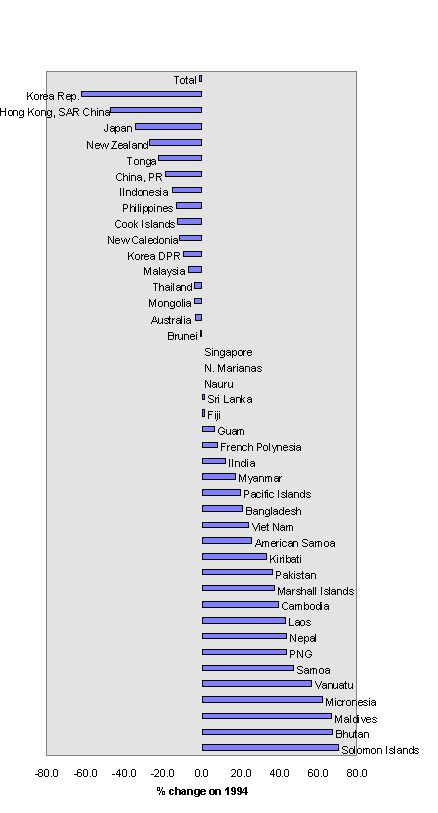
In many countries of the Asia-Pacific region, the level of economic development in the period till 2010 will remain low enough for rural populations to still be significant and for these to be directly dependent on agriculture. There will be an overall decrease in rural population by nearly 24 million, a negligible share (around 1% of the 1994 regional total) because the decreases are largely nullified by increases in other countries. In this connection, attention may be directed at the following countries where, if all else is unchanged, considerable rural population decrease gives good prospects for reduction of direct pressure on rural vegetation (in descending order - see Figure24):
Korea Rep., Japan, New Zealand, Tonga, China PR (including Hong Kong SAR, China), Indonesia, Philippines, Cook Is., New Caledonia, Korea DPR, Malaysia, Thailand, Mongolia, Australia, and Brunei. However, for some countries, the rural population will increase.
Figure 24: Projected rural population changes from 1994 to 2025
Source: See Table 12.
Table 17 - Projected Changes In Rural Population Between 1994 and 2025
COUNTRY |
1994 rural popul'n |
Change in rural population 1994-2025 | |
'000 |
'000 |
% | |
Solomon Islands |
305 |
220 |
70.8 |
Bhutan |
1514 |
1030 |
67.7 |
Maldives |
181 |
120 |
67.4 |
Micronesia |
88 |
60 |
62.5 |
Vanuatu |
134 |
80 |
56.7 |
Samoa |
134 |
60 |
47.8 |
PNG |
3540 |
1560 |
44.1 |
Nepal |
18563 |
8170 |
44.0 |
Laos |
3743 |
1630 |
43.5 |
Cambodia |
7969 |
3150 |
39.5 |
Marshall |
22 |
6 |
37.5 |
Pakistan |
90031 |
33220 |
36.9 |
Kiribati |
50 |
0 |
34.0 |
Amer. Samoa |
27 |
0 |
25.9 |
Vietnam |
57951 |
14060 |
24.3 |
Bangladesh |
96888 |
20810 |
21.5 |
Pacific Islands |
5 |
0 |
20.0 |
Myanmar |
33780 |
6030 |
17.8 |
India |
675084 |
87240 |
12.9 |
Fr. Polynesia |
94 |
0 |
8.5 |
Guam |
91 |
0 |
6.6 |
Fiji |
460 |
0 |
2.0 |
Sri Lanka |
14116 |
260 |
1.8 |
Nauru |
0 |
0 |
0.0 |
N. Marianas |
22 |
0 |
0.0 |
Singapore |
0 |
0 |
0.0 |
Brunei |
118 |
0 |
-0.8 |
Australia |
2724 |
-90 |
-3.3 |
Mongolia |
938 |
-40 |
-3.9 |
Thailand |
46696 |
-1870 |
-4.0 |
Malaysia |
9273 |
-640 |
-6.8 |
Korea DPR |
8292 |
-880 |
-9.6 |
New Caledonia |
68 |
0 |
-11.8 |
Cook Islands |
8 |
0 |
-12.5 |
Philippines |
31014 |
-4110 |
-13.3 |
Indonesia |
127590 |
-19360 |
-15.2 |
China, PR |
853244 |
-159020 |
-18.6 |
Tonga |
59 |
-10 |
-22.0 |
New Zealand |
501 |
-130 |
-26.9 |
Japan |
28052 |
-9650 |
-34.3 |
Hong Kong SAR, China |
299 |
-140 |
-47.2 |
Korea Rep. |
8918 |
-5490 |
-61.5 |
Total |
2122586 |
-23724 |
-1.1 |
Source: UN Department for Econ & Social Info. & Policy Analysis, 1996b
Attention needs to also be drawn to those countries in Figure 24 where significant rural population increase may significantly impact natural resources, among which the major ones are (in ascending order of increase in rural population): India, Myanmar, Bangladesh, Vietnam, Pakistan, Cambodia, Laos, Nepal, Papua New Guinea, and Bhutan.
Many islands also face this possibility, Solomon being in the lead but increases in rural populations being significant also for Maldives, Micronesia, Vanuatu, Samoa. The proportionate changes in rural population in Table 17 and Figure 24 can serve as potential indicators or alert signals as to which countries there is likelihood of continuing expansion of farming impacting on vegetation cover, including forests. The countries can be grouped as follows:
· Where rural population will grow over two-thirds (67%) between 1994 and 2025: Solomon Islands, Bhutan, Maldives. Total increase 1.37 millions (average increase of 60% for this group over the 1994 population);
· Where rural population will grow between half (50%) and two-thirds between 1994 and 2025: Micronesia and Vanuatu. Two countries/territories - total increase 0.14 million (average 63% increase over 1994 population);
· Where rural population will grow between one-third (33%) and half between 1994 and 2025: Papua New Guinea, Nepal, Laos, Cambodia, Marshall Islands, Pakistan, Kiribati. (Eight countries/territories; total increase 47.79 millions (average 39% over 1994 population);
· Where rural population will grow between a sixth (15%) and a third (33%) between 1994 and 2025: American Samoa, Vietnam, Bangladesh, Pacific Islands, Myanmar, India. (Five countries/territories: total increase 128.14 million (average 15% of 1994 population);
· Where some increase will occur (up to 15%) between 1994 and 2025: French Polynesia, Guam, Sri Lanka, Nauru, (four countries/territories; total increase 0.26 million (average 22% of 1994 population);
· Where rural population will decrease or remain static between 1994 and 2025:
i) zero growth: Nauru, N. Marianas, Singapore
ii) decrease by up to 15%: Brunei, Australia, Mongolia, Thailand, Malaysia, Korea D.P.R., Cook Islands, New Caledonia, Philippines. (Ten countries/territories; 7.63 millions; average -8% of 1994 population);
iii) decrease by between 15 and 33%: Indonesia, PR China, Tonga, New Zealand. (Four countries/territories: 178.52 millions; average -18% of 1994 population);
iv) decrease by between 33 and 50%: Japan, Hong Kong SAR, China. (Two countries/territories; 9.79 millions; average of -35% of 1994 population.
v) decrease by over 50%: Korea (Republic of): One country; 5.49 millions; a decline of 61.5%.
There is enormous variation in the foundations on which economies are based due to differing levels of development. According to Edwards (1997), while only 2% of GDP in Japan is derived from agriculture, the ratio in South Asia is about 29% of GDP. Between 1990 and 1994 agricultural output grew by 2.7% per annum in South Asia; 3.6% per annum output growth was achieved in East Asia and the Pacific - little being from an increase in the area under cultivation and most has been due to increases in yields. In the past 25 years, the output of cereals has almost trebled in East Asia and more than doubled in South Asia with over 85% of these increases being from higher yields. In 1992 the East Asian and Pacific region reportedly used on average about four times as much fertilizer per hectare of arable land as did Latin America and the Caribbean, and about 15 times as much as sub-Saharan Africa. This situation could change drastically if the current economic crisis is prolonged.
Figure 25: Dominance of agriculture in some Asia-Pacific economies, 1995
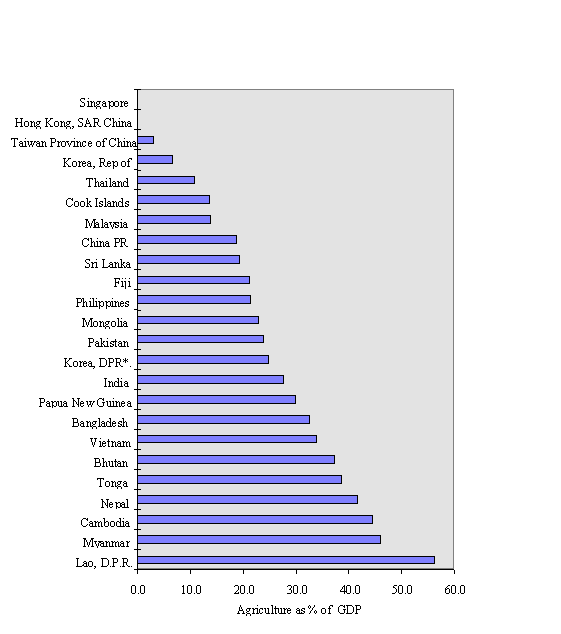
The contrasts in degree of reliance on agriculture were illustrated in Figure 1 and Figure 25. For the significant number of countries where agriculture remains very important, the availability or otherwise of land is important. From Figure 25, categorization could be as follows:
· very high agriculture dependency (more than 30% of GDP): Bangladesh, Vietnam, Bhutan, Tonga, Nepal, Cambodia, Myanmar, Lao;
· important dependency (20-29%): Papua New Guinea, India, Korea D.P.R., Pakistan, Mongolia, Philippines and Fiji;
· agricultural significant (10-20%): Sri Lanka, PR China, Malaysia, Cook Islands, Thailand;
· unimportant in economy (less than 10%): Republic of Korea, Hong Kong SAR, China, Singapore, Taiwan Province of China.
Movement of the agricultural frontier
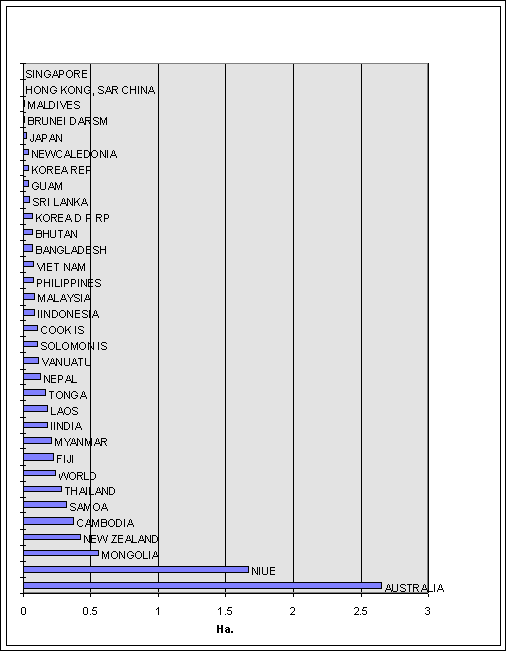
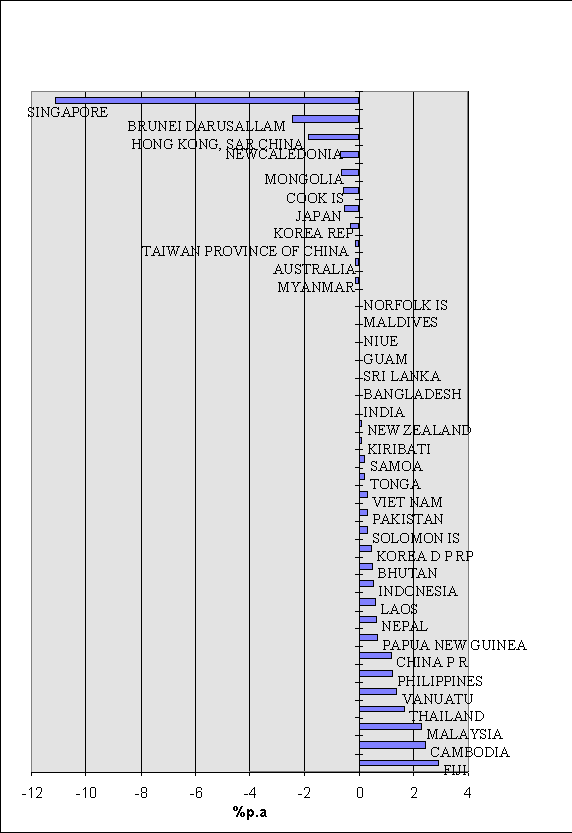
A matching of this stratification with per capita availability of arable land (Figure 26) is expected to be interesting, as is matching with rate at which the overall agricultural frontier is expanding (Figure 27). However, Table 18 which is a matrix of these relationships, shows no particular trends.
In spite of major contrasts in rate of permanent cropland expansion (Figure 25) there is no clear relationship between the significance of agriculture in the economy and a country/territory's ranking in terms of agriculture frontier expansion. Also some of the most agriculturally dependent countries (e.g. Bangladesh, Bhutan, Vietnam) have the lowest per capita arable land availability. Figure 26 shows some countries with reductions in cropland including India among the major countries. Pakistan, probably due to high population growth, leads in farmland expansion, with South East Asia generally quite high. For 11 countries, the 1970-1994 trend shows reduction of agricultural area by as fast as over 11% annually (Singapore) and nearly 9% annually (Cambodia) while for three countries, the agricultural land has grown at over 2% annually and for four others at over 1% annually. The rate of area expansion for crops shows even greater contrasts. Pakistan leads with a rate equivalent to a 14-year doubling time. The approximate doubling time of crops for selected countries are:
Vietnam |
18 years | |
Thailand |
19 years | |
Laos |
24 years | |
Solomon Islands |
29 years |
Of the very major countries, Indonesia has the equivalent of 31 yeas doubling time.
The combination of high agricultural dependency, low arable land availability, and recorded fast agriculture frontier expansion should however trigger concern at likelihood of great pressure on forests. In Table 18, countries in this situation include Laos, Cambodia, Nepal, Fiji, Thailand. Others with low arable land availability include already highly deforested countries such as Bangladesh, PR China.
Figure 26: Asia-Pacific landuse: per capita arable land, 1994
Source: See Annex Table A18.
Table 18 - Aspects of agricultural dependency and expansion
Country/territory |
Agric % in GDP |
Per cap. arable land (ha) |
Expansion (% p.a.) of permanent crops |
Agriculture at 30 or more % of GDP: |
|||
Laos |
56.5 |
0.18 |
2.88 |
Myanmar |
46.1 |
0.21 |
0.69 |
Cambodia |
44.6 |
0.38 |
-8.75 |
Nepal |
41.9 |
0.13 |
1.48 |
Tonga |
38.9 |
0.17 |
0.57 |
Bhutan |
37.6 |
0.07 |
0.98 |
Vietnam |
33.9 |
0.08 |
3.87 |
Bangladesh |
32.8 |
0.07 |
0.5 |
Agriculture 20-30% of GDP: |
|||
PNG |
30 |
na |
0.63 |
India |
27.8 |
0.19 |
-0.81 |
Korea PDR |
25 |
0.07 |
0.3 |
Pakistan |
24 |
na |
5.05 |
Mongolia |
23.1 |
0.56 |
na |
Philippines |
21.5 |
0.08 |
1.96 |
Fiji |
21.3 |
0.23 |
0.05 |
Agriculture 10-20% of GDP: |
|||
Sri Lanka |
19.8 |
0.05 |
-0.44 |
China PR |
18.9 |
na |
1.73 |
Malaysia |
13.9 |
0.09 |
2.19 |
Cook Is. |
13.7 |
0.11 |
-1.94 |
Thailand |
10.9 |
0.29 |
3.68 |
Agriculture less than 10% of GDP: |
|||
Korea Rep. |
6.7 |
0.04 |
0.94 |
Taiwan Province of China |
3.1 |
na |
-2 |
Hong Kong SAR, China |
0.2 |
0 |
0 |
Singapore |
0.2 |
0 |
na |
Figure 27: Asia-Pacific agricultural frontier annual expansion/contraction rate (%), 1970-94
Source: See Annex Table A19.
Incomes and income distribution
Prosperity, incomes and purchasing power
As stated in the introduction, wealth tends to confer a capacity to consume which is often far greater than that of mere population numbers. For any analysis which looks at future demand for services and goods, as much or more attention needs to be given to income changes as to gross population-number changes
A rich Asia
According to Hohol (1997), as recently as 1980, Asian society could be viewed as a pyramid where the top five percent were extremely wealthy and the remainder were living in poverty. The major social change, which has major direct implications for consumption of all goods and services, is the emergence of large numbers of people in middle income categories. According to Hohol, the orders of magnitude are as follows:
· people that are seriously rich probably number some 80 million across Asia;
· those who can be labelled "middle class", including professionals, are expected to number between 375 and 500 million by the year 2005;
· those who are leaving their poverty behind and beginning to spend significantly on some modern durables are expected to number some 750 million.
These estimates were derived before the economic turmoil which started in mid-1997; they probably should be reduced by anything up to 20% for the most dislocated economies. With or without adjustment for the turmoil, the numbers of rich and middle-income people are already high and compare to those of industrial-country markets in Europe and North America. On the basis of Purchasing Power Parity, the capacity of these Asian numbers to consume everything from ecotourism to consumer durables, construction material etc is enormous. Hohol illustrates this by saying within the first decade of the next century there will be over a billion Asian middle-class consumers which, according to him is "like having the equivalent of four to five US markets"; this may be an exaggeration. The general perception is that a middle-class of phenomenal proportions is in the making. Other recent speculations are as follows:
In 1996, Jim McNeill, Chairman of the International Institute for Sustainable Development referred to a recent OECD report suggesting that if PR China, India and Indonesia continued to grow at current rates, within 15 years, "some 700 million people in these three countries alone will have an average income equivalent to that of Spain today. That's more people than the combined populations of North America, the European Union and Japan."
Naisbitt (1996) reports that "A new middle class, the size of which the world has never before seen, is being created in Asia" and suggests that "Within five years or less as many as half a billion will be what the West understands as middle class. That market is roughly the size of the US and Europe combined" ...Furthermore, he contended, "if Asian economies continue their 6 to 10% annual expansion of the last decade, their middle classes will double or triple in the next decade. The Asian middle class, not counting Japan, could number between 800 million and 1 billion people by 2010, resulting in a stunning $89 to $10 trillion in spending power. That's in the neighbourhood of 50% more than today's US economy."
To illustrate for individual countries: for Thailand, Naisbitt reports that the number of Bangkok households earning $10,000 a year has jumped from just 160,000 in 1986 to one million today. As a result, economic growth is increasingly driven by internal momentum: in Thailand, once dependent on exports for economic expansion, domestic consumer spending now contributes 54% of its gross domestic product, with exports contributing only 30%. For PR China, Naisbitt reports that more than 80 million people earn between $10,000 and $40,000 a year and there are more than a million millionaires in PR China.
The above examples may not have identical numbers but the orders of magnitude are in agreement. In the aftermath of the post 1997 economic turmoil, there may be a temptation to discount all these numbers as entirely fanciful - this would be a mistake. Despite reduction of income in dollar terms, there still are in the Asia region very large numbers of people with middle class tastes and spending habits. It would take only a mild return to normality for their consumer power to be felt again.
Part of the particular efficiency of domestic purchasing power in Asia-Pacific to generate growth comes from the low "overheads" of living in the region. Naisbitt reports that while in the United States, 45-50% of household income goes on rent, health, education and transportation, in PR China, government subsidies reduce this proportion to only 5% so releasing earnings for other marketed products and services. Naisbitt also reports IMF findings that in terms of purchasing power parity (PPP), PR China produced $1.7 trillion worth of goods and services in 1992, far greater than the $400 billion previously estimated, and that its 1992 per capita income was worth $1,600 rather than $370.
The perceptions of Hohol, McNeill and Naisbitt illustrate income changes of a size and momentum which has potential to rapidly transform the patterns of major global flows of goods and services in any sector, including forestry.
A poor Asia
Ignoring the dip caused by the post 1997 economic turmoil, the Asia-Pacific region's share of the world's gross output has over only a quarter century grown rapidly from a sixth to a quarter. With this pace of growth, headlines have naturally focused on Asia's spectacular income improvements and may have given the impression of generalised prosperity in that region. The fact of the matter, however, is that much dramatic growth has been in relatively small countries with limited total populations, apart from PR China and Indonesia. Income levels in PR China, however, are still very low (Annex Table A2 gives recent estimates of per capita GNP - it confirms the wide disparities and also the fact that many countries are at low-income levels).
The continuing prevalence of low incomes is clear from the fact that, although Asia still accounts for nearly 60% of the world's population, it has only about a quarter of the world's income. Edwards (1997) reports that Asia and the Pacific is still home to a disproportionate share of the poor i.e. of those whose local purchasing power is less than US$1 a day.
The International Fund for Agricultural Development (IFAD) reported in 1995 that if PR China and India are excluded, Asia has 262 million rural poor; if they are included, Asia's share is two thirds of a billion poor, although their numbers were, until recently declining rapidly. Without going into any detail, the sections of society which are poor tend to be predominantly (a) smallholder farmers, pastoralists, and small/artisanal fishermen, (b) the landless, (c) tribal/ethnic populations, and (d) displaced persons. A disproportionate share among these categories are women.
An IFAD ranking exercise shows the following categorisation according to rural poverty10
in 1990:
· Countries with more than 50% of the rural population in poverty: Bangladesh, Bhutan, Laos, Nepal, Papua New Guinea, the Philippines, Vietnam and Western Samoa.
· Countries with rural poverty incidence between 25 and 50%: India, Indonesia, Iran, Maldives, Myanmar, Pakistan, Sri Lanka and Thailand.
Bangladesh in particular, is singled out as displaying a very high incidence of poverty, in spite of considerable progress made in the 1980s; this is reflected in its continuing significant reliance on food aid. Associated with poverty is Asia's vulnerability in food security. IFAD (1995) reports that out of 113 food insecure countries in the world, there are 23 in Asia, 12 of them in the high food insecure category. However, the food self-sufficiency ratio has increased and only few countries have significant resort to food aid (Annex Table A21).
Environmental awareness and demand for leisure are suppressed when poverty is widespread; conversely, concern for conservation and desire for leisure in natural environments tends to grow with prosperity. Therefore, the pace of development in general , reduction of poverty and growth of the middle class will be factors to watch with regard to implications for forest resources.
10 It should be noted that it is possible to have a low national average incidence of poverty but higher rural poverty rates.
