

ANNEX 1: Questionnaires for field surveys
ANNEX 2: Example of questionnaires
ANNEX 3: Rapid rural appraisal
ANNEX 4: Structure of a basic socio-economic report
ANNEX 5.: Example of a socio-economic area profile
ANNEX 6: Basic socio-economic indicators in Balochistan
ANNEX 7: Local socio-economic indicators
ANNEX 8: Essential socio-economic glossary Pashto-English and English-Pashto
ANNEX 9 Essential socio-economic bibliographic references on Balochistan
Annex 1: Questionnaires for field surveys
Annex 2: Examples of specific questionnaires
Annex 3: Rapid Rural Appraisal
Annex 4: Example of a socio-economic area profile
Annex 5: Structure of a basic socio-economic report
Annex 6: Basic socio-economic indicators in Balochistan
Annex 7: Local socio-economic indicators
Annex 8: Essential socio-economic glossary (Pashtu-English and English-Pashto)
Annex 9: Essential socio-economic bibliographic references on Balochistan
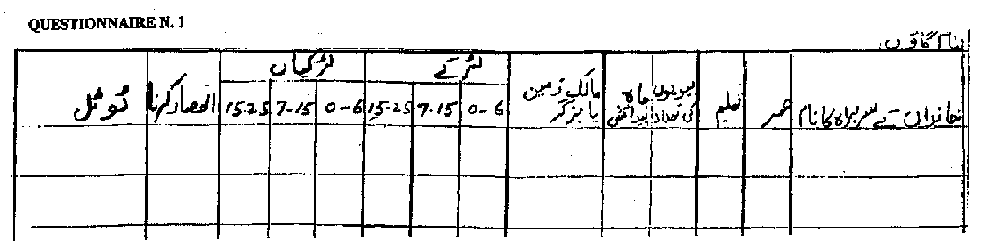
In each site covered by the project, before the initiation of development activities, of questionnaires is filled in by IRLDP field researchers (in Urdu). The objective is to obtain basic quantitative data on the main social and economic parameters. Some of the questionnaires include specific case studies on individual households. The list of questionnaires is the following:
1. Basic socio-demographic data (for each household and family) including data on age of heads of households, number and age of wives and children, level of education
2. Factors of production, including data on size of landholdings, and of family flocks for each unit of production.
3. Specific socio-demographic data on women (origin, education, present age, age at marriage, total number of children, number of children alive, possession and use of assets, etc.)
4. Production activities (by age and sex, and according to seasons)
5. Production activities (case studies on individual households)
6. Production inputs (according to the seasons)
7. Production inputs (case studies on individual households)
8. Production revenues (according to the seasons)
9. Production revenues (case studies on individual households)
10. Crop production (activities, cycles, harvest period for each crop)
11. Calendar of agricultural and livestock activities
12. Local prices for basic commodities (according to the seasons)
13. Marketing of agricultural and livestock products (case studies)
14. Marketing of agricultural and livestock products (case studies on individual households)
15. Purchase of animals (case studies on individual households)
16. Sales of animals ((case studies on individual households)
17. Animal diseases (according to the seasons)
18. Animal diseases (case studies on individual households)
19. Labor cost and other costs
20. Labor allocations (according to the crops and seasons, case studies on individual households)
21. Use of animals products
22. Wool and meat production (case studies on individual households)
23. Production of meat (case studies on individual households)
The Annex 2 gives the example of the questionnaires # 1 and 3
QUESTIONNAIRE N. 1
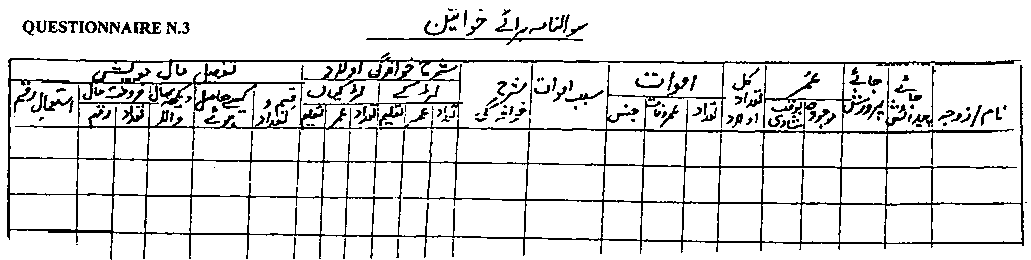
QUESTIONNAIRE N. 3
To assess the socio-economic situation of the different areas in the most rapid and efficient way, the SEU has used some tools of a methodology which puts particular emphasis on circa observation and semi-structured interviews of individuals and groups of individuals.
This methodology, called Rapid Rural Appraisal (RRA), has been developed by social scientists and social services providers as a means of understanding the social and economic life of human communities. RRA provides guidelines for conducting rapid assessments of producers' practices and behaviors. As an off-shoot of this method, Participatory Rural Appraisal (PRA) techniques implicate local populations more directly in the identification of their problems and needs. The method emphasizes the need to observe, listen to and understand the points of view, patterns of organization, and actions of the community, and to take into account the specific needs of categories of people (especially women).
Some tools of this approach can be applied at various points of the programme cycle (planning, implementation and evaluation).
* as a planing toot prior to program development, RRA is an effective means of collecting important baseline data on everyday activities, identifying major problems and issues, and judging the feasibility of a particular development activity or approach. RRA allows the people's own perceptions of problems to surface and enter into program design, thus fostering from the start community participation;
* as a means of monitoring program implementation, RRA allows project personnel to gain insight into problems encountered and, eventually, to modify project activities accordingly;
* as an instrument for evaluation, RRA can help assessment of whether the activities undertaken have effectively responded to the problems of the community.
The main RRA techniques utilized by the IRLDP/SEU have been:
+ observations: simple, consistent observations of actions and behaviors in different settings (in the home, in the field) to reveal extensive information about community patterns and interactions.
+ format interviews: a list of specific questions was prepared in advance and group promters and community motivators were asked to record responses in writing; this technique provided basic quantitative data (see also annex 1 and 2);
+ informal interviews: questions arose out of observation of a particular setting and are adapted to different individuals interviewed;
+ conversations: casual conversations were important means of gathering information from certain individuals or in certain circumstances;
+ focus-group discussions: this involves the selection of select members of the community (e.g., elders, local opinion leaders, women, mothers, shepherds) for discussions about specific interests: farming, animal husbandry, women's activities, child care, etc. Themes are raised for general discussion (perceptions, aspirations, identification of needs, etc.);
+ participative mapping: production of maps using local perceptions of the area (habitations, fields, grazing areas, springs, water points for animals, graveyards, etc.);
+ collection of local technical terms in domains concerning social life, economic activities, environment and natural resources, etc. (see annex 8: essential socio-economic glossary in Pashtu);
+ wealth-ranking: visualizing local criteria of ranking people and local perception of the internal stratification of the community),
+ participatory identification of priorities and needs in order to identify the initiatives to be undertaken and the conditions of their implementation,
+ participatory evaluation of the various activities in order to assess the reaction of individuals to project activities and understand the impact of the project on the life of local populations,
+ restitution mechanisms: process through which the main findings of the appraisal were communicated to the community, particularly to the Community Steering Committees and the Village Councils; it set the scene for a sustainable relationship between the community and the project in implementing activities
[This annex proposes a general outline to assist in structuring a report on issues concerning the social and economic life of populations. Each chapter may include from 5 to 15 pages according to the needs. Complementary information should be put in appropriate annexes. This form of report is necessary in areas where a project intends to start development activities. For a more general profile of surrounding or related areas see annex 5: Area Profile].
1. SOCIAL FEATURES
1.1 General historical and socio-cultural background
1.2 General demographic data and trends
1.3 Social organization: tribes, clans and main lineages
1.4 Socio-territorial units
1.5 Residential patterns
1.6 Structure/composition and typology of villages based on average population, arable land per capita, livestock units per capita and per ha. of grazing land. percentage of households with off-farm employment.
1.7 Typology of households on the basis of variables such as farm size, ownership of livestock and assets, cropping patterns, level of technology, income sources, access to remittances, age/stage in domestic cycle and gender of the household head, etc.
1.8 Presence and roles of chiefs, political and religious leaders, traditional councils; political parties
Annexes:
1.A List of local tribes and clans
1.B Local terms for social structures
1. C Maps (including maps representing local perceptions of space)
1.D Diagram on patterns of poverty (findings of participatory mechanisms on wealth ranking)
1.E Case studies on individual social histories
2. LAND AND NATURAL RESOURCES
2.1 Land categorization (private, communal, state lands) and estimations of area
2.2 Forms of land tenure (access to and use of communal grazing resources)
2.3 Forms of agricultural and non-agricultural land uses
2.4 Land market situation and trends
2.5 Forms of tenancy/social contracts on the use of agricultural lands
Annexes:
2.A Types and distribution of water resources
2.B Transhumance routes followed by nomads
2. C Mapping of current land uses
2.D Distribution of households by farm size and type of land
3. ECONOMIC CHARACTERISTICS
3.1 Typology of local production systems
3.2 Socio-economic stratification of local communities
3.3 General production and investment strategies
3.4 Differential farming and livestock practices (by categories of farming households)
3.5 Organization of labor (by gender and age)
3.6 Market of agricultural products and livestock
3.7 Relations with other communities
3.8 Dimensions of poverty, processes of impoverishment and coping/survival strategies
Annexes:
3.A General data on agriculture and livestock
3.B Income sources/levels of food security
3.C Traditional measures (weight, distance, capacity, etc.) and equivalents
3.D Marketing of livestock products (prices by category of animals)
3.E Marketing of agricultural products (prices, seasonality)
3.F General cost/benefit analysis of agriculture and livestock activities
4. SOCIO-ECONOMIC DEVELOPMENT
4.1 Relations with urban and semi-urban centers
4.2 General infrastructures in the area (roads, railway, telephone, etc.)
4.3 Social and technical services operating in the area and surrounding areas (structure and activities)
4.4 Development projects & programmes operating in the area/surrounding areas and lessons learned
4.5 Modern village institutions
Annexes:
4.A Local attitudes towards government agencies and development projects
4.B Inventory of past project activities
4.B List of locally-fen priorities (by gender categories)
LIST OF BIBLIOGRAPHIC REFERENCES
[This annex gives on example of a short socio-economic profile which should be prepared for each area directly or indirectly linked to the area/site covered by the project. A series of profiles would help to place targetted ' communities in a wider social and economic context]
AREA: |
Dasht Goran, Rej, Ronjedo and Dash Budu villages |
DISTRICT: |
Kalat |
LOCATION: |
Between 10 and 25 km. south of the town of Kalat |
SOCIAL GROUPINGS: |
Brahui Sarawan, with communities belonging to the Zari, Menngal and Alizei tribes |
POPULATION: |
Rough estimation of a settled population of between 400 to 700 households (=3500 and 6000 persons), plus about 100 households of seasonal inhabitants (nomads) belonging to the Channar clan of the Zari tribe. |
PRODUCTION SYSTEMS: |
The following production systems may be distinguished |
(i) fixed agriculturalists; | |
(ii) fixed agro-pastoralists; | |
(iii) transhumant agro-pastoralists (with fixed house in summer); | |
(iv) pastoralists. | |
Agriculturalists and agro-pastoralists cultivate orchards and khuskaba. It is reported that orchards had a very low production over the last 5 years. | |
Agro-pastoralists and pastoralists move to Kacchi lowlands in winter, using four main roads. | |
LIVESTOCK: |
Permanent animal population estimated at about 6,000 sheep and goats |
Average family flock size: between 5 and 10 animals (settled); about 100 animals (nomads) | |
AGRICULTURE: |
Orchards and rainfed agriculture |
WATER: |
Spring, karez and open-air wells |
LAND TENURE: |
Agricultural lands: (i) botari, ownership; and (ii) bazghari, tenancy. |
Some landless people have to pay a crop share (called batai) to the sardar controlling the land (about 1/7 of the harvest). | |
Pastoral lands: communal use of 'jama' (or land belonging to the community. | |
TRADITIONAL: |
Sardar of the Zari tribe |
LEADERSHIP: |
Sardar of the Menngal tribe |
DEVELOPMENT: |
No specific development initiatives in the area |
The main road (Kalat-Khuzdar) is currently under construction | |
REMARKS: |
* A relatively high number of pastoralists tend animals belonging to absentee owners, (i) under a traditional contract which lasts 4 years and allow them I out of every 4 new born animals), continuing seasonal migrations, or (ii) as salaried shephers, remaining in the area, and receiving 200 Rs. per year, I lamb out of 10 and a bag of wheat (for about 200 animals representing 4 to 5 individual flocks). |
* In winter, a relatively high number of settled agro-pastoralists migrate to Turbat and Karachi in search of labor. However, the number of these people has dramatically declined since the development of the orchards (15 to 20 years ago). |
POPULATION (1995 estimates): |
|||
Total population: |
6,738,000 (= 5.2% of total population in Pakistan | ||
Categories: |
Rural: 82%; Urban: 18% | ||
Gender: |
Male: 52.1%; Female 47.8% | ||
Young population (above 20 yrs): |
52% | ||
Total fertility rate (1990-95): |
6.47 (Pakistan: 6.00) | ||
Life expectancy: |
59.50 (Pakistan: 60.75) | ||
Infant mortality rate: |
93.50 (Pakistan: 80.00) | ||
Child mortality rate: |
138 (Pakistan: 130) | ||
Maternal mortality rate: |
500-1,000 (Pakistan: 500) | ||
AGRICULTURE (1992): |
|||
Total area of Balochistan: |
347,193 km2 | ||
Reported area: |
186,100 km2 | ||
Cultivated area: |
4.6% (of total area), 8.7% (of reported area) | ||
Cropped area: |
2% (of total), 3.7% (of reported) | ||
Cultivable waste: |
13.6% (of total), 25.4% (of reported) | ||
Forest: |
3.1% (of total), 5.8% (of reported) | ||
Not available for cultivation: |
32.1% (of total), 91.2% (of reported) | ||
LIVESTOCK (1991-92): |
|||
Number of sheep: |
12,889,449 | ||
Number of goats: |
9,388,720 | ||
Number of veterinary hospitals: |
53 | ||
Number of veterinary dispensaries: |
567 | ||
CLIMATE (1983 to 1992): |
|||
Mean of maxi temperature: |
Quetta: 24.8; Zhob: 26.2 (from 1983 to 1989 only) | ||
Mean of mini temperature: |
Quetta: 8.3; Zhob: 11.9 (from 1983 to 1989 only) | ||
Rainfall (1992): |
Quetta: 409.6 mm; Zhob: 357.7 mm | ||
HEALTH (1991-1992): |
|||
Number of hospitals: |
60 | ||
Number of beds: |
3,110 | ||
Number of dispensaries |
644 | ||
Number of rural health centres: |
44 | ||
Number of basic health units: |
17 | ||
Number of doctors: |
680 (female: 12%) | ||
Num of doctors per population: |
1 per 5,412 | ||
Number of nurses: |
191 (female: 82.7%) | ||
Num. of nurses per population: |
1 per 26,042 | ||
Number of lady visitors: |
654 | ||
EDUCATION (1991): |
|||
Number of primary schools: |
4,222 (males: 86.8%; females: 13.1%) | ||
Number of middle schools: |
582 (males: 88.1 %; females: 11.8%) | ||
Number of high schools: |
288 (males: 80.5%; females: 19.4%) | ||
Number of mosque schools: |
2,470 (males: 100%) | ||
Primary school enrollment: |
50% overall | ||
(% of popul. aged 5-9) |
27% girls; 71% boys | ||
Number of teachers (prim. schools): |
14,493 (males: 86%); females: 13.9%) | ||
Number of teachers (middle schools): |
5135 (males: 86.9%; females: 13%) | ||
Number of teachers (high schools): |
1,870 (males: 77%; females: 22.9%) | ||
Adult literacy rate (1991, estim.): |
20.4% (overall Balochistan); (35% overall Pakistan) | ||
Female literacy rate: |
6.2% (Balochistan); (Pakistan: 21%); 2.4% (rural women in Balochistan) | ||
This annex presents the main quantitative socio-economic indicators which may be collected in the highlands at the level of a village. Covering a wide range of subjects (population, human development , land, water, labor, livestock, market, and production), these indicators should aim essentially at identifying social and economic change, providing explanations, monitoring specific interventions, and modifying approaches. They also give background material for evaluating general socio-economic processes and trends at regional, provincial and national levels, and improve basic statistics. More particularly, indicators aim at:
* measuring the state, structures and changes in socio-economic conditions of rural populations;
* defining objectives and specific targets of rural development interventions;
* monitoring performance, effectiveness and efficiency of development interventions and progress towards defined objectives:
* identifying problem areas;
* describing, comparing and determining distributions, dispersions and variations among socio-economic entities.
The list of indicators given below reflects the main goals and concerns of a project like the ILRDP. This initial list could be completed by more specific indicators according to the needs.
LIST OF SOCIO-ECONOMIC INDICATORS
1. POPULATION
1.1 POPULATION SIZE
1.1.1 Total population
1.1.2 Number of nuclear families
1.1.3 Number of households
1.1.4 Average size of households
1.2 POPULATION STRUCTURE
1.2.1. Percentage of male population
1.2.2. Percentage of female population
1.2.3. Percentage of age category from 0 to 25 years
1.2.4. Percentage of age category over 50 years
1.2.5 Average age of heads of households
1.2.6 Average age of women at marriage
1.3 POPULATION ORIGIN
1.3.1 Percentage of heads of families born in the area
1.3.2 Percentage of women born and grown up in the area
1.3.3 Percentage of households belonging to a clan different than that of the majority
2. HUMAN DEVELOPMENT
2.1 EDUCATION
2.1.1 Literacy (1) rate of adult males (+ 15 years)
2.1.2 Literacy rate of adult females (+ 15 years)
2.1.3 Primary school enrolment rate (2) for boys
2.1.4 Primary school enrolment rate (3) for girls
2.1.5 Completion of primary school rate for boys
2.1.6 Completion of primary school rate for girls
2.1.7 Number of trained teachers per school age children
2.2 HEALTH ANT) NUTRITION
2.2.1 Mortality of infants (0-1 year)
2.2.2 Mortality of children (1-4 years)
2.2.3 Percentage of malnutrition among children (under 6 month age) (3)
2.2.4 Maternal mortality (at birth)
2.2.5 Number of trained health workers per person
2.2.6 Number of trained midwives per women
2.3. HOUSING
2.3.1 Percentage of households owning their own habitation and site
2.3.2 Percentage of households with electric facilities
2.3.3 Percentage of households with water pipe facilities (4)
2.3.4 Percentage of households with sanitation facilities (toilet facilities)
2.3.5 Percentage of households living in hutts
2.4 INCOME
2.4.1. Average household per capita income
2.4.2. Proportion of households per capita below the average
2.4.3. Proportion of households per capita income twice greater than the average
2.5 CREDIT
2.5.1 Percentage of households with access to institutional credit (5)
2.5.2 Percentage of formal credit per household
2.6. ASSETS (ratios)
2.6.1 Number of tractors per household
2.6.2 Number of cars per household
2.6.3 Number of trucks per household
2.6.4 Number of motorbikes per adult men
2.6.5 Number of radios per household
2.7 INFRASTRUCTURES
2.7.1 Percentage of households not reached by all-weather roads
2.8 COMMUNITY DEVELOPMENT
2.8.1 Percentage of households with memberships in formal or informal organizations
2.8.2 Percentage of adult members with formal/informal training by development projects
3. LAND
3.1 LAND OWNERSHIP
3.1.1 Percentage of landless households
3.1.2 Percentage of households working lands belonging to absentee owners
3.1.3 Average size of individual landholdings
3.1.4 Percentage of landholdings whose size is below the average (including landlesses)
3.1.5 Percentage of landholdings with a size twice greater than the average
3.2. LAND TENURE
3.2.1 Percentage of tenants to the total number of households
3.3. LAND USE
3.3.1 Percentage of cultivated lands to the total area
3.3.2 Proportion of land under rainfed and runoff agriculture
3.4. COST OF LAND (per acre)
4. WATER
4.1 WATER POINTS
4.1.1 Rate of tubewells per household
4.1.2 Rate of open-air wells per household
4.2 MINIMUM LEVEL OF GROUND WATER (summer and winter)
4.3 MAXIMUM LEVEL OF GROUND WATER (summer and winter)
4.4 WATER COSTS
4.3.1 Electrical pump (including installation costs)
4.3.2 Pipes (per meter)
5. LABOR
5.1. LABOR COSTS
5.1.1 Hired workers wage rates (daily)
5.1.2 Hired shepherds wage rates (daily or monthly)
5.1.3 Rental of tractors (cost per hour or per ha)
6. LIVESTOCK
6.1 ANIMAL POPULATION
6.1.1 Total Standard Tropical Units (STU) in the area
6.1.2 Ratio STU/household
6.1.3 Total number of small ruminants
6.1.4 Ratio small ruminants/household
6.1.5 Ratio sheep/goats
6.1.6 Ratio cattle per households
6.2 LIVESTOCK OWNERSHIP
6.2.1 Percentage of households without livestock (including those with fewer than 5 small ruminants)
6.2.2 Average size of individual flocks
6.2.3 Percentage of households with flocks below the average
6.2.4 Percentage of households with flocks twice bigger than the average
6.3 ANIMAL HEALTH
6.3.1 Animal losses (over one year)
6.3.2 Percentage of deaths due to parasites
6.3.3 Percentage of deaths dues to pneumonia
6.3.3 Percentage of vaccinated animals
6.4 ANIMAL NUTRITION
6.4.1 Percentage of households cultivating fodder
6.4.2 Percentage of households having a stock of straw or fodder
6.4.2 Percentage of households buying straw or fodder for their animals
7. PRODUCTION
7.1. AGRICULTURAL PRODUCTION
7.1.1 Wheat grain (average yield/hectare)
7.1.2 Wheat straw (average yield/hectare)
7.1.3 Barley (average yield/hectare)
7.1.4 Fodder (average yield/hectare)
7.1.5 Orchards (average yield/hectare for apples)
7.2 LIVESTOCK PRODUCTION
7.2.1 Annual birth rates per adult female
7.2.2 Annual death rates
7.3 PRODUCTIVITY
7.3.1 Returns per land (returns per person/day)
7.3.2 Returns per labor (returns per hectare)
8. Market
8.1 LOCAL PRICES OF AGRICULTURAL PRODUCTS (per kg.)
8.1.1 Wheat (summer/winter)
8.1.2 Barley (summer/winter)
8.1.3 Fodder (summer/winter)
8.1.4 Apple trees (minimum/maximum) (for tor kulu variety)
8.1.5 Apple crates (minimum/maximum) (for tor kulu variety)
8.2 PRICES OF ANIMALS AND ANIMAL PRODUCTS
8.2.1 Sheep (young female, 1-2 years)
8.2.2 Sheep (adult male (24 years)
8.2.3 Goats (young female, 1-2 years)
8.2.4 Goats (adult male, 2-4 years)
1 Literacy: ability both to read and to write
2 Enrollment rate: number of children enrolled in primary schools (first level education) per 100 children of primary school age.
3 Children whose weight-for-age, height-for-age, and weight-for-height are below 80% (use of experts may be required for this indicator)
4 Water pipe facilities: water laid on from community-wide system (installations within 100 mt. from family compounds) or from individual installations.
5 Institutional credit: all credit (usually expressed in money values) supplied by institutional agencies (agricultural banks, credit institutions, cooperatives, projects, housing finance institutions, building societies).
I. PASHTO-ENGLISH (1)
Abi: |
irrigated land (see: oba) | |
Adal-badal: |
barter; exchange (see: badal) | |
Ak: |
rights | |
Aka: |
uncle (= father's brother) | |
Ambar: |
manure; fertilizer (see: s_ra) | |
Ambar-khana: |
store; granary (=manure room) | |
Angur |
grape | |
Anna: |
grand-mother (see: niya) | |
Ashar: |
collective labor, group work | |
Aziiz: |
kin, descent group; clan (see also: zai, khek, kom) | |
aziiz-galwi: |
kinship | |
Badal: |
exchange; barter; reciprocity, vengeance; retaliation, revenge | |
Badar: |
landowner | |
Bagh: |
garden | |
Baha: |
payment | |
khuni baha |
(=murder payment) | |
Bahureï: |
open-air well (tubewell) | |
Baïtak: |
guesthouse | |
Balusan: |
Baluch (people) | |
Band: |
bar; dam; enbankment (see: lat) | |
Bandubast: |
settlement (of land); distribution of land (see: vesh) | |
Baran: |
rain | |
barani: |
rainfed agriculture (called also 'khuskawa') | |
Barkar: |
flock of young kids (for goats) (see: wula, for sheep) | |
Bataï: |
division of shares (tenancy) | |
Bazgar: |
tenant (see: dekan) | |
bazaar ak: |
tenancy rights; usufructuary rights | |
Bazgari: |
tenancy | |
Begaar: |
forced labour (imposed by chief, council, etc.) | |
Begherat: |
man/woman who has lost his/her honor (see: ghaïrat) | |
Beravi: |
Brahui | |
Bogareï: |
land given to a tenant by a landowner | |
Boena: |
co-wife | |
Boeza: |
goat | |
Chiné: |
spring; stream | |
chiné oba: |
water spring | |
Daba: |
stagnant water | |
Darzi: |
tailor | |
Dasht: |
plain; valley | |
Dekan: |
tenant (see: bazaar) | |
Dol: |
drum | |
dol-zan: |
musician (=drum beat) | |
Doobeï: |
summer | |
Drakht bagh: |
orchard (=tree garden) | |
Drakht: |
tree, fruit tree | |
Duk: |
anthrax | |
Dukan: |
shop | |
Dukandar: |
shop-keeper | |
Ekar: |
acre | |
Faïda: |
benefit; profit; advantage | |
Fakir: |
beggar; mendicant | |
Farlang: |
unit of measurement of distance (one farlang=200 m.) | |
Fasila: |
distance | |
Fasli: |
cultivation | |
do fasli: |
rotation of two crops | |
Garam: |
hot | |
garam |
mosum: hot, warm weather | |
garam yilaka: |
warm areas; winter quarters (for nomadic pastoralists) | |
Garma: |
sweet melon (see: sarda, khatakai) | |
Gelaï: |
small flock of sheep | |
Goneï: |
sack (for agricultural products) (= 100 to 120 kg.) | |
Gwasha: |
meat | |
Ghaïrat: |
honor (see: nang; tura; izzat); charity | |
Ghaïratmand: |
man of honor; honorable | |
Ghal: |
thief; robber; bandit | |
Gham: |
grief, sadness, mourning | |
Gh_nam: |
wheat (see: mulki and sarkari varieties) | |
Gharib: |
poor | |
gharibi: |
poverty | |
Ghoba: |
cow-herd | |
Gh_m: |
funeral | |
Ghwa: |
cow | |
Ghwayeï: |
bullock | |
Haj: |
pilgrimage to Mecca | |
Halak: |
boy (from 7 to 15 years) | |
Hamsaya: |
client; neighbour | |
Hawd: |
reservoir; cistern | |
Hokumat: |
state/government-owned land | |
Ijara: |
rent (for land) | |
Indwana: |
watermelon | |
Injileï: |
girl (from 7 to 15 years) | |
Jakei: |
hail | |
Jang: |
war | |
Jawar: |
sorghum | |
Jerga: |
council; elder council | |
Jig: |
tall | |
jiga drakhta: |
palm (=tall tree) | |
Jow: |
barley | |
Juwari: |
maize | |
Kaar: |
work; labour | |
mazduur kaar: |
wage labour | |
Kaarindar: |
worker | |
Kahkti: |
scarcity; absence; lack; famine | |
Kaleï: |
village (pl.: kili); neighborhoods | |
Kamat: |
price | |
Kambala: |
carpet (traditional) | |
Kandak: |
flock (of sheep) (see: taway, flock of goats) | |
Kanun: |
law; civil law | |
Karana: |
||
karana mzakka: |
cultivated land | |
Karez: |
underground spring | |
karez viala: |
karez channel | |
Karz: |
debt | |
karzdar: |
who is in debt | |
Kashida kari: |
handicrafts (=crafts work) | |
Kat: |
fertilizer | |
Ker: |
enclosure, corral (for animals) | |
Keteï: |
fields | |
Kili: |
villages (pi. of kaleï) | |
Kishdeï: |
tent; pastoral camp | |
kishdeï masher: |
camp leader | |
kishdeï-nu wale yilaka: |
camp territory | |
Kisht: |
cultivation | |
Kishtgar: |
tenant who provides seeds for cultivation | |
Kochean: |
pastoralists (see: pawondean, musafir) | |
Kolal: |
potter | |
Kom: |
confederacy; cluster or related tribes | |
Koor: |
house (separate cooking unit) | |
koor naï: |
household members; domestic group | |
koor khalq: |
household members | |
koor wale: |
nuclear family | |
Korot: |
cheese | |
Kozda: |
betrothal | |
K_raya: |
rent (for house) | |
Kret: |
crate (for fruits and vegetables, between 12 and 20 kg.) | |
Kuchi: |
butter | |
Kushneï: |
small | |
kushneï sar: |
small peak | |
kushneï injileï: |
girl (below 7 years) | |
kushneï halak: |
boy (below 7 years) | |
Kuweï: |
well | |
Khalq: |
people | |
Khan: |
wealthy landowning person; senior in a village (see: malik, village chief) | |
Khana: |
room; house | |
Khandan: |
family | |
Khatakaï: |
sweet melon (see: garma, sarda) | |
Khel: |
tribe | |
Þ khel yilaka: |
tribal territory | |
Kherat: |
social ceremonies (for weddings, deaths, circumcisions) | |
Khp_l: |
own | |
khp_l wuli: |
close relative (for intermarriages) | |
Khuni: |
murder | |
khuni baha: |
murder payment; blood money | |
Khur: |
sister | |
Khurma: |
dates | |
Khushk: |
to dry | |
khusk saali: |
drought (=dry year) | |
khushkwar: |
spring harvest | |
khuskawa: |
dry agriculture (see: barani) | |
Lat.: |
enbankment (see: band) | |
Lau: |
harvest | |
Lauzaghai: |
herding contract | |
Lavian: |
hired agricultural worker (for the harvest of wheat) (see: mazduur) | |
Lewa: |
wolf | |
Loe: |
big, high | |
loe sar: |
big, high peak | |
Lora: |
torrent | |
Loshal: |
to milk | |
Lur: |
daughter | |
Maal: |
livestock; animal capital | |
maaldar: |
livestock keeper | |
Maalik: |
landlord (see: bazgaar, or tenant) | |
Mahal: |
place | |
Maïna: |
wife | |
Malang: |
indigent; destitute | |
MaldaÞ: |
cattle | |
Malik: |
tribe chief; village chief (see: khan; nawab, sardar) | |
Malkiat: |
privately-owned land | |
Malikana: |
ownership; property | |
malikana ak: |
ownership rights | |
Mama: |
uncle (mother's brother) | |
mama zoyi: |
cousin (mother's brother's son) | |
mama-ganaï: |
matrilineage | |
Man: |
traditional weight measure (=37.32 kg., or 40 seer) | |
nim man (=half-man): = 18.6 kg. or 20 seer | ||
Mandaw: |
hut (to keep goats and sheep in winter) | |
Manguleï: |
non-cultivated fodder | |
Markit: |
market | |
Mashar: |
chief; household chief; elder (pl. mashraan) | |
Mayan: |
fish | |
mayanu shikar: |
fishing (=fish searchong) | |
Mazduur: |
hired agricultural worker (see: lavian) mazduur kaar: wage labour | |
Mazigar: |
share of water (at karez) (3 furs) in the evening (see: shabanaroz, nimakaye) | |
Melma: |
guest | |
melman khana: |
guest-house (see: baïtak) | |
melma-palana: |
hospitality (see: melmastiya, shaïgara) | |
melmastiya: |
hospitality (see: shaïgara, melmapalana) | |
Meja: |
sheep | |
Mil: |
unit of distance (=mile) | |
Minda: |
castrate (animals) | |
Miranaa: |
respect; estime | |
Miras: |
tribal land | |
Miraw: |
water (karez) supervisor in charge of distributing water shares (=miri-ab) | |
Mokam: |
solidarity | |
Moor: |
riche; wealthy | |
Mor: |
mother | |
Morgha: |
grass | |
Mosum: |
wheater | |
garam mosum: |
hot wheater | |
yakh mosum: |
cold wheather | |
Moza: |
administrative unit | |
Mulki (ghanam): |
local variety of wheat (see: sarkari) | |
Muneï: |
autumn | |
Musafir: |
traveller; nomad (see: kochean, pawondean) | |
Mzakka: |
land | |
Nabud: |
fallow | |
Nang: |
hono (see: tura, ghaïrat, izzat); protection | |
Nasab: |
lineage to whom somebody belongs by alliance (through marriage) | |
Nawab: |
chief (at the level of a confederacy) | |
Nawako: |
bride | |
Neiz: |
flood; flood agriculture (see: aïlob) | |
Nik_: |
grand-father | |
Nima: |
half | |
nima-kaye: |
share of water (12 furs) (at karez) (see: shabnaroz, mazigar) | |
Niya: |
grand-mother (mother's mother) (see: anna) | |
Niyaz: |
alms | |
Oba: |
water (see: abi) | |
pakhé oba: |
perennial water | |
obo malik: |
manager of water point (see: miraw) | |
Païsa: |
coin | |
Pakhé: |
permanent | |
pakhé oba: |
perennial water | |
Pam_nda: |
distributed land | |
Pargoor: |
protected grazing areas | |
Parda: |
veil, curtain, seclusion, hiding | |
PaÞi: |
leaf; foliage | |
Pashtun: |
Pashtun, Pathan | |
Pashtunwaali: |
social code; Pashtun customary law | |
Patata: |
potato | |
Patwari: |
officer in charge of land registration, cadastre | |
Pawondean: |
pastoralists; nomads (see:kochean, musafir) | |
Peaz: |
onion | |
Pedawar: |
production | |
PeÞla: |
girl (over 15 yrs) | |
Piaye: |
to graze | |
Plar: |
father, head of nuclear family | |
plar-u-nik_: |
ancestor (father's grand-fathers) | |
Pomba: |
cotton | |
Pop: |
loan | |
poÞawar: |
who received a loan | |
Psarleï: |
spring (season) | |
Paw: |
traditional weight measure (=0.23 kg., or 1/4 of seer) | |
nim paw (=half paw): 0.11 kg. | ||
Pun: |
ticks | |
Rawaaj: |
custom, traditions | |
Regana: |
sandy | |
regana mzakka: |
sandy soil | |
Reïk: |
sand | |
Rogha: |
peace | |
Rood: |
river | |
Saïlab: |
flood (agriculture); flooded land | |
Sakhawat: |
generosity | |
Sakhi: |
generous | |
Sar: |
peak (of mountain) | |
SaÞa ghanam: |
winter wheat | |
Saraï: |
man | |
Sarda: |
sweet melon (see:garma, khatakaï) | |
Sardar: |
chief (at the level of tribal groupings (see: nawab, malik) | |
Sarkari: |
government | |
sarkari ghanam: |
variety of wheat introduced by the Agric. dept.) | |
Sarsaya: |
alms (for ramadaan) | |
Sauzbar: |
autumn harvest | |
Seeb: |
apple | |
Seer: |
unit of weight (=0.933 kg.) (Þman) | |
nam seer (=half seer): 0.46 kg. | ||
S_ra: |
manure, animal manure see ambar) | |
Spin jire |
(=white beard):elder; old man | |
Spishti: |
lucerne | |
Shabanaroz: |
share of water (24 furs) (at karez) (= day and night) (see: nimakaye, mazigar) | |
Shaïgara: |
hospitality (see: melmastiya, melmapalana) | |
Shakannak: |
communal flock | |
Shalumbe: |
sour milk | |
Shamilat: |
non attributed lands, land under communal tenure | |
Shela: |
small torrent | |
Sheza: |
woman (see: zan) | |
Shikar: |
hunting | |
Shikari: |
hunter | |
Shpana: |
shepherd | |
Shpun: |
herder | |
Shudeï: |
milk | |
Talak: |
divorce | |
Tarbur: |
cousin (father's brother's son); rival | |
Tauda ghanam: |
summer wheat | |
Taway: |
flock of goats (see: kandak, for sheep) | |
Tehsil: |
administrative unit | |
Tofa: |
gift | |
Tror: |
aunt (mother's/father's sister) | |
Tubwel: |
tubewell (see: bahureï) | |
Tukhum: |
seed | |
Tchetank: |
traditional weight measures (=0.05 kg. or 1/16 of 1 seer) | |
Ush: |
camel (male) | |
Usha: |
camel (female) | |
Ustakar: |
blacksmith (pi. ustakaran) | |
Vesh: |
distribution of land (see: bandubast) | |
Viala: |
channel | |
Viala: |
water channel | |
Vina: |
blood | |
Vror: |
brother | |
Waada: |
marriage | |
Wada: |
wedding | |
Walwar: |
brideprice | |
Wareï: |
shearing | |
LaÞeï: |
wool | |
Warkhare: |
parasitism | |
Washa: |
fodder | |
Wawra: |
snow | |
Wula: |
flock of young lambs (sheep (see: barkar) | |
Yakh mowsum: |
cold weather | |
Yakh: |
winter | |
Yilaka: |
territory | |
Zai: |
lineage | |
Zamindar: |
agriculturalist | |
zamindari: |
agriculturale | |
Zan: |
woman | |
Zan: |
to beat (see: dol-zan) | |
Zindeï: |
irrigated agriculture(see: abi) | |
Zoyi: |
son | |
Zuwan: |
youth; young people | |
Zwan: |
boy (over 15 years) | |
1 NOTE for the transcription:
r: |
'r' with the tongue near the teeth; |
Þ: |
'r' with the tongue further back (palatale 'r') |
_: |
silent 'e' as the English '_' in 'but' |
ee: |
long 'e' |
II. ENGLISH-PASHTO
Administration: |
||
administrative units: |
see: tehsil, moza | |
Advantage: |
faïda | |
Agriculturalist: |
zamindar | |
Agriculture: |
zamindari | |
dry agric.: |
khuskawa, barani | |
flood agric.: |
saïlab, neiz | |
irrig. agric.: |
abi, zindeï | |
agric. worker: |
mazduur; lavian (for harvest of wheat) | |
Alms: |
sarsaya (for ramazan); niyaz | |
Ancestor: |
plar-u-nika | |
Anthrax: |
duk | |
Apple: |
seeb | |
Aunt (=mother's/father's sister): |
tror | |
Autumn: |
muneï | |
Baluch (people): |
balusan | |
Bandit: |
ghal | |
Barley: |
jow | |
Barter: |
adab-badal | |
Beggar: |
fakir | |
Benefit: |
faïda | |
Betrothal: |
kozda | |
Blacksmith: |
ustakar (pl. ustakaran) | |
Blood: |
vine | |
blood money: |
khuni baha (=murder payment) | |
Boy |
||
below 7 years: |
kushneï halak | |
from 7 to 15 years: |
halak | |
over 15 years: |
zwan | |
Brahui: |
beravi | |
Bride: |
nawako | |
Brideprice: |
walwar | |
Brother: |
vror | |
Bullock: |
ghwayeï | |
Butter: |
kuchi | |
Camel: |
||
male: |
ush | |
female: |
usha | |
Camp (pastoral): |
kishdeï | |
camp leader: |
kishdeï masher | |
camp territory: |
kishdeï-nu wale yilaka | |
Carpet: |
kambala (traditional) | |
Castrate: |
minda (animals) | |
Cattle: maldaÞ |
||
Channel: |
viala | |
karez channel: |
karez wiala | |
Charity: |
ghaïrat | |
Cheese: |
korot | |
Chief: |
||
village chief: |
masher | |
confederacy ch.nawab |
||
tribal chief: |
sardar | |
lineage chief: |
malik; khan | |
household chief: |
mashar | |
Cistern: |
hawd | |
Code: |
||
Pashtun social code: |
pashtunwaali | |
Coin: |
païsa | |
Client: |
hamsaya | |
Cold |
||
cold wheather: |
yakh mowsum | |
Confederacy: |
kom | |
Corral: |
ker (for animals) | |
Cotton: |
pomba | |
Council: |
jerga | |
Cousin |
||
father's brother's son: |
tarbur | |
mother's brother's son: |
mama zoyi | |
Cow: |
ghwa | |
Co-wife: |
b_na | |
Crate: |
kret (for agricultural products) | |
Cultivate: |
||
cultivated land: |
karana mzakka | |
cultivation: |
kisht | |
Custom: |
rawaaj | |
Dam: |
band | |
Dates: |
khurma | |
Daughter |
lur | |
Debt: |
karz | |
who is in debt: |
karzdar | |
Destitute: |
malang | |
Distance: |
fasila | |
unit of dist. (=mile): |
mil | |
Distribution |
||
d. of land: |
bandubast; vesh | |
Division |
||
d. of shares (tenancy): |
bataï | |
Divorce: |
talak | |
Drought: |
khusk saali (=dry year) | |
Elder: |
masher (pl. mashraan); spin jire (=white beard) | |
Enbankment: |
band; let | |
Enclosure: |
ker (fror animals) | |
Estime: |
miranaa | |
Exchange: |
badal | |
Fallow: |
nabud | |
Family: |
khandan | |
Famine: |
kahkti | |
Fertilizer: |
kat | |
Fields: |
keteï | |
Fish: |
mayan | |
Fishing: |
mayanu shikar (=fish hunting) | |
Flock: |
kandak (sheep); taway (goats) | |
communal flock: |
shakannak | |
small flock of sheep: |
ghelaï | |
flock of young lambs: |
wula (sheep); barker (goats) | |
Flood: |
neiz | |
flood agriculture: |
saïlab, neiz | |
Fodder: |
washa | |
non-cultivated: manguleï |
||
Foliage: |
pâÞi | |
Funeral: |
gh_m | |
Garden: |
bagh | |
Girl |
||
below 7 years: |
kushneï injileï | |
from 7 to 15 yrs. injileï |
||
over 15 yrs.: |
peÞla | |
Gift: |
tofa | |
Generosity: |
sakhawat | |
generous: |
sakhi | |
Grief: |
gham | |
Goat: |
b_za | |
Government: |
sarkari | |
government-owned land: |
hokumat | |
Granary: |
ambar khana | |
Grand-father: |
nik_ | |
Grand-mother: |
niya; anna | |
Grape: |
angur | |
Grass: |
morgha | |
Graze: |
piaye | |
grazing lands: |
shamilat; sara mzakka | |
protected graz. lands: |
pargoor | |
Group work: |
ashar | |
Guest: |
melma | |
guesthouse: |
melman khana (=guest room); baïtak | |
Hail: |
jakei | |
Half: |
nima | |
Handicrafts: |
kashida kari (=crafts work) | |
Harvest: |
lau | |
autumn harvest: |
sauzbar | |
spring harvest: |
khushkbar | |
Herd: |
meal | |
cow-herd: |
ghoba | |
Herder: |
shpun | |
Herding: herding contract: |
lauzaghai | |
Honor: |
nang; tura (=sword); ghaïrat (pers.); izzat | |
man of honor, honorable: |
ghaïratmand | |
who has lost his honor: |
begherat | |
Hospitality: |
melma-stiya; shaïgara; melma-palana | |
Hot |
||
hot weather: |
garam mosum | |
House: |
koor; khana | |
Household: |
koor wale | |
household members: |
koor-naï; koor khalq | |
Hunter: |
shikari | |
Hunting: |
shikar | |
Hut |
||
for keeping animals in winter: |
mandaw | |
Indigent: |
malang | |
Irrigation: |
||
irrigated agriculture: |
abi, zindeï | |
Kin: |
aziiz | |
Kinship: |
aziizgalwi | |
Labour: |
kaar | |
wage labour: |
mazduur kaar | |
collective labour: |
ashar | |
forced labour: |
begar | |
Lack: |
kahkti (=scarcity) | |
Land: |
mzakka | |
irrigated land: |
abi mzakka | |
distributed land: |
pam_nda | |
non-distrib. land: |
shamilat | |
cultivated land: |
karana mzakka | |
grazing land: |
sara mzakka | |
state/government land: |
hokumat | |
privately-owned land: |
malkiat | |
land owner: |
badar; khan | |
l. given to a tenant: |
bogareï | |
tribal land: |
mires | |
Law: |
kanun | |
modern law: |
sarkari kanun | |
customary law: |
pushtunwali (=way of living of the Pashtun) | |
Leaf: |
pâÞi | |
Lineage: |
zaï | |
lineage by marriage: |
nasab | |
matrilineage: |
mama ganaï | |
Livestock: |
maal | |
livestock keeper: |
maaldar | |
Loan: |
poÞ | |
who received a loan: |
poÞrawar | |
Lucerne: |
spishti | |
Maize: |
juwari | |
Man: |
saraï | |
Manure: |
ambar; s_ra | |
Marriage: |
waada | |
Market: |
markit | |
Matrilineage: |
mama-gani | |
Meat: |
ghwasha | |
Measures: |
||
traditional measure: |
see: man, seer, paw, tchetank, goneï, kret, farlang | |
Melon: |
||
watermelon: |
indwana | |
sweet melon: |
garma; sarda; khatakaï | |
Mendicant: |
fakir | |
Milk: |
shudeï | |
sour milk: |
shalumbe | |
to milk: |
loshal | |
Mother: |
mor | |
grand-mother: |
niya; anna | |
matrilineage: |
mama-gani | |
Mourning: |
gham | |
Murder: |
khuni | |
murder payment: |
khuni baha (blood money) | |
Musicians (tradit.): |
dol-zan (=drum beat) | |
Nomads: |
pawondean; kochean, musafir | |
Onion: |
peaz | |
Orchard: |
drakht bagh (=tree garden) | |
Palm: |
jiga drakhta (=tall tree) | |
Parasitism: |
warkhare | |
Pashtun: |
Pashtun | |
pashtun language: |
pashto | |
pashtun way of living: |
pashtunwali | |
Pastoralists: |
kochean; pawondean ( =nomads) | |
Patrilineage: |
zaï' | |
Peace: |
rogha | |
Peak (mountain): |
sar | |
big peak: |
loe sar | |
little peak: |
kuchnai sar | |
People: |
khalq | |
Place: |
mahal | |
Plain: |
dasht | |
Poor: |
gharib | |
very poor: |
malang | |
Potato: |
patata | |
Potter: |
kolal | |
Poverty: |
gharibi | |
Price: |
kamat | |
Production: |
pedawar | |
Profit: |
faïda | |
Protection: |
nang | |
protected grazing areas: |
pargoor | |
Quarters: |
||
summer quarters: |
yakh yilaka | |
winter quarters: |
germ yilaka | |
Rain: |
baran | |
Reciprocity: |
badal | |
Relatives |
||
close relatives: |
khp_l wuli (for preferred marriage) | |
Rent |
||
for land: |
ijara | |
for house: |
k_raya | |
Reservoir: |
hawd | |
Respect: |
miranaa | |
Revenge: |
badal | |
Rich: |
moor | |
Rights: |
ak | |
ownership rights: |
malikana ak | |
usufructuary rights: |
bazgaar ak | |
River: |
rood | |
Robber: |
ghal | |
Room: |
khana | |
Sack: |
goneï | |
Sadness: |
gham | |
Sand: |
reïk | |
sandy soils: |
regana mzakka | |
Seclusion: |
parda | |
Seed: |
turkhum | |
Settlement: |
bandubast | |
Shares (of karez water): |
shabanaroz (24 hrs.); | |
nimakaye (12 hrs.); | ||
mazigar (3 hrs.) | ||
Shearing: |
wareï | |
Sheep: |
meja | |
Shepherd: |
shpana | |
Shop: |
dukan | |
shop-keeper: |
dukandar | |
Sister: |
khur | |
Snow: |
wawra | |
Son: |
zoyi | |
Solidarity: |
mokam | |
Sorghum: |
jawar | |
Spring (season): |
psarieï | |
Spring (water): |
chine | |
Stream: |
chine | |
Summer: |
doobeï | |
summer quarters: |
yakh yilaka | |
Surface |
||
unit of surface (=acre): |
ekar | |
Tailor: |
darzi | |
Tall: |
kg | |
Tenant: |
bazgaar; dekan | |
t. who provide seeds: |
kishtgar | |
Tent: |
kishdaï | |
Territory: |
yilaka | |
Thief: |
ghal | |
Torrent: |
lore; (small torrent= shela) | |
Traditions: |
rawaaj | |
Tree: |
drakhta | |
Tribe: |
khel | |
tribal terr: |
khel yilaka, miras | |
Tubewell: |
tubwel; bahureï | |
Valley: |
dasht | |
Vengeance: |
badal | |
Village: |
kale') (pi. kili) | |
Uncle: (=father's brother): |
aka | |
mother's brother: |
mama | |
War: |
jang | |
Water: |
oba | |
water spring: |
chine oba | |
water channel: |
viala | |
stagnant water: |
dab | |
w. supervisor (karez): |
mirau | |
perennial water: |
pakhe oba | |
Wealthy: |
moor | |
Wedding: |
wade | |
Weight |
||
unit of weight (=0.933kg.): |
seer | |
Well: |
kuweï | |
Wheat: |
ghanam | |
winter wheat: |
saÞa ghanam | |
summer wheat: |
tauda ghanam | |
Wheather: |
mosum | |
cold weather: |
yakh mosum | |
warm wheather: |
garam mosum | |
Wife: |
maïna | |
co-wife: |
b_na | |
Winter: |
yakh | |
winter quarters: |
garam yilaka (=warm areas) | |
Wolf: |
lewa | |
Woman: |
sheza; zan | |
Wool: |
waÞeï | |
Work: |
kaar | |
wage work: |
mazduur kaar | |
Worker: |
kaarindar | |
Youth: |
zuwan | |
AHMED A. (1980) 'Pukhtun Economy and Society. Traditional Structure and Economic Development in a Tribal Society' (London, Routledge and Kegan Paul)
AHMED A.S. (1986) 'Pakistan Society. Islam, Ethnicity and Leadership in South Asia' (Karachi, Oxford University Press)
AHMED A. ed. (1990) 'Pakistan. The Social Sciences' Perspective' (Oxford University Press, Karachi)
ARIF S. (1987) ' Past production and future potential of fruit production in Baluchistan' in Pakistan Economic and Social Review pp. 89-108
AZHAR B.A. (1993) 'Rural Poverty in Pakistan: its incidence, causes, and alleviation' in Pakistan Journal of Agricultural Economy
BALLAND D. and KIEFFER C. (1979) 'Nomadisme et sécheresse en Afghanistan: l'exemple des nomades Pastun du Dast-e Nawor' in EQUIPE ECOLOGIE ET ANTHROPOLOGIE DES SOCIETES PASTORALES 'Pastoral Production and Society' (Paris-Cambridge, Editions de la Maison des Sciences de l'Homme and Cambridge University Press) pp. 75-90
BARTH F. (1959) 'Segmentary opposition and the theory of Games: A Study of Pathan Organization' in Journal of the Royal Anthropological Institute 89:5-21
BARTH F. (1965) 'Political Leadership among Swat Pathans' (London School of Economics Monographs on Social Anthropology, N. 19, New York, Humanities Press)
BONFIGLIOLI A. (1994) 'Socio-economic study of the Asghara-Wazulun Valley and the Kacch Mulazai area. Synthesis Report' (IRLDP, Working Paper n. 4) (Quetta, IRLDP)
BONFIGLIOLI A. (1195) 'Nomadic Pastoralists in the Highlands of Balochistan' (IRLDP, Working Paper n. 7) Quetta, IRLDP
BUZDAR N. (1992) 'The Role of Institutions in the Management of Commonly-owned Rangelands in Balochistan' in DOVE M. CARPENTER C. eds. 'Sociology of Natural Resources in Pakistan and Adjoining Countries' (Vanguard, Lahore, pp. 218-238 )
BYERLEE D. and HUSAIN T. (1992) eds. 'Farming Systems of Pakistan' (Karachi, Vanguard)
CAROE O.(1992) 'The Pathans' (Oxford University Press, Karachi)
CARPENTER C. (1992) ' The Impact of Afforestation on Women: The Development of Marginal Lands and Female Fodder Collectors in Pakistan' in DOVE M.- CARPENTER C. eds. 'Sociology of Natural Resources in Pakistan and Adjoining Countries' (Vanguard, Lahore, pp. 330-346
CENTLIVRES P. (19913) 'A State of the Art Review of Research on Internally Displaced, Refugees and Returnees from and in Afghanistan' (Report prepared for London)
COSSINS N. (1988) 'Islands in the Desert. Prospects for Rangelands Rehabilitation and Sustainable Livestock Production in Balochistan'
DEL CASTILLO C. (1987) 'Community Profiles: A Set of Cultural Sketches of Five Regions in Baluchistan' (Research Report n. 11) (Quetta, Arid Zone Research Institute)
DUPREE L. (1973) 'Afghanistan' (Princeton, Princeton University Press)
EDWARDS D.B. (1990) 'Frontiers, Boundaries and Frames: The Marginal Identity of Afghan Refugees' in AKBAR AHMED ed. 'Pakistan. The Social Sciences' Perspective' (Oxford University Press, Karachi)
ELPHINSTONE M. (1815) 'An Account of the Kingdom of Caubul' (2 vol.) (reprint in 1992 in Karachi, by Indus Publication)
FAO (1983) 'Report of the Balochistan Assistance Jo Rangeland and Livestock Development Survey' (TCP/PAK/0107), FAO Pakistan
GANKOVSKY Y. (1992) 'The Social Structure of the Brahui and the Baloch' in Ahmed A. ed. 'Pakistan: The Social Sciences Perspectives'
GAZETTEER OF BALOCHISTAN (1906) 'Loralai', 'Sibi', Zhob' (Reprint in 1989 in Quetta by Gosha-e-Adab)
GRIMA, B. (1993) 'The Performance of Emotion among Paxtun Women' (Oxford University Press, Karachi)
HALCROW, in association with EUROCONSULT ULG and NESPAK (1994) 'Balochistan Minor Irrigation and Agriculture Development Project' Poverty Study' (Quetta, BMIADP)
HART D.H. (1985) 'Guardian of the Khaibar Pass. The Social Organisation and History of the Afridis of Pakistan' (Vanguard, Lahore)
JAHANGIR A.M. (1994) 'Case-study on Participatory Planning of the Inter-regional Project for Participatory Upland and Conservation and Development (GCP/INT/542/ITA)' (Quetta, FAO)
IAN MACDONALD and Ass. (1988) 'Diagnostic Study of Farming Systems in Baluchistan' (Quetta, BAERB)
LINDHOLM, C. (1982) 'Generosity and Jealousy. The Swat Pukhtun of Northern Pakistan' (Columbia University Press, New York)
IMPERIAL GAZETTEER OF INDIA (1905, 1991) 'Provincial Series, BALUCHISTAN' (Lahore, Sang-E-Meel Publications
MERREY D. (1992) 'Irrigation and Honor: Cultural Impediments to the Improvement of Local Level Water Management in Punjab, Pakistan' in DOVE M. and CARPENTER C. eds. 'Sociology of Natural Resources in Pakistan and Adjoining Countries' (Vanguard, Lahore) pp. 126-160
NAGY I. et al. (1987) 'Range-Livestock: Production Constraint Diagnosis and Potential Research Opportunities in Baluchistan. A Farming Systems Perspective' (Research Report, Quetta, AZRI)
NOMAN O. (1992) 'Pakistan. Political and Economic History since 1947' (Paul Kegan, London)
PASTNER S. L. (1971) Camp and Territory among the Nomads of Northern Makran District, Balochistan: The Role of Sedentary Communities in Pastoral Social Organization. Unpublished Ph D. Dissertation, Brandeis University
PASTNER S. (1975) 'Co-operation in crisis among Baloch Nomads' in ASIAN AFFAIRS n.6, vol. 62 pp. 165-176
PEHRSON R. (1977) 'The Social Organization of the Marri Baloch' (Karachi, Indus Publications)
PLANHOL de, X. (1993) 'Les Nations du Prophéte. Manuel géographique de politique musulmane' (Fayard, Paris)
QUDDUS S.A. (1987) 'The Pathans' (Lahore, Feroz sons)
QUDDUS S.A. (1990) 'The Tribal Baluchistan' (Lahore, Ferozsons)
RAYERTY H.G. (1901) 'A Dictionary of the Pukhto, Pushto or Language of the Afghans' (new print in 1982, Peshawar, Saeed Jan Qureeshi)
REES D.J. - NAGY I. - RAZA S. - MAHMOOD K. - CHOWDRY B. - KEATINGE J. (1987) 'The Dryland Arable Farming System of Upland Baluchistan: A Case Study" Research Report n.5 (AZRI, Quetta)
ROBINSON (1934) 'Nomads of Afghanistan' (reprinted 1978, Nisa Traders, Quetta/Lahore)
SABIR F. & NAGY J. (1989) 'Women's household agricultural production systems survey results' (Research report n. 10 (AZRI, Quetta)'
SHAH M.A. (1992) 'Sardari, Jirga & Local Government Systems in Balochistan' (Quetta, Qaim Parinters)
SHERANI S.R., BUZDAR H. arid NAWAZ K. (1990) 'Organisational Innovations and the Impact on Resource Utilisation in the Pak-German Self-help Project Area, Baluchistan' (Discussion Paper, Mountain Population and Employment) (Kathmandu, International Centre for Integrated Mountain Development)
SIDDIQI A.H. (1991) 'Baluchistan (Pakistan). Its Society, Resources and Development' (Lanham, University Press of America)
SPAIN J. (1972) 'The Way of Pathans' (Karachi, Oxford University Press)
SPOONER B. (1975) 'Nomadism in Balochistan' in L. S . Leshnik and G. D. Sonthiemer eds. 'Pastoralists and Nomads in South Asia' (Wiesbaden, Harrossowitz) pp. 171-182
SPOONER B. (1988) 'Baluchistan' in ENCYCLOPAEDIA IRANICA vol. 3 fasc. 6 pp. 598-632
SPOONER B. (1988) 'Balochistan: Geography, History and Ethnography' in Encyclopedia lranica Vol. 3 Fasc. 6 pp. 598-634
SPOONER B. - GLICKMAN L. (1982) 'Balochistan, Pakistan: A Socio-Economic Literature Review Analysis' (IDA, Binghamton)
SPOONER B. - JONES A. (1982) 'Balochistan. An Introduction' (IDA, Binghamton)
SWIDLER N. (1969) 'The Political Structure of a Tribal Federation: The Brahui of Balochistan' (Ph.D. unpubl. dissertation, Columbia University, New York; Ann Arbor, University Microfilms)
SWIDLER N. (1977) 'Brahui Political Organization and the National State' in Ainslie T. Embree ed. 'Pakistan's Western Borderlands: The Transformation of a Political Order' (Durhan, N.C., Carolina Academic Press) pp. 109-125
SWIDLER W. (1968) 'Technology and Social Structure in Balochistan West Pakistan' (Ph.D. unpublish. dissertation, Columbia University, New York; Ann Arbor, University Microfilms)
SWIDLER W. (1977) 'Economic change in Balochistan: Processes of integration in the larger economy of Pakistan' in AINSLIE T. EMBREE ed. 'Pakistan's Western Borderlands: The Transformation of a Political Order' (Durhan, N.C., Carolina Academic Press) pp. 85-108
TAPPER R. (1979) 'The Organization of nomadic communities in pastoral societies of the Middle East' in EQUIPE ECOLOGIE ET ANTHROPOLOGY DES SOCIETES PASTORALES ed. 'Pastoral Production and Society' (Cambridge and Paris, Cambridge University Press and Editions de la Maison des Sciences de l'Homme) pp. 43-66
TITUS P. (1991) 'Tribalism, Ethnicity and the State in Pakistani Balochistan. The Economics and Politics of Detribalization in an Urban Setting' (Unpubl. Ph. D. Thesis, Riverside, University of California)
UNICEF (1980) 'Socio-economic Surveys of Rural Areas of Baluchistan' (report prepared by the Investment Advisory Centre of Pakistan)
UNICEF (1995) 'An Analysis of the Situation of Women and Children in Balochistan' (Unpubl. report, UNICEF, Quetta)
VAN OILS. H. and BAIG S. (1992) 'Environmental Profile. Balochistan Pakistan (LARUC-ITS, The Netherlands, and EU-SSP, Lahore)
WARDROP-ACRES, COWATER INTERNATIONAL AND NESPAK (1989) 'Balochistan: Strategic Provincial Investment Plan and Project Preparation for Rural Water Supply, Sanitation and Health' Quetta
WIRSING R.G. (1987) 'The Baluch and Pathans' (Report n.48 of the Minority Rights Group, London, Minority Rights Group).
