

Appendix 2. Participatory tools
Time allocation study
The objective of the time allocation study is to record in great detail the time engaged in certain activities while following the respondent the whole day. The following format is used and an example is given.
activity of |
beginning at |
duration (in minutes) |
productive reproductive community |
Mr./Mrs. |
|||
.................... |
|||
Role in household: |
|||
.......... |
|||
wake up, washing, pray |
4.45 |
25 |
r |
lighting the fire |
5.10 |
5 |
r |
fetching water at tap |
20 |
r + c | |
and chatting with women |
|||
making tea |
5.35 |
15 |
r |
taking care of children |
15 |
r | |
milking buffalo |
6.05 |
20 |
p |
etc. |
Seasonal calendars
To provide insight in the dynamics of daily time allocation, seasonal calendars can be made by the farmers. Participatory seasonal calendars can indicate the agricultural cycle, important festivals, labour migration patterns, seasonal price fluctuations, etc. The exercises start with determining the appropriate periods: months, seasons, cropping periods, etc. Plotting this period against activities provides a matrix (see Figure 2). If quantification is relevant, e.g. in the case of workload assessment, it can be done through making participatory bar diagrams (with stones or grains) for specific activities in each season or month.
It is useful to do this exercise with different participants because the seasonal calendar of a woman differs from that of a man, and the calendar from a poor landless farmer differs that of a richer village shopkeeper.
item |
symbol |
winter |
first rains |
baisaak jeth |
rain season |
dasair tihar |
rice |
plough |
plant |
harvest | |||
maize |
plough |
plant |
harvest |
|||
collect fuelwood |
***** |
*** |
*** |
* |
*** | |
food available |
++ |
+ |
- |
- - |
++ | |
price of crops |
*** |
* |
* |
** |
**** | |
migration |
****** |
*** |
* |
|||
need for hospital |
* |
* |
** |
**** |
* |
Figure 2: An example of a seasonal calendar matrix.
Time line
A tool for assessing gradual changes and their causes is making a time line. Ask the participant to recollect major events that have taken place in the community with approximate dates to construct a historical profile. These can relate to natural disasters, the introduction of new technologies, political events or the arrival of a outsiders. This exercise is useful as an ice-breaker. It can also be used for making a life history of a participant, indicating important events such as marriage, diseases, pregnancies, etc.
Ranking exercises
There are two ways of ranking: pair wise ranking and matrix ranking. For pair wise ranking items of interest are compared pair by pair, participants indicating which is preferred and why. In the ideal case this exercise needs prig: preparation to show the items, e.g. leaves of different fodder trees when you or they want to find out which fodder species they prefer. Matrix ranking puts the criteria on which selection will be made in the rows of a matrix, and items which are to be selected in the columns. The participants decide on the criteria and on the items. They fill in the boxes for each row (e.g. by putting a certain number of stones in the box).
Having filled in the matrix, the participants will decide on how to use this information. Which of the above species is preferred, or which of the listed criteria is most important? For example, maybe the total the count per species (sissoo 10 badahar 8, etc.) or during the exercise a consensus on intercropping as the main criterium emerged. PRA exercises are meant to let people think, talk, exchange views, draw conclusions and decide collectively.
items: |
sissoo |
badahar |
kutmiro |
dudhilo & utis mix |
criteria: |
||||
fuelwood |
** |
* |
* |
*** |
fodder |
* |
*** |
**** |
*** |
timber |
**** |
** |
* |
*** |
inter-cropping |
*** |
** |
* |
** |
Figure 3: An example of matrix ranking
.
Doing this exercise field staff should take into account that farmers almost never focus on one species, one off-farm activity or one strategy. To avoid risks and to manage their diverse resources, the farmers often need diversity rather than specialization. Doing the ranking exercise might easily produce results which do not reflect this reality. Doing pair wise ranking in the Terai will result in a preference for sissoo. Yet, this does not mean farmers want only sissoo. They prefer it, but need, want or manage other trees as well. Include combinations in your exercises and look how it works.
Venn diagram
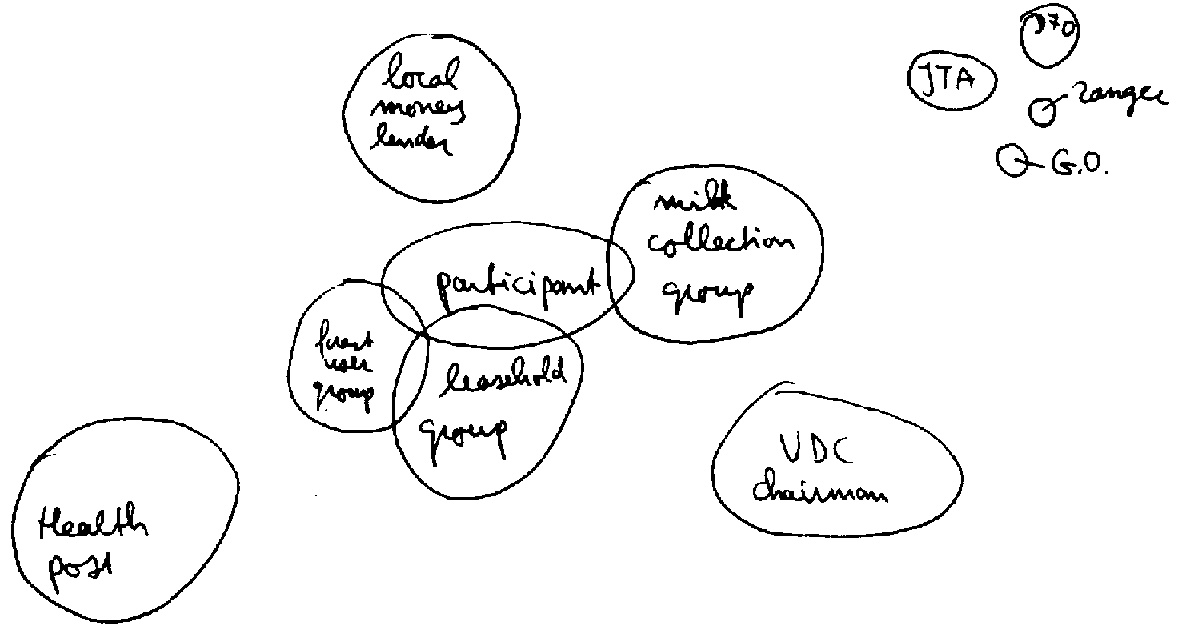
The participant (an individual or a group) is asked to draw a central circle to represent himself/herself/themselves and other circles representing groups and institutions with which he/she/they have relations. Their distance to the central circle indicates the strength of the relation, while the size of the circle shows their importance to the participants. Circles can overlap.
A venn-diagram of leasehold farmers .
Metaplan
Metaplan is a tool to focus and structure discussions and brainstorming sessions. All participants write down their ideas regarding a topic or their answers regarding a question on separate cards in such a way that people can read them from a distance. The facilitator then displays all the cards on a wall and might ask the writers for explanation. Thereafter, the participants group or classify them in order to structure the problem.
A very effective metaplan tool is the problem tree. Starting from a topic or problem, its causes and effects are analyzed. The problem is stated on a card, and the facilitator asks 'why?' (for causes) or 'so what?' (for effects). The participants write down their answers, either collectively or on first call basis. Example: the problem of deforestation; why? because of population increase, commercialization, smuggling, forest policy, etc.; 'so what?' erosion, poverty, extra burden for women, etc. etc. Mostly a lively discussion starts and perceptions are expressed.
