 Previous - Next
Dune fixation: a tool for desertification control
When sand encroachment assumes sizeable proportions it can lead to serious economic and social problems. It is often one of the most spectacular manifestations of desertification, well-known to many countries with long dry seasons.
If sand encroachment is to be controlled, we must first of all reduce saltation, a phenomenon where soil particles, carried by the wind, are lifted 30 to 40 cm high, for a distance of 0.5 to 1 metre.
We can reduce saltation by stabilizing the soil, or reducing wind speed at ground level. We may also use wind speed to clear away accumulated sand. Several techniques, based on these general principles, have been used and may be grouped into two categories:
1. Primary fixation, whose aim is to stabilize, by mechanical means, moving sand masses threatening human settlements and infrastructure, or to prevent the formation of these sand masses. This may be done by the following three techniques:
- the fencing technique: placing a linear obstacle in the wind's path;
- the mulch technique: spreading any product or material capable of evenly covering the soil;
- the aerodynamic method: streamlining the obstacle so that wind speed is not reduced and thus sand is not deposited; alternatively, facilitating sand transport.
2. Definitive fixation, achieved through the establishment of a permanent plant cover.
The fencing technique
The fence is a linear obstacle placed across the direction of the prevailing wind. It reduces wind speed and causes the moving sand to accumulate in front of it, finally forming a man-made protection dune.
There are two types of man-made dunes, depending on the angle at which the fence faces the prevailing wind:
- The "stop" dune, intended to halt the advancing sand as much as possible, forms when a fence is placed at right angles to the direction of the me.' dangerous wind. This is the most commonly used type of man-made dune (figure la).
Figure 1a.
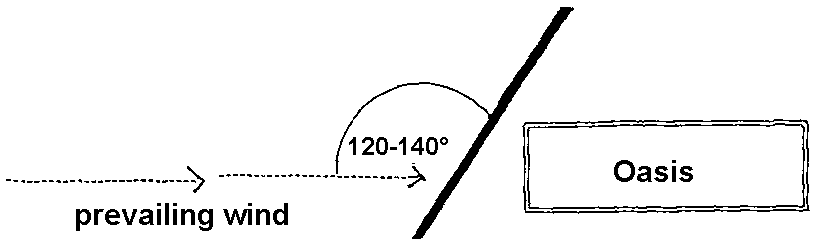
Figure 1b

- The "deflecting" dune, used to divert the sand. This is done with the help of a fence placed at an angle of 120° to 140° to the prevailing wind direction (figure 1b).
In order to form a man-made dune in coastal areas (where it is referred to as a litoral or coastal dune), the fence is placed as near as possible to the moving sand.
The fences should be:
- placed within 200 m of the area to be protected;
- permeable to wind;
- between 1 and 1.20 m high.
They are usually made of palm fronds, branches, plastic fencing or slabs of fibrocement.
When sand swirls between the fences, secondary fences have to be erected perpendicular and linked to the main ones to form a checkerboard pattern.
The mulch technique
This involves covering the sand with an even, protective layer of mulch in order to stop wind action at ground level and prevent saltation. Several methods are used:
- mulching with crop or grass residues, which must often be compacted or made to adhere to the ground through the application of the following substances: water (by spraying), mixtures of water and clay, plastic film, fine acrylic mesh, mineral oils (asphalt, heavy oils, crude oils);
- stabilization (using chemicals).
The aerodynamic methods
These use the transporting capacity of the wind (when wind speed is adequate) in two different ways:
-by having the wind remove unwanted sand deposits (in streets and gardens, for instance) using procedures that increase wind speed;
-by streamlining obstacles (road and canal sides, and wells) so that wind speed is not reduced on contact with them. These methods have traditionally been used to protect wells, underground channels etc.
Definitive fixation techniques
Once the dunes have been fixed by one of the mechanical procedures described above, they can then be fixed definitively. For this we need to establish perennial tree or shrub cover. There is no longer the risk of these being destroyed by moving sands, that might otherwise have exposed plant roots or damaged their aerial parts through abrasion.
Usable woody species should be drought resistant, need few nutrients, withstand wide variations in temperature (night/day), and resist very strong winds. Such species include the North African Calligonum (shrubs), Hedysarum argentatum, Lycium vitricalum, Nitraria retusa, Polygonum equisetiforme, Zygophyllum album, and others such as Callotropis, Balanites, Prosopis, Tamarix, Casuarina, Australian acacias, some eucalypts, etc.
Healthy nursery-selected seedlings should be used. The holes should be dug just before planting and care should be taken to prevent contact between the seedlings and dry sand. Finally, watering immediately after planting and protective fencing are essential for success.
Successful dune fixation plantations must also be suitably managed. In this way they will be able to meet their basic objectives, as well as improve the local environment, encourage tourism and provide wood (fuelwood) and non-wood products (fodder, sometimes fruits, mushrooms), and provide a habitat for wildlife.
| Further information on coastal or inland dune fixation may be obtained from the Forest and Wildlands Conservation Branch, Forest Resources Division, Forestry Department, Food and Agriculture Organization of the United Nations, via delle Terme di Caracalla, 00100 Rome (Italy) - Fax (39.6) 5797 5137 |
May 1993