


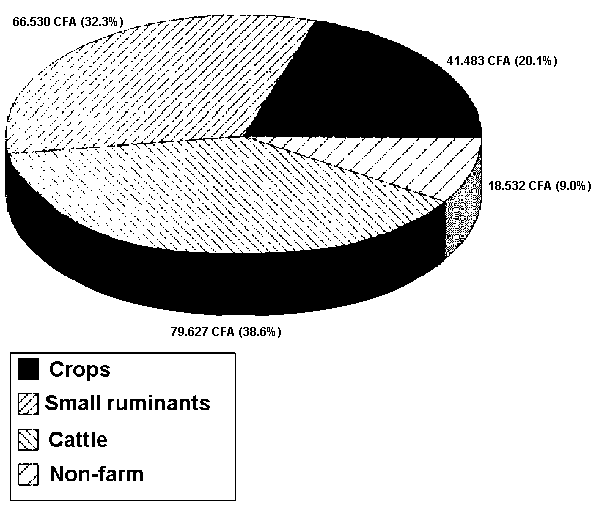
19. Figure 1 graphically summarizes the relative shares of the various farm and non-farm activities that constitute a smallholder mixed farmer's total cash income in the semi-arid zone of Mali. It shows that crops, smallstock, cattle and non-farm activities contribute 20%, 32%, 39% and 9% to total cash income respectively. Although based on a small sample of households that may be considered better endowed in resources than the average Sahelian smallholder mixed farmer, the results strongly suggest that smallholders consider opportunity costs across all sectors of the economy, both farm and non-farm, in their income generating activities.
Fig. 1. Relative shares of the different sources of cash income of smallholder mixed farmers in the semi-arid zone of Mali, 1987/88
20. In general, the smallholder mixed producers consumed most of their crop output and sold cash crops to purchase food grains they did not produce. They also used cash income from crop sales for the purchase of animal feed (see pare 16). Livestock cash income supports the purchase of cereals in the critical food shortage periods of the year. They also are used for paying hired agricultural labour as well as for the repair of farm equipment. Livestock cash incomes are also re-invested in livestock activities such as purchase of more stock and animal feed. Non-farm income supports both crop and livestock activities in the rural economy.
21. Another finding of the study is that the sample households are involved in market activity either through cash sales or transfers to generate both income and food. This contrasts to the conventional view in policy discussions of rural households, particularly semi-arid livestock producers, as being generally subsistence-oriented and by implication largely insensitive to price incentives.
22. The implications for policy are that policy instruments that tend to emphasize unisectoral pathways to food self-sufficiency, such as proclaiming target grain production levels to which all resources are diverted, may no longer be effective. A household as seen from the results of the study can assure its food self-sufficiency by generating cash from other sectors to have access to food through the market. Rural households' access to input and output markets needs to be improved, and reasonable prices for the wide range of products from which they earn their living be assured.
References
Ly R, Bartholomew P and Sissoko K. (1987). Caracteristiques des systemes de production agricole en zone semi-aride du Mali. Document INRZFH Projet Sectoriel/Volet Recherche. Bamako, Mali.
