4. The profitability of the transition from handhoes to animal drawn plows in a given area is determined by its population density, market infrastructure, soils, and the length of the growing period. The role of each of these determinants is discussed below.
(i) The profitability of the transition from handhoes to animal drawn plows is directly related to the population density and market infrastructure of a given area.
5. In order to understand this conclusion let us first examine how population density and market infrastructure influence agricultural production. Under sparse population densities, the prevailing form of farming is the forest fallow system. A plot of forest land is cleared and cultivated for one or two years after which it is allowed to lie fallow for 2025 years. In most agro-climatic environments this period of fallow is sufficient to allow forest regrowth. An increase in population density will result in a reduction in the period of fallow and eventually the forest land degenerates to bush savanna. Increasing population densities are associated with longer periods of continuous cultivation and shorter fallow periods. From bush-fallow, the system progressively moves through the stages of short (grass) fallow, annual cultivation and finally multi-cropping. This movement from shifting cultivation to permanent cultivation is known as the intensification of the agricultural system (Boserup, 1965; Ruthenberg, 1980).
6. Holding population density constant, agricultural intensification could also occur due to improvements in transport infrastructure. This happens due to two reasons. First, high prices and elastic demand for traceable goods imply greater marginal rewards for effort, and farmers will begin cultivating larger areas. Second, higher rewards to labor encourage immigration in the area from surrounding regions with higher transport costs.
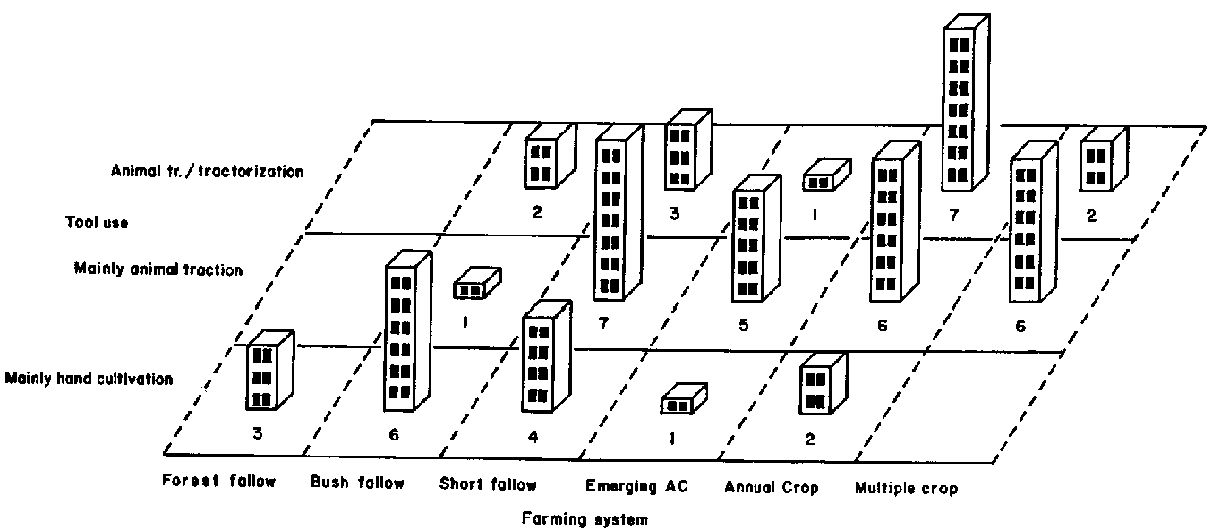
7. Our field visit data show a definite positive relationship between agricultural intensification and the transition from handhoes to animal drawn plows and/or tractors (see Figure 1 for details). All of the forest fallow cases and 6 of the 9 bush-fallow cases in our data set use hand tools for land preparation, while only 4 of the 14 short-fallow cases continue to rely on the handhoe. The dominance of mechanical tillage (via animal draft or tractors) becomes more prominent as short-fallow is replaced by permanent cultivation. Of the 30 cases under emerging or established permanent cultivation, 27 reported using animal draft and/or tractors for tillage.
8. Why is an apparently labor saving technology (the animal drawn plow) not used in forest- and bush-fallow systems when population densities are low and labor is scarce and why does it become attractive only when farming intensities increase, usually as a consequence of population growth? This puzzle has the following solution: when farming intensities increase beyond the forest-fallow stage, the number and intensity of farm operations increase (see Table 1), and labor requirements per unit of output (and per unit of land) rise faster than labor availability. Animal traction is indeed labor saving with respect to the high labor requirements (per unit of output) of handhoe cultivation in intensive farming systems. But it does not save on the relatively low labor requirements (per unit of output) of handhoe cultivation under the - forest and bush-fallow cultivation systems, but rather increases them. It does not improve the welfare of forest- and bush-fallow farmers who therefore reject it.
9. In the forest- and bush-fallow systems of cultivation, land clearing, planting and harvesting are the major tasks. Tree cover is removed during the clearing operation but the stumps are allowed to remain in the ground and planting is done in between the stumps. Because the land has been under tree cover it requires minimal amounts of land preparation and weeding. Now, suppose a plow was introduced into this system. The farmer would not only have to clear his land but also to have to remove the stumps and roots, a far more arduous task than clearing of the vegetation above the surface. Second, once the land has been destumped, the farmer would have to devote additional amounts of labor for soil fertility maintenance since forest-fallow can no longer be used for regenerating the soil. Third, since the soil is no longer under tree cover weeding requirements increase enormously. Finally, forest-fallow farmers, who usually do not keep any cattle due to the high incidence of disease and due to the low availability of grazing in these areas, would therefore have to add in the time required for animal husbandry into their decision to adopt the plow. Clearly, the introduction of a plow into the forest-fallow system would require a substantial increase in labor input, given the low availability of labor in these systems (due to low population density).
Figure 1. Evolution of farming systems and tools used
Note: The height of each column represents the frequency of each space
10. Now consider a farmer at the grass (short) fallow stage of cultivation, where two to three years of cultivation are followed by two to three years of fallow. The fallow period is not long enough for anything but grass growth. The weeding requirements are high because grass roots are hard to remove. Land preparation becomes an essential operation because the ground being exposed becomes hard and cannot be sown directly. Grassy fallows encourage the movement of animals into the area and farmers begin to keep livestock. Finally, with the reduction in fallow periods manure use becomes common as a means of augmenting the fertility of the soil. One can thus see quite clearly that the introduction of the plow at this stage would be truly labor saving since it would substantially reduce the labor requirements for land preparation and weeding without a significant increase in labor requirements for destumping, manuring and animal husbandry. It is at the grass-fallow stage that farmers first start using the plow and it becomes extremely common by the annual cultivation stage.
11. Intensification of the cultivation system is a necessary, though not a sufficient, condition for the introduction of the plow. Several intensively cultivated areas, such as the Kenyan Highlands, Kano area in Nigeria, etc., have persisted in the use of the handhoe. We will examine some of these exceptions later in the paper. Given an appropriate intensity of cultivation, the profitability of plowing varies by soil type, and the length of the growing season. These constraints are discussed below.
Table 1. Comparison of operations across farming systems
|
Operation |
Systems |
||||
|
FF |
BF |
SF |
AC |
MC |
|
|
Land Clearing |
Fire |
Fire |
None |
None |
None |
|
Land Preparation & Planting |
No land preparation digging sticks used to plant roots and sow seed |
Land is loosened using hoes and digging sticks |
Use of plow for preparing land |
Animal drawn plos and tractors |
Animal drawn plows and tractors |
|
Manure Use
|
- Ash |
- Ash |
- Animal dung or Manuring |
- Manure, sometimes human waste |
- Manure, sometimes human waste |
|
- Perhaps household refuse for garden plots
|
- Sometimes chitemene techniques |
- Sometimes comporting
|
- Composting |
- Composting |
|
|
- Household refuse for garden plots
|
- Cultivation of green manure crops |
- Cultivation of green manure crops |
|||
|
- Chemical fertilizers |
- Chemical fertilizers |
||||
|
Weeding |
Minimal |
Required as the length of fallow |
Intensive weeding required |
Intensive weeding required |
Intensive weeding required |
|
Use of Animals Farming
|
None
|
As length of fallow decreases- animal drawn plows begin to appear
|
- Plowing |
- Plowing |
- Plowing |
|
- Transport |
- Transport |
- Transport |
|||
|
- Interculture
|
- Interculture |
- Interculture |
|||
|
- Post-harvest tasks |
- Post-harvest tasks |
||||
|
- Irrigation |
- Irrigation |
||||
|
Seasonality of Labor Demand |
Minimal |
Weeding emerges as a peak |
Land preparation, weeding and harvesting |
Land preparation, weeding and harvesting |
Acute peak around land preparation, harvest, and post-harvest tasks |
|
Fodder Supply |
None |
Emergence of grazing land |
Abundant open grazing |
Open grazing restricted to marginal lands and stubble grazing. |
Intensive fodder management and fodder crop production. |
|
LEGEND:
|
FF = Forest-Fallow |
|
BF = Bush-Fallow |
|
|
SF = Short (Grass) Fallow |
|
|
AC = Animal Cropping |
|
|
MC = Multi-Cropping (i.e. for example double cropping) |
|
|
Source: Pingali et al (1987). |
|
(ii) The yield response to tillage is directly related to the depth and clay content of the soil.
12. Tillage increases the total porosity of the soil and thereby improves aeration, root penetration, water infiltration and reduces evaporation. Clearly, the importance of tillage increases with decreases in soil porosity; it is unnecessary on coarse sands and absolutely essential on clays (the latter have extremely low porosity and are impermeable to air and water). In the absence of an animal or motorized power source, clayey soils are virtually impossible to cultivate and often left for grazing.
13. Clay content and depth of soil also vary by the toposequence. On the top of ridges, soils tend to be shallow and rocky. In the mid-slopes, the soil is of moderate depth while the valley bottom soils are generally deep and have a high clay content. Soils on the upper slopes, being relatively light, are easy to work by hand, while the power requirements for tillage are the greatest in the valley bottoms due to the high clay content of the soil. Therefore, when a mechanical power source is first introduced, it is commonly adopted on the lower slopes and bottom lands and then gradually moves to the mid and upper slopes. One ought to keep in mind, however, that the cultivation of the clayey soils of the bottom lands requires high levels of investment in water control and drainage. These investments are usually not profitable under low population densities due to the scarcity of labor. Therefore, the cultivation and the use of a mechanical power source on these lands is closely associated with an increase in population densities. For a detailed discussion on the soil and toposequence issues and the associated agro-climatic variations, see Pingali et al (1987).
(iii) The profitability of plow use is directly related to the length of the growing season.
14. For given yield levels, the profitability of plow use is also related to the potential capacity utilization of equipment, which in turn depends primarily on the number of days available for land preparation. Severe constrains on capacity utilization can prevent the adoption of the plow even under high intensities of farming and even where the yield response to tillage is high. Conversely, where the plowing season is long, plows may be profitably employed even with modest yield effects.
15. The number of days available for land preparation are highest in humid tropical zones and lowest in the arid zones. Within a particular zone, the length of the growing period increases with the moisture-holding capacity of the soil and with altitude. In much of semi-arid and arid sub-Saharan Africa, land preparation cannot take place during the dry season because the soils are too dry (and compact in West Africa) to be worked on without damage to soil structure and to implements. Soil preparation has therefore to wait until the onset of the rains and plowing starts when enough rains have been received to wet the soil to the required depth of plowing. In these areas, however, delayed planting often results in a reduction in the effective length of the growing season and sharply decreases crop yields. Farmers therefore face a plowing-sowing tradeoff which can be described as follows: while plowing can improve soil structure and thereby yields, it results in inevitable delays in seeding. But delayed sowing results in decreased yields. Plowing is advantageous only where its yield effects exceed the yield losses associated with delays in sowing.
16. The plowing-sowing tradeoff is more severe in lower rainfall areas and on soils which have lower moisture-holding capacity. Consider the extreme case of the arid fringe areas with rainfall less than 500 mm per annum and a growing period of less than 90 days (see Table 2). Delays in sowing in this environment result in sharply higher risks of crop loss. Since the light sandy soils can be easily prepared by hand, the yield effects of plowing are minimal. If there is any plowing at all in these environments, it is concentrated on the heavy soils of the depressions and valley bottoms which have a slightly longer growing season due to the higher water retention capacity of the soils.
17. One implication of the above discussion is that, where the growing period is short, the opportunities for increasing capacity utilization through rental markets is limited. Rental markets for land preparation equipment are more likely to be established in areas where the plowing operation is not severely time bound. This applies where dry season or post-harvest plowing is possible, or where delayed plowing and planting does not lead to sharp declines in yield. In the lower rainfall semi-arid zones, however, rental markets will be limited due to sharp conflicts about timing among the potential users. This conflict arises because it is impossible to decide in advance the best sequence in which to serve different customers of the same rental service.
Table 2. Potential for animal drawn plows by agro-climatic zone.
|
Climatic Zone |
Average Annual Rainfall (mm) |
Length of Growing Period |
Remarks |
|
|
Arid |
0 - 400 |
<75 |
Plowing-sowing trade off severe. Plow use confined to heavy soils where absolutely
|
|
|
Semi-Arid |
|
|
||
|
|
- Arid Fringe Areas |
400 - 500 |
75 - 90 |
|
|
|
- Low to Medium Rainfall Zone |
500 - 650 |
90 - 120 |
Plow quite common.
|
|
|
- High Rainfall |
650 - 800 |
120 - 150 |
|
|
Sub-Humid |
800 - 1200 |
150 - 270 |
Plow faces constraints other than capacity utilization.
|
|
|
Humid |
>1200 |
>270 |
||
Source: Pingali et al (1987).