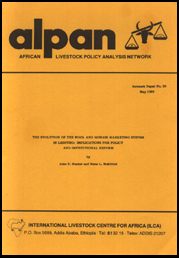
Network Paper No. 20
May 1989
by John P. Hunter* and None L. Mokitimi**
* Range/Livestock Economist, USAID-funded Lesotho Agricultural Production and Institutional Support Project, Ministry of Agriculture, Maseru, Lesotho.** Research Fellow, Institute of Southern African Studies, National University of Lesotho and Co-Project Leader of the IDRC-funded Agricultural Marketing Research Project being jointly conducted by the National University of Lesotho and the University of Saskatchewan.
This paper is based on a longer study of Lesotho's wool and mohair industry by Hunter (1987) and on an MSc Thesis at the University of Saskatchewan by Mokitimi (1988). Support for Hunter's research was provided by the USAID-funded Land Conservation and Range Development and Farming Systems Research projects in the Lesotho Ministry of Agriculture and by the IDRC-funded Agriculture Marketing Research Project in the Institute of Southern African Studies at the National University of Lesotho. This latter project also provided the funding for Mokitimi's research. All assistance is gratefully acknowledged. The views expressed in this paper are those of the authors and do not reflect the views of any of the institutions or agencies which have supported this research, nor of the governments of Lesotho, the United States, or Canada.
INTERNATIONAL LIVESTOCK CENTRE FOR AFRICA (ILCA)
P.O. Box 5689, Addis Ababa, Ethiopia · Tel: 61 32 15 · Telex: ADDIS 21207
AFRICAN LIVESTOCK POLICY ANALYSIS NETWORK
This electronic document has been scanned using optical character recognition (OCR) software and careful manual recorrection. Even if the quality of digitalisation is high, the FAO declines all responsibility for any discrepancies that may exist between the present document and its original printed version.
Evolution of the marketing system
The structure or private trading duo-trading
Relative performance in the marketing structure