Levels of milk consumption
41. A quantitative assessment of aggregate dairy demand by ecological zone and by rural/urban category requires precise information on milk consumption levels, human populations, incomes and prices in the urban and rural areas of different ecological zones. Detailed information of this kind is not available for West Africa. The following estimation of levels of milk consumption in different areas of West Africa is mainly based on aggregate FAO dairy production and import figures. As such, the estimates should only be taken as indicative.
42. The major assumptions made in estimating rural/urban differences in per caput milk consumption within each of the ecological zones of West Africa were that:
· Milk consumption is conditioned by milk availability which is determined by domestic production and imports;· Local milk production is predominantly rural and follows the distribution of milk producing livestock populations by ecological zone;
· Consumption of imported dairy products follows the distribution of urban populations by ecological zone since evidence for West Africa shows that a substantial proportion of dairy imports (as much as 80% according to Mbogoh 1984) is consumed in urban areas;
· Differences in the importance of milk in food consumption; in the availability and marketing of local and imported milk products; in the state of storage, transport and distribution prevailing in differing areas, determine the volume of milk actually consumed in rural and urban areas of each ecological zone. 6
43. Average rural/urban per caput milk consumption levels, estimated on the basis of these assumptions, are presented in Table 3. Since FAO milk production and import data, for the period after 1985, were not available at the time of this study, the estimates were calculated for 1983/85.
Table 3. Estimates of rural and urban per caput milk consumption levels in different ecological zones of West Africa 1983/85.
|
Ecological zone |
Consumption balance a> ('000 t LME) |
Human populations ('000) |
Per caput consumption (kg LME/pers.) |
||||
|
Rural |
Urban |
Rural |
Urban |
Rural |
Urban |
All b> |
|
|
Arid |
611 |
27 |
11025 |
896 |
55 |
30 |
54 |
|
Semi-arid |
583 |
288 |
46938 |
9117 |
12 |
32 |
16 |
|
Sub-humid |
197 |
314 |
24987 |
11850 |
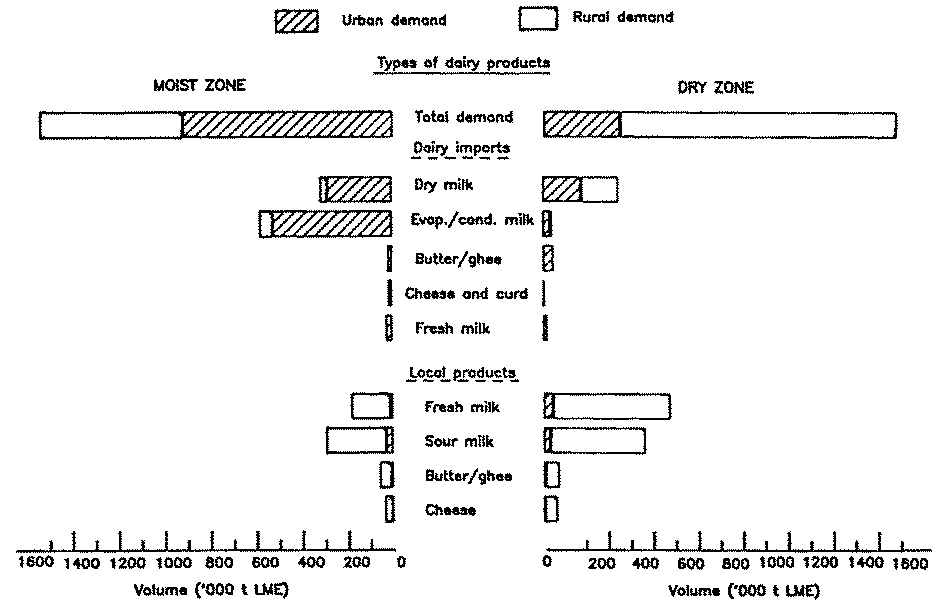
8 |
27 |
14 |
|
Humid |
259 |
421 |
41402 |
19048 |
6 |
22 |
11 |
|
Highlands |
16 |
12 |
2857 |
207 |
6 |
58 |
9 |
|
AH zones |
1666 |
1062 |
127209 |
41118 |
13 |
26 |
16 |
a> Rural consumption balance calculated as aggregate 1983/85 milk production net of losses (10% of production) and of production marketed in urban areas, plus imports reaching rural areas.Urban consumption balance calculated as net dairy imports in 1983/85 minus losses (10% of imports) and imports marketed in rural areas plus production marketed in urban areas.
Proportions of domestic production and net dairy imports marketed in urban and rural areas based on certain considerations regarding the availability and marketing of milk in different ecological zones of West Africa (see footnote 6/at end of text for more details).
b> Per caput consumption in urban and rural areas i.e. urban and rural consumption balances divided by total population.
Source: Own calculations based on FAO (1985a and 1985b) and Jahnke (1982).
44. Though only approximations, these results highlight some of the prominent features of milk consumption in West Africa, namely that:
(i) except possibly for the arid zone, overall milk consumption levels are low, by developed and even by developing country standards;(ii) imbalances in consumption occur between ecological zones, average milk consumption levels being highest in the arid zone and lowest in the highland and the humid zones;
(iii) the arid zone excluded, per caput consumption in all other zones is highest in urban areas. On average, urban communities in West Africa consume twice as much milk per caput as rural communities;
(iv) aggregate milk availability is diluted by population pressure, particularly in the densely populated urban areas of the humid and sub-humid zones where per caput milk consumption levels are relatively low.
Scale and nature of 1988 demand
45. Using the information in Table 1 on West African human populations in 1988 and assuming that 1983/85 milk consumption levels will prevail until 1988, aggregate 1988 dairy demand by ecological zone and rural/urban category, can be roughly estimated. On this basis, total 1988 demand for milk and milk products in West Africa amounts to about 3.1 million t LME, almost 60% of this total occurring in rural areas and 40% in urban areas.
46. Having got an idea of the scale of dairy demand in 1988, there is a need to determine the composition of this demand. This cannot be done with any precision, but by using aggregate FAO data and other sources of information, one can arrive at some approximate figures for the distribution of dairy demand between different products.
The following percentages were derived from product specific aggregate 1983/85 FAO data for predominantly moist and dry countries of West Africa (FAO 1980b and 1985b):
|
|
Dry zone |
Moist zone |
All zones |
|
|
(% of total LME) |
||||
|
Domestic prod |
||||
|
|
Fresh milk* |
50 |
32 |
44 |
|
|
Sour milk* |
40 |
52 |
44 |
|
|
Butter |
6 |
10 |
7 |
|
|
Cheese |
4 |
6 |
5 |
|
Total |
100 |
100 |
100 |
|
|
Dairy imports |
||||
|
|
Fresh milk |
2 |
2 |
2 |
|
|
Dried milk |
77 |
34 |
48 |
|
|
Evap./Cond. milk |
8 |
61 |
44 |
|
|
Butter/Ghee |
12 |
2 |
6 |
|
|
Cheese and curd |
0 |
1 |
1 |
|
Total |
100 |
100 |
100 |
|
* As FAO makes no distinction between sour and fresh milk production it is assumed that 50% of liquid milk production is consumed as fresh (largely by pastoralists and people in dry areas) and the remaining 50% as sour (by urban consumers of the moist zone and rural consumers of the dry zone).
47. Given these proportions, aggregate 1988 dairy demand in West Africa is disaggregated by product type and origin, by ecological zone and by rural/urban category in Figure 1. As is evident, dry and moist zones differ in the extent to which they have resorted to imported and/or locally produced dairy products and have directed available supply to urban and/or rural areas.
48. In the dry zone, a substantial amount of demand is supplied through domestic production of fresh and sour milk which are largely consumed in rural areas. Dairy imports in this zone mainly consist of dry milk, but are in no way as substantial as in the moist zone. Nevertheless, it appears that imports of dry milk, a product usually reconstituted into liquid milk, used for infant feeding and often donated as food aid, are widely consumed in urban as well as in rural areas of the dry zone.
49. Unlike the dry zone, the moist zone primarily relies on imports of evaporated/condensed and dry milk to satisfy its predominantly urban demand. Several studies also indicate that the consumption of evaporated/condensed milk in moister areas is much higher than that of dry milk. In Nigeria, for example, about 50% of the total population in 1978, mainly tea and coffee drinkers above 15 years of age, were assumed to be potential consumers of evaporated tinned "Peak" milk (Claesson 1978).
Figure 1. Estimated distribution of aggregate 1988 demand for milk and milk-products in West Africa.
Source: Adapted from data in Tables 1 and 4.
50. Imported fresh milk, butter/ghee, cheese and curd are of minor importance in both dry and moist zones, their consumption being closely related to consumers' means and disposition to purchase them. Because of the small quantities involved and of their generally prohibitive prices, the consumption of these products is often restricted to classes of higher officials, private sector employees and foreigners in urban areas. On the other hand, locally produced cheese, butter and ghee are consumed to a greater extent, but these items are generally produced on a small scale and their consumption is limited to certain localities and/or ethnic groups (e.g. the Western Yorubas in Nigeria).
Domestically unmet demand
51. Given the preceding picture of dairy demand in West Africa, the question arises as to how it is to be met. Table 4 relates aggregate 1988 dairy demand estimates to projected 1988 and actual 1985/87 milk supply figures. Domestic milk supply in 1988 is projected from FAO 1983/85 milk production data, at an assumed annual growth rate of 2% (the rate that prevailed in West Africa between 1974/76 and 1983/85).
52. The figures in Table 4 give an idea of how milk supply in West Africa has evolved in relation to dairy demand. Thus, for 1988, the magnitude of dairy demand unmet from domestic supply is of the order of 1.3 million t LME in West Africa as a whole i.e. roughly 42% of estimated total 1988 dairy demand. In terms of "domestically unmet demand", the largest deficit is observed in the moist zone, no doubt reflecting the low level of domestic milk supply in moister areas, and the traditional predominance of livestock and low human population densities in the drier areas of the region.
53. In practical terms, the consumption of milk in the dry zone seems to have been constrained by the slow growth of domestic milk production and the relatively low incomes of countries in this zone. Though rural milk consumption has traditionally been high in drier areas, the 1985/87 figures suggest that this is no more the case. Compared to 1983/85, dairy imports rose modestly and domestic milk supply declined substantially in 1985/87. Thus, the outlook for the dry zone is one of a general decline in milk consumption, with dairy imports meeting a small part of, presumably urban, dairy demand.
54. The substantial amount of domestically unmet dairy demand, calculated for the moist zone should be interpreted with caution since a significant portion of total dairy demand in this zone has until recently been met through imports. In the 1970s and early 1980s, relatively high income countries located in the moist zone could afford to import dairy products on a large scale. However, large deficits occur in 1985/87, as dairy imports decline sharply and domestic milk supply, though increasing, still lags behind demand.
Table 4. Projected 1988 dairy demand, supply and deficits in dry and moist zones of West Africa ('000 t LME)
|
|
Dry zone |
Moist zone |
All zones |
|
|
Projected 1988 figures a> |
||||
|
|
Total demand for milk |
1664 |
1443 |
3107 |
|
|
Domestic milk supply |
1457 |
354 |
1811 |
|
|
Domestically unmet demand |
-207 |
-1089 |
-1296 |
|
FAO 1985/87 figures |
||||
|
|
Total milk availability |
1512 |
1071 |
2583 |
|
|
Domestic milk supply |
1070 |
575 |
1645 |
|
|
Dairy imports |
442 |
496 |
938 |
|
Balance 1985/87-1988 b> |
||||
|
|
Domestic milk supply |
-387 |
221 |
-166 |
|
|
Domestically unmet demand |
-594 |
-868 |
-1462 |
a> Total demand for milk in 1988 as in Figure 1. Figures for domestically unmet demand are rough estimates calculated by deducting 1988 domestic milk supply from total 1988 demand.b> Difference between 1988 projections and 1985/87 FAO figures.
Source: Calculations based on FAO (1987a and 1987b), Tables 1 and 3.