

The International Livestock Centre for Africa (ILCA) is one of the 13 international agricultural research centres funded by the Consultative Group on International Agricultural Research (CGIAR). The 13 centres, located mostly within the tropics, have been set up by the CGIAR over the last decade to provide long-term support for agricultural development in the Third World. Their names, locations and research responsibilities are as follows:
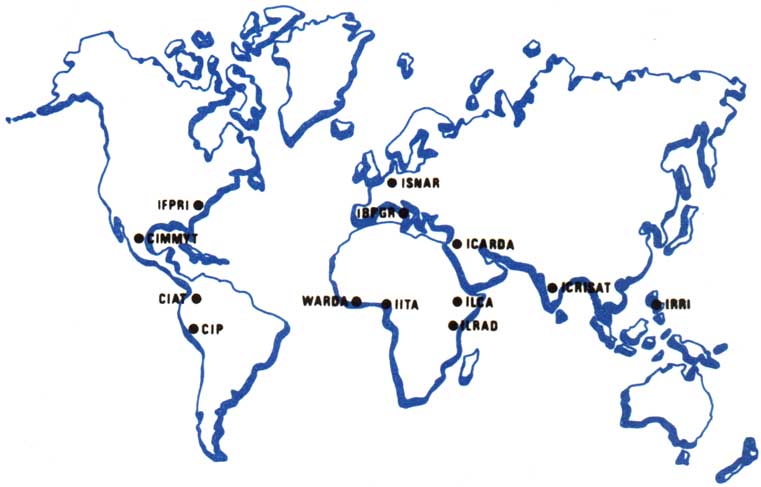
Centro Internacional de Agricultura Tropical (CIAT), Colombia: cassava, field beans, rice and tropical pastures.Centro Internacional de Mejoramiento de Maíz y Trigo (CIMMYT), Mexico: maize and wheat.
Centro Internacional de la Papa (CIP), Peru: potato.
International Centre for Agricultural Research in the Dry Areas (ICARDA), Lebanon: farming systems, cereals, food legumes (broad bean, lentil, chickpea), and forage crops.
International Board for Plant Genetic Resources (IBPGR), Italy.
International Crops Research Institute for the Semi-Arid Tropics (ICRISAT), India: chickpea, pigeon pea, pearl milks, sorghum, groundnut, and farming systems.
International Livestock Centre for Africa (ILCA), Ethiopia: African livestock production
International Rice Research Institute (IRRI), the Philippine: rice.
International Institute of Tropical Agriculture (IITA), Nigeria: farming systems, maize, rice, roots and tubers (sweet potatoes, cassava, yams), and food legumes (cowpea, lima bean, soybean).
International Laboratory for Research on Animal Disease (ILRAD), Kenya: trypanosomiasis and theileriosis of cattle.
West Africa Rice Development Association (WARDA), Liberia: rice.
International Service for National Agricultural Research (ISNAR), the Netherlands.
International Food Policy Research Institute (IFPRI), USA: analysis of world food problems
ILCA RESEARCH REPORTS
Research Reports
1. Trends and prospects for livestock and crop production in tropical Africa, by C. de Montgolfier-Kouévi and A. Vlavonou. 1983.
2. Cattle herd dynamics: An integer and stochastic model for evaluating production alternatives, by Panos A. Konandreas and Frank M. Anderson. 1982.
3. Evaluation of the productivities of Djallonke sheep and N'Dama cattle at the Centre de Recherches Zootechniques, Kolda, Senegal, by A. Fall, M. Diop, J. Sandford, Y.J. Wissocq, J. Durkin and J.C.M. Trail. 1982.
4. Research on farm and livestock productivity in the central Ethiopian highlands: Initial results, by G. Gryseels and F.M. Anderson. 1983.
5. Systems research in the arid zones of Mali: Initial results, eds P.N. de Leeuw, R.T. Wilson and C. de Haan. 1983.
6. The water resource in tropical Africa and its exploitation, by G.A. Classen, K.A. Edwards and E.H.J. Schroten. 1983.
7. Livestock water needs in pastoral Africa in relation to climate and forage, by J.M. King. 1983.
8. Organisation and management of water supplies in pastoral Africa, by S.G. Sandford. 1983.
9. Economics and planning of water supplies in pastoral Africa, by D.G. Browne. 1983.
10. Economic trade-offs between milk and meat production under various supplementation levels in Botswana, by P.A. Konandreas, F.M. Anderson and J.C.M. Trail. 1983.
11. Crossbred dairy cattle productivity in Arsi region, Ethiopia, by Gabriel H. Kiwuwa, John C.M. Trail, Mohamed Y. Kurtu, Getachew Worku, Frank M. Anderson and Jeffrey Durkin, 1983.
International Livestock Centre for Africa
P.O. Box 5689
Addis Ababa, Ethiopia
Printed at ILCA, Addis Ababa, Ethiopia
