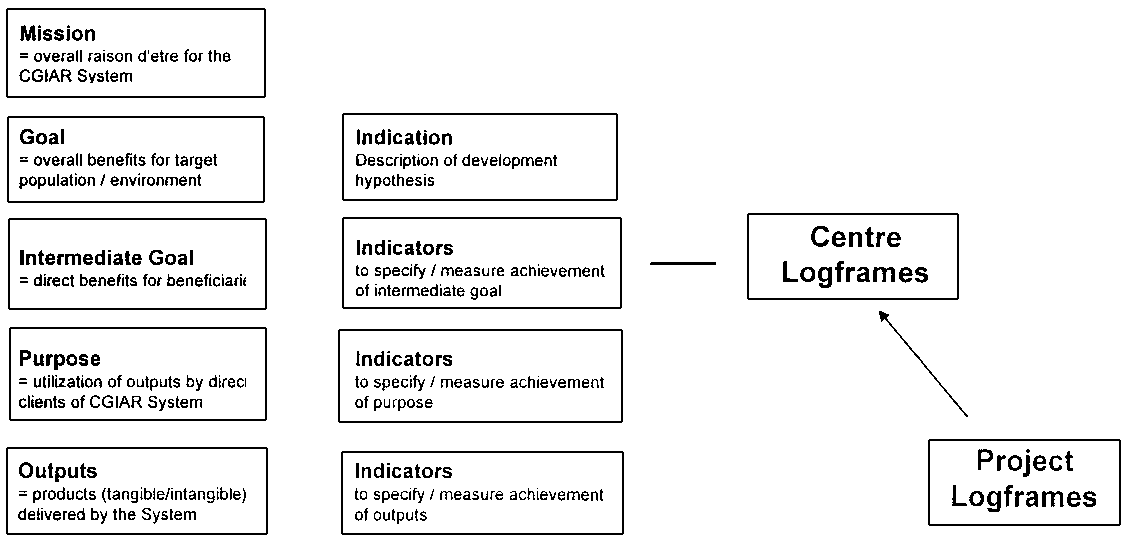
A number of centres have logframes which are in line with that presented here. In order to fully realize the potentials of the logframe approach, the planning processes of the System and the centres must be congruent and both must be consistent with CGIAR goals. This requires a tight logical relation between the logframe of a particular centre research project, the centre logframe and the strategic logframe for the System as a whole (see diagram). In order to reduce possible miscommunication, use of a common terminology is absolutely essential.
What follows here largely describes the System-level logframe. Even so, implications for centre-level logframes are noted. Moreover, design of the System logframe started from the precept that it must be able to accommodate centres' logframes.
RELATIONS AMONG LOG FRAMES: SYSTEM, CENTRE, AND PROJECT
|
Logical frameworks will cover each of three major levels. The most detailed will be those at the project level. For each centre, the projects can be aggregated into that centre's logframe. In turn, the centre logframes can be aggregated into the System's logframe. At each step, of course, detail will be reduced. At the same time the resulting conceptual framework will support relevant decision making. |
Terminology
· Goals:
Overall benefits for the target population which define the overarching goals of the CGIAR. The chain connecting outputs for which the CGIAR is responsible to its goals is long, but well articulated. Even so, many factors will influence goal attainment and measuring a change which is unequivocally attributable to CGIAR outputs is notably difficult.
· Intermediate Goals: Direct benefits resulting from the uptake of innovations which include outputs from the CGIAR.
· Purposes: Utilization of the CGIAR outputs by those who receive them.
· Outputs: Defined products (tangible/intangible) delivered by projects, for which the CGIAR is responsible, but which are generally produced together with partners.
· Indicators: Performance standards with observable characteristics which permit monitoring the achievement of outputs, purposes and goals.
· Milestones: Key intermediate targets necessary for achieving and/or delivering the outputs of a centre project within an agreed timeframe.
· Assumptions: Conditions which strongly influence the attainment of outputs, purposes, and goals, but which are outside the influence of the CGIAR.
All outputs of the CGIAR System are produced through centre research projects. Centre outputs are those for which the CGIAR is responsible, but to which others may contribute. Each output contributes to one or more System outputs.
The same relation holds true for the purpose level and the level of intermediate goal, given that centre and System logframes feature the same central concepts (outputs, purposes, goals, and indicators) and related definitions. The justification of a project proposal will therefore depend on the plausibility and probability with which project outputs will contribute to the achievement of the project's purpose as well as to the purpose and goals of the CGIAR System as a whole.
The general indicators used to describe and measure the achievements at the System level must be able to encompass indicators specified by the centres at the project level. At the System level, however, indicators are necessarily more abstract than at the centre level as they must cover a multitude of different projects.
Indicators for centre project logframes can be and necessarily must be more specific with respect to:
· the qualitative dimensions specifying the focus of a particular project· the formal criteria including (wherever feasible and meaningful)
· clearly defined direct user groups and ultimate beneficiaries
· quantitative targets
· region/location
· time frame· The degree of detail needed for each indicator is determined by its utility as a management tool, i.e., it must be detailed enough to support effective decision making. Precision levels may therefore vary between types of projects (e.g. basic versus applied research) and corresponding planning parameters (e.g. more detailed at output, than at intermediate goal level).
Indicators at the System and at the centre level interact:
· Indicators will thus evolve/mature over time as the iterative process of parallel development of the project and System logframes goes on, each contributing to and adjusting to the refinement of the other.
Note that within centre logframes, detailed planning which identifies the main activities required in order to produce the project outputs is useful. Here, milestones play the role of indicators. Formulated for each activity, these allow the management and monitoring of the implementation of project activities. Milestones are therefore important tools for project steering at centre level. However, at the CGIAR System level, as no such steering is done, these details are not required. Therefore, activities and their corresponding milestones are not included in the CGIAR System logframe.