
A great deal of Britain’s fish is served either in schools, hospitals, factory canteens and public restaurants, or in fried fish shops; this note gives some advice on selection and handling to those who buy and serve sea fish. The note explains briefly how fish spoil, emphasizes the need to use only good quality raw material, and points out that both wet and frozen fish supplies can meet this need when chosen and handled with care. An attempt is also made to answer some of the problems that caterers meet from time to time when examining and handling supplies of fish.
There are two main causes of spoilage in fish, first, substances called enzymes which cause self digestion of the flesh and, secondly, bacteria. Spoilage changes caused both by enzymes and bacteria are slowed by reducing the temperature.
The bacteria that cause fish to spoil are present in the gut, in the gills and on the skin of the living fish. Soon after the fish dies, the bacteria begin to invade the muscle, where their growth results eventually in the production of chemical substances like ammonia and hydrogen sulphide that give bad fish its typical foul smell and taste. Bacteria need food, water and the right temperature in order to grow. Fish muscle supplies the food and water; therefore temperature control is all-important for retarding spoilage. Spoiling bacteria in fish are most active at about 20°C, average room temperature, and become inactive at temperatures below -10°C; therefore bacterial spoilage can be stopped by freezing to below -10°C. However, chilled storage at about 0°C considerably reduces bacterial action and limits the spoilage rate.
White fish, like cod and haddock, kept in melting ice at about 0°C, will remain fresh and sweet for about 6 days after capture, after which they lose some sweetness.
TABLE 1
Age and Flavour of White Fish
|
Days in ice at 0°C |
Flavour |
Days at 10°C |
|
0 |
fresh |
0 |
|
3 |
sweet |
|
|
6 |
less sweet |
2 |
|
9 |
no sweetness |
|
|
12 |
slightly stale |
4 |
|
15 |
sour |
|
|
18 |
bitter |
6 |
|
21 |
putrid |
7 |
Newly caught fish, when cooled to temperatures slightly below 0°C, will keep a little longer than fish in ice; cod, for example, when kept at -1°C will be stale about a week later than the same fish at 0°C, but temperature control has to be precise; when the temperature falls to -2°C the flesh is physically damaged by the formation of large ice crystals and spoilage continues during the slow, inadequate freezing process. It is therefore inadvisable for caterers to keep fish below freezing point, in a domestic refrigerator for example, or to attempt to freeze wet fish in a cold store or frozen food cabinet where freezing will take a very long time. Fish should be frozen only in properly designed freezing equipment. Freezing and cold storage are discussed in more detail later in this note.
Wet fish is landed at fishing ports all round the British coast. Supplies may come from ports ranging in size from a small creek or harbour where the landings consist of small quantities of a wide variety of species, up to a very large port served by a fleet of trawlers that lands only a few common species in enormous quantities.
Ice is used for stowage of the catch on almost all fishing vessels, whatever their size, so that the temperature of the fish on landing should be in the region of 0°C.
The principal sources of wet fish are shown in the following table; the length of voyage and the age of the fish in ice are given for typical voyages from each ground:
TABLE 2
Sources of Wet Fish Supplies
|
Fishing ground |
Stowage method on board |
Examples of ports |
Length of voyage |
Age of fish on landing |
||
|
Distant waters: |
|
|
|
|
|
|
|
|
Barents Sea |
shelved |
in ice |
Hull |
15-22 days |
4-17 days |
|
Middle waters: |
|
|
|
|
|
|
|
|
Faroe Islands |
shelved |
in ice |
Aberdeen |
10-16 days |
3-13 days |
|
Near waters: |
|
|
|
|
|
|
|
|
North Sea |
shelved |
in ice |
Aberdeen |
3-8 days |
1-6 days |
|
Inshore: |
|
|
|
|
|
|
|
|
shelved |
in ice |
Ayr
|
1-3 days
|
0-3 days
|
|
|
boxed |
without ice |
|||||
|
Distant waters: |
|
|
|
|
|
|
|
|
(freezer trawlers) |
frozen blocks in -30ºC cold store |
Hull |
4-10 weeks |
Flavour equivalent of 1-3 days in ice when thawed |
|
|
Imported: |
|
|
|
|
||
|
|
boxed in ice |
Denmark |
unknown |
unknown |
||
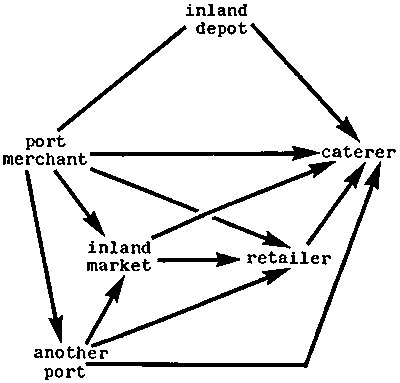
Wet fish should be taken quickly and by the most direct route from the port to the caterer; delays at inland depots and markets can seriously affect quality. Caterers who buy from inland wholesalers should insist that when delays are unavoidable the wholesaler keeps the boxes chilled and re-ices the fish where necessary. The supplier, whether at the port or inland, should be asked to use plenty of ice on wet fish; there should always be plenty left among the fish when it is delivered to the caterer’s premises. Extra ice is often necessary when long journeys are involved, particularly in warm weather; it should be remembered that air temperatures of 10°C can occur even in the winter months. Extra ice in the boxes on delivery is particularly useful to the caterer when no chill storage is available and the fish has to remain in the boxes until used.
The caterer should wherever possible keep fish cool by means of ice; it is cheap to buy or make and has a large cooling capacity. In addition it also keeps the fish moist. The use of a chillroom alone for storing wet fish is not satisfactory, and it is quite wrong to try to preserve a mass of wet fish in an ice-cream-type refrigerator or a cold store. Ideally, fish that has been delivered in ice should remain surrounded by ice in a chillroom at the caterer’s premises; the chillroom should be set at a temperature just above 0°C so that cold water from the melting ice can trickle through the fish.
Fig. 1. Distribution of wet fish to caterers
When a caterer buys wet fish on contract, the tenders of potential suppliers should be considered not only on grounds of price, but also on the freshness of the fish, presentation of the products, and on reliability of delivery. Guide specifications of caterers’ fish requirements are available which will enable caterers to ask for, and contractors to supply, exactly what is wanted.
Caterers should check that the specified quality is maintained throughout a long-term contract, and that the species of fish ordered is not replaced by other, often cheaper, species when large quantities are being delivered. For example whiting may sometimes be substituted for haddock, or coalfish for cod. Some caterers are thus reluctant to buy skinless fillets because identification is more difficult, but it is now possible by modern methods of analysis to identify species from a small sample of flesh. The addresses of public analysts able to offer this service are available from Torry or the White Fish Authority. Caterers should no longer be deterred from buying skinless fillets because of fear of substitution. It is usually more economic and more convenient to have the skinning done by the supplier.
Wet fish must be used as soon as possible after delivery; fish is spoiling all the time, even when properly stored in ice. Delivery to the kitchen should never be more than one day before the fish is to be cooked.
Different species should not be mixed either during distribution or during storage at the caterer’s premises; flavours, odours and even skin pigments are readily transferred from one species to another. For example, skate and dogfish produce ammonia when they spoil and coalfish has a dark-coloured skin which soon discolours other fish in contact with it. The flavours of plaice and other flatfish are easily absorbed by cod and haddock and the scales on the skin of a haddock easily rub off onto other fish. Ask the supplier to pack each species separately.
The caterer should insist on clean, new boxes being used for delivering fish; all too frequently old, and often, dirty boxes are used at port and inland markets.
Many caterers still have objections to frozen fish, objections that were in the past sometimes well-founded. In the early years of the quick freezing and cold storage industry, the technique for fish was not fully understood and the right equipment was not available; as a result, frozen fish products were sometimes very poor. Nowadays the technology has been so much improved that frozen fish can be as good as very fresh wet fish.
The principles of good practice for the freezing and cold storage of fish are set out in Advisory Notes 27 and 28. The caterer is more likely to be concerned with proper storage of the frozen product than with freezing the raw material, and storage life is dependent on temperature. White fish, such as cod and haddock, properly frozen within a few hours of catching, will keep in first class condition for at least 8 months at -30°C, whereas at -10°C the storage life is only 1 month. Nearly all cold stores at the ports now operate at -30°C, so that good quality frozen white fish is available all the year round.
Frozen fish supplied to the caterer comes mainly from three sources: the fish may be frozen on board the fishing vessel within a few hours of catching, frozen at the port after being landed as wet fish, or imported frozen. Fish frozen at sea, when properly handled and thawed, is equal to the best of chilled fish; fish frozen at the port can be of equally high quality but, occasionally, may be poor when stale wet fish is frozen. Quick freezing and cold storage can be used to maintain good quality raw material in the best possible condition for long periods, but freezing cannot be used to improve poor quality fish; stale fish, if frozen and stored, will still be stale when thawed.
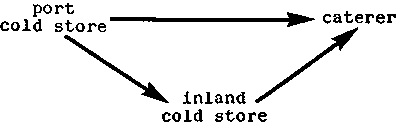
Although frozen fish supplies are kept at -30°C in the port cold store, there is inevitably some rise in temperature of the frozen product during subsequent transit, and it is recommended that frozen fish should be at about -20°C, and certainly not higher than -15°C, when delivered. Most frozen food cabinets are designed to operate at about -18°C, and frozen fish supplies should be transferred to such a cabinet immediately on arrival at the caterer’s premises, unless the fish is to be used within the next few hours. No attempt should be made to refreeze partially thawed fish by putting them into cold storage.
The caterer should insist on frozen fish being delivered in insulated vehicles or containers, suitably designed to maintain a low temperature, and there should be as little delay as possible during loading and unloading. Each time frozen fish is handled there is a rise in temperature, and the cumulative effect of temperature fluctuations of texture and flavour can result in reduced shelf life. It is impossible to determine the temperature of frozen fish merely by looking at it; frozen fish at -10°C looks and feels as cold and hard as fish at -30°C; the difference can be measured only by means of a suitable thermometer. Methods of measuring the temperature of frozen fish are explained in some detail in Advisory Note 94.
Stock rotation is important when large stocks of frozen fish are stored on the caterer’s premises at temperatures between -15 and -20°C, particularly when the fish has already been in store at the port for some time; to this end, all packages should be date-stamped by the producer, so that the caterer knows how old the frozen fish is when he receives it.
Frozen fish gradually dries out in cold storage unless it is adequately protected by an ice glaze or a wrapper that is a barrier to water vapour. Rather in the same way as water will evaporate from moist objects in a warm room and condense on a cold window pane, so water will leave frozen fish in a cold store to appear on the refrigeration piping as frost; the frozen product will gradually lose weight, and the texture will become chewy and stringy. Eventually white patches will appear on the product, a condition known as freezer burn.
Fig. 2. Distribution of frozen fish to caterers
Many cooks suspect that water is added to frozen fish to increase the weight and the cost, particularly since a pool of water may appear when the frozen product is thawed. This melt water comes mainly from two sources. First, when a thin skin of ice is added by the processor to protect the product from drying in cold store, any remaining glaze will melt when the fish is thawed; this protective glaze, however, is usually additional to the specified weight of the block. Secondly, some juice from the fish is lost when the fish is thawed; the amount of juice, known as drip, from fish that has been properly stored is very small but, when storage temperatures have been too high, the amount of drip released on thawing may be considerably increased. High drip loss is a sign of high temperature cold storage. Good quality frozen fish normally loses up to 5 per cent of its weight on thawing due to drip loss; the loss from badly cold stored fish may be much higher.
The range of frozen fish products available to caterers includes whole fish, either single or in blocks, fillets frozen singly or in blocks, interleaved blocks of fillets known as shatter packs, and pan-ready portions of various shapes cut from laminated blocks of fillets; fillets, portions and fingers are also available battered, or breaded. Products made from sea-frozen fish are normally not more than two days in ice before they are frozen and, therefore, are of consistently high quality; frozen products prepared at the ports from wet fish landings are made mainly from very fresh raw material, but the age of the wet fish used could be anything from 1 to 17 days in ice. The history of imported frozen fish, like imported wet fish, is normally not known.
A block of frozen fish can be thawed simply but slowly by laying it out on a bench or tray in a room where the air is at a temperature of about 20°C; a 50 mm-thick block of fillets takes about 5 hours to thaw at this temperature; thawing time at 10°C is about 10 hours. Temperatures above 20°C should not be used, or the outside of the fish may spoil, or even cook, before the block is completely thawed.
Blocks of fillets can be thawed twice as quickly by immersing them in warm water, but this usually results in the fillets becoming waterlogged and much of the flavour being lost; water thawing of fillets is therefore not recommended. A combination of water thawing and electrical thawing is practicable, however, and commercial equipment suitable for caterers is available. The block of fillets is warmed initially by immersion in water for about 20 minutes, and then the block is placed between metal plates and an electric current passed through the fish for a further 15-30 minutes until the fish are thawed. The current switches off automatically when thawing is complete. The total thawing time for a 3-kg block by this method is less than 1 hour.
It is important not to overthaw frozen fish; when thawed fish is warmed too much, spoilage is more rapid, and texture may be impaired. Thawed fish should be used immediately, or kept chilled until required; the spoilage rate for chilled thawed fish is the same as for chilled wet fish. Thawed fish left in warm air will become dried and discoloured as traces of blood pigment turn brown. Thawed fish left in water will rapidly become soft and mushy and will lose flavour as the flesh absorbs water.
It is not essential to thaw single fillets or portions before cooking them; some caterers prefer to cook the fish while still frozen or only partly thawed.
Occasionally a fish is found that has a smell and flavour not at all characteristic of the species. For example, cod that are described by fishermen as stinkers may sometimes be found. There are two kinds of stinker, resulting from totally different causes; one is caused by stowing the cod directly against a wooden surface, when certain types of bacteria multiply extremely rapidly to produce foul odours and flavours. The other kind of stinker, often called weedy or ‘blackberry’ cod, has a very strong seaweedy or petrol-like odour which is produced when cod feed on a snail-like mollusc that occurs in some Arctic waters; the weedy odour usually disappears when the cod is cooked.
At certain times of the year, the flesh of some north Atlantic species can be very watery, mushy or even jelly-like; cod, for example, from Labrador in winter and spring are often starved, and these slinks, as they are sometimes called, usually have a high water content which gives the flesh an unacceptable sloppy texture.
Worms in fish are an occasional nuisance to caterers; although
parasitic worms are found from time to time in a number of commercial species,
the fish most frequently found to be infested is the cod. Only a very small
fraction of the cod catch is affected but, in spite of fairly rigorous
inspection by the processor, a worm is occasionally found in a fillet. There is
no evidence to suggest the worms are in any way harmful when the fish is cooked,
but nevertheless they are unsightly and unpleasant. A brief account of the
occurrence, detection and eradication of cod worms, for the guidance of
processors and caterers, is given in Advisory Note 80.
