


State of Food Insecurity in the World 1999
The first issue of the State of Food Insecurity in the World (SOFI) was published by FAO on World Food Day in October 1999. The SOFI report represents a new FAO contribution to the FIVIMS programme and reports on progress towards the 1996 World Summit goal of reducing in half the number of undernourished people in the world by 2015. SOFI provides detailed data on the number of people facing hunger by region and country and looks at a broad range of factors that contribute to food insecurity.
The report offers mixed news, some encouraging and some less so. Since 1990/92, the number of people going hungry in developing countries has declined by 40 million. Malnourishment fell in 37 countries between 1990/92 and 1995/97.
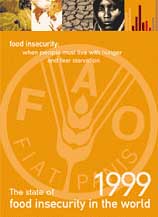
But the number of hungry people in developing countries remains unacceptably high, at 790 million. The findings in SOFI make it clear that at the current rate of progress - 8 million fewer undernourished people each year - the World Food Summit’s goal of reducing the number of hungry people in the world by half by the year 2015 will not be reached.
“The State of Food Insecurity in the World 1999” also presents the first data on hunger in industrialized regions. According to SOFI, around 34 million undernourished people are living in developed countries. More than three-quarters of them are in the countries in transition in Eastern Europe and the former Union of Soviet Socialist Republics.
Yet some regions have made impressive progress over the past two decades, demonstrating that hunger is not an intractable problem. Despite increases in Afghanistan and Iraq, most countries in the Near East and North Africa have managed to attain very low levels of undernourishment, accounting for 10 of the 14 developing countries where undernourishment affects less than 5 percent of the population. In Asia, only Mongolia and the Democratic People’s Republic of Korea have seen their rates of malnourishment increase. Many Latin American countries are also well on their way to food security for the very large majority. Although hunger has become worse in much of sub-Saharan Africa, several West African countries have made gains.
Key Indicators Mapping System
The Key Indicators mapping System (KIMS) is a user-friendly mapping software that was developed by FAO-WAICENT for the specific purpose of mapping, collecting and disseminating food insecurity and vulnerability indicators that are relevant to FIVIMS. The beta-version of the KIMS software will be released in April 2000. It will be distributed to key national and international FIVIMS partners, all national FIVIMS focal points and FAO representations. The beta-version of the KIMS software can be requested, free of charge, by sending an e-mail to [email protected]. Please consult this e-mail as well, for technical support. Users of the KIMS beta-version will be requested to fill out two questionnaires: a feedback form and a problem reporting form. The questionnaires are included on the KIMS CD-rom in electronic form. Based on the suggestions and comments modifications will be made to the KIMS software in order to further implement and adapt its functionalities to the user’s requirements.
FAO-WAICENT in collaboration with the FIVIMS Secretariat is planning to undertake a series of in-country training sessions on the role of KIMS in effectively building national FIVIMS networks. The goal is to develop and evaluate a set of self-explanatory training materials on KIMS for use by national FIVIMS teams.
More information on KIMS, including background information, description of the features and characteristics of the software and application examples, can be found on the FIVIMS web page.
(Please notify the Secretariat about new publications that you know of that are related to FIVIMS topics and that can be included in this Section.)
