


Pooling resources to turn plans into action, FAO and IFAD are forging ahead on the Global Cassava Development Strategy, following last year's International Validation Forum.
Boosting the production of cassava in order to generate income for some of the world's poorest farmers and small-scale processors in rural areas is the main objective of this joint development initiative.
With funds from IFAD, FAO is publishing the proceedings of the validation forum. The Organization is also maintaining, updating and enhancing the Global Cassava Strategy Web site (www.globalcassavastrategy.net/index.htm).
Cassava - a staple crop for more than half a billion people - was given increased attention in 1996, when IFAD started work on the Global Cassava Development Strategy.
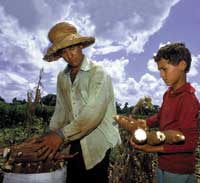 Farmers in Paraguay put cassava - IFAD/G. Bizzarri |
An ideal crop for subsistence farmers, cassava can be grown in poor soils and without costly inputs such as fertilizers and pesticides, or even water. It is drought-resistant and can be harvested any time from eight to 24 months after planting and is often left in the ground as a safeguard against food shortages.
Improving processing goes hand in hand with improving production because several varieties of cassava are potentially toxic until they have been properly processed. Stepping up production, therefore, also means finding new and improved processing technologies, which generate rural employment and provide income, particularly for women.
The Implementation Plan for the Strategy was the main outcome of last year's forum. Its purpose is to facilitate the design of cassava development activities and it sets out three key areas of action: coordination; information and promotion; and linkages and integration. The Web site is a key tool in all these areas.
Seed for rice FAO and WFP have combined resources to help 100 000 people in East Timor improve their household food security, decrease their dependency on food aid and restore cereal production through an organized exchange of seed for rice. The exchange, under which seed is collected in surplus areas in exchange for rice, and transported to areas where seed is in short supply, has enabled rice to be grown more extensively. WFP provides transport and storage for rice and maize collection and distribution, while FAO provides the seed. A substantial amount was collected and distributed during the 1999/2000 planting season. Distribution continues in 2000/2001. |
