


IFAD and WFP have a solid track record of collaboration in China, including six joint projects to date. Joint programming has been a major achievement, reinforced by the use of vulnerability analysis and mapping as tools for identifying priority project areas. Building on this framework for cooperation, the two agencies have accelerated the field-testing of practical methodologies to improve project design, targeting, and estimation of project impact.
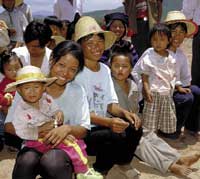 Combating childhood malnutrition - IFAD/L. Dematteis |
An important step in this process was the initiation of rapid nutrition surveys to establish benchmarks on childhood malnutrition. High levels of chronic malnutrition among children signal long-term deprivation and persistent vulnerability. The relevance of this information for development projects is twofold:
In October 2000, IFAD and WFP piloted a rapid nutrition survey with project staff from the Qinling Mountain Area Poverty Alleviation Project in Shaanxi Province. Following a series of hands-on training sessions, the survey team was able to visit 30 villages, weighing and measuring some 600 young children during less than a week of fieldwork. Subsequent data entry and analysis clearly showed that chronic malnutrition is a serious concern in the project area, and established a benchmark for future evaluations (in 2003 and 2006).
In addition to the successful completion of the pilot assessment, there have also been encouraging signs of sustainability. Less than a month after the rapid nutrition survey in Shaanxi, trained project staff were able to replicate the survey in Hubei Province - without any external assistance. Confirming the trend, in April 2001 the West Guangxi Poverty Alleviation Project took up the same survey methodology as part of its project baseline.