This joint FAO/International Office of Epizootics (OIE) initiative aims to prevent and control transboundary animal diseases (TADs) worldwide.
The Global Framework for the Progressive Control of Foot-and-Mouth Disease and Other Transboundary Animal Diseases (GF-TADs) initiative has the following goals:
It is believed that these objectives can only be achieved if the major TADs are controlled at source, which is mainly in developing countries. The GF-TADs programme will develop along four main thrusts:
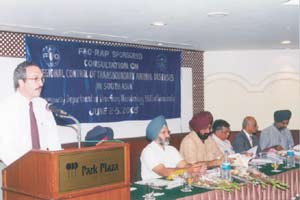 |
Regional consultation on transboundary animal diseases in South Asia, Ludhiana, Punjab, India, June 2003. |
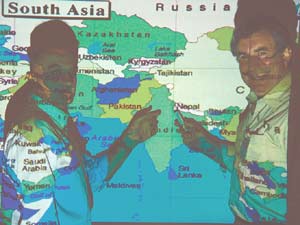 |
Drs Subhash Morzaria (left) and John Edwards (right) with a superimposed image of South Asia during discussions on GF-TADs |
All countries committed themselves to declaring freedom from rinderpest by 2007 through the OIE pathway, which will be an important step for a large part of Asia |
The regional consultation in South Asia was hosted and organized by Punjab Agricultural University Professor, Mohinder Oberoi (who had been a visiting scientist with EMPRES in 2002) and Dr Subhash Morzaria, Senior Animal Health and Production Officer, FAO, Bangkok, with the guidance of Dr John Edwards, OIE, Bangkok, Dr Peter Roeder and Dr Juan Lubroth, FAO, Rome. High-ranking officers from the veterinary services of Bangladesh, Bhutan, India, Nepal and Sri Lanka attended, as did researchers from several Indian institutes and private industry (biologics and food processing). The aims of the consultation were to: solve some of the issues surrounding transboundary disease control from a regional perspective; share information about flow patterns, market movements, weaknesses and strengths; and search collectively for opportunities. Although the focus was collective action against FMD, other priority issues were peste des petits ruminants (PPR) and haemorrhagic septicaemia. All countries committed themselves to declaring freedom from rinderpest by 2007 through the OIE pathway, which will be an important step for a large part of Asia. A second regional consultation will be held in Bangkok at the end of July 2003, and it was hoped that a similar commitment would be made there and that FAO/OIE could unveil its plans at the Regional Animal Production and Health Commission for Asia and the Pacific meeting planned for August 2003 in Pakistan.
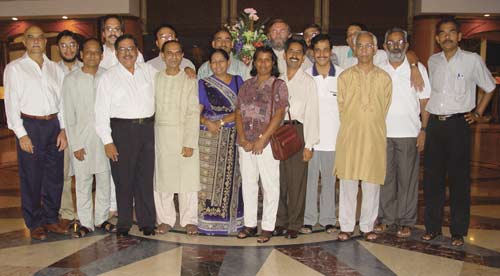
Participants at the GF-TADs first regional consultation in Ludhiana, Punjab, India, June 2003
In early 2003, Dr Rupert Holmes, Animal Health Officer, EMPRES, collaborated closely with the Southern African Development Community (SADC) on work aimed at improving both disease surveillance in the region and the SADC's regional animal health information system.
Development of the livestock sector within SADC is the domain of the Livestock Sector Technical Committee |
Development of the livestock sector within SADC is the domain of the Livestock Sector Technical Committee. This committee meets annually in SADC countries on a rotational basis, and consists of the heads of veterinary and livestock development/production services of member countries. It has established expert subcommittees to advise it and to carry out certain tasks in the region. One of these is the Subcommittee on Veterinary Epidemiology and Informatics, currently chaired by Namibia. Among its main terms of reference is the establishment of an animal health information system within the region.
In 1998, the subcommittee took the significant step of setting up a regional early warning system, with a disease database installed in Windhoek and hosted by the Namibian Directorate of Veterinary Services. Member countries have been participating actively in the system and submit regular summary and detailed disease reports to Windhoek. The unit produces monthly and yearly analyses of the data it receives, and these bulletins receive wide distribution.
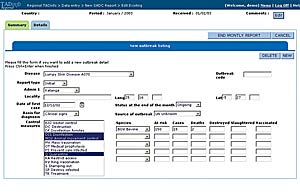
Following a request from the SADC Secretariat, further strengthening of the network has been conducted through the FAO Technical Cooperation Programme by the deployment of FAO's National Transboundary Animal Disease Information System (TADinfo) software in 8 of its 14 member countries, by training activities in disease surveillance, and by the development of a regional animal health information database - Regional TADinfo.
|
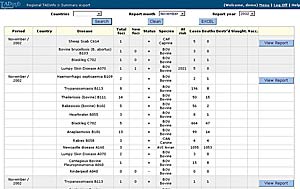
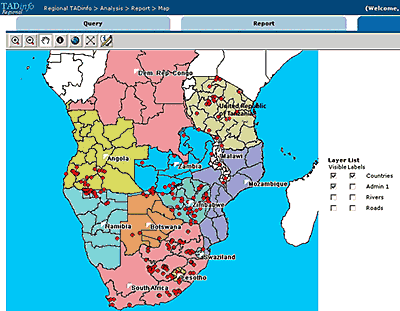
Regional TADinfo is a Web-based application, which was developed using Java programming language and is capable of operating over the Internet. It incorporates FAO's successful Key Indicators Mapping System (KIMS) software, which facilitates the rapid production of disease distribution maps without the need for any prior skills in geographic information systems (GIS) and gives the user an instant idea of the spatial distribution of disease data contained in the database. The software has very powerful yet flexible analytical capabilities and has been developed as a decision-making tool for regional epidemiologists.
In addition to map outputs, the simple graphics interface can readily produce tables and printed forms, and the system can export data in a variety of formats for charting and further statistical analysis. It has been developed using non-commercial products, and is thus a completely stand-alone application. Further work is planned to develop a password-protected Web site allowing users access to data sets and the analytical functions of the software.
Regional TADinfo has been developed in line with FAO's commitment to producing a hierarchical animal health information system, and it will be capable of integrating data that are automatically generated by National TADinfo. Its use is seen as a positive step towards the regional improvement of animal disease control in the SADC region.
|
|
|