

MEMBERS:
|
Andrew Gutierrez |
Tel: (1-510) 642-9186 |
|
|
|
|
Hermann Waibel |
Tel: (49-511) 762-2666 |
GUTIERREZ Andrew Paul (USA)
Professor and Entomologist, Division of Ecosystem Science, University of California, Berkeley.
Expertise: Entomology, IPM-biological control, insect ecology, agroecosystems analysis, population ecology, plant-herbivore interactions, tritrophic modelling, agricultural economics, GIS.
Education: Postdoctoral studies, University of British Colombia, Canada (1970); Ph.D. (insect ecology/IPM/biological control), Univ. California, Berkeley (1968); M.S. (biological control/insect ecology), Univ. of California, Berkeley (1966); B.S. in Biology, Arizona State College (1962).
Experience:
Since 1972: Assistant Professor, Purdue University.
1968-70: Research Scientist, Commonwealth Scientific and Industrial Research Organization, Canberra, ACT, Australia.
Other relevant professional experience:
- Panel Member of the 5th EPMR of the International Institute of Tropical Agriculture (IITA).
- Member, Executive Committee and Associate Director National IPM project (Huffaker Projects).
- Associate Director, National IPM Project (Adkisson Project) and leader of systems analysis.
- Leader IPM cotton project, California, Co-leader - IPM alfalfa project, California.
- Founder of the University of California State-wide IPM Project, Chairman of State-wide UC/IPM Technical Committee, Appointment FAO Panel of Experts in IPM, Rome, Italy, Chair, Africa-wide Committee on Biological Control.
- Founding member of the University of California Centre for Sustainable Development.
- Founding member of the University of California Centre for Biological Control.
He has carried out numerous consultancies, some examples of which are: FAO/Cotton in Nicaragua, California Wine Advisory Board, FAO/Brazilian Government - Biological Control of Cereal Aphids. Examples of some honours and awards which he has received are: Member Third USA/USSR Scientific Exchange, Yalta, USSR (1978),US Representative and Member, Pest Management Network, International Institute of Applied Systems Analysis, Vienna, Austria (1978 to 1986).
WAIBEL, Hermann (GERMANY)
Professor of Agricultural Economics, Faculty of Economics at Hannover University; Chair of Agriculture, Environment and Development.
Expertise: Resource and Environmental Economics of Horticultural and Agricultural Systems; Development Economics; Economics of Integrated Pest Management; Economics of Organic Agriculture/Horticulture; Economics of Urban/Peri-Urban Agriculture; Impact Assessment of Development Projects and Agricultural Research.
Education: Ph.D. Agricultural Economics, University of Hohenheim (1984); M.SC. Agricultural Economics, University of Hohenheim (1979).
Experience:
Professor of Agricultural Economics, Faculty of Economics at Hannover University; Chair of Agriculture, Environment and Development.
Director of International Affairs of the University of Hannover; Chairman of the University's Senate Committee on International Relation; Head of Institute of Horticultural Economics, Chairman of Inter-Governmental Association of Business Management in Horticulture in Germany.
Vice-Dean and Chairman student relations (Dean of Student Affairs), Faculty of Horticulture (until 10/2000).
Professor of Agricultural Economics, University of Göttingen (1991 - 1994); Head of Institute of Agricultural Economics, Faculty of Agriculture, Göttingen University (1993-1994).
Associate Professor of Farming Systems Economics, Asian Institute of Technology (AIT); (1988 - 1990), Bangkok, Thailand.
Project Economist, Thai German Project on Integrated Pest Management in Thailand (1984 - 1988), Bangkok, Thailand.
Associate Project Economist, Philippine German Project on Pest Surveillance (1980 - 1982).
Research Scholar of the German Academic Exchange Service (DAAD) in the Philippines (1979-1980).
1. Assess the relevance of the SP-IPM's objectives[31], priorities and strategies to the goals of the CGIAR, including evaluating the mechanisms used for setting priorities.
2. Assess the effectiveness and efficiency of the SP-IPM in:
(a) Achieving coherence in pest management related research across the CGIAR System and other stakeholders, especially NARIs and NGOS;
(b) Stimulating new directions in research that contribute to the System's overall IPM research agenda;
(c) Adding value to the System's ongoing research, to the benefit of knowledge relevant to IPM, agriculture and ecosystem sustainability and human well being.[32]
3. Building on the 1999 IAEG study on the impact of IPM, evaluate the quantity and quality of the SP-IPM's outputs and impact with respect to:
publications;
capacity building;
methodologies, technological innovations;
research achievements and actual/potential impact to-date; and, processes in place for monitoring/enhancing quality of outputs/impact.
4. Assess effectiveness of the SP-IPM's governance, decision-making, organization, accountability, resource mobilization and allocation and mode of operation, including identification of constraints in implementing the programme and lessons learnt.
5. Evaluate the effectiveness of IITA's convening role, including the relation between the SP-IPM and IITA's own research agenda.
6. Assess the need and continuing relevance of the SP-IPM and make recommendations as to its future role, its organization and funding.
SP/PPM-IPM Pilot Site Visit, Zaria, Nigeria, 26 January 2001
|
Jacob P. Voh |
Director, Institute for Agricultural Research (IAR) |
|
T.K. Atala |
Sociologist & Head, Department of Agricultural Economics and Rural Sociology |
|
S.O. Alabi |
Cotton Plant Breeder, IAR |
|
I. Kureh |
Plant Physiologist, IAR |
|
S. G. Aolo |
Maize Plant Breeder, IAR |
|
M. Hussaini |
Agronomist, IAR |
|
A. Odunze |
Soil Scientist, IAR |
|
A. Danbaba |
Sasakawa Global 2000 (NGO SG 2000) |
|
Ayuba Shnew |
Deputy Director, Kaduna State Agric. Development Project |
|
Alhayi Iaris |
KADP, Motts Barau, Zaria |
|
Sale Ibrahim |
KADP, Mangana Zone |
SP/PPM-IPM, 10 March 2001, Meeting at ICIPE, Mbita Point (List of Participants)
|
George Odhiambo |
KARI |
Agronomist |
|
B.O. Onyanho |
DALEO/MOA&RD |
DALEO |
|
Peter Nyongeh |
ICIPE |
Farm/Estate Services |
|
Eva Gachern |
KARI/ICRAF |
Weed Scientist |
|
Bart Knols |
ICIPE |
Medical Entomologist |
|
Bill Overholt |
ICIPE |
Scientist (Entomologist) |
|
Peter Akango |
AEP |
Extention |
|
Z.M. Magara |
for PDALE-Nyanzs DAO |
(District Agric. Officer) |
|
Janny Vos |
CABI |
Scientist |
|
Brima James |
IITA |
Scientist |
|
Khaled Makkouk |
ICARDA |
Scientist (Virologist) |
|
Hugo de Groote |
CIMMYT |
Scientist (Entomologist) |
|
E.M. Minja |
ICRISAT |
Scientist (Entomologist) |
|
Naboth Ochiel Ayugi |
Farmer |
|
|
Lawrence Odek |
Farmer |
|
|
Boaz Outta Nyateng |
Farmer |
|
|
A.P. Gutierrez |
SP-IPM Review Committee |
|
|
H. Waibel |
SP-IPM Review Committee |
|
|
Z. R. Khan |
ICIPE |
Scientist (Entomologist) |
|
H. A. O. Agengo |
MOARD |
DAV |
|
H.B. Ndonga |
MOARD |
DEC |
|
Matilda Ouma |
MOARD |
AHEO/GEM |
SP/Whitefly-IPM Site Visit to CIAT - CIAT Staff interviewed:
|
Joachim Voss |
Director General of CIAT |
|
Aart van Schoonhoven |
Director of Research for Genetic Resources |
|
Jaqueline Ashby |
Director of Research for Natural Resources |
|
Alvarez, Elizabeth |
(Pathologist) Cassava and IPM Projects |
|
Anderson, Pamela |
(Entomologist) Coordinator, SP-IPM Whitefly Project |
|
Bellotti, Anthony |
(Entomologist) IPM Project (Leader) |
|
Calatayud, Paul |
(Entomologist) IRD Research Fellow |
|
Calvert, Lee |
(Virologist) Rice Project (Leader) and IPM Project |
|
Cardona, Cesar |
(Entomologist) Bean Project (Leader) and Forages Project |
|
Cooke, Simon |
(Crop Biologist) Land Use Project (Leader) |
|
Hyman, Glenn |
(Geographer) Land Use Project |
|
Jones, Peter |
(Modeller) Consultant |
|
Kelemu, Segenet |
(Pathologist) Forages and IPM Projects |
|
Mahuko, George |
(Pathologist) Bean Project |
|
Morales, Francisco |
(Virology) Virology Laboratory (Head) |
SP-IPM Workshop Participants, 15-17 March 2001:
|
Abou Thiam |
PAN-Africa |
|
Bellotti, Anthony |
CIAT |
|
De Groote, Hugo |
CIMMYT-Kenya |
|
Douthwaite, Boru |
IITA |
|
Gallagher, Kevin |
IPM Facility |
|
Gutierrez, Andrew |
CGIAR Reviewer |
|
Hedlund, Roberts |
USAID-EGAD |
|
James, Braima |
SP-IPM |
|
Khan, Zeyaur |
ICIPE |
|
Kimani, Martin |
CABI-Kenya |
|
Lagnaoui, Aziz |
CIP |
|
Loevinsohn, Michael |
ISNAR |
|
Makkouk, Khaled |
ICARDA |
|
Markham, Richard |
SP-IPM |
|
Minja, Eli |
ICRISAT-Kenya |
|
Neuenschwander, Peter |
IITA |
|
Nono-Womdim, Remi |
AVRDC |
|
Nwilene, Francis |
WARDA |
|
Overholt, William |
ICIPE |
|
Roling, Neils |
Wageningen, Netherlands |
|
Sherwood, Steve |
(IPM Facility/CIP) |
|
Van der Fliert, Elske |
CIP |
|
Verchot, Louis |
ICRAF |
|
Vos, Janny |
CABI-UK |
|
Walker, Tom |
CIP |
|
Waibel, Hermann |
CGIAR review |
|
Whitaker, Mike |
GCPF |
|
Youm, Ousmane |
ICRISAT |
SP-IPM WORKSHOP 13 March 2001 (Visit to ICIPE R&D facilities)
|
Peter Njagi |
Chemical Ecology Scientist |
|
S. Sithanantham |
Vegetable IPM Scientist |
|
F. Onyango |
Animal rearing and Quarantine |
|
S. Raina |
Apiculture and Sericulture Scientist |
Visits to the CGIAR Secretariat, Washington DC
|
J. Reifschneider |
Director CGIAR |
|
M. Lantin |
Science Advisor |
|
S. Ozgediz |
Management Advisor |
Visits to IFPRI
|
M Rosegrant |
Research Fellow |
Visit to USAID
B. Hedlund
E. Simmons
Visits to the World Bank
|
G. Feder |
Manager in the Economics Research Department |
|
P. O'Connell |
Consultant in Natural Resource Economics |
|
S. Ganguly |
Manager Rural Development Department |
|
E. Terry |
Crops Advisor |
|
E. Pehu |
Research Advisor Biotechnology |
|
G. Fleischer |
IPM Policy Specialist |
Visit to the Global IPM Facility, ROME/FAO
|
K. Gallagher |
Scientist |
|
P. Kenmore |
Head |
A-Table 1:
|
Systemwide Programmes Undertaken by the CGIAR to Implement the Ecoregional Approach |
|
Sustainable natural resources management options to arrest
land degradation in the desert margins of sub-Saharan Africa
(DMI/ICRISAT) |
|
Systemwide Programmes to Strengthen Specific Areas of CGIAR Research |
|
Water management (SWIM/IWMI) |
(Provided by SP-IPM)
A-Table 2: SP-IPM Taskforces and level of funding (2000/2001)
|
Taskforce |
Lead Centre |
Collaborating Centres |
Received SP-IPM support* |
Received external funds** |
|
Cereal stem borers |
CIMMYT |
ICIPE, ICRISAT, IITA |
Yes (2) |
|
|
Insect pests of grain legumes |
ICRISAT |
AVRDC, IITA, ICIPE |
Yes |
|
|
Whiteflies and gemini viruses |
CIAT |
AVRDC, CIP, ICIPE, IITA |
Yes |
Yes (Denmark, USA, NZ, UK Australia,) |
|
Parasitic flowering plants |
IITA |
CIMMYT, ICARDA, ICRISAT |
Yes |
|
|
Weeds in rice |
WARDA |
CIAT, IRRI |
Yes |
Yes (UK, limited) |
|
Tsetse and trypanosomiasis |
ILRI |
ICIPE |
|
|
|
Farmer participatory methods |
CIAT |
CABI, CIP, GIPMF, IITA, IRRI, SP-PRGA |
Yes (major) |
Yes (Switzerland) |
|
Functional agrobiodiversity |
ICIPE |
CABI, CIAT, ICRAF, ICRISAT, IITA, IPGRI, WARDA |
Yes (2) |
|
|
Soil-borne pathogens |
ICARDA |
AVRDC, CIAT, CIMMYT, ICRISAT, IITA, INIBAP |
Yes |
|
|
Impact assessment methodologies |
CIP |
to be determined |
Yes |
|
|
Multi-host diseases |
IRRI |
|
|
|
|
Agroforestry pests |
ICRAF-ICIPE |
to be determined |
|
|
|
Biotechnology in IPM |
CIP |
to be determined |
|
|
|
Beneficial microorganisms |
IITA |
CIP, CIAT, ICIPE |
Yes (very limited) |
|
|
New approaches to loss assessment |
IRRI |
AVRDC, CIAT, CIMMYT, CIP, ICARDA, ICIPE, ICRISAT, IFPRI, IITA, ISNAR, WARDA |
Yes |
|
|
Whitegrubs (and other soil pests) |
CIAT |
to be determined |
Yes (very limited) |
|
|
Nematology |
ICRISAT |
CIP, ICARDA, ICRAF, IITA, IRRI, WARDA |
Yes (very limited) |
|
|
Weeds in the farming system |
IITA-WARDA |
ASB, EPHTA, ICRAF |
Yes (2) |
|
|
Partnerships for IPM adoption (pilot sites) initiative |
SP-IPM |
CIMMYT, ICARDA, ICIPE, ICRISAT, IITA |
Yes (major) |
Yes (CGIAR Finance Committee) |
* Funds allocated by the SP-IPM were usually at the level of 'seed funding' of approximately $30.000 to $50.000 to organize an international workshop and prepare a substantial project proposal. Where funds allocated were at a lower level (for instance to allow the intended Taskforce co-ordinator to attend a conference and canvas opinion) this is indicated as 'limited' or 'very limited'. Where sufficient funds were allocated by SP-IPM to support two international workshops, this is indicated by parentheses. Where a higher level of support was provided, this is indicated by the word 'major'.
** Donors contributing additional external support are indicated in parentheses.
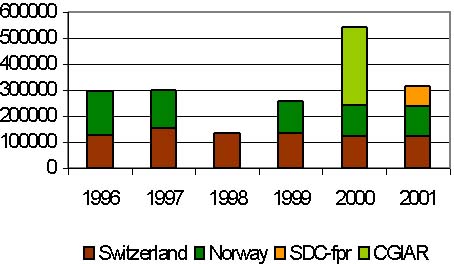
A-Figure 3: Sources of funding for SP-IPM
Agne, S., G. Fleischer, F. Jungbluth and H. Waibel (1995): Guidelines for Pesticide Policy Studies. A Framework for Analysing Economic and Political Factors of Pesticide Use in Developing Countries. Pesticide Policy Project Publication Series No. 1, Hannover, 27 p.
Ahmad I. et al. (2001): Policy and Strategy for Rational use of Pesticides in Pakistan. “Building Consensus for Action”. Report to the UNDP/FAO Global IPM Facility. Government of Pakistan, 137pp.
Anderson, J. R. (2001): Comments on 1.draft report of SP-IPM panel report. Email communication, October 2001.
Ashby, J., A. R. Braun, T. Gracia, M. del Pilar Guererro, L.A. Hernandéz, C. A. Quiros and J. I. Roa (2000): Investing in Farmers as Researchers. Experience with Local Agricultural Research Committees in Latin America. Centro International de Agricultura Tropical (CIAT), Publication No. 318.
AVRDC (2001): Comments to the First Draft of the SP-IPM Review Report (Letter of Dr. J. Friedrichsen, DDG AVRDC to Tim Kelley, Panel Secretary, 17. August.
Bonato, O., F. Schulthess and J. Baumgärtner (1999): Simulation Model for Maize Crop Growth based on Acquisition and Allocation Processes for Carbohydrate and Nitrogen. In: Ecol. Modelling. 124 (1): pp. 11-28.
Bosch van den, R. (1978): The Pesticide Conspiracy. Second edition. University of California Press, Berkeley, California.
Byerlee, D. (2001): Email information provided 15 October 2001.
CGIAR (2001): Charting the CGIAR's Future - Change Design and Management, Document No. MTM/01/05, Date April 24, 2001.
CGIAR (2001): The Systemwide Livestock Programme. Centre and TAC-commissioned external review (J. R. Anderson, panel chair).
CGIAR (2000): An Evaluation of the Impact of Integrated Pest Management Research at the International Agricultural Research Centres, A report from TAC's standing Panel on Impact Assessment, H. Waibel and D. Pemsl study panel, FAO, Rome.
CGIAR (1999): Review of System-wide Programmes with an Ecoregional Approach. (Ted Henzell, panel chair) TAC Secretariat, Rome: 38pp.
Cowan, R. and P. Gunby (1996): Sprayed to Death: Path Dependence, Lock-In and Pest Control Strategies. The Economic Journal, 106: pp. 521-542.
Dalrymple, D. (2001): International Agricultural Research as a Global Public Good - a Review of Literature, Issues and the CGIAR Experience. Paper prepared for the Warren Kronstad Commemorative Symposium arranged by the CYMMIT Wheat Program.
Dalrymple, D. (2001): Personal Communication, February 21, 2001, USAID, Washington D.C., USA.
Evenson, R.E. and D. Gollin (forthcoming): Crop Variety Improvement and its Effect on Productivity: the Impact of International Agricultural Research. CAB International, Wallingford, UK.
Falcons, L.A., R. van den Bosch, C.A. Ferris, L.K. Strombert, L.K., Etzel, R.E. Stinner and T.F. Leigh (1968): A Comparison of Season-long Cotton Pest-Control Programs in California. J. Econ. Entomol. 61: pp. 56-61.
FAO (2001): FAO - Statistical Data Base. www.fao.org.
Farah, J. (1993): Pesticide Policies in Developing Countries - Do they encourage Excessive Pesticide Use? World Bank Technical Paper No. 238, Washington D.C., USA.
Feder, G. (2001): Personal Communication February 20, 2001, The World Bank.
Fernandez-Cornejo, J. (1996): The Microeconomic Impact of IPM Adoption: Theory and Application. Agric. Res. Econ. Rev. 25: pp. 149-160.
Frandsen, S. And L. Jacobsen (2001): Economic Effects of a Ban on Pesticides in a Small Open Economy A Danish CGE Model Analysis. Paper presented at OECD workshop on Pesticide Risk Reduction, Copenhagen, 28-30 November 2001.
Gutierrez, A. P., L. A. Falcon, W. B. Loew, P. Leipzig and R. van den Bosch (1974): An Analysis of Cotton Production in California: A model for Acala cotton and the Efficiency of Defoliators on its Yields. Environ. Ent. 4(1): pp. 125-136.
Gutierrez, A. P., P. Neuenschwander, F. Schulthess, H. R. Herren, J. U. Baumgärtner, B. Wermelinger, J. S. Yaninek and C. K. Ellis (1988): Analysis of Biological Control of Cassava Pests in Africa: II. Cassava mealy bug Phenacoccus manihoti. J. Appl. Ecol. 25: pp. 921-940.
Gutierrez, A.P. (1997): Applied Population Ecology: A supply demand approach. Ecology 78 (2).
Gutierrez, A. P., J.S. Yaninek, P. Neuenschwander and C.K. Ellis. (1999): A physiologically-based tritrophic Metapopulation Model of the African cassava Food Web. In: Ecological Modelling. 123 (2-3): pp. 225-242.
Gutierrez, A. P., S. Ponsard: The three R's of Bt Cotton and Pink bollworm: Resistance, Refuges and Risk. (submitted).
Gutierrez, A. P., S. Ponsard, J.J. Adamcyzk: A physiologically based Model of Bt Cotton-Bollworm-Defoliator Interactions as modified by Weather and Natural Enemies. (in prep.).
Hartmann, M. (1993): Nationale und Internationale Auswirkungen einer Reduzierung des Einsatzes von Stickstoffdünger und Pflanzenschutzmitteln in der deutschen Landwirtschaft - Simulationsstudie mit dem Handelsmodell TEPSIM. In: P.M. Schmitz und M. Hartmann (eds.), Landwirtschaft und Chemie: Simulationsstudie zu den Auswirkungen einer Reduzierung des Einsatzes von Mineraldüngern und Pflanzenschutzmitteln aus ökonomischer Sicht. Kiel: Vauk Verlag.
Heong, K. L., M.M. Escalada, N.H. Huan and V. Mai (1998): Use of Communication Media in changing Rice Farmers' Pest Management in the Mekong delta, Vietnam. Crop Protection. 17: pp. 413-425.
Imperial County Agricultural Commissioner Reports for 1976-2000, California, USA.
Jiggins, J. (2001): Mid-term Review of the Global IPM Facility. Draft Report, FAO, Rome.
Kaul, I., I. Grunberg and M. Stern (eds.)(1999): Global Public Goods - International Cooperation in the 21st Century, Oxford University Press.
Kenmore, P. E., F. O. Carino, C. A. Perez, V. A. Dyck and A. P. Gutierrez (1985): Population Regulation of the Rice Brown Plant Hopper (Nilaparvata lugens Stal) within Rice Fields in the Philippines. J. Pl. Prot. Tropics 1(1): pp. 19-37.
Knutson, R.D., C.R. Taylor, J.B. Penson and E.S. Smith (1990): Economic Impacts of Reduced Chemical Use. Knutson and Associates, College Station, Texas, USA.
Lambert, A.L., J.R. Bradley, Jr. and J. Vanduyn (1996): Effects of Natural Enemy Conversation and planting Date on the Susceptibility of Bt cotton to Helicoverpa zea in North Carolina: pp. 931-932. In P. Dugger and D. Richter (eds.), Proceedings Beltwide Cotton Conference. National Cotton Council of America, Memphis, TN.
Lichtenberg, E. and D. Zilberman (1986): The Econometrics of Damage Control: Why Specification Matters. American Journal of Agricultural Economics, 68: pp. 261-273.
Luttrell, R.G., L. Wan and K. Knighten (1999): Variation in Susceptibility of noctuid (Lepitoptera) larvae attacking Cotton and Soybean to purified Endotoxin Proteins and Commercial Formulations of Bacillus thuringiensis, J.Econ. Entomol.92: 21-32.
Mahaffey, J.S., J.R. Bradley, Jr. and J.W. Vanduyn (1995): Bt Cotton: Field Performance in North Carolina under Conditions of unusually high Bollworm Populations, pp. 795-797. In D. Richter and J. Armour (eds.), Proceedings Beltwide Cotton Conference, National Cotton Council of America, Memphis, TN.
Maredia, M and P. Pingali (2001): Environmental Impacts of Productivity Enhancing Crop Research: A critical Review. Report prepared at the request of SPIA. Consultative Group on International Agricultural Research (CGIAR), Document No: DR/TAC: IAR/01/14.
Markham, R. and P. Neuenschwander (1996): Analysis of the Role of Biotechnology in Crop Protection in Developing Countries: A View from the International Agricultural Research Centres. In: J. Richter, J. Huber, B. Schuler (eds.) Biotechnology for Crop Protection - its Potential for Developing Countries. Proc. Int. Workshop, from 9 to 13.12.1996 in Berlin, Germany. Deutsche Stiftung fur Internationale Entwicklung.
Meikle, W., N. Holst and R.H. Markham (1999): Population Simulation Model of Sitophilus zeamais (Coleoptera: Curculionidae) in Grain Stores in West Africa. In: Environ. Entomol. 28 (5): pp. 836-844.
Mills, N. J. and A.P. Gutierrez (1996): Prospective Modelling in Biological Control: An Analysis of the Dynamics of Heteronomous hyperparasitism in a Cotton-Whitefly-Parasitoid System. J. Appl. Ecol. 33 (6): pp. 1379-1394.
Morales, J.A., J.A. Sierra, R. Ruano, M. Osorio, E. Landaverri, J.L. Ordónez and A. Viana (2000): The Socioeconomic and Environmental Impact of non-traditional Cropping Systems on small farming Communities in the Department of Baja Verapaz, Guatemala. CIAT, Working Document No. 183.
Murray, D.L. and P.L. Taylor (2000): Claim No Easy Victories: Evaluating the Industry's Global Safe Use Campaign. World Development Vol. 28, No. 10, pp. 1735-1749.
Neuenschwander, P. (1996): Evaluating the Efficacy of Biological Control of Three Exotic Homopteran Pests in tropical Africa. In: Entomophaga. 41 (3-4): pp. 405-424.
Neuenschwander, P., W.N.O. Hammond, A. P. Gutierrez, A. R. Cudjoe, R. Adjakloe, J. U. Baumgärtner and U. Regev (1989): Impact Assessment of the Biological Control of the Cassava Mealybug, Phenacoccus manihoti Matile-Ferrero (Hemiptera: Pseudococcidae), by the introduced Parasitoid Epidinocarsis lopezi (De Santis) (Hymenoptera: Encyrtidae). Bull. ent. Res. 79: pp. 579-594.
Neuenschwander, P. and R. Markham (1999): Presentation to the German Foundation for International Development.
Norgaard R. (1988): The biological control of the cassava mealy bug in Africa. Amer. J. of Agric. Econ. 70: pp. 366-371.
Oerke, E.C., H.W. Dehne, F. Schönbeck and A. Weber. (1994): Crop Production and Crop Protection - Estimated Crop Losses in Major Food and Cash Crops. Elsevier, Netherlands. (Reprinted in 1999).
Pardey, P. (2001): Personal Communication with Dana Dalrymple, 31.03.2001, cited in Dalrymple, D. (2001): International Agricultural Research as a Global Public Good - A Review of Literature, Issues and the CGIAR Experience. Paper prepared for the Warren Kronstad Commemorative Symposium arranged by the CYMMIT Wheat Program.
Poapongsakorn N., Meenakanit, L., Jungbluth, F. and H. Waibel (1999): Approaches to Pesticide Policy Reform. Pesticide Policy Project Publication Series No. 7, Hannover.
Quizon, J., G. Feder and R. Murgai (2001): Fiscal Sustainability of Agricultural Extension: The Case of the Farmer Field School Approach. (now published in a journal out of Ohio).
Regev, U. (1984): Man's Addiction to Pesticides. In Strategies, Tactics and Policy models. (G.R. Conway, ed.) Wiley-InterScience, Chichester, USA.
Repetto, R. (1985): Paying the price: Pesticides Subsidies in Developing Countries. World Resources Institute, Research Report No. 2.
Rochat, J. and A. P. Gutierrez (2001): Weather mediated Regulation of Olive Scale by two Parasitoids. J. Anim. Ecol. 70: pp. 476-490.
Rola, A. and P. Pingali (1993): Pesticide, Rice Productivity and Farmers Health - An Economic Assessment. Los Baños (Philippines), IRRI: 100pp.
Sachs, J. (2000): A New Map of the World, The Economist June 24, 2000: pp. 81-83.
Schillhorn van Veen, T.W., D.A. Forno, S. Joffe, D. Umali-Deininger and S. Cooke (1997): Integrated Pest Management Strategies and Polices for Effective Implementation. Environmental Sustainable Development Studies and Monographs No. 13, World Bank, Washington D.C., USA.
Schmitz, P. and Brockmeier, M. (2001b): Sectoral and economy-wide effects of a ban or a tax on chemical inputs in German and European Agriculture. German contribution, contact persons P. M. Schmitz (email [email protected]) and M. Brockmeier (email [email protected]).
Singh, S.P. (1999): Biological Control in India, Indian Journal of Plant Protection 27, pp. 126-138.
Stern, V. M., R.F. Smith, R. van den Bosch and K.S. Hagen (1959): The Integrated Control Concept. Hilgardia. 29: pp. 81-101.
Tamo, M., J. Baumgärtner and A.P. Gutierrez (1993): Analysis of the Cowpea Agro-Ecosystem in West Africa. II. Modelling the Interactions between Cowpea and the Bean flower thrips Megalurothrips sjostedti (Trybom) (Thysanoptera, Thripidae). Ecol. Modelling 70 (1-2): pp. 89-113.
Tozun, N. (2001): New Policy, old Patterns: a Survey of IPM in World Bank Projects. Global Pesticide Campaigner, Vol 11, No. 1, Pesticide Action Network, North America Regional Centre.
Turnipseed, S.G. and M.J. Sullivan (1999): Consequences of Natural Enemy Disruption with Hard Insecticides Prior to Bollworm Flight in Conventional and BT Cotton, pp. 1110-1112. In P. Dugger and D. Richter (eds), Proceedings Beltwide Cotton Conference, National Cotton Council of America, Memphis, TN.
Voorley, W. and D. Keeney (1998): Bugs in the System. Redisigning the Pesticide Industry for Sustainable Agriculture. Earthscan Publ. Ltd. London.
Waibel, H. and D. Pemsl (2000): (see CGIAR, 2000).
Waibel, H. (1990): Pesticide Subsidies and the Diffusion of IPM in Rice in Southeast Asia: The Case of Thailand. In: FAO Plant Protection Bulletin, Vol. 38, No.2: pp.105-111.
Wood, S., K. Sebastian and S.J. Scherr (2000): Agroecosystems - Pilot Analysis of Global Ecosystems. International Food Policy Research Institute and World Resources Institute, Washington D.C.
Yanniek J.S. (personal communication, 1999) Former leader of IITA's biological control of cassava greenmite project.
Yudelman, M, A. Ratta and D. Nygaard. (1998): Pest Management and Food Production. Food Agriculture and the Environment Discussion Paper 25. International Food Policy Research Institute, Washington DC.,USA.
Zadoks, J.C. and H. Waibel. (1999): From Pesticides to Genetically Modified Plants: History, Economics and Politics. Netherlands J. Agric. Sci. 48: pp. 125-149.
Zeddies, J., R.P. Schaab, P. Neuenschwander and H.R. Herren (2001): Economics of Biological Control of Cassava Mealybug in Africa. Agric. Econ. 24: pp. 209-219.
|
ARI |
Agricultural Research Institute |
|
AVRDC |
Asian Vegetable Research and Development Centre |
|
BMO |
Beneficial MicroOganisms |
|
Bt |
Bacillus thuringiensis |
|
CGIAR |
Consultative Group on International Agricultural Research |
|
CGM |
Cassava Green Mite |
|
CIAT |
Centro Internacional de Agricultura Tropical |
|
CIMMYT |
International Maize and Wheat Improvement Centre |
|
CIP |
Centro Internacional de la Papa |
|
CM |
Cassava Mealy bug |
|
CMD |
Cassava Mosaic Disease |
|
CP |
Challenge Programme |
|
CSI |
Consortium for Spatial Information |
|
DFID |
United Kingdom Department for International Development |
|
EPMR |
External Programme Management Review |
|
FFS |
Farmer Field Schools |
|
FPR |
Farmer Participatory Research |
|
GIPMF |
FAO Global IPM Facility |
|
GIS |
Geographic Information Systems |
|
GMO |
Genetically Modified Organism |
|
HPR |
Host Plant Resistance |
|
IARC |
International Agricultural Research Centre |
|
ICARDA |
International Centre for Agriculture Research in Dry Areas |
|
ICBD |
International Consortium of Biopesticide Development |
|
ICIPE |
International Centre of Insect Physiology and Ecology |
|
ICRAF |
International Centre for Research in Agroforestry |
|
ICRISAT |
International Crops Research Institute for the Semi-Arid Tropics |
|
IFPRI |
International Food Policy Research Institute |
|
IITA |
International Institute of Tropical Agriculture |
|
ILRI |
International Livestock Research Institute |
|
IPM |
Integrated Pest Management |
|
IPPM |
Integrated Production and Pest Management |
|
IPR |
Intellectual Property Rights |
|
IRRI |
International Rice Research Institute |
|
ISNAR |
International Service for National Agricultural Research |
|
KARI |
Kenya Agricultural Research Institute |
|
MFAT |
Ministry of Foreign Affairs and Trade |
|
MOA |
Ministry of Agriculture |
|
MRL |
Maximum Residue Level |
|
NARS |
National Agricultural Research System |
|
NGS |
Northern Guinea Savannah |
|
NRI |
Natural Resources Institute |
|
NRM |
Natural Resource Management |
|
OFDA |
USAID Office of Foreign Disaster Assistanc |
|
PANNA |
Pesticide Action Network North America |
|
PCR |
Polymerace Chain Reaction |
|
PHMD |
IITA Plant Health Management Division |
|
RCMD |
IITA Resource and Crop Management Division |
|
SG2000 |
NGO Sasakawa Global 2000 |
|
SIP |
Society of Invertebrate Pathology |
|
SLP |
Systemwide Livestock Programme |
|
SP/BMO-IPM |
Systemwide Taskforce on Beneficial Micro Organisms |
|
SP/PPM-IPM |
Systemwide Taskforce on Parasitic Plant Management |
|
SP/WF-IPM |
Systemwide Taskforce on Whitefly IPM |
|
SP-IPM |
Systemwide Programme on Integrated Pest Management |
|
SP-PRGA |
Systemwide Programme on Participatory Research and Gender Analysis |
|
SSA |
Sub-Saharan Africa |
|
SWP |
Systemwide Programme |
|
TAC |
Technical Advisory Committee of the CGIAR |
|
TOR |
Terms of Reference |
|
USAID |
United States Agency for International Development |
|
USDA/ARS |
United States Department of Agriculture/Agricultural Research Service |
|
WARDA |
West Africa Rice Development Association |
|
WB/ERD |
World Bank/Economics Research Department |
|
WB/RDV |
World Bank/Regional Development Vision |
[31] The SP-IPM was created
to ensure that "IPM principles guide all pest control efforts within the CGIAR
System" and that IARCs should "strongly support research leading to its wider
application." The more specific objectives of the SWP-IPM were to:
In pursuing these objectives it was envisioned that the SP-IPM
would help ensure greater impact of CGIAR IPM activities at the farm level by
(a) encouraging farmer participation and the formation of effective
collaboration with organizations primarily concerned with IPM implementation;
and (b) focus attention of IPM activities on sustainability and human
well-being. (Note: The objectives of the SP-IPM have evolved over the years--the
current version of the goals, purpose and expected outputs are found in the
attached file.) |
