|
There has been an increasing interest at the global level for the adoption of reduced impact logging (RIL) as one means for moving towards sustainable forest management. The primary reason for this is that the increased awareness of the negative impacts of ill-planned forestry operations by stakeholders at the national and international levels has put pressure on governments to impose stricter controls on timber harvesting. Furthermore, international markets now require timber products from well-managed forests. In this respect, forest certification is emerging as a major driving force for the adoption of RIL.
Considerable progress has been made towards some aspects of sustainable forest management in the Guiana region. Research experiences in Suriname, Guyana and Brazil - mainly based on research by CELOS in Suriname (Hendrison, 1990), Tropenbos in Guyana (Van der Hout, 1999, 2000), and research, demonstration and training by Fundaçao Floresta Tropical (FFT) in Brazil (Holmes et al., 2000) - have demonstrated unambiguously that RIL reduces logging damage while remaining financially attractive for logging companies in most cases. Nevertheless, forestry operations in Guyana and Suriname remain generally poorly planned and supervised; the operations remain characterised by low productivity, high costs, and excessive environmental modifications.
So why are the demonstrated benefits of RIL not translated into improved practices on the ground?
Understanding the potential
benefits of RIL
Frequently, the decision on whether or not to adopt
reduced impact logging is taken at head offices of forest enterprises.
Just as often, the decision depends on personal perceptions of what RIL is
and not so much on a realistic understanding of the RIL concept and its
pros and cons. In any case, a clear understanding about what really
constitutes RIL is often lacking. Specifically, this refers to a number of
essential measures to achieve noticeable financial and environmental
benefits and the training and the organizational changes that need to be
put in place to effect the necessary improvements (Klassen, 2002).
Convincing company management of the benefits of RIL is not enough. Field managers should be supportive of the necessary changes as well. Coordinating the correct implementation of the RIL components demands better supervision and communication, this may mean a fundamental change to a logging company's organizational structure (Jonkers 2002, Klassen 2002).
According to Klassen (2002), lack of serious intent remains a major reason for the failure of companies to adopt RIL practices. He explains that companies are not interested in RIL because it disrupts the status quo and because many companies are mainly concerned with their immediate supply of raw material. This is especially true in the case of Guyana (and Suriname) where most logging operations are order-driven.
The result is often that the modus operandi remains unchanged because there is no experience in implementing new practices and there is disbelief in their effectiveness.
The perceived cost of RIL
RIL has been tested and applied on a small scale for more than a decade and many studies have demonstrated that properly planned and supervised operations reduced harvesting costs as compared to conventional logging in many cases. The cost savings under RIL result from better planning, better supervisory control, and better utilization of felled timber. Nonetheless, many loggers argue that they cannot afford the adoption of RIL practices.
This is largely explained by two facts: first, concessionaires usually have poorly developed cost-accounting systems and secondly, the forest manager's perception of costs may be incomplete - e.g. not being aware of the amortization cost of heavy equipment. Forest managers need to appreciate the cost of various operational elements in order to benefit from studies on the financial benefits of RIL.
Training
For the successful application of RIL, it is necessary to have technically competent planners, operators, and supervisors. Well-trained operators need equally well-trained supervisors to ensure that work is carried out properly and to provide feedback that will help them to improve their practices continually (Dykstra, 2002). It is important that supervisors understand not only what to do and how to do it, but also why, and they must be able to communicate this understanding in an effective way.
The FAO Forest Harvesting Bulletin
is produced annually for distribution to about 5000
individuals, field projects, institutions and organizations
interested in environmentally sound forest harvesting and transport,
especially in developing countries and in countries undergoing the
transition to market economies. The Bulletin forms part of
the networking and technology transfer activities of the Forest
Harvesting, Trade and Marketing Branch of FAO, the Food and
Agriculture Organization of the United Nations.
Persons involved in the production of the
Forest
Harvesting Bulletin
Forestry Officer
Simmone Rose
Forestry Officer Joachim
Lorbach
APO Anna Springfors
Correspondence and Submissions
Requests for
information, to be added to the mailing list for the Bulletin and
letters or short contributions in English, French, or Spanish to be
considered for publication should be sent to:
Forest Products Service (FOPP)
Forest Products and Economic
Division, FAO
Viale delle Terme di Caracalla
00100 Rome,
Italy
Email: Forest-Harvesting@FAO.org
Telephone:
+39 06 570 52071
Facsimile: +39 06 570
55137
Internet: www.fao.org/forestry
|
Forestry Training Centre Incorporated (Guyana)
Experience from FFT in
Brazil has shown that the appropriate approach to promote the widespread
adoption of RIL is to allow forest operatives to experience at first hand
how the components of the RIL concept interrelate; in other words: "seeing
is believing".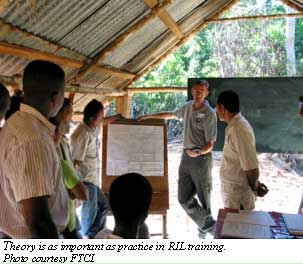
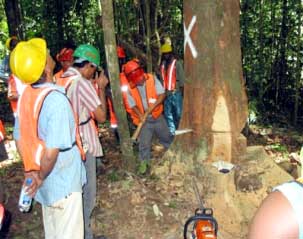
It is against this background, that the Tropical Forest Foundation (TFF), the Guyana Forestry Commission (GFC), and the Forest Products Association of Guyana (FPA) approached the International Tropical Timber Organization in 2001 to co-fund a RIL training and demonstration programme for Guyana and the region. The Forestry Training Centre Incorporated (FTCI) was established in 2002 to implement this programme. The Centre provides hands-on, practical training in and demonstration of RIL for all skill-levels from forest managers to field-based operators. Training is carried out at the Centre's permanent as well as satellite training sites and ex-situ by request. Hands-on training courses are being given as part of this real-life situation. Participants not only witness demonstrations and follow lecturers on best practices but also are encouraged to take part in them. This approach has been developed by Johan Zweede of FFT - a subsidiary of TFF - and has proven highly successful over the years, training over a thousand persons in RIL and catalyzing interest in applying RIL among a wide variety of stakeholders in Brazil (Blate, Putz & Zweede 2002)
During its first year, FTCI recruited and trained a well-qualified team that addresses all aspects of RIL. Through the generous support of the UK Department for International Development (DFID), Caterpillar Inc., Macorp Guyana (local Caterpillar dealer), Stihl AG and Farfan & Mendes (local Stihl dealer), much needed training equipment has been acquired, including appropriately configured logging equipment (D6 bulldozer, wheel skidder, and frondend loader), chainsaws and safety equipment.
Training courses
To facilitate the teaching of RIL, the Forestry Training Centre Inc. has prepared a training manual consisting of 17 modules that takes the student through the process of RIL step-by-step.
In general, three types of courses are offered:
Introductory courses that include all the
basic components of RIL in a logical, chronological sequence. This course
targets logging supervisors, block inspectors, inventory team leaders,
etc. and lasts for 12 days
Decision makers' courses of 3-4 days, showing
all the basics of RIL over a short period with many opportunities for
discussions, evaluations, etc.
Operators' courses teaching either harvest
planning, felling, skidding, or other heavy equipment operations. Courses
briefly touch on other aspects of RIL either preceding or following the
particular activity. Harvest planning courses are twelve days, while
chainsaw and machine operators' courses take seven days.
Issues of occupational health and safety are included in all courses.
To date, FTCI has organised two courses and one workshop ex-situ, in which 55 persons participated. Participants included field-based operators, field supervisors, concession owners, and representatives of forest administrations of Guyana, Suriname, French Guiana, and Belize. The courses and workshop were well received and led to a growing acceptance and awareness of RIL and a demand for training in RIL in the region. FTCI's permanent training site is expected to be operational by August 2004. Some sixty persons are expected to be trained between August and December 2004.
References
Blate, G.M., Putz F.E. and Zweede, J.C. 2002. Progress towards RIL adaptation in Brazil and Bolivia: driving forces and implementation successes. In T. Enters P. Durst, G. Applegate, P. Kho & G. Man, eds. Applying reduced impact logging to advance sustainable forest management, pp. 217-238. International conference proceedings, 26 February - 1 March 2001, Kuching, Malaysia. FAO RAP Publication 2002/14.
Dykstra, D.P. 2002. Reduced impact logging: concepts and issues. In T. Enters P. Durst, G. Applegate, P. Kho & G. Man, eds. Applying reduced impact logging to advance sustainable forest management, pp. 9-18 International conference proceedings, 26 February - 1 March 2001, Kuching, Malaysia. FAO RAP Publication 2002/14.
Hendrison, J. 1990. Damage-controlled logging in managed tropical rain forest in Suriname. Ecology and management of tropical rain forests in Suriname 4. Wageningen Agricultural University, Wageningen, the Netherlands.
Holmes, T.P, Blate, G.M., Zweede, J.C.,
Pereira, R., Jr., Barreto, P., Boltz, F. & Bauch, R. 2000. Financial costs and benefits of reduced impact logging in Eastern Amazonia. Tropical Forest Foundation, Alexandria, Virginia.
Jonkers, W.B.J. 2002. Reduced impact logging in Sarawak, Guyana and Cameroon - the reasons behind differences in approach. In T. Enters P. Durst, G. Applegate, P. Kho & G. Man, eds. Applying reduced impact logging to advance sustainable forest management, pp. 199-208. International conference proceedings, 26 February - 1 March 2001, Kuching, Malaysia. FAO RAP Publication 2002/14.
Klassen, A.W. 2002. Impediments to adoption of RIL in the Indonesia corporate sector. In T. Enters P. Durst, G. Applegate, P. Kho & G. Man, eds. Applying reduced impact logging to advance sustainable forest management, pp. 19-28. International conference proceedings, 26 February - 1 March 2001, Kuching, Malaysia. FAO RAP Publication 2002/14.
Van der Hout, P. 1999. Reduced impact logging in the tropical rain forest of Guyana. Tropenbos-Guyana Series 6. Tropenbos Guyana Programme, Georgetown, Guyana.
Van der Hout, P. 2000. Testing the applicability of reduced impact logging in greenheart forest in Guyana. International Forestry Review, 2(1): 24-32.
Contacts
Peter van der Hout is the Director and Godfrey
Marshall the Coordinator of the Guyana Forestry Training Centre.
For more information on the activities of the FTCI please
contact:
Lot 1, Water Street, Kingston, Georgetown,
GUYANA
Telephone/Fax: +592 - 223 - 5061
Email: ftrc@networksgy.com
| |

 joined FAO on 29 March 2004 as Chief of FOPP. This is the second time he works for FAO. He was Project Operations Officer at the Asia Pacific Desk (FODO) 1985-1988. He started his career in the Forestry Agency as forest ranger in the northern part of Japan. His field project experiences include JICA's cable logging technical cooperation project in Java, Indonesia. For the past seven years, he worked for Japan Wood-products Information & Research Center as director of Seattle office and also director of overseas research division at its head office in Tokyo.
  joined FAO on 1 February 2004 as an Associate Professional Officer. She will work with FOPP on the development of regional code of practice for forest harvesting in Latin America and the issue of gender and forestry. She spent one year at International Labour Organization undertaking similar duties. Previously, she worked as an environmental consultant in Sweden.