| April 1997 | FO: ACPWP 97/2 |

|
|
|
|
|
|
|
|
|
|
Introduction
AIMEX is the Association of the Timber Industries
Exporters in the State of Pará, in Brazil, concentrating,
mostly, producers of plywood and sawn lumber.
The State of Pará represents about 30 percent
of the Brazilian timber products exports, and 70 percent
of the exports from the Amazon Region, which comprises nine states.
Due to the complexity of a huge country as Brazil,
considering that AIMEX is a regional Association, and also the
limitation of the size for the presentation of this paper, we
will give an overview of some aspects, and focus a special attention
on issues related to the native Brazilian tropical forest. Naturally,
none of these issues will be analysed in depth.
In July 1994 a new Economic Plan, named Real,
the same as the country's currency, was launched in Brazil. Since
then, for the first time in more than 15 years, an acceptable
stability in the inflation rate has been achieved, which
stayed at a level of 10 percent in 1996.
However, this stability was conquered sacrificing
some sectors of the economy, especially the export one, and also
generating a concerning level of unemployment.
Special attention has to be given to the main
anchor of this Plan, which is the exchange rate of the
US Dollar vis-à-vis the Brazilian Real.
The evaluation of the Brazilian Foreign Trade Association
(AEB) is that the appreciation of the Real facing the Dollar could have
reached around 50 percent.
Estimates from other institutions, including the
World Bank and the International Monetary Fund vary from 19 percent
to 30 percent.
The fact is that there is indeed an artificial appreciation
of our currency, that stimulates imports and makes export products
less competitive, which was also responsible for the negative
value in our trade balance in 1996 being around US$ 5.5 billions.
Measures taken by the Government to present do not
seem to be sufficient. A great amount of time was lost in 1996
trying to change the Constitution in order to allow the inclusion
of right for re-election of the President, that was finally approved
by the Congress last January in the first voting of four.
The following issues have yet to be implemented
by the Government:
Perspectives as a whole are very good, but the task
to overcome the above issues is very difficult.
Performance of the Forest Industry
More than 60 percent of the Brazilian territory
is covered by forests, representing around 400 million ha.
Natural tropical rain forest in the Amazon is the most important
forest formation, but there are also temperate softwood species
in the south and large plantations spread all over the country.
In spite of the fact that the participation of Brazil
in the international trade of forest is relatively small, the
country is the largest producer and exporter of wood products
in Latin America. Having a population of almost 150 million
inhabitants, Brazil is also the largest market for wood products
of the region. In fact, for at least one product Brazil is the
largest world consumer: the domestic consumption of tropical sawn
lumber is around 16 million m3 per year.
Extensive resources, large and growing domestic
market, as well as favourable macro economic conditions, make
Brazil an excellent alternative for investments in the forest
industry.
Composed by the sectors of sawn lumber, veneer,
plywood, fibre boards, particleboards and pulp and paper, the
forest industry in Brazil intends to invest around US$ 10 billions
till the year 2000.
Up to the end of the 1960s, the sector was not expressive
within the Brazilian economy. Regular plantations covered no more
than 30 000 ha; wood exports, mainly sawn lumber from
the state of Paraná, did not reach US$ 70 million.
In recent years, the picture has been changing.
Plantations now cover an area of about 6 million ha.
The contribution of the forest industry represents more than 2.5 percent
of the GNP; employment, direct and indirect represents 3.5 percent
of the economically active population in rural areas, and the
activity generates an annual income of US$ 11 billion,
being US$ 2.3 billion in exports.
These figures do not include furniture plants, and
several other segments which use wood in some form, such as charcoal
and chemical products, nor machinery and equipment manufacturers.
A profile of the forest production could be designed
as follows:
Brazilian production of wood panels in 1995 achieved
approximately 3.1 million m3, representing 2.2 percent
of the world production, being plywood 1.6 million m3.
Plywood
In 1996 plywood production reached 1.7 million
m3.
Sawn Lumber
It is interesting to note the efforts being made
to increase new species in the international market. In the State
of Pará, where precise figures for exports are available,
while in 1973 only 10 species were exported, in 1996 around
70 species have been exported, with about 50 percent in volumes
above 1 000 m3. However, a higher concentration
is observed in about 15 species (see attached table).
Another significant point is that, individually
speaking, mahogany (Swietenia macrophylla) that was the
most exported species in Pará till 1993, fell to the third
place in 1994, being surpassed by Tauari (Couratari spp.)
and Jatoba (Hymenaea courbaril) (see attached table).
Consumption
Investments
In any country, in any language, money is a must,
and actual possibilities, many times, a mystery!
Due to the complexity of this matter, especially
when related to the native tropical forest, we do not dare deal
with this item under such a small space.
However, the figures presented by the Brazilian
Government, during the Council Session of the International Tropical
Timber Organization, held in Yokohama in November of 1995, just
to reach the so called Target 2000: US$ 7 billions.
In addition, it is important to notice that there
are absolutely no lines of credit available for plantations or
sustainable forest management in Brazil, compatible with the time
requirements of the growing of tropical species, which can vary
from 10-15 to 50-80 years.
Issues of Particular Interest
Sustainable Forest Management (SFM)
Difficulties to prepare and implement SFM in Brazil:
The SFM facing the great amount of species in the
Amazon (more than 3 000 types of trees, while, at most, around
80 are presently commercially traded) leads to the huge extensions
of land. As an example, a plywood mill that consumes yearly 120 000
m3 of soft logs (low density), and located in an area
where the forest produces an average of 20 m3/hectare
of suitable species. There will be a need of exploring 6 000 ha
per year. The present accepted rotation cycle by IBAMA (Portaria
48/95) is 30 years requiring therefore a total area of 180 000 ha.
A positive point is the implementation of the AIMEX
Laboratory of Seeds and Seedlings, being built in Belém
in an area of 21 ha, the first private initiative in the
region, which will be ready by July 1997. It is expected to produce
high quality seeds and seedlings, to allow good Reforestation
programs.
AIMEX believes that the solution comprises two basic
points:
Certification
Certification is an extremely polemic issue as regards
trade. It is rather seen as a non-tariff barrier to be imposed
on tropical forest products, and also a new industry to be created,
generating jobs to hundreds of people, rather than an actual and
sincere concern for the environment.
It is obvious that if the market wishes any kind
of certification, it will have to pay for it, and costs will have
to be added to the price. When consulted, importing countries
generally inform they are willing to pay an extra price to receive
certified products. However, there is a big distance between willing
to pay and actually paying, and also paying the
full cost of such certification.
Even so, CERFLOR, a joint system conducted by the
SBS, Brazilian Silviculture Society, and ABNT, Brazilian Association
of Technical Rules, is having its Technical Committee established
on 17 March. This system is almost ready to certify timber from
plantations, but nothing yet has been discussed, in terms of principles
and criteria, for the native Brazilian tropical forest.
Public Forest Concessions
The Brazilian Government, through the Ministry of
Environment and IBAMA, is intensifying the studies to simplify
and extend the access to the public forest concessions, which
could be an interesting alternative to the private forests, presently
the only feasible possibility.
IBAMA´s Absurd Increases on Taxes
We would like to give some special attention to
this issue, due to its important impact on the costs of trade.
IBAMA is the Brazilian Department of Environment
and Renewable Natural Resources, responsible for the legislation
of several activities, including the timber industry, as regards
the conservation and (management) operation of forests.
In September 1996, the President of IBAMA, Dr. Eduardo
Martins, requested, through a direct phone call to the President
of AIMEX, Mr. Danilo Remor, to start conversations and jointly
search for mechanisms to overcome the existing problems resulting
in proposing a policy on the tropical forest, as well as evaluating
the present level of taxes being charged by IBAMA.
Four meetings were held, two in Belém, one
in Brasilia and one in Manaus. During the last meeting, we were
surprised by the publication of Portaria Nr. 89/96, on
25 October, which increased all taxes of IBAMA, some of them up
to 2 841 percent (two thousand, eight hundred and forty
one percent) and the creation of others which did not exist
before, such as the imposition of a tax of R$ 100.00 (roughly
US$ 100) per each cubic metre of mahogany, virola, Paraná
pine and imbuia exported.
Considering a market price of US$ 200/m3
for virola the tax in this case would represent about 50 percent
of the sale. Simply a nonsense!
Due to the political pressure from all timber associations
in Brazil, among them AIMEX, IBAMA issued a new Portaria
Nr. 118/96 on 27 December, reducing some taxes, but not yet to
reasonable levels, and reducing the R$ 100/m3 tax to
R$ 6/m3, but now including all species of wood in Brazil,
and also from plantations!!
The pressure was then made by the pulp and paper
industry, and on 8 January Portaria No. 118/96 was
issued again, excluding plantations, but maintaining all species
if thickness was above 4 inches.
To better understand these acts of pure madness,
it is important to observe that the accumulated inflation since
July 1994 is of the order of 50 percent and that Government
is creating mechanisms to stimulate exports and is pressing any
economy sector that increases prices beyond 1020 percent,
and not accepting even automatic transfer of inflation, as it
was common in the past. So, how can IBAMA allow itself to make
such tax increases going against a national Government policy?
In fact, IBAMA does not consider sufficient its
budget and therefore is trying to impose higher taxes to compensate
for that, acting against the legislation, which requires a law
to permit a tax increase or duties on export products, and not
only an internal Portaria.
Not accepting this procedure, 30 (thirty) timber
associations from all over Brazil have taken out a court injunction
against Portaria Nos. 89 and 118/96, for which a decision
is awaited.
After sending five faxes to the President of IBAMA,
without any response, AIMEX sent a letter to the Governor of Pará,
signed also by seven Unions of Timber Workers, protesting and
requesting the Governor's help, who immediately phoned the President
of IBAMA, who finally decided to come to Belém, on 20 February
to talk with us.
As a result of this meeting, IBAMA decided to:
Though this seems a progress, and in fact it is,
we are still concerned with the lack of criteria that IBAMA used
to create and modify all these Portarias. III International Congress on Plywood and Tropical Timber
II Machinery and Wood Products Fair The above issues will be discussed during the III International Congress on Plywood and Tropical Timber, which will be held in Belém, State of Pará, Brazil, from 4 to 9 November 1997, in a joint venture of AIMEX and ABIMCI (Brazilian Plywood Association).
We would be pleased to count on your participation!
Bibliography - AIMEX statistics and documents - The Socio-Economic Importance of the Forest Industry-ABIMCI - Wood-Based Panels in Brazil-STCP/Dr. Ivan Tomaselli
- Partnership Program Forest Industry x Ministry
of Environment-SBS-Brazilian Silviculture Society
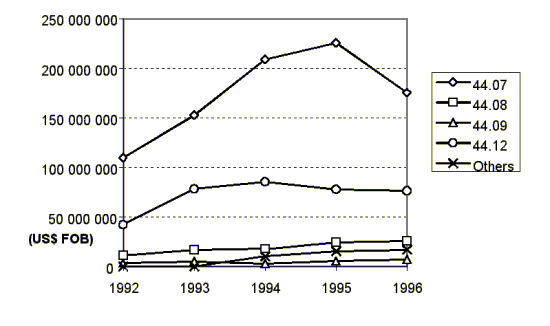
Tables Attached - Brazilian Wood Exports 1996 - Amazon Region Comparison - Evolution of Total Timber Products Exports from Pará 1992-96 - Comparison of Mahogany Quota System 1990-96 - Evolution of Wood Exports from Pará 1990-96 by Products/Species
Source: Department of Foreign Trade Operations - DECEX Prepared by: AIMEX
Forester: GUILHERME DOS SANTOS CARVALHO
NOTE:
* Higher exported volumes in 1993 and 1994 are due
to the old system of exports control of SISCOMEX permitting valid
date of the issuance of authorization for 60 days from the date
of its liberation. Thus, autorizations issued for exports by SISCOMEX
in December were valid until February of the next year. If exports
authorized in December for any reason were not placed on board,
they were transferred for shipping the next year.
** It is important to also note additional liberation
of the volume of permitted technical reserve in the quota system
decree.

| ||||||||||||||||||||||||||||||||||||||||||||||||||||||||||||||||||||||||||||||||||||||||||||||||||||||||||||||||||||||||||||||||||||||||||||||||||||||||||||||||||||||||||||||||||||||||||||||||||||||||||||||||||||||||||||||||||||||||||||||||