| April 1997 | FO: ACPWP 97/2 |

|
|
|
|
|
|
|
|
|
|
Background
The New Zealand Economy - A Decade of Change
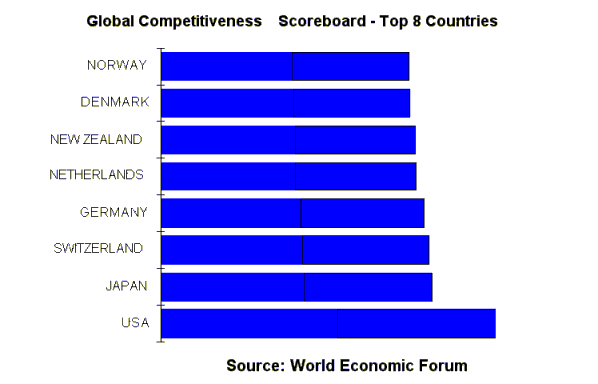
Since 1984 New Zealand has transformed its economy
to a point where, according to the World Economic Forum, it is
now ranked as the sixth most competitive economy amongst the world's
24 most developed countries.
An integral part of this reform programme has been
the internationalisation of the New Zealand forest industry.
New Zealand Forest Industry - Historical
Development
Starting at the turn of the century, the New Zealand
Government purposely set out to develop a planted production forest
estate to:
During the period 1910-1930s the Government provided
the research drive that selected radiata pine as the ideal plantation
species, undertook extensive production forests planting activity
and implemented forest management and species improvement programmes.
The 1940s through to the early 1980s the Government
undertook additional plantings but increasingly encouraged private
sector participation through a range of incentive and support
mechanisms.
It encouraged the development of the processing
sector - saw milling , panels and pulp and paper operations -
and undertook local and international market development for radiata
sawn timber and logs. The Government also entered into a number
of joint-venture forestry developments with Maori interests (New Zealand's
indigenous people).
Internationalisation of the New Zealand Forest
Industry
During 1987-90 the New Zealand Government reorganised
its involvement in forestry by formally separating its natural
and production forestry assets, viz.
The New Zealand Government's exit from the
forest industry was completed in 1996.
Purchasers of the Government's production forest
assets included local interests as well as international forestry
interests from the US, Japan, China, Malaysia, Hong Kong and Indonesia.
As part of this reformation process, the New Zealand
Government put in place mechanisms to address Maori claims on
land area that the Government had developed as production forests
(a similar settlement process is being undertaken in other resource
areas as well).
New Zealand Forest Industry - Key Features
Today New Zealand's forest industry is an expanding
sector, based on a 1.5 million hectare production forest resource
(covering 5 percent of land area), converting 17 million m 3
of material into a wide range of softwood fibre and timber products
worth in excess of NZ$ 6 billion in annual sales. The industry
operates on a 25-30 year rotational cycle with an annual average
wood growth rates of around 22 m 3 per hectare.
Radiata pine is the main commercial species at around 90 percent
of forest area. Private sector interests now control 92 percent
of the production forest resource.
The industry has a significant number of vertical
and international market integrated companies, largely as a result
of the Government's forest asset sale process. Export values have
increased by 325 percent since 1986 and doubled since 1990.
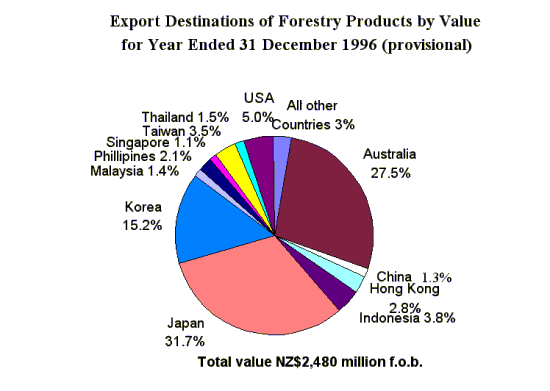
It is now New Zealand's second largest export sector and
in 1996 earned NZ$ 2.4 billion from sales to customers in a number
of Asian-Pacific markets.
Employing some 31 000 persons, the industry
is a major driver of New Zealand's overall economic growth
and accounts for 7 percent of GDP.
Consumption The New Zealand market for wood fibre and timber products is mature and annual per caput consumption - estimated at 3 m 3 - is amongst the highest in the world. The construction and agriculture industries make extensive use of timber products. Paper and packaging consumption is also high reflecting a well developed, modern consumer society with high literacy rates as well as the use of packaging materials by other industrial sectors in New Zealand which are also highly export-orientated, such as the food and beverage industry.
Domestic consumption, in roundwood equivalents,
is static at around 10 million m 3 annually.
As indicated by the growth in exports, a combination of the well
developed local market and marginal domestic population growth
means the increasing harvest being processed by the forest industry
is for its global customer base.
Growing and Harvesting
The New Zealand forest industry actively replants
harvested areas. In addition, new plantings of production forests
is an important industry feature. Planting takes place on farmland
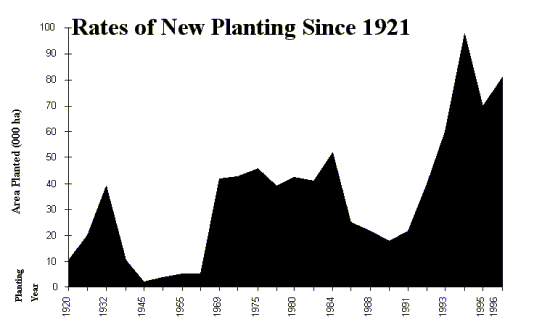
and since 1992 new planting rates have been significant - reaching
a peak of 98 000 ha in 1994. New Zealand has an
estimated 3 million ha of additional farmland potentially
available for conversion into production forestry.
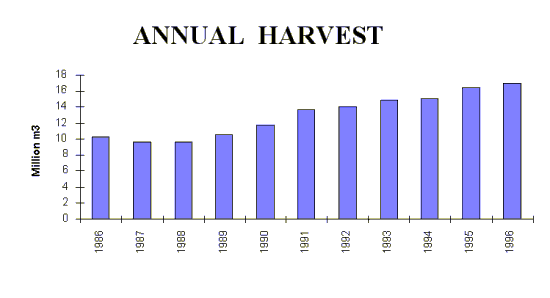
Harvest rates have also increased significantly
as the wood from forests planted in the 1970s comes on stream.
Processing and Marketing
The processing and marketing sector has undergone
significant changes over the past decade as a result of the deregulation
and internationalisation process and expanding harvest levels.
Pulp and paper companies have faced increasing local
market competition from imports and have consolidated product
ranges while maintaining steady export growth. Product customisation
has also been a feature.
The panels industry has expanded significantly with
a number of "greenfield" MDF facilities coming on stream
and being further expanded during this period. To illustrate the
level of development, between 1986 and 1996, the value of panel
exports increased by nearly 1 000 percent.
New Zealand's sawmilling output has continued
to grow while undergoing quite significant structural change,
which has seen a reduction in the overall number of sawmilling
companies operating and extensive mill consolidation by larger
firms. Sawn timber export values increase by 332 percent
during this same period.
New Zealand has also developed a significant
log export trade which has expanded dramatically during this period.
Over the past 5 years log exports have averaged around 28 percent
of total forest product export value.
New Zealand has a timber remanufacturing and
engineering sector which continues to expand from its small base.
Internationally competitive downstream wooden furniture and kitset
housing sectors are evident and New Zealand's forestry services
sector is actively expanding into Asian-Pacific markets.
New Zealand Forest Industry Performance -
1995-96
Over the past two years
the New Zealand forest industry has faced very tough international
trading conditions - a mix of low commodity prices in key products
including pulp, newsprint, logs and timber; weak demand in some
key product markets - such as the Australian housing market for
sawn timber; and the ongoing appreciation of the New Zealand
dollar against the US dollar squeezing margins and company profitability
(the New Zealand dollar strengthened by nearly 11 percent
during 1995-96).
Despite this, reflecting
medium-long term confidence in its ability to compete internationally
as a supplier of increasing significance to rapidly expanding
Asia-Pacific forest product markets, the following key performance
features were apparent:
New Zealand's annual
wood harvest will at least double over the next 15 years to over
30 million m 3. Depending on planting
rates future potential beyond 2010 could increase significantly
and by the year 2035 New Zealand's total annual harvest could
be in excess of 50 million m 3.

Sustainable Forestry Management
Since the 1992 Earth
Summit in Rio, the New Zealand forest industry has become
increasingly involved in international environment issues relating
to sustainable forestry management (SFM). This involvement has
ranged from:
As a result of this, the New Zealand forest
industry has some well developed views on SFM and the role of
certification and product labelling.
Key Policy Positions
The New Zealand forest industry's position on SFM,
and forests and forest products certification and labelling is
based on the following viewpoints:
Sustainable Forestry Management
The most appropriate level at which to address sustainability
issues is at the national level, as the forestry management and
forest product processing practices which occur take place within
a framework of local laws and regulations, ownership and processing
arrangements, and environment, social and economic development
objectives which are unique to each and every country.
National and local governments, working in partnership
with forest owners, processors, communities and other stakeholders,
have the capacity to achieve SFM solutions that meet their particular
environment, economic and social needs at the country level.
While the UN and regional intergovernmental initiatives
(such as the Helsinki and Montreal processes) have usefully focused
attention on SFM issues post the Rio Earth Summit, their future
role should be aimed to assisting individual countries develop
relevant SFM solutions - including the integrated forestry estate
model when appropriate - through information sharing and technology
transfer.
The forest industry has a major role to play in
developing SFM solutions. The Third International Forestry Roundtable
(Concepción, Chile, 14-17 October 1996) has led to the
development of a shared vision on SFM involving resource stewardship,
best practice, continuous improvement, enhancing soil, water and
ecological values and compliance at the national level with local
laws and regulations governing social, environmental and economic
activity.
Certification and Labelling
Products certification and labelling, per se,
is a commercial issue involving buyers and suppliers. From a forest
products marketing perspective, sustainability is a product attribute
which customers may or may not value and seek in the wood fibre
and timber products they buy from industry.
Certification and labelling systems should not create
barriers to trade between nations and be compatible with WTO rules.
Certification and labelling systems should therefore be performance
based (i.e., not prescriptive) or management system based, be
voluntary and designed to provide industry a methodology to measure,
demonstrate and verify forestry management systems and practices
in order to satisfy customer requirements - whatever these requirements
may be. All criteria and indicators relating to SFM must be scientifically
based.
The monopolistic approach to global certification
and labelling system proposed by the Forest Stewardship Council
is inappropriate as it attempts to impose a particular definition
of sustainable forestry management on global consumers and suppliers
and will impact on forest product trade flows, in particular planted
production forest sourced goods.
The ISO provides a more appropriate consultative,
participatory, multi-stakeholder framework within which relevant
certification and labelling tools can be developed for use by
industry. The TC207 Forestry Working Group is developing a technical
resource document for the forest industry that will enable certification
of forestry management systems at the company level - potentially
against whatever standard specific customers might set, including
FSC definitions.
While third party auditing clearly improves certification
credibility, the level of auditing is best determined by customers,
and should not be prescribed by industry, regulators or environmental
groups.
Achieving SFM - The New Zealand Model
New Zealand has achieved SFM by developing complimentary
forestry estates and separating commercial from non-commercial
management values and objectives, i.e.:
These benefits include:
The additional key components that have enabled
New Zealand to achieve its SFM solution are:
|