Asia-Pacific Conference on Sustainable Agricultural Mechanization (APSAM)
Manila, Philippines
Hybrid Event, 23/11/2026 - 26/11/2026

In the Asia-Pacific region, sustainable agricultural mechanization (APSAM) is increasingly recognized as a key driver of agrifood systems transformation. Progress has been supported not only by new technologies, but also by the development of enabling mechanization ecosystems that include appropriate machinery, supportive policies, financing, service providers and innovative business models. When applied through a systems approach and adapted to local conditions, SAM can help boost productivity, reduce labor drudgery, improve climate resilience, protect natural resources and create decent employment opportunities, particularly for smallholder farmers facing labor shortages and diverse farming environments.
Against this backdrop, the Food and Agriculture Organization of the United Nations (FAO) is organizing the Asia-Pacific Conference on Sustainable Agricultural Mechanization (APSAM) under the theme “Modernize. Scale. Sustain.” Hosted by the Department of Agriculture of the Government of the Philippines, APSAM will be held from 23 to 26 November 2026 in Manila, Philippines, in a hybrid format.
Building on the momentum of the first-ever Global Conference on Sustainable Agricultural Mechanization (GAMC) in 2023, and the Africa Conference on Sustainable Agricultural Mechanization (ACSAM) in February 2026, APSAM aims to strengthen partnerships, promote locally adapted and inclusive mechanization solution, and support countries in harnessing SAM as a key enabler of agrifood systems transformation. The conference will also contribute to FAO’s Strategic Framework 2022–2031 and the achievement of better production, better nutrition, a better environment and a better life for all.
Why does this conference matter?
Bringing together FAO Members, farmers, youth, researchers, development partners, civil society and the private sector, the conference aims to:
- Share best practices and practical knowledge on sustainable agricultural mechanization (SAM) ecosystems to support evidence-based and scalable solutions.
- Strengthen regional cooperation and multi-stakeholder partnerships for resilient mechanization ecosystems.
- Showcase innovative technologies, services, financing and business models tailored to diverse contexts, with a focus on smallholder farmers, women and youth.
- Identify policy, institutional and capacity gaps to guide investment, policy development and regional action.
Thematic Areas
Participants will examine the impacts, opportunities and challenges of developing SAM ecosystems for agrifood systems transformation across the following focus areas:
Focus Area 1: Enabling environment for mechanization ecosystem and private sector growthFocus Area 2: Innovation and technologies for inclusive, resilient and profitable livelihoods
Focus Area 3: Financing and partnerships for SAM development
Cross-cutting theme: Youth and women in action for SAM – leadership and impact
Join the agricultural mechanization exhibition
A dedicated exhibition will take place at APSAM, giving participants a hands-on opportunity to discover innovative agricultural mechanization technologies and business models suited to diverse landscapes and farming systems. Integrated into the conference programme, the exhibition will feature equipment, innovations for small-scale farming, precision agriculture technologies, automation and agri-robots, business models, illustrating some of the latest emerging technological developments in agricultural mechanization and digitalization that can be adapted to the needs of small-scale farmers in developing countries.
Participants are invited to explore, connect and gain practical insights into solutions that can support small-scale farmers and agrifood systems across the Asia-Pacific region.
Exhibition
The exhibition will showcase advanced, innovative mechanization across all plants in the region, as well as small- and medium-manufacturers and traditional mechanization that highlights indigenous knowledge from member states in the Asia-Pacific region.
Governments, academia, and the private sector are welcome to book exhibition booths, with balanced and coordinated geographic coverage. The exhibitors will bear all costs, including transportation, customs, insurance, demonstrations, and dismantling. FAO will provide facilitation and coordination support.
>> Exhibitor Application Form | >> Exhibitor Operational Guidelines |
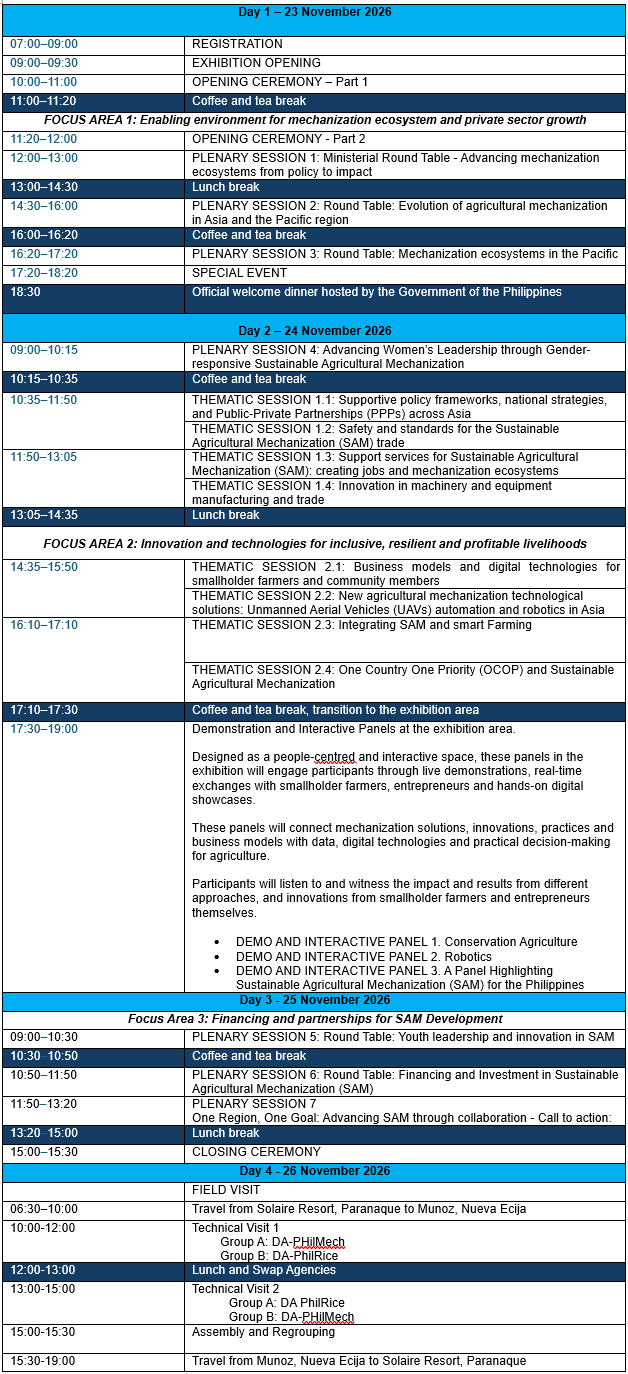
Programme