
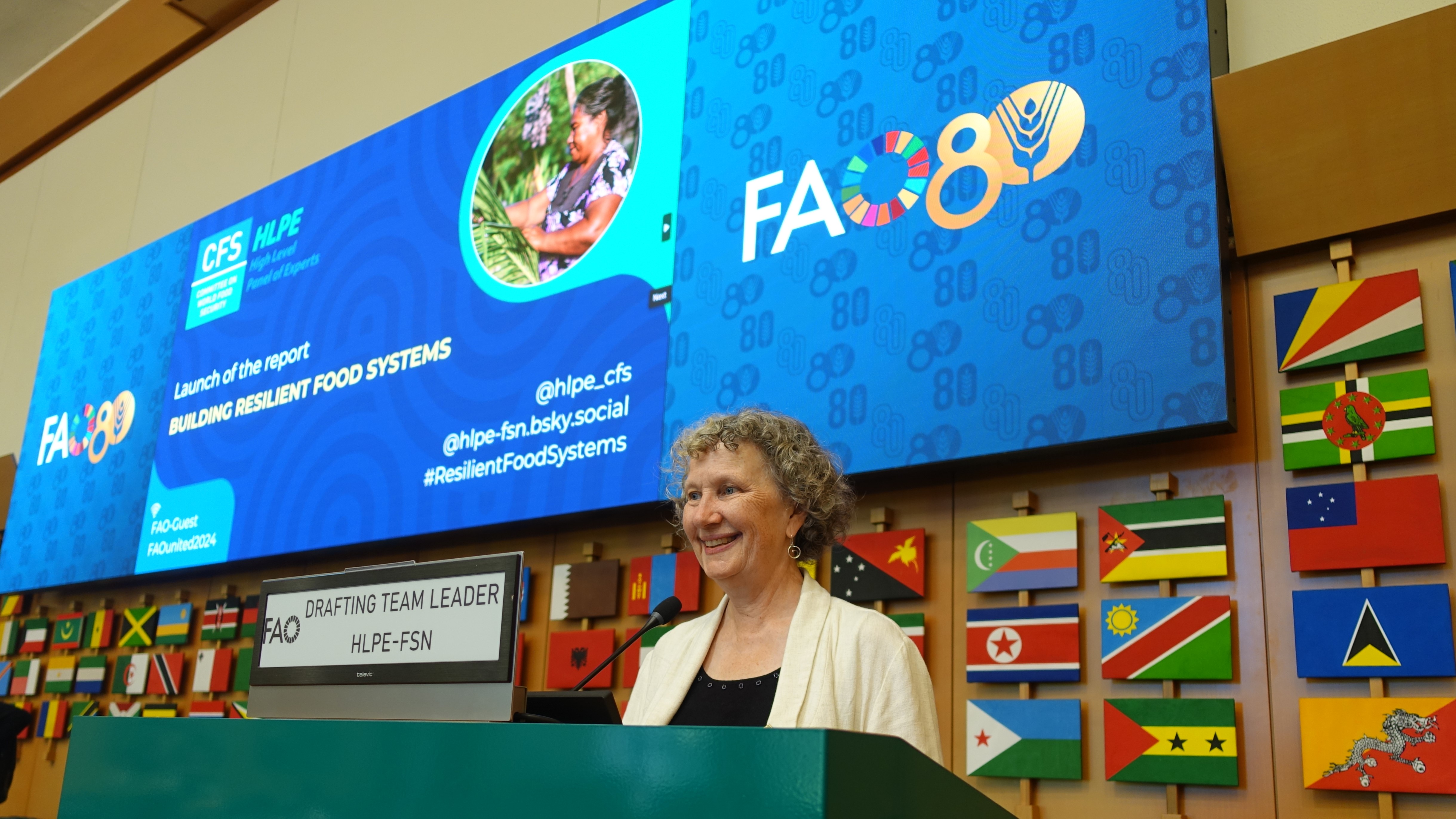
Lead author Alison Blay-Palmer presenting the HLPE-FSN report’s main findings.
©FAO/HLPE-FSN Silvia Meiattini
📘 Read the report and its executive summary
🖥️ Check out the presentation delivered by Alison Blay-Palmer
Food systems are facing unprecedented shocks, from pandemics and protracted crises to climate impacts and supply chain disruptions. The HLPE-FSN’s latest report, “Building resilient food systems”, presents evidence-based pathways to strengthen food systems, reduce vulnerabilities, and promote equitable, transformative resilience (ETR) while respecting human rights and planetary boundaries.
The report outlines practical actions to build resilience, combining short-term responses with long-term structural reforms across socio-ecological systems. Interventions focus on reducing the probability and impacts of future shocks, preparing actors for uncertainties, and enabling swift, equitable responses when crises occur.
In her welcome address, Beth Crawford, FAO Chief Scientist ad interim, emphasized the urgent need for resilient food systems, highlighting that shocks can rapidly push vulnerable populations into food insecurity. She underlined FAO’s commitment to better production, nutrition, environment, and livelihoods, and praised the HLPE-FSN report for providing a long-term, transformative perspective to guide action.
H.E. Ambassador Nosipho Nausca-Jean Jezile, Chairperson of the CFS, emphasized the HLPE-FSN’s value in guiding global policy. She pointed out that resilient food systems are essential to withstand climate change, conflicts, and economic crises, while continuing to deliver food security and nutrition for all and the right to adequate food.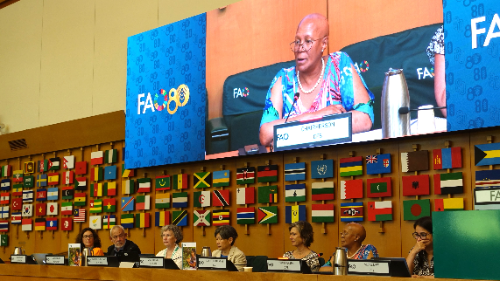
She highlighted that this report provides science-based and actionable policy recommendations and marks the beginning of the CFS policy convergence process. Her message was clear: we must put science into action to build food systems that are equitable, sustainable, and resilient.
 Akiko Suwa-Eisenmann, HLPE-FSN Chairperson, introduced the report, noting its 20th edition milestone in the 15th HLPE-FSN anniversary, and stressing the importance of addressing differential vulnerabilities that disproportionately affect certain populations. She emphasized the report’s spotlight on local initiatives and the potential for HLPE-FSN findings to shape real-world policies.
Lead author Alison Blay-Palmer presented the report’s main findings, explaining the entire spectrum of resilience and what it entails: bouncing back, bouncing forward, and equitable, transformative resilience (ETR). She shared practical examples, including policy coherence ones, and cases of diversification of socio-ecological systems, emergency preparedness, and ways of integrating traditional and Indigenous Peoples' knowledge.
Key recommendations presented in the report fall into four thematic areas:
1. Governance and policy: reform governance to embed equity and participation, strengthen policy coherence across sectors, support agroecological and nutrition-sensitive practices, protect vulnerable food-system workers, and expand social protection.
2. Emergency response, contingency planning, and foresight: move beyond reactive measures by anticipating shocks, integrating agroecology into planning, strengthening early warning systems, investing in resilient infrastructure, and coordinating across humanitarian, development, and climate sectors.
3. Diversity in production, markets, and diets: support diverse production systems, rehabilitate ecosystems, ensure market stability for smallholders, promote access to healthy, culturally appropriate diets, and strengthen territorial food systems for long-term resilience.
4. Knowledge systems for ETR: prioritize resilience-focused research, protect Indigenous and local knowledge, foster participatory knowledge co-creation, enhance education and training, and establish robust monitoring systems that track structural inequalities and local vulnerabilities.
By combining evidence, inclusive governance, and local solutions, the HLPE-FSN report provides a toolbox for resilient, just, and sustainable food systems that can be adapted to different regions and contexts, guiding governments, stakeholders, and communities towards a more secure and equitable future.
During the questions and answers session of the launch, participants explored themes such as agroecology, gender-transformative approaches, land tenure security, and Indigenous knowledge systems, among the many and complex questions. Discussions underscored the structural challenges facing food systems and the need for long-term capacity building to reduce vulnerability to shocks and stresses. The session highlighted the importance of locally-led solutions, multi-directional knowledge flows, and diversified financing for resilience-building. It also highlighted one of the key findings of the report, the importance of building resilience of food systems to ensure the realization of the right to food.
Akiko Suwa-Eisenmann concluded by noting that building resilient food systems is complex but achievable, particularly through diversification of production and consumption. Ambassador Nosipho Nausca-Jean Jezile closed the event by calling on all stakeholders to act on the report’s recommendations to foster more inclusive, just, and sustainable food systems worldwide.
The HLPE-FSN report offers a comprehensive framework for policymakers and stakeholders to advance resilient food systems, ensuring food security and nutrition for all and the progressive realization of the right to food while respecting planetary boundaries.
Read the report and its executive summary
Check out the presentation delivered by Alison Blay-Palmer

The contribution of current donors of the HLPE-FSN - the European Union, the Swiss Confederation, the French Republic, and the Principality of Monaco - is gratefully acknowledged.


