| FAO/FIIT Fishing Gear Type Fact-Sheet |
|
| Trammel nets [GTR] | updated : 10-mai-2001 |
|
|
|  |
|
ISSCFG Classification :
|
| > | Category : Trammel nets |
|
|
| Profile |
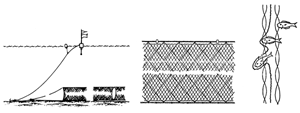
| General Description: A trammel net consists of two/three
layers of netting with a slack small mesh inner netting
between two layers of large mesh netting within which fish
will entangle. These nets are strings of single, double or
triple netting walls kept more or less vertical by floats on
theheadrope and mostly by weights
on thegroundrope. These are
occasionally set in strings. |
| Specific Equipment: Small solid floats, usually made of
plastic and either cylindrical or egg-shaped, are attached
to the headrope and lead weights are evenly distributed
along the groundrope. |
| Specific Handling Equipment: Most trammel nets use to be hauled by
hand. Moderngillnet haulers may
also be used fro hauling the nets.Net
drums are also, occasionally, employed. |
| Fishing Vessels using this gear:
Gillnetters
|
| Fishing Operations: Trammel nets are most common as stationary
gear, but they can also be used drifting. The fish entangle
themselves in a pocket of small mesh webbing between the two
layers and large meshed walls. Afterwards, the trammel nets
are hauled back to the surface for extracting the entangling
fish from the netting. |
|
| Features |
| Target Species: Demersal species, fish and crustaceans. |
| The Gear and its Environment:
|
| Deployment Area: These nets are especially used to fish
at, or near to, the bottom in inland and marine waters. |
| Impact on Aquatic Species:
"Ghost" fishing of lost
gears and capture of small sized organisms and
non-target species, which are frequently discarded
at sea. Such impact can be mitigated by using larger
meshes. However, compared to gillnets the
selectivity of trammel nets are lower and catches of
small organisms and non-target species are common. |
|
|