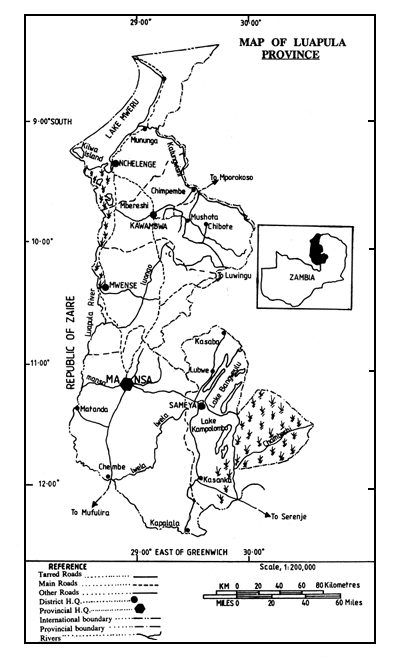
A two-member research team sponsored by ALCOM did a survey of gender issues in fish farming in the Chibote area, Luapula province, Zambia, in August 1990. The team spent three weeks in Musonda Bule village and one week in the Chibote centre, collecting data and interviewing fish farmers, both male and female, village headmen and others.
The survey focused particularly on identifying factors that would encourage or impede women's participation in fish farming.
It was found that none of the women in Chibote took to fish farming while there were nearly 30 women fish farmers in Musonda Bule. The reasons for the big disparity:
In Chibote, fish farming was introduced by the Chibote mission, as an activity for male youth; in Musonda Bule, the Department of Fisheries and ALCOM made it clear that both men and women could take to fish farming. In fact women were encouraged to become fish farmers.
In Musonda Bule, the headman liked the idea of women taking up fish farming and encouraged it. This was not the case in Chibote.
In Musonda Bule, the fields where people worked were closer to homes than in Chibote. This meant that more time was available for other activities such as fish farming.
There are several factors that encourage or impede participation by women in fish farming. These are best revealed by the following questions: Is land available? Do the women have time? Is labour available? Can fingerlings for stocking ponds be got? Is equipment available? Can fish feed be obtained easily? How much do women know about fish farming?
The survey revealed the following answers as they apply to Musonda Bule and Chibote center.
Land: for fish farming is available in Musonda Bule; in the Chibote centre, land scarcity may soon hamper fish farming. It's likely that a single person will dig a lot of ponds to win the right to more land. A scramble to construct more ponds will disadvantage women more than men, since women lack access to labour.
Time: Since women are loaded with both domestic chores and farm work, they are more hard-pressed for time to pursue fish farming than men. Without active co-operation and inputs from men, women can't take up fish farming on their own.
Labour: In Musonda Bule, ponds were constructed with family labour. In Chibote centre, family labour was more difficult to mobilize since fields were far away from homes. Hired labour on the other hand was too expensive.
Equipment: Men use hoes and shovels to construct ponds. In Musonda Bule, it was easy to borrow equipment from young fish farmers trained by Fr Angelo, who had got the equipment free of charge, because everyone there was related to one another. In Chibote, people do not lend to one another so readily; lending to women was even more difficult because they would be borrowing the equipment for some one else.
Fingerlings: were in short supply before November 1989, so young fish farmers trained by Fr Angelo were the main source. Heavy demand and high prices meant that women could not afford them.
Fish feed: was not a problem and needed no extra time to prepare. The feeding was done usually by men and children, but women sometimes fed the fish on their way to the fields or on their way home.
Knowledge: In Chibote, women picked up whatever they knew of fish farming from observation. In Musonda Bule, a slide show organized by ALCOM and the Department of Fisheries sparked the initial enthusiasm and proved quite instructive.
The survey also highlighted the following information:
Fish pond owners and spouses take joint decisions on matters concerning fish consumption (when to take out and eat the fish), but decide individually when it comes to starting fish farming, distributing fish or the proceeds from sales. It's the men who allocate tasks at home; so if they consider some other activity to be more important, women may have to put fish farming tasks aside.
Some of the women had a complaint: they were not free to take fish out to feed visiting relatives, when the ponds were owned by husbands. This is one reason why women found it necessary to have their own ponds.
In Chibote, the idea of a woman digging pond or farming fish aroused amusement, even antagonism. But it was believed that if several women dug ponds at the same time, or if husbands helped wives in pond construction, the reaction would not be so negative. In Musonda Bule, on the other hand, a woman could dig a pond without raising anyone's eyebrows.
It's too early to gauge the impact of fish farming on the status of women. But the women pointed out that when they own ponds, everyone in the household benefits. Their ownership of ponds also gives them the power to use fish in the ponds as they like, for consumption or sale.
Women believed that though group work is not easy and poses problems, clubs of individual pond owners would help mobilize essential requirements for fish ponds, such as labour, equipment and fingerlings. A club should ideally consist of five members: it would be easy to manage, co-operation would be easier.