


| Chibote Centre | Musonda Bule | |
| Population | -- | 70 |
| Number of families | 204 | 22 |
| Number of families covered by the survey | 14 | 17 |
| Number of people covered in the survey | 14 | 27 |
| Number of ponds | -- | 42 |
| Number of fish farmers | -- | 25 |
| Male fish farmers | -- | 11 |
| Female fish farmers | -- | 14 |
| Average size of ponds | 177m2 | 93m2 |
| Main crops | Cassava, beans | Cassava, beans |
| Main fruits | Bananas | Bananas |
Chibote area is in Kawambwa district of Luapula province, Zambia (see map). Luapula Province lies between latitudes 8° and 12.4° and longitudes 28.5° and 30° with an altitude of 1200 – 1500 metres in the plateau and 900–1000 metres in the valley.
Kawambwa district, 1500 metres above sea level, has the highest altitude in the province. Being on the plateau, Kawambwa has mild weather. The rainfall distribution favours Kawambwa and Samfya districts since they receive early rains. The majority of the people in Luapula live in rural areas, which make up 84% of the province's population. Fishing is the main industry, and infrastructure development is biased towards it. Therefore the communication network outside this industry is generally poor.
Chibote, which lies on the south-east of Kawambwa, has several villages around and within it which people refer to as the Chibote area. A Roman Catholic Mission Centre at Chibote is the core of this area. The centre houses a junior secondary school and an “Ox Training Centre”. Chibote also has a health centre and two extension workers, a fish scout (Department of Fisheries) and an agricultural assistant.
Among the villages that surround Chibote centre and are actually served by Chibote for schooling, religion and health is Musonda Bule, about 10 kilometres south-east of the Chibote Mission.
The people who live in the Chibote area are Bemba by tribe. They are known as Lungu, Chishinga, and Lundas if one goes by the list of 73 Zambian tribal groupings, but they all speak Bemba and practise Bemba customs. They are matrilineal, and observe the “matrilocal” practice -- which means that a man lives in his wife's village.
The staple food in Chibote and Bule is cassava, which is mixed with millet. The main crops grown in Bule and Chibote are cassava, millet, beans and groundnuts. Apart from these, sweet potatoes, groundnuts, cowpeas, pumpkins and maize are grown in small quantities; they do not get much priority or attention. Sweet potatoes and maize are grown to add variety to the food, while the rest of the supplements are grown mainly for “relish”. Tobacco is grown by four households in Bule but they did not care to mention it. “Well, we grow it, yes” they said when asked about it.
Two households in Musonda Bule grow pineapples, and one household has a banana plantation. Mangoes and guavas are grown by a number of people in the village. The residents of Bule do not own large numbers of birds and animals: just five goats, three pigeons and fewer than 100 chickens were noticed during the survey. The picture was similar in Chibote, except that there were more chickens among the 14 households, about 150 in all. There was just one household with five goats amongst those interviewed in Chibote, and none of the respondents talked about rearing pigeons.
The majority of the female respondents regarded the household animals and birds as theirs. In Musonda Bule, however, one female respondent was encountered who owned no birds; her husband owned 15 chicken. In Chibote, too, three women said they do not own any birds or animals.
The major sources of income are beer brewing and sale of crops, mainly beans, millet and groundnuts. For a complete list refer to Table 1. Women tend to rely rather heavily on beer-brewing and crops for their income; some of the men also engage in petty contract jobs and small-scale businesses while their wives concentrate on crop-selling and beer-brewing. Although crops are a major source of revenue, they rarely find their way to major towns, and are rarely sold to major buyers such as the co-operative union. They are sold in small quantities, seemingly in a haphazard way.
Chicken, chikanaa, beans and groundnuts are sometimes traded with itinerant hawkers for their wares -- which include washing detergents, second-hand clothing and dried fish.
Table 1: Major sources of income or goods ranked in order of importance for men and women
| MEN | WOMEN | ||
| Item | % of respondents | Item | % of respondents |
| Beans | 68 | Beans | 100 |
| Millet | 45 | Beer-brewing | 88 |
| Groundnuts | 38 | Chikanda (wild orchid) | 56 |
| Beer-brewing & Sweet potatoes | 31 | Groundnuts & millet | 50 |
| Bananas, pineapples, chikanda, temporary employment | 23 | Sweet potatoes | 25 |
| Chickens, building houses, carpentry, basket-making | 15 | Bananas, chickens | 13 |
| Shoe-repair, making handles of hoes/axes | 8 | knitting, temporary employment | 6 |
Division of labour by gender is a characteristic of the households in Chibote and Musonda Bule. Women take care of child-8rearing and house-running. They grind, pound, wash, collect fire-wood, fetch water and cook. Table 2 gives an idea of the activities carried out by men and women in Musonda Bule and Chibote. Cassava is harvested in small quantities throughout the year. Since it cannot be stored after processing it as flour, cassava-processing takes up a big chunk of women's time. A woman has to dig it, peel the covers and soak it in water every two to three days. She has to dry and pound it again every two to three days. In general, a woman is likely to be involved in processing of cassava flour every other day (Figure 1).
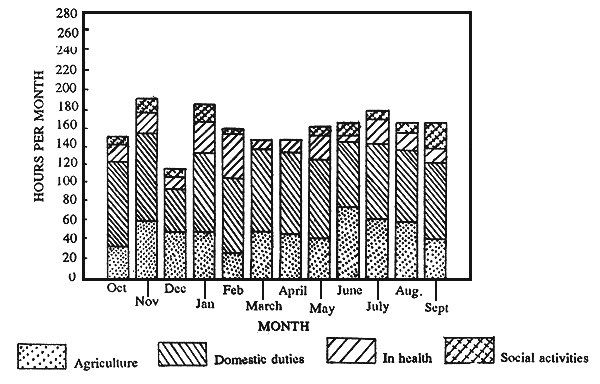
The other major activity is work in the fields. Bemba practise the Chitemene system of cultivation, which requires an area of land with many trees. The men cut these trees to a height of about 1.5 metres. The women pick up the branches and arrange them in circles at the centre of the field. These are later burned. The Chitemene fields are not very large but many of them are needed. Every year a new field has to be cleared. Cassava takes about three years to grow before it can be harvested; thus there has to be continuous cassava-growing to ensure continuous harvesting. Figures 2, 3 and 4 show the number of hours spent on various activities by women and men respectively in Luapula province.
Figure 1: Cassava-Processing Chart for a Six-day cycle
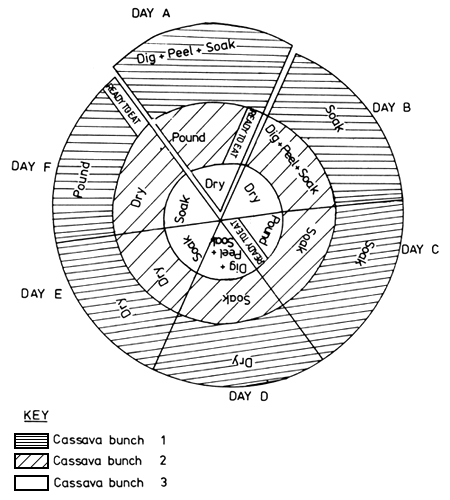
Table 2: Division of labour in the household
| Tasks usually done by women | Tasks usually done by men | Tasks done by either men or women |
| AGRICULTURE | AGRICULTURE | AGRICULTURE |
| * Picking and heaping branches | * Cutting trees | * Harvesting maize |
| * Preparing for the fields | * Making ridges | |
| * Planting cassava | ||
| * Digging holes for cassava plants | ||
| * Planting crops other than cassava | ||
| * Weeding | * Growing vegetables | |
| * Harvesting cassava | ||
| * Harvesting crops other than cassava | ||
| DOMESTIC DUTIES | HANDICRAFT | |
| * Taking care of children | *Carpentry | |
| * Fetching water and firewood | *Basket-making | |
* Digging cassava, peeling, soaking, drying, pounding, winnowing | *Building, roofing houses | |
| *Building bath shelters | ||
| * Searching for relish/wild vegetables | *Making drums | |
| * Cleaning yard, house and plates | *Blacksmithy | |
| * Washing clothes | ||
| HANDICRAFT | OTHER ACTIVITIES | |
| *Knitting | *Hawking | |
| *Embroidery | ||
| *Crocheting |
Weeding, sowing and harvesting are basically female activities. Men cut trees in the Chitemene fields; they also engage in building houses (although the roofing grass is cut by women), making baskets to carry millet, and mitonga carpentry and piece work. Male activities are fewer than female, more spaced out and less repetitive.
Figure 2: Activities in hours per month for men in male-headed households
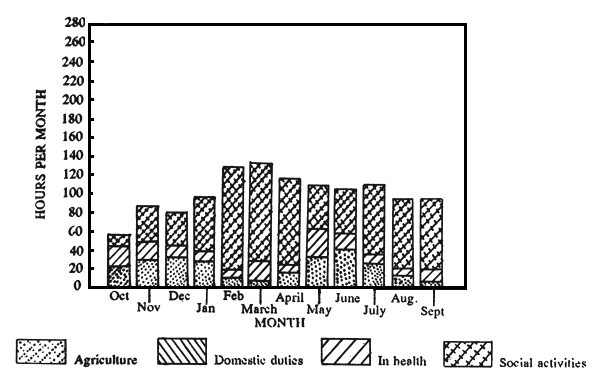
Figure 3: Activities in hours per month for women in male-headed households
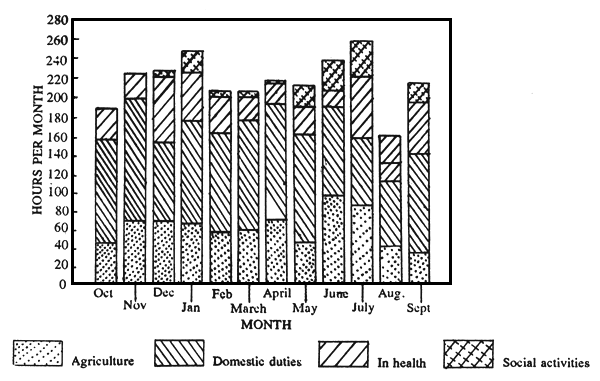
Figure 4: Activities in hours per month for women in female-headed households
Source: Allen (n.d.)
