


The Pirassununga Station has at present 57 tanks and six earthen ponds covering a total area of 0.93 ha. All have individual inlets and outlets and can be operated entirely independently of each other.
Thirty-two of the tanks are small, 2 × 4 m, and average 0.8 m in depth (Fig. 1, VIII). These tanks are of nearly identical construction, which would make them suitable for replicated experiments. Twelve tanks are 8 × 8 m and average 1.8 m in depth, again of similar construction. Eight tanks are 8 × 20 m, four are 20 × 20 m, and one is 17.2 × 20 m. These tanks total 0.425 ha (Fig. 1, IX).
There are six earthen ponds, five are rectangular in shape and one is trapezoidal (Fig. 1, X). These ponds are somewhat similar in depth, averaging about 0.8 m, but vary in size from 525 to 2 760 m2. Total area of the six ponds is 0.51 ha. Water supply for the existing ponds and tanks comes from seepage water gathered into an open ditch, which empties into a circular supply tank dug into the ground. Water from this supply tank is distributed to the existing ponds and tanks through a system of underground pipes.
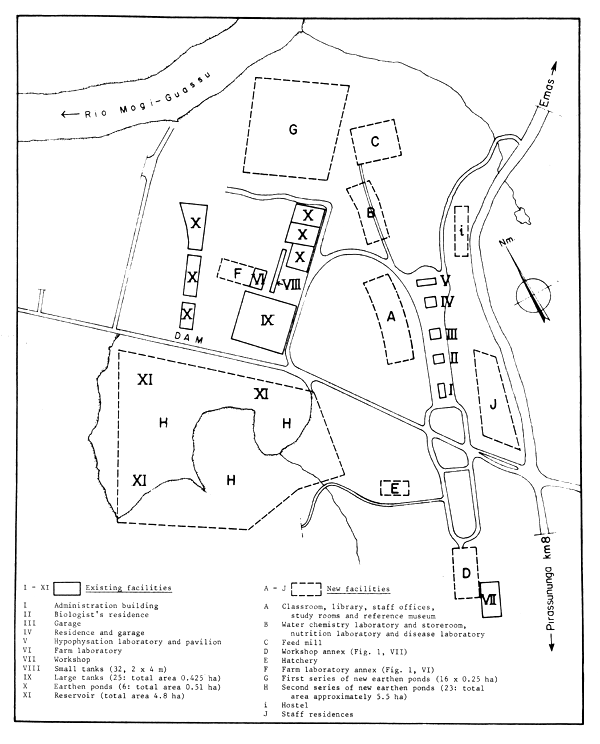
Figure 1 Plan of the Experimental Biology and Pisciculture Station in Pirassununga showing the proposed additions
To the south of the existing tanks and ponds there is a reservoir of about 4.8 ha (Fig. 1, XI) supplied by water from a spring which issues from the base of an old lake bed located at the southern end of the station property.
The existing ponds and tanks should make it unnecessary to construct any more small ponds in the centre. There is, however, a need for larger ponds for experiments and training. For experimental use, such ponds should be of similar size, depth, soil characteristics, and if possible, shape.
A topographic survey was made of the area deemed to be most suitable for pond construction (Fig. 2). The total area of land owned by the station is 266 ha, of which the survey covered approximately 45 ha. The area between the existing ponds and tanks (Fig. 2) and the river offers the most suitable conditions for a series of additional ponds. A soil survey was therefore made in this area, and the soils, which may be described as heavy loamy clay, were found suitable for pond construction.
If further addition of experimental ponds is considered necessary, at least six more hectares of suitable land should be available immediately for the purpose outside the surveyed area.
The data available in the station records show that hardness of the water presently used in the ponds and tanks is low (20–28 ppm as total carbonates). Consequently there is little natural buffering action and liming may therefore be necessary to achieve reasonable production levels. The pH of the river water varies from 7.0 to 7.5, but the pH levels in the station tanks and ponds one year after the reservoir was constructed were 4.6 at the spring source and 7.1 in the reservoir. Some of the ground water at the station is high in ferrous ions, while other nearby water is not.
Total yearly rainfall at the station averages 1.5 m. Most of this (ca 70 percent) occurs in the six-month period from October to March, which is also the warm season. Totally cloudy days are rare during the cool season from April to September.
Ground water temperature is 20°C ± 1°C, and hatchery water may require heating for the propagation of certain species. This could be accomplished by solar heating, since the winter months are mostly sunny.
As can be noted in Fig. 3, water temperatures in the river are somewhat above air temperatures. Water temperatures in the reservoir and in the tanks average somewhat above river temperatures.
The pronounced winter-summer water temperature changes would slow the growth of tropical species during the winter period. However, it should be possible to obtain production data for tropical species during the summer months (November-April), and for temperate species during the winter (May-October). This adds to the usefulness of the station.
The water quality and temperature conditions in Pirassununga and neighbouring areas in the State of Sao Paulo seem to be suitable for experimental work on most freshwater species selected for production programmes in Latin American countries, including some coldwater species.
Since enough suitable land is available on the station for the construction of additional ponds, a hatchery and other required facilities, the only major factor which could limit the suitability of Pirassununga Station as a regional centre is additional water supply. The existing water supply is derived from springs and seepage as described earlier, and is estimated to be about 35 litres/sec. Additional ponds can be operated with only this amount of water if necessary storage facilities are built, but it was considered clearly advantageous to have additional supplies to allow flexibility in operations.
The river Mogi-Guassu, which borders the station, was considered as a possible additional source of water. It is situated at a much lower elevation than the station property and carries a rather high silt load, especially during the wet season. It is also subject to wide variations in flow, partly due to the pronounced dry and rainy seasons. The water is reported to be polluted by industrial and domestic waste discharges. Because of these reasons, particularly the pollution, it does not appear advisable to depend on river water, except in an emergency.
An alternative is a series of shallow wells dug in selected areas in the station. Investigations indicate that at least modest amounts of water would be available from shallow wells. A shallow well is the present source of water supply to the station headquarters. Further, a hole dug for soil sampling in the area between the present ponds and the river was found to yield water at 1 m depth, yielding about 2 litres/sec. At the request of the mission, the station authorities arranged for a test well to be bored at a selected site just above the proposed reservoir (Fig. 2, R2). This site was chosen for its proximity to the ponds and the possibility of constructing a small reservoir just below the site whereby water could be delivered to all ponds by gravity flow. Although the test well was originally intended to be a deep well, the equipment used was not suited to this purpose. The 15-cm diameter test well indicated an output of water of 8 litres/sec, from a shallow gravel layer. Water table was about 25 cm below ground level.
These facts indicate that shallow wells are feasible, but the number which would have to be developed to add a significant amount of water presents some problems in maintenance and in incorporating them into a single water supply system. If, however, it becomes necessary to use shallow wells, it is recommended that they be located in the area of the test well described above.
Another alternative would be to construct a water collection system in the area of the above-mentioned test well. Collector pipes could be installed in the gravel layer found during drilling of the test well. The collector pipes could be joined to a pipe leading to the reservoir (Fig. 2, R2). If the water table is too low to permit gravity flow it will be necessary to lift the water into the reservoir with a pump.
A third alternative would be the installation of a single deep well, preferably in the area just south of the reservoir (Fig. 2, R2). It is recommended that another test well, using suitable equipment, be drilled in this area to determine its feasibility. If water of suitable quality and in excess of 30 litres/sec can be obtained, this would be the alternative of first choice. Deep well water is usually uniform in quality and quantity, and a single source reduces maintenance problems.
If a satisfactory deep well cannot be built, then a water collection system would become the most suitable alternative. In case this system also does not provide a desirable quantity of water, one or more shallow wells should be constructed to supplement the existing supply.
In any case, a shallow well should be dug to supply the proposed hatchery. Hatchery water must be from a source free of wild fish and so it is preferable to use well water for this purpose. Its location should be near the proposed hatchery. A shallow well in this area is presently supplying the station headquarters with adequate amounts of good quality water. This was one of the factors considered in choosing the hatchery location.
The proposed layout of the experimental farm is shown in Fig. 2. It is suggested that the construction work should be done in two phases. During the first phase a series of 16 ponds of identical size of 0.25 ha (total 4 ha) should be constructed in the area between the existing ponds and the river (Fig. 1, G). Since this area has been largely under continuous cultivation very little removal of vegetation for levee bases will be necessary. Levees should be well compacted during construction and should have 3-m wide tops and 2.5:1 slopes. Settled elevation of levee tops are the following:
Levee elevations
| (1) | 538.0 |
| (2) | 538.0 |
| (3) | 538.5 |
| (4) | 538.2 |
| (5) | 538.2 |
| (6) | 538.2 |
| (7) | 539.0 |
| (8) | 535.5 |
| (9) | 535.5 |
| (10) | 535.5 |
| (11) | 535.5 |
| (12) | 536.0 |
| (13) | 538.8 |
| (14) | 538.4 |
| (15) | 538.8 |
| (16) | 539.2 |
Soil for levee construction can be obtained from the pond area. Pond bottoms should slope gradually (1:1 000) toward the drain. Approximately 10 m from the drain the bottom may be sloped to form a shallow basin, 15–20 cm in depth, around the drain (see cross-section Fig. 4).
Drain lines should be placed before levee construction is begun. This will permit the area to be drained if rain occurs during the construction period. The lowest pond in each series has to be constructed first. In some cases soil from adjacent ponds can be used to balance cut and fill. Drain line elevations for the 16 ponds follow:
Drain elevations
| (1) | 535.0 |
| (2) | 535.0 |
| (3) | 535.5 |
| (4) | 535.3 |
| (5) | 535.2 |
| (6) | 535.2 |
| (7) | 536.0 |
| (8) | 535.7 |
| (9) | 535.6 |
| (10) | 535.5 |
| (11) | 535.5 |
| (12) | 536.2 |
| (13) | 535.5 |
| (14) | 535.5 |
| (15) | 535.8 |
| (16) | 535.8 |
All drains in this series should be of heavy duty PVC, with a diameter of 6 inches (15 cm). An elbow, with a riser of appropriate length, has to be installed in each pond to control water elevation. Drains should be screened to prevent escape of fish. Bottom water can be removed by placing a larger diameter pipe, extending above the water surface, over the 6-inch (15-cm) drainpipe. Drain lines should be placed in the toe of the levee slopes to facilitate access, if necessary, and to permit construction after emplacement without danger of damaging the lines.
Inlet lines should also be of 6-inch (15-cm) diameter PVC and should be installed in a shallow trench in the centre of the completed levees (Fig. 2). Branch lines to each pond have to be connected to the main inlet lines and water control should be effected by means of low-pressure valves or cutoffs. Inlet lines may be covered with soil to prevent damage after installation.
The 16 new ponds described above, plus the ponds and tanks already in existence, can be operated on the amount of water now available at the station without major changes in the water delivery system. However, the addition of ponds to be built during the second phase of construction will require new water sources or water storage facilities.
As shown in Fig. 2, it is recommended that two water storage reservoirs be constructed: R1 and R2. R2 will be required only if the additional source of water is a deep well or the water collection system described earlier. In this case R1 need be only relatively small as its use would be water distribution control. However, if no additional source of water is found, it is necessary for R1 to have adequate storage capacity in order to enable filling at any one time up to 12 ponds that may be required for a series of experiments (about 30 000 m3).
It should be noted that the storage reservoir of the main water supply system (R1) also serves to direct runoff water from the pond area and as a source for inlet water to the ponds. The water supply line from the reservoir is connected to the open ditch receiving seepage water and water from the proposed deep well reservoir. The line from the storage reservoir (R1) to the open ditch should be of at least 10 inches (25 cm) diameter to facilitate rapid filling of the ponds.
During the second phase of construction, the existing reservoir should be drained and a second series of ponds constructed in the drained area (Fig. 1, H). Of the 23 ponds recommended to be constructed in this area, 21 can be of the same size (0.25 ha) as in the first series. Two will be slightly smaller. Total pond area will be approximately 5.5 ha. Construction of levees and placement of drain and inlet lines should be as described for ponds in phase one. It is suggested that some of the additional pond construction be done during the training session to give trainees practical experience in the various aspects of pond design and construction. Also, as noted elsewhere, there is an area of approximately 6 ha located near the proposed deep well and in the present orchard area which is suitable for pond construction, if additional ponds are needed as the station is developed.
The estimated cost of construction of additional ponds and storage reservoir is as follows:
| U.S.$ | |
| Land clearing - 60 hours at $16.50/hour | 990 |
| Pump reservoir construction - 60 hours at $16.50/hour | 990 |
| Reservoir and drain | 1 000 |
| Ponds, 11.75 ha at $3 000/ha (includes inlet and drain lines) | 35 250 |
| Pipe from reservoir and well - 2 000 m at $7.50/m | 15 000 |
| Valves (low pressure) 40 × 10 cm at $25 | 1 000 |
| Well | 3 000 |
| Pump - 25 cm; 125 litres/sec | 2 500 |
| Incidentals | 5 000 |
| Total | 64 730 |
A hatchery (Fig. 1, E and Fig. 5) is recommended to be built southwest of the administration building (Fig. 1, I). A separate well should be dug to supply the hatchery as mentioned earlier. The pump from this well will discharge into a tank. The water in the tank should be aerated with compressed air or by agitation. Two pumps will deliver water from this tank to the storage tanks for the hatchery. One pump will discharge into a cold water storage and the other through a solar heater to a warm water storage tank.
A second solar heater will be used to maintain temperatures in the warm water tank at 50°–60°C. A mixing valve will be installed between the warm and cold water lines in the hatchery building to maintain the desired temperature. The solar heater may operate on differential water densities and may not need pumps. A photocell should be used to interrupt the pumping of cold water into this tank during the night. The solar heaters will be located on the roof of the hatchery and adjacent to the warm and cold water storage tanks.
The hatchery building is suggested to be 60 m2 in size and may have four tanks (as listed in the equipment list below) for holding fish for maturation and spawning, and for rearing larvae and fry until they are moved to outdoor tanks and ponds. There will be four tanks for hatching and rearing of larvae, as well as a series of separate hatching jars. This design will provide the basic facilities for spawning, hatching and rearing of larvae of all the species of fish proposed to be studied in the centre.
The estimated cost of construction of the hatchery and the equipment required for it are detailed below:
| U.S.$ | |
| Hatchery building 60 m2 at $150/m2 | 9 000 |
| Hot water storage tank 64 m3 | 5 500 |
| Cold water storage tank 48 m3 | 3 000 |
| Pump tank 8 m3 | 500 |
| Solar heaters (2) including piping, glass, valves | 3 000 |
| Brood fish tanks 1 × 1 × 4 m plastic or equivalent, 4 at $500 | 2 000 |
| Hatching tanks, 2 at $500 | 1 000 |
| Holding tanks, raceway type, 2 at $300 | 600 |
| Hatching jars | 2 000 |
| Pumps - 150 litres/min at 2 kg/cm2, 6 at $150 | 900 |
| Pumps - 300 litres/min at 1 kg/cm2, 2 at $250 | 500 |
| Mixing valves | 500 |
| Valves, plumbing, screens, nets | 2 000 |
| Incidentals | 3 000 |
| Total | 33 500 |
