 |
Work Plan Implementation (Working Paper) SCS/79/WP/84
SOUTH CHINA SEA FISHERIES DEVELOPMENT AND COORDINATING PROGRAMME
REPORT ON SECOND REGIONAL CONSULTANCY LOW-COST WATER FILTRATION
|
SOUTH CHINA SEA FISHERIES DEVELOPMENT AND COORDINATING PROGRAMME
Manila, Philippines
November 1979
NOTICE OF COPYRIGHT
The copyright in this publication is vested in the Food and Agriculture
Organization of the United Nations. This publication may not be reproduced,
in whole or in part, by any method or process, without written
permission from the copyright holder. Applications for such permission
with a statement of the purpose and extent of the reproduction desired,
should be made through and addressed to the Programme Leader, South
China Sea Fisheries Development and Coordinating Programme, P. O. Box
1184, MCC, Makati, Metro Manila, Philippines.
REPORT ON
SECOND REGIONAL CONSULTANCY
LOW-COST WATER FILTRATION
by
George S. Cansdale, B.A., B.Sc., F.L.S., M.I.W.E.S.
Consultant
Project Document Identification
Work Plan Activity: 4 (e) (f)
4. Aquaculture
The objective will be to establish a programme of action for aquaculture
development through the improvement of cultural practices in existing
areas in particular countries, and the development of new areas. The
Work Plan will be implemented through a permanent South China Sea Programme
staff member and consultants. The work of consultants will usually
be carried out in the individual countries; there will also be desk
studies and consultations at the Programme's headquarters. The work will
commence in 1974, and will continue over five years of the Programme.
The work will involve:
Assistance in training of technical personnel - Training of technical
personnel through fellowships and regional activities, e.g. working
parties.
Aquatic pollution - It is intended to include on the staffing for
Phase II specialization in aquatic pollution. Consultants should
assist participating countries to minimize the impact of pollution,
and elaborate and formulate project proposals for UNDP and/or bilateral
agencies for possible funding. Programmes should include the
protection of living aquatic resources from the influence of domestic
and industrial wastes, related legal aspects af pollution
control, industrial development and pollution, and advice on national
monitoring programmes. Funds should be allocated under the fellowship
component to allow for trained personnel in the region to travel
to appropriate working parties.
Hyperlinks to non-FAO Internet sites do not imply any official endorsement of or responsibility for the opinions, ideas, data or products presented at these locations, or guarantee the validity of the information provided. The sole purpose of links to non-FAO sites is to indicate further information available on related topics.
This electronic document has been scanned using optical character recognition (OCR) software. FAO declines all responsibility for any discrepancies that may exist between the present document and its original printed version.
INTRODUCTION
ABSTRACT
ACKNOWLEDGMENTS
1. ITINERARY AND ACTIVITIES
APPENDICES
Appendix 1 Extracts from a Report to: Mr. Bienvenido
N. Garcia, Deputy Commissioner, National
Pollution Control Commission, Manila
Appendix 2 Navotas Harbour - Sea Water Supply
Appendix 3 Investigation of Potential Sub-Sand Sources
of Water at Miagao for New Campus for
Fishery Faculty, U.P.
Appendix 4 Comment on Community and Industrial Water
Supplies - Philippines
Appendix 4-A Copy of a Letter to Col. Rogelio L. Luis,
Executive Director, Presidential Management
Staff, Office of the President Following a
Briefing at the Malacañang Office
Appendix 5 Sea Water Intake: appangi Point Fisheries
Complex, Singapore
Appendix 6 Penang - Sea Water Intake for Researapp
Institute and Aquarium
Appendix 7 Sea Water Abstractions in Capt. Hughes Bay
and Ban Lamung
Appendix 8 Ban Lamung - Note on Iron Pollution
Appendix 9 appaappeongsao Fishery Station
Appendix 10 Community Water Supplies for Phang Nga
Project
Appendix 11 Thailand: Conclusions
Appendix 12 Equipment
REPORT ON SECOND REGIONAL CONSULTANCY
LOW-COST WATER FILTRATION
by
George S. Cansdale, B.A., B.Sc., F.L.S., M.I.W.E.S.
Consultant1
Following the successful visit of the consultant George S. Cansdale to
Southeast Asia in October-November 1978, and the publication of the Working
Paper SCS/79/WP/80 in February 1979, FAO received several urgent requests
from government departments in the region for a follow-up visit by the consultant.
The requests came from the Philippines, Thailand, Malaysia and
Singapore.
The South China Sea Fisheries Development and Coordinating Programme
undertook the responsibility of arranging and directing the consultancy in
close cooperation with the governments concerned and the relative FAO and
UNDP offices. Funding was obtained from a variety of sources. The FAO country
representative in the Philippines contributed towards the cost of the
Philippine visit. Two FAO projects in Thailand contributed towards the cost
of the Thailand visit. These were THA/75/008 Programme for the Expansion of
Freshwater Prawn Farming in Thailand, and THA/75/012 Programme for the Formulation
of Pond Management Techniques. The bulk of the overall cost was
shared jointly by the Indian Ocean Programme and the South China Sea Programme.
Like the previous visit, this consultancy was a wide ranging one and
several formidable problems were tackled and solutions developed in the very
limited time available. Various techniques had to be adopted to suit particular
conditions but all situations tackled were successfully dealt with.
This is a tribute to the ingenuity and tenacity of the consultant and to the
enthusiastic support and cooperation of the many government officers and FAO
field staff involved.
The primary interest of the FAO Fisheries Department in the system is in
relation to the benefits it can bring to fish farms, fish markets, and ice
plants. But the greatest potential lies in village water supplies as the
system could provide rural communities in the tropics, with an abundance of
clean potable water at a very modest cost. This aspect has not been overlooked.
The successful demonstration at Marikina River, Manila on 30th August was
brought to the attention of the Office of the President at which the consultant
was asked to brief Presidential staff on 5th September. As a
result, the government has decided to consider using the system, to considerable
benefit and cost saving, in the Bicol River Basin Project.
Much follow-up work remains to be done in each of the countries visited
so that local technical officers can acquire competence in the technology
and so that fish farmers, fish plant and market managers and village
authorities can be made aware of the benefits of the system. This further
report on the subject is issued by the South China Sea Programme as a small
step in that direction.
The report gives details of water filtration work undertaken by the
consultant in the Philippines, Singapore, Malaysia and Thailand. Both marine
and freshwater situations were tackled using SWS steel screen wells, box
units and mini units. The appendices give fuller details of the problems
encountered at each site, and of amendments to the system designed to overcome
those problems. Not all sites were difficult, but many required a
custom-designed modification to the system.
This brief mission began with a request for follow-up work in the
Philippines planned by the South China Sea Fisheries Development and Coordinating
Programme, and a visit to Thailand under the auspices of the Programme
for the Expansion of Freshwater Prawn Farming in Thailand, where the
hatcheries had major water problems. An appeal for help in planning a sea
intake for the Fisheries Research Institute at Penang was received and this
was added to the itinerary. During briefing at Rome a further request was
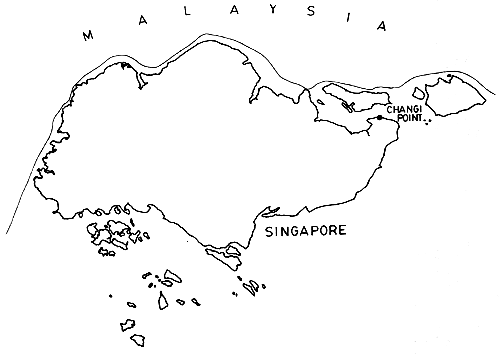
made -- for assistance with the intake at the Changi Point Fishery Complex
at Singapore -- and it was possible also to include this. During the stay
in Manila further projects called for attention, as listed in the itinerary
and activities of the report.
To numerous officials, both senior and junior, I am grateful for encouragement
and entertainment. Rather than offend by unwitting omissions or
spelling errors I feel it is best to thank them all collectively, especially
including those who worked alongside me in the water and proved to be apt
pupils.
| August, 1979 |
| Monday, 20th | Left London for Rome. |
| Tuesday, 21st | At FAO HQs, Rome. Meetings with Messrs. Henderson, Isarankura, James, Payne, Pedini and others. Left Rome 2050H. |
| Wednesday, 22nd | Arrived Singapore 1700H. |
| Thursday, 23rd | At Singapore. |
| Friday, 24th | Public holiday. At Changi Point Fishery Station with Mr. Chen Foo Yan to plan work on new sea intake. Left Singapore 1400H. Arrived Manila 1700H. |
| Saturday, 25th | Visited areas near Manila to advise on water abstrac- tion from streams and rivers for community supply, concrete block factory, etc. |
| Sunday, 26th | At Manila. |
| Monday, 27th | Meeting with Mr. Dall (FAO) and members of the British Council staff. Planning schedule of work with David Thomson. Discussion with technical members of World Bank Mission on water supplies for the new fishery faculty U.P. being built at Iloilo. At BFAR to plan clean sea water supply at Navotas Harbour and else- where. |
| Tuesday, 28th | Meeting with technical members of World Vision re water supplies for small and isolated communities. Meeting with Mr. Bienvenido N. Garcia, Deputy Com- missioner of National Pollution Control Board to discuss aspects of industrial effluent treatment and provision of emergency water supplies during flood conditions. (Aide memoire in Appendix 1). |
| Wednesday, 29th | At FAO office for correspondence and preparing reports. Planning clean sea water supply system for fishing harbour with Mr. Svend Kelson, FAO Consultant. Afternoon. To Marikina river to instruct in instal- lation procedure and prepare for demonstration on 30 August. |
| Thursday, 30th | Lecture at BFAR to c. 24 persons representing a wide range of Government Departments and Welfare Organ- isations, including Office of the President, NEDA, IBO, EDPITAF/UP, and British Council as well as Bureau of Fisheries. The meeting adjourned to the Marikina River where successful demonstrations of sub-sand abstraction were given in water very dirty after recent rains. |
| Friday, 31st | At Navotas Harbour with officials and engineers com- pleting design for clean sea water intake to supply distribution system under construction on the main fish wharf. Probing and test pumping located a bed of shell/sand under c. 4.5 m water: there was only a thin layer of mud in contrast to nearly 1 m off the small fishing wharf previously explored. Measure- ments were made to allow fabrication of corrosion- proof pipe extensions and fittings suitable for per- manent use but unfortunately these could not be obtained before my departure. (See Appendix 2 for detailed instructions) |
| September, 1979 |
| Saturday, 1st | At Manila working on reports. |
| Sunday, 2nd | To Iloilo by air; at request of World Bank Mission. |
| Monday, 3rd | At Iloilo meeting officials concerned with planning new Fishery Department U.P. Running assessment trials in 2 rivers and sea. Discussion with offi- cial about possible sub-sand intake for SEAFDEC Department. Return to Manila 2100H. |
| Tuesday, 4th | At FAO Office. Meeting with Mr. Arthur G. Woodland (FAO/SCSP). Preparation of recommendations for Iloilo water supplies and presentation to members of World Bank Mission and staff members of Fisheries Faculty. (See Appendix 3). |
| Wednesday, 5th | Office. Meeting with Executive Director, Presiden- tial Management Staff of the President of the Philippines' office (Col. Rogelio L. Luis) and staff to discuss low-cost village water supplies. An aide memoire was then prepared, a copy of which is included in the appendices. |
| Thursday, 6th | To Singapore. Meeting with staff of Aquaculture Unit, Changi Point Fishery Complex, and exploration of beach and foreshore. Pumping trials begun. |
| Friday, 7th | At Singapore. Beach survey and quality pumping trials continued, collecting data to design intake for c. 24,000 g/h continuous of pre-filtered water. Further discussion with technical staff. (See Appendix 5) |
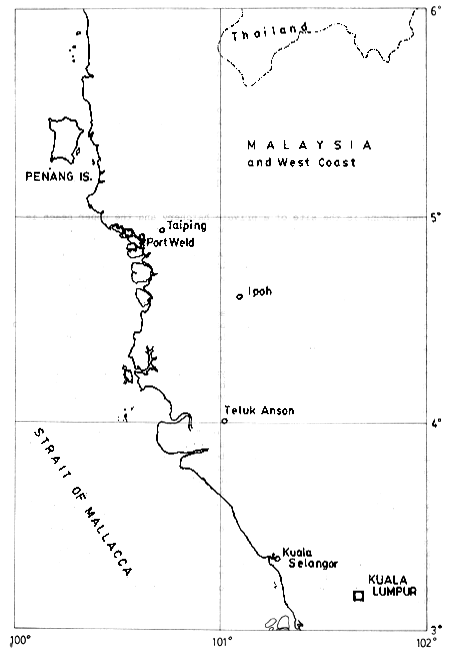
| Saturday, 8th | To Penang. At Research Institute with Mr. Ong Kah Sin. Aquaculture, planning survey programme and assembling equipment. |
| Sunday, 9th | Visits to several rubber plantations in Central Malaysia to discuss problems of sub-sand abstraction from turbid rivers and tertiary treatment of factory effluent from facultative and aerobic lagoons. |
| Monday, 10th & Tuesday, 11th | Beach survey and pumping trials to collect data for planning intake for 50,000 g/d, by either continuous pumping or a convenient batch regime. This is a site with many adverse factors, but a supply of high quality water will be possible. Site details and suggestions for this are given in Appendix 6. |
| Wednesday, 12th | To Kuala Lumpur. |
| Thursday, 13th | At Kuala Lumpur. Discussion with UNDP/FAO. Prepar- ing reports for Changi Point and Penang sea intakes. |
| Friday, 14th | To Bangkok 0715H. Planning meeting with Michael New (FAO) and officials of the Fisheries Department. |
| Saturday, 15th | Visits to Chacheongsao Fishery Station, a proposed new government hatchery site at Capt. Hughes Bay and a private Macrobrachium hatchery at Ban Lamung. At Capt. Hughes Bay and Ban Lamung there was direct access to beaches ideal for sub-sand abstraction and successful demonstrations were made at each site. See Appendix 7. Also Appendix 8 re iron pollution. |
| Sunday, 16th | At Bangkok. |
| Monday, 17th | Meeting with officials of USAID, Ministry of Public Health Dr. Suang, Chief of Sanitation Technique (2), WHO, Mr. B.J. Kukielka, FAO, and other interested persons to plan demonstrations of sub-sand working in natural and artificial sites. Afternoon to ESCAP to meet Mr. Chung dew Wang and Mr. Edmund F. Schulz of Water Resources Section. |
| Tuesday, 18th | To NIFI. Discussion with Dr. Alexander Fedoruk about general use of sub-sand abstraction; also with John Coleman, Water Quality Scientist funded by USAID and other fishery officials. Discussion with Mr. Akadij Artechinda at the Faculty of Engi- neering about village water supplies for the Phang Nga project (see Appendix 10). Afternoon discussions with Dr. Kitjar Jaiyen, Depart- ment of Fisheries about water supplies for hatcheries. |
| Wednesday, 19th | To Chacheongsao. An artificial bed was created in a large concrete tank in which a village unit was suc- cessfully installed and developed. This will be used to filter the water drawn from storage to supply the hatchery. Methods of using the mini-unit in recircu- lation systems were also shown. The above techniques are covered fully in Appendix 1 and 5 of the Working Paper SCS/79/WP/80. Further suggestions for applying these systems at Chacheongsao are given in Appendix 9. Return to Bangkok. |
| Thursday, 20th | Office. Preparation of report. Discussion with Dr. Piamsak Menasveta of Chulalongkorn University about the use of sub-sand abstraction in Macrobrachium culture, with special reference to pre-filtered sea intakes. |
| Friday, 21st | To Chacheongsao Fishery Station for demonstration of artificial systems installed on 19 September. Those present included Mrs. Medina Delmendo (FAO), John Coleman, Dr. Alexander Fedoruk (FAO & NIFI), members of USAID team headed by Wayne Slotton. To Ban Lamung to demonstrate installation of SWS unit in beach gravel: the use of stainless steel well screens for exploiting deeper sand strata and also methods of beach survey and assessment. Return to Bangkok. |
| Saturday, 22nd | To Khao Yai National Park and return to Bangkok. The opportunity was taken to travel through the area at Saraburi where a major hatchery and fisheries station is being planned with Asian Development Bank funds. Although the proposed site is just off the actual central plains and its very slightly higher elevation (measured in few meters) allows rather better tree cover and less universal flooding, the canal/river system from which the water will be drawn is always turbid and this will require treat- ment before use in the hatchery and fry stages. An artificial bed, as demonstrated at Chacheongsao, is recommended, preferably in a concrete tank into which the raw water will flow. Procedure should be as outlined in Appendix 9. Rocky hills within a few kilometers will provide ample material for stone crushing, including both limestone and igneous rocks, but it is also possible that stream beds may yield valuable material which may not even need classifying. There was not time to check on this, but it was confirmed that there are excellent deposits of sand/gravel in some of the streams flow- ing out of the national park. |
| Sunday, 23rd | At Bangkok. |
| Monday, 24th | Left Bangkok 0010H and arrived London 1100H. |
Figure 1
ACTION OF SWS WATER FILTRATION SYSTEM
Suitable for gravel and sand bed rivers, streams and sea shores.
In unsuitable sites, artificial bed is used.
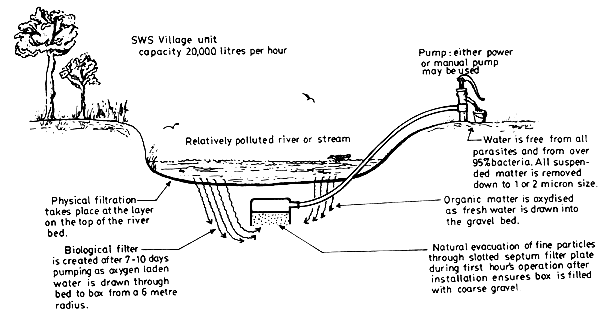
ref. Cansdale, G. Low cost water filtration, FAO SCSP/79/WP/80 Manila 1979
by
George S. Cansdale
FAO Consultant (SWS Ltd.)
The Consultant begins by referring to the original report on low-cost
water filtration, SCS/79/WP/80, a copy of which was attached to this aide
memoire:
“While much of it relates to water problems within the fishing industry,
many of its solutions worked out are of general application and I feel that
the method outlined in Appendix 5 on p. 42, which is also involved in Appendix
3 on p. 37, might well be of value as a low-cost emergency filter for
flood water. As described, it is for use in a large aquarium tank but we
are already using it in Britain and elsewhere for supplying water to households.
Any plastic container can be used if it is strong: we normally use
P.V.C. cisterns of 45 cm × 30 cm or C 40 cm diameter. The gravel should be
2–5 mm or close to that range, with surface of 5 cm clean sand.
Although a small electric pump is mentioned, the system works equally
well with a small hand pump. This should not be able to deliver more than
1 m3/h, for that is maximum capacity of this small system. It shall be
pumped to waste for at least 15 minutes to establish it and form a good
filter surface. After that we would expect it to remove suspended particles
down to about 3 micron, including larvae, etc., and also up to 50% of total
bacteria. The main bacterial control is by biological filter which takes
perhaps 8 days to build up at local temperatures. Because the organic debris
has been removed, only low chlorine dosage would be needed to sterilize the
filtrate.
As regards costs, this mini-unit retails in U.K. for ₤25 but your local
labour costs are much lower and I would expect it to be distinctly less here.
If you feel that this can be of value, we shall be glad to draft a small
instruction card about it.
As regards pollution control generally, we are only now moving into
this work. We have recently been approached by a large company specializing
in this with a request for rights to use our system. We believe that its
cost-effectiveness can make it very useful, especially to the small factory,
one of its big advantage being that a test can be made quickly and cheaply”.
The consultant ends his report referring to his own background in ecology
and expresses his personal interest in combating pollution.
Figure 2

During my time in Manila it was impossible to obtain suitable non-metallic
pipes and fittings to complete the work. The armoured rubber hose could not be
fixed securely to the only pipe obtainable when the trial was conducted (a 6 m
length of 2" g.i. pipe) but enough pressure was generated to insert the jet
probe, which showed that under c. 4 m water the shell/sand bed was covered by
only a thin layer of silt/mud. This contrasts markedly with the smaller harbour
where earlier tests had shown the silt layer to be up to c. 1 m deep.
Before the pipe connection finally broke down the source had been test-pumped
for long enough to show that the shell bed can become a good source of clean
sea water.
The water consumption will not be even through the day but water will be
drained at c. 8,000 g/h for 6 or 8 hours. An 8 hp pump has been ordered which
will fill the storage quickly: twin wells will allow this. The following
intake system is recommended.
Two (2) stainless steel screen wells. One of 2" × 12" length is
already at the harbour. A further screen well of 3" × 12" is at FAO
HQ Manila. (Since this larger well might be difficult to insert at
a distance, it is probably better to supply a second screen of 2"
× 12" and use the 3" screen where the water is shallower).
Two (2) rising pipes of 2" Durapipe or heavy PVC, c. 7 m long. It
is essential to connect these to the screen wells by strong plastic,
non-corrosive, fittings, and not by iron joints.
Sufficient flexible armoured hose from the end of each rising pipe
and pump chamber, with strong permanent connections.
Method
The yellow test probe left with FAO at Bangkok is being returned to Manila
shortly and will be available for jetting down to locate a suitable site: the
steel screen well can then be pushed down alongside it. This needs careful
placing and it may be best to tie together lightly the yellow probe and steel
screen, each fixed to its PVC extension. Once the correct depth has been
reached, as tested by sucking from one or other and with the top of the screen
not less than 1 m deep, the yellow screen is withdrawn. It may prove simpler
to use the jet end of the steel probe of SCS/79/WP/80 (Appendix 12) fixed
firmly to a stout PVC pipe, in place of yellow probe.
When the screen well is in position develop very fully, with stop/starts
and several short periods of pumping back, until the pump is at full volume
and water is crystal clear. Repeat for second screen well at not less than 6
m distance.
Placing
The presence of fishing boats close to the wharf restricts the choice
and necessitates a site rather close to the wall. If possible the screen
should be inserted diagonally, taking it away from the wall but ensuring
that it is clear of any ship's hull. At the same time this brings the top
of the PVC pipe closer to harbour wall. The precise method of fastening
the rising pipe to harbour wall, and the length of rigid PVC pipe to which
the armoured flexible hose is firmly attached, must be decided on the spot,
the main factors being protection against damage by ships and by vandals.
Unless a suitably placed drainage pipe or gully exists, a channel must be
prepared to take the pipelines across the roadway: this is used by heavy
traffic and a strong cover is needed.
Plumbing
The 2 rising mains should meet at a Y-piece close to pump intake but
with a straight run of c. 1 m from base of Y to present a non-turbulent flow
to the impeller. This pump must be self-priming and it is not sufficient
to rely on non-return valve. The two mains are jointed to Y-piece by hose
couplings and a simple plumbing modification will allow one line to pump
back the other if this is found necessary from time to time.
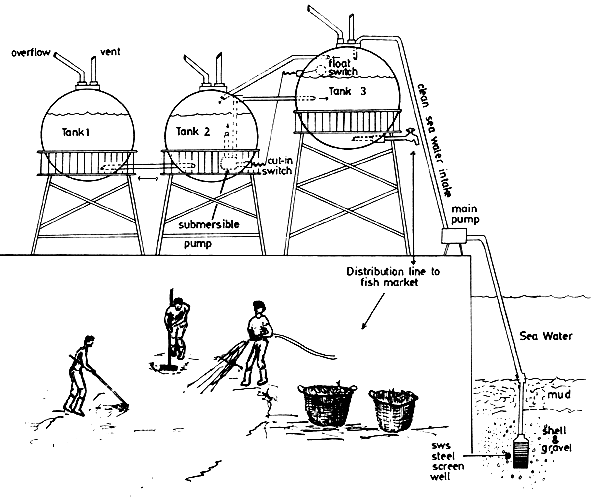
Distribution System
The design for this seems to have been settled, but the following
suggestion for convenience and efficiency is made. There is great value in
having a permanent head of water sufficient to serve the various outlets.
This could be achieved by raising just one of the 3 spherical storage tanks
to a height of c. 2 m: the pipe supplying the taps draws from the bottom.
The line from the main pump goes into this tank, with overflow to No. 2,
which is connected to No. 3 by a pipe at low level. A submersible pump, on
float switch controlled by level in tank No. 1 will keep this full when
demand requires. The diagram below suggests the connection.
Water Quality
It has been shown that physically clean water can be provided. It is
expected that bacteria will be greatly reduced but the parameter must be
monitored after about 10 days pumping on the pattern likely to be used.
figure 3 NAVOTAS FISH MARKET INSTALLATION
Three supplies will eventually be required:
500 g/m for the campus community, including both potable and general
purpose water.
At a rather later stage, 500 g/m for servicing fish farms.
200 g/m sea water for the Marine Laboratory complex near the beach.
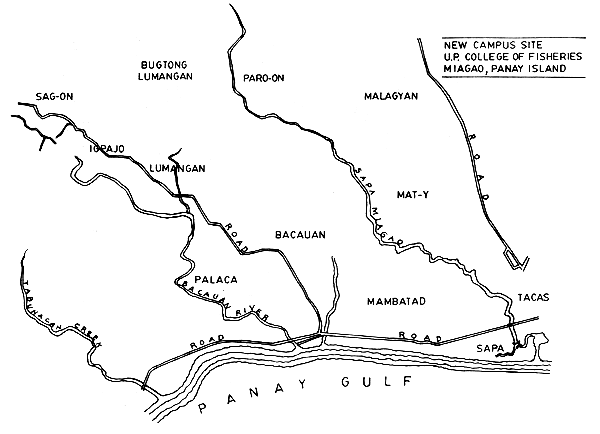
At the request of the World Bank Mission the general area of the above
was inspected on 3rd September in company with Prof. Dureza of the Fishery
Faculty, and Prof. B. Ravena, a member of the committee concerned with
planning.
Site 1
If surface water is used, the most likely site will be in the section
of the river described as Bagumbayan. The width varies but is an average
of c. 40 m. Flow is not continuous across the whole bed and varies in
depth from a few cm to c. 50 cm. Assurance was given by the staff that the
dry season flow does not fall below the required 500 g/m, plus that already
being taken for community use nearer the river mouth. There was no way of
confirming this at this season. The bed consists of typical water-worn
gravel with the following size ratio -1 mm 34%, 1–5 mm 49%, +5 mm 17%,
which is ideal for sub-sand abstraction. However, there are large numbers
of stones up to at least 20 cm in diameter throughout the bed but not firmly
compacted. This is said to be of such a depth that no dam can be constructed
because water could always find its way through the underlying gravel.
At least 1 km of this reach seemed to be of this general character and
therefore equally suitable for use: the point most accessible to the storage
and distribution center can thus be chosen.
Although the large stones made deep penetration of the bed impossible,
the test probe was inserted far enough to demonstrate sub-sand abstraction
and to confirm that the bed made a most effective filter.
Site 2
Site 2 was on a smaller river at Lumangan, at a point just below the
confluence of two main streams. The general character of the bed closely
resembled that of Site 1 and the gravel is clearly derived from similar
parent rocks, largely igneous, with much granite breakdown and quarzite.
No opinion was offered of the flow at different seasons but it was stated
that in the dry season the stream runs beneath the bed surface at some
points. Since the permeable gravel appears to be of considerable depth
this might still yield a useful volume, but only dry season trials would
quantify this. The surface water was too hot for fish pond use but subsand
abstraction would tap the buried cooler zone and perhaps be of an
acceptable temperature.
Fresh Water - Recommendations
The river at Site 1 has apparently sufficient flow to supply all water
needed. With minor bed modification, i.e. the removal of large stones by
hand or by machine, this can be made into an excellent sub-sand abstraction
zone. It is expected that only minimum further treatment will be needed,
including low dosage chlorine for the potable supply. Water for general
use and irrigation would not need this. This work can be undertaken by a
local company and in a brief interim report made to the World Bank Mission
on 4th September, the cost of such a system was suggested at around  130,000
at current costs. In the absence of some basic facts, such as the siting
of storage, etc., and in the 12 hours available between return from Iloilo
and meeting the Mission again, no detailed figuring was possible, but the
above is considered to be of the right order of magnitude. It includes
the abstraction system, primary pumps, and polishing treatment -- either
chlorine or U/V -- for the potable water. It does not include piping, etc.
beyond the pumps.
130,000
at current costs. In the absence of some basic facts, such as the siting
of storage, etc., and in the 12 hours available between return from Iloilo
and meeting the Mission again, no detailed figuring was possible, but the
above is considered to be of the right order of magnitude. It includes
the abstraction system, primary pumps, and polishing treatment -- either
chlorine or U/V -- for the potable water. It does not include piping, etc.
beyond the pumps.
It is understood that the alternative method being considered is deep
bore holes. From data available the capital cost of bore hole and pump
would far exceed the total suggested above: equally important, maintenance
of deep well pumps is much more sophisticated, while power costs
for raising the water, even from 100m, are likely to be at least 3 times
that of the surface water. It is suggested that very careful consideration
be given to alternative methods before deciding on deep wells.
Note: Fears were expressed that the current flow in the larger river
might be inadequate. Two comments are relevant:
Conservation measures, with hillside reclamation and reafforestation,
are to be undertaken. This action should help spread the flow more
evenly throughout the year and increase the minimum available.
The programme must clearly be phased to some degree. Experience in
the first dry season, when the remaining flow can be monitored, will
provide useful data, and point to any need for seasonal supplement.
Fish Farm Provision of 500 g/m
This is a later requirement and in the time available it could not
be considered. One suggestion may be made. Presumably the various sections
of the campus will have sewage treatment plants: if the effluent is of
satisfactory quality, could it be fed into the stream running through Site
2 giving sufficient time for biodegredation of at least some of the excess
nutrients, etc. to take place before it is abstracted again, sub-sand, for
fisheries work?
Supply for Marine Research Laboratories
The beach at Sapa Miagao was examined and test-pumped. The particle
size distribution seems suitable and the sand depth ample. Two complexes
of two wells each will easily supply the 200 g/m required. The beach
character suggests that very high quality water will be provided by subsand
abstraction, i.e. water free from particles down to 2 micron, including
all stages of plankton: almost complete removal of bacteria in the
biological filter zone and avoidance of bringing in warm water at low
tide. The use of sub-sand abstraction prevents any pipe fouling. No
onshore treatment is needed and the water can be fed straight into all
working systems.
Details of pump house siting have yet to be settled but a budget
price of around 60,000 is suggested. This should include pump and pump
house, assuming that this will be sited in the area immediately above
high tide.
The need for water of correct salinity is noted. During installation
this is carefully monitored before a well is finally established.
An interim report, including all relevant points in the above, was
prepared for and submitted to the World Bank Mission at Manila on 4th
September 1979.
Figure 4
Wider travel and the examination of further rivers and streams confirm
the opinion expressed in WP/80 that many water courses in this country are
ideal for sub-sand abstraction. It is most unfortunate that a strong tradition
has been established that deep bore holes are the standard and only
solution. The commitment to this method is suggested not only by the near
impossibility of persuading most engineers to consider alternatives, but
also by the fact that nearly 40 bore hole pumps are illustrated in the
Manila telephone yellow pages. Parts of the islands have little or no
surface water and here the deep bore hole may be the only technique for
tapping permanent water, but in many areas this expensive method is wholly
unnecessary. The cost of sinking a 100 m bore hole, which may be wholly
wasted, approaches 100,000 and a suitable bore hole pump can cost up to
twice this amount. The on-going costs are even more important, for a deep
well pump may use at least 3 times the power required by a surface pump
to move the same volume of water. In addition, deep bore hole water in a
volcanic country is often highly mineralized, requiring special and expensive
treatment, especially for such demanding uses as boiler feed. Where
sub-sand abstraction can be used, it is likely to show a saving of over 50%
and in many cases much higher, in capital costs alone. It is hard to avoid
concluding that deeply entrenched vested interests help to ensure the continuance
of the more expensive method.
Further scrutiny of river gravel specimens suggests that although the
actual composition varies widely these generally form very suitable media.
Analysis of two typical samples are as follows: Marikina River - 1 mm
46% (but very little 0.5 mm), 1–5 mm 43%, +5 mm 6%.
Numerous trials run in this river bed on the outskirts of Manila gave
excellent results; careful examination of the particles shows that they
are predominantly of granite and are all angular, with no sign of wear,
which suggests that they have originated comparatively near the site.
This is broadly true also for the -1 mm fraction, which includes many grains
of quartz and some pumice.
In contrast, typical gravel being dug continuously from a river south
of Manila for use as aggregate consists almost wholly of rounded water-worn
particles: this sample was much more varied in origin, with several types
of granite, schists and pumice, yet the size distribution is very similar,
with -1 mm 40%, 1–5 mm 49% and +5 mm 11%. This too would form an ideal
bed.
Figure 5
“Thank you for the opportunity to talk to you and your colleagues about
our work in low-cost filtration. We believe that the principle can be used
to bring much improved water to many small communities far outside the
reach of piped supplies and at a fraction of the cost of most other systems.
However, I must emphasize that we make no suggestion that it is the
answer to all problems. A Working Paper SCS/79/WP/80 (attached) shows how
it can be adapted to many situations. But it has no application where
water can be obtained only from deep wells. In general the river beds in
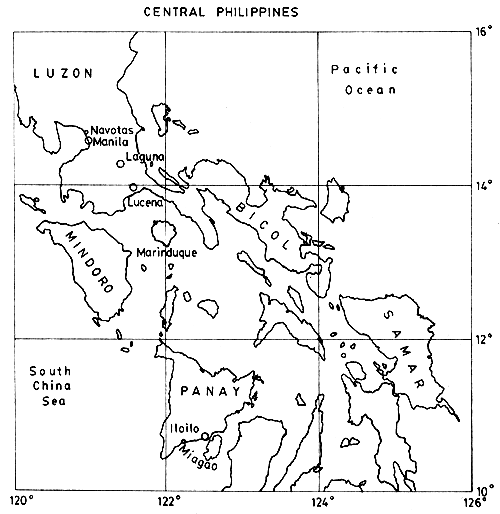
the Philippines have gravel layers ideal for working and we have been able
to abstract clean potable water from relatively polluted streams at Marikina,
Lucena, West Samar, Marinduque, and Iloilo.
The SWS system makes use of natural sand and gravel for its filter
medium. The unit normally made in GRP for strength and durability is a
simple device for cleaning the bed and making it more porous, and then for
abstracting the water that has been cleaned by passing through the gravel
bed. Filtration takes place in two parts: (i) the physical cleaning of
the water occurs on the surface layer where a mat forms that can retain
particles down to about 2 microns. This excludes larval forms of parasites.
This process is complete within a short time, mostly in under an hour, by
which time it is already removing about 80 per cent of bacteria; (ii) as
oxygenated water is drawn through the bed, the whole zone becomes aerobic
and a biological filter forms, taking 8-10 days at local temperatures.
This is expected to reduce total bacteria by above 95 per cent and ammonia
and BOD by 70–90 per cent.
Two sizes are currently made: the Village Unit has a capacity of
5,000 U.S. gallon/hour. The Mini Unit has a capacity of 200 U.S. gallon/
hour.
This system is now being used in about 20 countries and local manufacture
is encouraged. Only one critical component is normally imported,
this is the slotted plate, since it must be of precise shape and composition,
and it is uneconomical to make locally except in very large numbers.
A Philippine company is already preparing for production locally. Although
the system is simple, correct installation is essential, and great stress
is placed on training a local team.
The system has the following applications in S.E. Asia:
Village and town supplies.
Pollution control, bringing effluents to a condition allowing
discharge into rivers.
Fish farming, providing clean water both salt and fresh, free
from parasites, especially for rearing fry.
Abstracting the filtered water from harbours for use in washing
fish, boxes, boats and fish markets.
Bulk supplies of clean sea water for Marine Laboratories,
aquariums, and swimming pools.
As regards the Philippines, there seem to be three areas where the
system could bring big benefits.
(1) Supplies for isolated communities. With few exceptions, these now
use raw, untreated water. Our refiltered water is so obviously far superior
that we have never encountered a case where it is refused. However, it
could be that some individuals need convincing and this could be done by
public example or use of test kits. The system would eliminate all amoebas
and bilharzia parasites and would reduce bacteria by over 95 per cent. A
simple test can verify the quality. Since petrol supplies are likely to
become more difficult, we strongly advise that all village systems should
have a hand pump supplied.
A budget figure of 15,000 was suggested, covering unit, piping, petrol
pump, hand pump, clips, labour, taxes, etc. Bulk production, tax concessions,
prompt payment, self-help by the village, etc. could reduce this usefully.
However, it is essential to compare it with more orthodox systems which
have a much greater cost.
(2) Forming the actual intake for larger schemes, allowing the water
to pass straight to main filters. Elsewhere, the saving at this stage
can be 80 per cent, with much reduced use of chemicals. For large volumes
a complex of units at 10 meters centers is used. For really large installations
requiring over 100,000 gallons per hour, the system may be incorporated
at considerable cost saving, but comprehensive engineering studies have to
be completed first in view of the complexities involved.
(3) In areas liable to flooding. If a unit is carefully installed
when water is low, it should be safe against wash-out in floods. The depth
of water over it makes no difference to performance and it remains efficient,
even if only a hand pump can be used. On page 42 of the Working
Paper, a simple self-contained system is described that could be considered
for use in emergencies. The small system could be stored already assembled.
The efficiency could quickly be tested by running it in any dirty river.
(If there is any interest in this, we will gladly prepare a card of working
instructions).
Experience in a wide range of sites suggest that maintenance of SWS
units is simple, with occasional disturbance of the surface, or a gentle
pumping back if flow is reduced. At the very worst, the unit could be taken
up and replaced nearby in a hour or so, but this is rarely ever necessary
even after years of operation. Literature will shortly be ready covering
all these points in detail.
A major advantage of this system is that a site can be quickly and
simply assessed. For all larger schemes, a feasibility study is essential
but our system entails minimum apparatus and expense.
We are aware that the simplicity of the system can be a barrier to
understanding by men trained in sophisticated technology, but we believe
that such an approach, with its reduced energy content, is increasingly
necessary.”
Existing System
A supply of c. 24,000 g/h is currently brought in by two parallel systems,
each capable of this volume and running alternately. The reduction of volume
at low tide is thought to be of the order of 10% but the system seemed to be
subject to other interruptions and the average through the day may be well
below 24,000 g/h.
To avoid excessive suction head the duplicate intake system is in two
sections, with a c. 100 m long pipe, its end in 4 ft. of water at lowest tide,
bringing water by gravity to manholes from which twin 150 mm lines c. 24 m
long run to the pumphouse. The water then passes through gravity sand filter.
Beach Sand
Extent
Beach probing was first hampered by pump problems, and only one length
of suction hose was available. Later, when the pump was able to give near
maximum flow, it was possible to probe deeply and in several places the sand
bed was explored to a depth of over 4 m without reaching any base rock or
clay.
Quality
Beach and shore to well below e.l.w. are forms of typical granite
breakdown material from which the mica fraction has largely been lost. The
translucent white quartz grains range in size from c. 0.5 mm to c. 4.0 mm,
giving an ideal mixture for sub-sand working. The bed is permeated with
grey clay particles, presumably from felspar breakdown, and in places where
there are a few small lumps of soft clay. Pumping trials showed that this
is easily leached out and, after 15 minutes of pumping, the filtrate was of
high quality. Samples were taken and results are awaited.
Raw Water
This is typical of inshore water in such tropical regions, with a
visible content of suspended solids: these seemed rather uniform and it is
likely that they are mainly organic breakdown particles. This organic
fraction, rather than mineral silt, may be causing the damage in the hatchery.
At the ruling temperature of c. 30°C the already low D.O. is soon exhausted
if the flow to the filter stops, making the bed anaerobic. Unless water is
piped to waste on restarting the pumps, noxious breakdown products may
enter the working systems.
Tides
The extreme tidal pattern became apparent only when the 1979 tables
were studied in detail. The maximum difference between two consecutive
high and low waters is 3.4 m and the minimum 1.0 m. High tide may vary
from datum height of 3.4 to 2.3 m, but no two consecutive high waters vary
by more than 0.5 m and usually by under 0.2 m. In contrast, low tides vary
from datum -0.1 to +1.5 m and two consecutive low waters frequently differ
by c. 1.0 m.
The varying heights of high water are rather unimportant, for the upper
section of beach has a steep profile and horizontal distances are small.
In contrast, the highest recordings for low water are near the foot of the
steep section and below this the slope is very gentle, so that a drop of,
say, 0.5 m can mean a horizontal recession of many meters. Analysis of the
tables shows that while the distribution is very uneven, one low water in
22 tides falls below the datum of 0.3 m.
Discussion
The Changi Beach can yield unlimited volumes of high quality prefiltered
water from stainless steel screen wells. The basic problem is to
design a system with acceptable total suction head at all states of tide.
The static head at lowest water is c. 5 m and this leaves room for little
friction head. Three possible general solutions may be listed:
Use the existing twin 150 mm lines from pump house, connecting a
sub-sand complex to each at the seaward end, i.e. near the manholes.
This involves considerable labour and may not be economic.
Friction head would be almost eliminated if it proved possible to
modify plumbing in the pump house and allow either pump to draw
from both 150 mm lines at the same time. Since sub-sand working
obviates pipeline fouling there is no obvious reason why the two
should not be used together.
Put in new intake mains
- to existing pump house or
- serviced by submersible pumps.
The detailed discussion of these three alternatives must await further
data that has been requested, but a comment on pump house siting must be
made. In all tidal systems the pump must be placed as low as possible,
even if this requires a sunk chamber, for whereas an extra 1 m is of no
importance on the delivery side it can be critical in the suction line.
It is understood that an existing structure was used for the two Desmi
pumps, which fill it uncomfortably. Serious consideration should be given
to lowering the pump level and at the same time modifying and simplifying
the plumbing if the existing lines can be used. The removal of elbows
and valves on the suction side, especially near the pump intake, can
extend the effective suction length by many meters.
The fact that the sand generally is of great depth reduces the adverse
influence of the low tide pattern, for it should make it possible so to
site the wells that the beach can serve as reservoir for the short period
that the water recedes beyond them. This factor is basic on solving the
problem and a series of tests has therefore been devised to decide the
optimum siting. To save time these suggestions were sent direct to Mr. Chen
Foo Yan shortly after I left Singapore. During my 2 days he and his staff
worked with me and became familiar with techniques of survey, installation
and development. They are well able to carry out these tests and, in due
course, install the system.
Figure 6
At present an open intake connected to a mono pump by a 75 mm PVC line
supplies raw water to both Research Institute and Aquarium, pumping only
when covered by the tide, which is not everyday. Three sumps, filled by
gravity from the tide, hold about 160 m3 of raw water and serve as a reservoir.
The current combined needs of the Institute and Aquarium could be met
by continuous supply of 2,000 g/h. The raw water is of bad quality, having
flowed over about 200 m of mud-covered flats. It has a high content of
mineral silt and much organic matter in suspension, but it was usually too
cloudy to see individual particles. On-shore filtration is proving difficult
and it is suspected that this is as much due to the organic debris as
the silt. It is essential to devise a method of supplying pre-filtered
water of high quality.
Site
This is probably the most difficult site on which a survey by the SWS
team has yet been done. The four major adverse factors are:
Erosion of hillsides on Penang Island, resulting from bad farming,
has resulted in deposits of mud on this and other beaches. Exploration
was confined to the approx. 30 m on the landward side but
this seems typical of the whole: the very soft black mud is up
to 40 cm deep. Local opinion was that conditions have now stabized,
in that tidal scour balances new deposits. This mud does
not prevent sub-sand working but makes it much more difficult.
The beach profile has a rather steep upper sector of clean sand
covered only by spring high water. Many tides barely reach it
and the water runs to and fro over the gently sloping mud flats,
receding at lowest point of spring tide to a distance of c. 150 m.
The tidal pattern is very complex, which probably makes continuous
pumping impossible. Each of the four daily heights forms a wave
pattern steadily increasing and then decreasing, the average
daily move being c. 0.1 m. These four curves are not in phase,
resulting in a maximum amplitude of 2.6 m and a minimum of 0.1 m.
The maximum high water reading is 2.8 m above datum and the
minimum 1.4 m. The maximum low water reading is 1.5 m (i.e.
above the minimum high water) and the minimum is 0.1 m. Continuous
pumping would be possible only from near ELW and this is not
practical. However, see note below. To allow daily pumping a
prepared site would need to be at about 1.4 m above datum. Neap
tides, with negligible amplitude, stay around this point all day.
For most other tides this is more or less mid-point, allowing at
least six hours of pumping per tide.
Although the underlying bed of sand has high potential, it requires
thorough cleaning and preparation, made more difficult by factors
(1) (2) and (3). This is discussed in detail under Bed Characteristics
below.
Note:
A new coastal road is planned to pass more or less through the pump
house site and this may involve reclaiming the beach to perhaps 200 m. This
basically alters the whole position and until this is confirmed there is
little point in discussing a final solution in detail. However, two points
must be made. First, if this scheme matures in something of this form, the
new, artificial, shoreline will be near the present E.L.W. This will give
much easier access to water, and the new sea wall may well change currents
and reduce silt deposition. Second, when plans are first discussed with
the Authorities it is essential to include provision for burying a large
pipe under the roadway, etc. to take the delivery and effluent lines.
Bed Characteristics
Disregarding the recent surface deposits, the bed consists of an intimate
mixture of almost translucent quartz grains and clay: the former is
the basic constituent of granite with an ideal particle size distribution,
from c. 0.5 mm to c. 5 mm. A random sample gave the following breakdown:
c. -0.5 mm 21%, 0.5 – 1.0 mm 11%, 1–5 mm 59% and +5 mm 16%. The -0.5 mm
fraction has 3 components: grey clay particles, fine quartz grains and
organic debris. The latter was reduced by raising to red heat but unfortunately
the container was upset and the weight loss could not be measured.
It is unlikely to have been as much as 10% of the sample -- an estimate is
1% to 2% of the total. This would be true only of samples from near the
surface. The lower bed consists only of clay and sand. The above 5 mm
fraction is very variable and most of the 16% noted above was one long
granite fragment. The clay is the breakdown product of the felspar crystals
in the granite. Unfortunately, in much of the local granite, felspar forms
a higher-than-usual fraction. Some of this clay is finely disseminated
and mixed with the quartz. This is easily leached out, but much is present
in a proportion high enough to bind quartz grains together and this makes
working more difficult. The bed is said to be of great depth and is easily
probed by water jet to 4 meters. After full cleaning and preparation this
can form an excellent filter medium. Practical problems are discussed
below.
Beach Trials
Probing near where the mud flats join the rather steeper sandy beach
quickly confirmed the presence of unlimited quartz sand intermixed with
clay, as discussed above. Exploring the mud-covered zone was more difficult
and while the tide was making, preliminary soundings were made by drawing
water from the sump and improvising a 30 m line. The bed under c. 30 cm
mud was found to have the same general pattern as farther inshore, and after
c. 20 minutes of jetting around a point to make the bed more permeable, an
attempt was made to abstract water, first by the yellow test probe and then
by a screen well with slots. However, at such distance it proved difficult
to establish a fast enough flow through the suction line. As the tide rose
over this zone, a boat was used as a pump platform and work proceeded much
better. Unfortunately, the official working hours made it necessary to
abandon this test and continue work inshore, where the tide now covered the
first test site. After 20 minutes pumping, with the volume steadily increasing,
the water was much better than the raw water, but work had to stop.
It is worth comparing this with experience at Changi Point a few days before.
The sand/gravel fraction there appeared identical but the clay fraction was
almost entirely in the well dispersed form. Fast pumping was possible within
minutes, allowing both clay and fine sand to be evacuated. In each of
2 trials at Changi Point the water was crystal clear and at full bore after
20 minutes, in contrast to the low volume filtrate at Penang in which there
were numerous suspended particles.
Discussion
Two separate problems must be solved:
1. Bed preparation
The high potential of the bed to serve as both filter and reservoir
can be realized only after full preparation and development. For each
source a zone of at least 5 × 5 m must be jetted to a depth of 2–3 m. This
will ‘boil out’ much of the clay which will be distributed by the tide.
It will also break up compacted lumps and allow pumping at a rate fast
enough to wash it throughly when development starts. During the site
tests we were able to spend only an hour or so on each. If necessary
several days should be spent in preparation but one whole day may be
enough. The team was most cooperative and quickly understood the procedure.
I am satisfied that the leaders can carry out the work themselves.
The benefits of clean water are such that much effort will be fully justified.
2. Site location
This is complicated by the possible road works discussed above.
If these are delayed by one year or more it will be well worthwhile to
prepare a bed near the present intake, or as much farther out as suction
head allows, even if this must be abandoned later. The site in the upper
beach already worked and can be prepared and developed much more easily.
There is a sound case for doing this, for perhaps this can be developed
to a greater depth and have a usefully high storage capacity. As this
work proceeds, salinity should be monitored in case a fresh water spring
is tapped, but there was no sign of this during the two days on site.
Pump and Pipeline
The mono pump now in use has a theoretical suction lift of at least 6 m
and probably 7 m. With a maximum tidal range of 2.8 m, careful planning can
reduce the maximum total static head to little more than this figure, while
correct dimensioning of pipework can cut friction head to a minimum. To
calculate the maximum acceptable suction length, the following factors must
be carefully considered.
1. Condition of pipeline
The fouling of the actual intake suggests that this might be extensive.
On the other hand, heating up by the sun while empty might prevent
colonization in the exposed part. Its condition should be checked.
2. Pipe design around pump
Each elbow may in effect add to the suction line an extra length
in feet of 5 times the diameter in inches, i.e. c. 15 ft. On the suction
side alone there are at least 3 such bends and one valve: together these
could add as much friction as the actual length. The aim must be to have
as direct a line as possible, with only smooth curves, from raw water
intake to pump intake port. Friction head on the delivery side is much
less important but should not be any higher than necessary.
3. Height of pump
It is standard practice in tidal situations to site the pump
intake as low as possible, even in a sunk pump chamber. The mono pump
could usefully be lowered, even if only to the existing floor. There
seems no sound reason why it should not be placed distinctly lower than
that. Assuming that the existing run from pump to intake is 30 m, the
above rationalization could easily triple the acceptable length. (It is
worth quoting one actual system recently installed. The tidal amplitude
is up to 4.7 m and the recession c. 100 m. A sunk pump chamber has a
mono pump capable of 4,000 g/h continuous through 110 m of 75 mm line, fed
by twin wells).
Analysis of the tide tables suggests that datum plus 1.7 meters is
probably the nearest point that can be drawn from daily, but 1.5 m would
be better. Neap tides could be pumped for much of the day, since they
are almost stationary around this point. Higher tides should supply
water for at least half the 24 hours; the reservoir effect may markedly
extend this time but only test pumping will quantify this.
The following measurements have now been made:
| 1.7 m above datum | c. 60 m from pump |
| 1.5 m above datum | c. 80 m from pump |
| 1.0 m above datum | c. 120 m from pump |
| E.L.W. | c. 150 m from pump |
The implications of these distances on suction head are now being
studied and suggestions for action will be made shortly.
Site Preparation
The following procedure is advised and Mr. Ong Kah Sin has already
been given full notes on this. For each beach well, mark the central
point and an approximate 3 m radius around it. Taking if need be several
days, according to access, jet over this with a steel probe to a depth of
c. 2.5 m. The object is to remove as much as possible of the fine material,
break up the clay lumps and leave a permeable bed for the steel screen well.
One screen of 3" diameter and 12" length has already been ordered. This is
inserted by placing it alongside the steel jet. The PVC pipe should be
cut off at c. 2 m and given an elbow which is pushed c. 20 cm below the
surface so that the flexible hose attached to it can be buried. Develop
very fully from as near as possible with numerous stop/starts and several
reversals of flow until full volume is obtained, i.e. at least 5,000 g/h,
and the water is crystal clear. If need be a whole day must be taken over
this development, gradually increasing the flow. Then cut back to not
more than 3,000 g/h and pump steadily for several hours before monitoring.
If this is satisfactory, a further site can be prepared with at least 8 m
between centers and the two linked to the suction line by flexible hose
and Y-piece.
Emergency Supplies
The use of the zone alongside the pump house was also discussed. A
similar procedure to the above should be followed but this site can be
prepared much more easily than an offshore site, using water from the
sump, and this would be a sound provision. It may also be worth converting
the sump into an emergency sand filter, using one SWS unit as take
off. A suggested procedure is as follows:
Clean out all sections thoroughly.
Prepare right hand (no. 1) section as a filter in these stages.
Put down circle of stones (3–10 cm) more or less centrally
for diameter of c. 1 m and depth of c. 15 cm. This stops
the unit sealing on the bottom and gives lateral access
to water.
Using washed sand from the upper beach, put 10 cm depth
over the stones and put unit in position with 2'' flexible
hose fixed to it. If convenient, sift enough coarser
material (3–5 m) to pre-pack unit before putting in position.
Cover with washed coarse sand to 15 cm above top of unit.
Allow filling from the sea only to the left section, no. 3
Make up two 50 mm pipes to syphon water from 3 to 2 and from 2 to
1, but reaching only to 30 cm from the bottom. It is probably
best to use PVC semi-rigid or similar with two elbows at the
top. It may be necessary to cut down into the top of the partition
to ensure that the pipe fills before water overflows to the
next section. This general arrangement is suggested as a way of
allowing some sedimentation before the water reaches the filter
but this is only for consideration. It is hoped that the general
idea of such a system is clear but more effective details may
perhaps be worked out on the spot.
From time to time the filter surface may need to be raked gently and
the dirty water pumped out.
Figure 7
All the beaches examined had sand of above 3 m in depth in the upper
section, with ideal particle size distribution for forming beach wells.
At Capt. Hughes Bay the colour of fine material evacuated during development
suggested a minor degree of pollution. This is only tentative opinion
and it is not important, for the site was pumping particle-free
water at full volume in under 10 minutes. If the hatchery is established
in this bay, an unlimited flow of high quality pre-filtered water is
easily obtainable.
Ban Lamung is the site of a private hatchery and the upper beach is
perhaps the most favourable on which the SWS system has ever been tested
for it was pumping at full volume and high quality in about 5 minutes.
The pump outlet was then attached to the existing rising main and, for
the time available, clean water was delivered to the working systems
nearly 400 m distance through a 50 mm pipeline. The flow was assessed at
c. 10 m3/h, causing a friction head of at least 16 m, plus 2 or 3 m static
head. Since the pump had a flow of c. 30 m3/h through a short delivery
pipe the rising main is the limiting factor. If a larger pump was used
to increase the flow to 13 m3/h, the head would then increase to over 30 m
and the connection and lower part of the pipeline itself would be in
danger of damage. A new 75 mm line would carry at least 25 m3/h without
excessive head but the extra cost would not be justified. It is simpler
and much cheaper to use the existing system and pipeline for a longer
period daily. Establishment takes such a short time that it is probably
best to insert the well daily and remove both pump and line when pumping
is complete.
The first work was done when most of the beach was covered by the
tide. A subsequent visit at low tide allowed more detailed exploration.
While the more steeply shelving upper beach has a great depth of mixed
sand, the lower and more level zone, most of which seems to be exposed
only at very low tides, has a different texture, being of fine sand and
silt with numerous broken shells. If it became necessary to pump continuously,
this zone could be prepared as a source incorporating coarse
sand from (the upper beach) perhaps 30 meters away. As demonstrated on
site, the SWS unit is more suitable than a screen well in such terrain,
since it is easy to gravel-pack, while the much greater perimeter makes
it easier to pump at above the critical flow needed to evacuate fine
particles and so develop the source. In addition, it is much more stable
near the surface than a screen well. The area around such a permanent
intake should be worked over very thoroughly as described in Appendix
6 (Penang).
Since the upper beach can be used for several hours over each high
water, and, apart from spring tides, almost continuously it will be
simpler to pump from a locally made PVC point installed and left in
position as low down the beach as possible in order to give maximum
hours of pumping while keeping the well in the coarser medium. This will
tend to block easily but it can be taken up, cleaned and replaced in a
very short time. Alternatively, it may be preferable to install daily
at a suitable point the stainless steel screen well now at Ban Lamung.
The site at Ban Lamung has fresh water which currently has a sufficiently
high iron content to stain all tanks, so that advice was asked
about possible treatment. The well has been pumped for only a few months
on a routine of 3 or 4 hours daily. The iron precipitates slowly and most
come out of solution in the working tanks. Iron in water can range from
solid particles to chemical forms which are hard to precipitate, and while
aeration usually converts the more soluble ferrous into the less soluble
ferric compounds reaction may be delayed. The following suggestions are
made for reducing this nuisance.
The opinion was expressed by local staff that the iron being
sedimented is now rather less and this was again confirmed at the end of
my visit. It may be that instead of being in the water itself iron is
being leached from the bed. If this is so, the amount is finite and in
time will cease to be noticeable. It is not uncommon for a bed to be
cleaned just by pumping, and to expedite this the pump should be run as
continuously as recharge rate allows for several weeks, any surplus being
put into the ground at a distance from the well, while monitoring weekly
for iron. A simple iron testing kit is easily available.
Construct a simple cascading column from an old oil drum or
similar, putting in two perforated supports to hold coke, broken breeze
blocks, etc. on the top layer and ditto with some finer gravel (1/2" to
2") on the lower. The first serves to give thorough aeration and a long
contact time with the air. The lower layer takes out the coarse floc.
This is simply made from scrap and quickly tested. If it works, several
can be made and used alternately to allow cleaning out, etc. (A more
elaborate and expensive version of this device can be seen at NIFI).
In some cases iron settles on the pipe wall to form a coating
of ‘iron bacteria’ which are oxygen-demanding, and it may be helpful to
run an intermittent pumping regime something as follows:
Switch off pump, making sure that the non-return valve
does not allow the pipe to empty.
After an interval switch on again and pump to waste.
Allow the water to go into system.
The time needed for (a) when the iron bacteria run out of oxygen
and become detached from the wall, and (b) when the dirty water is run
to waste can be found only by experiment, beginning with a twice-daily
stop for about 15 minutes and working each way from this.
If none of the above is helpful, a series of settlement tanks plus
added chlorine or air may be needed. Special iron filters can be bought
but these are more expensive and need careful maintenance. We can only
express the hope that the suggestion in no. 1 above is confirmed.
Figure 8
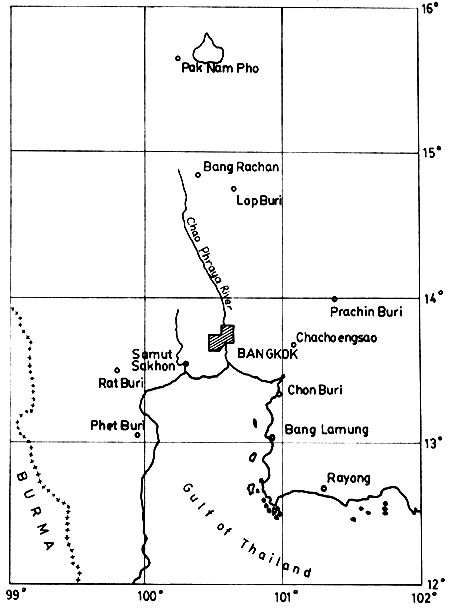
The fishery station uses brackishwater which can be drawn direct from
the canal at only two periods of the year. During the rainy seasons the
estuary supplying the canal has fresh water, so that salt water needed for
mixing is drawn fron storage. In the dry seasons the Bangpagong estuary is
salty and fresh water is drawn from the reservoir. Current total needs are
for c. 200m3/d or 8 m3 (1,800 g/h). Storage capacity is adequate. The
station has a number of large earth ponds but an almost unlimited depth of
mud makes it impossible to construct an artificial bed in one of these.
There are no natural sand beds but unlimited suitable sand/gravel is obtainable
nearby.
An artificial bed with an approximate surface of 5 m × 5 m was prepared
in one of the large concrete tanks with a cross section as in Appendix 1 of
WP/80. The central core was of 30–50 mm stones. The unit was pre-packed
with c. 2–5 mm gravel; the remainder was sand/gravel as supplied, of part
river and part beach origin and was a mixture ranging from below 0.5 to
5.0 mm. The tank was filled with partly settled raw water. After fifteen
minutes the clay fraction in the bed was largely evacuated and water was
clean and physically acceptable for use, though still with a faint opalescence
caused by a small clay particle. The water was then fed to the
main system and the quality steadily improved over a further 2 hours pumping.
A mini unit was established in an existing sand bed within one of the
smaller concrete tanks where the recirculation water was opaque with both
mineral particles and organic debris. The mini unit was developed and run
by gravity only, in the absence of a suitable hand or small electric pump,
and it gave excellent quality. A reducing head of water made volume measurements
difficult but at c. 60 cm head the flow through a 20 mm pipe was
c. 0.5 m3/h. This flow will be much increased by full development using a
suitable small pump.
The mini filter was demonstrated in the sand already part filling the
center of a concrete tank and serving as a sand filter through which the
water passed horizontally. This seems potentially dangerous since the
water probably travels through only part of the cross section keeping this
aerobic, while the remainder may become anaerobic. This may not cause any
trouble but it is better to organize circuits so that the whole is fully
used. A more positive method would be to use a series of mini units at
about 1 m centers in a bed of sand/gravel 50 cm deep, the space above being
filled with water. The levels overall do not allow gravity working, but
this layout would probably make it possible to use air lifts for each individual
mini unit. Formulae are available to calculate flow in an air lift
system but it is generally best to work out details by trial and error.
The mini unit is proving effective when used in a container in aquarium
circuits and in open small ornamental fish ponds and it is suggested that
this is tried here with careful monitoring. (See Appendix 5 of SCS/79/WP/80).
This pack can safely stand actually in the tank for the rate of downward
flow to the filter surface will not draw down the larvae. Cleaning should
be infrequent, especially if nylon, wool, etc. is placed on the filter
surface to act as a strainer but it is easily achieved by lifting out one
pack after putting in another few days earlier to build up efficiency or
preferably, having sufficient mini units working to allow one to be taken
out at any time for maintenance.
Quality
There was general agreement that even after the above short period of
development the water from the larger filter was physically more than adequate
for hatchery use but for recirculation systems the emphasis was
placed on chemical parameters, in particular ammoniacal nitrogen. Conditions
in Thailand are markedly different from those in temperate zones and
monitoring of the relevant parameters is necessary but we are confident
that if flow rates and bed size conform to those suggested, the biological
filter zone will be more than sufficient to process the ammonia and other
breakdown products in normal systems, even when more heavily stocked with
larvae than at present. These rates should therefore be taken as a starting
point and in many cases, after test running, it should be possible to
increase the flow with safety. In English outdoor conditions it is found
that bacterial removal and reduction of BOD and ammoniacal nitrogen run
almost parallel and that the percentage removal remains more or less constant
over a range of raw water values, the former remaining steady at about 97%
and ammoniacal nitrogen at about 90%. In local systems the temperature
is around 27°C at which the biological activity is much greater.
Although tentative plans had been made to visit this area, this was at
once seen to be unnecessary when the problem was discussed with Mr. Akadij
Artachinda. He was clearly so familiar with details of the problem -- and
understood so quickly the potential of sub-sand working -- that a meeting
was arranged at his office at the University to discuss possible solutions.
Water Available
A shallow well close to a brackishwater canal supplies c. 200 people.
This is c. 1 m × 1 m in plan. The total depth is 3 m and stable water
level at c. 1.5 m. It holds nearly 2 m3 when fully recharged, which is at
the rate of c. 0.7 m3/h. The water is drawn by hand and put into storage
jars of 200 liters, of which each boat holds 3. These are taken back to
the compound by canal. After three boats have been loaded, they are then
dependent on recharge which takes c. 1 hr per boatload. The total water
available per day cannot therefore be greater than 2 m3 + about 11 × 0.7 m3,
i.e. nearly 10 m3.
Quality
The water as drawn has an unacceptable amount of sediment, which is
fairly coarse and settles out in about 24 hours if undisturbed. In the
normal way it is not practical to allow this time.
Possible Methods of Improving Quality
Use of mini unit in well (a) in bed of introduced gravel, (b) in
container of gravel, in both cases abstracting by hand pump. This would
have the added advantage that the well could be covered over against abuse
and pollution. Unless covered, in both (a) and (b) the water is still
subject to contamination by pails used for dipping up water by those too
impatient to wait for the pump.
Erecting overhead storage at the village and drawing filtered
water by tap, as in Appendix 3 of SCS/79/WP/80. This would have the
advantage that water can settle well and it is filtered as used, but it
would be much more expensive and would require double handling of all water.
After some discussion it became clear that 1 (b) is the most acceptable
and practical method. Since the water will be drawn through the surface
by pumping, it will not be kept agitated by frequent dipping. Further,
the container stands on the bottom with its intake surface well above it,
thus keeping clear of the worst silt. Appendix 5 of SCS/79/WP/80 describes
this procedure in detail. In addition, it is essential to ensure that the
plastic container is strong enough to be lifted in and out by ropes on
either side. Nylon, wool or old clean cloth over the surface would hold
macroscopic particles and thus extend each filter run, but this is likely
to be in many weeks rather than days. A few holes in the bottom will allow
water to drain out and so reduce weight when lifted. Since the water
enters the sides and bottom of the well, there is no need to fit the hard
plastic shield shown in the diagram of Appendix 3. Various models of pump
are available. The decision about permanent mounting or removal daily
must be made according to local conditions and the danger of either theft
or vandalism.
Increased Supply
Although the theoretical yield of 10 m3/d should be enough for a community
of 200 people, seeing that it is all carried, the pattern of collection
and slow recharge may prevent the whole from being used. Any suggestions for
increasing supply are only tentative. Proximity of brackishwater makes it
risky to deepen the well which might have the effect of only increasing storage.
It is also impossible to predict the results of increasing its cross
section to, say, 2 m2. Since there are other wells in the vicinity, it may
be best to try digging a second well at not less than 10 m center, but time
would be well spent studying the draw-down and recharge pattern in nearby
wells and seeking to trace the direction of any underground flow.
Figure 9

The primary reason for visiting Bangkok was to help in solving problems
of unsatisfactory water in Macrobrachium hatchery systems. Methods of
abstracting pre-filtered sea water from the natural bed were taught and had
already been applied before the visit ended. The technique of using both
village units for primary filtration and mini units for recirculation, in
wholly artificial beds was shown in Chacheongsao. In this case also a
permanent source was created and this had been supplying clean water for
some four days before the mission ended.
Abstraction from in situ beds is clearly impossible on the vast Central
Plain, where the canal's base usually consists of almost bottomless mud.
For the numerous isolated communities who still take much of their household
water from these canals it seems that the mini unit methods in Appendix
3 and 5 of SCS/79/WP/80 could bring much improved water at minimal cost.
Throughout this region there are numerous fish ponds. While it can hardly
be economic to filter the whole supply it seems that the general method
described in Appendix 1 SCS/79/WP/80 and as in Appendix 9 could well be
used for that part of the supply needed for the actual hatchery and the
early fry stages, as well as for any sensitive species that might be kept.
It was clear that many beaches to the east of Bangkok are ideal for
providing by sub-sand abstraction the marine part of the water supplies for
Macrobrachium culture, removing any need for settlement or filtration. It
is understood that the same is true of beaches on the Isthmus of Kra. It
is likely that this method will be adopted fairly widely, in places with
the use of homemade hardware, resulting in much saving of labour and improved
results. The application to fresh water is equally valuable since in many
hatcheries this can be taken only from the canals and is high in silt.
The provision of sediment-free water is directly helpful to the stock and
also allows fuller use of water.
Thanks to the initiative of Michael New, many contacts were made with
a wide range of persons interested in water, whether for human use or in
fish farming, and discussions were held with all those listed in the
itinerary and activities. It was unfortunate that the nearest practical
sites for demonstrating these techniques were at Chacheongsao and Ban
Lamung, but a total of some 25 people were present at the former or at
both sites on the 21st September.
All pumps supplied were well able to handle the volume required and
were fully self-priming, but unsuitable armoured hose caused much waste
of time and frustration, especially during development. This was no fault
of the organizers for, except in Thailand, little was available other than
standard lengths of wire-lined rubber hose. This type is heavy and cumbersome
and it is supplied in set lengths only, with special ends for
attaching to the male pump ports. This pattern can be wasteful and inefficient
in several ways. A short length cannot be cut off, while even a
15 m run involves joins, and even more important long term, its durability
is suspect. For instance, the length used at Iloilo had been bought less
than twelve months before, but in the sea trials it collapsed in two places
and the wire reinforcement was found to have rusted through.
The armoured plastic hose supplied at Bangkok was much better, but
this also had special rubber ends. One such joint broke down under
pressure on the delivery side -- pumping to a head of c. 60 ft. -- and
another joint came right off when twisted, so that the hose had to be
fastened directly to the pump.
For permanent installations especially in the sea it is essential to
fit the most durable armoured hose that can be obtained, for the extra
cost is negligible as a percentage of the whole and in the long run it is
a big economy. The type mostly used in U.K. and widely overseas has
the brand name of ‘Heliflex’, made in several grades and in sizes from 37
mm to 150 mm. The marine grade has shown itself able to withstand heavy
duty in rough sea conditions on rocky shores for above seven years. In
normal sub-sand working it is largely buried and protected from abrasion
since it is not subject to any movement so it is expected to have a serviceable
life of at least 10 years. Other major advantages are that it is
made in 30 m lengths, quickly cut and easily joined, and therefore less
wasteful and ideal for rapid laying in a tidal situation. Secondly, the
PVC material is partly thermoplastic and when heated by hot water or
blow-lamp can be shrunk or expanded before fastening with stainless steel
clips to make a very firm connection. Thirdly, the friction loss is less
than in other armoured hoses. Priority should be given to identifying
such material among what is obtainable or arranging to import it as a vital
component of the system.
In some countries the duty on plastic materials is punitively heavy
but there are also territories, especially in Africa where equipment to
be used in water treatment attracts only nominal or no duty. In all
cases enquiry should be made to see whether this applies. Current U.K.
prices vary from about ₤2.50 per meter for 37 mm to ₤4.70 per meter for
marine 50 mm and ₤6.50 per meter for marine 75 mm. The fact that precise
lengths are used with no waste will often compensate for the possible
higher cost per meter. Systems vary widely but few are likely to require
more than about 1 m per 2 m3/h (500 g/h), i.e. about 10 m for a single
unit system providing 20–22 m3/h. This is a near enough figure for
budget purposes and it allows calculation of any extra prime cost of
armoured hose. When durability is taken into account, it is likely to be
very much cheaper.
Locally made polybutylene and high density polyethylene pipes may
be available in some sizes. These are made in long lengths and are flexible
to some degree, but the specimens examined were not really suitable
for attaching to the unit and it was not easy to connect them.
PUBLICATIONS OF THE
SOUTH CHINA SEA FISHERIES DEVELOPMENT AND COORDINATING PROGRAMME
WORKING PAPERS
| SCS/74/WP/1 | Rabanal, H.R. The potentials of aquaculture development in the Indo-Pacific Region. Manila, South China Sea Fisheries Programme, 1974. 34p. |
| SCS/74/WP/2 | Crutchfield, J.A., D.A. Lawson and G.K. Moore. Malaysia - Legal and institutional aspects of fisheries development. Manila, South China Sea Fisheries Programme, 1974. 27p. |
| SCS/74/WP/3 | Marr, J.C. Republic of Vietnam - Legal and institutional aspects of fisheries development. Manila, South China Sea Fisheries Programme, 1974. 20p. |
| SCS/74/WP/4 | Larsson, S.O.R., G.C.A. Van Noort and E.O. Oswald. Malaysia - A report on artisanal fisheries of Peninsular Malaysia with particular reference to Kuala Besut. Manila, South China Sea Fisheries Programme, 1975. 58p. |
| SCS/75/WP/5 | Rabanal, H.R. Irian Jaya, Indonesia - Survey of possibilities and recommendations for development of brackishwater fish production. Manila, South China Sea Fisheries Programme, 1975. 27p. |
| SCS/75/WP/6 | Tussing, A.R. Fishery development perspectives. Sub-Region V: South China Sea. Manila, South China Sea Fisheries Programme, 1975. (IPFC/74/Sym/7). 23p. |
| SCS/75/WP/7 | Murdoch, W.R. and M.A. Myers. Republic of Singapore - An assessment of the Jurong Fishing Harbour complex and expansion site on the east bank of the Jurong River. Manila, South China Sea Fisheries Programme, 1975. 46p. |
| SCS/75/WP/8 | Peterson, C.L., K.J. Rosenberg and A.C. Simpson. Regional - Trip reports of chartered purse seine vessels Royal Venture and Southward Ho covering voyages I and II. Dec. 1–13, 1974 and Jan. 5 - Feb. 3, 1975. Manila, South China Sea Fisheries Programme, 1975. 37p. |
| SCS/75/WP/9 | Oswald, E.O. and R.E.K.D. Lee. Regional - A proposal for a live bait pole-and-line tuna fishing survey in the South China Sea and adjacent waters. Manila, South China Sea Fisheries Programme, 1975. 38p. |
| SCS/75/WP/10 | Rosenberg, K.J. and A.C. Simpson. Regional - Trip reports of chartered purse seine vessels Royal Venture and Southward Ho covering voyage 3. 9 February to 26 March 1975. Manila, South China Sea Fisheries Programme, 1975. 28p. |
| SCS/75/WP/11 | Peterson, C.L. Regional - Resource survey of larger pelagic fish. Manila, South China Sea Fisheries Programme, 1975. 32p. |
| SCS/75/WP/12 | Rosenberg, K.J., A.C. Simpson and C.M. Renwick. Regional - Trip reports of chartered purse seine vessels Royal Venture and Southward Ho covering voyage 4. 9 April to 24 May 1975. Manila, South China Sea Fisheries Programme, 1975. 36p. |
| SCS/75/WP/13 | Baum, G.A. Kuala Besut II - A supplementary report on selected socio-economic aspects and problems in a fisherman's community on the East Coast of Peninsular Malaysia. Manila, South China Sea Fisheries Programme, 1975. 43p. |
| SCS/75/WP/14 | Cuerden, C. Library services for the South China Sea Fisheries Programme and its participating countries. Manila, South China Sea Fisheries Programme, 1975. 48p. |
| SCS/75/WP/15 | Lawson, R.M. Malaysia - An interim report on socio-economic aspects of the development of artisanal fisheries on the East Coast of Malaysia. Manila, South China Sea Fisheries Programme, 1975. 29p. |
| SCS/75/WP/16 | Jamandre, T.J. and H.R. Rabanal. Engineering aspects of brackish water aquaculture in the South China Sea region. Manila, South China Sea Fisheries Programme, 1975. 96p. |
| SCS/75/WP/17 | Murdoch, W.R. Malaysia - Assessment of the viability and potential of the joint venture, Majuikan Mideast Sdn Bhd, Kuching, Sarawak, as requested by Lembaga Majuikan, Malaysia. Manila, South China Sea Fisheries Programme, 1975. 16p. (Restricted) |
| SCS/75/WP/18 | Cleaver, W.D. Malaysia - A preliminary design and general arrangement for an offshore purse seine vessel for the East Coast of West Malaysia. Manila, South China Sea Fisheries Programme, 1975. 35p. |
| SCS/75/WP/19 | Pischedda, J.L. Republic of the Philippines - Legal and institutional aspects in the development of the fishing industry. Preliminary observations and identification of the main obstacles. Manila, South China Sea Fisheries Programme, 1975. 35p. |
| SCS/75/WP/20 | Simpson, A.C. Regional - Acoustic surveys of pelagic resources. Report No. 1. Gulf of Thailand, July 1975. Manila, South China Sea Fisheries Programme, 1975. 28p. |
| SCS/75/WP/21 | Cintas, D. and C.M. Renwick. Regional - Report of aerial survey for schooling pelagic fish. 1. Philippine waters, 12–29 June 1975. Manila, South China Sea Fisheries Programme, 1975. 28p. |
| SCS/75/WP/22 | Baum, G.A. and J.A. Maynard. Tobuan/Sual, Pangasinan Province Central Luzon - A socio-economic study on a rural fishing population in Central Luzon in connection with the Municipal Fisheries Pilot Programme. Manila, South China Sea Fisheries Programme, 1976. 44p. |
| SCS/76/WP/23 | Baum, G.A. and J.A. Maynard. Panigayan, Lampinigan, Baluk-Baluk and Manangal, Basilan Province. A socio-economic study on four fishermen's communities affiliated to the Basilan Fishing Association (BFA/Isabela in connection with the Municipal Fisheries Pilot Programme). Manila, South China Sea Fisheries Programme, 1976. 62p. |
| SCS/76/WP/24 | Barica, J. Nutrient-dynamics in eutrophic inland waters used for aquaculture in some countries bordering the South China Sea with particular reference to mass fish mortalities. Proposal for monitoring programmes, Philippines, Thailand and Hong Kong. Manila, South China Sea Fisheries Programme, 1976. 43p. |
| SCS/76/WP/25 | Rosenberg, K.J., A.C. Simpson and J.A. Maynard. Regional - Trip reports of chartered purse seine vessels Royal Venture and Southward Ho covering voyages 5 and 6. 13 June to 10 September 1975. Manila, South China Sea Fisheries Programme, 1976. 52p. |
| SCS/76/WP/26 | Moore, G.K. Malaysia - Legal and institutional aspects of fisheries development. (2nd working paper). Manila, South China Sea Fisheries Programme, 1976. 38p. |
| SCS/76/WP/27 | Wheeland, H.A. Malaysia - Preliminary observations and recommendations concerning the fisheries statistics programme of Peninsular Malaysia. Manila, South China Sea Fisheries Programme, 1976. 22p. |
| SCS/76/WP/28 | Maynard, J.A. Regional - Report of aerial survey for schooling pelagic fish. II. Thailand - 20 November to 1 December 1975. Manila, South China Sea Fisheries Programme, 1976. 20p. |
| SCS/76/WP/29 | Baum, G.A. and J.A. Maynard. Salay, Misamis Oriental Province - A socio-economic study on the fishing population of the seven coastal barrios of Salay Municipality in connection with the Municipal Fisheries Pilot Programme. Manila, South China Sea Fisheries Programme, 1976. 47p. (Country - Philippines) |
| SCS/76/WP/30 | Murdoch, W.R. Hong Kong - A preliminary feasibility study to prosecute offshore pelagic stocks from Hong Kong. Manila, South China Sea Fisheries Programme, 1976. 27p. |
| SCS/76/WP/31 | Johnson, R.F. Preliminary report on aquatic pollution in the South China Sea Region. Manila, South China Sea Fisheries Programme, 1976. 34p. |
| SCS/76/WP/32 | Wheeland, H.A. Preliminary observations and recommendations concerning the fisheries statistics programme of Singapore. Manila, South China Sea Fisheries Programme, 1976. 21p. |
| SCS/76/WP/33 | Baum, G.A. and J.A. Maynard. Coron/Tagumpay - Busuanga Island/ Calamianes Group (Palawan Province). A socio-economic study on two rural fishing populations in northern Palawan in connection with the Municipal Fisheries Pilot Programme. Manila, South China Sea Fisheries Programme, 1976. 112p. |
| SCS/76/WP/34 | Jones, R. Mesh regulations in the demersal fisheries of the South China Sea area. Regional. Manila, South China Sea Fisheries Programme, 1976. 79p. |
| SCS/76/WP/35 | Simpson, A.C. and S. Chikuni. Progress report on fishing for tuna in Philippine waters by FAO chartered purse seiners. Manila, South China Sea Fisheries Programme, 1976. 38p. |
| SCS/76/WP/36 | Bonga, O.B. Vessel specifications and drawings for two 10 m multi-purpose fishing vessels for the small scale fisheries project - Kuala Besut. Manila, South China Sea Fisheries Programme, 1976. 36p. |
| SCS/76/WP/37 | Shang, Y.C. Economics of various management techniques for pond culture of finfish. Manila, South China Sea Fisheries Programme, 1976. 36p. |
| SCS/76/WP/38 | Johnson, H.N. Malaysia - A preliminary study of investment opportunities for the development of small-scale fisheries on east coast of Peninsular Malaysia. Manila, South China Sea Fisheries Programme, 1976. 21p. |
| SCS/76/WP/39 | Shang, Y.C. Follow-up programmes on economics of aquaculture in the South China Sea Region. Manila, South China Sea Fisheries Programme, 1976. 19p. |
| SCS/76/WP/40 | Cook, H.L. Problems in shrimp culture in the South China Sea Region. Manila, South China Sea Fisheries Programme, 1976. 50p. |
| SCS/76/WP/41 | Johnson, H., J. Dibbs and R. Nasoetion. Indonesia - A preliminary assessment for small-scale fisheries development in Riau, North Sumatra and West Kalimantan Provinces. Manila, South China Sea Fisheries Programme, 1976. 51p. |
| SCS/76/WP/42 | Baum, G.A. and J.A. Maynard. Bayawan Municipality, Negros Oriental Province/Negros. A socio-economic study on the rural fishing population of Bayawan Municipality in connection with the Municipal Fisheries Pilot Programme. Manila, South China Sea Fisheries Programme, 1976. 33p. (Country - Philippines) |
| SCS/76/WP/43 | Maynard, J.A. Philippines - Report on aerial survey for schooling pelagic fish in waters of the South China Sea and Sulu Sea adjacent to Palawan Island, 9–12 March 1976. Manila, South China Sea Fisheries Programme, 1976. 17p. |
| SCS/76/WP/44 | Chakraborty, D. Fisheries statistics in the Philippines - A plan for a new and expanded data collection programme. Manila, South China Sea Fisheries Programme, 1976. 70p. |
| SCS/76/WP/45 | Marr, J.C., G. Campleman and W.R. Murdoch. Thailand - An analysis of the present and recommendations for future fishery development and management policies, programmes and institutional arrangements. Manila, South China Sea Fisheries Programme, 1976. 185p. (Restricted) |
| SCS/76/WP/46 | Cleaver, W. and O.B. Bonga. Thailand - Preliminary design, general arrangement and lines plans for two pelagic purse - seine/midwater trawl research vessel, 27.5 m and 24 m lengths. Manila, South China Sea Fisheries Programme, 1976. |
| SCS/76/WP/47 | Cleaver, W. Hong Kong - A preliminary design, general arrangement and specifications for a combination pelagic/demersal research vessel. Manila, South China Sea Fisheries Programme, 1976. |
| SCS/76/WP/48 | Simpson, A.C. and W.R. Murdoch. Regional - Trip reports of chartered purse seine vessel Royal Venture - Trips Nos. 7 & 8. 1 October to February 1976. Area - Moro Gulf. Manila, South China Sea Fisheries Programme, 1976. 17p. |
| SCS/76/WP/49 | Simpson. Regional - Trip reports of chartered vessel Southward Ho - Trips 7 & 8. 11 September 1975 to March 1976. Areas - Malaysia and Thailand. Manila, South China Sea Fisheries Programme, 1976. 33p. |
| SCS/76/WP/50 | Simpson. Regional - Trip reports of chartered purse seine vessel Royal Venture and Southward Ho- Trip No. 9. Manila, South China Sea Fisheries Programme, 1976. 22p. |
| SCS/76/WP/51 | Simpson. Regional - Trip reports of chartered purse seine vessel Southward Ho - Trips 10 and 11. 15 April to 8 August 1976. Area - East, North and West Coasts Luzon Island, Bohol Sea, Sulu Sea, Moro Gulf. Manila, South China Sea Fisheries Programme, 1976. 20p. |
| SCS/76/WP/52 | Simpson. Wheeland, H.A. Statistics for fisheries development. Regional. Manila, South China Sea Fisheries Programme, 1976. 11p. |
| SCS/76/WP/53 | Christy, L.C. Republic of the Philippines - Legal and institutional aspects of fisheries development. Manila, South China Sea Fisheries Programme, 1976. 65p. (Restricted) |
| SCS/76/WP/54 | Maynard, J.A. Philippines - Province of Tawi-Tawi project identification and semi-detailed feasibility study relative to improving the status of small-scale fishermen and creating an integrated fishing industry in the Province of Tawi-Tawi. Manila, South China Sea Fisheries Programme, 1976. 110p. |
| SCS/77/WP/55 | Oswald, E.O. & J.A. Maynard. Thailand - Proposed small-scale fisheries pilot project for Ban Ao Makam Pom, Rayong Province. Manila, South China Sea Fisheries Programme, 1977. |
| SCS/77/WP/56 | Murdoch, W.R. & P.S. Walczak. Regional - Trip reports of chartered purse seine vessel. Southward Ho covering voyage 12. Area - waters of the Sulu Sea. Manila, South China Sea Fisheries Programme, 1977. 11p. |
| SCS/77/WP/57 | Murdoch, W.R. & P.S. Walczak. Regional - Trip reports of chartered purse seine vessels Southward Ho and Royal Venture covering voyage 13. Area - mainly Moro Gulf, Philippines. Manila, South China Sea Fisheries Programme, 1977. 18p. |
| SCS/77/WP/58 | Simpson, A.C., W.R. Murdoch. Regional - Trip reports of chartered purse seine vessel Southward Ho covering voyages nos. 14 and 15. Area - Moro Gulf. Manila, South China Sea Fisheries Programme, 1977. 15p. |
| SCS/77/WP/59 | Murdoch, W.R. & P.S. Walczak. Regional - Trip reports of chartered purse seine vessel Southward Ho covering voyages nos. 16 and 17. Area - Waters of the Moro Gulf. Manila, South China Sea Fisheries Programme, 1977. 23p. |
| SCS/77/WP/60 | Doty, M.S. Seaweed resources and their culture in the countries of the South China Sea Region. Manila, South China Sea Fisheries Programme, 1977. 19p. |
| SCS/77/WP/61 | Rabanal, H.R. et al. Shellfisheries of Thailand: Background and proposal for development. Manila, South China Sea Fisheries Programme, 1977. 14p. |
| SCS/77/WP/62 | Chakraborty, D. Observations and recommendations concerning the fisheries statistics programme of Hong Kong. Manila, South China Sea Fisheries Programme, 1977. 14p. |
| SCS/77/WP/63 | Chakraborty. Observations and recommendations concerning the inland fisheries statistics programme of Thailand. Manila, South China Sea Fisheries Programme, 1977. 15p. |
| SCS/77/WP/64 | Hansen, K.A., P. Lovseth and A.C. Simpson. Acoustic surveys of pelagic resources. Report No. 2. Hong Kong, Nov. 1976. Manila, South China Sea Fisheries Programme, 1977. 24p. |
| SCS/77/WP/65 | Christy, L.C. Republic of the Philippines - Legal and institutional aspects of fisheries development. Manila, South China Sea Fisheries Programme, 1977. 55p. |
| SCS/77/WP/66 | Murdoch, W.R. et al. A proposal for a small-scale fisheries pilot project in the Pulau Tujuh (Seven Islands) area, Riau Archipelago District, Riau Province, Indonesia. Manila, South China Sea Fisheries Programme, 1977. 69p. |
| SCS/77/WP/67 | Moore, G. Malaysia - A new fisheries bill. Manila, South China Sea Fisheries Programme, 1977. 56p. |
| SCS/77/WP/68 | Gedney, R.H. Water supply of the fishery development centre in freshwater aquaculture at Sukabumi, West Java, Indonesia. Manila, South China Sea Fisheries Programme, 1977. 20p. |
| SCS/78/WP/69 | Chan, W.L. et al. Cage culture of marine fish in East Coast Peninsular Malaysia. Manila, South China Sea Fisheries Programme, 1978. 66p. |
| SCS/78/WP/70 | Lee, R.E.K.D. Results of small-scale live bait pole-and-line fishing explorations for tuna in the Philippines. Manila, South China Sea Fisheries Programme, 1978. 41p. |
| SCS/78/WP/71 | Moore, G. Legal and institutional aspects of fisheries management and development - a new licensing system, Thailand. Manila, South China Sea Fisheries Programme, 1978. 23p. (Restricted) |
| SCS/78/WP/72 | Angeles, H.G. Preliminary fish and resources survey along the coast of Peninsular Malaysia. Manila, South China Sea Fisheries Programme, 1978. |
| SCS/78/WP/73 | De la Cruz, Y.T. Malaysia - Small-scale fishermen credit and subsidy programmes - Implementing guideline recommendations (with particular reference to the Kuala Besut Fishermen's Association). Manila, South China Sea Fisheries Programme, 1978. 50p. |
| SCS/78/WP/74 | Chikuni, S. Report on fishing for tuna in Philippine waters by FAO chartered purse seiners. Manila, South China Sea Fisheries Programme, 1978. (Published as SCS/DEV/78/18) |
| SCS/78/WP/75 | Fyson, J.E. Fishing vessel design proposals for small-scale artisanal fisheries in the Philippines. Manila, South China Sea Fisheries Programme, 1978. |
| SCS/78/WP/76 | Lau F. and Cheng Chor Luk. Recent innovations in the cage culture activity at Kuala Besut small-scale fisheries pilot project, Malaysia. Manila, South China Sea Fisheries Programme, 1978. 16p. |
| SCS/78/WP/77 | Wheeland, H.A. Proposal for further development of fishery statistics programmes in developing countries with particular reference to the South China Sea region. Manila, South China Sea Fisheries Programme, 1978. 6p. |
| SCS/78/WP/78 | Moore, G. Legal and institutional aspects of fisheries management and development - A second Interim Report (Thailand). Manila, South China Sea Fisheries Programme, 1978. 37p. (Restricted) |
| SCS/79/WP/79 | Jonasson G. and Paisal Katanyuwong. Review of fishing activities of the small-scale fisheries project in Kuala Besut, Malaysia. Manila, South China Sea Fisheries Programme, 1979. 23p. |
| SCS/79/WP/80 | Cansdale, G.S. Low-coast water filtration system. Manila, Manila, South China Sea Fisheries Programme, 1979. 73p. |
| SCS/79/WP/81 | Lisac, H. Some technical aspects of small-scale fish landing facilities. Manila, South China Sea Fisheries Programme, 1979. 32p. |
| SCS/79/WP/82 | Chakraborty, D. Catch analysis of fishermen in Kuala Besut, Peninsular Malaysia. Manila, South China Sea Fisheries Programme, 1979. 59p. |
| SCS/79/WP/83 | Thompson, B.G. Thailand - Management of fisheries data- Feasibility of computerization. Manila, South China Sea Fisheries Programme, 1979. 24p. |
| SCS/79/WP/84 | Cansdale, G.S. Report on second regional consultancy low-cost water filtration. Manila, South China Sea Fisheries Programme, 1979. |
COORDINATING COMMITTEE REPORTS
| SCSP: | 74/1 | REP | Report of the Ad Hoc Coordinating Committee Meeting of the South China Sea Fisheries Development and Coordinating Programme. Manila, 18–19 June 1974. 27p. |
| SCSP: | 74/2 | REP | Report of the first session of the Coordinating Committee of the South China Sea Fisheries Development and Coordinating Programme. Jakarta, Indonesia, 6 November 1974. Rome, FAO, 1974. 22p. |
| SCSP: | 76/3 | REP | Report of the second srssion of the Coordinating Committee of the South China Sea Fisheries Development and Coordinating Programme. Manila, 9 April 1976. 16p. |
| SCSP: | 77/4 | REP | Report of the third session of the Coordinating Committee of the South China Sea Fisheries Development and Coordinating Programme. Manila, 24–25 February 1977. 19p. |
| SCSP: | 77/5 | REP | Report of the fourth session of the Coordinating Committee of the South China Sea Fisheries Development and Coordinating Programme. Manila, 11–12 October 1977. 21p. |
| SCSP: | 78/6 | REP | Report of the fifth session of the Coordinating Committee of the South China Sea Fisheries Development and Coordinating Programme. Manila, 11 March 1978. 16p. |
| SCSP: | 78/7 | REP | Report of the sixth session of the Coordinating Committee of the South China Sea Fisheries Development and Coordinating Programme. Manila, 28–29 September 1978. |
| SCSP: | 79/8 | REP | Report of the seventh session of the Coordinating Committe of the South China Sea Fisheries Development and Coordinating Programme. Rome, 11–16 October 1979. |
WORKSHOP REPORTS
| SCS/GEN/74/1 | Report of the workshop on planning and coordinating of resources survey and evaluation in the South China Sea. 28 August to 4 September 1974. Manila, South China Sea Fisheries Programme, 1974. 197p. |
| SCS/GEN/76/2 | Report of the workshop on the fishery resources of the Malacca Strait. Part I. Jakarta, 29 March to 2 April 1976. Manila, South China Sea Fisheries Programme, 1976. 89p. |
| SCS/GEN/76/3 | Report of workshop on legal and institutional aspects of fishery resources management and development. 5–8 April 1976. Manila, South China Sea Fisheries Programme, 1976. 95p. |
| SCS/GEN/76/4 | Report on the training workshop for field enumerators of the Bureau of Fisheries and Aquatic Resources - Philippines. 22–31 March 1976 by D. Chakraborty and H. Wheeland. Manila, South China Sea Fisheries Programme, 1976. 32p. |
| SCS/GEN/76/5 | UNDP/FAO Training Course on the management of small-scale fishery enterprises. Kuala Trengganu, Malaysia. 25 August to 26 September 1975. Rome, FAO, 1976. 14p. |
| SCS/GEN/77/6 | Report of the workshop on the fishery resources of the Malacca Strait - Part II. Jakarta, 29 March to 2 April 1976. South China Sea Fisheries Programme, 1976. 85p. |
| SCS/GEN/76/7 | Report of the BFAR/SCSP workshop on the fishery resources of the Visayan and Sibuyan area. Tigbauan, Iloilo, Philippines. 18–22 October 1976. Manila, South China Sea Fisheries Programme, 1976. 26p. |
| SCS/GEN/76/8 | Philippines - Report seminar on the fisheries statistics survey of the Bureau of fisheries and Aquatic Resources. 23 July 1976. DNR/BFAR/SCSP, Manila, 1976. 17p. |
| SCS/GEN/76/9 | Report of the consultative group meeting on small-scale fisheries development in the South China Sea region. 13–15 December 1976. Manila, South China Sea Fisheries Programme, 1976. 140p. |
| SCS/GEN/77/10 | Report on the training workshop on fisheries statistics, Malaysia, 12–21 October 1976. Manila, South China Sea Fisheries Programme, 1977. 27p. |
| SCS/GEN/77/11 | Report on the BFAR/SCSP workshop on fishery resources of the Sulu Sea and Moro Gulf areas, 25–29 April 1977, Cagayan de Oro. Manila, 1977. 58p. |
| SCS/GEN/77/12 | Report of the workshop on the demersal resources, Sunda Shelf. Part I. Nov. 7–11, 1977. Penang, Malaysia. Manila South China Sea Fisheries Programme, 1978. 58p. |
| SCS/GEN/77/13 | Report of the workshop on the demersal resources, Sunda Shelf. Part II. Nov. 7–11, 1977. Penang, Malaysia. Manila, South China Sea Fisheries Programme, 1978. 120p. |
| SCS/GEN/77/14 | Joint SCSP/SEAFDEC workshop on aquaculture engineering (with emphasis on small-scale aquaculture projects) Vol. 1 - General Report. Manila, South China Sea Fisheries Programme, 1978. v.p. |
| SCS/GEN/77/15 | Joint SCSP/SEAFDEC workshop on aquaculture engineering (with emphasis on small-scale aquaculture projects) Vol. 2 - Technical Report. Manila, South China Sea Fisheries Programme, 1978. 463p. |
| SCS/GEN/77/16 | A layout of standard tables of fishery statistics in the Philippines. Manila, South China Sea Fisheries Programme, 1978. 162p. |
| SCS/GEN/77/17 | Report of the workshop on the biology and resources of mackerels (Rastrelliger spp.) and round scads (Decapterus spp.) in the South China Sea. Part I. Manila, South China Sea Fisheries Programme, 1978. 70p. |
| SCS/GEN/78/18 | Report of the workshop on management of resources of the Sunda Shelf, Malacca Strait and related areas. Manila, South China Sea Fisheries Programme, 1978. 14p. |
| SCS/GEN/78/19 | Report of the BFAR/SCSP workshop on the fishery resources of the Pacific Coast of the Philippines. 18–22 September 1978. Manila, South China Sea Fisheries Programme, 1978. 48p. |
| SCS/GEN/79/20 | Report of the workshop on demersal and pelagic fish resources of the Java Sea. 5–9 December 1978. Semarang, Indonesia. Manila, South China Sea Fisheries Programme, 1979. 60p. |
| SCS/GEN/79/21 | Report of the workshop on the tuna resources of Indonesia and Philippine waters. Jakarta, 20–23 March 1979. Manila, South China Sea Fisheries Programme, 1979. 35p. |
| SCS/GEN/79/22 | Report of the BFAR/SCSP workshop on the fishery resources of the north Luzon and Western Coasts of Luzon, 18–20 April 1979, Manila, Philippines. Manila, South China Sea Fisheries Programme, 1979. 57p. |
| SCS/GEN/79/23 | Report on training course in fishery statistics, 2 October- 10 November 1978, Manila, Philippines. Manila, South China Sea Fisheries Programme, 1979. v.p. |
| SCS/GEN/79/24 | Report of the consultation meeting on management of tuna resources of the Indian and Pacific Oceans. 26–29 June, 1979, Manila, Philippines, Manila, South China Sea Fisheries Programme, 1979. |
SCS MANUALS
| SCS Manuals No. 1 | Handbook on field identification of fishes, crustaceans molluscs, shells, and important aquatic plants. Mnaila, South China Sea Fisheries Programme, 1978. 60p. |
PERIODIC PROGRESS REPORTS
| SCS/PR/74/1 | Woodland, A.G. Project progress report of the South China Sea Fisheries Development and Coordinating Programme. 1 July to 31 December 1974. Manila, South China Sea Fisheries Programme, 1974. 19p. |
| SCS/PR/75/2 | Woodland. Project progres report of the South China Sea Fisheries Development and Coordinating Programme. 1 January to 30 June 1975. Manila, South China Sea Fisheries Programme, 1975. 40p. |
| SCS/PR/75/3 | Woodland. Project progress report of the South China Sea Fisheries Development and Coordinating Programme. 1 July to 31 December 1975. Manila, South China Sea Fisheries Programme, 1975. 38p. |
| SCS/PR/76/4 | Woodland. Project progress report of the South China Sea Fisheries Development and Coordinating Programme. 1 January to 31 December 1976. Manila, South China Sea Fisheries Programme, 1976. 47p. |
| SCS/PR/77/5 | Woodland. Project progress report of the South China Sea Fisheries Development and Coordinating Programme. 1 January to 30 June 1977. Manila, South China Sea Fisheries Programme, 1977. 37p. |
| SCS/PR/77/66 | Woodland. Project progress report of the South China Sea Sea Fisheries Development and Coordinating Programme. 1 July to 31 December 1977. Manila, South China Sea Fisheries Programme, 1977. 19p. |
| SCS/PR/78/7 | Woodland. Project progress report of the South China Sea Fisheries Development and Coordinating Programme. 1 January to 30 June 1978. Manila, South China Sea Fisheries Programme, 1978. 12p. |
| SCS/PR/78/8 | Woodland. Project progress report of the South China Sea Fisheries Development and Coordinating Programme. 1 July to 31 December 1978. Manila, South China Sea Fisheries Programme, 1978. 11p. |
| SCS/PR/79/9 | Woodland. Project progress report of the South China Sea Fisheries Development and Coordinating Programme. 1 January to 30 June 1979. Manila, South China Sea Fisheries Programme, 1979. 12p. |
FISHERIES TECHNICAL PAPERS
| SCS/DEV/73/1 | Woodland, A.G. et al. The South China Sea Fisheries: A proposal for accelerated development. Rome, FAO, 1974. 162p. |
| SCS/DEV/73/2 | Yamamoto, T. Review of marine fishery statistical system in countries bordering the South China Sea, and proposals for their improvement. Rome, FAO, 1973. 46p. (Cover title: The South China Sea Fisheries Statistical Systems) |
| SCS/DEV/73/3 | Aoyama, T. The demersal fish stocks and fisheries of the South China Sea. Rome, FAO, 1973. 80p. (Cover title: The South China Sea Fisheries Demersal Resources) |
| SCS/DEV/73/4 | Kume, S. Tuna resources in the South China Sea. Rome, FAO, 1973. 18p. |
| SCS/DEV/73/5 | Ling, S. Status, potential and development of coastal aquaculture in the countries bordering the South China Sea. Rome, FAO, 1973. 51p. (Cover title: The South China Sea Fisheries Aquaculture Development) |
| SCS/DEV/73/6 | Menasveta, D. et. al. Pelagic fishery resources of the South China Sea and prospects for their development. Rome, FAO, 1973. (Cover title: The South China Sea Fisheries Pelagic Resources) |
| SCS/DEV/73/7 | Mistakidis, M.N. The crustacean resources and related fisheries in the countries bordering the South China Sea. (Cover title: The South China Sea Fisheries Fisheries Crustacean Resources) |
| SCS/DEV/73/8 | Ruckes, E. Fish utilization, marketing and trade in countries bordering the Sputh China Sea - status and programme proposals. Rome, FAO, 1973. 33p. (Cover title: The South China Sea Fisheries Marketing and Trade) |
| SCS/DEV/73/9 | Doucet, F.J. et al. Institutional and legal aspects affecting fishery development in selected countries bordering the South China Sea. Rome, FAO, 1973. 32p. (Cover title: The South China Sea Fisheries Institutional Legal Aspects) |
| SCS/DEV/76/11 | Development potential of selected fishery products in the regional member countries of the Asian Development Bank. Manila, South China Sea Fisheries Programme, 1976. 107p. (ADB/FAO Market Studies) |
| SCS/DEV/76/11 (Appendix 1) | Fishery country profiles. Manila, South China Sea Fisheries Programme, 1976. 173p. (ADB/FAO Market Studies) |
| SCS/DEV/76/12 | The international market for shrimp. Manila, South China Sea Fisheries Programme, 1976. 105p. (ADB/FAO Market Studies) |
| SCS/DEV/76/13 | The international market for tuna. Manila, South China Sea Fisheries Programme, 1976. 69p. (ADB/FAO Market Studies) |
| SCS/DEV/76/14 | The international market for crab. Manila, South China Sea Fisheries Programme, 1976. 49. (ADB/FAO Market Studies) |
| SCS/DEV/76/15 | The international market for lobster. Manila, South China Sea Fisheries Programme, 1976. 46p. (ADB/FAO Market Studies) |
| SCS/DEV/76/16 | The international market for cephalopods. Manila, South China Sea Fisheries Programme, 1976. 95p. (ADB/FAO Market Studies) |
| SCS/DEV/76/17 | The European canned fish market: Prospects for Rastrelliger spp. Manila, South China Sea Fisheries Programme, 1976. 56p. (ADB/FAO Market SLudies) |
| SCS/DEV/78/18 | Chikuni, S., A.C. Simpson and W.R. Murdoch. Test fishing for tuna and small pelagic species: Reports on the operation of FAO chartered purse seiners in Philippine and South China Sea waters, 1974–1977. Manila, South China Sea Fisheries Programme, 1978. v.p. |
| SCS/DEV/79/19 | Pope, J. Stock assessment in multispecies fisheries with special reference to the trawl fishery in the Gulf of Thailand. Manila, South China Sea Fisheries Programme, 1979. 106p. |
FAO species identification sheets for fishery purposes. Eastern Indian
Ocean (Fishing area 57) and Western Central Pacific (Fishing area 71) Rome,
FAO, 1974. 4 vols.
TECHNICAL REPORTS CONTRIBUTED TO SYMPOSIA/MEETINGS, ETC.
Rabanal, H.R. 1975 FAO activities in inland fisheries and aquaculture with
particular reference to Asia and the Far East. Manila, South China
Sea Fisheries Programme. 17p. (Contributed to the First Fisheries
Research Congress, Philippine Council for Agriculture and Resources
Research, 7–10 March 1975, Legaspi City, Philippines)
Rabanal. 1975 Preliminary report on the Macrobrachium fishery in the Indo-Pacific
region. Manila, South China Sea Fisheries Programme. 20p.
(Contributed to the International Conference on Prawn Farming, Vung
Rau, Vietnam, 31 March – 4 April 1975)
Rabanal. 1975 Distribution and occurrence of milkfish Chanos chanos (Forskal).
Manila, South China Sea Fisheries Programme, 1975. 18p. (Contributed
to the National Bangus Symposium. Manila, 25–26 July 1975)
Rabanal. 1976 Mangrove and their utilization for aquaculture. Manila, South
China Sea Fisheries Programme. 20p. (Contributed to the National
Workshop on Mangrove Ecology held in Phuket, Thailand, 10–16 January
1976)
Rabanal. 1976 Report of project identification misson to Bangladesh on
inland fisheries and aquaculture. Manila, Asian Development Bank.
56p.
Rabanal. 1976 Aquaculture 1976: Focus Southeast Asia. Manila, South China
Sea Fisheries Programme. 12p. (Talk delivered at the National
Convention of the Federation of Fish Producers of the Philippines,
Iloilo City, 26 August 1976)
Simpson, A.C. 1976 Some proposals for research related to the understanding of
mangrove ecology and the utilization of mangrove areas. Manila,
South China Sea Fisheries Programme. 10p. (Contributed to the
National Workshop on Mangrove Ecology held in Phuket, Thailand,
10–16 January 1976)
Cook, H.L. 1976 Some aspects of shrimp culture research with particular reference
to Philippine species. Manila, South China Sea Fisheries Programme.
7p. (Contributed to the Philippine Council for Agriculture and
Resources Research (PCARR) Fisheries Workshop, Subic, Zambales,
Philippines, 15–17 January 1976)
Rabanal, H. R. 1976 The resources in inland waters: their utilization and
management. Manila, South China Sea Fisheries Programme. 21p.
(Talk delivered before the Phi Sigma Biological Society as a contribution
to the Deogracias V. Villadolid Memorial lecture series.
Manila, Philippines, 26 November 1976)
Rabanal, H. R. 1977 Aquaculture in the Philippines. Manila, South China Sea
Fisheries Programme. 15p. (Talk delivered before the United States
Peace Corps Volunteers, Los Baños, Laguna, Philippines - 11 January
1977)
Rabanal. 1977 Aquaculture in Southeast Asia. Manila, South China Sea
Fisheries Programme. 10p. (Paper contributed to the Fifth FAO/SIDA
Workshop on Aquatic Pollution in relation to Protection of Living
Resources. Manila, Philippines, 17–27 February 1977)
Simpson, A.C. 1977 Fisheries research and development in the Philippines: Some
recommendations with special reference to resource management.
Manila, South China Sea Fisheries Programme. 16p.
Rabanal, H. R. 1977 Aquaculture management. Manila, South China Sea Fisheries
Programme. 12p. (Contribution to the BFAR/FAO-UNDP Training of
Regional Trainors in Aquaculture. Lucena, Quezon, Philippines,
19 September to 27 October 1977)
Rabanal. 1977 Recent trends in aquaculture. Manila, South China Sea Fisheries
Programme. 13p. (Paper contributed to the Seminar/Workshop for
Fishery Schools' Administrators, conducted by the Bureau of Fisheries
and Aquatic Resources. Manila, Philippines, 24–28 October 1977)
Rabanal. 1977 Forest conservation and aquaculture develoment of mangroves.
Manila, South China Sea Fisheries Programme. 15p. (Paper contributed
to the International Workshop on Mangrove and Estuarine Area
Development for the Indo-Pacific region. 14–19 November 1977, Manila
Philippines)
Rabanal, H.R. and R. O. Juliano. 1979 Aquaculture extension: How it could be a
potent force in fisheries development in the ASEAN region. Manila,
South China Sea Fisheries Programme, 1979. (Paper contributed to
the First ASEAN Seminar/Workshop on Fisheries Extension, Manila
18–25 February 1979)
Thomson, D. B. 1979 Marine fisheries extension. Manila, South China Sea Fisheries
Programme, 1979. 41p. (Paper contributed to the First ASEAN Seminar/
Workshop on Fisheries Extension, Manila, 18–25 February, 1979)
Thomson. 1979 Training requirements of the fisheries of Southeast Asia.
Manila, South China Sea Fisheries Programme, 1979. 11p. (Paper
presented at the SEAFDEC Consultative Meeting on Fisheries Training,
Bangkok, 14–18 May 1979)
Rabanal, H.R. 1979 Production and recent innovation in design and management
in aquaculture industry in Southeast Asia. Manila, South China Sea
Fisheries Programme, 1979. 7p. (Paper contributed to the Asian
Seminar and Tour sponsored by the Bank of America, Manila, 6–9
November 1979)
Thomson, D.B. 1979 The challenge of 1980's for fisheries education, training and extension.
Manila, South China Sea Fisheries Programme, 1979. 11p.
(Paper presented at the First International Symposium on Fishery
Education, Fish Processing and Marketing Systems. Mexico, December
1979)

