
|
SCHOONER HANDLINING IN SEYCHELLES |
September 1984
RAF/79/065/14/84
G. Lablache and G. Carrara
The designations employed and the presentation of material in this publication do not imply the expression of any opinion whatsoever by the Food and Agriculture Organization of the United Nations concerning the legal status of any country, territory, city or area or of its authorities, or concerning the delimitation of its frontiers or boundaries. The views expressed are those of the authors.
4. Simulation of net profit/year using different prices of fish |
5. Comparison between actual days at sea and expected days at sea |
As from September 1981, a data collection form was introduced by Joel Nageon (Fisheries Division) for the fishing schooners of FIDECO (Fishing Development Company Ltd.), a parastatal fishing company. A report on FIDECO's first fishing year was subsequently published, based on the analysis of these forms.
Since September 1982, a new data collection form has been introduced to compile more detailed information on the schooner handline fishery.
Analysis of the data thus obtained provides information on:
The results of this analysis are reported on below, and should provide a basis for future development and management of the fishery.
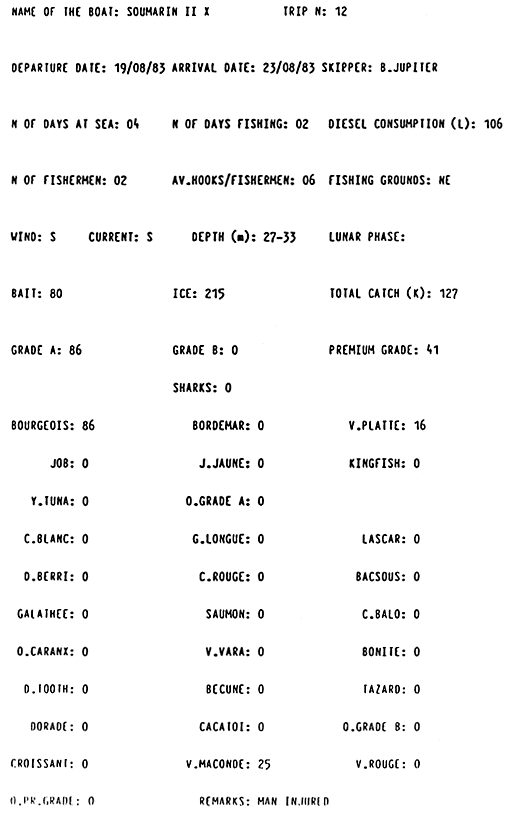
The data form used is shown in Fig. 1.
In addition to details of the vessel, dates of the trip and area fished, items concerning operational requirements such as ice, bait and a more detailed breakdown of species have been included, together with miscellaneous items such as fishing depth and remarks about the trip. Since all the fish is gutted onboard the boat, all catches given in this report are expressed as kilogrammes or tonnes of gutted fish.
In November 1982, FIDECO started unloading their catch on their own premises, but only since December/January 1983 it has been possible to obtain more detailed information on species composition on most of the forms.
This new form has been designed to be processed on the Apple III computer of the FAO/SWIOP using the Personal Filing System (PFS) Software Packages.
The micro-computer used to store and analyse the data has a memory of 128 kilobytes and two floppy disk drives. Each month the data for each trip were entered on a specially designed "PFS File" form and stored on a disk. The sorting of the forms and the data were computed using the "PFS Report" package. This computer programme allows the choice of the forms to be analysed, sorts the items to be computed, prints them in columns and computes sub-averages, averages, sub-totals, totals, sub-counts and counts. Three columns of recalculation such as catch/man/day or percentages can be displayed.
FIG. 1: Printout of PFS Data Form.
For this study, the schooners have been divided into three main groups
The study is based mainly on the 25 Hp and 37 Hp schooners, as most of the fleet fails into these two main groups and few trips were carried out by the larger schooners.
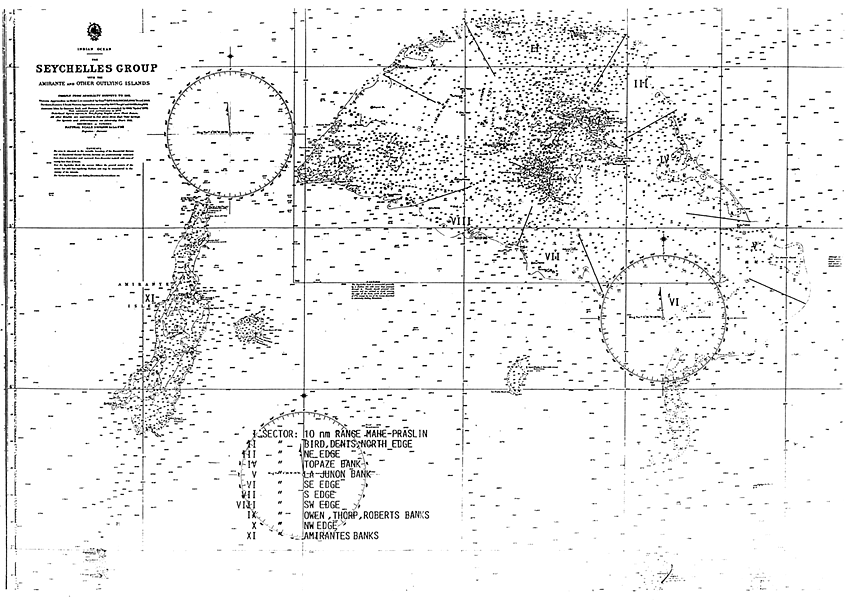
For statistical purpose, the Mahé Plateau has been divided into 10 sectors the eleventh being the Amirantes Bank. The boundary of each sector was chosen so as to enclose one major bank or related groups of banks (see Fig:2). Sector I is not included in the analysis as the fishery is almost exclusively exploited with open boats. Sector VIII data are insufficient to have warranted inclusion in some elements of analysis.
Handlining is the major traditional fishing technique in Seychelles waters. This technique is practised on three main types of fishing boats:
(i) Open FRP boats with outboard engines, usually 16ft long, operating within a 10-mile range of the main islands.
(ii) "Whalers": planked boats with Inboard engines, fishing mostly for jacks (Carangidae) but entering the demersal fishery during the good weather season.
(iii) Schooners: planked boats with inboard engines, sleeping accommodation and ice box, rigged with cutter marconi sails.
At present, a total of 38 schooners are in operation, 18 of which are owned by FIDECO. The characteristics of FIDECO fleet are shown in Table 1.
| BOAT | ENGINE MODEL | DIESEL | LENGTH |
|---|---|---|---|
| CONSUMPTION | (FT) | ||
| Morning Star | Yanmar 2TE 25 HP | 6 L/hr | 24 |
| Mirella | - " - | - " - | 30 |
| Sagitaire | - " - | - " - | 29 |
| Soumarin I | - " - | - " - | 23 |
| Soumarin II | - " - | - " - | 30 |
| Alert | 3TE 37 HP | 8.8 L/hr | 35 |
| Calypa | - " - | - " - | 40 |
| Dick | - " - | - " - | 35 |
| Innocent | - " - | - " - | 34 |
| Lanina | - " - | - " - | 35.5 |
| Mami | - " - | - " - | 35 |
| Queen | - " - | - " - | 32 |
| Serre | - " - | - " - | 35 |
| St. Marc | - " - | - " - | 36.5 |
| Tokos | - " - | - " - | 35 |
| Toussainy | - " - | - " - | 35 |
| Virgilant | - " - | - " - | 32 |
| Chantal | 3ESDE 56 HP | 11 L/hr | 49 |
| Sea Gleaner | Volvo MD 120 HP | 25 L/hr | 47 |
FIG:2 FISHING SECTORS
The gear consists of a cotton main line, and a monofilament leader with several branch lines with 2/0 to 4/0 size barbed hooks; the mainline weighted at the bottom with about 700g of iron. The number of hooks varies according to the target species. For relatively small species such as Lethrinids and small groupers, 10-15 hooks are used. For larger species such as snappers and big groupers, there are 4-8 hooks.
Lethrinids and small groupers are mostly fished at shallower depths of 25-35m on coralline substrates; whereas big groupers and snappers in depths greater than 35m, characterised by scattered large coral heads.
Fishing activity is mostly concentrated on banks situated near the edge of the Mahé Plateau, and on the Amirantes Bank. The navigation equipment onboard the schooners is limited to a compass. The only indicator of the fishing ground is given by the course of the boat and the time sailed, as the fishing grounds are generally out of sight of land.
A total of 491 trips were carried out during the study period, of which 459 trips were made by the two major schooner categories.
| Duration of the trips average | 4.8 days for the 25 Hp schooners and |
| 6.9 days for the 37 Hp schooners | |
| The average number of trips per month is: | 3 for the 25 Hp |
| 2.5 for the 37 Hp |
The 25 Hp boat types average a total of 168 sea days per year (14.5 sea days/month), whereas a 37 Hp schooner spends an average of 205 days per year at sea (17.1 sea days/month).
| 25 HP ENGINE | 37 HP ENGINE | |||||||
|---|---|---|---|---|---|---|---|---|
| MONTH | Number of boat in operation |
Total number of trip |
Mean number of trip/boat |
Mean number of days at sea/boat |
Number of boat in operation |
Total number of trip |
Mean number of trip/boat |
Mean number of days at sea/boat |
| SEPTEMBER '82 | 3 | 9 | 3.0 | 15.0 | 10 | 21 | 2.1 | 14.9 |
| OCTOBER | 3 | 11 | 3.7 | 18.5 | 10 | 27 | 2.7 | 19.1 |
| NOVEMBER | 3 | 12 | 4.0 | 20.0 | 12 | 30 | 2.5 | 17.7 |
| DECEMBER | 3 | 8 | 2.7 | 13.5 | 12 | 36 | 3.0 | 21.2 |
| JANUARY '83 | 3 | 11 | 3.7 | 18.5 | 12 | 34 | 2.8 | 19.8 |
| FEBRUARY | 3 | 7 | 2.3 | 10.5 | 12 | 26 | 2.2 | 15.1 |
| MARCH | 4 | 16 | 4.0 | 18.3 | 11 | 33 | 3.0 | 20.5 |
| APRIL | 4 | 13 | 3.3 | 15.0 | 11 | 29 | 2.6 | 17.8 |
| MAY | 5 | 10 | 2.0 | 9.1 | 11 | 26 | 2.4 | 16.4 |
| JUNE | 5 | 13 | 2.6 | 11.9 | 11 | 27 | 2.5 | 17.1 |
| JULY | 4 | 8 | 2.0 | 9.1 | 12 | 19 | 1.6 | 11.0 |
| AUGUST | 4 | 13 | 3.3 | 15.0 | 9 | 20 | 2.2 | 15.1 |
| TOTAL | - | 131 | 168.0 | 328 | 205.0 | |||
| MONTHLY
MEAN |
3.7 | 3.0 | 14.5 | 11.1 | 2.5 | 17.1 | ||
The mean crew for each boat type is as follows:
| 25 Hp schooners | - | 3.5 men |
| 37 Hp schooners | - | 4.5 men |
| Larger boats | - | 7-8 men |
A total of 398.4t was landed by the FIDECO fleet from September 1982-August 1983. The monthly catch ranges from a maximum of 53.7t during March to a minimum of 14.3t during July, giving a mean monthly catch of 33.2t.
The wide fluctuations in catch per month show a marked seasonality. This seasonality seems to be correlated with the weather conditions and does not reflect a change in abundance of demersal fish (See Table 3 and Fig. 3).
The total catch has been divided into four groups according to the pricing system:
| Grade A | (mostly large groupers and snappers) |
| Grade B | (mostly Lethrinidae) |
| Premium Grade | (small species of groupers and snappers) |
| Sharks | (mostly by-catch) |
The fluctuation in catch closely follow the monthly pattern of Grade A landings whereas those of Grade B and Premium Grade remain fairly constant throughout the year (See Fig. 3).
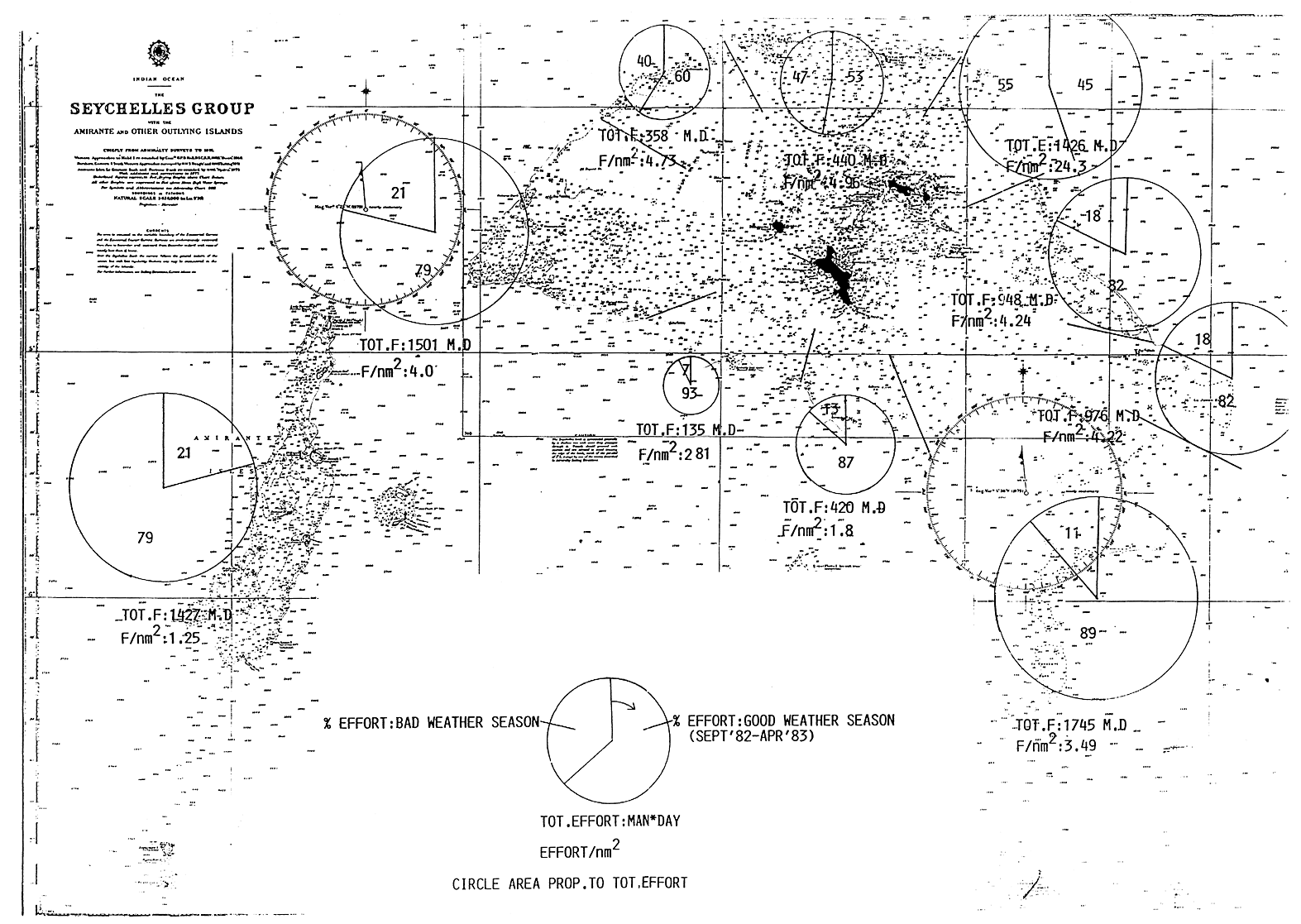
The decline in percentage of Grade A for May to August 1983 may be due to the fact that the fishermen are forced under bad weather conditions to fish in more sheltered areas or near islands. Those areas have probably thus been more heavily exploited, affecting particularly the slower growing demersal species of Grade A. This is well illustrated by Fig. 4 and Fig. 5, where there is a correlation between areas having a high percentage in Grade A and a higher effort during the good weather season. Sheltered areas which are more frequented during the S-E monsoon season produce much less Grade A fish.
Table 4 and Fig. 4 show the distribution of total catch by zone. The majority of the catch comes from Sectors III, V, VI, IX and XI.
| MONTH | NO. OF BOATS | NO. OF TRIPS | D. FI. | AVE MEN | GR. A. | GR. B. | P. GR. | SHARKS | T. CATCH | MEAN C/M/D |
|---|---|---|---|---|---|---|---|---|---|---|
| SEPTEMBER | 14 | 32 | 139 |
4 | 15 758 |
7 991 |
6 320 |
416 |
30 485 |
57.12 |
| OCTOBER | 14 | 42 | 209 |
4 | 22 577 |
8 713 |
6 325 |
271 |
37 886 |
45.07 |
| NOVEMBER | 16 | 45 | 207 |
4 | 20 603 |
9 805 |
9 467 |
1 389 |
41 264 |
51.15 |
| DECEMBER | 16 | 47 | 196 |
4 | 18 152 |
6 118 |
7 222 |
824 |
32 316 |
41.86 |
| JANUARY | 16 | 48 | 218 |
4 | 25 404 |
13 689 |
6 043 |
1 479 |
46 615 |
50.51 |
| FEBRUARY | 16 | 34 | 134 |
4 | 16 488 |
7 969 |
4 664 |
734 |
29 855 |
55.32 |
| MARCH | 18 | 56 | 234 |
4 | 32 524 |
10 911 |
9 738 |
564 |
53 737 |
59.09 |
| APRIL | 17 | 46 | 213 |
4 | 21 530 |
8 704 |
8 422 |
511 |
39 167 |
48.52 |
| MAY | 18 | 38 | 178 |
4 | 13 242 |
8 894 |
7 619 |
1 466 |
31 221 |
40.11 |
| JUNE | 16 | 39 | 239 |
4 | 6 795 |
7 965 |
9 587 |
168 |
24 515 |
24.01 |
| JULY | 16 | 28 | 142 |
4 | 2 924 |
5 674 |
5 341 |
405 |
14 344 |
25.76 |
| AUGUST | 15 | 36 | 85 |
4 | 4 069 |
4 984 |
5 125 |
2 775 |
16 953 |
28.27 |
| TOTAL | 491 | 2 294 |
200 066 |
101 417 |
85 873 |
11 002 |
398 358 |
|||
| % of T. CATCH | 50% |
25% |
22% |
3% |
FIG. 3 FIDECO SCHOONERS LANDINGS VS MONTH
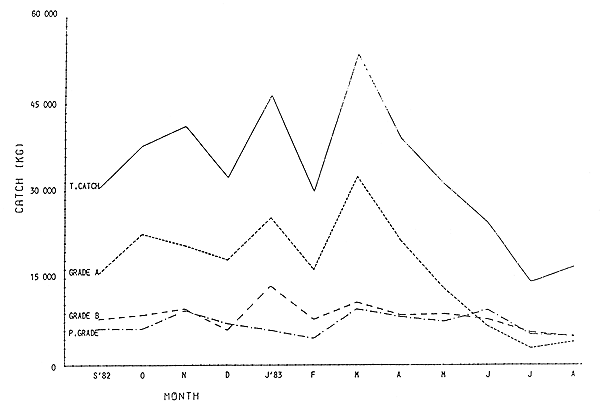
TABLE 4: FIDECO FLEET (SEPTEMBER 1982-AUGUST 1983) CATCH DISTRIBUTION - BY ZONE BY MONTH
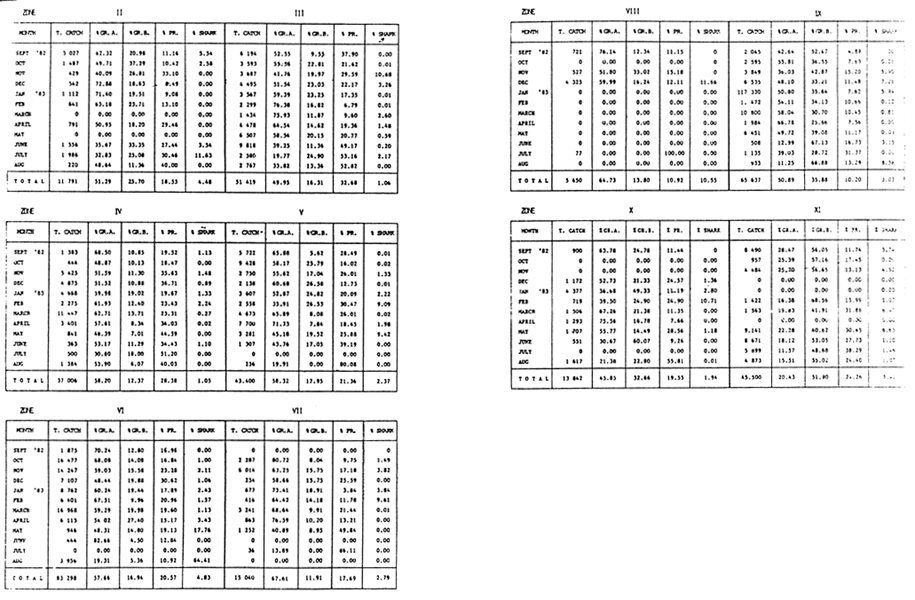
FIG.4: DISTRIBUTION OF CATCH & CATCH RATE BY FISHING ZONE.FIDECO ONLY
(SEPT '82-AUG '83)
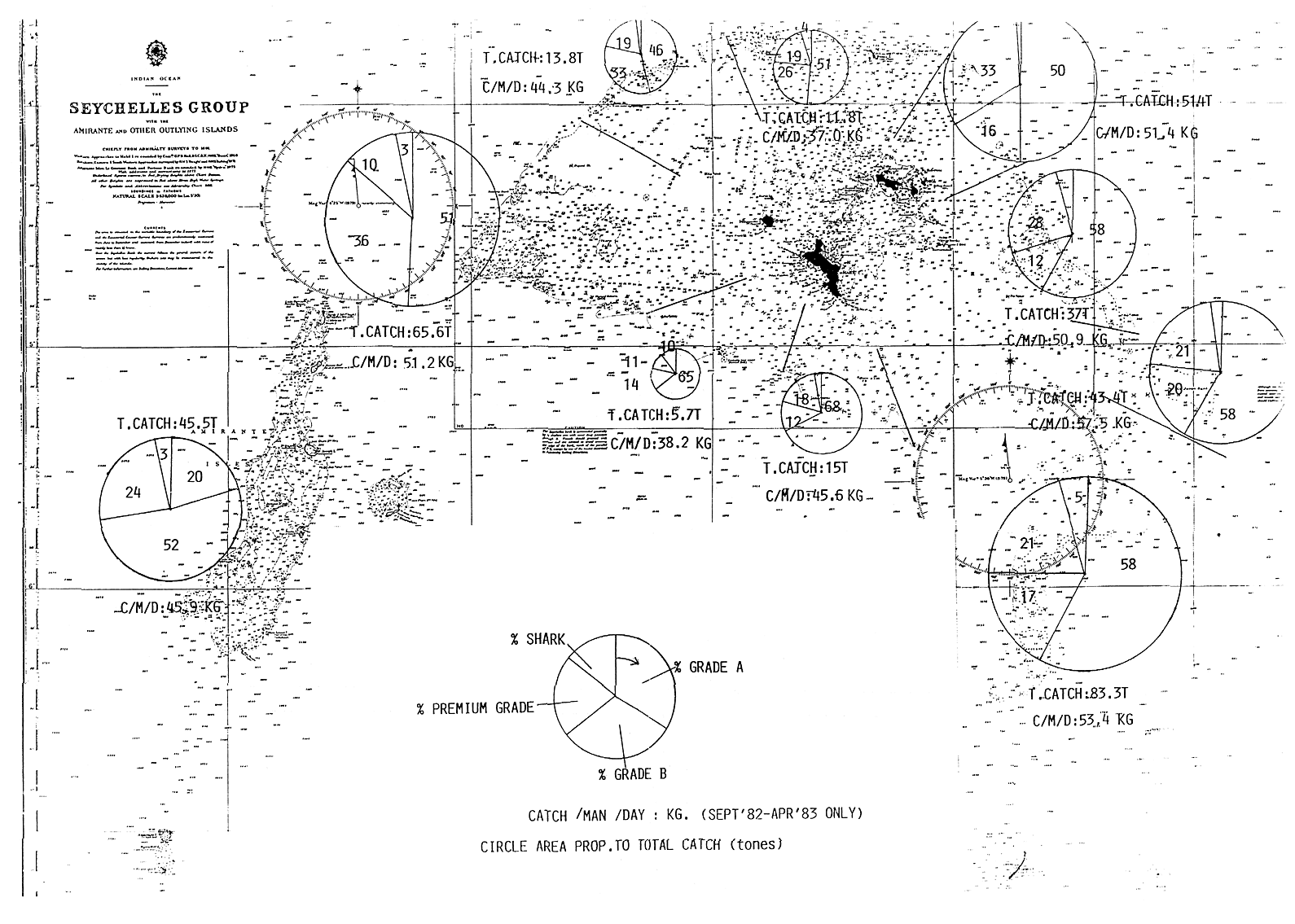
FIG.5: DISTRIBUTION OF EFFORT BY FISHING ZONE BY SEASON:FIDECO ONLY
Large differences in Grade composition are found between the Mahé Plateau and the Amirantes Bank, the latter characterised by a high percentage in Grade B. This is probably due to the type of substrate associated with shallow waters.
Within the Mahé Plateau itself, the area extending from the East to the SSW (Sectors IV, V, VI, VII and VIII) have the highest percentage in Grade A.
Table 5 shows a detailed breakdown of the catch into species which has been computed from Jan-Aug 1983. For the Mahé Plateau, the most important species are:
| Lutjanus sebae (Bourgeois) and L. sanguineus (Bordemar) | 34% |
| Epinephelus chlorostigma (Maconde) | 14% |
| E. leprosus (Vieille platte) | 8% |
| Pristipomoides spp. (Job jaune + Batrican) | 8% |
| Aprion virescens (Job) | 5% |
| Lethrinus enigmaticus (Lascar) | 5% |
| Lutjanus bohar (ara Vara) | 4% |
| Gymnocranius rivulatus (Capitaine blanc) | 3% |
| E. fasciatus (Vieille rouge.) | 2% |
| Variola louti (Croissant) | 2% |
| Lethrinus nebulosus (Capitaine rouge) | 1% |
For the Amirantes Plateau:
| Lethrinus enigmaticus | 25% |
| E. chlorostigma | 20% |
| Lutjanus bohar | 15% |
| A. virescens | 6% |
| E. leprosus | 6% |
| Pristipomoides spp. | 4% |
| E. fasciatus | 3% |
| V. louti | 2% |
| Lutjanus sebae and L. sanguineus | 2% |
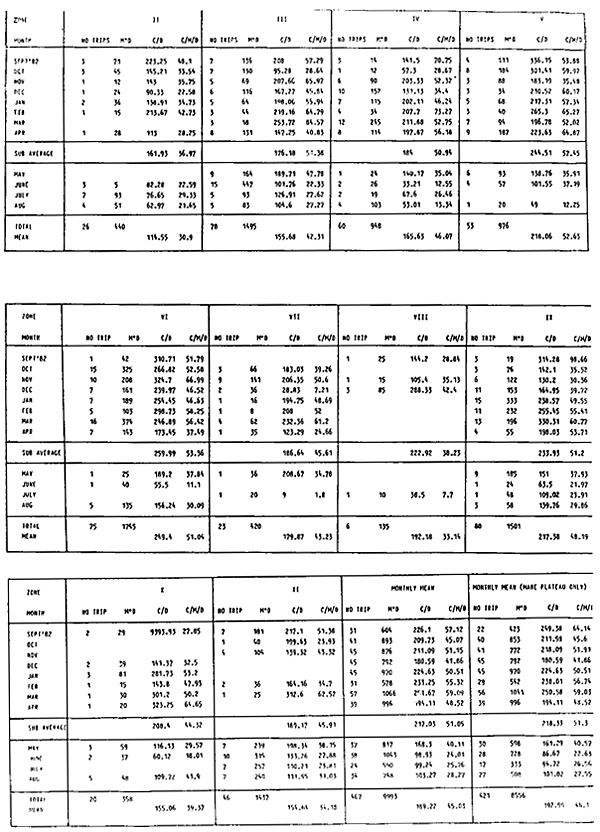
A total of 491 trips were made throughout the year with peaks during January and March, totalling 9 993 man-days. The number of man-days during the S-E monsoon is quite elevated due to trips being longer as weather conditions are bad and the catch rates are very low.
The distribution of effort by fishing zone is shown in Table 6 and Fig. 5. The highest effort in man-days are found in Sectors III, VI, IX and XI.
During the S-E monsoon season (May-August 1983), the majority of the effort is concentrated in Sectors II and III, which are found close to islands (Denis, Bird, Praslin group) and on the Amirantes Plateau (79% of the effort during the S-E season).
TABLE 5: PERCENTAGE CATCH COMPOSITION BY FISHING ZONE (JAN-AUG '83)
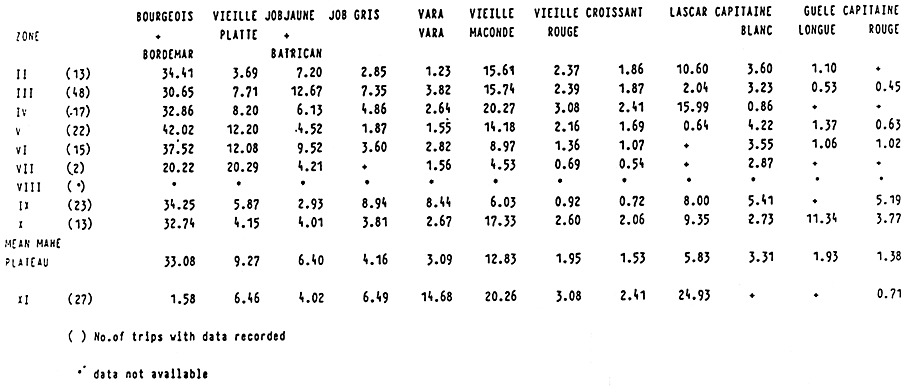
TABLE 6: MONTHLY EFFORT AND CATCH PER UNIT OF EFFORT
All these sectors, with the exception of Sectors II and III are characterised by large banks therefore the relative effort per unit of area is low (see fig. 5).
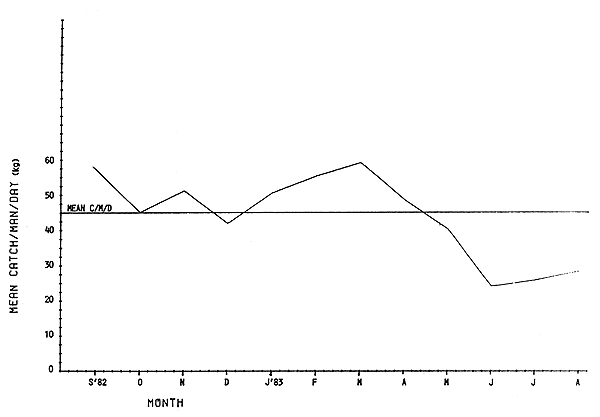
The catch rate varied from a maximum of 59kg/man/day during March to a minimum of 24kg/man/day during the month of June giving a monthly average of 45kg/man/day. (Table 6 and Fig. 6). The sharp drop in catch rate during the S-E monsoons indicates that this is very dependent on weather conditions. Possibly this is due to the fast drift of the boat and related difficulty in keeping the line close to the sea floor. Furthermore poor living conditions and lack of security on board the boat do not allow the fishermen to exploit the best fishing grounds. The time spent moored waiting for improvement of weather conditions is also affecting the catch rates per fishing day and cannot be easily recorded.
Catch rates between different sectors cannot be compared on a yearly basis since some of the sectors are fished more during the S-E monsoon period when the catch rates are generally lower and others are fished more during good weather season when the catch rate is generally higher. Valid comparisons are therefore only those of the average catch/man/day for the months from September 1982 to April 1983.
Catch rates appear to be higher in Sectors IV, V, VI and IX, corresponding to Topaze Bank, Junon Bank, the S-E region and Owen Bank. This could be due to low effort per unit of area, and low effort during the S-E monsoon season; also the exploitation of these areas date only from the past few years.
It should be noted that the catch rates for Sector III during the good season are high despite the high level of effort in this area.
On the other hand, the low catch rates in Sector II may be due to the higher level of exploitation of this area due to proximity to islands which facilitates navigation and permits year-round exploitation. This fishing ground could have also been more exploited in the past.
Sectors VII, X and XI show an intermediate catch rate averaging 45kg/man/day. For Sector VIII, very few trips have been made to this region, and the catch rate is low.
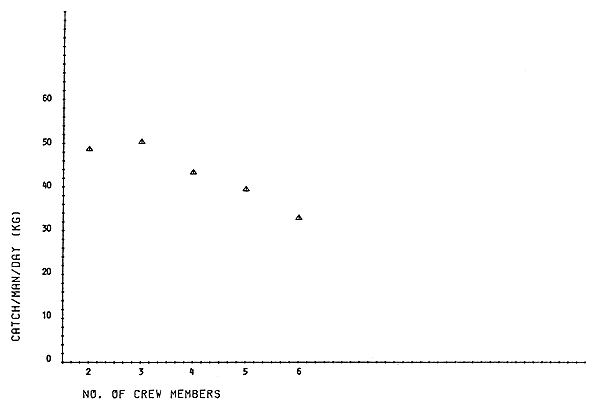
Table 7 and Fig. 7 clearly show the variation of catch rate with increasing number of crew members. An optimum catch rate of 50 kg/man/day is attained with a crew of 3 men. With increasing number of men, the catch rate decreases sharply in a sigmoid fashion.
FIG.6 MEAN CATCH/MAN/DAY VS MONTH
| ORDINARY SCHOONERS | SCHOONER WITH DO RIES | |||||
|---|---|---|---|---|---|---|
| NO OF | CATCH/MAN/DAY (KG) | CATCH/MAN/DAY (KG) | ||||
| CREW | ||||||
| MEMBERS | SEPT '82-JAN '83 | FEB-AUG '83 | ALL YEAR | SEPT '82-JAN '83 | FEB-AUG '83 | ALL YEAR |
| 2 | 53.17 (17) | 44.60 (19) | 48.65 | |||
| 3 | 47.50 (36) | 52.00 (56) | 50.24 | |||
| 4 | 47.90 (81) | 38.82 (86) | 43.22 | |||
| 5 | 44.00 (50) | 35.37 (59) | 39.33 | |||
| 6 | 38.13 (14) | 27.48 (14) | 32.80 | 82.14 (3) | 41.47 (2) | 65.87 |
| 7 | - | 30.57 (6) | - | 80.09 (2) | 54.48 (4) | 63.02 |
| 8 | - | - | - | 86.06 (6) | 49.74 (7) | 66.50 |
FIG.7 CATCH/MAN/DAY VS NO.OF CREW MEMBERS
| NO. OF | CATCH/MAN/DAY (KG) | ||
|---|---|---|---|
| DAYS FISHING | SEPT '82-JAN '83 | FEB-AUG '83 | ALL YEAR |
| 2 | 57.96 (28) | 63.64 (33) | 61.03 |
| 3 | 55.87 (23) | 49.02 (42) | 51.44 |
| 4 | 53.78 (39) | 41.18 (41) | 47.32 |
| 5 | 40.82 (42) | 39.14 (47) | 39.93 |
| 6 | 34.95 (30) | 33.16 (28) | 34.09 |
| 7 | 35.82 (15) | 27.95 (31) | 30.52 |
| 8 | 31.29 (13) | 15.94 (12) | 23.92 |
| 9 | 44.59 (1) | 21.33 (6) | 24.65 |
| 10 | 19.45 (1) | 16.49 (2) | - |
In Table 7, catch rates for larger schooners with 6-8 crew members are more elevated due to the fact that catcher boats (dories) are employed when possible.
The decline of catch rate with a crew exceeding 3 men may be due to the long attraction range of baited lines in clear waters, which allows few lines, to catch most of the fish available in the area covered. In the case of a dory-fishery, the boats are covering different areas.
Table 8 shows a decrease in catch rate with increasing number of days fishing. This is probably because longer trips result from bad weather conditions, difficulty in locating the fishing grounds or ether problems affecting the number of fishing hours per day.
Data for private schooners are only available for the months of October and November 1983. The average catch rate for this period comes to 64.86kg/man/day compared to 48.25kg/man/day for FIDECO schooners during the same period, representing an increase of 34%.
Reasons for the higher productivity may include the level of experience of the skippers and longer working hours on the private schooners.
Using the PFS Report Computer Programme, the "Gross Return" was calculated for each trip using the following formula:
| Gross Return | = | Gross Revenue - Operating Costs - Crew share | |
| Gross Revenue by FIDECO | = kg Grade A x Rs.5.50 + kg Grade B x Rs.3.50 + | ||
| kg Premium Grade x Rs.8.00 + kg Sharks x Rs.1.50 | |||
| Operating Cost | = | Diesel Consumption x Rs.3.64 + oil cost + bait | |
| cost + ice cost + Social Security | |||
| (repair and maintenence have been considered | |||
| as fixed costs) | |||
Bait and ice consumption were not available for all the trips, therefore a mean was taken of available data for the 25 Hp and 37 Hp schooners respectively. These are given in Table 13. Oil cost for each trip was taken as 10% of the respective diesel cost. Social Security was taken as 10% of crew share.
Crew share = kg Grade A x Rs.2.50 + kg Grade B x Rs.1.90 + Premium Grade x Rs.5.00 + kg Shark x Rs.1.50
The prices of fish used in the calculation of 'Gross Revenue for FIDECO' are the prices paid by Seycom. Prices used for Crew share are those paid by FIDECO to the skipper.
The 'Gross Return for FIDECO' was then computed as the 'Mean Gross Return per trip' and analysed separately for the two main schooner types (the 25 Hp and 37 Hp schooners).
The 'Mean Gross Return per trip' for the two boat types was then analysed accprdomg to following parameters:
The 'Net Profit for FIDECO' for the two boat types will be introduced in Chapter E 3.
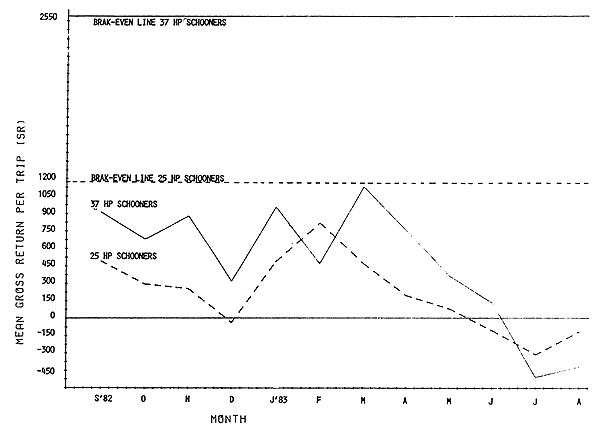
Table 9 and Fig.8 show that the 'Mean Gross Return' per trip for the two boat types by month drops to minima during December which corresponds to the N-W monsoon and from May to August (S-E monsoon). During the S-E monsoon, the 'Gross Return' per trip is negative, which means that the operating cost/trip are not being covered by the 'Gross Revenue'.
The price of fish throughout the year is constant and independent of supply. The 37 Hp schooners show a generally higher mean 'Gross Return'/trip. This does not indicate that this boat type is more profitable than the 25 Hp schooners since the fixed costs are not included in this part of the study.
This is shown in Table 10 and Fig.9. The mean Gross Return/trip increases to a maximum with increasing number of crew and then flattens out. This is related to the sharp decline in catch/man/day with increasing number of fishermen (see para C4).
From the point of view of the company, the optimum crew for the 25 Hp schooners seem to be around 5 and for the 37 Hp Schooner, 6 crew members. Any further increase in crew members result in a minimal increase in 'Gross Return'.
Since some zones are visited only during the good season and others throughout the year, the mean Gross return/trip by zone has been computed only for the good season, so as to be able to compare the profitability of each zone. It would be misleading to compare the profitability of each zone on a yearly basis as catch rates are mostly influenced by the weather conditions.
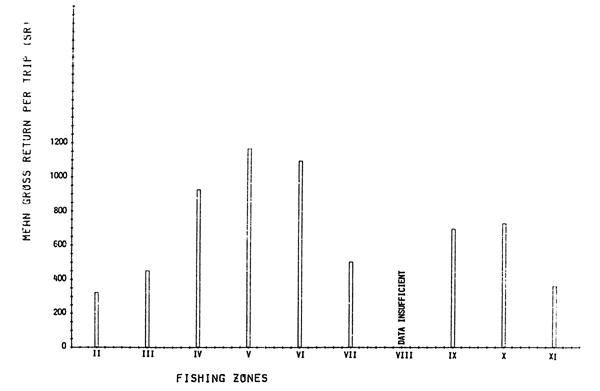
Table 11 and Fig. 10 show that 37 Hp schooners give the highest mean gross return/trip in sectors ranging from the East to SE of the Mahé Plateau (IV, V, VI), whereas in sectors lying from the North to NE (II, III) and the Amirantes Banks they are less profitable.
The profitability of a fishing zone is dependent on three factors:
The catch rate by zone is the factor showing more positive correlation with Mean Gross Return per trip. On the following table the zones are given in Columns 1 and 2 in increasing order of mean gross return per trip and mean catch rates respectively. The arrows represent positive correlations.
| 25 H.P. ENGINE | 37 H.P. ENGINE | |
|---|---|---|
| MONTH | MEAN GROSS RETURN/TRIP (SR) |
MEAN GROSS RETURN/TRIP (SR) |
| SEPTEMBER '82 | 488.10 |
910.16 |
| OCTOBER | 292.19 |
677.19 |
| NOVEMBER | 252.76 |
876.06 |
| DECEMBER | -37.74 |
315.29 |
| JANUARY '83 | 485.51 |
951.25 |
| FEBRUARY | 814.65 |
463.70 |
| MARCH | 466.74 |
1124.55 |
| APRIL | 190.54 |
745.61 |
| MAY | 77.69 |
357.93 |
| JUNE | -109.20 |
128.27 |
| JULY | -313.49 |
-507.12 |
| AUGUST | -115.52 |
-417.38 |
| MEAN | 207.72 |
468.79 |
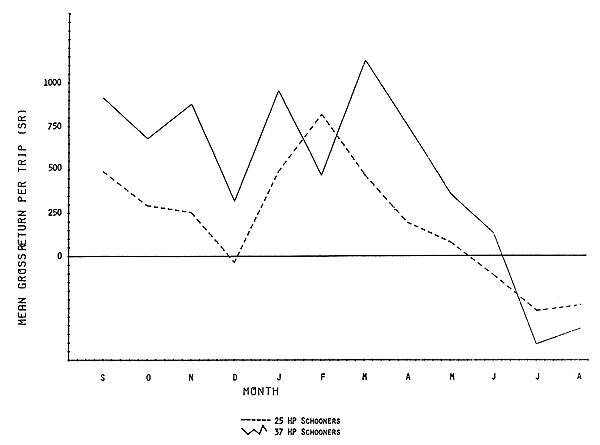
FIG.8 FIG.8 MEAN GROSS RETURN PER TRIP VS MONTH
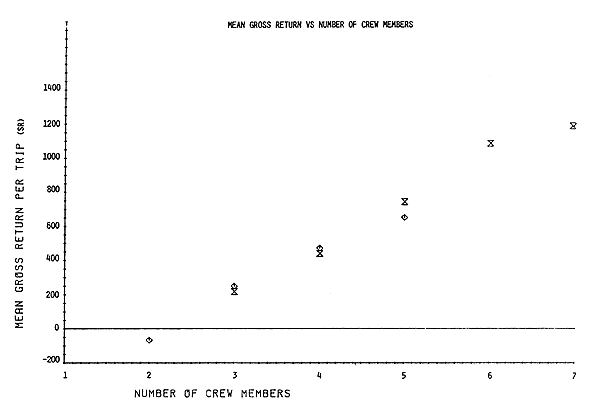
FIG.9 MEAN GROSS RETURN PER TRIP VS NUMBER OF CREW MEMBERS
 25 HP SCHOONERS
 37 HP SCHOONERS
25 H.P. ENGINE |
37 H.P. ENGINE |
|||||
| NO OF CREW MEMBERS |
MEAN GROSS RETURN/TRIP (SR) |
MEAN GROSS RETURN/TRIP (SR) |
||||
SEPT '82-JAN '83 |
FEB-AUG '83 |
ALL YEAR |
SEPT '82-JAN '83 |
FEB-AUG '83 |
ALL YEAR |
|
2 |
117.23 (16) |
-293.32 (13) |
-66.81 |
- |
240.00 (5) |
- |
3 |
310.62 (17) |
224.33 (46) |
247.61 |
374.44 (19) |
12.32 (15) |
215 |
4 |
564.40 (13) |
389.58 (16) |
467.99 |
604.57 (63) |
281.77 (70) |
435 |
5 |
646.53 (3) |
- |
646.53 |
899.49 (48) |
594.59 (55) |
737 |
6 |
- |
- |
- |
1570.82 (14) |
583.97 (14) |
1078 |
7 |
- |
- |
- |
836.92 (2) |
1293.25 (6) |
1179 |
FISHING |
MEAN GROSS RETURN/TRIP |
|
SEPTEMBER 1982 - APRIL 1983 |
||
25 H.P. ENGINE |
37 H.P. ENGINE |
|
II |
514.96 (9) |
323.18 (11) |
III |
446.43 (21) |
449.77 (32) |
IV |
488.95 (27) |
923.15 (22) |
V |
322.84 (12) |
1 162.75 (32) |
VI |
491.35 (5) |
1 090.19 (51) |
VII |
17.28 (8) |
500.17 (12) |
VIII |
-- |
95.30* (4) |
IX |
289.81 (11) |
691.31 (52) |
X |
-- |
723.81 (8) |
XI |
-- |
357.79 (15) |
FIG. 10 MEAN GROSS RETURN PER TRIP VS FISHING ZONES
It can be seen that the profitability for Sectors II, V, VI and VII are positively correlated with catch rate. For Sectors IV and IX the relationship is still valid as the difference in catch is not significant.
In Sector XI (Amirantes), the low return is not only due to the relatively low catch rate but also to the high percentage of low value fish and the increased fuel consumption.
It is not possible to derive any sort of relationship for the 25 Hp as their fishing capacity seems to be limited mostly to certain zones.
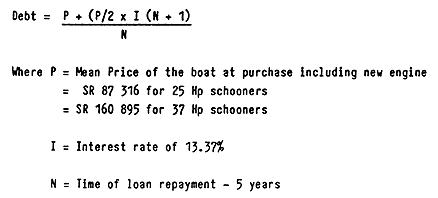
This was calculated using the following fomula:
Fixed Cost/Year = Debt + Depreciation + Maintenance
25 H.P. SCHOONERS |
37 H.P. SCHOONERS |
|||||
| FIXED COST | 42,129.97 |
77,631.84 |
||||
| OPERATING COST | QUANTITY |
PRICE/UNIT |
TOTAL |
QUANTITY |
PRICE/UNIT |
TOTAL |
| Diesel & oil | 5,113.35l |
3.64 |
18,612.59 |
7,351.29l |
3.64 |
26,758.69 |
| Ice | 58.30t |
125.00 |
7,287.50 |
103.70t |
125.00 |
12,962.50 |
| Bait (1/2 paid by FIDECO) | 1,404.00 |
1,875.20 |
||||
| Crew Share | 17,540.00kg |
2.87 |
50,339.80 |
27,400.00kg |
2.87 |
78,638.00 |
| Social Security 10%
of crew share |
5,033.98 |
7,863.80 |
||||
| TOTAL | 82,677.87 |
128,098.19 |
||||
| GRAND TOTAL
Cost/Boat |
124,807.84 |
205,730.03 |
||||
Depreciation = 10% of Purchase price, P
Maintenance = 10% of Purchase price, P.
Fixed costs for the two boat types are:
- 25 Hp schooners SR 42 130/yr
- 37 Hp schooners SR 77 632/yr
The break-even line per trip has been superimposed on the graph showing the mean gross return/trip (Fig. 11). This is based on the assumption that the 25 Hp schooners average 3 trips/month and the 37 Hp schooners 2.5 trips/month.
At SEYCOM prices, Fig. 11 shows that the mean Gross Return/trip never reaches the break-even line, the gap being bigger for the 37 Hp schooners.
This, however, no longer reflects the real situation of FIDECO since part of the catch is being exported at a much higher price.
Total cost/year = Fixed cost + Operating cost.
Fixed costs are given in Paragraph E 2.
Operating cost has been calculated using the mean running costs/trip raised by the mean number of trips per month. The results for the first five years are given in Table 12.
The break-even point ranges from SR 7.67/kg for the 25 Hp schooners to SR 7.51/kg for the 37 Hp schooners at the FIDECO level of productivity. Using the increased catch rate of privately operated schooners, these figures are respectively SR 5.7 and SR 5.6/kg.
The mean net profit/boat/year has been simulated for four different prices and these are shown in Table 13. The mean net profit/boat/year has also been computed using a catch rate increased by 34% as that for private schooners. (see Table 14)
The mean number of days at sea per boat was computed for each boat type for the twelve months as shown in Table 2. The expected days at sea for both 25 and 37 HP schooners were computed for each month as follow based on data on daily mean and maximum wind speed supplied for the study period by the Seychelles Meteorological Service:
FIG. 11 MEAN GROSS RETURN PER TRIP VS MONTH WITH BREAK EVEN LINE.
MEAN PRICE/kg. |
NET PROFIT/BOAT/YR FOR FIDECO |
||
25 Hp schooners |
37 Hp schooners |
||
| Actual SEYCOM Price - Mean:5.40/kg |
-36980.00 |
-57756.00 |
|
| Break-even price for 25HP Schooners: 7.67/kg |
0.00 |
4453.00 |
|
| Break-even price for 25HP Schooners: 7.51/kg |
-2670.00 |
0.00 |
|
| Mean price with part of the catch exported: 11/kg |
54081.00 |
95712.00 |
|
% of Catch |
Price/kg 16.00 12.00 5.50 3.50 |
||
MEAN PRICE/kg. |
NET PROFIT/BOAT/YR FOR FIDECO |
||
25 Hp schooners |
37 Hp schooners |
||
| Actual SEYCOM Price - Mean:5.40/kg |
-7125.00 |
-7440.50 |
|
| Break-even price for 25HP Schooners: 5.70/kg |
0.00 |
3652.00 |
|
| Break-even price for 25HP Schooners: 5.60/kg |
-2844.00 |
0.00 |
|
| Mean price with part of the catch exported: 11/kg |
114746.00 |
198353.00 |
|
% of Catch |
Price/kg 16.00 12.00 5.50 3.50 |
||

| ED | = Expected Days at Sea |
| DM | = Calendar Days of the month |
| BWD | = Bad weather days; all days having mean wind speed 9 knots and |
| ID | = Inactive days including 3 days/month for loading and unloading, |
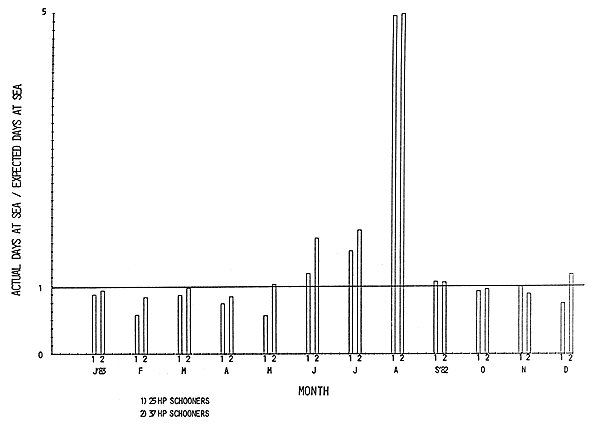
This method probably gives under estimated figures since with winds exceeding go knots the boats though unable to fish can steer to and from the fishing grounds. The ratio of mean actual days at sea to expected days at sea, R, for each month and boat type, has then been computed (see Table 15 and Fig. 12).
Two distinct patterns can be isolated for both boat types throughout the year:
2. During the S-E Monsoon season (June-September 1983), the ratio is higher than I meaning that the boats spend more days at sea than expected considering the weather conditions. This pattern is more evident for the 25 Hp schooners.
Considering that:
During the SE Monsoon, the boats spend most of the days at sea in sheltered waters waiting for a calm and have on average, very low catches and negative gross return per trip:
The obvious conclusion is to carry out complete maintenance of the boats during the SE period so that the boats are in good general condition during the good weather to exploit all the fishable days.
Such a strategy would not necessarily mean an increase in yearly production but would rather increase the economic return.
| COMPARISON BETWEEN ACTUAL AND EXPECTED DAYS AT SEA. | ||||||
| MONTH | 25HP SCHOONERS | 37HP SCHOONERS | ||||
ACTUAL |
EXPECTED |
RATIO |
ACTUAL |
EXPECTED |
RATIO |
|
| JAN.'83 | 18.50 |
21.00 |
0.88 |
19.80 |
21.00 |
0.94 |
| FEB. | 10.50 |
18.00 |
0.58 |
15.10 |
18.00 |
0.84 |
| MAR. | 18.30 |
21.00 |
0.87 |
20.50 |
21.00 |
0.98 |
| APR. | 15.00 |
20.00 |
0.75 |
17.80 |
20.00 |
0.89 |
| MAY | 9.10 |
16.00 |
0.57 |
16.40 |
16.00 |
1.03 |
| JUN. | 11.90 |
10.00 |
1.19 |
17.10 |
10.00 |
1.71 |
| JUL. | 9.10 |
6.00 |
1.52 |
11.00 |
6.00 |
1.83 |
| AUG. | 15.00 |
3.00 |
5.00 |
15.10 |
3.00 |
5.03 |
| SEP.'82 | 15.00 |
14.00 |
1.07 |
14.90 |
14.00 |
1.06 |
| OCT. | 18.50 |
20.00 |
0.93 |
19.10 |
20.00 |
0.96 |
| NOV. | 20.00 |
20.00 |
1.00 |
17.70 |
20.00 |
0.89 |
| DEC. | 13.50 |
18.00 |
0.75 |
21.20 |
18.00 |
1.18 |
In order to make a first attempt in assessing the state of the demersal stocks on the Seychelles Banks, further work needs to be carried out in the following fields:
From these data, a first attempt can be made to assess the state of the demersal stocks on the Mahé and Amirante Banks
At the prices obtained locally to fish, both the 25 Hp and 37 Hp schooners show a net loss throughout the year with the 'Gross Return' negative during the SE monsoon period. The net loss was less marked for the 25 Hp schooners due to their lower fixed costs.
Using an improved production level based on the catch per man per day of privately-owned schooners (an increase of 34% in catch rate) the yearly net balance is still negative. The producer must, therefore, obtain an increase in price in order to maintain a healthy fishery.
However, production could be further increased by the folowing measures:
These measures should provide the necessary incentive for further development of the handline fishery.