|
THE MARINE FISHERIES OF MADAGASCAR |
January 1982
RAF/79/065/WP/1/82/E
J. C. Rey
The designations employed and the presentation of material in this publication do not imply the expression of any opinion whatsoever by the Food and Agriculture Organization of the United Nations concerning the legal status of any country, territory, city or area or of its authorities, or concerning the delimitation of its frontiers or boundaries. The views expressed are those of the authors.
Study of the self-consumption level in the Mahanjanga Faritany |
With the aim of producing a report describing in detail the artisanal and industrial marine fisheries of Madagascar, the consultant will visit as many fishing harbours and fish landing areas as possible in order to collect in the field all the information relative to the following points:
This report should be illustrated with:
A standard form could be used for each landing spot in order to facilitate completion at some later time.
| 10 November | : | Antananarivo |
| 10 - 16 November | : | Nosy Bé, |
| 16 - 21 November | : | Mahajanga |
| 22 - 25 November | : | Toamasina |
| 26 - 30 November | : | Toliary |
| 30 - 03 December | : | Tolagnaro |
| 03 - 06 December | : | Antananarivo |
| 06 - 10 December | : | Toamasina - Isla Ste. Marie |
| 11 - 15 December | : | Manakara |
| 15 - 18 December | : | Morondave |
| 18 - 21 December | : | Antananarivo |
| 22 - 27 December | : | Antseranana |
| 28 - 02 December | ||
| January 1982 | : | Nosy Bé, |
| 03 January 1982 | : | Antananarivo |
Mr. H. G. TUNISSEN, Représentant-Résident P.N.U.D.
Mr. H. M. BOULARES, " " Adjoint P.N.U.D
Mr. O. RANAIVONDRAMBOLA, chargé des Programmes P.N.U.D.
Mr. C. RANDRIANAIVOJAONA, chef de la Division Pêche Maritimes.
Mme. F. ANDRIANIARISATRANA, Chef du Service de la Production Animal.
Mr. H. RAZAFIMBELD, Division Pêche Maritimes.
Mr. A. RALISON, Directeur du C.R.N.O.
Mr. S. SALIMO, Chef du Secteur de la Pêche Maritime.
Mr. BRANDHORST, F.A.O.
Mr. P. BLANCHARD, Directeur Adjoint de la Pêcherie de Nosy Bé (P.N.B.)
Mr. BERNARD, Directeur chantier naval du Cratere.
Mr. G. RAZAFINTSALAMA, Secrétaire Général du Faritany de Mahajanga.
Mr. RANDRIANARIJAONA, Directeur du Service de Développement Rural.
Mr. L. RABENOMANANA, Chef de la Division Pêches Maritimes.
Mr. A. RAJONSON, Directeur Adjoint SOMAPECH.
Mr. M. PRIEUR, Directeur Général FAMAKO
Mr. E. ZAR, Capitaine d'armament FAMAKO.
Mr. ARHAN, Coopérante aux Service des Pêches Maritimes.
Mr. VINNCENT, Directeur atelier VINNCENT.
Mr. JEAN IBE, Chef Service de Pêches Maritimes
Mr. ACHILSON, Service de Production Animal
Mr. P. MAIGNAN, Directeur REFRIGEPECH.
Mr. Le Directeur S.I.C.E.
Mr. Le Président Coopérative de Pêche VATOARA
Mr. C. RAKOTOMALALA, Chef Division des Pêches Maritimes.
Mr. Le ler Vice-Président du Faritany.
Mr. ANDRIANTSARAFARA, Directeur du Service de Développement Rural.
Mr. Président de la Coopérative de Pêche.
Mr. A. NAMBOLE, Chef Division Pêches Maritimes.
Mr. J. RAZAFINDRATSIMANDRESY, Président du Comité Exécutive du Fivondronapokontany,
Mr. COULIBALY, Responsable Opération "ANDROY" F.A.O.
Mr. W. RAJAONARY, Chef Circonscription de la Pêche Maritime.
Mr. NOELY, Service de Pêche Maritime.
Mr. V. E. JODA, Chef Section de la Pêche Maritime.
Mr. T. ELSON, Président Coopérative Pêche COOPEMO.
Mr. RALISON, CESIAM.
Mr. T. HOTUNKEN, Chef de Département de Ventas SECREN.
Mr. OLIVO, Directeur SUMMING EXPORT S.A.
Mr. BIKINI, Chef Division Pêches Maritimes.
Mr. M. MAHEVA, Président du FIVONDRONOND
Mr. O. BIMBA, Délégué du Ministère de la Population.
Mr. N. SALAVA, Directeur d'Agence de la Tranombarotra R.O.S.O.
The marine fisheries in Madagascar are composed of three well-defined levels: industrial, artisanal and traditional.
Each level has specific characteristics according to the methods and systems used, each level having its own marketing and organizational schemes.
The artisanal fisheries are at a very low level of development but are better organized and technically more advanced than the traditional fisheries. Each level also exploits different fishing grounds. The industrial fleet trawls off the central and north-west and east coasts between 1 and 2 miles from shore and exploits a coastal area 1 - 10 miles wide on the west coast. The artisanal fisheries also work in the same coastal areas, but with greater autonomy and capacity to go further off-shore.
Meteorological conditions very between the west and the east coasts, and are factors that influence the traditional fisheries. The west coast has an alternating wind regime during the day (in the morning the wind blows from the shore towards the sea and changes to the opposite direction starting in the afternoon). This wind blows with a moderated strength and favours the sailing of the pirogues to the fishing grounds in the morning and back to shore in the evening. Fishing is possible on a greater number of days in comparison with the east coast.
The west coast affords no protection from the constant trade winds which vary in strength. This reduces the possibilities of the traditional fisheries. The traditional fisheries are also influenced by the width of the continental shelf. On the east coast the platform is narrow and the slope shelf drops very fast to depths of 3,000 metres, in the west coast the continental shelf is wider and the drop off is softer, representing 70% of the total shelf area.
The tidal regime is semi-diurnal, the tide range greater being in the west and north-west coasts (in the latter, great surfaces are exposed with very low tides, which favours fishing and collection on foot) than in the east and south-east coasts.
Presently the only industrial fishing is for the shrimps, even though the marketing at industrial level includes also other products, especially lobsters. Between 1972 and 1975, a commercial fishing activity for tuna using live bait was developed with success in the northern area of Madagascar.
Experimental tuna fishing in Malagasy waters was started in February 1972 by the Japanese Company KAIGAI GYOGYO KABUSHIKI KAISHA (KG.KK). The fishing activities were carried out by three live bait boats supported by a mothership of 1,500 tons. Their activities finished in February 1973 with a total catch of 4.036 tons.
From January to September 1973, only one boat from TOSHOKU Company was authorized to fish off the north-west coast. The catch of skipjack during the above mentioned period was of 545.7 tons.
The COMANIP (Compagnie Malgache Nippone de Pêcherie) started fishing with five fishing boats during the months of May and June 1973. From July 1973, 4 fishing boats were added to the fleet. Finally, the MANIVECO which started with only one fishing boat started fishing in September 1973 and during the last five months of that year they got 208 tons. Their fishing operations ceased shortly after this year.
With the stop of operations of the COMANIP due to low prices of tuna on the world market and disagreements between the partners of the company, tuna fishing activities in Madagascar ceased.
All the tuna fishing was in the north, north-east and north-west of Madagascar.
The species that are part of these fisheries are listed below, arranged in order of importance:-
The depth distribution for the first four species is up to 45 metres, with a maximum concentration between 4 and 15 metres, over muddy bottoms. Peneaus species show a great preference for sandy bottoms.
According to Ralison (1980), the first fishing ventures at industrial level of the shrimp fisheries were giving 9% of the tonnage to Panaeus indicus.
In the years 1973 - 74, this figure lowered to 65%, increasing the proportion of Metapenaeus monoceros. In 1977, the proportion of Penaeus indicus started increasing up to the present levels of 80 - 85% of the total weight.
Penaeus indicus known commercially as 'White', is the species of major importance both from the standpoint of quantity and of value. Knowledge of its biological cycle, described by Ralison (1980 (1), is important in order to evaluate the relationship between industrial fishing (trawl) and small-scale fishing on this species (valakiras or barrages operation in the intertidal areas).
Penaeuz indicus is a species having a short life cycle with the following characteristics:-
Spawning in the open sea; a postlarvae migration takes place from the sea to the estuarine area where the prawns develop to 6 - 8mm. A second migration from the estuaries to the sea takes place at a length of 7.5cm, entering the fishing grounds (trawling) around 12cm long for the males and 14cm for females. The "valikiras" catch the prawns mainly during the migration and period when they are in the intertidal zone (sizes between 3 and 7.5cm). Almost all the industrial fishing and half of the annual catch of the "valikira", comes from the spawning of September to December (Ralison 1980 (1) of the previous year. The other half of the catch of the "valikira" comes from the March - April spawning.
The shrimp catches from the industrial fishery is almost all exported (98%) to Japan, U.S.A and Europe. A small part of the catch, mainly small sizes, goes to La Réunion and Mauritius. The value of sales during 1979 was of 4.200 million F.M. (1 US$ = 250 F.M.)
Industrial fishing of shrimps with trawl in the Malagasy waters is ruled by:
This last decree is determined under the responsibility of a technical interministerial commission which determines the number of fishing licences for areas I - II - III and IV, which are considered protected areas. The shrimp fisheries in the north-west remains closed from December 15 to February 15.
Regulations also provide for:
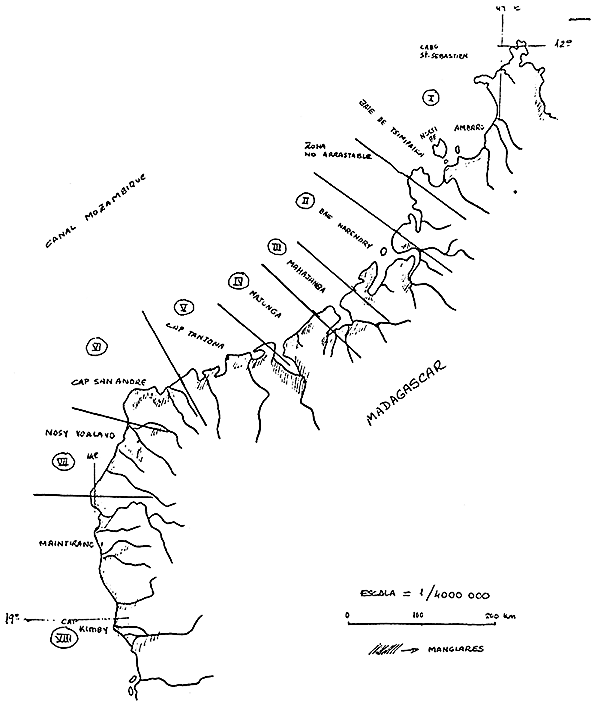
Shrimp trawling grounds are divided into seven areas, defined as zone I to zone VIII (zones VII and VIII are considered as only one). The first four zones are protected areas (between Mahajanga port and Cape San Sebastian), the other zones, V, VI, VII and VIII are considered free areas. For each zone the annual allowable catch has been evaluated;
| - | Zone I | : | Covers the Nosy-Bé area, Ambaro and Tsimipaika Bay. |
| The permissible catch is 1,560 ton/year; | |||
| - | Zone II | : | Natendry Bay. |
| The permissible catch is 760 ton/year. Only eight trawlers are allowed; |
|||
| - | Zone III | : | Mahajamba Bay. |
| The permissible catch is 320 ton/year. Only three trawlers are allowed; |
|||
| - | Zone IV | : | Mahajanga. |
| The permissible catch is 310 ton/year. Only three trawlers are allowed; |
|||
| - | Zone V | : | Cap Tanjona. |
| The permissible catch is 930 ton/year. Only 10 trawlers are allowed; |
|||
| - | Zone VI | : | Cap San Andres. |
| - | Zone VII and VIII | : | Area between Nosy Voalavo and south of Morondave. |
| The permissible catch is 1,000 ton/year. | |||
| More than 10 trawlers are allowed. |
The zones V, VI, VII and VIII are considered free despite the figure on recommended catch.
The following chart shows the development of catch and effort of the fleet. The effort is calculated in ponderated hours, being understood as the catch obtained by one trawler (15 metres LOA) in one hour of trawling.
| Year | Effort | Catch |
|---|---|---|
| 1967 | 11.360 |
775 |
| 1968 | 17.100 |
1340 |
| 1969 | 16.710 |
1635 |
| 1970 | 35.810 |
2910 |
| 1971 | 78.640 |
4080 |
| 1972 | 140.250 | 4690 |
| 1973 | 144.420 | 4800 |
| 1974 | 175.050 | 4450 |
| 1975 | 126.850 | 4630 |
| 1976 | 111.130 | 4540 |
| 1977 | 106.690 | 5125 |
| 1978 | 117.419 | 4950 |
| 1979 | 115.668 | 4330 |
| 1980 | See data | 4910 |
| Data obtained from Ralison 1/ | ||
Industrial fishing for shrimps was started in 1967 by the SIPMAD Company. Two periods are distinguished in the history of the shrimp fisheries from 1967 to 1975 with a spectacular increase of the catch followed by a decline. At present the fishery is in a steady state. Presently there are four (4) companies that are trawling for shrimps:
1/ Ralison A et all.: Bilan de connaissances sur lapêche crevettière malgache et propositions d'aménagement C.R.N.O 1980 (Saus Presse).*
SIPMAD (Société Industrielle et de Pêche à Madagascar) finished fishing activities in 1975. Another company, the GPO (Grande Pêcherie de l'Ouest) closed fishing activities in 1974 and was replaced by FAMAKO.
SOMAPECH is a joint venture which has formed its capital as follows:
Has as its main port of operations, Mahajanga.
Started its fishing activities in 1966.
It has fifteen (15) trawlers Florida type with steel hulls, of which 11 have been constructed in Japan and four (4) smaller ones have been constructed in Antseranana.
| Fleet distribution | LOA | HP. | Storage capacity(m3) |
| 1 freezer-trawler | 41.57 | 1250 | 336 |
| 5 " " | 25.20 | 500 | 79.72 |
| 2 " " | 25.2 | 450 | 79.72 |
| 3 (chilled with ice) trawler | 19.8 | 270 | 35.69 |
| 4 " " " " | 18.1 | 270 | 25 |
The fleet is supported by a transport and unloading ship of 45Hp. The level of maintenance of the fleet is good. There is a well-equipped workshop for repairs and slip way facilities for the smaller units. All the fishing gear and related equipment have been imported from Japan.
1/ This company started their activities in March 1981, with only one trawler that operates in Antongil Bay (East Coast)*
They are equipped with four (4) cold stores with a total capacity of 525m2 and one other cold store that can handle 80 metric tons of various products. Three (3) ice plants assure a production of 30 tons of ice in one (1) day.
There are 600 employees of which 300 are working on the fishing fleet and 300 in the shore based facilities. In the peak season additional casual labour is hired.
The processing on board is as follows:
On the freezer-trawlers; sorting - deheading - sizing -weighing - packing and freezing.
On the trawlers carrying ice; transhipment to the auxiliary units - transport to port - unloading (mechanical conveyor),sorting - deheading - sizing - weighing - packing and freezing.
The packaging of the shrimps is in groups of 6 boxes of 2Kg.
The catch of the trawlers is composed of from 70 - 90% shrimp and 10 - 30% fish varying seasonally.
The peak season for shrimp is from April to June and lowest landings are in October and November. The fish is sorted and species of commerical value are frozen; the rest of the by-catch is thrown to the sea.
The catch of the company between 1977 and 1981 was in tons:
| Fish | 99 | 141.7 | 115 1/105.9 2/ | 238.8 | ? |
| Shrimp | 2330.8 | 2220.4 | 2013.7 | 2345.3 | 25003/ |
90% of the frozen product (headless shrimp) is exported to the japanese market. 10% of the frozen shrimp is sold locally in Mahajanga or in the inland Malagasy market. Almost all the fish is sold in the inland markets of the country, expecially Antananarivo. The exports of SOMAPECH between 1978 and 1980 were:
| Year | Exports | Value in F.M. |
|---|---|---|
| in tons | ||
| 1978 | 1341 | 1.275.358.831 |
| 1979 | 1233.1 | 1.276.838.127 |
| 1980 | 1330.7 | 1.472.780.011 |
| (Data obtained from the company) | ||
The products are shipped for export markets by refrigerated reefers belonging to TAIYO or specially chartered.
The local sales (fish + shrimps) in 1980 were 239.9 tons with a value of 50.072.522FM.
This company paid between 1978 and June 1981 a total of 637.220.368F.M. in duties and other taxes.

| Year | Sales in tons | Average Price/Kg F.M. |
||
|---|---|---|---|---|
| Fish | Shrimp | Fish | Shrimp | |
| 1979 | 14.3 | 10.8 | 150 | 500 |
| 1980 | 17.5 | 19.7 | 650 | 850 |
| Year | Sales in tons | Average price/Kg F.M. |
||
|---|---|---|---|---|
| Fish | Shrimp | Fish | Shrimp | |
| 1979 | 100.7 | 103.6 | 125 | 480 |
| 1980 | 221.3 | 219.6 | 160 | 900 |
| Year | Tons | Av. Price/Kg (F.M) |
|---|---|---|
| 1979 | 1233.1 | 1040 |
| 1980 | 1330.7 | 1107 |
A joint venture formed by the Malgache state with 51% of the capital and the United fisheries of Kuwait with 49% started operating in 1968 based on Morondave with the name of Pack freeze. In 1969 they transferred to their present station in Mahajanga with the name of G.P.O. (Grande Pêcheries de l'Oueste) which was changed to FAMAKO in 1974.
The fleet is composed of 13 freezer-trawlers of 25 metres L.O.A. with 400 Hp. and storage capacity of 35 tons. The general condition of the fleet is bad due to the lack of care and maintenance of the units. All the units were built in France.
FAMAKO has (4) cold stores of 300 tons capacity and one (1)chilled store of 5 tons capacity, three (3) plate freezers of 1 200Kg/batch capacity and other freezer of 6 tons capacity (out of order).
Total staff is of 374, of which 200 are on board the fishing fleet and 174 in the shore based facilities. The number of workers in peak season increases with casual workers.
Initially all the processing was carried out at sea on board the trawlers. Presently the shrimps are sorted and brine frozen on board. The other stages consist in unloading - de-heading - sizing - weighing - packing - freezing. The product is packed in boxes (2Kg each) which are repacked in sets of 6 boxes (12Kg total).
The catch consists in 90% shrimp and 10% fish in peak season for shrimps. This rate can be lowered up to 40% shrimp and 60% fish in the off season for shrimp and depending of the type of bottom.
The catch for the years 1977 to 1981 are (MT)
| Year | 1977 | 1978 | 1979 | 1980 | 1981 |
| Fish | 45.3 | ? | 52.5 | 58.6 | ? |
| Shrimp | 1171.3 | 630 | 517.2 | 692.3 | 640 1/ |
98% of the shrimp goes to the japanese and french markets. A small quantity goes to La Réunion and Mauritius. The value of exports from 1979 to 1980 was 1 500 million F.M. The total volumes of production from January to September 1981 was 889 tons (shrimp + fish + crabs). The sales distribution was :
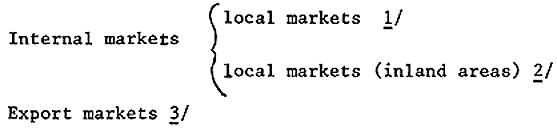
Note: FAMAKO exports frozen crabs (Scylla senata) that are bought from small-scale fishermen.
| Year | Sales in tons | Average price/Kg F.M. |
||
|---|---|---|---|---|
| Fish | Shrimp | Fish | Shrimp | |
| 1979 | 20.3 | 14 | 150 | 500 |
| 1980 | 28.9 | 6.5 | 650 | 850 |
| Year | Sales in tons | Average price/Kg F.M. |
||
|---|---|---|---|---|
| Fish | Shrimp | Fish | Shrimp | |
| 1979 | 30.9 | 4.7 | 150 | 500 |
| 1980 | 27.6 | 10.6 | 160 | 900 |
| Year | Sales in tons | Average price/Kg F.M. |
||
|---|---|---|---|---|
| Shrimp | Crabs | Shrimp | Crabs | |
| 1979 | 489 | 22.3 | 1310 | 605 |
| 1980 | 647 | 89.3 | 1300 | 696 |
Observations: Since September 31st, 1981, FAMAKO has, due to its financial deficits, ceased all activities except export of crabs. A restructure of FAMAKO with the start of operations during peak season is planned. Various reasons have contributed to this situation.
This Company is a Malgache-French join venture (the Malgache state being majority shareholder and is a subsidiary of Cotona (Cotonniere d'Antsirabé). It was created in 1972 and has its base of operations in Cratere de Nosy-bé Bay.
The fleet is composed of 13 trawlers having the following characteristics:
| Number | LOA | Power | Number of crew |
|---|---|---|---|
| 5 Freezer-trawlers | 25m | 400Hp | 18 |
| 4 Trawlers carrying ice | 17m | 280Hp | 12 |
| 4 Trawlers carrying ice | 14m | 150Hp | 10 |
| 3 " " " | 8.5m | 25Hp | 4 |
The fishing units are in good condition and with proper maintenance. There are also two (2) transport ships carrying the catch from the fishing grounds to the processing plants and also providing ice and other needs to the fishing fleet.
The fishing trips of the freezer-trawlers of 25 days, and 3 - 4 days for the smaller units. The bigger trawlers remain at sea for around 300 days/ year with 2500 - 3000 hours of trawling. The trawling takes around 3-4 hours on bottoms of 4 - 25 metres deep.
PNB has one cold store of 300 mt capacity; one cold store on the port area of 80mt capacity ; one processing plant of 12ton/day capacity and one ice plant of 30ton/day capacity. It also has workshop for repairs and maintenance.
The staff consists of 250 workers, of which 150 are on board of the trawlers and 60 are working in the shore based-facilities. During the peak season the staff is increased up to 600 with hired casual workers.
The shrimp is processed in the same way as the other companies.
The production from 1977 to 1981 was as follows:-
| Year | 1977 | 1978 | 1979 | 1980 | 1981 |
| Fish | 67 | 39 8 | ? | ||
| Shrimp | 1679.5 | 1692.8 | 1407.1 | 1790 1/ 1916 2/ |
1800 3/ |
Besides their own production (shrimp trawlers), the company buys part of the production of the "valakiras" from Ambaro bay. A vehicle is in charge of collecting the shrimp from the landing centres.
99% of the production is sold on the japanese and european (France) markets, as well as La Réunion. The remaining 1% is sold locally.
In 1979, 946 mt of shrimps were exported and in 1980, 1112 mt. The total production of fish is frozen for the inland markets.
This company, which is based in Toamasina as of 10th March 1981 to exploit Antongil bay with one "Florida" type trawler. Its only fishing craft is 48m L.O.A. (392 G.T.) and has an engine of 450 Hp. It is equipped with two blast freezers with a capacity of 5tm/day and one cold store of 150m3 plus one freezing brine tank of 200Kg/hour capacity. Fishing trips are of 20 days with 2 days steaming to and from the fishing grounds. The company has no shore based freezing or storage facilities. The frozen products are therefore kept in hired cold stores of the AUXIMAD Company.
The staff is composed of 36 workers, of which 28 are crew of the trawler and 8 are on shore (5 in the office and 3 for marketing).
The production from March to November 1981 was 180 mt of fish and 35 mt of shrimps. The average daily catch is 1.5 tons of fish and 200 to 300Kg of shrimps.
The shrimps are processed as follows:
Sorting - sizing - weighing - packing - freezing. The fish are graded in two classes and also frozen.
The total shrimp production is frozen whole and shipped to France. The fish is sold on the local market or in Antananarive.
The fishery in Antongil Bay was developed following recommendations of a survey which identified this area as having a prawn resource. The catches of this company have not confirmed this, and the fishing effort is now mainly directed towards the fish stocks.
The marketing at industrial level of spiny lobsters is carried out by LANSU (Enterprise Socialiste Langouste du Sud) in the Tolagnaro region, where the most lobster production is found. This company was created in May 1979 for the collection and marketing of lobsters captured by traditional fisheries in the southern area.
The staff is composed of 28 workers.
Six (6) ponds of 7 x 2 x 0.5m fed by an open seawater system, with 500 to 700Kg capacity of lobster storage. In the case of damage to the seawater circulation system the lobsters are stored in lobsters pots (metalic type) of 1.2 x 0.7 x 1m (there are 100 units) in the sea.
One (1) plate freezer (4 mt capacity).
Three (3) cold stores with a capacity of 25m3 (constructed in 1977), 50m3 (constructed in 1968) and 12m3 (constructed in 1977 but damaged). All the cold stores are in deficient operational condition, due to their age.
Three (3) pick-up trucks with 1 ton load capacity, (working since June 1981) only two are operational.
During 1980 68 435 3Kg of lobsters were collected. The collection and capture season is from May 1st to December 31st, with a peak in the months of May and June (in these two months 26 000Kg were collected). In 1981, from May to October 54 700Kg of lobsters were collected.
The marketing of lobsters is done as follows:-
The sales from May to October 1981 were as follows:-
| Alive lobsters (local market) | 5 391Kg |
| Alive lobsters (export market) | 24 460Kg |
| Cooked lobsters (export market) | 8 600 |
| Frozen lobster tail (export market) | 12 075Kg |
Marketing of lobster products in 1980 and prices:-
| Sales on local market (alive lobsters) | 15 663Kg at 1 200 F.M./Kg |
| Sales in Antananarivo (alive lobsters) | 8 066Kg at 1 600 F.M./Kg |
| " on export market (alive lobsters) | 13 732Kg at 2 450 F.M./Kg |
| " in Antananarivo (frozen lobsters) | 59Kg at 1 450 F.M./Kg |
| " on export market (frozen lobsters) | 9 351Kg at 1 600 F.M./Kg |
| " on export market (frozen lobster tails) | 5 745Kg at 3 050 F.M./Kg |
A decline in lobster production has been noted in this area. In 1966, lobster production was 110 mt, in 1971 it was 80 mt and 10 years later it only reached 60 mt. This decline can only be attributed to a deficient operation of the above-mentioned industry of collection and marketing. Lack of physical means and failure to meet the small scale lobster fishermen on prearranged dates make fishermen abandon the capture of lobsters. The transportation system from the collection areas to the ponds is inappropriate, which promotes a high mortality rate and the maintenance of the lobsters in ponds is also inadequate. During a visit made to the ponds, 10% of the lobsters were dead. It must also be mentioned that a high percentage (30%) of the captured lobsters is composed of lobsters which are below the regulatory size.1/.
The purchasing price for lobster was checked for each season. For the 1981 season it was 700 F.M./Kg of which 600 F.M. goes to the fishermen and 100 F.M. to VATOEKA (control office).
Four species which compose the catches are:
1/ The regulatory minimum size is 20cm. The fishing season is closed from January 1st to April 30th.*
The artisanal fisheries differ from the traditional fisheries in the fact that they are performed by groups of 4, 5 or more fishermen with motorized fishing boats (either inboard or outboard engines), with a well-organised division of labour (skipper, mechanic, fishermen). The use of ice for preservation of the catch is common. The marketing of the catch is performed by the owners of the boats, fishing cooperatives or private middlemen. In the latter case, a close relationship is established between the middlemen and fishermen. The middlemen who are wholesale or retail collectors, provide the fishing gear, ice, fuel, etc., and the catch is divided in two shares. One share is for the middlemen and the other half is by obligation sold to the same middlemen at low prices. The profit of these sales are divided between the fishermen according to the proportion of the catch supplied by each fishermen. In some cases a minimum salary is fixed for the fishermen.
The artisanal fleet is composed by fishing crafts with wooden or metal hulls, equipped with inboard or outboard engines. The December 1981 census shows 62 fishing craft and 287 fishermen.
The number of artisanal fishermen is 150. The fishing method most often used is hand line and in second place gill nets.
| Vessel type | Number | Length (m) | Power (Hp) | Observations |
|---|---|---|---|---|
| Classic | 2 | 6-7 | 6-10* | In Tamatave |
" |
1 | 8,5 | 25 | " |
| ? | 2 | 7,5 | 25 | In I, Santa Maria |
| ? | ? | 7 | ? | In Vatomandry |
| *Outboard | ||||
The approximate number of fishermen is 35.
Presently the main fishing method is hand line, during 1981 one artisanal trawler was out of order due to damages.
| Vessel type | Number | Length (m) | Power (Hp) | Observations |
|---|---|---|---|---|
| Classic | 1 | 9 | 25 | In Morondave trawl |
fishing |
||||
" |
1 | 7 | 18 | In Morondave of |
shrimps |
||||
| Pirogue | 1 | 9,8 | 18 | In Fulear |
| ? | 1 | ? | ? | In Morombe |
The number of artisanal fishermen is 17.
Traditional fisheries are defined as those carried out by individual or pairs of fishermen, occasionally associated in small groups (from four to ten) utilizing traditional fishing methods, with non-motorized pirogues or without fishing craft and having a very limited range of operation.
The traditional fisheries are mainly at a subsistance level, often being a complementary activity to agriculture and for animal husbandry (except for the Vezo population which has fishing as its main activity).
Fishing activities are reduced in those areas and seasons in which harvest of agricultural produce such as coffee, vanilla, clover, etc., is predominant. This reduction in activity of fishing is greater in the east coast and in certain points of the west coast (Nosy-bé).
Potentially each inhabitant of the coast, adult or juvenile, is a fisherman. The fishing activity is often occasional, trying to compensate the present protein deficit of the Malagasy population.
A great share of the production is consumed by the fishermen and their families. The level of knowledge regarding fishing methods and utilization is low, and strongly traditional in the way of construction and utilization of the fishing gears and methods as well as in the exploitation of the same fishing grounds, etc., which is caused by a low professional level. Their level of educational background is low and is occasionally nil. Presently the traditional fisheries are facing serious problems due to the lack of supplies for fishing gear construction. The great difficulty to find nylon monofilament, hooks, lead, etc., together with a spectacular increase in prices of the above mentioned materials in the local markets, represents a very important setback for development and even for maintaining the present production level, although there is an increase in the local demand of proteins of marine origin. Only very exceptionally do traditional fishermen utilize ice to preserve their catch at sea or from the landing areas to markets. One of the main characteristics of the traditional fisheries is the wide dispersion of fishermen along the 5 000Km of the Malagasy coast and their isolation from markets and marketing channels (with the exception of fishing villages near to the large marketing and consumption centres).
This isolation is increased during the rainy season (November to April) due to the fact that the road systems are very affected and sometimes paralized.
A census of the number of fishermen engaged in the traditional fisheries in Madagascar is not possible for the present study due to:
In this document we have tried to know the approximate number of fishermen in the different faritanys located at the coast. We have taken as source of statistical data a survey performed by the marine fisheries department and estimation made in the field.
| FARITANY | NUMBER OF FISHERMEN | |
| Antseranana | 2280 |
|
| Mahajanga | 1221 |
|
| Toliary | 3882 |
|
| Fianarantsoa | 1477 |
|
| Toamasina | 1791 |
|
______ |
||
TOTAL = 10651 |
||
______ |
||
The number of 10651 fishermen should be considered only as an indicative figure. Even though the real number of professional and part-time fishermen could be a higher figure, this estimation represents roughly double the data obtained in 1971 which showed 5822 fishermen in the five Faritanys. The distribution on each coast of Madagascar (East and West coasts) is approximately 50% for each, eventhough there is a great difference in the number of occasional fishermen on the two coasts. On the east coast, the percentage of employment of the population in fisheries fluctuates between 50% to 70% and for the Vezo population (south occidental zone) their employment is exclusive in fisheries. Another factor that affects this unbalance in the employment is the climatic conditions of both coasts. The number of days available for fishing operations in the east coast is lesser than the available days in the west coast.
| FARITANY | Census 1971 | Census 1981 |
|---|---|---|
| Antseranana | 1198 | 2280 |
| Toamasina | 608 | 1719 |
| Toliary | 2837 | 3882 |
| Mahajanga | 552 | 1221 |
| Fianarantsoa | 633 | 1477 |
| _____ | ______ | |
| TOTAL = | 5822 | 10651 |
| _____ | ______ | |
| _____ | ______ |
The boats used by the traditional fisheries are dug-out canoes with a single outrigger (on the right side) or with no outriggers. The latter are in a number and are used mainly on the east coast. The outrigger canoe is used mostly only along the west and northwest coasts. On the east coast, they are only used in Antseranana bay, the Faux-cap region and le Sante Marie where double outrigger canoes exist also, but are not used for fishing. The outrigger canoe is used for fishing, but eventually can also be used for the transport of light merchandise, agricultural products, passengers and fish going from the traditional fisheries to the markets. The propulsion system used is the paddle and the square sail (Cingalese type) which permits sailing with the wind astern or on a broad reach (with a great drift). These pirogues have no rudder, but use a paddle for steering under sail.
In Antseranana bay a small number of outrigger pirogues make use of the lateen sail, which performs and manoeuvres better. The speed that a pirogue with sail can reach with favourable wind is very high, being estimated at 6 to 7 knots. Outboard engines of 15 to 20 Hp are used on pirogues for the transport of merchandise or passengers.
The estimated number of pirogues for each faritany is as follows:-
| FARITANY | Single out- | Dugout-canoe | Large dugout | Large pirogue |
|---|---|---|---|---|
| rigger canoe | (no outrigger) | pirogue 1/ | with single | |
| Outrigger 2/ | ||||
| Toliary | 2899 | 1138 | --- | --- |
| Fianarantsoa | -- | 472 | 103 | --- |
| Mahajanga | 781 | -- | --- | 10 |
| Antseranana | 950 | 40 | --- | --- |
| Toamasina | 60 | 540 | --- | --- |
| T O T A L | 4690 | 2190 | 103 | 10 |
| 1/ Pirogue capable of transporting from 8 to 10 fishermen | ||||
| 2/ Pirogue of 10m long and 80cm wide for fish transport. They belong to the fish collectors. | ||||
As for the estimation of the number of fishermen in Madagascar, the estimation of the number of pirogues is almost certainly underestimated.
The dimensions of the pirogues used for fishing activities vary between 3.5 and 7m. The pirogues with a single outrigger used by the Vezo fishermen are of the biggest size: 6 to 7m. On the southeast coast (Makakara, Mananjary and Anosikely) there are big dugout canoes (7 to 9m) capable of carrying 8 to 10 fishermen. These craft are used when it is necessary to go off-shore in that area, due to the greater security in comparison with the small canoes with no outriggers.
The pirogues are constructed by the fishermen themselves or by craftmen specialised in pirogue construction and operating mainly near the areas where logs (raw material) are obtained. If the yard is located inland, the most common transport system to the coast is by the river. The outrigger pirogues from the west and northwest coasts are of better finish in comparison with the east coast pirogues which are very rudimentary. The hulls of the canoes are dug out from a single log. In the case of the outrigger pirogues, the free-board is raised by planks joined to the log. The sail is also constructed by the fishermen.
The materials used for pirogue construction are in relation with the availability in the area or nearby. The type of wood used for the construction of pirogues with outrigger on the northwest coast is hard-wood. In the southeast region (Taliary) a soft light wood known as FARAFATSA is used.
On the east coast, heavy and hardwoods are utilized, like albiza, narongy, nato, kininy, vaopaka, etc.
The useful life of a pirogue depends on three factors:-
The useful life of a pirogue, with an average use of 100 to 220 days per year and with normal maintenance, is around 3 to 4 years, depending on the type of wood used in its construction.
The price of a pirogue depends on:-
the quality of the wood;
We have gathered different prices in each place:
| Place | Length | Price |
|---|---|---|
| TOAMASINA | ||
| Dugout canoes without outrigger | 3 metres | 7 000 F.M. |
| " " " " | 4 - 5 metres | 10 000 to 15 000 F.M. |
| One paddle | 1 250 F.M. | |
| MANAKARA | ||
| Dugout canoes without outrigger | 4 - 5 metres | 10 000 to 15 000 F.M. |
| " " " " | 7 - 8 metres | 45 000 F.M. |
| TOLOGNARO | ||
| Dugout canoes without outrigger | 4 - 5 metres | 15 000 F.M. |
| TOLIARY | ||
| Dugout canoes without outrigger | 3 - 4 metres | 4 000 to 5 000 F.M. |
| Outrigger canoes | 4 - 5 metres | 10 000 to 15 000 F.M. |
| Outrigger canoes | 6 - 7 metres | 50 000 to 60 000 F.M. |
| MORONDAVE | ||
| Outrigger canoes | 3.5 - 4 metres | 20 000 to 25 000 F.M. |
| " " | 5 - 6 metres | 35 000 F.M. |
| NOSY-BE | ||
| Outrigger canoes | 4 - 5 metres | 35 000 to 40 000 F.M. |
| " " | 7 - 8 metres | 75 000 F.M. |
Sail made by fishermen are worth around 2 000 and 3 000 F.M. plus 300 F.M. for the rope.
The fishing methods used along the Malagasy coast are as follow:
- Trawl nets - used by the industrial fleet for the shrimp fishery and also by some small crafts in the artisanal fisheries sector. They are used on sandy bottoms. The main species composing the catch are : shrimps, Penaeus indicus, Penaeus semisulcatus, Metapenaeus monoceros, Penaeus monodon, and Penaeus japonicus. Also fish species from the families Bothidae, Lutjanidae, Sciaenidae, Sparidae, Mullidae and Psettotidae.
- Hand lines - the gear most widely utilized and important in the traditional and artisanal fisheries. They are used for bottom fishing in rocky or coralline areas. The catch is composed mainly of: Carangidae, Labridae, Lethrinidae, Lutjanidae. Serranidae, Sparidae and Sphyraenidae.
- Bottom gillnets - used widely throughout Madagascar. They are used over "clean" bottoms (sand, etc.,) near reefs, rocks, etc. A great variety of fish families are among the catch, mainly Acanthuridae, Carangidae, Holocentridae, Labridae, Lethrinidae, Lutjanidae, Serranidae, and Sparidae.
- Beach seins - mostly used on the west coast over sandy bottoms near the coast. Among the catch are Clupeidae, Engraulidae, Siganidae and Seleidae.
- Troll lines - the use of troll lines is occasional, generally on passage to and from the fishing grounds. The catch is composed of: Carangidae, Scombridae and Sphyraenidae.
- Pots for fishes - widely used on the northwest (Nosy-bé) and west coasts (Ile Sainte Marie). The pots are set on the reefs. Among the fish families mainly caught are: Arijdae, Balistidae, Labridae and Scaridae.
- Pots for lobsters - widely used on the south coast (Tolognaro region). They are set over rocky and coralline bottoms.
- Valikiras - (fusg weirs), used is massively on the northwest coast (d'Ambaro Bay). Among the catch are juvenile specimens of Penaeus indicus.
- Cast nets - used by fishermen on foot along the coast, in the shallow waters or very close to the shore line. The catch is composed mainly of fish families such as Mugilidae, Belonidae, and other small shore pelagic species.
- Mosquito nets - used in shallow waters and estuaries. The catch is composed of juvenile Atherinidae, Clupeidae, etc. and Euphasidae.
- "Balance" (Lift net) - used in the crab fishery in the Pangalanes channels.
- Baragges - not so widely used, mainly in the east coast (Toamasina) and west coast.
- Harpoons - used for the low tide fishing or in most cases, to land the fish caught by hand line or gillnets. The main species caught are octopus and lobsters.
- Fishing by hand - very widely used during low tide, by this method are caught shellfishes, holoturidae, algae and mainly crabs, Scylla serrata on the west coast.
- Fishing with torches (lights) - used in the southern part of the island (Faux-Cap) mainly on foot or in a pirogue. The catch is composed mainly of lobsters.
- Underwater fishing - not very often used. In the Nosy-Bé (Nosy Iranja) region it is used for lobster and in the Toliary region only for shellfishes.
Note: The number of hand lines per fishermen is 2 to 3, and sometimes it can reach 5 lines (of different sizes) for each fisherman.
The number of harpoons is normally only one per fisherman. The great number of handlines and gillnets in Madagascar is worthy of mention.
The model of handline used in all the Malagasy coasts is the same. They are made with monofilament nylon of different diametres and lengths from 20 to 150 metres. The most usual length is 100 metres, with one or two hooks. Hooks are generally bought already prepared, but in the south region (Tolognaro), fishermen make their own hooks with springs from car seats.
Lead (coming from car batteries) or other heavy objects are used to weight the lines. A modification of the handline is the drift line which the lead, and with the hook joined to the nylon with wire: it is used for the scombroid fishes and sharks.
The hand line is used over rocky and reef bottoms.
The troll line hangs 30 to 40 metres behind the pirogue which is powered either by paddle or sail. It is made with monofilament nylon of 60 to 100Kg breaking load and 100 metres long. The hook is joined to the nylon with a wire of 30cm long. It carries a lead of 20 - 30 grams at the end of the nylon.

Price: according to the nylon diametre and size of the hook, between 2 000 and 2 500 F.M.
Gill nets are very widely used in Madagascar and together with the hand line are the most often used fishing methods.
The model of gill net do not change much along the coast, with the exception of the mesh size. The construction and use is the same in all the places visited.
There are different ways of using the gill nets:
Gill nets are usually used as bottom gill nets. Only exceptionally is the buoyancy increased in order to use them as surface gill nets in the Morondave region where it is known as Valopindy.
The most usual dimensions of gill nets are 100m by 1.5m, with a rectangular form. The netting is sewed by hand from monofilament nylon by the fishermen or their wife. Wooden floats of good buoyancy are used such as Rafia, Hazomalany, but also rubber floats are seen. Lead, shells, concrete or ceramic weights are used as sinkers. Nylon recuperated from old car or plane tyres is often used to make the webbing. Gill nets are used over sandy bottoms or gravel, near rocky or coralline reefs in depths from 1 to 10 m. The duration of each set is from 20 minutes (east coast), to 4 - 6 hours in the northwest coast. Two fishermen are generally enough to operate a net.
The prices fluctuate accroding to the length, material used and regions.
Beach seines are less widely used than gill nets due to:
We have been able to investigate three (3) types of beach seines of different sophistication.
They are barriers set-up in the intertidal area which are covered during high tide. They have the form of a funnel in which the angle zone are accumulated for the catch.
This fishing method is very widely used in the northwest coast (Ambaro). The name Valakira comes from the "vala" which means barrier and "kira" which is the material used in construction. The main catch are juvenile shrimps. On some occasions the opening in between the "kiras" are closed with leaves or tree branches which make it more difficult for the smaller shrimps to escape. The price of one "valakira" is between 12 000 and 18 000 F.M. depending on the length.
Fishing gear with a very fine mesh (mosquito netting mesh) being used for fish fry, fingerlings, small shrimps and Euphausidae. It requires two persons generally women and children employ this gear in bays or estuaries in shallow waters from 0.5 to 1 metre.
We have been able to identify two types of mosquito net:
Used mainly in shallow waters and close to the shore. They are used by operators on foot.
The utilization of harpoons is mainly by fishermen walking along the reefs at low tide. But, more frequent use is for landing big fishes which are caught by handline or gill nets.
There is only one model, but sometimes the dimensions are variable. They are constructed with bamboo. The useful life is about 6 months, and the prices are between 600F.M. to 800 F.M. according to the size.
They are only used in the southern area. They are constructed with Vahipiky which is a natural rope. They are set using bait (mussels, shellfishes and in very few occasions fish) in the afternoon and recovered in the morning. The pots are easily dismounted and folded. Their prices are around 600 F.M.
In the traditional fisheries (pirogues) fishing trips are daily. The fishermen leave port between 5 and 6 a.m. and return between 12 and 16 hours. Travel to the fishing grounds is around 2 hours, from which we can observe that they are having around 5 to 7 hours of effective fishing.
For the artisanal fisheries, fishing trips take from 3 to 4 days, with 5 to 7 hours of travel to the fishing grounds (with engine) influenced by weather conditions (winds). The effective days for fishing operations on the west coast, which is protected from the wind, is of 220 days / year. On the east coast the number of fishing days decreases to 150 days / year. On the east and northeast coasts the number of effective fishing days can be decreased even more if they are located in areas unprotected by barrier-reefs. or any other topographic accident.
It is of modern and well defined level, organized by the big shrimp production factories (SOMAPECH, FAMAKO, PNB, REFRIGEPECHE), lobster marketing cooperatives (LANSU) and other organizations engaged in collection (nonproductive) and marketing (Pêcherie de l'Est, Summing, Sorex, etc.), as well as the organizations engaged in the collection and distribution of shellfish (Turbo spp.) sea cucumber (trepang) and shark fins. These marketing and/or production enterprises are also operating in the local market as:
The main export markets according to the products are:
The export of these products, mainly shrimps, provide annually very significant amounts of foreign exchange, very necessary to counterbalance the balance of payments deficits. The shrimp exports of the three main companies (SOMAPECH, P.N.B. and FAMAKO during 1979 and 1980, exceeded 6 600 million F.M. The exports are subject to taxation with the exception of FAMAKO which is a parastatal company. The taxes are based on ad valorum (10%) on F.O.B. value and 3% duties are also included.
The part of the production of the marine fisheries channeled for local consumption is at the following levels: the subsistance level and a commercial level composed of two different marketing channels or circuits, a traditional, short and direct channel and a long modern channel.
| - subsistence level | - | home consumption; |
| - commercial level | traditional, short direct channel | |
| Modern long channel. |
This level defines a subsistence situation, in which the production is consumed by the fishermen themselves.
Producer = consumer
Frequently the production of a fisherman is channeled to supply the food requirements of the fisherman and his family. Once these food requirements are fulfilled the rest of the production is channeled to the market in the traditional commercial circuit. The present home-consumption level is not known for Madagascar as a whole; there is only data covering the Mahajanga faritany, which shows an average value of self-consumption of 38.1% of the total annual production of the faritany (1 594 tons) during 1981.
This channel is supplied by the artisanal fisheries production units, which are composed of two levels with simple structures showing a basic or undeveloped phase of economic relationships, with division of labour.
Another of the main characteristics of this marketing channel at its two levels, is the great variety of products being marketed (all the fish species caught are marketed fresh or already processed). The use of infrastructure and other means (chill storages, ice, appropriate transportation system, etc) are non-existing. The price difference in between qualities of fish or products is minimum.
First level - Direct or family marketing:

This level is considered as the first step in structure of local marketing, which is characterized by:
Second level - Small scale professional marketing:

To this level, belongs the most widely found commercial circuit (channel) which is characterized by the inclusion of a middleman - salesman in the markets or public markets in the cities or towns. In this case the inclusion of a middleman - salesman means an increase in the price of the products.
The transport of the products from the landing or processing area is performed by the middleman or the fisherman's wife according to the habits of the areas. As for the first level, the geographical area in which marketing takes place is limited for the fresh produce, but processed products (dried, salted or smoked) are marketed in inland and mountain areas of the country. The transportation is public or private vehicles, the latter being rare.
This more developed commercial channel is supplied by:
The main characteristics of the channel are:
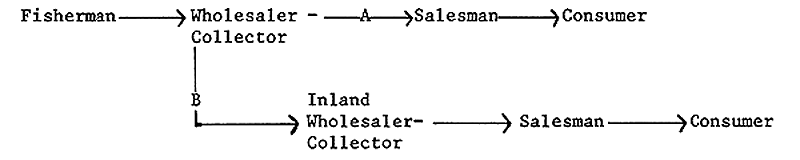
Two marketing channels go through the wholesaler - collector located in the coastal areas:
The socialists production and/or marketing cooperatives are trying to reduce the number of links in the marketing chain.
The consumption of the various species and qualities are in direct relationship with the purchasing power of the different social structures. The selection of the fish species is according to qualitative criteria. The selected high quality species are, mainly from the fish families: Carangidae, Lutjanidae, Sciaenidae, Serranidae, Sparidae and Soleidae.
In secondly, among the species already mentioned, fish are selected according to size. The prime fish species, and shrimp for the inland markets are consumed by the higher social class, generally located in Tananarive.
The variation of price of the produce through the different links of the marketing chain depends on the following:
The selling price at the fishermen level fluctuates between 50 FM/Kg in the rural areas for non-selected species to 225FM/Kg for prime species.
The increase in price at the middleman level in the local market is from 180 to 250 FM/Kg for non-selected species and from 400 to 600 FM/Kg for selected species. The selling price for the same species in the inland markets (Antananarivo prices) fluctuates between 450 and 600 FM/Kg for non-selected species and 900 to 1 000 FM/Kg for selected species.
Live lobsters are purchased at 700 FM/Kg from fishermen in landing areas. The price in the Antananarive markets are as follow:
The price for the mangrove crab (Scylla serrata) fluctuates as follow:
For processed products (dried, dried and salted fish and shrimps or smoked inland markets (Antananarivo) they reach 700 FM/Kg.
This is the only faritany for which the Marine Fisheries Service have accurate production data. We have tried to calculate the present level of self-consumption and the economic effect by fishermen / year of the benefits of the basic fishery produce.
The data from 1981 for the different fivondronampokontany are as follow (in tons):
| Production | |||
|---|---|---|---|
| Pirogue Production | by gathering | Total |
|
| without craft 1/ | |||
| Mahanjanga | 250 | 500 2/ | 750 |
| Antsohihy | 115 | 20 | 135 |
| Analalave | 291 | 50 | 341 |
| Besalampsy | 50 | 10 | 60 |
| Maintirano | 138 | 30 | 168 |
| Soalala | 120 | 20 | 140 |
| TOTAL | 964 | 630 | 1 594 |
| 1/ This includes also catches from beach seines, mosquito nets, gathering by hand, etc. | |||
| 2/ Much of this figure is from the catches of hand gathering crabs (Scylla serrata) | |||
The level of self-consumption in the Mahanjanga Fivondronampokontany is 79 tons, or 17.6% of the total production. This is distributed as follow:
| 1. Self-consumption | : | 79 tons (10.6%) |
| 2. Fresh sales | : | 101 tons |
| 3. Iced fresh sales | : | 141.5 tons |
| 4. Processed produce | : | 428.5 tons |
The sales value (self-consumption not included) at the base, meaning the value obtained by the fisherman, was 100 975 000 FM which gives an income per fisherman of 290 000 FM during 1981.
For the other Fivondronampokontanys the volume of self-consumption was of 526.5 tons which represents 65.3% of the production. This is distributed as follow:
| 1. Self-consumption | : | 526.9 tons (65.3%) |
| 2. Fresh sales | : | 101 tons |
| 3. Iced fresh sales | : | 30* tons |
| 4. Processed produce | : | 150.5 tons |
| * For the Antsohihy region only. | ||
Of the 281.5 tons sold, came from:
With a total producer value of 8 875 000 FM for Antsohihy and 2 089 000 FM for the rest. Earnings per fisherman / year in Antsohihy were 51 599 FM and 33 485 FM for the remaining Fivondronampokontanys.
From this calculation we can observe the fluctuation of the selfconsumption level, according to the facilities for marketing the produce. In the higher marketing / consumption centres the self-consumption is lesser and at the same time the returns to the fishermen are higher (higher prices for the produce) than in the areas of greater difficulty to distribute the produce and less demand (lower prices) where which the selfconsumption level is higher.
The principal species landed in the Malagasy fisheries are:
All the information regarding the speciation of fish are reveiwed in the "Rapport de Mission de M.L. BAUCHOT et G. Bianchi-SCHMIDT a MADAGASCAR".
| - | Shrimps | : | The species already mentioned compose the catch of the industrial trawl fleet and valakiras. |
| - | Lobster | : | The species already mentioned in the specific chapter caught by hand, with harpoons and in particular by pots. |
| - | Crabs | : | The main species is Scylla serrata, known locally as "DRAKAKA", which is caught by hand in the mangrove areas of Morondave, Maintirano, Mahanjanga. |
| - | Krill | : | Euphausiacae - caught by mosquito nets. |
| - | Turtles | : | Two species, the hawksbill turtle (Chelonia imbricata) and the green turtle (Chetonia midas) are the species most often caught. |
| - | Shellfish | : | - Octopus: A small number are collected by hand or with Harpoons during the low tide. |
| - Gastropods: A great number of species are caught for industrial (Furbo spp.) extraction of pearl shell Or for ornamental and collection purposes. Gathering is by hand or by diving. |
|||
| - | Bivalves | : | Several species are gathered by hand at low tide, mostly on the west and northwest coasts. |
| - | Asteriods | : | - Sea cucumber: The whole catch of sea-cucumber is for processing to "trepang". Regulations (1975) specifying a minimum size of 30 cms for gathering, but this legislation is not being followed. The main gathering areas are the northeast (Vohemar) and Southwest (Toliary) coasts. |
| - | Algae | : | The gathering of algae in the Tolagnaro zone has stopped since 1978. |
The main characteristics of landing centres for the traditional fisheries is their great dispersion. None of the commercial ports of Madagascar have a fishing port or an area for the landing of fish. Important urban centres which represent a sure market receive the fish from fishing communities within a radius of 30 - 40Km.
Pirogue landings are directly on the beach and there are no infrastructure facilities.
The processing of the catch from the industrial fisheries has already been described in the chapter regarding Industrial fisheries.
In the Artisanal fisheries the only processing done is freezing, for marketing either locally or in the inland (Antananarive or other important cities).
For the traditional fisheries all processing is in response to a need to avoid spoilage rather than to look for a better price for processed products, through a value added to the product. Lack of communications and transport and seasonality of the fisheries make marketing of fresh fish difficult and necessitate processing.
The processing performed for different products is as follows:
The fish is placed on a wired mesh supported by a wooden frame, placed over fire (generally of mangrove branches) at a distance of 25 to 30cm. The fish is turned over after one side is considered well done. The product is partly smoked and partly grilled. Fish processed in this way had its skin and external flesh grilled, but the flesh near the backbone remained raw.
A modified version of this system consists in placing the fish in between two bamboo sticks and setting the bamboos on the ground near a fire bed.
The shelf-life is reduced as the relative humidity increases. On the east coast, during the rainy season, the shelf-life is an average around two weeks.
Crabs: (Scylla serrata)
The only processing for crab consists in freezing for export markets. Marketing is usually alive, maintaining them on wet soil inside baskets made of vegetable materials.
| Octopus | : | The only processing is by sun drying. |
| Shrimps | : | a) Drying |
| Directly sun drying. They spread over matting on roofs, on | ||
| the ground, etc | ||
| b) Boiled and dried | ||
| The shrimps are first boiled, then sun-dried. | ||
| Sea-cucumber | : | They are sun-dried on mattings on the ground. |
The statistics of fishery products are gathered by officers from the fisheries service, directly from the markets, in visits that are not always daily. If there are two or more markets, the one of greater importance only is visited.
The weight of fish and fishery products is only estimated by the officers at the time of their visits to the markets. There is a constant supply of fish during marketing hours but suppliers are larger in early morning and late evening. The quantity of product exposed for sale therefore fluctuate constantly. There is control of fish quantities before it is exposed for marketing. The fish is sold in small heaps or by weight. Large fishes (Scombridae, carangidae, sharks) are cut in portions.
The statisticians take no account of estimated quantities of fish self-consumed by fishermen. This important figure of the production is therefore not included in the statistics. From previous estimates, it appears probable that the self-consumption level might be around 40 - 50% of the total traditional fisheries production. The fish sold directly at the landing areas or by house to house peddling is also not considered. Both marketing systems are widely used in the coastal areas remote from important urban centres.
The gathering of data is sometimes not performed due to the lack of adequate equipment (vehicles) or difficult communications between the numerous sales points.
Based on these deficiencies in the data collection for fishery production, it would not be exaggerated to think that the total production of the artisanal fisheries could be at least double the figure given for local consumption and fishing trips out of the respective faritany (the exports of the industrial fishing companies are not included).
I Presentation
The code of symbols used is as follows:
| (Fresh | A1 | ||
| FISH | (Salted/dried | A2 | |
| (Smoked | A3 | ||
| (Frozen filleted | A4 | ||
| (Fresh/frozen/chilled | Ba1 | ||
| SHRIMPS | (Boiled | Ba2 | |
| (Dried | Ba3 | ||
| (Meal | Ba4 | ||
| (Live | Bb1 | ||
| CRABS | (Frozen | Bb2 | |
| (Cooked/boiled | Bb3 | ||
| (Frozen meat | Bb4 | ||
| (live/whole/frozen | Bc1 | ||
| SPINY LOBSTERS |
(Frozen tails | Bc2 | |
| (Cooked: whole/frozen | Bc3 | ||
| Shellfish - diverse | Bd | ||
| Oysters | Ca | ||
| Mussels | Cb | ||
| Octopus / cuttlefish / squid (Fresh live | Cc1 | ||
| (Dried | Cc2 | ||
| (Smoked | Cc3 | ||
| Shellfish diverse (ornamental or mother of pearl) | Cd | ||
| Turtles (carapace, non-worked shell, meat) | Da | ||
| Trepang | Db | ||
| Shark fins and meat | Dc | ||
| Algae (marine) | Dd | ||
| Sea Urchins | De | ||
Weights are rounded off to the nearest 0.1 ton, and the following symbols are used in tables:
-: nil, quantity equal to zero
0,0: quantity more than zero but less than 51Kg
...: data not available
The present system of freezing and storage of fish and fishery products, consists in refrigeration installations set-up mainly by private companies based on their particular requirements and not inter-connected.
Most of the freezing and storage capacity (more than 2 400m3) is used mainly for export products while 600m3 is available to provide the inland frozen products market. In this latter case the cold chain between the coast and the inland area is broken due to the non-existence of adequate transport (isothermic trucks or wagons).
Japanese aid is presently constructing three cold centres with a total capacity of 133m3 (63m3 for produce and 70m3 for ice).
The infrastructure found in the visited areas is described as follows:
Antseranana town:
Nosy-Bé
Mahajanga town:
Toliary Town:
Morondave town:
These installations are part of the industrial cattle abattoirs. During 1981, they were non-operative. Presently, they are intended to be used to store fishery products (shrimps and others). The installations are located 11Kms from Morondave.
Tolagnaro town:
Faux-Cap town:
One (1) freezing chamber of 21m3 (constructed in 1965);
One (1) cold store, capacity 36.6m3;
One (1) ice plant of 0.5 ton / day (being repaired).
Toamasina town:
AUXIMAD, this company has cold stores with a capacity of 400m3, for different products.
The REFRIGEPECH Company had rented 74m3 of cold store for fish and shrimp storage.
SICE, has cold stores of 600m3 for mild and meat storage. 50% of this capacity could be used as cold storage for fishery products.
VATO-ARA fishing Cooperative
One (1) cold store of 36m3 (constructed in 1981);
One (1) ice plant 10.5 ton / day.
Santa Maria Town:
Installations owned by the Fivondronapokontany.
One (1) freezing chamber, 20m3 capacity;
two (2) cold stores, 60m3 total capacity;
One (1) ice plant 0.3 ton / day.
There is at present no cold system in use in the coastal towns, for fishery products. An interlinked triangle between of Manajary - Manakar - Finarantsoa is in project form.
The refrigeration centres are presently being constructed, one in Manakara, composed of one (1) freezing chamber of 37.86m3 and a cold store of 48m3 with an ice plant of 2 ton / day.
For Mananjary one (1) freezing chamber of 67m3, one (1) cold store of 50m3 and one (1) ice plant of 2 ton / day are planned. This project has as objective to supply the inland area of the Faritany with fish and fishery products and to facilitate and increase the output capacity of fishery products. For the time being this is the only coordinated project for the establishment of a cold chain.
Presently, the only training centre for Marine purposes in Madagascar is the E.N.E.M. Ecole Nationale de l'Enseignement Maritime of Mahajanga.
This is a public centre operated by the state depending on the Ministry of Transport (Merchant Marine), created in 1963 for the training of manpower for the merchant fleet and for fisheries.
The courses offered are:
For fisheries training and previously to enrol students have to undergo eight (8) months of experience on fishing crafts. They receive two years of theoretical training in the school, three years of practical training on board fishing crafts and one more year in the training school to obtain the skipper diploma. For the time being there is no training for fishing officers (skippers).
The teaching staff is composed of nine permanent teachers (8 French and one Malgache) and eight part-time teachers with annual contracts (seven Malgache and one French).
The management of the E.N.E.M. is looking to give a wider scope to this training school in order to perform as a regional training centre for marine purposes for the Indian Ocean area. Presently nine (9) students from Seychelles are enrolled in the school. The main problem of the E.N.E.M. is the lack of a ship for seaborne training activities.
Two training centres for artisanal fisheries depending on the Ministère du Développement Rural have recently been established (Tulear and Nosy-Bé) but are not yet operational. They have as objectives to train fishermen in the use of traditional and improved fishing gears and methods, provide cooperatives training etc.
Socialist Cooperatives
The Malgache state is presently making a great effort in the establishment of fishermen's cooperatives. Two ministries, the "Développement Rural et de la Reforme Agraire" and the Ministry of the "Population" in an independent non-coordinated way are encouraging the membership of cooperatives for fishermen. This has caused a certain rivality between fishermen belonging to cooperatives established by each ministry.
With the establishment of cooperatives, it is expected to:
The cooperatives organization is based on a common model, initially for agriculture cooperatives. This structure has been tried in traditional fisheries with very little success.
The operation of cooperatives is ruled by:
The profit obtained during the year, in the case of Vato-Ara cooperative in Toamasina, is divided in three shares:
Only in very exceptional cases, for example, COOPEMO and VATO-ARA, have cooperatives receiving some little support from fishermen. The number of members is diminishing due to:
Traditional Organization
Traditional organizations exist in small fishing communities. A spiritual moral leader organizes work in common and acts as a moderator in case of disputes in between members of the community. On the social level, there are no schools, hospitals or first-aid centres in fishing communities.
The naval construction in Madagascar at industrial level is centralized in Antseranana, where the SECREM boatyard installations are located. The construction and repair installations initially belonged to the French National Navy, and presently are state-owned.
SECREM is located inside Antseranana Bay and from the technical point of view is well equipped for any type of construction (wood, plastic, or metal hulls) and repairs, although tools and equipment date mainly from 1950's or 1960's. Here also is located the only dry dock of the island, 200 metre long, which can be divided in two sections.
This boatyard has constructed shrimp trawlers and boats of the FAO "catcher" type from 7.3m to 9m long for fishermen cooperatives.
At present, a 20m long trawler for the marine station of Tular is in construction. Other types of boats for transport, tugs, etc have been constructed in these installations.
At a lower level, we have been able to identify the following boatbuilders:
In this town there are the:
Morondave town -
It has one boatyard for artisanal boats, but with no installations. Intended for construction of sail boats for transport with wooden hulls of 20m long.
Foliary town -
Presently there is no boatyard, but SATEC Project (Société d'Aide Technique et Cooperation) is planning the construction of a boatyard for "dory" type boat construction.
Toamasina town -
In this town there are:
Manakara town-
One (1) workshop for marine carpentry, which has build lighters (in wood 20m long) for the transport between the port and the commercial ships. They had not built any fishing vessels.
Presently the development of naval construction is very low due to the lack of materials, tools, spare parts, etc. Nevertheless, there is great possibility, the existence of local manpower and basic materials (wood) would permit the improvement of local construction of fishing boats from 7 to 12 metres.
An aid agreement between the Japanese Agency for International Cooperation and the Malgache Republic was signed in 1980. This aid programme which provides technical and financial support, plans the development and rationalization of the fisheries in the Northwest (Phase I) and Southwest (Phase II) coasts. In 1980, a Japanese mission prepared a preliminary study of the occidental coast of Madagascar. This programme started at the end of 1981 with cold store installations. The total Japanese aid is 500 million yen and includes the following:
The donation of fishing materials as gill nets, handlines, bottom long lines, etc., is also planned. The supply of spare parts is assured for three years.
All the information regarding this programme is available from: "Rapport d'étude sur le Projet de base pour le développement de la pêche en République Démocratique de Madagascar" October 1981
A This report deals with the present situation of the marine fisheries in Madagascar, at the industrial, artisanal and traditional levels. It describes the situation of the fisheries at the end of 1981. Any action to improve aspects regarding the artisanal fisheries and in particular the traditional fisheries should be based on the knowledge of the status of such fisheries. Eventually, the most proper decisions to be made would be more precise if there is adequate knowledge of the situation on a continuous basis.
Knowledge of the tendencies followed by certain aspects of the artisanal and traditional fisheries will provide greater opportunities for action than if we have only the knowledge of the situation of the fisheries during different periods more or less distant in time.
Several topics, especially regarding:
and other basic data that could be gathered and processed on a continuous basis by the local officers from the different services of the Marine Fisheries Division based in the coastal areas.
The Marine Fisheries Division have the properly qualified manpower to develop and maintain these activities. It is therefore recommended that assistance be given for the development and improvement of a proper statistical infrastructure. This assistance could be provided by an expert or eventually by an associate expert based in Madagascar. The mission of such an expert could consist in (three phases):
B) The processing of fishery products has a major economic importance for the artisanal fisheries. During 1980, 2 375 tons of fishery products were sold in the inland malgache markets.
The difficult communications, seasonality of the fisheries and present marketing systems, impose that a high proportion of the catches should be processed in order to avoid spoilage. The same situation is found in the inland fisheries.
The most common processing techniques are drying and smoking.
Smoking is carried out in a very primitive way and even with this treatment the product has a short shelf life (2 to 5 weeks depending on the relative humidity of the air). This method of preservation as well as the drying and salting / drying can be widely improved, using conventional processing techniques.
Fish processing in the marine and inland areas is very important due to the fact that presently only rpocessed fishery products can reach areas far away from fishing centres. It is recommended that an expert in fish processing can study the present situation and introduce or improve the present fish processing techniques in particular "smoking".
C) The climatic conditions of the east coast greatly reduce the fishing operations of the pirogues. The use of adequate fishing craft in that area could to a great extent reduce this constraint of the dugout canoes. The local construction of small craft (7 - 8 metres long) made by naval carpenters in several points of Madagascar (Mahajanga, Nosy-Bé, Antseranana, etc) is completely satisfactory.
Due to the present situation of imports of all machinery and materials, spare parts, high fuel and oils prices together with a lack of maintenance and also with a constant flow of trade winds, make us inclined to strongly recommend sail as a propulsion system. The use of sail (arab or lateen sail) in Madagascar is well known and used. Transport boats are presently using this system. In conclusion, in Madagascar there are favorable conditions to start an experimental fishing with troll lines in the Southeast, East and North coasts.
Therefore a preparatory mission conducted by an expert in fishing craft, dimensions, sail type which could be necessary for the conditions of the area.
The model of handline is used throughout Madagascar. They are made of monofilament nylon of variable lenghts (normally 100m) and strength (from 4 to 11oKg).
One to two hooks are used for each line. Hooks are normally bought ready made, but in the region of Tolagnaro, the fishermen can make their own hooks from the springs of car seats. Lead from car batteries or shells, used to weight the lines. Each fisherman disposes of several lines.
A variant in the "drifting line" which have a wire leader of 40cm to 50cm between the nylon and hook. These lines are used mainly for catching sharks and tunas.
Prices: Prices depend on the type and length of nylon and the size of the hook. They generally vary between 1 500 and 2 600 FM.
Trolling lines are made of stronger nylon (over 60Kg) and hooks are joined to the nylon by a wire leader of 30 - 40cm. The nylon is weighed at its extremity by a lead of 20 - 30g.
The total length is 100m, and the hook is towed at 30 - 40m distance from the boat. No artificial lures are used.
Prices: Prices vary between 2 000 and 2 500 FM.
Essentially, the same type of gill nets is used throughout the Malgache coast.
Dimensions vary from 50 to 300m length and 1.5 to 2.5m depth. The most usual dimensions are 100m x 1.5m. vary between cm and 4.5cmm bar
Materials: The netting is monofilament nylon, which is very seldom bought ready made. Floats are of wood, rubber, etc. Weights are of lead or stones.
Prices: Prices vary depending on the dimensions and materials used. Normally, for a net of 1.0m x 1.5m, the price may very between 20 000 and 30 000 FM.
A net of 300 x 1.5m costs between 110 and 120 000 FM.
Three ways of mounting the netting on the floatline and leadline were observed:
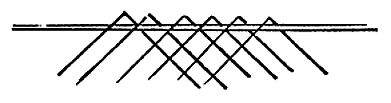
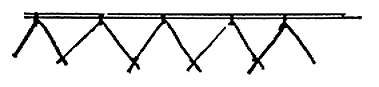
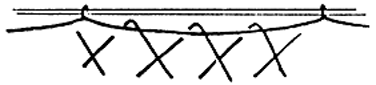
or:
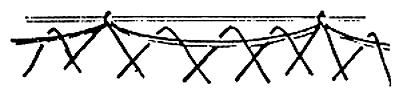
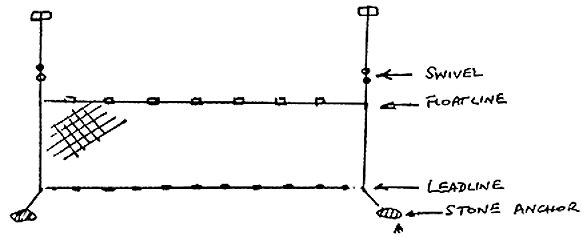
In the area of Toamasina, the use of swivels on the buoylines were observed.
Three types of beach seine were observed:
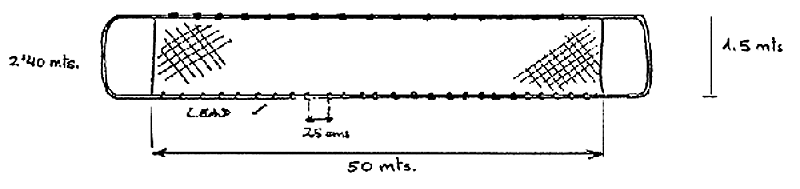
A. The most simple type consists of a net similar to a gill net, which is towed by hand by the two ends onto the shore. The nets are generally small: 50 x 1.5m with meshes of 2cm bar. They are used in Morondave region.
The floats are cylinders of HAZOMALANY wood, placed at 28cm intervals. Lead rings of 50g each are placed every 25cm. The netting is of monofilament nylon, made by hand. There are 10 meshes between each float.
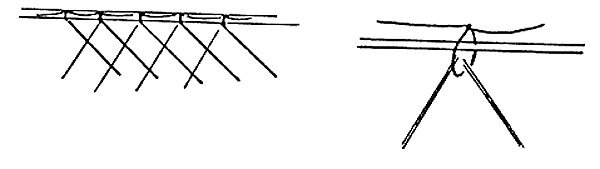
The netting is joined to the ropes by knots:
B. Beach Seine with Bunt
The dimensions of the meshes is reduced in the bunt. The length of each wing is 156m, and of the bunt 16.7m. Total length is 328.70cm.
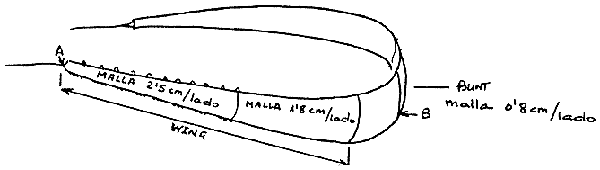
Depth of netting from point A to point B at centre of net:
| Length in m | 0 |
5 |
10 |
15 |
20 |
25 |
30 |
35 |
40 |
45 |
50 |
55 |
60 |
65 |
70 |
75 |
||
| Depth in cm | 90 |
100 |
110 |
120 |
130 |
140 |
140 |
145 |
145 |
160 |
160 |
165 |
165 |
170 |
175 |
180 |
||
WING |
||||||||||||||||||
Meshes 2.5cm bar |
||||||||||||||||||
| Length in m | 80 |
85 |
90 |
95 |
100 | 105 | 110 | 115 | 120 | 125 | 130 | 156 | 161 | 163.35 | ||
180 |
200 |
210 |
220 |
220 | 220 | 220 | 225 | 230 | 235 | 240 | 250 | 310 | 330 | |||
WING |
BUNT |
|||||||||||||||
Meshes 1.8cm bar |
Meshes 0.8cm bar | |||||||||||||||
Prices: Between 250 000 and 300 000 FM
C. Beach Seine with Bag

Two types of mosquito nets have been observed:
A. A simple net made of a rectangular panel of variable dimensions (2.5 x 0.8m to 5 x 2m), the edges being bordered by a rope formed into loops in each corner.
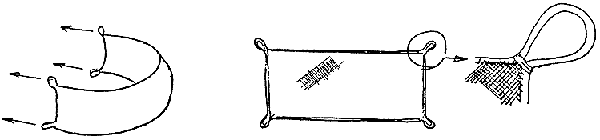
B. Mosquito net composed of several panels with bag.
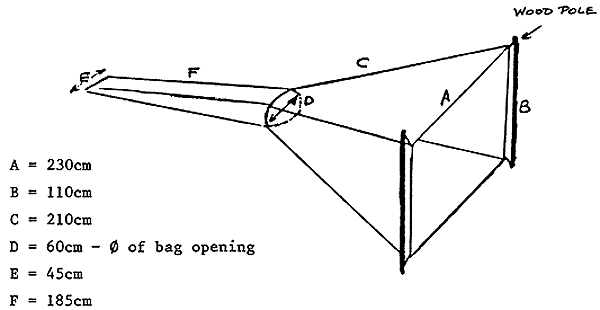
The front of the net is made of 6 panels held open by two wooden poles. Two people tow the net on foot, holding the poles.
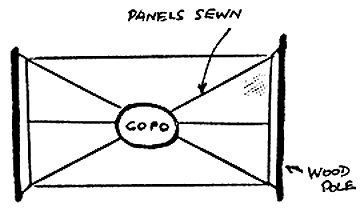
| Prices | Netting 4 metres | - | 6 000 FM |
| Netting for bag | - | 1 500 FM | |
| Ropes | - | 1 000 FM | |
| Thread for joining | 1 000 FM | ||
| ------------ | |||
| TOTAL | = | 9 500 FM + labour |
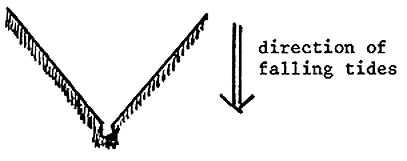
Valakiras ave V-shaped fish wheirs in the intertidal zone, oriented in the direction of falling tides.
The name valakira comes from VALA = "barrier" and KIRA which is the wood used in construction.
Prices vary from 12 000 to 20 000 FM
depending on dimensions, which are normally of 50.100m for each wing.
Made by the fishermen themselves of monofilament nylon.
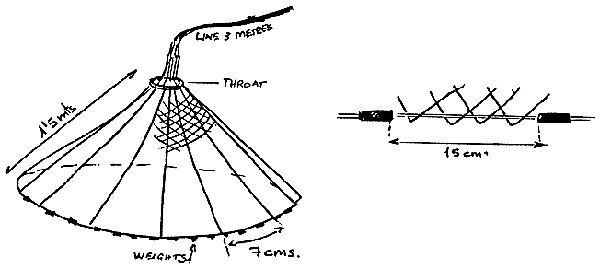
The leadline passes simply through the selvage.
Prices: from 7 000 to 8 000 FM plus labour.
Each fisherman has a harpoon, of which many types exist.
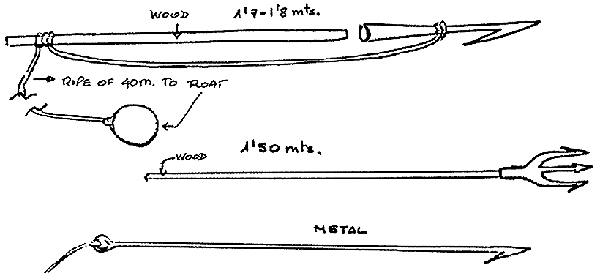
Always of the same model, but of varying sizes.
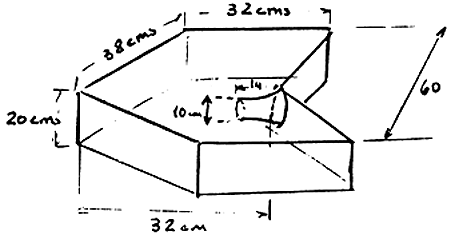
| Prices: | Basket trap of 75 x 45cm | - | 600 FM |
| Basked trap of 120 x 90cm | - | 800 FM |

| Mahajanga | Antsiranana | Nosy-Be | Manakara | Toamasina | Morondava | Tolagnaro | Toliary | |||||||||
|---|---|---|---|---|---|---|---|---|---|---|---|---|---|---|---|---|
| 1979 | 1980 | 1979 | 1980 | 1979 | 1980 | 1979 | 1980 | 1979 | 1980 | 1979 | 1980 | 1979 | 1980 | 1979 | 1980 | |
| A1 | 157,7 |
98,2 |
120,6 |
260,5 |
176,7 |
23,9 |
18,9 |
61,0 |
36,4 |
34,7 |
33,1 |
122,5 |
227,1 |
170,2 |
136,7 |
|
| A2 | 66,2 |
29,2 |
19,8 |
51,0 |
9,9 |
0,8 |
- | 10,5 |
7,5 |
14,9 |
13,6 |
19,2 |
20,6 |
4,7 |
3,4 |
|
| A3 | 51,3 |
29,8 |
17,7 |
54,1 |
14,2 |
14,8 |
13,0 |
0,4 |
- | 10,1 |
10,9 |
38,3 |
71,1 |
27,9 |
19,0 |
|
| Ba1 | 59,1 |
68,5 |
47,2 |
8,9 |
40,3 |
7,2 |
6,8 |
11,8 |
6,2 |
9,1 |
8,4 |
8,3 |
9,6 |
3,8 |
3,6 |
|
| Ba2 | 0,3 |
- | 19,5 |
61,3 |
12,6 |
2,8 |
- | - | - | 6,8 |
7,1 |
0,0 |
- | - | - | |
| Ba3 | 16,1 |
25,7 |
17,1 |
41,7 |
15,6 |
- | 2,8 |
- | 25,2 |
21,0 |
1,3 |
5,8 |
- | - | ||
| Bb1 | 65,5 |
54,2 |
55,7 |
69,6 |
30,9 |
- | 7,3 |
3,5 |
21,4 |
19,7 |
14,7 |
17,7 |
3,2 |
2,9 |
||
| Bc1 | 16,1 |
- | 0,6 |
2,3 |
- | - | - | 0,2 |
0,3 |
6,7 |
8,2 |
- | ||||
| Ca | 0,0 |
13,3 |
0,0 |
10,2 |
2,2 |
- | - | - | - | 9,3 |
10,1 |
- | ||||
| Dc | 2,0 |
3,0 |
8,0 |
6,6 |
3,5 |
1,6 |
- | - | - | |||||||
| A | B | C | D | ||||||||||||||
|---|---|---|---|---|---|---|---|---|---|---|---|---|---|---|---|---|---|
| 1 | 2 | 3 | a1 | a2 | a3 | b1 | b2 | b3 | c1 | c2 | c3 | C2 | d | b | c | ||
| MAHAJANGA | - | - | - | 1.697,2 |
- | - | 29,3 |
- | - | - | - | - | - | - | 21 | 3,7 | |
| TOLIARY | 0,0 |
0,0 | - | 0,0 |
- | 25,5 |
0,0 |
0,0 |
- | 0,0 |
- | - | 0,0 |
43,4 |
0,0 |
0,0 | |
| TAOLAGNARO | 0,0 |
0,0 | - | 0,0 |
- | 0,0 |
- | 0,0 |
- | 22,5 |
4,8 |
2,4 | - | - | 0,0 |
0,0 | |
| MORONDAVA | - | 0,0 | - | - | 0,0 | 27,5 |
- | - | - | - | - | - | - | - | 0,0 |
- | |
| ANTSIRANANA | - | - | - | 12,9 |
- | - | 2,1 |
- | - | - | - | - | - | - | - | - | |
| NOSY-BE | - | - | - | 1.112,4 |
- | - | 34,4 |
- | - | - | - | - | - | - | - | - | |
| TOAMASINA | 0,1 |
0,0 | 0,0 | 0,2 |
0,0 | 0,0 |
0,0 |
0,0 |
- | 0,1 |
- | - | 0,0 |
0,1 |
31,2 |
1,2 | |
| ANTANANARIVO | 0,4 |
0,5 | 0,5 | 1,3 |
0,5 | 7,3 |
1,6 |
0,1 |
0,1 | 0,4 |
- | 0,2 | - | - | 14,2 |
- | |
| DESTINATIONS : | ai : USA, La Réunion, France, Maurice, Japon Bbl : La Réunion Bcl : France Cd : Allemagne Fédérale, France, Italic, Allemagne Fédérale Db : Singapore, Hong-Kong Dc : Singapore, Hong-Kong |
||||||||||||||||
| 1977 | 1978 | 1979 | 1980 | |||||||||||||||
|---|---|---|---|---|---|---|---|---|---|---|---|---|---|---|---|---|---|---|
| MOIS | SOCIETIES | A | B | C | A | B | C | D | A | B | C | D | A | B | D | |||
| 1 | a1 | b1 | c1 | 1 | a1 | c1 | c | 1 | a1 | b1 | c1 | C | 1 | a1 | B2 | C | ||
| 1 | SOMAPSCHIO | 8,2 |
141,8 |
- | - | 11,2 |
79,1 |
- | - | 8,5 |
182,1 |
- | - | - | 13,5 |
124,7 |
- | - |
| 2 | 4,3 |
330,1 |
- | - | 8,0 |
265,4 |
- | - | 5,8 |
246,3 |
- | - | - | 7,4 |
346,5 |
- | - | |
| 3 | 1,1 |
407,2 |
- | - | 0,2 |
321,6 |
- | - | 3,8 |
278,5 |
- | - | - | 0,8 |
261,3 |
- | - | |
| 4 | 2,6 |
226,3 |
- | - | 0,2 |
333,1 |
- | - | 3,4 |
207,1 |
- | - | - | 2,2 |
203,7 |
- | - | |
| 5 | 5,8 |
311,2 |
- | - | 5,3 |
263,7 |
- | - | 4,8 |
294,0 |
- | - | - | 2,5 |
336,5 |
- | - | |
| 6 | 3,2 |
258,1 |
- | - | 17,4 |
165,7 |
- | - | 5,4 |
137,5 |
- | - | - | 4,0 |
217,7 |
- | - | |
| 7 | 4,9 |
168,5 |
- | - | 19,4 |
155,9 |
- | - | 16,4 |
158,9 |
- | - | - | 2,5 |
181,4 |
- | - | |
| 8 | 16,6 |
183,8 |
- | - | 15,5 |
196,4 |
- | - | 19,5 |
176,6 |
- | - | - | 12,1 |
186,5 |
- | - | |
| 9 | 19,7 |
133,8 |
- | - | 22,7 |
131,6 |
- | - | 12,8 |
126,2 |
- | - | - | 8,4 |
104,7 |
- | - | |
| 10 | 19,0 |
90,4 |
- | - | 16,2 |
95,8 |
- | - | 3,7 |
75,6 |
- | - | - | 8,8 |
90,1 |
- | - | |
| 11 | 4,8 |
42,3 |
- | - | 10,1 |
68,5 |
- | - | 11,9 |
64,0 |
- | - | - | 13,1 |
102,8 |
- | - | |
| 12 | 8,8 |
64,3 |
- | - | 23,5 |
143,6 |
- | - | 9,9 |
66,9 |
- | - | - | 20,6 |
190,4 |
- | ||
| TOTAL | 99,0 |
2,330,8 |
- | - | 141,7 |
2.220,4 |
- | - | 105,9 |
2.013,7 |
- | - | - | 95,9 |
2.345,3 |
- | - | |
| 1 | FAMAKO | 4,0 |
57,1 |
- | - | 33,5 |
- | - | ... | 28,5 |
- | - | - | 0,9 |
34,4 |
0,4 |
- | |
| 2 | 2,1 |
140,5 |
- | - | - | 106,7 |
- | - | ... | 80,2 |
- | - | - | 0,4 |
79,4 |
- | - | |
| 3 | 2,5 |
225,1 |
- | - | - | 118,9 |
- | - | ... | 60,6 |
- | - | - | 0,5 |
83 |
- | - | |
| 4 | 1,8 |
173,8 |
- | - | - | 99,6 |
- | - | ... | 48,5 |
- | - | - | 1,1 |
82,3 |
- | - | |
| 5 | 2,2 |
143,4 |
- | - | - | 67,1 |
- | - | ... | 55,6 |
- | - | - | 1,4 |
96,7 |
- | - | |
| 6 | 2,5 |
126,0 |
- | - | - | 33,4 |
- | - | ... | 51,9 |
- | - | - | 2,1 |
55,2 |
4,7 |
- | |
| 7 | 4,6 |
77,5 |
- | - | - | 45,6 |
- | - | ... | ... | - | - | - | 2,6 |
42,6 |
14,3 |
- | |
| 8 | 8,0 |
73,6 |
- | - | - | 37,5 |
- | - | ... | ... | - | - | - | 2,2 |
47,5 |
11,4 |
- | |
| 9 | 7,6 |
54,5 |
- | - | - | 24,7 |
- | - | ... | ... | - | - | - | 11,1 |
52 |
10,3 |
- | |
| 10 | 3,4 |
36,3 |
- | - | - | 17,5 |
- | - | ... | ... | - | - | - | 17,2 |
47,0 |
19,2 |
- | |
| 11 | 2,6 |
23,8 |
- | - | - | 26,8 |
- | - | ... | ... | - | - | - | 11,4 |
28,6 |
13,2 |
- | |
| 12 | 4,2 |
39,7 |
- | - | - | 18,7 |
- | - | ... | ... | - | - | - | 7,7 |
41,3 |
7,9 |
- | |
| TOTAL | 45,3 |
1,171,3 |
- | - | - | 630,0 |
- | - | - | 517,2 |
- | - | - | 58,6 |
692,3 |
95,4 |
- | |
| 1 | P.N.B. | - | - |
- | - | - | - |
- | - | - | - | - | - | - | - | - |
- | - |
| 2 | - | 118,8 |
- | - | - | 185,0 |
- | - | - | 183,4 |
- | - | - | 1,1 |
87,8 |
- | - | |
| 3 | - | 342,6 |
- | - | - | 385,4 |
- | - | - | 256,2 |
- | - | - | 0,1 |
345,8 |
- | - | |
| 4 | - | 295,4 |
- | - | - | 290,4 |
- | - | 4,4 |
169,8 |
- | - | - | 0,0 |
245,9 |
- | - | |
| 5 | - | 203,2 |
- | - | - | 251,9 |
- | - | 3,7 |
223,5 |
- | - | - | 1,2 |
257,0 |
- | - | |
| 6 | - | 165,5 |
- | - | - | 131,7 |
- | - | 6,6 |
174,3 |
- | - | - | 1,7 |
265,9 |
- | - | |
| 7 | - | 158,2 |
- | - | - | 116,9 |
- | - | 8,0 |
89,8 |
- | - | - | 8,6 |
103,2 |
- | - | |
| 8 | - | 143,1 |
- | - | - | 111.1 |
- | - | 9,4 |
80,9 |
- | - | - | 2,6 |
114,9 |
- | - | |
| 9 | - | 104,8 |
- | - | - | 87,1 |
- | - | 8,7 |
81,6 |
- | - | - | 5,0 |
125,9 |
- | - | |
| 10 | - | 68,0 |
- | - | - | 62,2 |
- | - | 14,2 |
73,0 |
- | - | - | 3,2 |
120,9 |
- | - | |
| 11 | - | 50,9 |
- | - | - | 45,0 |
- | - | 4,5 |
49,6 |
- | - | - | 5,8 |
74,5 |
- | - | |
| 12 | - | 39,0 |
- | - | - | 26,1 |
- | - | 7,5 |
25,0 |
- | - | - | 10,5 |
69,2 |
- | - | |
| TOTAL | - | 1,879,5 |
- | - | - | 1.692,0 |
- | - | 67,0 |
1.407,1 |
- | - | - | 39,8 |
1.790,0 |
- | - | |
| A | B | C | D | ||||||||||||||||||
|---|---|---|---|---|---|---|---|---|---|---|---|---|---|---|---|---|---|---|---|---|---|
| 1 | 2 | 3 | a1 | a2 | a3 | b1 | b2 | b3 | c1 | c3 | d | a | b | c1 | c2 | c3 | a | b | c | d | |
| Toamasina | 163,9 |
14,2 |
38,0 |
27,0 |
0,5 |
2,9 |
15,2 |
- | - |
0,7 |
- | - | 0,2 |
3,4 | 4,4 |
1,6 | 4,6 | - | 9,5 |
21,8 |
- |
| Fianarantsoa | 89,0 |
11,8 |
57,2 |
20,7 |
12,2 |
- | 11,9 |
- | - |
0,3 |
- | - | 0,3 |
- | - | - | - | - | - | 20,7 |
- |
| Toliary | 727,7 |
701,1 |
107,9 |
23,3 |
7,1 |
121,3 |
62,7 |
- | 0,1 |
14,5 |
0,0 | - | 9,9 |
0,1 | 1,3 |
4,5 | - | 2,5 | - | 1,0 |
0,0 |
| Antsiranana | 648,2 |
100,3 |
253,3 |
121,7 |
196,2 |
121,6 |
295,3 |
0,2 | - |
2,9 |
- | 6,4 | 10,2 |
- | 4,9 |
3,0 | - | 6,1 | 72,6 |
- | - |
| Mahajanga | 269,0 |
100,6 |
68,5 |
110,7 |
1,7 |
44,7 |
118,9 |
- | - |
0,2 |
- | - | 16,1 |
- | 0,0 |
- | - | - | 6,3 |
6,2 |
0,6 |
| Total | 1897,8 |
928,0 |
524,9 |
303,4 |
217,7 |
290,5 |
504,0 |
0,2 | 0,1 |
18,6 |
0,0 | 6,4 | 36,7 |
3,5 | 10,6 |
9,1 | 4,6 | 8,6 | 88,4 |
49,7 |
0,6 |
| A | B | C | D | |||||||||||||
|---|---|---|---|---|---|---|---|---|---|---|---|---|---|---|---|---|
| 1 | 2 | a1 | a2 | a3 | b1 | b2 | b3 | c1 | c2 | c3 | c2 | d | a | b | c | |
| MAHAJANGA | 0,1 |
76,2 |
1.722,4 |
0,0 | 1,1 |
0,0 | 28,2 |
- | 0,0 |
- | - | - | - | - | - | - |
| TOLIARY | 0,0 |
0,0 |
- | - | - | - | - | - | 0,0 |
0,0 | - | - | 145,5 |
0,1 | 12,5 |
0,2 |
| TAOLAGNARO | - | 0,0 |
0,0 |
- | 0,0 |
- | - | - | 22,1 |
4,4 | 1,3 | - | - | - | 0,1 |
0,0 |
| ANTSIRANANA | - | - | 47,6 |
- | - | - | 12,0 |
- | 0,1 |
- | - | - | - | - | - | - |
| NOSY-BE | 10,8 |
- | 946,0 |
- | - | - | 44,8 |
- | - | - | 0,0 | - | - | - | - | - |
| TOAMASINA | 0,2 |
1,3 |
17,0 |
0,0 | 0,0 |
0,0 | 0,0 |
0,0 | 0,0 |
- | 0,0 | 0,0 | 0,1 |
0,0 | 104,5 |
0,1 |
| ANTANANARIVO | 2,3 |
0,4 |
1,3 |
0,0 | 9,2 |
2,0 | 8,2 |
- | 0,4 |
1,1 | 0,0 | 0,0 | 0,0 |
- | 2,1 |
4,0 |
| TOTAUX | 13,4 |
77,9 |
2.734,3 |
0,0 | 10,3 |
2,0 | 93,2 |
0,0 | 22,6 |
5,5 | 1,3 | 0,0 | 145,6 |
0,1 | 119,2 |
4,3 |
| x Ba1 whole and headed shrimp x The shrimp exported from Toamasina nearly all come from Mahajanga (Somapêche) x Cd : operculate of the shellfish included. |
||||||||||||||||
| A | B | C | D | |||||||||||||||||
|---|---|---|---|---|---|---|---|---|---|---|---|---|---|---|---|---|---|---|---|---|
| 1 | 2 | 3 | a1 | a2 | a3 | b1 | b2 | b3 | c1 | c2 | d | a | b | c1 | c2 | c3 | a | b | c | |
| TOAMASINA | 138,3 |
9,2 |
35,9 |
19,6 |
2,2 |
2,4 |
12,5 |
- | - | 0,6 | - | - | 0,9 |
2,6 | 3,6 | 1,0 |
0,6 | - | - | 8,7 |
| FIANARANTSOA | 60,7 |
0,9 |
41,7 |
17,6 |
0,3 |
13,2 |
1,1 |
- | - | - | - | - | - | - | - | - | - | - | - | 14,1 |
| TOLIARY | 778,6 |
1206,8 |
134,6 |
31,2 |
17,2 |
86,1 |
61,1 |
0,1 | 0,1 | 2,2 | 0,1 | - | 10,6 |
2,2 | 1,5 | 61 |
- | 12,5 |
- | - |
| ANTSIRANANA | 568,1 |
59,6 |
213,3 |
132 |
152,2 |
99,8 |
249,4 |
- | - | 1,0 | - | 4,4 | 2, |
0,0 | 2,6 | 2,3 |
- | 8,8 |
1,4 | 5,9 |
| MAHAJANGA | 334,5 |
64,3 |
54,2 |
107,7 |
5,5 |
71 |
112,6 |
- | - | 0,4 | - | - | 13,3 |
- | - | - | - | 6,6 |
4,0 | 5,5 |
| TOTAL | 1880,2 |
1340,8 |
479,7 |
308,1 |
177,4 |
272,5 |
436,7 |
0,1 | 0,1 | 4,2 | 0,1 | 4,4 | 27 | 4,8 | 7,7 | 64,3 |
0,6 | 22,9 |
5,4 | 34,2 |
| NB: Data for marine product sales in 1980 are not available for the centres listed below: Ambanja, Anivorano-Nord, Sambava, Antsiranana, Morombe and Mahabo. The figures for 1979 have been used in order to have in 1980 a global estimate of sales of marine products for the whole island (on the assumption that production and sales were constant for 1980. | ||||||||||||||||||||