- Trawling at 80% of main engine power:

= 357
- Shooting and hauling at 50% of main engine power:

= 64
- Freezing fish and cooling fish hold at 80% of one auxiliary engine power:

= 204
TOTAL
625

M. GUIDICELLI
December 1984
RAF/79/065/WP/16/84
This electronic document has been scanned using optical character recognition (OCR) software and careful manual recorrection. Even if the quality of digitalisation is high, the FAO declines all responsibility for any discrepancies that may exist between the present document and its original printed version.
4. CASE NO. 1 (C1): EXPLOITATION OF A NEW TRAWLER
4.1. The Production Unit
4.2. Investment, Replacement and maintenance Costs
4.3. Yearly trips, fishing effort, production and sales
4.4. Yearly production costs
4.5. Analysis of financial results
5. CASE NO. 2 (C2); EXPLOITATION OF A SECOND HAND TRAWLER
5.1 The production unit
5.2. Investment, Replacement and Maintenance Costs
5.3. Yearly effort, production, sales and production costs
5.4. Analysis of financial results
1. BACKGROUND AND JUSTIFICATION
2. DEVELOPMENT OBJECTIVES
3. IMMEDIATE OBJECTIVES
4. SUMMARY OF ACTIVITIES
5. Outputs
6. ESTIMATED COSTS FOR THE INTERNATIONAL CONTRIBUTION
7. GOVERNMENT INPUTS
APPENDIX 1 - TIMING OF ACTIVITIES
APPENDIX 2 - Modalities of Project Administration
APPENDIX 3 - List of Fishing Gear
ANNEX 1
ANNEX 2
ANNEX 3
ANNEX 4
ANNEX 5
ANNEX 6
ANNEX 7
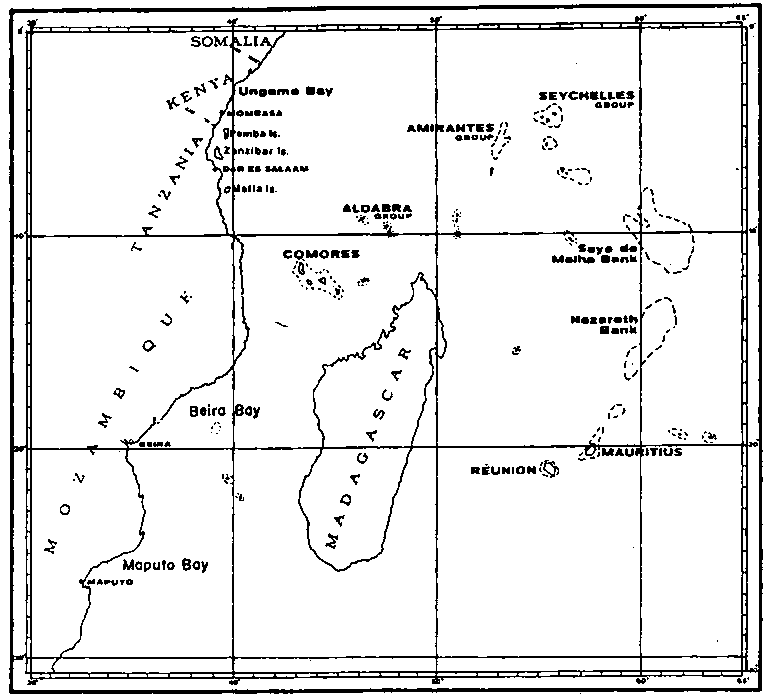
1.1.1 Saya de Malha Bank is roughly located between latitudes 09°20' and 12°00' South and longitudes 59°30' and 62°00' East at an average distance of 600 miles from Port Louis (Annex 1). It has an approximate surface of 47,000 km sq inside the 200m isobath. Its floors are mainly coralline on the Eastern edge and sand or shell with good trawalability on the South and central portions.
2.1.2 Demersal resources located on the rocky and coralline floors of the bank have been exploited for several decades by hand liners based in Mauritius and Reunion. This exploitation seems to have reached or to be very close to the Maximum Sustainable Yield (MSY) of the stock considered. It appears therefore that the time has come for control and management rather than for further development of the handline fishery (2).
2.1.3 On the other hand, fish stocks located on and above the sandy areas of the Bank have to date been exploited only by a trawler fleet from USSR, although they could be fairly substantial. Indeed, exploratory campaigns carried out by the Indian Ocean Programme have demonstrated that (3):
- The major part of the Bank area is composed of sandy floors with, on the average, a good degree of trawlability for demersal operations.- Concentrations of fish species accepted on the Mauritian market are located on these sandy floors, mainly horse mackerels (Decapterus macarellus, D. ruselli, Trachurus indicus) and, to a lesser extent, lizard fishes (Saurida sp.).
- Exploited with a 32m headline demersal trawl net these concentrations produced average hourly catches from 569 to 842 kg in April, and from 221 to 901 kg in October.
- The MSY of the species considered could be assessed to lie between 13,000 and 26,000 t/year.
3.1.4 The fact that, on the one hand, the Bank has a relatively important underutilized fish production potential and that, on the other hand, Mauritius is Importing every year several thousand tons of low price fish for low income consumers, represents an undeniable development opportunity for the Mauritian fishery economy, as well as for the improvement of the national trade balance and reducing unemployment.
3.1.5 However, taking advantage of this opportunity entails Investments which will be important compared to the size of the Mauritian economy. Therefore, a decision cannot be taken on investment without a pilot project to demonstrate the financial and economic feasibility of the new fishery, as well as its probable size, thus the magnitude of the investments required for full development.
3.1.6 This pilot project, which should operate a deep sea freezer trawler at sea for at least 18 months, will itself demand a substantial financial input, to the approximate value of US$ 1,560,000. It is therefore advisable to carry out a financial feasibility study based on existing information. This preliminary study should provide facts on which to decide on the utility of a pilot project.
4.1. The Production Unit
4.2. Investment, Replacement and maintenance Costs
4.3. Yearly trips, fishing effort, production and sales
4.4. Yearly production costs
4.5. Analysis of financial results
4.1. Efficient trawling of the Bank inside the 200m isobath will require a medium size freezer-trawler. The ship selected for study would be a 36m steel unit with a 800 Hp main engine, two 200 Hp auxiliary engines, a freezing capacity of 10 t/day, a refrigerated fish hold of 100 t, a cruising speed of 10 knots and a range of 450 hours at full power. This trawler should be equipped with 4 high-opening demersal trawl-nets with 3 m head line, 3 pairs of curved oval steel trawling doors, each one weighing 650 kg, 2.000m of 18 mm towing warps, complementary gear and spare parts.
|
4.2.8 Component |
Cost |
Life |
Yearly maintenance |
|
|
(US$ millions) |
(year) |
(US$ millions) |
||
|
Hull |
0.600 |
20 |
(5%) |
0.030 |
|
Machinery |
0.600 |
10 |
(15%) |
0.090 |
|
Fishing gear |
0.050 |
5 |
(50%) |
0.025 |
|
|
1.250 |
|
|
0.145 |
4.2.9 For investment through a US$ 1.25 million loan repayable in ten years with an interest rate of 7%, the average total yearly debt service would be US$ 0.1 3 million from years 1 to 10.
a) Average hourly catches
4.3.10 Based on the results obtained by the Indian Ocean Programme (Para. 3) and on the catching power of the ship and fishing gear selected, three assumptions are made regarding average catch per trawling hour:
Assumption 1 (C1-A1) = 400 kgs per hour
Assumption 2 (C1-A2) = 500 kgs per hour
Assumption 3 (C1-A3) = 600 kgs per hour
b) Daily fishing effort
4.3.11 The target species (Para. 3) are efficiently caught only in day time. During the average 12 hours of daylight at the latitudes of the Bank, three hauls are made, the daily work programme being the following:
|
|
Hours |
|
- Trawling, 3 hauls of 3.5 hours each |
10.5 |
|
- Shooting-hauling, 1 hour per haul |
3.0 |
|
- Drifting or anchoring at night |
10.5 |
|
- Total |
24.0 |
c) Yearly fishing effort
4.3.12 Ship's maintenance, periods in port for cyclones, etc. take 10% of the year: 36 days. The remaining 329 days are spent steaming, fishing, unloading and on regular maintenance.
4.3.13 The two-way passage between Port Louis and the Bank is 1200 miles long (Para. 1). Streaming this distance at 10 knots (Para. 7) requires 120 hours, i.e. 5 days for each trip. Unloading catches and regular maintenance also require 5 days, so that 10 days are lost each trip.
4.3.14 Fish hold capacity is 1001 (Para. 7). According to the three assumptions made as to average hourly catches (Para. 10), the number of days required for filling the fish hold during one trip is the following:
|
- Assumptions |
C1-A1 |
C1-A2 |
C1-A3 |
|
- Daily catch (t) |
4.20 |
5.25 |
6.30 |
|
- Number of fishing days |
24 |
19 |
16 |
4.3.15 This means that, with the 10 days of unproductive operations (Para 3), the total number of days per trip will be:
|
- Assumptions |
C1-A1 |
C1-A2 |
C1-A3 |
|
- Number of fishing days |
24 |
19 |
16 |
|
- Number of unproductive days |
10 |
10 |
10 |
|
- Total number of days |
I4 |
29 |
26 |
d) Annual production
4.3.16 On the basis of the 329 days available for operation (Para. 13), of the duration of a trip in function of the hourly catch (Para. 15), for a catch of 100 t per trip (Para. 14), the yearly number of trips and total production will be:
|
- Assumptions |
C1-A1 |
C1-A2 |
C1-A3 |
|
- Number of trips |
9.7 |
11.3 |
12.6 |
|
- Yearly production (t) |
970 |
1130 |
1260 |
e) Yearly Sales
4.3.17 In order to ensure an acceptable retail price for the low income consumer in Mauritius, the catch is sold at an ex-vessel price of US$ 550/t. At the three levels of yearly production (Para. 16), yearly sales will be (US$ millions):
|
- Assumptions |
C1-A1 |
C1-A2 |
C1-A3 |
|
- Yearly sales |
0.533 |
0.621 |
0.693 |
a) Fuel
4.4.18 Taking into account engine power (Para. 7), main engine utilization during the fishing (Para. 11) and the cost of fuel oil in Mauritius, US$ 0.25/litre, fuel oil cost per fishing day will be (US$):
|
- Trawling at 80% of main engine power: |
|
|
|
= 357 |
|
- Shooting and hauling at 50% of main engine power: |
|
|
|
= 64 |
|
- Freezing fish and cooling fish hold at 80% of one auxiliary engine power: |
|
|
|
= 204 |
|
TOTAL |
625 |
4.4.19 Based on engine power (Para. 7) and on streaming time to and from fishing grounds, fuel oil cost for each trip will be:
|
- Steaming at 90% power of main engine: |
|
|
|
= 4590 |
|
Cooling fish hold at 80% power of one auxiliary: |
|
|
|
= 1020 |
|
TOTAL |
= 5610 |
4.4.20 According to the number of fishing days per trip and of the number of trips yearly which result from these catch assumptions (Paras. 14 and 16), the annual cost of fuel will be (US$ million).
|
- Assumptions |
C1-A1 |
C1-A2 |
C1-A3 |
|
- Fuel cost trawling |
0.145 |
0.134 |
0.126 |
|
- Fuel cost steaming |
0.055 |
0.064 |
0.071 |
|
- Total fuel cost |
0.200 |
0.198 |
0.19 |
b) Lubricants
4.4.21 Lubricants will amount to 10% of fuel cost: US$ 0.020 million.
c) Crew
4.4.22 The crew receives a share of the sales given in Para. 17. Its rounded income is thus the following (US$ million):
|
Duty |
Percentage of sales |
Assumptions |
||
|
C1-A1 |
C1-A2 |
C1-A3 |
||
|
1 Captain |
2.5 |
0.013 |
0.015 |
0.017 |
|
1 mate |
1.6 |
0.008 |
0.010 |
0.011 |
|
1 chief engineer |
1.9 |
0.010 |
0.013 |
0.013 |
|
2 second engineers |
0.4 x 2 |
0.004 |
0.005 |
0.006 |
|
1 cook |
0.5 |
0.003 |
0.003 |
0.004 |
|
8 deck hands |
0.4 x 8 |
0.017 |
0.020 |
0.022 |
|
Food |
|
0.010 |
0.010 |
0.010 |
|
Total |
10.5 |
0.065 |
0.075 |
0.083 |
d) Other costs
4.4.23 Insurance @ 5% of investment = US$ 0.062 million.
4.4.24 Miscellaneous costs @ 5% of all other production costs.
e) Total Yearly Production cost (US$ million)
|
4.4.25 - Assumptions |
C1-A1 |
C1-A2 |
C1-A3 |
|
- Maintenance (para. 8) |
0.145 |
0.149 |
0.145 |
|
- Fuel (para. 20) |
0.200 |
0.198 |
0.197 |
|
- Lubricants (para. 21) |
0.020 |
0.020 |
0.020 |
|
- Crew (para. 22) |
0.065 |
0.075 |
0.073 |
|
- Insurance (para. 23) |
0.062 |
0.062 |
0.062 |
|
- Miscellaneous (para. 24) |
0.025 |
0.025 |
0.025 |
|
- Total |
0.517 |
0.525 |
0.532 |
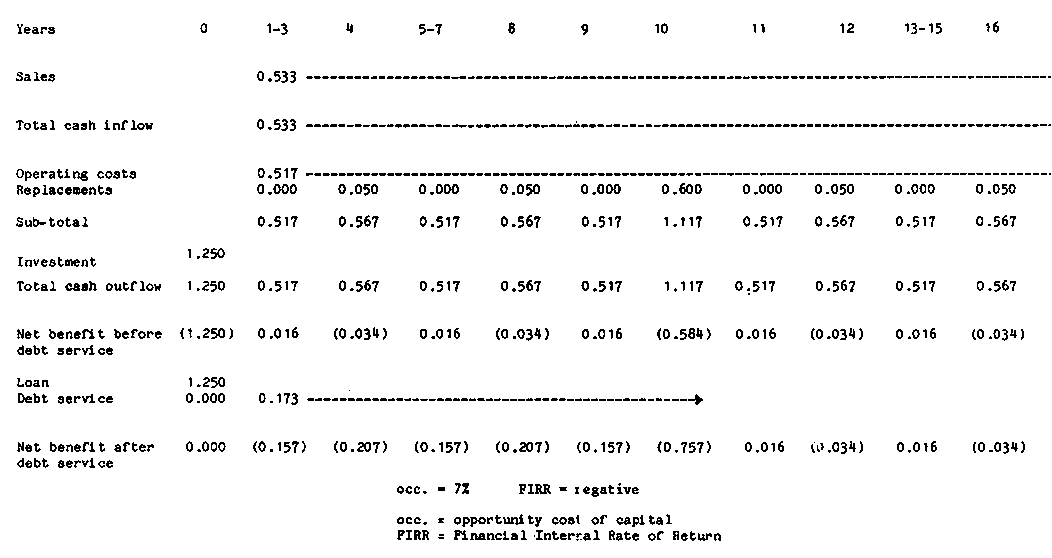
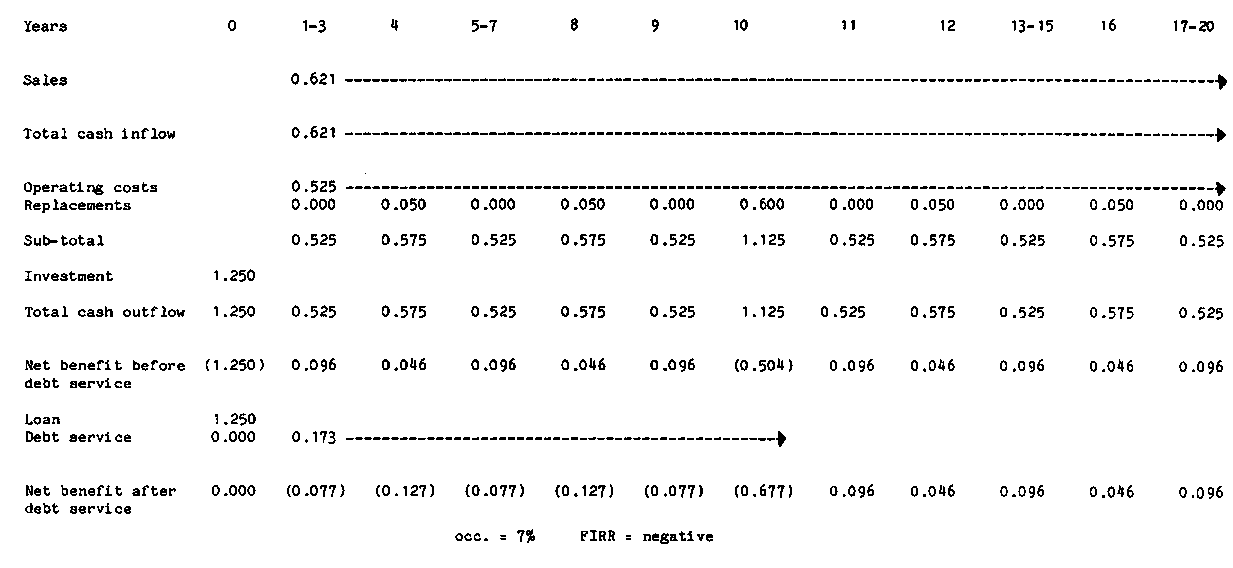
4.5.26 This is an unproductive enterprise. Debt service is not covered in assumption C1-A1 and C1-A1 (Annexes 2 and 3), which result in a negative financial internal rate of returns (FIRR) on total investment.
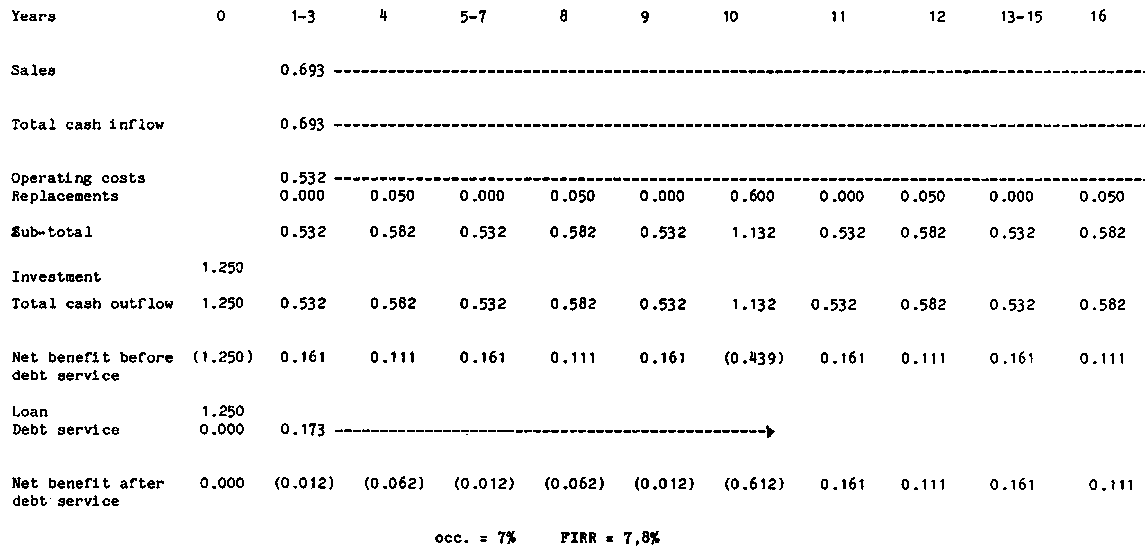
4.5.27 Assumption C1-A3 (Annex 4) results in a weak positive FIRR, 7.8%. However, it cannot cover debt service from years 1 to 10. Its results are marginal and command the rejection of the project.
5.1 The production unit
5.2. Investment, Replacement and Maintenance Costs
5.3. Yearly effort, production, sales and production costs
5.4. Analysis of financial results
5.1.28 A second hand trawler similar to and equipped as the one described in paragraph 7, about 8 years old, in good shape and working condition.
|
5.2.29 Components |
Cost |
Life |
Yearly Maintenance |
|
|
(US$ Millions) |
(year) |
(US$ Millions) |
||
|
Hull |
0.200 |
12 |
(10%) |
0.020 |
|
Machinery |
0.200 |
12 |
(30%) |
0.060 |
|
Fishing gear |
0.050 |
4 |
(50%) |
0.025 |
|
|
0.450 |
|
|
0.105 |
5.2.30 Investment through a US$ 0.450 million loan repayable in five years with an interest rate of 7%, the average total yearly debt service being US$ 0.109 million from years 1 to 5.
5.3.31 These are the same as for the new trawler (sections 4.3 and 4.4), except for the insurance which, at 5% of investment, represents US$ 0.022 million. Total yearly production costs for each catch assumption is therefore the following (US$ million):
|
Assumptions |
C2-A1 |
C2-A2 |
C2-A3 |
|
- Maintenance (Para. 29) |
0.105 |
0.105 |
0.105 |
|
- Fuel (Para. 20) |
0.200 |
0.198 |
0.197 |
|
- Lubricants (Para. 21) |
0.020 |
0.020 |
0.020 |
|
- Crew (Para. 22) |
0.065 |
0.075 |
0.083 |
|
- Insurance (Para. 31) |
0.022 |
0.022 |
0.022 |
|
- Miscellaneous (Para. 24) |
0.020 |
0.020 |
0.020 |
|
|
0.432 |
0.440 |
0.447 |
5.4.32 This is a productive enterprise, especially for assumptions C2-A2 and C2-A3 (Annexes 6 and 7) which easily cover debt service and turn out a high FIRR on total investment, with rates of 28 and 44% respectively
5.4.36 Therefore, it can be assumed that, under certain conditions, trawling operations on Saya de Malha Bank for the supply of the Mauritian market could be a financially viable activity.
5.4.37 This possibility justifies the undertaking of a pilot project of the type proposed in Annex 8. This project, the main objective of which is to demonstrate the real financial and economic feasibility of the new fishery, is all the more desirable as the size of the estimated fish stocks with an MSY of 13,000 to 26,000 t per year (Para. 3) is sufficient for ample supplies of low cost products on the national market. Furthermore, it could eventually sustain canning operations directed at the national and external markets. This exploitation, furthermore, would require a fleet of 10 to 15 trawlers which in turn could generate 600 to 1200 direct and indirect jobs.
5.4.38 Finally, it must be considered that, as has been demonstrated by numerous world fisheries, there is a high probability that a strictly commercial fishing effort will turn out average hourly catches superior to those admitted in this study which uses figures obtained from exploratory and non-commercial operations.
5.4.39 Obviously, knowledge of the fishing grounds and of fish behaviour gained through repeated commercial operations in the same area permit the improvement of fishing technologies and tactics and the concentration of fishing efforts on fish aggregations. This cannot be the Case in exploratory fishing which, in a short period of time, has to disperse its fishing effort on the entire area of a bank without the possibility of concentrating it at length on the best fish aggregations. These facts are supplementary indications that the real financial results of commercial trawling operation on the Saya de Malha Bank could indeed be superior to those shown by this study.
(1) This report is the revised version of the draft report "Etude de Prefaisaibilite Financiere d'Operations de Chalutage sur le Banc Saya de Malha" (GUIDICELLI, M. Dec. 1984).
(2) CHRISTY, L. and D. GREBOVAL, Fisheries Institutions in Mauritius, interim report, FAO/RAF/79.065, October 1984.
(3) BIRKETT, L. Western Indian Ocean Fishery Resources Survey, Report on the Cruises of R/V 'Professor Mesyatsev', December 1975 - June 1976/July 1977 - December 1977, IOP/TECH. 79.26, R NO. 2, FAO 1979.
1. BACKGROUND AND JUSTIFICATION
2. DEVELOPMENT OBJECTIVES
3. IMMEDIATE OBJECTIVES
4. SUMMARY OF ACTIVITIES
5. Outputs
6. ESTIMATED COSTS FOR THE INTERNATIONAL CONTRIBUTION
7. GOVERNMENT INPUTS
APPENDIX 1 - TIMING OF ACTIVITIES
APPENDIX 2 - Modalities of Project Administration
APPENDIX 3 - List of Fishing Gear
ANNEX 1
ANNEX 2
ANNEX 3
ANNEX 4
ANNEX 5
ANNEX 6
ANNEX 7
|
TITLE |
: Development of a Mauritian Trawl Fishery on Saya de Malha Bank |
|
TYPE |
: Feasibility and Training pilot project |
|
DURATION |
: 29 months (of which 10 for the preparatory phase) |
|
LOCATION |
: Port Louis, Mauritius |
|
TARGET SPECIES |
: Horse mackerel and associated species |
|
ESTIMATED COST FOR THE DONOR |
: US$ 1,560,000 |
|
GOVERNMENT IMPLEMENTING AGENCY |
: Ministry of Agriculture, Fisheries and Natural Resources |
|
EXECUTING AGENCY |
: FAO |
1. Saya de Malha Bank has a surface of about 47,000 Km sq inside the 200 m isobath. This is an important area compared, for example, with the 1865 sq km of Mauritius and the 1630 km sq of the Mauritian continental shelf (Annex 1) (1).
(1) All annexes referred to in this proposal are to be found in the preceeding feasibility study.
2. For several decades this Bank has been fished by hand liners from Mauritius and Reunion. The exact state of exploitation of this fishery, which only exploits the demersal species of the rocky and coralline floors, is not known. However, some facts such as the decreasing size of the fish caught and the decrease of catch per unit of fishing effort from some parts of the Bank could very well indicate that the present hand line fishery has reached or is close to the MSY of the target species. There is therefore little scope for improved production from this fishery.
3. Other traditional sources of fish in Mauritian waters are also close to their limits of exploitation and even maintaining present levels of consumption in the face of population growth (about 1.2% per year) would increase the dependence of the country on imports. In 1979, for example, annual consumption of fish per head was 17 kg, of which 2.7 came from artisanal fisheries in Mauritius and its dependant oceanic islands, 3.8 from the handline bank fishery and about 10.5 from imports (1). This bleak situation is furthermore worsened by the fact that Mauritius has indeed few replacement alternatives to solve the problem of its animal protein supply, as the country has only small development potentials for increased animal production and aquaculture.
4. In conclusion, in order to improve its food supply and trade balance, the deficit of which was of the order of US$ 50 million in 1983, i.e. 4.5% of the PNB, it is urgent for Mauritius to consider the utilization of new animal resources.
5. Saya de Malha Bank could very well offer an opportunity to do so. Exploratory trawling conducted on this Bank by FAO in 1976 and 1977 (BIRKETT, L., Western Indian Ocean Fishery Resources Survey, Report on the cruise of R/V Professor MESYATSEV, Dec. 1975 - June 1976/July 1977- Dec. 1979, IOP/Tech/79/26, TR No. 26, FAO 1979.) indicated that, outside the rocky and coralline floors traditionally exploited by the handline fishery, the sandy trawlable seafloors sustain commercial fish resources inaccessible to handlining. In particular these campaigns have shown that:
- The major part of the Bank area is composed of sandy floors with, on average, a good degree of trawlability for demersal operations.- Concentration of fish species accepted on the Mauritian market are located on these sandy floors, mainly horse mackerels (Decapterus macarellus, D. ruselli, Trachurus indicus) and to a lesser extent, lizard fishes (Saurida sp.).
- Exploited with a 32m headline demersal trawl net these concentrations produced average hourly catches from 569 to 842 kg in April, and from 221 to 901 kg in October. The MSY of the species considered could be assessed to lie between 13.000 and 26,000 t/year.
6. On the hypothesis that these potentials could be exploited to the level of the lower estimate of MSY, 13,000 t, they could cover the future demand for fish in Mauritius and also replace imports which are a heavy burden on the trade balance.
7. The establishment of a new trawl fishery on Saya de Malha Bank will require investments which will, by Mauritian standards, be important. Before any decision is taken in this respect, the real financial and economic productivity of the new fishery, as well as its foreseeable size and the extent of the investments needed for its full development must be thoroughly demonstrated.
8. To provide a decisive demonstration in this field, a pilot project is needed, exploiting an adequate trawler on the Bank on a strictly commercial basis. This vessel would fish with the only objective of obtaining the optimal financial return.
9. To preserve all chances of success, this pilot project would have to be carried out by specialists of commercial trawling operations on unknown grounds and not by private enterprises lacking experience and the financial means necessary for a long and risky enterprise.
12. In view of the cost of a pilot project, a feasibility study of the future fishery is needed as prior Justification. This study is to be found in the analysis proceeding this proposal. In short, it shows that, under certain conditions, the exploitation of Saya de Malha Bank with trawlers supplying fish to the Mauritian market could be a financially sound activity, with Financial Internal Rates of Return (FIRR) on total Investment ranging from 28 to 43%, on the basis of assumed catches of 500 and 600 kg/hour.
13. It appears, therefore, that on a strictly financial level, the proposed pilot project is justified. It would seem to be also interesting in terms of economic and social outputs. The full development of the new fishery could in fact land abundant supplies of low price fish, possibly help to develop canning operations and create 600 to 1200 direct and indirect new jobs.
14. It has to be stated, finally, that all the catch assumptions on which have been based the feasibility study from which originated the financial results referred to above in (12), came from the average hourly catches of exploratory trawling efforts. Exploratory fishing, unlike commercial fishing, does not concentrate its efforts on the best fish aggregations encountered in a given area but, on the contrary, attempts to cover the whole area independent of catch rates.
15. Through this fact, and this has been demonstrated by numerous commercial fisheries in the World, there is a high probability that strictly commercial efforts on Saya de Malha Bank will result in average hourly catches superior to those used in the catch assumptions in the study and, therefore, that the financial productivity of the new fishery will show FIRRs higher than those given above in(12).
16. Increase low priced fish supplies of national origin on the internal market of Mauritius, lessen dependence on fish imports and improve nutrition, trade balance and employment, by the exploitation of the trawlable fish resources of Saya de Malha Bank.
17. The immediate objectives of this pilot project will be to produce:
- An investment programme based on knowledge of the financial and economic productivity of the new fishery;- Charts showing trawlable areas and seasonal fish distribution;
- Gear designs and techniques adapted to fishing grounds and target species;
- A marketing network adapted to the fish species produced and to consumer preferences;
- National personnel trained in fishing and marketing;
- Estimates of stocks and biological data needed for management of the resource.
18. These objectives will be reached through a pilot project which will apply, through the use of a chartered trawler of appropriate size and design, commercial fishing efforts on the fish resources offering the best possibility of financial productivity, this action being strengthened by a marketing effort in the country and on-the-job training in both fishing and marketing.
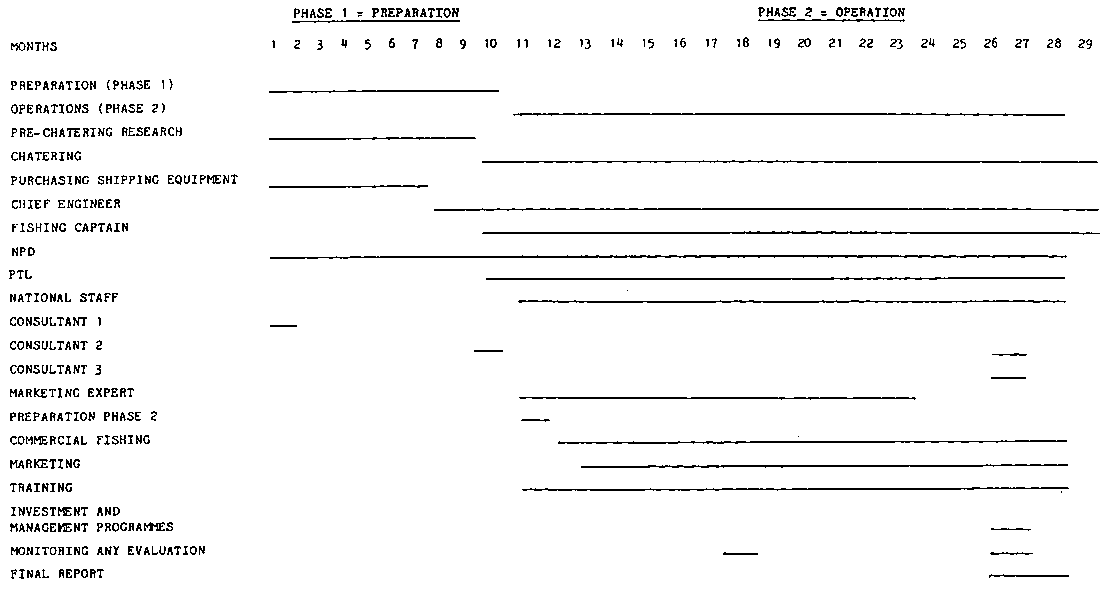
19. The project will have a 29 month duration: 10 for preparation, 18 for operations at sea and on shore and 1 for the return of chartered trawler to its port of origin. Its zone of action will embrace the entire surface of Saya de Malha Bank inside the 200m isobath, outside the traditional fishing zones of the oceanic Mauritian handliners. The operational and administrative base will be established in Port Louis. The timing of activities is given in Appendix 1.
20. This phase will start with the signature of the project document and run from months 1 to 10. During its execution, FAO and the Government Implementing Agency will carry out the following activities:
21. A fisheries development specialist provided by FAO will immediately visit Mauritius for 0.5 months. In collaboration with the national project director, selected by the Government Implementing Agency at the beginning of month 1, he will make all necessary contacts for establishing the project base of operation: dock, bunkering facilities, storage for gear, for frozen fish, etc.
22. He will also make contact with the potential project operational partners for determining their ability to support project activities during its operational phase. The role of these partners is described in Appendix 2. He will then make necessary recommendations to the Government Implementing Agency for the selection of the best project operational partners during the first two months of the project.
23. FAO, from the very beginning of month 1 will carry out actions necessary for the chartering of a stern freezer trawler of approximately 36m LOA, with a power of 800 HP, a freezing capacity of 10 t/day, a refrigerated fish storage capacity of 100t, a cruising speed of 10 knots and a range of 450 hours at full power. This unit will be chartered for 20 months starting at the beginning of month 10 and will join the project at the end of this same month. This delay is estimated necessary as a high probability exists that the ship will have to be chartered in Europe. If it can be chartered in the region this will reduce transfer time and thus reduce proportionally the duration and cost of the operational phase.
24. The chief engineer and the fishing captain responsible for the trawler will be recruited by FAO, the first for a duration of 21 months and the second for 20 months. The chief engineer will start his task on month 9 in order to control the refit and overhaul of the ship by the owners. The fishing captain will take his post at the beginning of month 10. Both these officers, with a reduced transfer crew recruited in the port of departure or in Mauritius, will transfer the ship to Mauritius at the beginning of month 10.
25. FAO will purchase fishing gear, spare parts and other equipment required in the execution of the project. In order to decrease costs and simplify operations, these items will, when possible, be embarked on the trawler at the port of departure. Alternatively, they will be shipped to Mauritius in due time by other means. A succinct list of these items is given in Appendix 3. FAO will also purchase equipment needed ashore for the project. This will be shipped to Mauritius by the end of month 7 at the latest. Reception and storage of these items will be the responsibility of the national project director.
26. Furthermore, FAO will recruit a senior expert, specialist of fishing company management and of fisheries development who will act as project team leader. This expert, recruited for 19 months, will Join the project at the beginning of month 10. During this month, in collaboration with the national project director, he will prepare the arrival of the trawler and its programme of exploitation for the 18 months of the operational phase. He will also select a group of Mauritian mariners, candidates for jobs on board the trawler on its arrival in the country.
27. FAO will also recruit a fish marketing expert for a duration of 12 months. This expert will join the project at the end of month 10 and will undertake necessary actions for distributing the catch of the vessel on the national market.
28. Finally, FAO will recruit a consultant in fish stock assessment and management for a duration of 1.5 months. This expert will Join the project for 0,5 months during month 10 in order to set up a sampling scheme, the rest of his assignment taking place during the operational phase.
29. This phase will start at the beginning of month 11 with the arrival of the trawler in Mauritius and will last for 18 months. The first half of month 11 will be used for preparing the trawler, rigging fishing gear and giving basic training to the Mauritian crew. During this period the fishing captain and the chief engineer will select the best among the crew candidates and hire a crew of 16 men: 2 skippers, 2 mates, 2 chief engineers, 2 bosuns, 7 deck-hands and 1 cook.
30. During the following 17.5 months, principal project activities will be the following:
a) Commercial production fishing
31. The trawler, under command of the fishing captain, will carry out commercial production fishing on the best fish aggregations encountered on Saya de Malha Bank, with the only objective of obtaining the best financial productivity of the fishing effort. When searching for these aggregations she will not undertake systematic exploration but only scouting activities of the type in current use in commercial fisheries.
32. About 400 sea days, i.e. about 16 to 19 trips, will be carried out during this phase. This means that 305 to 380 days will be spent fishing, with a turn out of 915 to 1,140 trawl hauls and 3,200 to 4,000 trawling hours.
33. The fishing captain will be responsible for fishing operations and for the ship and her crew, both at sea and in harbour. He will train the bridge and deck crew, prepare fishing charts and fishing gear plans, keep up to date a sea log and fishing log, etc. He will not be responsible for the unloading of the catches, this responsibility falling on the national project director, the project team leader and the marketing expert.
34. The chief engineer will be responsible for the trawler machinery, both at sea and ashore. He will train the national engineers and keep up to date the engine room log.
b) Marketing
35. The ship's catch will be landed at Port Louis and kept in the project operational partners cold storage facilities pending sale. Landed products will be the responsibility of the marketing expert during his stay in the project. After this time, the national project director will be responsible.
36. The production will be marketed by the project which, therefore, will have the capacity and authority to carry out commercial operations. Production will be marketed through both traditional circuits and the new network established by the marketing expert. This expert will also try to interest the canning industry in the utilization of the fish caught by the project.
37. The accounting system necessary for monitoring production costs and sales of the project is given in Appendix 3.
c) Training
38. Training of Mauritian personnel will be an essential project activity.
39. At sea, the fishing captain will train skippers, mates, bosuns and deck-hands on the Job in all activities related to fishing operations including, for the officers, offshore and coastal navigation, security at sea and ashore. In order to transfer the experience of command at sea to the local deck officers, the fishing captain will progressively give them, under his direct supervision, the execution of fishing operations and navigation, the responsibility to prepare campaigns and take care of the ship.
40. Training of engineers by the chief engineer will follow the same lines.
41. In principle, two complete crews will be trained by the project.
42. The project team leader will train the national project director in project management and in business management of an industrial fishing enterprise, with emphasis on the analysis and improvement of financial productivity. He will also train all the personnel engaged in project activities ashore in accountancy, ship supply, maintenance, etc.
43. The marketing expert will train the personnel engaged in fish distribution and marketing.
d) Investment
44. The project team leader will constantly monitor project financial outputs with the view to determining and improving productivity.
45. At the beginning of month 27 an investment specialist appointed by FAO will visit the project for one month. In collaboration with the national and international project staff, including the resource evaluation and management specialist (Para. 47) he will analyse the results of the first 16 months of exploitation in order to determine the investment potential of the new fishery and the technical needs for this activity.
46. In relation with the size of the fish stocks (estimated by the resource and management specialist; Para. 47), he will also determine the investment required for various levels of exploitation of the trawlable resources of the Bank. He will finalize his task by producing a medium and long term investment programme.
e) Fishery management
47. The resource evaluation and management specialist recruited by FAO will visit the project for one month at the beginning of month 27. In collaboration with the project national and international staff, he will analyse the biological information produced by the project in order to assess the size of the fish stocks and establish an exploitation programme which will ensure their rational utilization.
f) Administration
48. The project will be administrated according to the scheme given in Appendix
g) Monitoring and evaluation
49. The project will be subject to monitoring and review according to policies and procedures established by the donor, the implementing agency and the Government of Mauritius. In principle this review will take place during month 18 and consists of two consultants representing an input of 2 man/months. In order to respond to any potential need during the execution of the project, a supplementary one man/month consultancy is foreseen.
50. The project will be also subject to an evaluation in accordance with the policies referred to in (49). This evaluation for which 2 man/months are foreseen, will be carried out by two consultants visiting the project at the beginning of month 28.
51. The project will:
a. Locate the best fish aggregations accessible to trawl nets on Saya de Malha Bankb. Provide knowledge of fish behaviour and the best fishing technology and tactics. These results will be of utmost importance for the future development of the new fishery.
c. Through production commercial fishing operations, demonstrate the financial and economic productivity of the new fishery to potential investors and entrepreneurs.
d. Provide, an estimate of the size of the resource and,
e. Produce an investment programme taking account of the management aspects of the fishery.
f. Train on the Job, in all project activities, the national personnel necessary for follow up, including 32 sea-going personnel in all operations and responsibilities related to the fishery.
52. Quantifiable results expected from the project will be about 400 sea days and 3200 to 4000 trawling hours producing about 1700 to 20001 of fish with an approximate value in the order of US$ 930,000 to 1,100,000.
53. Considering the apparent importance of the resource and the average hourly catches it sustained in the past (Para. 8), considering furthermore that the project will carry out commercial and not exploratory operations, (Para. 15 and 16), it is probable that the financial results will be superior to those given in Paragraph 13 and, therefore, that it will promote a fast development of the new fishery.
54. Such a development will be of considerable importance to the Mauritian economy. It will provide a regular substantial supply of low priced fish to the internal market, Improving the national trade balance through reduction of fish imports, improving of the nutritional situation and lead to the creation of 600 to 1200 jobs, directly and indirectly.
|
International Personnel |
m/m |
US$ |
|
|
- Project Team Leader |
19 |
158,000 |
|
|
- Fishing Captain |
20 |
147,000 |
|
|
- Chief Engineer |
21 |
154,000 |
|
|
- Marketing Expert |
12 |
86,000 |
|
|
- Consultants |
8 |
80,000 |
|
|
|
|
625,000 |
|
|
- Official Travel |
|
55,000 |
680,000 |
|
Equipment |
|
|
|
|
- 1 personnel vehicle |
|
10,000 |
|
|
- 1 insulated truck (5t) |
|
25,000 |
|
|
- Fishing equipment (1) |
|
70,000 |
|
|
- Mechanical spare parts (2) |
|
30,000 |
135,000 |
|
Operations (3) |
|
|
220,000 |
|
Chartering and transfer |
|
|
500,000 |
|
Working Capital (4) |
|
|
15,000 |
|
Miscellaneous |
|
|
10,000 |
|
|
|
|
|
|
|
|
TOTAL |
1,560,000 |
(1) Details in Appendix 3.(2) For the trawler machinery.
(3) Of which US$ 180,000 are foreseen for trawler production costs during five months. Monthly gross sales of this unit, which will be of the order of US$ 53,000 to 63,000, will normally cover monthly production costs which will roughly amount to US$ 40,000. This provision is made however in order to avoid jeopardizing project execution in the case of unforeseen technical and commercial difficulties.
(4) For the commencement of marketing operations.
55. The Government will select a project operational partner, preferably a company already involved in fish marketing activities. This enterprise will need to possess storage and handling facilities for frozen fish in or close to Port Louis harbour.
56. Project national staff, except for the trawler crew, will be recruited and paid by the Government. This staff will consist in a national project director, counterpart of the project team leader, two sea-going biologists, technicians and service personnel for all land-based project activities: accountancy, secretariat, ship supplies, transport, fish handling and marketing, etc. The total number of this staff will be about 10.
57. The Government will provide a dock for the trawler and, inside the port area, a 30 m sq store for fishing gear and equipment together with a flat and clean area of about 100 m sq for fishing gear repairs and transformations.
58. Finally, the Government will ensure that the project will be exonerated of customs duties and taxes for imported equipment, spare parts, stores, fuel and lubricants.
The project will be entitled to carry out the commercial operations necessary for the marketing of its produce in the country through the traditional networks as well as through new circuits it may establish. The money accrueing from by sales, as well as the working capital and provision for operating costs foreseen in the project budget will be deposited in a special bank account.
The money deposited in this account will be used to pay for the operating costs of the trawler, including crew salaries and incentives, and marketing expenses. It will also cover the acquisition of new fishing equipment as necessary.
All operations on this account will require the signatures of both the national project director and project team leader.
At the end of the project, the balance of this account will be transferred either to the Government of Mauritius or to the donor. This point will be settled in the final project document.
The project operational partner selected by the Government Implementing Agency will provide the cold storage required by the project, stores, ship supplies, maintenance, etc. This partner will render services to the project against payments made by the project according to scales and procedures which will be defined between him, the Government Implementing Agency and FAO during the preparatory phase.
The project will maintain three different accountancies, one concerning the administration of technical assistance, the second, the trawler exploitation and the third, marketing operations. The holding of the first one will be the responsibility of the project team leader, and the holding of the two others the joint responsibilities of the national project director and project team leader. All three accountancies will be held according to FAO rules which will monitor and supervise all financial operations.
The two commercial accountancies related to the trawler exploitation and marketing operations will show at any time inflows and outflows of money generated by project activities, as well as the financial productivity of these activities.
|
|
Estimated Cost |
|
US$ |
|
|
- 4 High vertical opening demersal trawl-nets, 3/43 m (1) |
20,000 |
|
- 3 pairs oval curved steel trawling doors, 650 kgs each |
12,000 |
|
- 100m steel cable Ø 22 mm |
250 |
|
- 3000m steel cable Ø 18 mm |
10,000 |
|
- 500m steel cable Ø 14 mm |
900 |
|
- 500m steel cable Ø 12 mm |
850 |
|
- 500m combination rope Ø 22 mm |
1,700 |
|
- 200m PA rope Ø 20 mm |
600 |
|
- 500m PA rope Ø 16 mm |
400 |
|
- 500m PE rope Ø 16 mm |
200 |
|
- 500m PE rope Ø 12 mm |
150 |
|
- 500m Plastic floats Ø 200 mm with central hole Ø 12 mm |
5,000 |
|
- 100 kg chain Ø 18 mm |
350 |
|
- 500 kg chain Ø 12 mm |
1,700 |
|
- Shackles, swivels, G hooks, Ø links, etc. |
5,000 |
|
- 300 kg PA webbing |
1,800 |
|
- 200 kg PA twine |
1,100 |
|
- Miscellaneous |
8,000 |
|
|
70,000 |
(1) Experience in clear tropical waters has shown that pelagic (mid-water) trawl-nets, unless they are very big and towed at great speed, which would require trawlers too big and powerful for the fishery considered, generally produce poor catches when aimed at schools of horse-mackerel, mackerel and other small pelagics.
It is generally accepted that the reason of this lack of efficiency is due, in daylight, to fish reaction to fishing gear which is more rapid and strong in warm tropical waters than in temperate or cold seas. At night, in any case, school dispersion makes pelagic trawls highly ineffective.
These are the main reasons why high vertical opening demersal trawl-nets have been selected for the project. This fishing gear permits the efficient exploitation of small pelagics such as horse-mackerels which are prone to live on or near the sea floor during daylight. During this period, most of the aggregations lie on the sea floor with their higher boundaries at heights of 1 to 10m above the bottom. They are therefore highly vulnerable to demersal trawl-nets, the vertical opening of which range from 5 to 7 m.
These trawl-nets also capture demersal species which represented about 30% of the production during the exploratory fishing efforts referred in paragraph 8 of the project proposal.
General Geographical Location of Saya de Malha Bank and Mauritius
ASSUMPTION C1-A1 (US$ Millions)
ASSUMPTION C1-A2 (US$ Millions)
ASSUMPTION C1-A3 (US$ Millions)
ASSUMPTION C2-A1 (US$ Millions)
|
Years |
0 |
1-3 |
4 |
5 |
6-7 |
8 |
9-12 |
|
Sales |
|
0.533 |
® |
||||
|
Total cash inflow |
|
0.533 |
® |
||||
|
Operating costs |
|
0.472 |
® |
||||
|
Replacements |
|
0.000 |
0.050 |
0.000 |
® |
0.050 |
0.000 |
|
Sub-total |
|
0.472 |
0.522 |
0.472 |
® |
0.522 |
0.472 |
|
Investment |
0.450 |
|
|
|
|
|
|
|
Total cash outflow |
0.450 |
0.472 |
0.522 |
0.472 |
® |
0.522 |
0-472 |
|
Net benefit before debt service |
(0.450) |
0.061 |
0.011 |
0.061 |
® |
0.011 |
0.061 |
|
Loan |
0.450 |
|
|
|
|
|
|
|
Debt service |
0.000 |
0.109 |
® |
|
|
|
|
|
Net benefit after debt service |
0.000 |
(0.048) |
(0.098) |
(0.048) |
0.101 |
0.051 |
0.101 |
occ. = 7% FIRR = 5,6%
ASSUMPTION C2-A2 (US$ Millions)
|
Years |
0 |
1-3 |
4 |
5 |
6-7 |
8 |
9-12 |
|
Sales |
|
0.621 |
® |
||||
|
Total cash inflow |
|
0.621 |
® |
||||
|
Operating costs |
|
0.480 |
® |
||||
|
Replacements |
|
0.000 |
0.050 |
0.000 |
® |
0.050 |
0.000 |
|
Sub-total |
|
0.480 |
0.530 |
0.480 |
® |
0.530 |
0.480 |
|
Investment |
0.450 |
|
|
|
|
|
|
|
Total cash outflow |
0.450 |
0.480 |
0.530 |
0.480 |
® |
0.530 |
0.480 |
|
Net benefit before debt service |
(0.450) |
0.141 |
0.091 |
0.141 |
® |
0.091 |
0.141 |
|
Loan |
0.450 |
|
|
|
|
|
|
|
Debt service |
0.000 |
0.109 |
® |
|
|
|
|
|
Net benefit after debt service |
0.000 |
0.632 |
0.018 |
0.032 |
0.181 |
0.131 |
0.181 |
occ. = 7% FIRR = 28,1%
ASSUMPTION C2-A3 (US$ Millions)
|
Years |
0 |
1-3 |
4 |
5 |
6-7 |
8 |
9-12 |
|
Sales |
|
0.693 |
® |
||||
|
Total cash inflow |
|
0.693 |
® |
||||
|
Operating costs |
|
0.487 |
® |
||||
|
Replacements |
|
0.000 |
0.050 |
0.000 |
® |
0.050 |
0.000 |
|
Sub-total |
|
0.487 |
0.537 |
0.487 |
® |
0.537 |
0.487 |
|
Investment |
0.450 |
|
|
|
|
|
|
|
Total cash outflow |
0.450 |
0.487 |
0.537 |
0.487 |
® |
0.537 |
0.487 |
|
Net benefit before debt service |
(0.450) |
0.206 |
0.156 |
0.206 |
® |
0.156 |
0.206 |
|
Loan |
0.450 |
|
|
|
|
|
|
|
Debt service |
0.000 |
0.109 |
® |
||||
|
Net benefit after debt service |
0.000 |
0.097 |
0.047 |
0.097 |
0.246 |
0.196 |
0.246 |
occ. = 7% FIRR = 43,8%