Dar-es-Salaam, Tanzania;
29-02 August 1985
August 1985 RAF/79/065/WP/22/85
REGIONAL PROJECT FOE THE DEVELOPMENT & MANAGEMENT OF FISHERIES IN THE SOUTHWEST INDIAN OCEAN
PROJET REGIONAL POUR LE DEVELOPPEMENT ET L'AMENAGEMENT DES PECHES DANS L'OCEAN INDIEN SUD-OCCIDENTAL
c/o UNITY HOUSE, P.O. BOX 487, VICTORIA, MAHE, SEYCHELLES
TELEPHONE: 23773
TELEX: 2254 SWIOP SZ
This electronic document has been scanned using optical character recognition (OCR) software and careful manual recorrection. Even if the quality of digitalisation is high, the FAO declines all responsibility for any discrepancies that may exist between the present document and its original printed version.
NATIONAL WORKSHOP ON FISH HANDLING
FEATURES OF FISH
FACTORS INFLUENCING SPOILAGE OF FISH
FRESHNESS OF FISH
FISH CONTAINERS
ICE AND FISH
CHILLED STORAGE OF FISH
LANDING AND RECEPTION OF FISH
EXTENTION AND PUBLICITY
HANDLING SHELLFISH
THE BEAM BALANCE
NATIONAL WORKSHOP ON
BECHE DE MER
ABSTRACT
1. INTRODUCTION
2. ADMINISTRATION AND CONDUCT OF THE WORKSHOP
2.1. Administrative and Financial Responsibility
2.2. Conduct of the workshop4. PROGRAMME OF THE WORKSHOP
5. CONCLUSION
6. EVALUATION
Appendix I - ADDRESSES OF STAFF AND PARTICIPANTS
Appendix II - TIMETABLE
Appendix III PARTICIPANTS WORKSHOP EVALUATION
Appendix IV - OPENING ADDRESS TO WELCOME THE DIRECTOR OF FISHERIES TO OPEN THE WORKSHOP AT KUNDUCHI FISHERIES INSTITUTE
Appendix V - A SPEECH GIVEN BY ND. B.K. LIBABA, DIRECTOR OF FISHERIES AT THE OPENING SESSION OF THE NATIONAL WORKSHOP ON THE PROCESSING OF BECHE-DE-MER KUNDUCHI, 29 JULY 1985.
Appendix VI - ADDRESS TO WELCOME THE DIRECTOR GENERAL OF TAFIRI, TO CLOSE THE WORKSHOP AT KUNDUCHI FISHERIES INSTITUTE
Appendix VII - A SPEECH BY PROFESSOR P.O.J. BWATHONDI, DIRECTOR GENERAL, TAFIRI AT THE CLOSING SESSION OF THE NATIONAL WORKSHOP ON THE PROCESSING OF BECHE-DE-MER, KUNDUCHI 2ND AUGUST, 1985
COMMERCIALLY IMPORTANT HOLOTHURIANS
EXTERNAL AND INTERNAL FEATURES OF HOLOTHURIANS
METHODS OF CATCHING & HANDLING ON BOARD
CLEANING AND HANDLING
STEP BY STEP PROCEDURE FOR SAND FISH
STEP BY STEP PROCEDURE FOR TEAT FISH
GRADING, PACKAGING AND STORAGE
MARKET TRENDS - MARKETING
COMMERCIALLY VALUABLE SPECIES OF BECHE-DE-MER IN THE TROPICAL PACIFIC
FEATURES OF FISH
FACTORS INFLUENCING SPOILAGE OF FISH
FRESHNESS OF FISH
FISH CONTAINERS
ICE AND FISH
CHILLED STORAGE OF FISH
LANDING AND RECEPTION OF FISH
EXTENTION AND PUBLICITY
HANDLING SHELLFISH
THE BEAM BALANCE
UNITED REPUBLIC OF TANZANIA
ZANZIBAR
MINISTRY OF MARINE, TOURISM AND FORESTRY
REGIONAL PROJECT FOR THE DEVELOPMENT AND MANAGEMENT OF FISHERIES IN THE SOUTH WEST INDIAN OCEAN
23-27 March, 1985
Ministry of Marine, Tourism and Forestry
ZANZIBAR, Tanzania
NATIONAL WORKSHOP ON FISH HANDLING
|
1. Place |
ZAFICO premises, Zanzibar. |
|
2. Dates |
23 to 27 March 1985. |
|
3. Number of participants |
16 |
|
4. Language |
English/Swahili |
5. Tentative work programme
(i) Pathways of fish spoilage
(ii) Keeping time of fresh fish
(iii) Assessment of freshness of fish
(iv) Methods of handling fish on board and shore - use of fish boxes
(v) Ice and fish
(vi) Insulated boxes for fish on board the fishing vessel
(vii) Fish landing facilities
(viii) Fish handling during distribution
(ix) Fresh fish in the market
(x) Production of publicity material on fish handling.
6. FAO Project will
- provide two lecturers
-. provide relevant FAO publications to the participants.
7. Zanzibar Ministry of Marine, Tourism and Forestry will
- cover the salaries, board and transportation costs of participants from Zanzibar- nominate an officer from the Ministry to act as Director/Coordinator of the workshop.
- arrange final facilities at ZAFICO premises (classroom, fish boxes, insulated boxes, chill room, ice, fresh fish, etc.).
- arrange transport facilities to the participants
(a) to visit fish landing sites
(b) to go on board the various artisanal fishing crafts.- arrange to Issue certificates to the participants upon completion of the course.
8. Workshop staff.
1. Director/Coordinator Mr. Saleh S. Osman
Chief of Fisheries Division or his representative.2. - Lecturer Mr. M. Mlay
Senior Fisheries Officer
(Training) Tanzania.3. - Lecturer
Mr. K. Sachithananthan
Processing/Distribution Expert, RAF/79/0654. - Lecturer
Mr. Roelof Schoemaker
Associate Expert, RAF/79/065
9. Participants
|
Name |
Age |
Designation |
|||
|
1. Mr. Bakari Musa |
35 |
Reg. Fisheries Officer |
(North) |
||
|
2. Mr. Ahmada Masoud |
26 |
" |
" |
" |
(West) |
|
3. Mr. Haji Mwinyi |
26 |
" |
" |
" |
(South) |
|
4. Mr. Hassan Mpango |
32 |
Dist. Fisheries Officer |
|
||
|
5. Mr. Ahmada Toufiki |
25 |
" |
" |
" |
|
|
6. Mr. Mwinyi Mwaka |
23 |
" |
" |
" |
|
|
7. Mr. Haji Jaffer |
25 |
" |
" |
" |
|
|
8. Mr. Maulid Machanoo |
27 |
" |
" |
" |
|
|
9. Mr. Juma Suleiman |
25 |
" |
" |
" |
|
|
10. Mr. Khamis A. Twala |
27 |
" |
" |
" |
(Pemba) |
|
11. Mr. Juma B. Mshindo |
26 |
" |
" |
" |
" |
|
12. Mr. Moamed A. Mhammed |
28 |
" |
" |
" |
" |
|
13. Mr. Msellem O. Khamis |
23 |
" |
" |
" |
" |
|
14. Mr. Ali K. Bakari |
25 |
" |
" |
" |
" |
|
15. Mr. Hamadi K. Kombo |
26 |
" |
" |
" |
" |
|
16. Mr. Nassor Moh'd |
38 |
Fisheries Officer |
(Pemba) |
||
Ministry of Marine, Tourism and Forestry
NATIONAL WORKSHOP ON FISH HANDLING
Time-Table
23.03.85 - SATURDAY
|
0800 - 0900 |
Opening. Registration of participants. Introductions. |
|
0900 - 1000 |
Chemical and Bacteriological factors influencing spoilage of fish. |
|
1015 - 1130 |
Physical factors influencing spoilage of fish. |
|
1300 - 1500 |
Project work. |
24.03.85 - SUNDAY
|
0800 - 0900 |
Assessment of Freshness - Theoretical |
|
0900 - 1000 |
Fish boxes - an appraisal of their use. |
|
1015 - 1130 |
Ice and fish. |
|
1300 - 1700 |
Project work. |
25.03.85 - MONDAY
|
0600 - 1130 |
Project work. |
|
1300 - 1400 |
Chill storage of fish |
|
1500 - 1600 |
Fish landing facilities. |
26.03.85 - TUESDAY
|
0800 - 0900 |
Transport from the landing sites to the market. |
|
0900 - 1000 |
Fish marketing in a village |
|
1015 - 1130 |
Fish market. |
|
1300 - 1700 |
Project work. |
27.03.85 - WEDNESDAY
|
0900 - 0900 |
Production of publicity material |
|
0900 - 1000 |
Role of extension services |
|
1015 - 1130 |
Presentation of project work reports |
|
1300 - 1400 |
Presentation of project work reports (continuation) and workshop evaluation. |
|
1500 - 1600 |
Closure. |
The term fish is used to denote most aquatic animals. However, the word chiefly denotes the vertebrates, belonging to the class PISCES.
Fishes are either BONY, like king fish, tilapia or sardine or CARTILAGINOUS like sharks and rays.
External Features
Cartilaginous fishes have spiny scales and the skeleton is made of soft cartilage.
Bony fishes have flattened plate-like scales and the skeleton is made of hard and rigid bone.
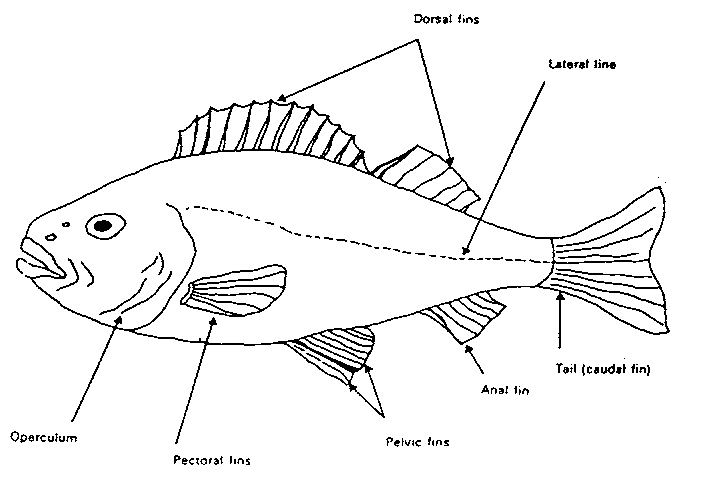
All fishes have a streamlined body, with protusions called fins. The CAUDAL fin forms the tail; the DORSAL fin is on the back or upper surface; the ANAL fin is behind the anal opening; the pair of PECTORAL fins are attached to the pectoral girdle; and the PELVIC fins attached to the bones at the hip region.
The mouth is usually at the tip of the snout of bony fishes; the cartilaginous fishes have their mouth underneath the snout.
Eyes are placed on either sides of the head.
Gill rays or arches are at the region between the head and the trunk. In bony fishes, the gills are protected by the operculum.
Anus and genital openings are at the mid-ventral region of the pelvis.
Internal Features
The skin of the fish encloses within, a variety of organs and tissues for
|
respiration |
(gills) |
|
coordination |
(brain, nervous system) |
|
digestion |
(stomach, intestine, liver, etc) |
|
circulation |
(heart, blood vessels, blood) |
|
excretion |
(kidneys, urinary tubes) |
|
locomotion |
(musculature, swim bladder) |
|
reproduction |
(genital system) |
Utilizable Portions
Not all the portions of the fish are consumed as food.
Musculature, is the major portion commonly used for direct consumption.
Liver, brain, kidneys are occasionally used.
All other portions are either discarded or converted into animal feed.
Edible portion of the fish usually refers to the musculature and the skin.
The physical component of cod as percentage of the whole body weight are as follows
|
Head |
21% |
|
Viscera |
16% |
|
Skeleton excluding skull |
14% |
|
Skin and fins |
13% |
|
Fillet |
36% |
Fish are dressed by removal of head, tail, fins and viscera. Fish are commonly filletted and the yield of fillets vary with the type of fish, between 20 to 40 percent. Dressed fish averages about 73 percent flesh, 21 percent bone and 6 percent skin.
|
|
Dressed portion |
Liver |
Viscera |
Other trimmings |
|
For most fishes |
65% |
2% |
8% |
25% |
Composition of fish
A good knowledge of the chemical composition of fish is necessary to evaluate its nutritive value.
Fishes are classified as FATTY FISH, if the percentage fat content in a species of fish usually increases at the expense of percentage water content, reaching a level of 10 to 20 percentage of the composition.
LEAN FISHES have a low fat content, usually less than 5 percent.
Chemical composition of fish depends of the fish species, the season, the condition and the feed of the fish, age, sex and size of the fish.
Main components are WATER, FAT and PROTEIN. Low concentrations of CARBOHYDRATES, MINERALS. VITAMINS, SUGARS and FREE AMINO ACIDS are also present.
Water is the principal component amounting to about 60-80 percent of the fish.
The most important component of fish is protein, usually amounting to 18-22 percent. Essential amino acids required for man are available in fish.
Fish body oils are composed of triglycerides. Usually there is a reverse relationship between oil and water content of fish muscle, such that the sum of two is close to 80 percent.
The principal carbohydrate occuring in fish in glycogen. Free glucose occurs in fish. however in very minor concentrations (1-75 mg percent).
Vitamins A, B, C, D, and E are present in fishes in appreciable quantities.
Inorganic components like aluminium barium, chromium, cobalt, lead, lithium, silver, strontium, titanium are known to be present in traces in the fish muscle.
Growth rates in fishes
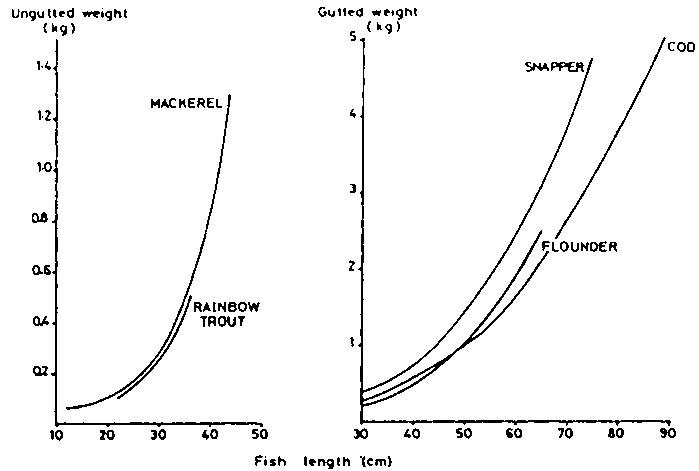
Fish, like any other living thing grows with passage of time. As it grows, its length increases, its weight increases. The relationship between the length and weight of a fish as it grows is significant to fish technologists. The length-weight relationship follows a set pattern. The increase in length is faster than the increase in weight during the initial growth period whereas the weight continues to increase even after the fish shows only marginal increase in length.
Shell Fish
Aquatic animals with an exterior hard shell covering their soft interior body all referred to as shell fish. Mostly this term is used to include
a) the crustacea, having segmented bodies at some stage of their life,b) the molluscs, having chalky shells outside their body, and the animals like squid, octopus and cuttlefish which do not have an exterior shell.
A fish out of water dies. Death initiates a series of deteriorative changes resulting in spoilage.
Fish is one of the most perishable of all foods. The deteriorative changes responsible for the spoilage can be
1) chemical
2) enzymatic
and 3) bacteriological.
These changes can be accelerated or retarded by physical conditions like
1) temperature
2) physical damage to fish
3) pollution and contamination by bacterial flora.
CHEMICAL
Fats and oils are present in fish. Most of it is highly poly-unsaturated fatty acids susceptible to rapid oxidation in the presence of atmospheric oxygen resulting in the production of rancid odours and flavours. Fat rancidity is of importance in storing frozen fish and in the dried fish production.
ENZYMETIC
At death, blood circulation is arrested and the supply of food ceases. Energy resources become depleted. However, enzymetic activity continues.
Enzymes are catalytic agents for chemical reactions within the body of fish. They are found all over the body catalysing various reactions.
Metabolic activities in the living muscle are catalysed by a series of enzymes resulting in the breakdown of complex substances and the release of energy.
Once fish dies, these metabolic activities are not regulated. So the pattern of metabolism is changed, resulting in the accumulation of lactic acid. The musculature becomes acidic.
The intensity of acidity varies with the species of fish; it is also a function of glycogen content at the time of death. The characteristic flavour of fresh fish is lost during this autolytic process. The flavour producing compound inosinic acid is broken down to produce hypoxanthene which contributes to the bitter flavour of spoilt fish.
Due to denaturation of proteins the muscular texture is softened.
Digestive enzymes inside the intestine usually assists in the digestion of food taken into the gut. But once the fish is dead, these enzymes catalyses digestive reaction involving the gut wall first and the adjacent body musculature and skin subsequently.
The soft belly of dead ungutted fish is due to this self-digestive reaction.
BACTERIAL
Bacteria are present in the living fish. They are found upon the surface of the skin, inside the gill rakers and inside the intestine of a healthy fish.
The living system maintains a balance by which the multiplication of bacteria beyond a certain limit as well as the presence of harmful species of bacteria are prevented.
Bacteria flourishes unchecked in dead fish, multiplying in large numbers invading the areas adjacent to the skin, gill rakers and the intestinal wall. If the fish was damaged, bacteria penetrate inwards through cut surfaces.
Bacterial multiplication and penetration results in softening of tissues, bursting of intestinal walls and production of off-odour through release of trimethylamine and ammonia.
TEMPERATURE
Of all the physical and chemical factors influencing spoilage, temperature is the most significant factor. Chemical reactions, enzymetic activity and bacterial multiplication require an optimal temperature range.
Fish kept directly exposed to sun's heat spoils faster than those kept in the shade. Fish kept in ice has a longer shelf life than those kept in shade. Fish frozen and stored in cold rooms stay preserved for extended periods of time.
PHYSICAL DAMAGE
Trampling under feet, kicking and other physical pressures cause severe damage to fish. The skin may be cut, the head may be smashed, the belly region sunken.
CONTAMINATION
Introduction of new bacterial flora due to the fish coming into contact with unclean and unhygienic deck surface, beach sand, fish containers causes contamination and rapid deterioration.
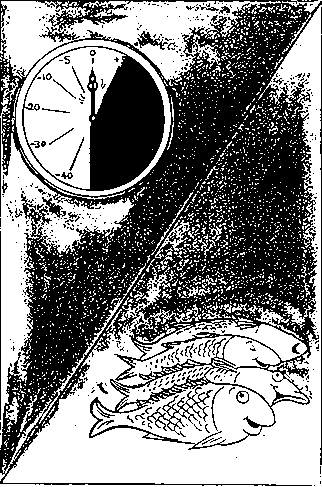
Anything new is fresh. Anything not preserved is fresh. Having its original qualities unimpaired is fresh.
Fresh fish has the following characteristics
1. Flesh Firm and elastic flesh not separating from the bones, indicates that fish is fresh.
2. Odour A fish just taken from water has no fishy odour. Fresh fish. after a few hours will produce fishy odour. If not properly handled, this odour becomes disagreable with passage of time.
3. Eyes Bright, clear and full. As the fish becomes stale, the eyes loose their brightness, becomes cloudy and turn pink. If fresh they protrude, if stale they are sunken.
4. Gills Bright red. The colour gradually fades with passage of time to become pink then grey and finally brownish or grebish.
5. Skin Shiny with unfaded colour. Each species has its own characteristic colour and marking. With passage of time, they fade and become less pronounced.
6. Fresh shrimp has a mild odour. The meat is firm in texture. The colour of the shell may be greyish green, pinkish tan or light pink. When cooked, the shells turns red; the meat also takes a similar attractive reddish tint with possibly some dark red spots. With passage of time, the flesh becomes soft rapidly, the head portion tend to break away from the trunk. Appendages break away. Colour changes from pink to brown and eventually black patches appear.
7. Fresh oysters and clams should be alive in the shell. The shells should close tight when tapped lightly. After removing the shell, the oyster meat should be plump with a natural creamy colour. Improper handling results in excess liquid in the flesh. Excessive water results in bloating of the oyster meat, loss of flavour and its nutritive value.
8. Crabs and lobsters should always be brought alive. They should show movement of the legs. The caudal region of the lobster curls under the body, when alive.
Guidelines to keep freshness of fish
a) The deck should be clean. All material inside the boat should be clean.
b) Always have a container to place your fish.
c) Whenever practicable, gut your fish as soon as possible after catching. Remove all the gut and liver.
d) Co not drop guts on top of other fish. Contamination by this offal speeds spoilage.
e) Co not trample on fish or kick them about.
f) Do not mix spoilt fish with fresh fish.
g) Gut and stow small fish first and then go to the large ones - small fish spoils more quickly.
h) Do not place the fish on dirty surfaces, like unclean deck, beach sand, unclean bench, unclean containers, etc.
i) Adequate icing using small pieces of ice is essential for cooling. Replenish periodically for keeping cool.
j) Sharks, rays and skates quickly form ammonia; if they are mixed with bony fish/shell fish the ammonical smell will taint the bony fish/shell fish.
k) Remember CLEANLINESS, CARE and COOLING are the three important features in fish handling to keep fish fresh.
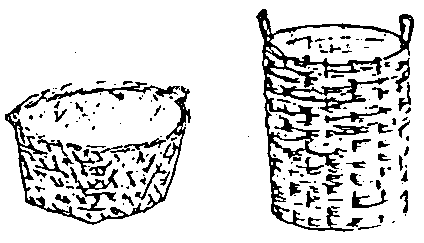
Artisanal fishermen are beginning to use plastic fish boxes in most developing countries. The most popular method is to sew the stem of palm leaf through the eyes of fishes of the same size and carry them with fingers.
Fishing net often becomes a make-shift bag; cane or plant fibre woven baskets are also used.
Fish as we know is a highly perishable material and requires better handling to avoid rapid deterioration. Bruising and squashing of the flesh, rough treatment, trampling under foot, physical impact due to throwing or dropping will cause quicker spoilage. Poor handling and lack of suitable containers may cause appreciable amount of loss through spoilage.
Advantages of using fish boxes
1. Ease the handling of small and large quantities of fish.
2. Simplify and increase the speed of unloading/loading and transportation of raw material.
3. Protect the fish against physical damage, contamination and other deteriorating factors.
4. Offer a suitable unit for fish and ice.
5. Contain the fish under such conditions that it reaches the buyer in the best possible condition.
6. Help to protect the raw material against natural deteriorating effects.
7. Help to make maximum utilization of resources and to achieve optimum economical results through the whole system of handling from harvest to consumption.
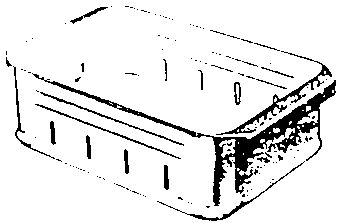
Plastic fish boxes are better than those made of wood or plant fibre. Plastic is non-corrosible, insulating, smooth in surface, strong and is non-toxic.
Plant fibre baskets are strong and non-corrosible. However, they are not hardy. Fish in these baskets could easily be contaminated. Fish cannot be kept in ice. Plant fibre, if wet, is a good medium for bacterial growth.
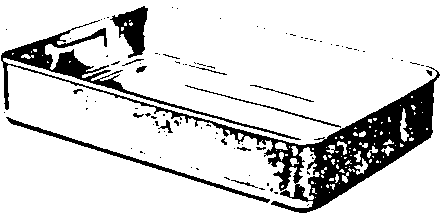
Wooden boxes are non-corrosive, except the fixing nails. They are hardy and strong. Wet wood provides a suitable medium for growth of bacteria and moulds. The surfaces are not as clean as that of plastic.
Comparing the three types of fish boxes
|
|
PLANT FIBRE |
WOOD |
PLASTIC |
|
Corrosion |
Nil |
the nails |
No |
|
Strength |
good |
better |
best |
|
Capacity |
all sizes but no uniformity |
all sizes |
all sizes |
|
Storage |
not stackable |
stackable |
stackable |
|
Insulation effecting |
nil |
yes |
yes |
|
Resistance to chemicals and toxicity |
slight |
slight |
yes |
|
Surface |
rough/uneven |
rough |
smooth |
|
External contaminants |
yes |
slight |
nil |
|
Reparability |
easy |
easy |
impossible |
|
Colours |
no |
wooden |
wide range |
|
Weight of box |
variable with water |
variable |
not variable |
While comparing the above three as well as looking for suitable alternatives it is necessary to look into the general requirements of fish containers.
Requirements of the material for fish boxes
1. Material of the container should be cleanable.
2. Physical strength should protect fish against pressure and shocks.
3. Must not contain harmful or health damaging substances that can be transferred to people with fish. Must not produce smell taste or colour which can contaminate the fish. ..
Fish boxes should have good drainage to allow melt-water which contains bacteria from the fish to drain away.
The ability of the box to rest is when not in use assists in storing or transporting empty boxes within reduced storage volumes. Fish box washing is an important aspect and the boxes should be suitable for quick washing.
Dimensions and capacities for wooden and plastic boxes.
|
External Dimensions (cm) |
Capacity at fish/ice ratio 1:1 |
|
80 x 45 x 15 |
12 |
|
60 x 35 x 21 |
16 |
|
80 x 45 x 35 |
25 |
|
90 x 50 x 35 |
40 |
PLANT FIBRE CONTAINERS FOR FISH
Fish spoilage is reduced at cooler temperatures. Ice is a cooling medium in tropical countries. A mixture of ice and fish has a longer shelf life than fish stored in normal atmospheric temperatures.
A
B
C
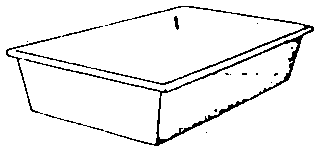
D
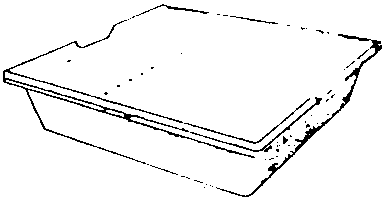
E
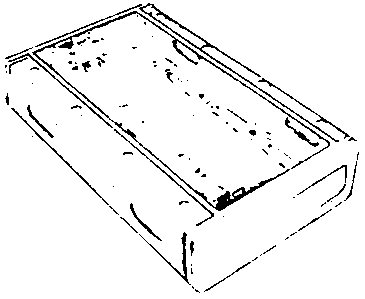
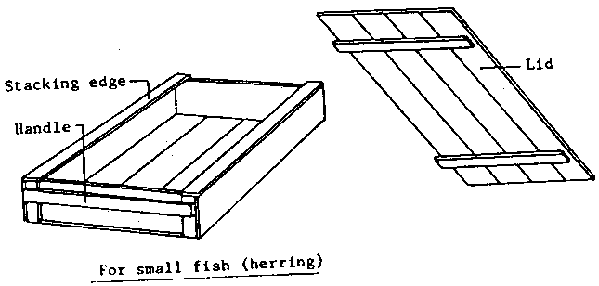
Ice is harmless, portable and cheap. It has a very large cooling capacity. Ice comes into intimate contact with fish and cools it.
Ice could be made from fresh water or sea water. Ice is made traditionally in blocks of 10 kg or 25 kg. Flake ice plants are becoming popular in recent times.
Whether block ice or flake ice is advantageous depends on the situation. Bulk transport of flake ice requires containers. Whereas a cycle can transport about 50 kg of ice for long distances without containers.
Storing block ice at fishing villages with sawdust, is easier than storing flake ice.
Flake ice performs better than ice crushed from a block In transferring heat from the fish. Smaller and smoother are the flakes that they do not damage the fish physically.
The rate of melting in flake ice is faster than that in block ice or crushed ice.
To cool fish as quickly as possible to 0 C and maintain fish quality, ice and fish are mixed. The ratio of the mixture depends mostly on the atmospheric temperature. If the atmospheric temperature is 30° C, 0.34 kg of ice is required to cool 1 kg of fish down to 0° C.
The amount of ice required to maintain fish at 0° C after cooling depends on:
1. Insulative properties of the container.
2. Atmospheric temperature.
3. Position of the fish box inside the storage area.
At atmospheric temperatures of 25°C to 30°C the fish ice ratio is 1:1. Replenishment of melted ice should take place every 12-15 hours, if kept in plastic or wooden boxes at atmospheric temperatures.
Fish in ice can be stored in chill stores that maintain a temperature of +1° C to -1° C. At this temperature range, most fishes can be kept without significant deteriorative changes for 15-25 days.
Guidelines for chilling fish with ice
a) Always chill fish within the first 2 hours of catch. The earlier the fish are chilled, the better will be the quality.
b) Arrange fish in layers of ice in between layers of fish. The top and bottom layers shall be ice.
c) Use a ratio of 1 kg of fish to 1 kg of ice (for conditions in Zanzibar) for the initial mixture, and replenish the mixture once every 12-15 hours with 10-15 kg of ice for every 50 kg of fish.
d) Insulating effect of the container reduces the amount of ice required for keeping the fish cool.
e) Do not re-use ice left over from one batch of fish.
f) If ice has been stored under gunny bags or sawdust, the block surface should be cleaned before crushing.
g) To store for longer periods in ice, the fish/ice mixture should be kept in insulated containers or insulated chambers.
Sea-water ice
Sea-water ice must be manufactured by a quick process. Otherwise ice will be formed from fresh water first and the concentrated salt solution is frozen last.
Fish stored in sea-water ice may become partially frozen; some fish may become salty.
DETERIORATION OF LEAN FISH
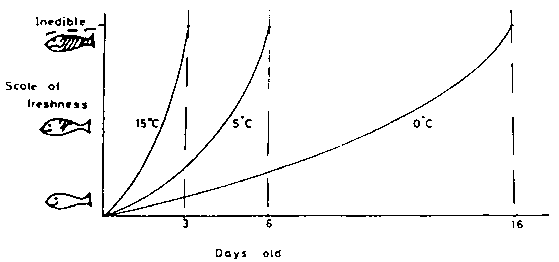
Chilling means bringing down the temperature to 0° C. Fish does not freeze at 0° C. The presence of salt, blood and other substances in the mixture of fish and ice, depress the temperature a little below the natural melting point of fresh water/ice at 0° C.
At 2° C the fish begins to freeze slowly. Slow freezing of fish in undesirable because large ice crystals form which can damage the structure of the muscle. The slower the ice freezes, the longer are the ice crystals and the greater the damage.
Cooling of fish in chilled sea water is more efficient than cooling in ice, provided the chilled water is kept circulated or stirred and replenished periodically with ice, if not mechanically cooled.
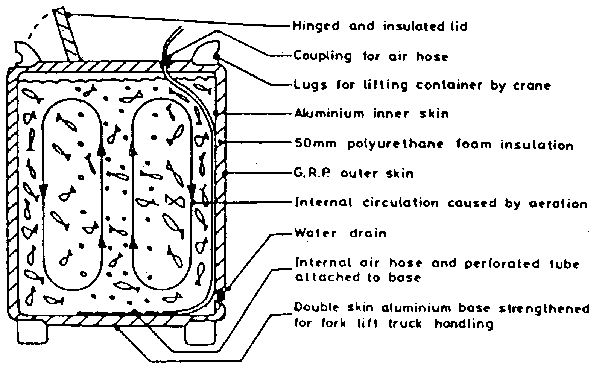
Chilled sea water is made by cooling sea water with ice to 0° C and maintaining this temperature. Ordinary fish boxes' walls are inadequately insulated for chilled sea water storage. Boxes with insulated walls and lids are necessary.
Chilled sea water could be used from the time of capture until the fish reaches the market or the processing site as the case may be. Gutted fish keeps better in chilled sea water than ungutted fish.
Insulated boxes with drain holes are used to keep fish in ice. Insulated boxes without drain holes and with narrower mouths are used for chilled sea water storage.
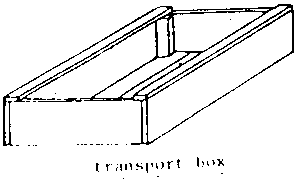
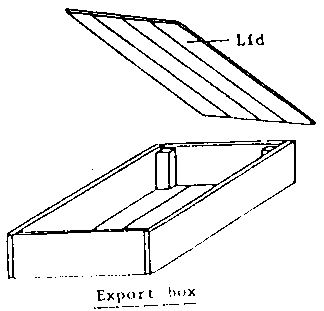
A jacket cover for an ordinary box with lid. and with insulating material in between the two covers makes an insulated box. The insulating material is usually expanded polystyrene (styrophor) for industrially manufactured boxes.
However, materials like coconut fibre, sawdust could be used depending on the requirements and situations. The box, as well as the material shall be made waterproof in a pre-requisite.
Fresh Fish Export
Chilled storage is used in handling fresh fish for export. If fresh fish is to be exported, firstly the supply position should be reasonably steady.
The market should be an urban centre accessible by road, sea or air within 24-36 hours (point to point). Consumers in the market should be in a position to pay for the fish, airfreight charges and other related costs.
Insulated boxes are used to keep the fish/ice mixture during transportation. Safety, economy and quality are the important factors in determining the mode of transport.
Fish importers will not accept to import low quality fish. If by airfreight, carriers will refuse to accept fish in leaking containers. Suppliers, buyers as well as consumers will prefer to have lightweight containers to save airfreight costs.
Scandinavian countries use The Airenbox, a solid fibre-board insulated box with very high water resistance surfaces.
BERENT IVERSON
Plastic Box Manufacturers
OSLO
Norway
could be contacted regarding the supply of these boxes.
Expanded polystyrene boxes are cheaper, lightweight with good insulation qualities and safe if lid is taped securely. However, they tend to break on rough treatment and are difficult to clean for re-use.
Chilled sea water container
In most artisanal fisheries, fishermen land their fish on beaches. The boat comes to knee deep water. The fishermen get into the water. collect their catch, walk up to the beach, display them on the ground, sell the catch to middlemen mostly by auction and go home with a portion of the catch and the money.
The deck of the boat where the fish is kept is unclean; while wading through water which is often polluted, the fish is contaminated. It is not uncommon to meet feacal contaminants on tropical beaches near human habitations and the fish displayed at the beach often picks up feacal contaminants; if it is not in the early mornings on in the later evenings, the fish are exposed to the direct heat of the sun, from the time it is caught to the time of the sale.
Each fisherman has his own landing point, and the middlemen could often be seen running from one to the other over a distance of a kilometre sometimes. Multiplicity of landing points is a major handicap to any programmed development of the small scale fishery.
Construction of a pier and centralising the landing point is one of the methods of overcoming this constraint. Pier construction can be simple, if wooden logs and planks are available. Protutions with cement blocks interfere with water/tidal currents and sometimes results in accumulation of sand in the wrong location. But construction with wooden logs or concrete poles on a small scale does not cause problems.
Knowledge of the tidal levels at various seasons of the year is necessary for the design and the construction of a small pier.
Advantages of a pier
1. Centralise the landing of fish for a village
2. Wading through water is avoided.
3. Fish, ice, provisions, netting etc. could be carried to/from the boat on a wheelbarrow.
4. By keeping the pier clean and the surroundings hygienic, much of the contamination familiar to beach landings can be eliminated.
5. A location near the pier becomes a fish receiving station or a fish auction area, facilitating fishermen to bring their catch to one location for better competitive auctioning.
6. Fishermen will have access to fuel, netting and other facilities from a centralized point.
7. Fisheries extension officers, fish inspection services, fisheries statistical collectors, fisheries cooperative officials, fishermen's welfare organizations will have access to fishermen to introduce better techniques in handling, to enforce regulations, to implement planned programmes for fisheries development.
8. Exchange of information on fishing grounds and schools located is facilitated emergency assistance to fishermen in distress could be better organized from centralized landing points.
FISH RECEIVING STATION
Whether landing is centralised or scattered, an auction shed is part of fish landing areas. Uncared for, open and habitated by cats, dogs and birds during many hours of the day, this shed becomes a live during fish landing hours, with fish, fishermen, middlemen and buyers. Of course this activity does not inhibit its off-time dwelling, the cats, dogs, etc., from mingling with fish and humans, competing amongst themselves and with persons to flick away fish and scavange upon throw-offs and trash.
Uneven floor, broken cement platforms, battered fish-cutting boards, heaped up fish scales, cut off fins, flies, cockroaches, pungent odour, black sleak formed by the mixture of oil and sand, pools of water, blood and slime in pits are typical scenes in auction sheds in most developing countries.
Fish handled in such situations are heavily contaminated. People passing through these auction sheds carry with them infectious material.
Improve the fish reception area;
1. The area of a fish receiving centre, should be proportional to the quantum of fish expected to land at the centre daily, to avoid congestion.
2. Calibrated weighing scales are necessary in fish receiving centres. They could be either simple beam balances or heavy duty platform balances depending on the size and magnitude of the quantum of fish passing through.
3. Containers in fish receiving centres facilitate better handling of fish.
4. If necessary wheelbarrows are also used.
5. Uppermost in maintenance should be the hygienic condition of the area:
- the floor should be hard and sloping down to allow water to drain quickly drain;- proper disposal of the drain water is essential
- keep flies, cockroaches and vermins away
- fish cutting area should be separated from the auction area
- disposal of offals should be effective
- sign boards displaying information on cleanliness like DO NOT SPIT ON THE FLOOR, DO NOT THROW GARBAGE, are necessary
- arrangement to have the place cleaned at the end of each auction necessary
- spraying insecticides and disinfectants should be done if possible.
6. Availability of ice and presence of a chilled room are optional, but wherever possible, should be provided.
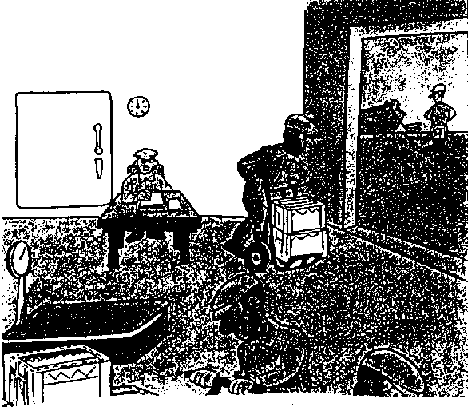
Techniques are continuously being improved. Unless otherwise improved techniques reach the fishermen, fisheries development will be impossible.
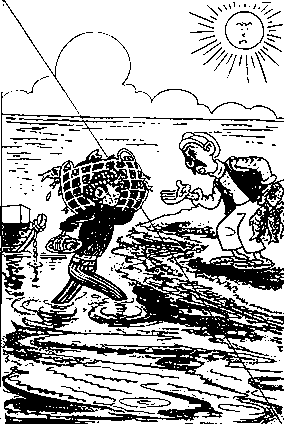
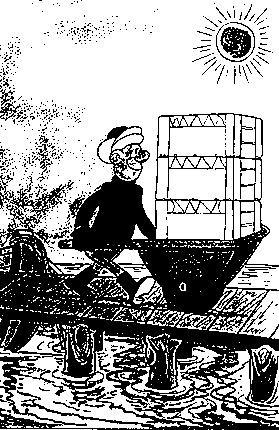
Carrying improved technology to fishermen, trying out these technologies in their situations, introducing the useful ones and integrating them into their usual activity is a continuous programme for fisheries extension officers.
Conveying information is the primary task of the extension officer:
- talking to small groups
- informal discussions while at work
- preplanned well prepared formal meetings
- brain-storming sessions
- publicity material distribution
- radio talks/TV programme/Feature articles in newspapers
- demonstration of techniques
- hiring or loaning of equipment
- continued advice and assistance even after introduction of new technique.
- working through model fishermen
- setting up examples and model situations.
These are the many pathways extension workers adopt to carry the message.
Identification of problem areas requiring technical inputs is the primary effort.
Assigning priorities, the extension officer collects relevant information.
In fish handling the most familiar problems are:
- rapid deterioration
- physical damage due to pressure
- contamination
- improper containers
- absence of pier, and
- unhygienic conditions at various stages of handling.
These problems require solutions for which the extension officers themselves should be adequately informed. Frequent consultations amongst them. exchange of information and group sessions are some of the many ways of enhancing and updating the information that the extension officers have.
MATERIAL FOR PUBLICITY
The impact of written word on human response is stronger and long-standing than of the spoken word. Talks and demonstrations, if supplemented by notes, drawings, sketches and diagrams, provide two-dimensional presentation and facility for subsequent reference.
In preparing publicity material, the most important factor is the understanding level of the persons to whom the material is intended for.
In most situations, sketches and cartoons are better communicative than extended prose. If a particular technique could be explained by drawing, indicating the step by step method of doing it, the message is carried more effectively than through written descriptions. Coloured sketches and line drawings are preferable to shaded drawings.
If necessary, written descriptions should be provided. The presentation should be simple with sentences constructed with 3-4 words. Few sentences should make a paragraph. Sketches in between text provide better understanding. The size of the letter should be large as most of the fishermen do not wear reading glasses. Most important is that the text should be in the language that the fishermen or their children usually speak, read and write.
Differences between the extant methodology and the improved methodology should be highlighted to show the immediate, long-term individual social, and national benefits.
Specific instructions saying DO NOT DO THIS and/or DO THIS, should be provided only after a prolonged effort to make the receivers understand the essence of the technique.
Publications can be folders, hand-outs, notices, posters, booklets, handbooks, manuals, codes of practice, etc. The paper used should be reasonably thick. The margins along the four sides of the page should be larger than usual. The cover of a book should be in paperback. Binding should be firm. Uniformity in sizes of a series of publications facilitate better storage for reference by the fishermen.
Production of the publications should be followed by their efficient distribution. Amongst the intended fishermen's community, the recipients should include, in addition to individual fisherman; their social, educational, cultural, professional, financial and other related institutions.
Shell fish has a hard cover encasing the soft flesh. Cephalopods like cuttle fish, octopus and squid are without an external casing; they are also called shell fish.
Shell fish like crabs, lobsters and shrimps periodically cast off their hard cover and replace them with larger hard covers to allow room for growth.
Shell fish like oysters and clams increase the size of their external shell in proportion to their body size until reaching their adult size.
CRABS
Crabs are usually attracted by baits into traps. The traps are designed to allow the entry of crabs and to prevent their escape.
Crabs should be kept alive until the time of processing but should be killed prior to boiling. Live crabs shed their claws if boiled without killing.
Crabs can be killed by spiking the nerve centre or the brain.
Guidelines for handling alive
1. Live crabs should be handled as little as possible after capture.
2. Do not remove crabs from traps by their claws, for they will be shed.
3. Do not expose crabs to direct heat from the sun. They swoon and die in a short time.
4. Place them immediately after capture inside boxes or containers.
5. If packing for transport, they should be packed back uppermost in ventilated boxes, fairly close to each other to prevent damage. Wet straw or shavings at the bottom of the box can help to prolong the life of crabs.
Killing a crab
Spiking through a nerve centre is done by inserting a pointed rod just above the mouth parts; the crab is killed almost immediately. Meat is about 30% of the total body weight of the crab. Proximate composition of fresh raw white crab meat has been estimated at 71-74% water, 19-24% protein, 0-6% fat and 1-2% minerals Principal minerals present in the raw meat include phosphorous, magnesium and calcium.
LOBSTERS
Lobsters are caught (a) by hand, scaring with an octopus bait (b) by spearing and (c) by traps.
Those caught by hand and with traps are taken alive.
Lobsters caught by spearing should be kept in clean boxes or containers. If the market demand is for lobster tails only, the anterior portion may be removed immediately after capture. Care should be taken to break at the end of the cephalo-thorax and not to allow too much of flesh to become part of the offal.
Dead lobsters or lobster tails are kept under shade in clean containers and taken to the sale point or the processing point as quickly as possible. Deterioration of the flesh of lobster is very much faster than that of fish.
Live lobsters are left in traps under water until transport arrives to collect them. Collected lobsters are kept in lobster pounds until they are transported to the market or to the processing site.
To handle live lobsters by their claws results in the shedding of the claws. Live lobsters are usually held between two fingers from the dorsal side at the cephalo-thorax region.
Lobsters may be kept alive during shipment if they are kept moist and cool. It is important that ice and water do not come in direct contact with the lobsters; otherwise they may die.
SHRIMPS
Shrimps are usually caught by either cast nets or trawls. Shrimp trawls pick up considerable quantities of trash including fish, sponges, crabs, and materials like stone and shells. Cast net caught shrimp are not usually mixed with trash.
To separate the trash from the shrimp is the first step in good handling. The separated shrimp should immediately put into containers, mixed with ice in the ratio of 1:1; ice should be replenished to keep the shrimp cool.
Black spot is a condition affecting the shell of the shrimp which is caused by an oxidation-reduction enzyme system, and is aggravated by exposition of shrimp to air. Dip in dilute solutions of sodium biosulphate inhibits the formation of black spot.
If the market demand is for beheaded shrimp, it is better to behead the shrimp immediately after catch, carefully putting the gut along with the head facilitates better keeping time.
Always keep offals and trash away from good shrimp to reduce rapid deterioration changes.
OYSTERS, CLAMS
Oysters are collected when the tide is low. They also form part of trawl catches. Keep oysters alive. If they are kept in chlorinated water for 2-3 hours, any undesirable bacteria from the inside could be eliminated.
Usual hygienic practices are necessary to prevent oysters from being the source of health hazards.
MAKING THE BEAM BALANCE
Materials
- a wooden stick or metal beam approximately 1 metre long,
- a large hook,
- one heavy object weighing approx. 700 grammes for use as a counterpoise.
The exact weight of the counterpoise (C) need not be known, but the SAME one should be used at all times otherwise the scale will change.
The beam is horizontal when the product of the weight of the counterpoise (C) and its distance from the pivot (c in figure 9) equals the product of the weight of the produce (A) and its distance from the pivot (a) A x a = C x c.
The scale is linear, but as the beam itself has some weight, the whole scale is shifted in the direction of the pivot, and this requires calibration from known weights.
Construction
a. The hook is placed at one end of the beam.
b. As pivot, a loop of twine or wire is placed a few inches from the hook. Attaching some rope or chain to the loop enables the whole balance to be hung from a convenient object such as a tree.
c. The scale to be used for the weighing of the produce must be calibrated and notches cut out of the wooden stick at intervals of 1 kg, the smallest weight which is required for statistical purposes.
Calibration of the Scale
a. An object (A) of known weight (e.g. A = 1 kg) corresponding to the lower limit of the scale is hung by the hook.
b. The weight of (A) is counterbalanced by the weight of the object chosen as the counterpoise (C). The point at which the objects balance each other must be marked.
c. Operations 'a' and 'b' are repeated with a heavier weight (e.g. 10 kg) corresponding to the upper limit of the scale.
d. The scale is then sub-divided into equally spaced segments, (e.g. at 1 kg intervals).
It should be possible to make a scale which is exact to 250 grammes, even with a balance capable of weighing of 10 kilos. When one has acquired some skill in the use of a properly constructed beam balance. the expected margin of error is about 1%.
Figure 1
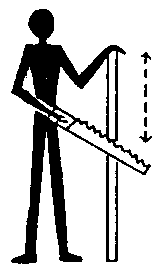
Figure 2
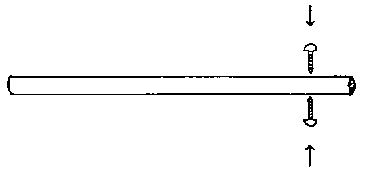
Figure 3
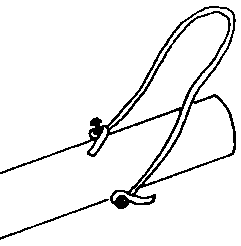
Figure 4
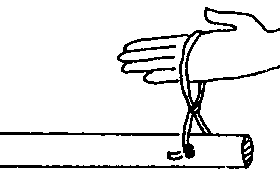
Figure 5
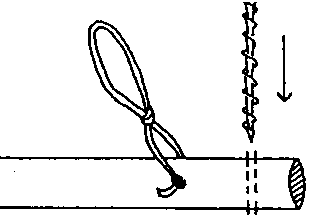
Figure 6
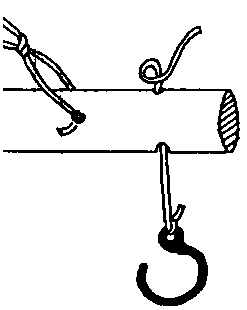
Figure 7
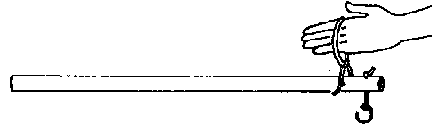
Figure 8

Figure 9
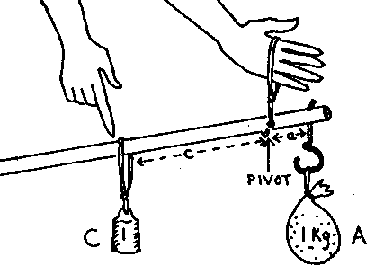
Figure 10
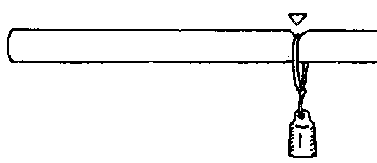
Figure 11

Figure 12
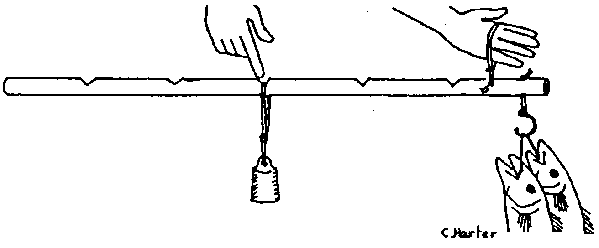
By making an extra pivot which is a bit further from the hook one can make a second, more precise scale, but in this case the balance will not be able to take as much load.
CONVERSION TABLES
|
To convert from |
to |
Multiply by |
|
Atmospheres |
Inches of Mercury (at 62° F) |
29.92 |
|
Atmospheres |
p.s.i. |
14.7 |
|
B.Th.U. |
Foot pounds |
777.8 |
|
Cubic centimetres |
Cubic inches |
0.061 |
|
Cubic feet |
Cubic metres |
0.0283 |
|
Cubic feet minute |
Cubic metres hour |
1.7 |
|
Cubic inches |
Cubic centimetres |
16.39 |
|
Cubic inches |
Gallons |
0.0036 |
|
Cubic inches |
Litres |
0.0164 |
|
Cubic metres |
Cubic feet |
35.31 |
|
Square metres |
Square feet |
10.76 |
|
Square metres |
Square yard |
1.196 |
|
Square feet |
Square metres |
0.093 |
|
Square yards |
Square metres |
0.836 |
|
Feet |
Metres |
0.305 |
|
Feet of water |
p.s.i. |
0.433 |
|
Feet per minute |
Metres per second |
0.00508 |
|
Feet per second |
Knots |
0.592 |
|
Feet per second |
Miles per hour, |
0.682 |
|
Foot pounds |
Kilogrammetres |
0.1383 |
|
Gallons |
Cubic inches |
277.27 |
|
Gallons |
Litres |
4.543 |
|
Gallons per mile |
Litres per kilometre |
2.82 |
|
Gallons |
U.S. gallons |
1.2 |
|
Horsepower |
Metric Horsepower |
1.014 |
|
Inches |
Metres |
0.0254 |
|
Inches |
Millimetres |
25.4 |
|
Inches of Mercury |
p.s.i. |
0.4913 |
|
Kilograms |
Pounds |
2.205 |
|
Kg./Sq.cm. |
p.s.i. |
14.22 |
|
Kg./sq/metre |
Pounds/square foot |
0.205 |
|
Kilogrammetres |
Foot pounds |
7.23 |
|
Kilometres |
Miles |
0.621 |
|
Kilowatts |
Metric horsepower |
1.359 |
|
Kilowatts |
Horsepower |
1.3406 |
|
Kilowatts |
B.Th.U./Min. |
56 9 |
|
Kilowatts |
C.H.U./min. |
31.6 |
|
Knots |
Feet per second |
1.689 |
|
Knots |
Miles per hour |
1.152 |
|
Litres |
Cubic inches |
61.0 |
|
Litres |
Gallons |
0.220 |
|
Litres |
Pints |
1.761 |
|
Metres |
Feet |
3.28 |
|
Metres |
Inches |
39.37 |
|
Metres |
Yards |
1.094 |
|
Metres per second |
Feet per minute |
196.8 |
|
Metres per second |
Miles per hour |
2.24 |
|
Metric horsepower |
Horsepower |
0.986 |
|
Metric horsepower |
Kilowatts |
0.735 |
|
Miles |
Kilometres |
1.609 |
|
Millimetres |
Inches |
0.039 |
|
Miles per hour |
feet per second |
1.467 |
|
Miles per hour |
Knots |
0.868 |
|
Miles per hour |
Metres per second |
0.447 |
|
Pints |
Litres |
0.5689 |
|
Pints |
Cubic inches |
34.66 |
|
Pounds |
Kilograms |
0.4536 |
|
Pounds/square foot |
Kg./sq.metres |
4.88 |
|
p.s.i. |
Atmospheres |
0.0680 |
|
p.s.i. |
Feet of water |
2.31 |
|
p.s.i. |
Kg./sq.cm. |
0.0703 |
|
Short tons (U.S.A.) |
Tons |
0.893 |
|
Square inches |
Square millimetres |
645.16 |
|
Square feet |
Square metres |
0.0929 |
|
Square metres |
Square feet |
10.76 |
|
Tons |
Kilograms |
1016.0 |
|
Tons |
Short tons (U.S.A.) |
1.12 |
|
Watts |
Foot pounds/minute |
44.2 |
|
Yards |
Metres |
0.914 |
ABSTRACT
1. INTRODUCTION
2. ADMINISTRATION AND CONDUCT OF THE WORKSHOP
3. STAFF AND PARTICIPANTS
4. PROGRAMME OF THE WORKSHOP
5. CONCLUSION
6. EVALUATION
Appendix I - ADDRESSES OF STAFF AND PARTICIPANTS
Appendix II - TIMETABLE
Appendix III PARTICIPANTS WORKSHOP EVALUATION
Appendix IV - OPENING ADDRESS TO WELCOME THE DIRECTOR OF FISHERIES TO OPEN THE WORKSHOP AT KUNDUCHI FISHERIES INSTITUTE
Appendix V - A SPEECH GIVEN BY ND. B.K. LIBABA, DIRECTOR OF FISHERIES AT THE OPENING SESSION OF THE NATIONAL WORKSHOP ON THE PROCESSING OF BECHE-DE-MER KUNDUCHI, 29 JULY 1985.
Appendix VI - ADDRESS TO WELCOME THE DIRECTOR GENERAL OF TAFIRI, TO CLOSE THE WORKSHOP AT KUNDUCHI FISHERIES INSTITUTE
Appendix VII - A SPEECH BY PROFESSOR P.O.J. BWATHONDI, DIRECTOR GENERAL, TAFIRI AT THE CLOSING SESSION OF THE NATIONAL WORKSHOP ON THE PROCESSING OF BECHE-DE-MER, KUNDUCHI 2ND AUGUST, 1985
COMMERCIALLY IMPORTANT HOLOTHURIANS
EXTERNAL AND INTERNAL FEATURES OF HOLOTHURIANS
METHODS OF CATCHING & HANDLING ON BOARD
CLEANING AND HANDLING
STEP BY STEP PROCEDURE FOR SAND FISH
STEP BY STEP PROCEDURE FOR TEAT FISH
GRADING, PACKAGING AND STORAGE
MARKET TRENDS - MARKETING
COMMERCIALLY VALUABLE SPECIES OF BECHE-DE-MER IN THE TROPICAL PACIFIC
UNITED REPUBLIC OF TANZANIA
MINISTRY OF TOURISM MARINE AND FORESTRY
REGIONAL PROJECT FOR THE DEVELOPMENT AND MANAGEMENT OF FISHERIES IN THE SOUTH WEST INDIAN OCEAN
JULY 29TH TO AUGUST 2ND 1985
REPORT OF TANZANIA/SWIOP NATIONAL WORKSHOP ON BECHE-DE-MER PROCESSING
Held at Kunduchi Fisheries Institute - Dar-es-Salaam, Tanzania
July 29-02 August 1985
The Tanzania/SWIOP National Workshop on beche-de-mer processing drew 13 participants from the three main islands of Tanzania in the Indian Ocean: Zanzibar, Pemba, and Mafia, as well as from regions along the coast: Mtwara, Lindi, Dar-es-Salaam and Tanga. The workshop programme covered the biology of commercially important beche-de-mer species, features of beche-de-mer fishing, handling, processing, and marketing, as well as the Tanzania Export Regulations. This report covers activities carried out, documents prepared and distributed and evaluation of the workshop.
This document reports on the SWIO Project/Tanzania National Workshop on beche-de-mer processing held from 29th July - 2nd August 1985 at Kunduchi Fisheries Institute, Dar-es-Salaam. The workshop was organized and conducted by the Fisheries Division in the Ministry of Lands, Natural Resources and Tourism, assisted by the FAO/UNDP South West Indian Ocean Project.
2.1. Administrative and Financial Responsibility
2.2. Conduct of the workshop
The administrative and financial responsibility for the workshop were shared between SWIOP and Fisheries Division in the Ministry of Lands, Natural Resources and Tourism.
SWIOP was responsible for providing expatriate expertise, relevant FAO publications, boiling pans for demonstration of processing and funds for the procurement of workshop materials. The Fisheries Division was responsible for appointing a Director/Coordinator of the workshop, covering the salaries, board and transportation of participants, provision of facilities at Kunduchi Fisheries Institute, arranging transport facilities for the participants to go on board fishing craft to harvest beche-de-mer, for the issue of certificates to the participants upon completion of the course and for the closing reception.
The workshop was opened officially by the Director of Fisheries Ndugu G.K. Libaba on 29th July at 14.00 hrs. His speech is attached to this report as Appendix 5. He was welcomed by the Director of Workshop Ndugu J. Makene (Appendix 4) Mr. Sachithananthan spoke on behalf of SWIOP to describe the purpose of the workshop.
Participants were accommodated at Kunduchi Fisheries Institute, Lecturers were accommodated at Kunduchi Beach Hotel nearby. Lectures, project work, practicals and discussions were carried out at the Kunduchi Fisheries Institute. Most of the beche-de-mer for practicals were obtained from Msasani, Dar-es-Saalam and from Mbegani, Bagamoyo.
The closing ceremony was held at the Institute. The guest of honour was Prof. Bwathondi the Director General of Tanzania Fisheries Research Institute. He addressed the participants (Appendix 7) and issued certificates.
FAO Processing/Distribution Expert - Mr. K. Sachithananthan;
Fisheries Consultant - Mr. M. L. Mlay;
Director/Coordinator Mr. J. Makene;
Two liaison officers - Miss. A. Omari and R. Makenya and
Personal secretary - Miss M.E, Mugusi.
13 participants took part in the workshop:-
|
NAME |
AGE |
DESIGNATION |
|
1. K.M. Mvugaro |
38 |
Assistant Fisheries Officer III |
|
2. Y.I. Mgawe |
25 |
Fish Technologist IV |
|
3. S.S. Ngaweje |
29 |
Assistant Fisheries Officer IV |
|
4. R.S. Tamim |
35 |
Assistant Fisheries Officer III |
|
5. B.G. Meela |
27 |
Assistant Fisheries Officer IV |
|
6. S.A. Muhamed |
35 |
Assistant Fisheries Officer IV |
|
7. Kh. A. Twala |
29 |
Assistant Fisheries Officer |
|
8. M.L. Gn'owo |
27 |
Fish Technologist IV |
|
9. P.B. Bahindah |
30 |
Fish Technologist IV |
|
10. I.M.A. Matemba |
29 |
Publicity and Information Officer |
|
11. Said Hafidh |
23 |
Fisheries Officer |
|
12. Salim Said Nassor |
37 |
Fisheries Officer |
|
13. Felix L. Chusi |
37 |
Assistant Fisheries Officer III |
The workshop covered:-
Commercially important beche-de-mer species;
External and internal features of beche-de-mer; Methods of fishing and handling
on board;
Processing methods, including boiling, cleaning, drying and grading;
Packing and storage;
Marketing and market trends;
Export procedures in Tanzania;
Workshop report and evaluation.
Details of the programme are given in Appendix 2.
Lectures followed the schedule presented in a background paper compiled for the workshop by Mr. Sachithananthan of SWIOP. Miss A. Omari compiled information on Export Procedure in Tanzania, presented to participants as a lecture.
The workshop provided training in beche-de-mer handling, processing and marketing with reference to artisanal processing for export.
To encourage the continuation of the training, Attai Chatti pans were provided to Pemba, Zanzibar, Mbegani FDC, Mtwara and Kunduchi Fisheries Institute.
A questionnaire was distributed to participants for evaluation of the workshop. The combined answers are shown in Appendix 3. Eased on the discussion and the participants workshop evaluation, the following suggestions and recommendations can be put forward:
(a) The activities of the workshop were very stimulating, lectures and practicals were very effective. The instruction level and balance between practicals and lectures were just right.
(b) Many participants felt that the duration of the workshop was too short. The duration of the sessions were short and participants felt that there was little free time. Some suggested two weeks would have been adequate.
(c) Most of the participants agreed that the workshop was quite educative and relevant. The knowledge gained would be valuable in their work. The problem remaining was that it was not possible to construct or obtain locally the "Attai Chatti" pans or pans of similar shape.
(d) Some of the participants strongly recommended the conduct of similar workshops for the benefit of fishermen, exporters, cooperatives and processors. It was suggested that Mbegani Development Centre could assist on the technical and manpower aspects.
|
1. Mr. K. Sachithananthan |
SWIOP |
|
2. Mr. M.L.Mlay |
c/o FAO Office |
|
3. Mr. J. Makene |
Mbegani Fisheries Dev. Centre |
|
4. Miss A. Omari |
Fisheries Headquarters |
|
5. Mr. Raphael J.d. Makenya |
Kunduchi Fisheries Institute |
|
6. Miss M.E. Mugusi |
Fisheries Headquarters |
|
7. S.S. Ngaweje |
P.O. Box 653 |
|
8. F.L. Chusi |
P.O. Box; 277 |
|
9. Michael L. Ng'owo |
Lands, Natural Resources & Tourism |
|
10. Baison G. Meela |
Kunduchi Fisheries Institute |
|
11. Mgawe Yahya Ibrahim |
Mbegani Fisheries Dev. Centre |
|
12. Said Abdullah Muhamed |
Ofisi ya Mkuu wa Mkoa |
|
13. K.M. Mvugaro |
Maliasili |
|
14. S.S, Nassor |
Zanzibar Fisheries Dev. Corporation |
|
15. R.S. Tamin |
MALIASILI |
|
16. Khamisi Ali Twala |
Wizara ya Bahari Utalii na Miitu |
|
17. P.B. Bahindah |
Bagamoyo Fishing Company |
|
18. I.M. A. Matemba |
Fisheries Division |
|
19. Said Hafidhi Thabit |
Wizara ya Bahari Utalii na Misitu |
29th July, 1985 - MONDAY
|
1400 - 1500 |
Opening, registration of participants Introduction |
|
1500 - 1600 |
Lecture 1: Commercially important holothurians by K. Sachithananthan |
30th July, 1985 - TUESDAY
|
0800 - 0900 |
Lecture 2: Commercially important holothurians by K. Sachithananthan |
|
0900 - 1000 |
Practical 1: Preparation of processing site |
|
1000 - 1030 |
Tea Break |
|
1030 - 1230 |
Continue with Practical 1 |
|
1230 - 1400 |
Lunch |
|
1400 onwards |
Practical 2: Fishing for holothurians |
31st July, 1985 - WEDNESDAY
|
0800 - 1000 |
Practical 3: Preparation/initial processing and cleaning |
|
1000 - 1020 |
Tea Break |
|
1030 - 1230 |
Practical 4: Boiling |
|
1230 - 1400 |
Lunch |
|
1400 - 1500 |
Lecture 3: External and internal features of holothurians - by M. Mlay |
|
1500 - 1600 |
Lecture 4: Method of catching and handling of holothurians on board - by J. Makene |
1st August, 1985 - THURSDAY
|
0800 - 0900 |
Lecture 5: Preparation and initial processing by K. Sachithananthan |
|
0900 - 1000 |
Lecture 6: Boiling and cleaning |
|
1000 - 1030 |
Tea Break |
|
1030 - 1130 |
Lecture 7: Drying and cleaning - by J. Makene |
|
1130 - 1230 |
Lecture 8: Grading/packing and storage -by M. Mlay |
|
1230 - 1400 |
Lunch |
|
1400 onwards |
Practical 5: Drying/grading |
2nd August, 1985 - FRIDAY
|
0800 - 0900 |
Lecture 8; Market trends and marketing -by K. Sachithananthan |
|
0900 - 1000 |
Export procedure in Tanzania - by A. Omari 1000 - 1030 Tea Break |
|
1030 - 1230 |
Preparation of report by participants 1230 - 1400 Lunch |
|
1400 - 1530 |
Presentation of work report and workshop evaluation |
|
1530 - closing of workshop and issue of certificates. |
|
END OF WORKSHOP PROGRAMME
2nd August, 1985
|
TIME |
ACTIVITY |
|
1530 - 1600 |
Guests taken around to see the display |
|
1600 - 1610 |
Workshop Director welcomes guests |
|
1610 - 630 |
Issue of certificates and address by Guest of Honour |
|
1630 - 1730 |
Reception |
Please tick one answer for each question
1. Were you aware of the objectives of this Workshop?
|
|
Answer |
|
Full |
6 |
|
Partially |
3 |
|
Has not at all |
0 |
2. How do you feel about the programme?
|
|
Answer |
|
Very satisfied |
1 |
|
Satisfied |
5 |
|
Fairly satisfied |
4 |
|
Not satisfied |
0 |
3. How were the training facilities?
|
|
Answer |
|
Excellent |
1 |
|
Good |
8 |
|
Fair |
0 |
|
Poor |
1 |
4. How do you feel the activities of the Workshop were?
|
|
Answer |
|
Interesting |
8 |
|
Stimulating |
1 |
|
Informative |
1 |
|
None of the above |
0 |
5. How would you rate the teaching methods used in this
|
|
Very effective |
Effective |
Not effective |
|
Lectures |
3 |
6 |
0 |
|
Practical |
3 |
5 |
1 |
|
Field trips |
0 |
1 |
5 |
6. How do you rate the amount of time made available for this Workshop?
|
|
Answer |
|
Far too much |
0 |
|
Too much |
0 |
|
Just right |
2 |
|
Too little |
4 |
|
Far too little |
3 |
7. How do you rate the instructional level of the sessions for this workshop?
|
|
Answer |
|
Far too high |
1 |
|
Too high |
0 |
|
Just right |
8 |
|
Too low |
1 |
|
Far too low |
0 |
8. How do you rate the balance between lectures and discussion/practicals?
|
|
Answer |
|
Far too many lectures |
0 |
|
Too many lectures |
2 |
|
Just right |
8 |
|
Too many discussions/Practicals |
0 |
|
Far too many discussions/practicals |
0 |
9. How do you rate the value of the group work and discussions for depending your understanding of this Workshop?
|
|
Answer |
|
Essential |
5 |
|
Very useful |
4 |
|
In between |
1 |
|
Not very useful |
0 |
|
Useless |
0 |
10. How do you rate the importance of this Workshop for your own work?
|
|
Answer |
|
Very high |
5 |
|
High |
3 |
|
In between |
1 |
|
Low |
0 |
|
Very low |
0 |
11. How do you rate the relevance of the background material distributed to all participants (reports, lecture notes, books, etc)?
|
|
Answer |
|
Highly relevant |
2 |
|
Quite relevant |
4 |
|
About right |
3 |
|
Not very relevant |
0 |
|
Irrelevant |
0 |
12. How were the contacts with the staff members?
|
|
Answer |
|
Very good |
5 |
|
Good |
3 |
|
Passable |
1 |
|
Poor |
0 |
|
Very poor |
0 |
13. How much opportunity were you given for private study?
|
|
Answer |
|
A great deal |
0 |
|
Enough |
6 |
|
Some |
0 |
|
Little |
3 |
|
Far too little |
0 |
14. Describe the duration of the sessions?
|
|
Answer |
|
Far too long |
0 |
|
Too long |
1 |
|
Just right |
4 |
|
Too short |
4 |
|
Far too short |
0 |
15. Describe the size of the group?
|
|
Answer |
|
Far too large |
1 |
|
Too large |
0 |
|
Just right |
6 |
|
Too small |
0 |
|
Far too small |
2 |
16. How much free time was available?
|
|
Answer |
|
Far too much |
0 |
|
Too much |
0 |
|
Just right |
4 |
|
Too little |
5 |
|
Far too little |
0 |
17. The theoretical level was?
|
|
Answer |
|
Far too high |
0 |
|
Too high |
0 |
|
Just right |
8 |
|
Too low |
1 |
|
Far too low |
1 |
18. The practical level was?
|
|
Answer |
|
Far too complicated |
0 |
|
Too complicated |
0 |
|
Just right |
8 |
|
Too simple |
2 |
|
Far too simple |
0 |
19. The amount of theoretical lectures was:
|
|
Answer |
|
Far too much |
0 |
|
Too much |
0 |
|
Just right |
9 |
|
Too little |
1 |
|
Far too little |
0 |
20. The amount of practical work was:
|
|
Answer |
|
Far too much |
0 |
|
Too much |
0 |
|
Just right |
3 |
|
Too little |
7 |
|
Far too little |
0 |
21. The programming of the activity was:
|
|
Answer |
|
Far too rigid |
0 |
|
Too rigid |
2 |
|
Just right |
7 |
|
Too lax |
0 |
|
Far too lax. |
0 |
The Director of Fisheries Mr. G.K, Libaba, the FAO/SWIO Representative Mr. Sachithananthan, the Principal of Kunduchi Fisheries Institute Mr. Haule, workshop participants, ladies and gentlemen.
First I would like to thank the Director of Fisheries, Mr. Libaba for accepting to come here in order to officially open this SWIO/Tanzania National Workshop on beche-de-mer processing. I understand Mr. Director, that you have to attend to many other matters, but due to your awareness of the importance of beche-de-mer to the national economy, you chose to cone and officially open this workshop. We thank you very much.
I would also like to thank Mr. Sachithananthan for his effort to get the workshop planned and started in the right way. At this juncture I would also like to thank Mr. Mlay for his participation in planning this workshop.
Me also are in debt to the Principal and his staff, for all the arrangements they have made to facilitate our workshop. We thank you very much.
Mr. Principal allow me to welcome the workshop participants to Kunduchi Fisheries Institute. You are most welcome and I wish you a happy and profitable stay.
Mr. Director, the workshop consists of 13 participants from Zanzibar, Lindi, Mtwara, Tanga, TAFICO, BAFICO, Mbegani and Kunduchi.
All the participants are key people in the field of processing in their respective areas.
Mr. Director the workshop will be for five days, the main objective is to train the participants on beche-de-mer collection, handling, processing and marketing with emphasis to foreign markets. Participants will have both practical and theoretical training. The knowledge obtained will be transferred to local fishermen, processors, fishermen's cooperatives and products export companies either directly on extension work or through training institutions.
Mr. Director, my work was to welcome you to officially open our workshop. I call upon you to address and open the workshop, welcome Mr. Director.
The Workshop Director - Nd. Makene, the Principal of Kunduchi Marine Fisheries Training Institute - Nd. Haule, the FAO Processing Expert - Mr. Sachithananthan, workshop participants, Ladies and Gentlemen,
It gives me great pleasure to be with you today for the opening session of the first SWIO/National Workshop on the processing of beche-de-mer. I think it would be appropriate for me to welcome all of you to Kunduchi. I hope the Principal managed to give you the keys to this Institute, if he did not, then I would urge him to do so immediately after the opening session.
Maybe it will appear rather surprising why we seem to take a particular interest in this little known animal. After all, nobody in Tanzania eats it. So why the farce of wishing to process it and for whom.
Beche-de-mer or sometimes called the sea slug has got a commercial name which is namako trepang. It is held in great esteem by the Chinese. It is not surprising therefore that almost all beche-de-mer caught in Tanzania are for export.
Fishermen use sail-powered outrigger canoes to reach the collecting areas. Some fishermen even dive for them. When they are brought onshore they are cooked and dried. But the quality of our product docs not compete well with those sold from other countries. We therefore thought it would be useful if we got an expert who could help us in demonstrating to use the best ways of processing the sea slug so as to improve the quality.
The South West Indian Ocean Programme based in Seychelles, honoured our request by bringing Mr. Sachithananthan a competent expert in the field of beche-de-mer processing. He will be assisted by Nd. Mlay and Makene our fish processing experts. I hope you will all work tirelessly together in order to absorb as much of the technology that will be provided.
It is not my duty to go into the technology of processing but what I will urge you now is that you should not let this opportunity to slip away without ensuring that whatever problems you may encounter in the course of the workshop you should all endeavour to solve them together. You should be ready to ask questions if you happen not to understand certain aspects of the lectures. What is even more important is that you should be smart in using your hands so that by the time you close the workshop you should be knowledgeable in the processing of beche-de-mer.
We are all anxious to receive proceedings of your workshop and I would like to wish you well during your stay at Kunduchi.
The Director General of TAFIRI - Prof. P. Bwathondi, the Director of Fisheries -Mr. G.K. Libaba, FAO Representative - Mr. C.R. MacCulloch, the Principal of Kunduchi Fisheries Institute - Mr. Haule, Lecturers and Participants, Ladies and Gentlemen.
It gives me pleasure to welcome you all to the closing session of the SWIO/Tanzania National Workshop on beche-de-mer processing. First, I would like to thank Prof. Bwathondi for accepting our invitation for closing the workshop. Me highly appreciate your acceptance and we thank you very much.
May I take this opportunity to thank my colleagues, the FAO Experts - Mr. K. Sachithananthan and Mr. M. Mlay for their tremendous amount of work they put in organising and conducting the workshop.
I also thank the Principal of Kunduchi Fisheries Institute and his staff for their assistance and cooperation which resulted in making your workshop a success. The secretarial staff did a wonderful job to type all the reports and lecture notes and changed the participants' money in the bank in Dar-es-Salaam.
Mr. Director-General, Ladies and Gentlemen, we started our workshop on the 29th July, 1985. The objective of the workshop has been to train participants on Behce-de-mer collection, handling, processing and marketing.
To facilitate the objectives we have covered:
- commercially important Beche-de-mer species
- external and internal features
- methods of fishing and handling on board
- processing which included boiling, cleaning, drying and grading
- packing and storage
- marketing and markets
- Tanzania Export of beche-de-mer
- Tanzania Export Regulations.
Based on the final evaluation, the workshop has been very successful. The goals set have been achieved. The knowledge obtained will be transferred to local fishermen, processors, Fisherman Cooperatives and beche-de-mer exporting companies and individuals.
Mr. Director-General, the country has benefited a lot from the workshop by acquiring the required knowledge, skills and the equipment which was imported for the workshop as a donation from FAO/UNDP SWIO Project. The attai chatti will be shared to enable the participants to disseminate the skills and knowledge so gained to these who need it most. Kunduchi will retain one. The rest will go to Mbegani Fisheries Development Centre, Zanzibar, Pemba and Mtwara,
Mr. Director-General, the duration of the workshop was rather short but the participants have been kept quite busy and I am glad to report that they have utilised the time available fully. During the workshop, the participants have displayed a high degree of discipline and sense of maturity. On behalf of the management group of the workshop, I can say they made our task very easy. They are going back to their stations quite well armed to provide better extension services to the people than before.
Mr. Director-General, I would like now to inform you that we are pleased to have the FAO Representative here with us and he has kindly agreed to address the workshop. I therefore, leave the floor to the FAO Representative, Mr. Fontana.
Ladies and Gentlemen, allow me to request the guest of honour to issue certificates to the participants and then to address the workshop.
Honourable Chairman, invited guests and workshop participants, I feel greatly honoured to be given this opportunity to come here at Kunduchi Fisheries Training Institute to close this workshop. This workshop, which has been going on for about five days has drawn participants from different disciplines and sections throughout the country.
The main purpose of the workshop is to train and acquaint participants with the best methods of processing beche-de-mer (or holothurains or sea cucumbers) ready for export markets abroad. It is my sincere hope that the knowledge you have acquired during these five days will be passed on to those who did not have the opportunity to attend this workshop especially to the common fishermen.
It is only by doing this that we can proudly say that the workshop was a success.
The Tanzanian marine waters are fairly rich in these sluggish marine animals, the sea cucumbers. There are several species of these organisms in the area but the most popular for export trade are Matriatyla scabra or sand fish and Actinopyga. Of the two genera, Matriatyla scabra is the most popular.
Records from the Tanzanian major exporter, TAFICO show that almost all beche-de-mer collected are exported mainly to Hong Kong, China, Singapore and other Far East countries. Information from INFOFISH Trade News of may 15th, 1985 gives the price of sand fishes in Singapore markets as 17 pieces per kg at US $15.75; 29-30 pieces per kg at US $ 13.95 and 55-56 pieces per kg at US$ 11.25. The new prices show that the market prices of sand fishes have been rising over the past years. For example, 1974 the price of 17 pieces per kg was US$ 2.95.
In order that we may increase our foreign earnings, we must improve the quality of our products. This emphasizes the importance of this workshop. Our traditional fishermen (artisanal fishermen) have been working on the processing of beche-de-mer for many years. Despite their long experience in processing beche-de-mer, they still lack the equipment hence their products do not meet the required quality or standards.
It is your duty therefore, to disseminate this knowledge to fishermen. When this is achieved, I am sure, our products will compete favourably in the world markets.
May I take this opportunity to thank the organizers of this workshop for the initiative they took to make this workshop a success. And to the participants, I would like to congratulate you for the good work you did during these five days. After saying all this I now declare that this workshop is officially closed.
Fisheries Division
MINISTRY OF LANDS, NATURAL RESOURCES AND TOURISM
TANZANIA
|
1. Place |
Kunduchi Fisheries Training Institute, Kunduchi |
|
|
2. Date |
July 29th to August 2nd 1985. |
|
|
3. Number of Participants |
|
|
|
4.. Language: |
Swahili/English |
English/Swahili |
5. Tentative work programme:
a) Commercially important species of holothurians
b) External and internal features
c) Methods of catching/handling on board
d) Preparation and initial processes
e) Boiling/cleaning
f) Drying/cleaning
g) Grading/packaging/storage
h) Market trends/marketing
6. FAO Project will provide:
- a lecturer
- relevant FAO publications
- boiling pans for demonstration of processing
7. Fisheries Division will:
- cover the salaries, board and transportation of participants from Tanzania
- nominate an officer from the Ministry to act as Coordinator of the Workshop
- arrange facilities at Kunduchi (classroom, diver fisherman boat, firewood, etc)
- arrange transport facilities to the participants to go on board fishing for beche de mer
- arrange to issue certificates to the participants upon completion of the course.
8. Workshop staff:
a) Coordinator
b) Lecturer: Mr K. Sachithananthan, Processing/Distribution Expert
Fisheries Division
MINISTRY OF LANDS, NATURAL RESOURCES AND TOURISM
NATIONAL WORKSHOP ON BECHE DE MER PROCESSING
TIME TABLE
29th July 1985 Monday
|
0800 - 0900: |
Opening, Registration of participants, Introduction |
|
0900 - 1000: |
Lecture 1: Commercially important holothurians - 1 |
|
1015 - 1130: |
Lecture 2: Commercially important holothurians - 2 |
|
1300 onwards: |
Practical - Preparation of processing site. |
30th July 1985 Tuesday
|
0600 - 1300: |
Fishing for holothurians |
|
1500 onwards: |
Practical preparation/initial process |
31st July 1985 Wednesday
|
0730 - 1100: |
Practical cleaning/boiling |
|
1300 - 1400: |
Lecture 3: External, Internal Features |
|
1415 - 1530: |
Lecture 4: Processing - 1 |
1st August 1985 Thursday
|
0800 - 0900: |
Lecture 5: Processing - 2 |
|
0915 - 1030: |
Lecture 6: Processing - 3 |
|
1100 - 1200: |
Lecture 7: Grading/packing/storage |
|
1400 - onwards: |
Practical. Drying/grading |
2nd August 1985 Friday
|
0800 - 0900: |
Lecture 8: Market trends/marketing |
|
0915 - 1200: |
Preparation of report by participants |
|
1400 - - |
Presentation of work report/workshop evaluation |
|
1530 - - |
Closure |
Many of us go to the sea, walking in shallow water, diving, swimming and on boats. We look underneath. We are surprised to see a large variety of living things, fish, the most obvious, corals, seaweeds, starfish, sea urchins, sea lillies, sea slugs or holothurians, crabs, bivalves and numerous other creatures. We do not normally assign much importance to the sea slug; in fact most people are averse to touching or feeling it.
However, sea slug is an important marine resource of commercial value. Sea slug is a delicacy of people of Chiese origin. It is also consumed by other South East asians such as the Japanese, Koreans and Vietnamese. To all these people sea slug is an expensive delicacy. Its association with their culture is so dominant in some communities, that brides are given few bags of dried sea slug as dowry on their wedding day. In some parts of the Pacific, it is not unusual for pregnant women to walk in shallow seas to pick up a certain variety of sea slug, clean them in sea water and eat it raw.
In the South East Asian countries most grocery shops stock dried sea slug. In Japan, fresh sea slug is highly priced. Sometimes Japanese import them fresh by airfreight from the Tropical islands in the Pacific. Hongkong and Singapore are the major trading centers. Since people of Chinese origin are spread all over South East Asia, Pacific and the American continent, they import large quantities of dried sea slug from countries in the Indo-Pacific region. The Peoples Republic of China does not at present import dried sea slug since it is able to supply its own needs.
Most states of the Indian and Pacific Oceans produce dried sea slugs. Indonesia, India, Sri Lanka, Papua New Guinea, Philippines, Fiji, Australia, Vanuvatu, Maldives, Yemen, Sudan, Somalia, Kenya, Tanzania, Mozambique, Madagascar and Seychelles, export dried sea slug in significant quantities.
Usually the sea slug is referred to "as sea cucumber or beche de mer. It has many names in the different Chinese dialects but is commonly known as trepang. The swahili name for the sea slug is.........
They form an important part of the bottom fauna within the reefs. The shallow water situations which provide shelter for these sluggish creatures, although some species occur at depths.
The larger types move about slowly on the sandy and grassy bottoms away from the coast towards the reef. Some types bury themselves in sandy mud, others crowd into crevices of the coral colonies or hide beneath rocks. They are mostly sediment feeders.
Not all holothurians are edible. Even of the edible ones, consumers have preferences, such that, there are only about 10 species which could be termed commercially important. Most of them have thick body wall, and grow up to adults length of 50-70 cm. They are picked up at depths of 1 m to 10 m. Few of them live in deeper waters. For the same species the deeper you go the larger is its size.
The commercially valuable species of beche de mer are:
|
1. Microthele nobilis |
(teat fish, mamy fish) |
|
2. Actinopyga sp. |
(black fish) |
|
3. Actionpyga echinites |
(deep water red fish) |
|
4. Actinopyga mauriliana |
(surf red fish) |
|
5. Actionpyga lecanora |
(stone fish) |
|
6. Thelenota ananas |
(Prickly red fish) |
|
7. Metriatyla scabra |
(sand fish) |
|
8. Microthele axiologa |
(elephant trunk fish) |
The species belonging to the genera Actinopyga and Microthele are mostly found in sandy bottoms with coralline growth near and upon the reef where the water is clear and salinity variation is minimal. Such habitats are found near coraline islands. Thelenota ananas also habitates in similar places but in deeper waters. These species are rarely found near river mouths or mangrove lagoons with muddy bottoms.
Typical habitat of sand fish Metriatyla scabra will be in mud bottom near mangrove vegetation, where eel grass grows. Sand fish is also found in sandy bottoms in deeper waters outside the reef.
It is common to observe the black sea-cucumber Holothuria atra (lolly fish) in most shallow waters of the Indo Pacific region. This should not be confused with the black fish Actinopyga sp. The common one H. atra will always have sand particles over the body with 'black spots' exposed. Also when H. atra is picked up by hand, a pink coloured fluidy substance oozes out from the skin and colour your fingers. This substance is supposed to be toxic and is certainly poisonous to small fish, that fishermen use them occasionally to maim fish in the reef area.:
Another genus that is commonly seen-is Stichopus. The bluish green coloured Stichopus chloronotus is soft and when picked up, breaks up into pieces. The other species of Stichopus behave similarly either initially or during later stages of handling. These varieties are not used for commercial purposes.
Holothurians are cylindrical, elongated and worm like in shape; some flatten out along the sides, some have wider middle sections tapering towards the ends, some have a flat underside and some are square in cross section.
They are variously coloured from pitch black to light yellow or white; most of them have more than one colour; colour composition is always set to blend with the habitat. Underneath in the ventral side the colour is light, sometimes milky white. Sizes can be variable, with very long or very short holothurians, however, the commercial varieties grow to adult lengths of 50 cm to 80 cm.
The body wall of many holothurians is smooth; some of them have protrusions or tubercles (Thelenota ananas) all over the dorsal and latteral sides, or at restricted areas as teats in Microthele nobilis.
Because of the contractile nature of the animal, both longitudinal and circularly, the body wall in a few holothnurians has many circular wrinkles.
The anterior end is where the mouth is. A circle of tentacles surround the mouth. These tentacles are protactile; when feeding they spread out and appear like a flower.
The posterior end is where the cloaca is. It is wide open in situ with water stream moving in and out from the respiratory tree inside. For the genera Actinopyga, five calcareous teeth are present in the circular brim of the cloaca.. These are called cuvierian tubules.
Tube feet, or water filled finger like proctusions are characteristic of all animals belonging to Phylum Echinodermata, that includes class Holothuria. The ventral side is filled with tube feet in almost all holothurians. However, on the dorsal and lateral sides they may be in longitudenal rows or spread all over the body.
Spicules are present all over the body and are characteristic of certain species. When passing the finger over the body wall, one can easily feel the roughness due to the spicules.
The thickness of the body wall varies with different species, but most species of commercial value have a reasonably thick body wall.
Circular and longitudenal muscles line the interior of the bodywall. Five sets of longitudenal muscles runs anterior-posteriorly. The number and density of the circular muscles vary.
Connecting the mouth to the anus, the gut is a coiled tube, containing mostly debris laden sand particles. The excreta of the sea cucumber are easily distinguishable in the sea bottom, by the presence of coiled tubular sand particles.
From the cloaca, extending into the body, a tree-like branched out tubular structure which pumps water for respiration in and out of the tree through the cloaca. This is called the respiratory tree. It is either black or dark brown in colour.
Sticky white threads or ribbon like structures called cuvierian tubules are also found inside the body near the claocal region. They are defensive in function, being are thrown out when the animal is disturbed. Not all sea cucumbers possess these tubules, even of those in possession not all will throw them out when disturbed.
There are other organs inside the body cavity for excretion and reproduction. Reproductive organs are prominent and visible only during the breeding season.
In the sand fish, Metriatyla scabra the most common species exploited in the Indian Ocean area, the respiratory tree habours a species of crab as a commensal.
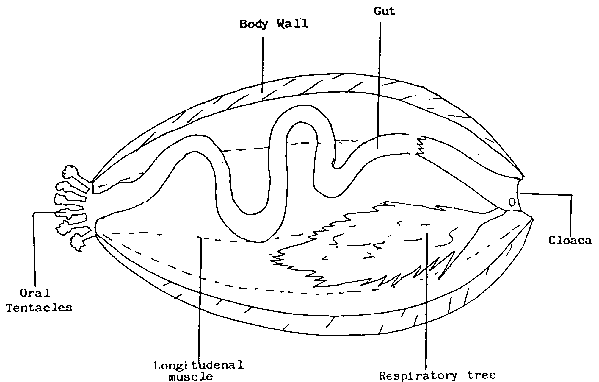
Sea cucumbers are easily picked up by hand in knee deep waters. They are harmless and do not resist being caught. In depths of 2 to 3 meters fishermen from their boats, use a fork ended rod called MANDA to pick these animals.
Fishermen dive to collect sea cucumbers from waters deeper than 4 m. Skin diving is the most common. Divers have a bag tied to their waist into which collected sea slugs are deposited until they return to the boat with a catch of 20- 30 animals.
Those familiar with the locations where larger sizes are abundant frequent these locations for fishing. Most fishermen use dug out canoes or small size boats or cattamaran, some of them are powered by out board motor. If the reefs are located far away from the shore 8-10 m. size boats fitted with inboard engines are used.
After being picked up from the sea bed the animals are brought to the boat. Few hours of collection leaves the boat bottom full of sea cucumbers mixed up with their eviscerated guts, respiratory trees, sticky threads and water thrown out of the respiratory trees. If exposed to the sun, the top surfaces of the top layer of animals dry up; sometimes the animals stick to each other with dried up slime. The surfaces of the boat make an imprint on the animals; if nets are on the boat bottom the animals get entangled..
Improved methodology:
Handling the catch on board is an important aspect in,
1. improving the market value of the product;
2. reducing the losses during processing; and in
3. observing better practice of cleanliness and hygiene on board.
As soon as the animal is brought to the boat, a slit of 2 - 3 cm is made near the cloaca. Pressing the body wall near the mouth with the thumb, the gut and entrails are quickly eviscerated. A wise fishermen will always hold the animal out of the boat so that the eviscerated material falls into the sea. After squeezing the water out again into the sea, the sea cucumber is placed inside a plastic fish box having a smooth interior surface and drain holes one cm. diameter or less. If the holes are larger, those animals adjacent to the holes shape into it and the holes are blocked.
So the box should be clean prior to placing the animals as dirt or sand particles become embedded into the body wall.
If corals, or algal pieces are found attached to the body wall they are removed and the animal is cleaned in sea water before placing inside the box.
Sand fish can be placed on top of each other. They flatten out remaining alive. In the case of teat fish, a single layer is preferable. If stacked, the outer skin of the body wall tends to break and after processing these appear as tear-marks down grading the appearance. Usually, teat fish collection is slow, and the few that can be collected in a days' fishing trip does not necessitate stocking. Prickly fish requires care as the tubercles can be damaged if handled improperly.
An extra person on board could do the job of slitting open and forcing evisceration. If the boat had a boat operator, he could do it. If not, fishermen at the end of fishing during their return journey could be occupied in slitting and forced evisceration.
Keeping the catch in boxes facilitate easier handling during transfer from the boat to the shore.. Animals are simply carried in boxes.
Use of palm-leaf woven baskets should be avoided in carrying holothurians from the boat to the shore. As said earlier, the animals shape into the openings between the strips of leaves and are cut or torn during removal from the basket.
Please note that the animals are still alive; if returned into the sea, their chances of survival are high. They have regenerating capabilities; the lost parts including the gut-entrials, broken cut or torn body wall, etc. grow again to achieve full capabilities.
If the animals have to remain over night, or to be kept for extended periods, it would be advisable to keep them in sea water, probably inside a drain hole-less fish box. The sea water inside the box should be changed at least every 12 hours if the water to animal ratio by volume is 2:1.
The animals become weak if kept under such conditions for long periods. This affects the end-product quality. If kept in pens near shore in sea water, the animals burrow out of the pens. Temperature rises beyond tolerable limits in concrete pens for the animals to survive beyond 2-3 days. The initial reaction is the formation of lesions in the outer skin of the body wall, followed by breakages in the body wall and its softening.
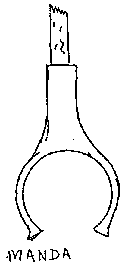
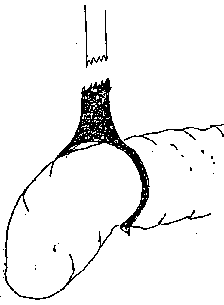
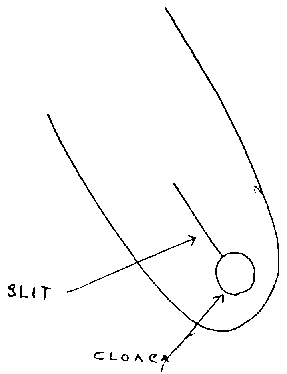
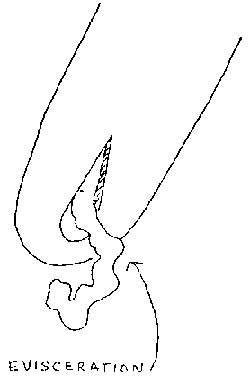
Cleaning sea cucumbers before boiling is essential. Cleaning in clean sea water, removes the outer slime, other extraneous particles and left over gut and entrails. Cleaning also includes squeezing out from the animal any water that may have been consumed during storage in the fish box.
If the animals are kept in sea water in the boiling pan and heated to boil the disadvantages are as follows.
1. The animal consumes water. It has the capacity to close its mouth and cloaca while being heated and effectivly seal them. Heating boils the water outside and inside the animal. Pressure builds up inside and the body wall breaks unless removed from the boiling pan before that time.
2. After placing inside the pan and until the time of its death the sea cucumber could form any shape. A cylindrical shape is the acceptable shape in the market.
3. Heating slowly could irritate the animal to form lesions in the outer body wall followed by breakages.
4. During the heating process animals touching the bottom of the pan where heat is intense, could easily be damaged.
5. It will be labour intensive to keep churning the animals inside the pan while heating.
Introducing the animals in boiling water has the following advantages.
1. The animal is killed within few seconds of introduction.
2. The first reaction of the animal to an adverse situation like intense heat is to contract itself, both with its longitudinal and circular muscles. This facilitates the formation of a cylindrical shape, a shape that is most preferred on the market.
3. If squeezed properly before introduction into boiling water, the animal has no chance of water intake and the consequential pressure build up to break the body wall.
4. Labour to churn the pan with contents is required for the short period of boiling only to ensure equidistribution of heat to the animals.
The shape of the pan used for boiling determines the end-product quality. A vessel that can quickly transfer the heat from the bottom of the pan to the top is advantageous. A vessel that can receive the heat from the heat source along its entire bottom surface is more advantageous than one which can receive heat only from a part of the bottom. To slide the stirrer pole at an angle to lift the animals from the bottom of the pan during the churning process is better than having to work near the pan and have the pole operating at its vertical position.
The pan should be made of a metal which can retain the heat gained and transfer it to the water inside. Unless the fire place is constantly fed with wood fuel as is usual in artisanal fisheries, boiling may not be uniformly good. Slackness is not uncommon. A heat retaining metal can 'look after' such slackness in the fire place.
Steam jacketed pans and semi pressurised vessels have been tried out experimentally to boil beche de mer. They are efficient in laboratory situations but are incompatible with situations artisanal fishermen meet in their villages, where facilities like running water, electrical points and replacement gas cylinders will not soon become available.
It is usual for artisanal fishemen to cut a 200 l (45 gallon) drum into two and use the bottom half as the boiling pan. This may be the best in the given the circumstances, but is not the most suitable.
A saucer shaped pan made of cast iron is the most suitable pan for the artisanel fishermen to use with their traditional fire place using wood, especially semi dried mangrove wood.
This pan could easily be cast in any foundary. However, pans could be imparted from the nearest industrial centre of most countries in the SWIO region if necessary. Specifications of the pan are: Diameter of the top rim 90 cm. Depth at centre 60 cm. Gradual sloping from the rim to the centre to form a saucer shape with rim flattened out. Material used - cast iron.
The fire place is simple in construction using locally available material. The most important point to be considered is the concentration of heat for the intense heating of the pan.
On a beach or in a windy place, an open fire place tends to impart relatively low heat to the pan. This require the use of more fire wood and extended period of heating not to mention fire hazards.
Traditionally, people know the most suitable clayey soil in their area that can withstand the intense heat of a fire without crumbling. To rest the pan on a circular wall of clay, 90-100 cm high (supported if necessary by vertical iron rods) of the same diameter as that of the outer rim of the pan and to have a fire-mouth facing the windward side facilitates concentration of heat on the pan. Of course, holes are positioned at the sides of the wall for the smoke to escape.
Use coconut husks to start the fire. Coconut shells, semi dried mangrove and some hard wood gives a combination to produce uninterrupted and intense fire/heat. The flames should constantly be touching the lower surface of the pan during boiling. Slackness or relaxation is detrimental to the quality of the product.
Multiple flame gas burners can provide the necessary heat to boil the water. Whether they are obtainable by artisanel fishemen, and whether it will be cost effective are some of the questions to be looked into.
Cleaning the sea cucumber after boiling is necessary as in the case of the sand fish Metriatyla scabra. The ventral side is pigmented and appear milky white in colour. This animal lives mostly in mud bottom. Fine mud gets embedded onto the outer body wall of the dorsal and lateral surfaces.
These should be removed to have an acceptable product for the market. The traditional method involves bacterial decomposition of the outer layer, which is scrubbed off removing the outer mud embedded layer and the pigmented layer.
Bacterial decomposition is activated by inviting the bacteria from the sand. When boiled sea cucumbers are cooled and kept moist inside pits in the beach and covered by sand, bacterial attack on the sea cucumbers begin. Bacteria multiply fast and eventually cover the entire surface of the body; they start penetrating inside the body wall. It is just enough if they could penetrate to 2 mm or so. Therefore, time duration of keeping the sea cucumbers inside pits is an important factor. If kept for a longer time the body wall may become too soft for further processing. If not moist at the time of burying, bacterial action may be slow and decomposition inadequate.
Proper care is necessary in selecting the site for burial. Most beaches near villages are polluted with feacal matter. Also not all beaches are sandy. Tidal waters also move in and out at certain areas. Clean, sandy beaches where with little human activity are the best sites.
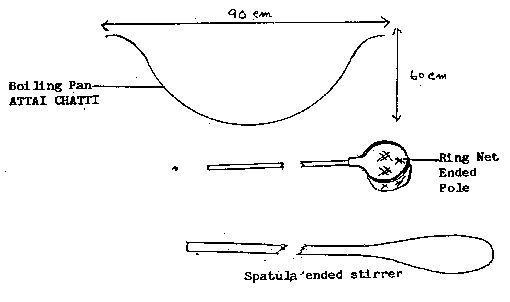
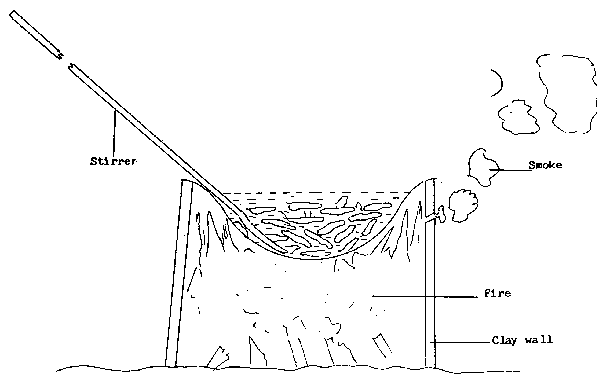
The catch is brought to the shore in fish boxes.
Clean the pan on top of the fire place without removing it. Use coconut husks to scruo adherants. Wash with clean sea water. Bail all water out.
Fill the pan to two thirds height with clean sea water.
Light the fire place using coconut husks; as flames slowly rise, introduce coconut shells. Later arrange pieces of semi-dried mangrove wood one by one into the fire; follow this with two or three pieces of hard wood.
Allow water to boil. It takes a while. Please wait.
Take the sand fish in hand. Squeeze out the water (assuming that evisceration had taken place before placing inside fish boxes). Slide it down the side of the pan; if dropped into the pan carelessly, hot water splashes to hurt.
Repeat this procedure quickly with each sea cucumber. Do not introduce them in bulk. This will bring down the temperature of the water quickly. Introduce them one by one or two by two.
Check the fire. Intense heat is necessary at this stage.
After the height of the water rises to nine tenth of the height of the pan, stop further introduction of animals.
A spatula-ended pole is the stirrer. Slide the spatula along the side of the pan to reach the centre. Lever it on the edge of the pan to lift the bottom layer out slowly. If carelessly levered, hot water splashes to hurt and sea cucumbers spill over to the ground.
Stirring should continue for the next 45 minutes at intervals of three minutes during the first twenty minutes and at five minutes intervals during the later period.
Forty five minutes is long enough for boiling. However, one could check whether boiling is adequate by picking a sea cucumber from the pan and dropping it vertically down; if the piece bounces like a rubber ball, the material is ready for the next stage of processing. If bouncing is nil or poor then continue boiling for a further period of ten minutes before checking again.
A pole with a ring-net end is used for removing sea cucumbers from the boiling pan. Remove the material from the pan and allow them to cool on the sand.
Add some more clean sea water to the pan to make-up for what had been lost and heat again to boil. Introduce the next batch. The same water could be used for 3-4 batches. As it becomes a concentrate of scum, mud and slime during this process, bail this out to fill the pan with clean sea water.
Excavate a shallow pit in a clean sandy beach 100 cm long and 75 cm wide and 20 cm deep as far as possible with an evenly flat floor.
Arrange the cooled sea-cucumber in a single layer; pack them densely. Cover it with a jute-hessain sac. Sprinkle water to wet the sac, close the pit with sand. Mark the area.
After 15 - 18 hours, remove the sand and the sac cover; remove the sea cucumbers into a palm-fibre woven basket.
The sea cucumber should at this stage have a decomposed outer body wall. Pasty material comes to the hand when touched.
Half-full with these sea cucumbers, carry the basket to the sea. Close the mouth of the basket. Put it in knee deep water. Trample over it until all decomposed material is washed away.
Soft mud emedded outer skin has gone! Milky white ventral pigmentation has gone! Pale and ask-grey material, cylindrical in shape, rubber like in texture, wrinkles still visible, slit opening prominent, will be the norm-description of the product at this stage.
Give a final wash at the surface water. Carry it back to the beach. Spread them on the sand.
A descummer as described in Appendix II could be used for removal of the scum and pigments. But artisanal fishermen will not have access to such devices for few years to come.
Select those ones which may still have patches of white pigment or muddy skin. Separate them. They may require another round of boiling, burial and descumming. Those without any patches are ready for boiling and drying.
Introduce these into boiling sea water once again. Stirr well. Cook for another 45 minutes. All remnants of bacteria that devastated the outer layer are killed.
Remove the product from the pan with a ring-net end pole. Transfer them to drying platforms or trays for sun drying.
Normal sunny days are good enough to dry sea cucumbers at this stage. They should be dried on platforms with wire-mesh trays. Never dry them on sand.
Rainy weather is problematic. For any spray of water on the cooked and partialy sterile product introduces microorganisms like bacteria and fungus, which can have devastating effect on the product. Never allow the product in the open even if it drizzles.
Such weather conditions require, smoke driers or solar driers. Smoke driers consist of tray-laden sea cucumbers, aranged in vertical rows, above a heat generator, usually a 200 litre (45 gallons) drum kept horizontally, with wood fueled fire, all housed inside an enclosure. This smoke-drier could be made of wooden beams galvanised sheets, wire mesh and a 200 1 drum, under local conditions.
Solar dome dryers provide another alternative. Materials have to be imported.
Sea cucumbers are dried until they are hard dried that the product appears brittle, allowing only 8-10% water content.
During the drying process, the product shrinks.
Set up water in the pan and the fire place as outlined in the earlier chapter.
Squeeze water out (assuming that gut-entrails have been evicerated prior to storing in fish boxes), and introduce one by one, slowly into the boiling water.
Hot water near boiling point is required to kill teat-fish quickly; so introduce one by one and that too very slowly.
Keep the flames high in the fire place.
Relatively few numbers of teat fish can be handled in one batch, so as to provide individual care during boiling.
Teat fish tends to float, as it seals inside water or air, which builds up pressure with rising temperature. After some time, the body wall breaks if not properly attended.
Bloated teat fish are taken out, punctured at mid dorsal side and placed back for completion of the cooking process.
Stirr frequently using the spatula ended pole. 30-45 minutes of cooking in boiling water is adequate for teat fish. Since it does not become very rubber like, the bouncing test for sand fish does not apply for teat fish.
Remove the teat fish using ring-net end pole.
Cool by placing in raised platform or wooden planks or on top of logs.
Cut open anterior - posteriorly at the mid dorsal line along most of the dorsal side leaving uncut portions near the mouth and near the cloaca. Do not extend the out over the ends.
If there were unremoved visceral portions, wash out using lukewarm water.
Boil the product for another 15-20 minutes. The product shrinks and the body wall becomes hard. Stirr frequently. Inspect frequently during stirring.
Remove after boiling with a ring-net ended pole. Cool. Place wooden splint -stick of 3-5 cm long between the out edges of the dorsal wall to expose the interior.
Dry them in the sun on drying platforms. Never let them dry on the sand.
Rainy weather requires the use of smoke driers or solar driers, as described in the earlier chapter.
Since market value for beche de mer is based in the variety initially, it is necessary to separate the product according to the species.
Within each species group, length is the most predominant factor in grading.
Longer, sturdier and stouter ones fetch higher prices than shorter, weak and flexible ones.
In some production/marketing centres 'pieces per kg is used as a grade-determiner. But this is not preferred because, unknown, ungutted sea cucumber pieces can add weight. Also dryage could influence the piece-weight relationship.
Following grades are in vouge at the Singapore market for sand fish:
|
Grade 1 |
16 pieces per kg |
|
Grade 2 |
20 pieces per kg |
|
Grade 3 |
35 pieces per kg |
|
Grade 4 |
50 pieces per kg |
|
Grade 5 |
80 pieces per kg |
|
Grade 6 |
120 pieces per kg |
|
Grade 7 |
160 pieces per kg |
Following length grades are used by Singapore buyers for Sri Lankan and Indian Exporters:
|
Length in cm |
Grade |
|
12+ |
ONDU-SFO |
|
10 - 12 |
RENDU-FO |
|
8-10 |
MUND-0 |
|
6-8 |
NAALU-1 |
|
0-6 (broken pieces) |
ANCHU-2 (KALAVAN) |
Appearance is another grade determiner. In sand fish patches of white pigmentation on the outer surface lowers the market value. Smooth surface with not so deep wrinkles are of better appearance than rugged surfaces.
If darker coloured products are matched against lighter coloured products, traders pick the former in preference to the latter for the consumer believes that darker ones are the 'true' sea cucumbers.
If a product is hard, inflexible and wholesome, then that product scores in price over less rigid, rubberlike and unwholesome product. Moisture content is a grade determiner. Around 8% to 10% (w/w), of moisture content seems an excellent product.
Externally the product appears dry; the soft internal parts have already absorbed enough moisture to attract microorganisms. Fungal growth is an index of undesirable moisture content. Being a cooked product, an increase in the level of moisture immediately attracts microorganisms. Higher percentage, of relative humidity in the air could alter the moisture level of dried beche de mer. This is why fishermen frequently spread their stored products in the sun and keep the moisture level low enough.
Packaging in box cartons lined by polythene assists in:-
1) extending storage life2) being easily stackable during storage
3) better handling during transport easy
4) being acceptable to shipping lines for taking as hold cargo (rather than deck cargo with Jute hessain see packaging)
5) providing visible and clear specifications of the product on the box.
From India, Sri Lanka, Indonesia and parts of the Pacific, beche de mer is exported, packed in jute-hessein sacs, lined internally with palm leaf woven mats.
That the shipping lines do not prefer this cargo to be kept with other cargo inside is a limiting factor. The internal lining of palm leaf-woven mat protects the product, when carried in open deck and covered by canvas, from sea spray, rain spray etc. But this is not the most desirable packaging.
South Yemen exports beche de mer in cartons lined internally with polythene. Singapore buyers were impressed with this packaging because of their safer transport in the hold of the ship, as well as the easiness with which they stacked the boxes for storage.
If beche de mer could be sealed inside polythene bags after a good day of drying; the chances of moisture reabsorbtion is reduced. To prevent tear of the bag, it could be kept inside an appropriate box carton, storage life of the product could be extended this way.
During the last ten years beche de mer (sand fish) prices have jumped from a megre US$2.95 for 17 pc/kg in 1974, to US$16.00 in 1985 in the Singapore market.
Beche de mer fishermen in India and Sri Lank became rich within a short time. Sri Lanka supplied 97,000 kgs in 1983 to the Singapore market. The price attracted new fishermen to the same resource, resulting in over-exploitation that in 1984 India temporarily banned exports to conserve its resources. Beche de mer fishermen all over the world and the middle men marketing this product, would have had a favourable period during the last few years.
China markets a great deal of beche de mer and supplies its own demands. It does not import.
Hongkong and Singapore are the main trading centres. Singapore buys mostly sand fish from South and South East Asia. Hongkong is supplied with sand fish from South West Indian Ocean and with Teat fish, prickly red fish and black fish from the Tropical Pacific.
Singapore and Hongkong import beche de mer for re-export. Most of the re-export from Singapore goes to Malaysia. That from Hongkong goes to Thailand, USA and other areas.
Requirement for the Singapore market is around 500 to 600 tons per year. Of which Indonesia and Sri Lanka supply the largest share. For the Hongkong market, the requirement is even more, to the extent of 600-700 tons per year. East African littoral states supply the Hongkong market with sand fish, and the Tropical Pacific Islands supply the market with Teat Fish, Prickly red fish etc.
Prices vary with seasons. In most countries in the Indo Pacific region, fishing commences in mid-February and goes on till the end of September. Prices are lower during this period. Chinese New Year falls generally around February. Prices are high during January.
Price trends in the Singapore market for beche de mer (source - INFOFISH Trade News). All prices in United States Dollars.
|
Date: |
16.03.85 |
01.04.85 |
15.04.85 |
01.05.85 |
15.05.85 |
|
TEAT FISH |
|||||
|
22 - 24 cm |
4.15 |
4.20 |
4.05 |
4.00 |
4.50 |
|
17 - 19 cm |
3.10 |
3.15 |
3.05 |
3.00 |
3.10 |
|
12 - 14 cm |
2.10 |
2.10 |
2.00 |
2.00 |
2.00 |
|
SAND FISH |
|||||
|
10 cm and above |
- |
9.00 |
9.10 |
10.20 |
10.10 |
|
17 piece/kg |
16.20 |
16.50 |
16.60 |
16.60 |
15.75 |
|
29/30 pieces/kg |
14.05 |
14.30 |
14.35 |
14.35 |
13.95 |
|
55/56 pieces/kg |
10.30 |
10.50 |
10.55 |
10.55 |
11.25 |
The order of preferences by the consumers is as follows: White Teat Fish. Black Teat Fish, Prickly Red Fish, Black Fish, Deep Water Red Fish and Sand Fish. Others follow these varieties.
Efficient marketing of beche de mer is an important step in the development of the beche de mer fishery. Fishermen are always induced by better prices. As we have seen, prices have been rising stedily during the past few years.
Whether this price increase has been passed to the fishermen deserves to be looked into.
Experiences have shown that fishermen gain more by being members of a cooperative that can export their produce direct to Singapore/Hongkong. The cooperative could send samples from its stock to buyers in Singapore and Hongkong (refer to Appendix I for list of traders in beche der mer) request to bid them for their stock, choose the best bidder for the sale, and export their stock.
Members benefit directly from such a deal, that they get all their money except a commission for the cooperative and payment of handling charges.
If members so desire, they could use part of their earnings to insure them, save through a pension fund and provide security through the cooperative during their off season.
Marketing require efficient managerial skills, alertness to market situation, equipment like telex/telephone for communication, with buyers and secretarial facilities. Producer will benefit by promoting his product through his cooperative.
TEATFISH Microthele nobilis
This species, which is also known as the mammy fish, occurs in two colour phases, white and black.
|
Chinese |
|
|
yenshen (Mandarin) |
|
|
Cook Islands Maori |
rori-ü |
|
Fijian (black form) |
loaloa |
|
(white form) |
sucuwalu |
|
Gilbertese (black form) |
terommama |
|
(white form) |
temaimmama |
|
Motu (PNG) (black form) |
tamasi loremana |
|
(while form) |
tamasi kurukuruna |
|
Palauan |
bakelungal |
|
Ponapean |
matchip |
|
Solomon Islands Pidgin |
susufish |
|
Tahitian |
rori iu |
|
Tongan |
huhuwalu |
|
Tokelauan |
ikahiuhiu |
|
Trukese |
machonepech |
Size
Length 30-40 cm
Width 10-15 cm
Body wall thickness 10-12 mm
Live weight 1-3 kg
Shape
A flattened oval in shape. Six to eight teats on each side give this species its English names. Five anal teeth are present.
Colour
The colour of this species is variable, ranging from completely black to white with black flecks. Body usually has a fine coating of sand.
Habitat
The white and black forms of the teatfish occur in different habitats.
(i) The white teatfish is usually found in water deeper than 3 m and is said to occur at depths as great as 30 m. It is most abundant on clean sand in reef passages and near turtlegrass (Syringodium isoetifolium) beds. Young white teatfish live among turtlegrass plants.(ii) The black teatfish is typically found in shallow water of about 3 m on clean sand bottoms where there is living coral and a free movement of water.
Value
This is the most valuable species of bêche-de-mer, fetching a price of Fiji$4-5 per kg with a greater demand for the white variety.1
1. In August 1979. F$1 = US$1.23.
*Reproduced from SPC Handbook No. 18 (1979)
White teatfish (Microthele nobilis) (G Bargibant. ORSTOM)
Black teatfish (Microthele nobilis) (P. Laboute, ORSTOM)

Bêche-de-mer of the genus Actinopyga
This genus includes several large species of bêche-de-mer of considerable commercial value. Because many of the species are very similar in colour and appearance, their precise scientific names can only be determined by a specialist. However, the information given here should be sufficient for the needs of a fisherman.
BLACKFISH Actinopyga sp.
|
Chinese |
|
|
Fijian |
dri, dri-dakai |
|
Motu |
(PNG) dubana karemana |
|
Palauan |
erumrum |
|
Tongan |
mokuhunu |
|
Trukese |
chon |
Size
Length 20-30 cm
Width 8-12 cm
Body wall thickness 8 mm
Live weight 0.5-2 kg
Shape
Cylindrical with five anal teeth and tube feet arranged in three rows on the underside.
Colour
Black, sometimes with a dark brown underside.
Habitat
Found mainly in water less than 2 m deep on reef flats among living coral (often in the same places as the black teatfish), and in turtlegrass beds.
Value
F$2-3 per kg for first grade product.
Blackfish (Actinopyga sp.) (FAO)
DEEP-WATER REDFISH Actinopyga echinites
|
Chinese |
(Characters unknown) |
|
hung hur (Cantonese) |
|
|
Fijian |
dri-tabua |
Size
Length 20-30 cm
Width 8 10 cm
Body wall thickness 7 mm.
Live weight 0.5-1 kg
Shape
The body is wider in the middle, tapers towards the ends and has a slightly wrinkled dorsal surface. Three rows of lube feel on underside and five anal teeth.
Colour
Brick-red above, a lighter orange on the underside. Body generally covered with a fine coating of sand.
Habitat
Between 3 m and 30 m deep on sand bottoms among living corals (frequently found together with the while teatfish).
Value
F$2-3 per kg for first grade product.
Deep-water redfish (Actinopyga echinites) (P. Laboute, ORSTOM)
PRICKLY REDFISH Thelenota ananas
|
Chinese |
|
|
Fijian |
sucudrau |
|
Gilbertese |
teuningauninga |
|
Motu (PNG) |
ratarata |
|
Palauan |
temtamch |
|
Tahitian |
rori euta |
|
Trukese |
lachcha |
Size
Length 40-70 cm
Width 10-15 cm
Body wall thickness 15-20 mm
Live weight 3-6 kg
Shape
Very distinctive appearance because of numerous large pointed teats in groups of two or three all over the body surface. There are numerous large tube feet on the flat underside.
Colour
Reddish-orange in colour, with the teats darker in colour than the body surface. The tube feet on the underside are bright orange.
Habitat
Found at a depth of 2-30 m on clean sand bottoms, often beside large coral heads.
Value
Formerly one of the most valuable species of bêche-de-mer, but there is now only a limited demand for it. A problem with this species is that it shrinks much more than other species during processing. Some buyers will pay up to F$5 per kg for first grade product.
Prickly redfish (Thelenota ananas) (FAO)
SANDFISH Metriatyla scabra
|
Chinese |
|
|
Fijian |
dairo |
|
Palauan |
rebothal |
Site
Length 30-40 cm
Width 8-10 cm
Body wall thickness 5-10 mm
Live weigh 0.5-1.5 kg
Shape
Short and stout with flattened ends and prominent wrinkles on upper surface.
Colour
Lower surface dull cream and upper surface grey. A few are entirely cream or almost black. There are fine black spots all over the upper surface.
Habitat
Found in silty sand. often near estuaries and frequently together with turtle grasses. This species spends part of the day buried in the sand. Depth range 1-10 m.
Value
Approximately F$1 per kg
(special processing methods are needed for this species).
Sandfish (Metriatyla scabra) (P. Laboute, ORSTOM)

SURF REDFISH Actinopyga mauritiana
|
Chinese |
(Characters unknown) |
|
Cook Islands Maori |
rori pua |
|
Gilbertese |
tawaeura |
|
Motu (PNG) |
dubana kahakaka |
|
Tahitian |
rori papa'o |
Size
Length 20-30 cm
Width 8-10 cm
Body wall thickness 6 mm
Live weight 0.5-1 kg
Shape
Almost cylindrical but with a flat underside. Three rows of tube feet on the underside and five anal teeth.
Colour
Brick-red above and pale orange below. There is a grey area around the anus and flecks of grey on the upper surface.
Habitat
Found only where the surf breaks on the outside of the reef. The tube feel are very firmly attached to the substrate to prevent the animal being carried away by the waves.
Value
This species is not exploited at present but because it is common, is of large size and is similar to the valuable deep-water redfish, it is likely that it could be marketed successfully.
Surf redfish (Actinopyga mauritiana) (J. L. Menou, ORSTOM)
STONEFISH Actinopyga lecanora
|
Chinese |
(Characters unknown) |
Size
Length up to 40 cm
Shape
Almost cylindrical, but flattened below and slighly tapering towards the front. Five anal teeth, tube feet in three bands.
Colour
Variable, but most commonly dark brown with an ash grey area around the anus.
Habitat
Found from 2-10 m, often on the underside of large stones. This species seems to be most active at night, so this may be the best lime 10 search for it.
Value
Unknown; this species is not exploited at present but because of us large size it may be saleable.
Stonefish (Actinopyga lecanora) (P. Laboute, ORSTOM)

ELEPHANT'S TRUNK FISH
Microthele axiologa
|
Chinese |
|
|
Fijian |
dairo-ni-cakau |
Size
Length 40-60 cm
Width 10-15 cm
Body wall thickness 8-12 mm
Live weight 2-4 kg
Shape
Almost cylindrical with a slightly flattened underside. Prominent wrinkles on the upper side. A notch in the body indicates the position of the anus.
Colour
Dark orange or rust-brown above with pale grey sides and underside.
Habitat
10-30 m deep often on very fine sand. Frequently occurs in groups. Like the sandfish, this species is able to bury itself.
Value
Although this species is not exploited at present, a market for it is said to exist.1
1. Recent information is that this species has a poor flavour and is probably therefore of no commercial value.
Elephant's trunk fish (Microthele axiologa) (P. Laboute, ORSTOM)
GIANT BECHE-DE-MER (AMBERFISH)
Thelenota anax
(Chinese names not known)
Tahitian rori he
Size
Length up to 80 cm
Shape
Square in cross-section with many small tubercles on the body and a distinctly flattened lower surface.
Colour
Uniformly dull grey (some specimens have a speckling of brown on upper side).
Habitat
Depths greater than 10 m on fine sand bottoms. often together with the elephant's trunk fish.
Value
Historical sources indicate that this species was once in great demand but it is not known if a market still exists for it.
Giant bêche-de-mer (amberfish) (Thelenota anax) (P. Laboute, ORSTOM)

LOLLY FISH Halodeima atra
|
Chinese |
|
|
Cook Islands Maori |
rori toto |
|
Fijian |
loliloli |
|
Gilbertese |
ten tabanebane |
|
Palauan |
esengl |
|
Ponapean |
kotop |
|
Tahitian |
rori toto |
|
Tokelauan |
loli |
|
Trukese |
perijan |
Size
Length up to 60 cm
Shape
Cylindrical with a smooth body surface.
Colour
Black, always with fine covering of sand but with patches along the sides lacking sand (of illustration). If the body surface is rubbed vigorously a red fluid is given off.
Habitat
Very numerous on sandy reef flats, often in only ankle-deep water. Specimens up to 30 cm are common to a depth of about 3 m, larger individuals are scattered in deeper water, but at lower densities.
Value
Large specimens are said to have some value.:
Lollyfish (Halodeima atra) (FAO)

CURRYFISH Stichopus variegatus
|
Chinese |
|
Size
Length 25-35 cm
Width 10-15 cm
Body wall thickness 9 mm
Live weight 1-1.5 kg
Shape
Lower side flat with many tube feet. Upper side has a rough surface bearing many tubercles.
Colour
Typically dark yellow with irregular brown patches and pink tube feet. A few specimens are almost white.
Habitat
Turtle grass beds and clean sand bottoms between 3-30 m.
Value
Little commercial value because it tends to fall apart with boiling.
Curryfish (Stichopus variegatus) (N. Coleman)

GREEN FISH Stichopus chloronotus
|
Chinese |
|
|
Cook Islands Maori |
rori matie |
|
Fijian |
tarasea |
Size
Length up to 40 cm
Shape
Square in cross-section with numerous prominent teats at each corner of the square. Body surface otherwise smooth.
Colour
Very dark green often appearing almost black.
Habitat
Reef flats on broken coral rubble. Depth range: 0.5-2 m.
Value
Little commercial value because it lends to fall apart with boiling.
Greenfish (Stichopus chloronotus) (FAO)
LEOPARD (TIGER) FISH Bohadschia argus
|
Chinese |
|
|
Fijian |
vula |
|
Gilbertese |
tebunia |
|
Motu (PNG) |
toutou |
|
Palauan |
ehosobal |
|
Ponapean |
penepen |
|
Tahitian |
rori ruahine |
|
Trukese |
asaia |
Size
Length 30-50 cm
Width 10-12 cm
Body wall thickness 6-12 mm
Live weight 12 kg
Shape
Cylindrical with a very smooth surface. Sticky white threads (cuvierian tubules) are extruded through the anus if the animal is disturbed.
Colour
Background colour either brown or silvery. Distinctive eyelike spots all over the surface which are conspicuously encircled with a light colour (yellow, white or grey).
Habitat
Common on coarse coral sand at depths of 2-6 m.
Value
Negligible commercial value.
Leopard (tiger) fish (Bohadschia argus) (FAO)
BROWN SANDFISH
Bohadschia marmorata vitiensis
|
Chinese |
|
|
Cook Islands Maori |
rori puakatoro |
|
Fijian |
vula |
|
Gilbertese |
uninganibakoa |
|
Tahitian |
rori ruahine |
Size
Length up to 40 cm
Shape
Body short and thick with lower surface only slightly flattened. Sticky white threads (cuvierian tubules) extruded through anus if the animal is prodded.
Colour
Uniformly distributed small dark brown dots contrast with a golden-brown background.
Habitat
Common on coarse coral sand at depths of 2-6 m.
Value
Negligible commercial value.
Brown sandfish (Bohadschia marmorata vitiensis) (FAO)
PROCESSING
EQUIPMENT
Only simple equipment is required.
1. A large container for boiling the bêche-de-mer. A shallow container is best since it allows more even heating and makes it easier to inspect the bêche-de-mer. Half a 44-gallon drum cut lengthwise and thoroughly cleaned is ideal for this purpose.2. A wire mesh basket (see photograph) for easy inspection and removal of the bêche-de-mer during boiling. There should be no projecting ends of wire since these might damage the product.
3. A sharp knife for slitting and gutting.
4. A drying shed or copra drier with drying trays of wire mesh with wooden frames.
PROCEDURE
This is simple but must be carried out with care if a good quality product is to be obtained. The following technique can be applied to ail species except sandfish (for which see page 26).
First boiling. Fill the boiler with clean seawater and bring it to boil. It is important that the water is brought to the boil before the bêche-de-mer are put into the boiler. Put the bêche-de-mer into the boiling water, making sure they are completely covered with water. Bêche-de-mer of a similar size should be boiled together as cooking time varies with size. To ensure even heating, do not boil too many at once.
Stir continuously and examine frequently. Cooking time depends upon the size of the animals and may be as short as a few minutes. The best way to judge the cooking time is by inspection. When the animals have started to swell up, the time is right for them to be removed to cool. If they are left to boil too long at this stage they will burst. Remove from the boiler and put into cold seawater to cool.
Slitting the body wall. Place the bêche-de-mer on a flat board with the belly-side down. With a sharp knife make a neat cut along the back. Cut to within 2-3 cm (one inch) of the mouth and 2-3 cm of the anus (see photo). Do not extend the cut over the ends for this will prevent the animals from being closed properly and an inferior product will result.
Second boiling. Follow the same procedure as in the first boiling. Boil for 15-30 minutes. Exact boiling time will depend upon animal size. The bêche-de-mer will shrink slightly and gradually become hard. This hardness is the best way to gauge cooking time, so inspect them frequently.
Once they become firm and rubber-like they are cooked and should be quickly removed from the boiler. You will recognise this rubber-like hardness while stirring and scooping them above the surface of the water. If they have not reached this rubber-like hardness they are under-cooked, but if they have started to shrink and soften they are over-cooked. These changes occur quickly, so keep a careful watch. Remove from the boiler and put into cold seawater to cool.
Removal of guts. Open up the bêche-de-mer and empty out the loose contents. Cut out the organs that run through the centre. Make sure no stubs are left at the ends. Do not remove the tissues lining the inner walls of the body cavity.
Smoke drying. Coconut husks or mangrove wood are good materials for the fire. If mangrove is used, throw branches with leaves over the fire. This will prevent the fire from getting too hot and will create the necessary smoke. The fire should be of a very low and constant heat. Open the bêche-de-mer and place a short stick (not more than 2.5 cm or one inch long) across the cut to keep the sides apart.
Place the bêche-de-mer on the smoking tray with their split sides down, so the inner part of the body is exposed to the heat of the fire. Do not turn the material during the smoking, always leave the split side facing down.
Periodically move the trays around in the dryer. The tray on the bottom rung should be moved to the top rung and all other trays moved down a rung.
The sucks should be removed about half-way through the drying process and (he bêche-de-mer tied up with thick string or vines Otherwise the dried product will have a misshapen appearance (see photograph).
Drying will usually be completed after 24-48 hours. Exact drying time will depend upon many factors such as heat of the fire, size, weather, etc. Judge the dryness by placing your finger inside the product. Make sure you check the inside ends as they will be the last areas to dry completely.
Remember a hard dry product is preferred to a soft, moisture-laden one.
Sun curing. Brush off any soot, ash or dirt that has accumulated during the smoking. Place the product in the sun on a clean, dry surface. Watch the weather. The product should not be exposed to the rain. After four or five days a powdery substance will have formed on the bêche-de-mer. This indicates that the sun drying and curing process is complete.
Remove siring and brush off any dirt or sand. Now the product is ready for packing and storing.
If after examining the product you find it somewhat soft and damp, you may have to repeat the smoking and curing process. The properly dried and cured state of bêche-de-mer is something that can be recognised with a little experience.
Cutting. Les Nouvelles Calédoniennes
A correctly cut bêche-de-mer after the second boiling and ready to be gutted. Les Nouvelles Calédoniennes
Wire basket for use during boiling. Les Nouvelles Calédoniennes
Boiling. Les Nouvelles Calédoniennes
Drying shed. Les Nouvelles Calédoniennes
Bêche-de-mer after the first boiling; note swollen shape. Les Nouvelles Calédoniennes
Processing of sandfish. Special methods must be used in processing sandfish so as to remove the deposits of chalk-like material in the skin of this species. After boiling twice and cleaning as for other species, sandfish must be buried overnight in clean, moist sand. Burial aids decomposition and easy cleaning of the outer skin layer. The outer skin layer is removed by hand scrubbing (coconut husks are used in some places). Special care is taken in cleaning the whitish lower layer of the skin. Sandfish is then boiled again in seawater before being dried as for other species.
PACKING AND STORING
Copra sacks are good for packing the finished product. Pack in clean, dry sacks and store in a cool, dry place. The product can also be packed in polythene bags. Where the product has had to be stored for a long lime in humid conditions, re-drying is generally necessary. It is important that all bêche-de-mer in a sack are perfectly dry. This is because the rot from even one damp bêche-de-mer will spread and spoil all the others in the sack.
GRADING
Certain varieties of bêche-de-mer are preferred by consumers. Teatfish, both black and white varieties, are the most highly priced. Prickly redfish, blackfish and deep-water redfish are next in value. Separation into species is the first step in grading. Size, appearance, odour, colour, moisture content and dirt content are other factors which determine the grade.
Size. Within a species, the larger the size the better the grade.
Appearance. A pleasing, smooth surface and a uniform shape are preferred to shrunken, uneven products. The body wall cut should be clean, not ragged.
Odour. A pleasing smell should be attained. Those smelling of decomposition should be discarded.
Colour. Dark coloration is generally preferred. The chalky white ventral surface of sandfish is to be avoided.
Moisture content. Bêche-de-mer stored in a humid atmosphere tend to absorb moisture and become soft. Twenty to thirty per cent moisture content by weight may be allowed. A hard, dry product is preferred.
Spoilage. Products should be free from bacterial and chemical spoilage.
Bêche-de-mer split side down on the smoking tray.
Bêche-de-mer (above) after removal of sticks; halfway through smoking and (below) tied with string for final processing stages.
MARKETING OF BECHE-DE-MER
The following list of bêche-de-mer buyers includes most of (he important buyers in South-East Asia and the U.S.A. at the time of publication.
Gradings and prices vary considerably between merchants, and also vary somewhat according to season (highest prices are usually before Chinese New Year which generally falls in February). In addition, some merchants are very selective as to which species they will buy. Many only want white teatfish. whereas others will accept several kinds. It is advisable 10 seek several quotations before making a commitment to sell. In the following list, the buyers who will accept prickly redfish are marked with an asterisk.
|
BECHE-DE-MER BUYERS |
|
|
Hong Kong |
|
|
Chi Fu Company, |
Cables: Chifucopan |
|
Concord International Ltd., |
Cables: Asafla |
|
Heep Tong Hong, |
Cables: Tiburon |
|
Tai Hing International (Trading) Ltd., |
Cables: Taihigram |
|
Tai Yeong Trading Co., |
Cables: Sharkfins |
|
Japan |
|
|
Malaysia |
|
|
Singapore |
|
|
*Avimarine Pte. Ltd., |
Cables: Lokemarine |
|
Chop Chip Chaing, |
|
|
Chop Yong Hong, |
|
|
* Daniel Oei Enterprises, |
|
|
Eng Thong Co. (Pte) Ltd., |
|
|
Hon Huat Enterprises (Pte) Ltd., |
|
|
Ng Eng What, |
|
|
Phoon Hoat and Co. (Pte) Ltd., |
|
|
Taiwan |
|
|
Transworld Enterprises Co. Ltd., |
Cables: Twenter |
|
U.S.A. |
|
|
The Intersource Company, |
|
|
George K. Tang. |
|
Bull. Fish. Res. Sin., Sri Lanka, Vol 26. Nos. 1 & 2, pp. 11-15, June & December, 1975.
De-Scummer for Beche-de-mer Processing
By
K. SACHITHANANTHAN*, P. NATESAN†, C. ALAGARATNAM†, A. THEVATHASAN‡ AND L. B. PHILIP‡
* Fisheries Research Station, Colombo 3.
† Walker Sons & Co. Ldt. Colombo Iron Works, Colombo 15.
‡ District Fisheries Extension Office, Jaffna.
SEA cucumber other wise known as beche-de-mer or the species Holothuria scabra is found in abundance on the sea bed off the north western coast or Sri Lanka. These animals arc picked up by divers from depths of 6 to 20 in. and are processed on a cottage industry level for export.
An improved method of processing sea cucumber is discussed in this paper. Details of a machine named de-scummer designed and tested by the authors for operation in this processing method arc presented here.
Traditional Method
The outer surface of body wall of the sea cucumber is scum-laden, and this scum needs removal during processing. In the traditional method which is cumbersome, unhygenic and time-consuming the animals are boiled then buried in loose wet sand for ten to twelve hours (during which time bacteria action decomposes and softens the outer scum-laden layer) and are cleaned. They are again boiled before drying. For cleaning, the animals are transferred from burial pits to cane baskets, which are then immersed in the shallow sea and workmen wading knee deep in water remove the scum and surface layer by trampling the sea cucumber in the baskets. The practice of burying the animals in the wet loose sand of the sea shore, increases the possibility of fecal contamination and workers trampling with bare feet would make these products still more unfit for human consumption.
The Improved Method
The boiled sea cucumber are buried in clean sand contained in cement pits for periods of six to ten hours. The animals are next transferred to the de-scummer machine to remove the scum mechanically; they arc boiled again and dried.
De-scummer
The machine consists of a cylinderical trough (Fig. 3) with a lid and a movable base. 7 he base is rotated about its central axis by an electric driven motor. Numerous finger-shaped short rods of rubber (Fig. 2) project from the sides, base and the lid into the chamber. The trough is made of stainless steel. Water is led in through an inlet pipe on the lid and drained through the circular gap between the vertical sides and base on to a gutter and into the outlet pipe (Fig. 1 and 4).
Fig. 1. - Part section and elevation of De-scummer.
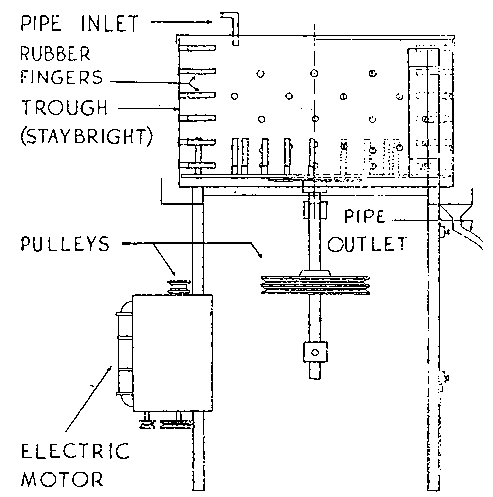
Fig. 2 - Sectional plan of De-scummer.
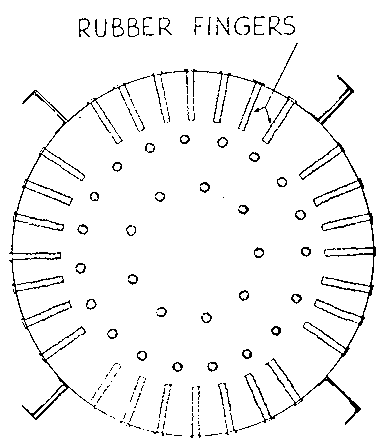
Fig. 3 - Plan of De-scummer.
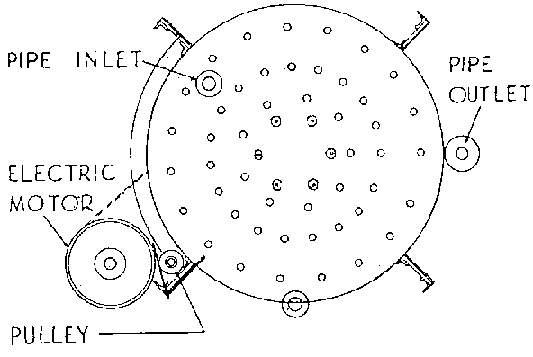
Fig. 4 - Pictorial view of De-scummer.
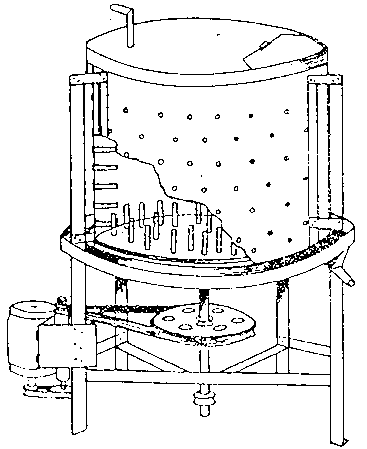
The machine (de-scummer) is fed with raw material, water is led into it and the motor switched on to rotate the base. The grooved rubber fingers rub against the decomposed outer surface of the animals to remove the scum. The scum is carried away with water flowing out of the de-scummer.
The size of the chamber and the horse power rating of the electric motor are factors influencing the capacity of the machine. About 100 sea cucumbers could be cleaned in 5 minutes using a de-scummer with a chamber 1 m. in diameter and 0.45 m. in height, and a base plate rotating at a speed of 120 revolutions per minute motivated by a 3 horse power electric motor.
ACKNOWLEDGEMENTS
Messers Walker Sons & Co. Ltd., Colombo and Mr. K. Thayaparan, Additional Government Agent, Mannar and President, Mannar Division Fishermen's Co-operative Society Ltd., Mannar, assisted us in conducting trials of the machine. Dr. T. P. Goonawardena, Assistant Director (Research) guided us throughout this programme of work. We are grateful to them.