by
T.M. Hoekstra, APO Socio-economist
October 1990
RAF/87/008/WP/61/90/E
REGIONAL PROJECT FOR THE DEVELOPMENT & MANAGEMENT OF FISHERIES IN THE SOUTHWEST INDIAN OCEAN
PROJET REGIONAL POUR LE DEVELOPPEMENT ET L'AMENAGEMENT DES PECHES DANS L'OCEAN INDIEN SUD-OCCIDENTAL
c/o UNITY HOUSE P.O. BOX 487, VICTORIA, MAHE SEYCHELLES
TELEPHONE 23773
TELEX 2254 SWIOP SZ
Regional Project for the Development and Management of Fisheries in the
Southwest Indian Ocean
RAF/87/008
FOOD AND AGRICULTURE ORGANIZATION OF THE UNITED NATIONS UNITED NATIONS DEVELOPMENT PROGRAMME
Victoria, SEYCHELLES, October 1990
Distribution:
Member States of SWIOP,
UNDP (Offices in the Region)
FAO (Offices in the Region)
SWIOP Mailing List
Bibliographic Entry:
Hoekstra, T.M. (1990),
Results of a fishermen survey in Lamu District, Kenya
FAO/UNDP: RAF/87/008/DR/61/90/E, 19 P.
This electronic document has been scanned using optical character recognition (OCR) software and careful manual recorrection. Even if the quality of digitalisation is high, the FAO declines all responsibility for any discrepancies that may exist between the present document and its original printed version.
3. Methodology and survey execution
3.1. Objective and unit of inquiry
3.2. The questionnaire
3.3. Data collection
4.1. Introduction
4.2. Geographical distribution of respondents
4.3. Socio-demographic characteristics of the fishermen4.3.1. Age and sex distribution
4.3.2. Household characteristics
4.3.3. Family of origin
4.3.4. Secondary occupations of fishermen4.4. Characteristics of the fishing industry
4.4.1. Fishery types
4.4.2. Boats
4.4.3. Gears
4.4.4. Fishing experience
4.4.5. Fishing area
4.4.6. Membership of fisherman society
5. Some critical notes on the Lamu survey design and suggestions for improvement
5.1. Definition of the unit of inquiry
5.2. Questionnaire design and categorization of answers
5.3. Alternative layout of the questionnaire, coding and processing
Annex 1. The Lamu Questionnaire
Annex 2. An Alternative Questionnaire
In 1985, a survey of fishermen was carried out in the Lamu district, Kenya, by an officer of the Fisheries Department in this district. The main objective of the survey was to assess the total number of fishermen (coastal and inland) in the district.
The data were never processed due to the transfer of the fisheries officer responsible for the survey. The assistance of the FAO Regional Project for the Development and Management of Fisheries in the Southwest Indian Ocean (SWIOP) was requested and the author travelled to Lamu to collect the data and interview the officer responsible for the survey, as well as local officials and fishermen. This report describes the results from the analysis of the survey data.
While processing and analysing the data, difficulties were encountered which largely emanated from the design of the questionnaire and the lack of instructions on how the enumerators were to record the data. As officials of the Fisheries department expressed a wish to carry out a follow-up survey, this report includes a section on possible improvements to the questionnaire and data processing.
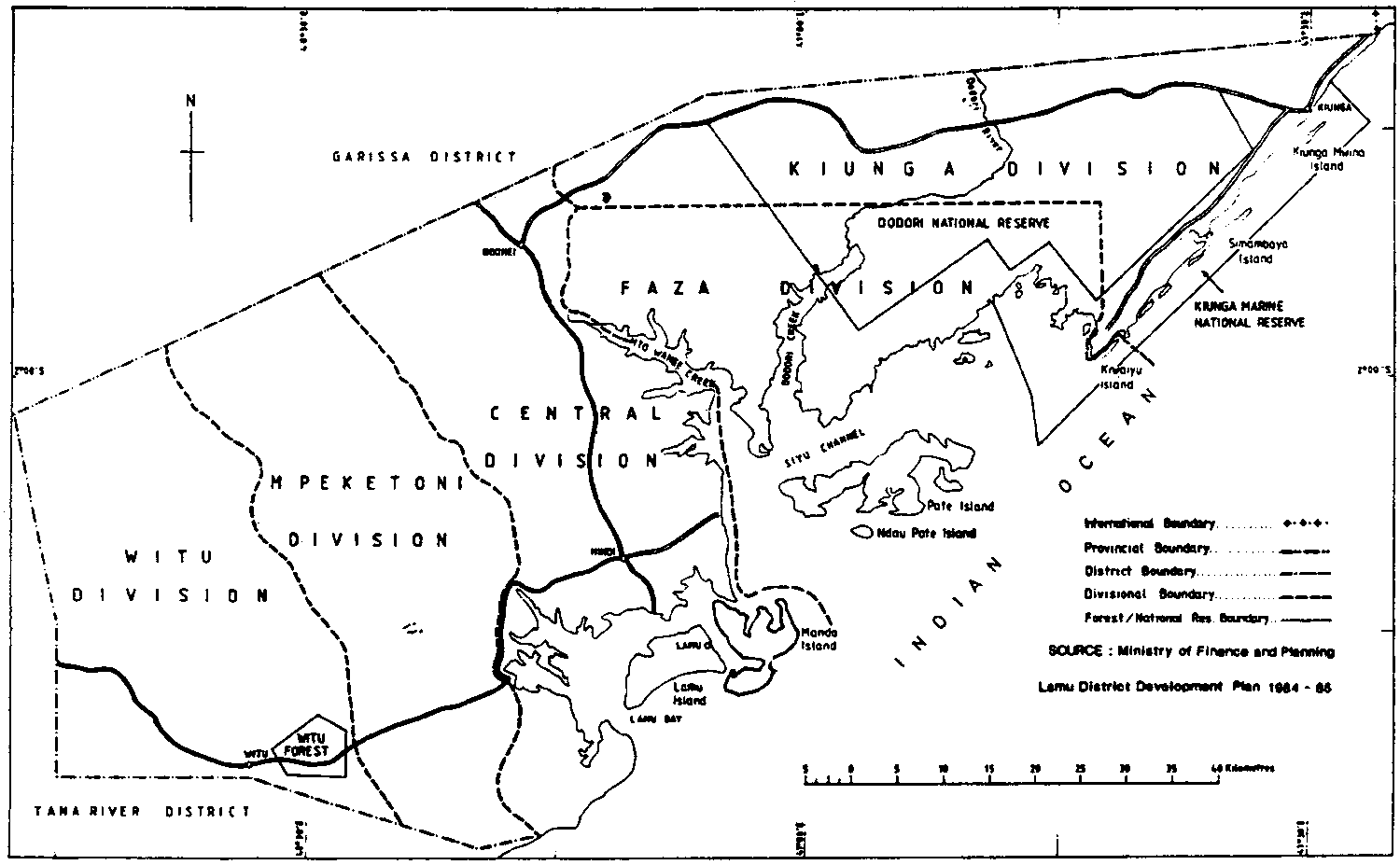
The Lamu District1 occupies the northern-most part of the Kenya coast, and extends northeastwards for approximately 130 kilometers. The district has a number of islands among which Lamu, Pate and Manda are the largest. With the exception of the coastal sand dunes, the topography of the district is characterized by low, almost level plain. The sand dunes and sand hills hardly exceed 50 m above sea-level.
1 This brief description is derived from the "Lamu District Environmental Assessment Report, Ministry of Environment and Natural resources, 1985".
The climate is conditioned by the biannual movement of the Inter-tropical Convergence Zone and the two Monsoons, namely the North-Eastern ('Kazkasi') between October and May and the South-Eastern ('Kuzi') between June and September. The rainfall pattern in Lamu is bimodal, with the long rains falling throughout the district from mid-April to the end of June and with slight showers in July. May is the wettest month. The short rains fall in November and December. January and March are usually dry months.
Temperatures throughout the district are usually high, ranging from 23°C to 30°C. The hottest months are December and April, while the coolest months are May and July.
The population of Lamu in 1979 was only 42 299, giving an average density of approximately 6 persons per km2. This average figure is however misleading, since the majority of the population is found on the islands of Lamu, Pate and Manda and in the Lake Kenyatta settlement scheme.
The waters adjacent to the Lamu district are reputed to be the most productive for sea fishing in Kenya. Fishing is an important revenue earner for the Lamu district. The more valuable species caught include shrimp, lobsters and oysters. The catch averages 900/1,000 tonnes per year, half of which is consumed locally, the rest being sold to Mombasa. Fishing is largely undertaken in the nearshore waters.
3.1. Objective and unit of inquiry
3.2. The questionnaire
3.3. Data collection
The main objective of the survey was to assess the total number of fishermen (coastal and inland) in the district. The unit of inquiry was the individual fisherman (irrespective of employment status).
A data sheet was designed (see Annex 1) to record a number of characteristics of each fisherman. The data sheet took the form of a simple matrix, each row representing one fisherman and each column a characteristic/variable. No possible answer categories were established beforehand. Consequently all questions were so-called open questions.
The original aim was to completely undertake the data collection during one Friday. On Fridays most of the fishermen do not normally go out fishing. In fact, the two subsequent Fridays were needed to complete the data collection.
Some 15 statistical enumerators of the Fisheries Department, strategically positioned in the district, carried out the interviews. The fishermen were interviewed on the beach, at the landing site, at home or, in some places, in the office of the Fisheries Department.
4.1. Introduction
4.2. Geographical distribution of respondents
4.3. Socio-demographic characteristics of the fishermen
4.4. Characteristics of the fishing industry
The results of the survey are presented separately for coastal fishermen and inland fishermen. Where appropriate, the coastal fishermen are further sub-divided according to fishery type i.e. general marine fishing, lobster diving, crab fishing, shrimp fishing and shell collection.
The geographical distribution of the respondents in the survey was as given in Table 4.1 below.
Table 4.1: Number of respondents by residential village, Lamu district, 1985
|
|
Coastal fishermen |
Inland fishermen | ||
|
Village |
respondents |
% |
respondents |
% |
|
Bori |
4 |
0.6 |
0 |
0.0 |
|
Bwajumwali |
3 |
0.5 |
0 |
0.0 |
|
Faza |
1 |
0.2 |
0 |
0.0 |
|
Ishakani |
26 |
4.2 |
0 |
0.0 |
|
Kau |
0 |
0.0 |
3 |
3.1 |
|
Kipini (area) |
33 |
5.3 |
10 |
10.2 |
|
Kipungani |
8 |
1.3 |
0 |
0.0 |
|
Kiunga |
110 |
17.8 |
0 |
0.0 |
|
Kiwayuu |
12 |
1.9 |
0 |
0.0 |
|
Kizingitini |
189 |
30.6 |
0 |
0.0 |
|
Lake Amu |
0 |
0.0 |
16 |
16.3 |
|
Lake Kenyatta |
0 |
0.0 |
2 |
2.0 |
|
Lamu |
2 |
0.3 |
0 |
0.0 |
|
Lanconi |
1 |
0.2 |
0 |
0.0 |
|
Matondoni |
50 |
8.1 |
0 |
0.0 |
|
Mkunumbi |
14 |
2.3 |
0 |
0.0 |
|
Moa |
0 |
0.0 |
42 |
42.9 |
|
Mokowe |
1 |
0.2 |
0 |
0.0 |
|
Mtanga wanda |
2 |
0.3 |
0 |
0.0 |
|
Mwanbore |
8 |
1.3 |
0 |
0.0 |
|
Mwudeni |
2 |
0.3 |
0 |
0.0 |
|
Myabogi |
1 |
0.2 |
0 |
0.0 |
|
Ndununi |
11 |
1.8 |
0 |
0.0 |
|
Pate |
7 |
1.1 |
0 |
0.0 |
|
Rasini |
70 |
11.3 |
0 |
0.0 |
|
Rubu (Robo) |
22 |
3.6 |
0 |
0.0 |
|
Shanga |
9 |
1.5 |
0 |
0.0 |
|
Siyu |
11 |
1.8 |
0 |
0.0 |
|
Tchundwa |
10 |
1.6 |
0 |
0.0 |
|
Other |
10 |
1.6 |
25 |
25.5 |
|
Total |
617 |
100.0 |
98 |
100.0 |
Note: The residential villages are listed in alphabetical order. Although Kipini was not part of the Lamu district, fishing there was administered by the Lamu Fisheries Department. Kipini, was therefore, within the scope of this study.
It was the opinion of the officer responsible for the survey that approximately eighty percent of the fishermen in the district had been covered in the survey.
4.3.1. Age and sex distribution
4.3.2. Household characteristics
4.3.3. Family of origin
4.3.4. Secondary occupations of fishermen
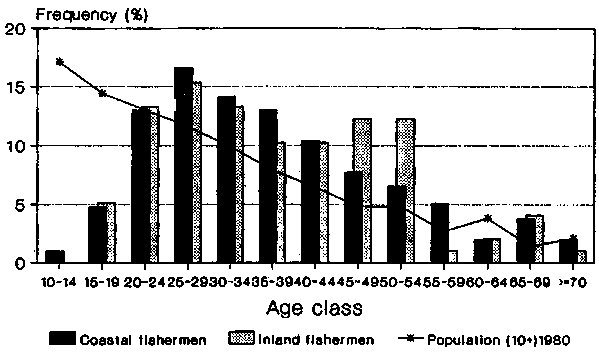
Out of a total of 715 fishermen 29 or 4.1 % were females. Only one female was encountered in the inland fishery. The average age for men and women were 36.9 and 41.5 years respectively. Figure 4.1 below presents the age distribution separately for coastal and inland fishermen (male and female fishermen combined) and for the entire population (of 10 years and older) in the Lamu district.
Figure 4.1: Age distribution of fishermen (1985) and the entire population (1980) in the Lamu district
Note: The distribution of the population is based on a population projection for 1980 (Source: Lamu District Planning Study, Min. of Economic Planning and Development). The age classes < 10 years have been disregarded to make the distribution comparable with the distribution of the fishermen. In other words the sum of the percentages in the classes of 10 years and older add up to 100 % for each of the three groups considered.
The average age for coastal and inland fishermen was 37,0 and 37,8 respectively. Assuming that the age distribution of the population did not change significantly between 1980 and 1985 it is concluded that fishermen were relatively under represented in the age classes of 25 years and younger. As age classes older than the end of primary schooling are involved, this distribution may represent a true fall in recruitment to the fishing profession. Although people sometimes enter the fishery at a fairly young age it appears that the average age of the fishermen was above the average of the entire population.
The marital status of the fishermen was as given in Table 4.2.
Table 4.2: Marital status of coastal and inland fishermen
|
|
Coastal Fishermen |
Inland Fishermen |
||||||
|
Men |
Women |
Men |
Women |
|||||
|
no. |
% |
no. |
% |
no. |
% |
no. |
% |
|
|
Not married |
147 |
25.0 |
2 |
7.1 |
21 |
21.6 |
0 |
0.0 |
|
Married |
409 |
69.4 |
18 |
64.3 |
73 |
75.3 |
0 |
0.0 |
|
Divorced |
12 |
2.0 |
0 |
0.0 |
0 |
0.0 |
0 |
0.0 |
|
Widowed |
2 |
0.3 |
0 |
0.0 |
2 |
2.1 |
1 |
100.0 |
|
Unknown |
19 |
3.2 |
8 |
28.6 |
1 |
1.0 |
0 |
0.0 |
|
Total |
589 |
100.0 |
28 |
100.0 |
97 |
100.0 |
1 |
100.0 |
The marital status of the coastal and inland fishermen appeared to be similar.
The major part of the population in the Lamu district is Muslim, hence polygamy is not uncommon. Table 4.3 gives the distribution of the number of wives per fishermen.
Table 4.3: Number of wives of coastal and inland fishermen
|
|
Coastal fishermen |
Inland fishermen | ||
|
Number of wives |
Number |
Percentage |
Number |
Percentage |
|
1 |
381 |
89.2 |
46 |
62.2 |
|
2 |
19 |
4.4 |
22 |
29.7 |
|
3 |
2 |
0.5 |
4 |
5.4 |
|
4 |
1 |
0.2 |
0 |
0.0 |
|
Unknown |
24 |
5.6 |
2 |
2.7 |
|
Total |
427 |
100.0 |
74 |
100.0 |
It is noted that the inland fishermen more frequently had more than one wive (35.1%) when compared to the coastal fishermen (5.1%).
The distribution of the number of children per coastal and inland fisherman is presented in Figure 4.2.
Figure 4.2: Frequency distribution of number of children of coastal and inland fishermen
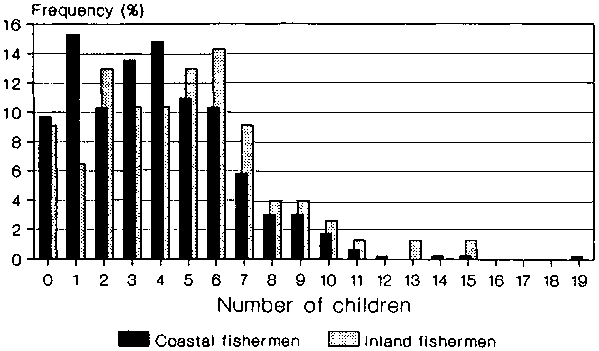
No single fishermen with children were encountered. As such, the distribution of the number of children only takes into consideration those fisher(wo)men who were either married, divorced or widowed. The average number of children of coastal and inland fishermen (for those with one or more children) was 4,2 and 5,1 respectively. When the fishermen with zero children are included, the average number of children for the coastal fishermen and inland fishermen comes to 3.8 and 4.6 children respectively. The average household2 size of the fishermen was estimated at 6.2 and 7.2 persons per household for the coastal and inland fishermen respectively.
2 In calculating the average household size, the average number of wives of fishermen hat been taken into consideration. It was assumed that fishermen form nuclear families (fishermen, wife(s) and children) and that single fishermen do not form one person households but share household in the group married, divorced and widowed.
The population census of 1979 for Lamu district listed 42,299 persons in 8,681 households, bringing the average household size to 4.87 persons. As such, it appears that the average household size of fishermen was significantly higher when compared to the average household size of the entire population in the district.
The survey included a question on the occupation of the fishermans' father but only in the sense of whether or not the father was a fishermen. Table 4.4. presents the results.
Table 4.4: Occupation of father of coastal and inland fishermen
|
|
Coastal fishermen |
Inland fishermen |
||
|
number |
percentage |
number |
percentage |
|
|
Fisherman |
283 |
45.9 |
29 |
29.6 |
|
Not Fisherman |
334 |
54.1 |
69 |
70.4 |
|
Unknown |
0 |
0.0 |
0 |
0.0 |
|
Total |
617 |
100.0 |
98 |
100.0 |
It is rather surprising that less than half of the coastal fishermen stated their father to be a fisherman.
A categorization was made of the secondary activities (besides fishing) stated by the fishermen (Table 4.5).
Table 4.5: Secondary occupations of coastal and inland fishermen
|
|
Coastal fishermen |
Inland fishermen | ||
|
Secondary occupation |
number |
% |
number |
% |
|
Farming |
178 |
28.8 |
82 |
83.7 |
|
Mangrove cutting |
6 |
1.0 |
0 |
0.0 |
|
Business |
7 |
1.1 |
4 |
4.1 |
|
Seaman |
9 |
1.5 |
0 |
0.0 |
|
Employee |
4 |
0.6 |
0 |
0.0 |
|
Boatbuilding |
1 |
0.2 |
0 |
0.0 |
|
Schooling |
4 |
0.6 |
0 |
0.0 |
|
None |
408 |
66.1 |
11 |
11.2 |
|
Unknown |
0 |
0.0 |
1 |
1.0 |
|
Total |
617 |
100.0 |
98 |
100.0 |
While 66.1% of the coastal fishermen were engaged full-time in fishing, this was only the case for 11.2% of the inland fishermen. The large majority of the inland fishermen were also farmers.
4.4.1. Fishery types
4.4.2. Boats
4.4.3. Gears
4.4.4. Fishing experience
4.4.5. Fishing area
4.4.6. Membership of fisherman society
The distribution of the number of fishermen per fishery type was as given in Table 4.6 below. The fishery type was deduced from the answers entered on the questionnaire concerning the gear type and/or the target species (see also Chapter 5).
Most fishermen in the district (61.3%) were engaged in general marine fishing3. Marine fishing is usually carried out in small boats operating within five miles from the coast. The normal duration of a fishing trip is half a day.
3 A fisherman was categorized as "general marine fishing" if the type of gear used was for catching marine fish or if the target species were marine fish.
Table 4.6: Number of fishermen by fishery type
|
|
|
Secondary fishery type |
||||
|
Principal fishery type |
Number |
% |
Lobster diving |
Crab fishing |
Shrimp fishing |
Unknown |
|
General Marine fishing |
438 |
61.3 |
98 |
1 |
42 |
0 |
|
Inland fishing |
98 |
13.7 |
0 |
0 |
0 |
0 |
|
Lobster diving |
120 |
16.8 |
0 |
0 |
0 |
0 |
|
Crab fishing |
11 |
1.5 |
0 |
0 |
0 |
0 |
|
Shrimp fishing |
9 |
1.3 |
0 |
0 |
0 |
0 |
|
Shell collection |
35 |
4.9 |
0 |
0 |
0 |
0 |
|
Unknown |
4 |
0.6 |
0 |
0 |
0 |
4 |
|
Total |
715 |
100.0 |
98 |
1 |
42 |
4 |
Lobster fishing was the second fishery type with 16.7 % of the fishermen. About one quarter of the marine fishermen also engaged part-time in lobster diving4.
4 Lobsters are mainly found in the coral reef areas and are caught by diving using goggles. Many lobster fishermen migrate for a period of two to three weeks to temporary beach sites. The lobster is caught and kept alive in baskets during this period before it is sold.
The few crab fishermen encountered during the survey were mainly concentrated in Mkunumbi. Here the fishermen poke the crab out of their holes using curved sticks.
Shell collection appeared to be mainly a women's activity. Some 77% of the shell collectors were women. Around 63 % of the shell collectors surveyed operated in Kiunga.
The most important fishing areas for inland fishing were the Mangai and Tana river and Lake Adhi and Lake Amu. The main species caught were Tilapia, Clarias and Protopterus.
The fishermen were asked if they owned a boat. Table 4.7 presents the results.
Table 4.7: Number of boats of coastal and inland fishermen
|
|
Coastal fishermen |
Inland fishermen | ||
|
Number of boats |
number |
% |
number |
% |
|
0 |
423 |
68.6 |
67 |
68.4 |
|
1 |
183 |
29.7 |
30 |
30.6 |
|
2 |
10 |
1.6 |
0 |
0.0 |
|
3 |
0 |
0.0 |
1 |
1.0 |
|
4 |
1 |
0.2 |
0 |
0.0 |
|
Total |
617 |
100.0 |
98 |
100.0 |
Almost 69 % of the marine and inland fishermen appeared not to have a boat and should consequently be regarded as either "fishermen on foot", "crew members" or "fishing with another persons' boat". Because the numbers in these categories were not evident from the data a calculation of average crew size was not possible.
The number of boats per fishery type were as given in Table 4.8.
Table 4.8: Number of boats by fishery type
|
|
General Marine fishing |
Lobster diving |
Crab fishing |
Shrimp fishing |
Shell collection | |||||
|
No. of Boats |
no. |
% |
no. |
% |
no. |
% |
no. |
% |
no. |
% |
|
0 |
282 |
64.4 |
90 |
75.0 |
9 |
81.8 |
5 |
55.6 |
33 |
94.3 |
|
1 |
147 |
33.6 |
28 |
23.3 |
2 |
18.2 |
4 |
44.4 |
2 |
5.7 |
|
2 |
9 |
2.1 |
1 |
0.8 |
0 |
0.0 |
0 |
0.0 |
0 |
0.0 |
|
3 |
0 |
0.0 |
0 |
0.0 |
0 |
0.0 |
0 |
0.0 |
0 |
0.0 |
|
4 |
0 |
0.0 |
1 |
0.8 |
0 |
0.0 |
0 |
0.0 |
0 |
0.0 |
|
Total |
438 |
100.0 |
120 |
100.0 |
11 |
100.0 |
9 |
100.0 |
35 |
100.0 |
The types of boats encountered in the survey are listed in Table 4.9.
Table 4.9: Types of boats of coastal and inland fishermen
|
|
Coastal fishermen |
Inland fishermen |
||
|
Boat type |
number |
% |
number |
% |
|
Planked boats |
||||
|
Keeled boat |
33 |
17.0 |
0 |
0.0 |
|
Flat bottom |
22 |
11.3 |
0 |
0.0 |
|
Mashua |
36 |
18.6 |
0 |
0.0 |
|
Keeled dhow |
9 |
4.6 |
0 |
0.0 |
|
Dau |
35 |
18.0 |
0 |
0.0 |
|
Subtotal |
135 |
69.6 |
0 |
0.0 |
|
Dugout canoes |
||||
|
Hori |
44 |
22.7 |
0 |
0.0 |
|
Dugout canoe |
8 |
4.1 |
31 |
100.0 |
|
Ngalawa |
3 |
1.5 |
0 |
0.0 |
|
Subtotal |
55 |
28.4 |
31 |
100.0 |
|
Unknown |
4 |
2.1 |
0 |
0.0 |
|
Total |
194 |
100.0 |
31 |
100.0 |
Note: These categories are not altogether mutually exclusive (e.g. a ngalawa is a dugout canoe but not every dugout canoe is a ngalawa).
A high proportion (69.6%) of the boats of coastal fishermen were planked boats. Dugout canoes with outrigger(s) were hardly encountered.
The survey did not cover the means of propulsion of the boats.
Boats need to be officially registered by the Fisheries Department. Before registration takes place the boat is inspected by the Regional Fisheries Officer. Table 4.10 gives the extent of registration of boats.
Table 4.10: Registration of fishing boats by coastal and inland fishermen
|
|
Coastal fishermen |
Inland fishermen |
||
|
number |
% |
number |
% |
|
|
Registered |
168 |
86.6 |
1 |
3.2 |
|
Not registered |
8 |
4.1 |
30 |
96.8 |
|
Unknown |
18 |
9.3 |
0 |
0.0 |
|
Total |
194 |
100.0 |
31 |
100.0 |
As opposed to the case of coastal fishermen, the boats of inland fishermen were generally not registered.
Table 4.11 gives the distribution of the associations of gear types used as stated by the fishermen.
Table 4.11: Distribution of types of gear in use by coastal and inland fishermen
|
|
Coastal fishermen |
Inland fishermen | ||||
|
Gear |
First gear |
Second gear |
Third gear |
First gear |
Second gear |
Third gear |
|
Beach seine |
20.7 |
0.0 |
0.0 |
0.0 |
0.0 |
0.0 |
|
Gill net |
24.0 |
1.8 |
0.0 |
75.5 |
0.0 |
0.0 |
|
Set net |
5.5 |
1.1 |
0.0 |
0.0 |
0.0 |
0.0 |
|
Shrimp net |
0.3 |
1.6 |
0.3 |
0.0 |
0.0 |
0.0 |
|
Handline |
4.2 |
5.8 |
0.6 |
18.4 |
78.5 |
1.0 |
|
Moveable trap |
2.6 |
0.2 |
0.0 |
0.0 |
0.0 |
0.0 |
|
Fixed trap |
5.8 |
3.4 |
1.5 |
0.0 |
0.0 |
0.0 |
|
Diving equipment |
18.2 |
11.8 |
1.8 |
0.0 |
0.0 |
0.0 |
|
Stick |
1.8 |
0.0 |
0.0 |
0.0 |
0.0 |
0.0 |
|
Shell coil. equipment |
0.3 |
0.0 |
0.0 |
0.0 |
0.0 |
0.0 |
|
Net (different types) |
5.2 |
0.0 |
0.2 |
5.1 |
0.0 |
0.0 |
|
Castnet |
0.3 |
0.0 |
0.0 |
0.0 |
0.0 |
0.0 |
|
None |
9.2 |
72.6 |
94.0 |
1.0 |
21.4 |
99.0 |
|
Unknown |
1.8 |
1.6 |
1.6 |
0.0 |
0.0 |
0.0 |
|
Total |
100.0 |
100.0 |
100.0 |
100.0 |
100.0 |
100.0 |
|
(N) |
617 |
617 |
617 |
98 |
98 |
98 |
Note: Again, the categories are not altogether mutually exclusive.
No data on the number of crew per fishing unit were collected. This partly relates to the fact that the individual fisherman, was the unit of inquiry, not the fishing unit. Interviews with fishermen (by the author), however, revealed the following numbers of crew per gear type:
|
Gear |
Crew |
|
Beach seine |
6-16 |
|
Gill (shark) net |
4-8 |
|
Moveable trap |
1-3 |
|
Lobster diving |
3-6 |
|
Line fishing |
2-4 |
|
Crab fishing |
1-2 |
|
Shell collection |
1-2 |
Figure 4.3 below gives the relative frequency distribution of the number of years of fishing experience of coastal and inland fishermen.
Figure 4.3: Number of years of fishing experience of coastal and inland fishermen, Lamu 1985
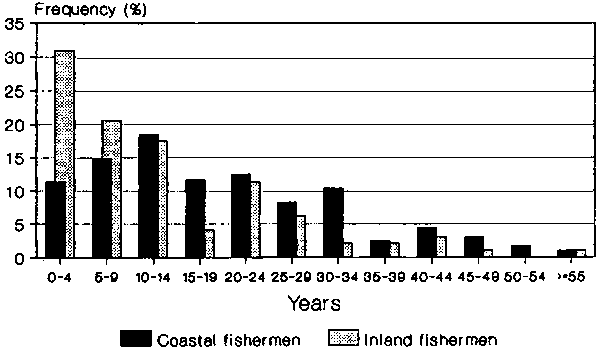
More than 30 % of the inland fishermen had less than 5 years experience with fishing. Inland fishermen originate mainly from farming families and have started fishing only at a more advanced age. In the case of coastal fishermen the distribution of the number of years of fishing experience runs more or less parallel with their age distribution (see Figure 4.1).
One question in the survey related to the "normal" fishing base. Usually one, two or three villages were mentioned by the fishermen. By checking the villages on the map, a rough categorization was made. The frequency of occurrences of the two categories was as given in Table 4.12 below.
Table 4.12: Fishing area of coastal and inland fishermen
|
|
Coastal fishermen |
Inland fishermen | ||
|
Area |
number |
% |
number |
% |
|
In residential village |
154 |
25.0 |
6 |
6.1 |
|
Also in other areas |
461 |
74.7 |
92 |
93.9 |
|
Unknown |
2 |
0.3 |
0 |
0.0 |
|
Total |
617 |
100.0 |
98 |
100.0 |
As can be seen, the fishermen were rather mobile, i.e., some 75% and 94% of the coastal and inland fishermen regularly moved to areas outside the immediate vicinity of their village.
For the coastal fishermen, two cooperatives existed in the Lamu district in 1985: the Kipini Fisherman Society and the North Coast Fishermen Society. In areas with important fresh water fisheries, notably the settlement schemes around Lake Amu and Lake Kenyatta, the Fisheries Department promoted the formation of "Fresh Water Fishermen Groups". The objectives of these groups was basically the same as those for the coastal fisherman societies i.e. organization of marketing, sales of gear and provision of credit.
Table 4.13 below gives the extent of membership of the surveyed fishermen.
Table 4.13: Membership of fisherman society of coastal and inland fishermen
|
|
Coastal fishermen |
Inland fishermen |
||
|
number |
% |
number |
% |
|
|
Not society member |
363 |
58.8 |
60 |
61.2 |
|
Society member |
254 |
41.2 |
38 |
38.8 |
|
Total |
617 |
100.0 |
98 |
100.0 |
A minority of the fishermen stated to be member of a fisherman society.
According to the 1985 records of the societies, the Kipini society had 83 and the NCFS 667 members. The Kipini society was considered especially weak and inactive. The only activity was the sale of small amounts of gears from their retail shop. The FWFGs were not very active either and ceased to exist after 1985.
The cost of registration for the NCFS is Kshs 5. Furthermore, the fishermen were obliged to buy at least one share in the society at a cost of Kshs 25 per share.
The NCFS provided credit to its members to buy fishing craft and gear. The amount of credit depended, among others, on the evaluation of the fisherman's capability to pay back. According to officials in Lamu, many fishermen made use of this facility. There were plans to engage in fish marketing. An application had been made to the Kenya Cooperative Bank for a loan of Kshs 1,500,000 to finance the purchase of vehicles and (fish collecting) boats. The headquarters of the NCFS was in Lamu town, with a permanent staff of 4 persons.
5.1. Definition of the unit of inquiry
5.2. Questionnaire design and categorization of answers
5.3. Alternative layout of the questionnaire, coding and processing
The unit of inquiry of this survey was the individual fisherman. The enumerators, however, were not provided with a definition of a fishermen. It was left to their own judgement who were to be considered fishermen.
The definition of the unit of inquiry of a survey is as important as an accurate definition of subjects of a survey. The population to be covered in a survey should be well defined. This involves:
1. The definition of the unit of population (the unit of inquiry)2. The geographical limitation of the population, and
3. The fixing of limits other than merely geographical ones e.g. whether fishermen living in institutions like prison or hospital should be excluded from the survey.
By going through the process of coding, processing and analysing the data collected during this survey, the author was confronted with one major problem i.e. the problem of categorization of the answers entered on the questionnaires.
When processing data from a survey, the first step in the categorization of the answers provided by the respondents is the identification of applicable categories.
In general, two types of questions can be distinguished in a questionnaire i.e. open questions and closed questions. In an open question the respondent (fisherman) has the opportunity to phrase his answers as he likes. In a closed question, the respondent is given a limited number of alternative answers. When closed questions with multiple choice answers are used, these categories are either obvious (e.g. "yes" or "no" as the only alternatives), or else a pilot survey has revealed the possible answers.
The main problem with this "Lamu fishermen survey" was (as can be seen in the questionnaire Annex 1) that all questions were (unnecessarily) open questions.
When answer categories cannot be established beforehand, the normal procedure is to take a sample, from which the alternative categories (also called the coding frame) can be derived. In the case of this survey this procedure had to be followed by the author. This procedure is quite time consuming and should not have been necessary in this particular survey. The type of questions were such that categories could have been established beforehand. The enumerators could have been provided with a questionnaire with predetermined (and coded) answer categories or at least a list with these categories.
As the enumerators were not properly trained or instructed on how to fill in the questionnaire different enumerators interpreted the questions, or what to enter on the questionnaires, differently.
This was particularly a problem with the following variables:
a. Type of boat
b. Type of fishing
c. Fishing equipment
d. Number of fishing equipment
e. Other activities
To make the point made above clear a selection of answers, entered on the questionnaires, with respect to each of these questions is provided below.
a. Question: Type of boat:
Answers entered:
- Keeled boat
- Flat bottom boat
- Mtumbwi
- Mashua
- Dau
- Dhow
- Keeled dhow
- Ngalawa
- Dugout canoe
These categories are not mutually exclusive. For example mtumbwi and ngalawa are both dugout canoes. A mtumbwi is a dugout canoe without outriggers and an ngalawa a dugout canoe with outrigger(s). What is then the dugout canoe entered on the questionnaire; a mtumbwi or a ngalawa? All mtumbwis are dugout canoes but not all dugout canoes are mtumbwis. Mashua and Dhow are both keeled boats. What is the keeled boat entered on the questionnaire; a mashua or a dhow? We unnecessarily lose information if we want to present the results of the survey in mutually exclusive categories. The only solution in this case is to make the categories more general for example: a. Planked boats and b. Dugout canoes. The consequence of this choice is that in presenting the results, as mentioned, information is lost.
b. Question: Type of fishing:
Answers entered:
- Lobster
- Finned fish
- Traps
- Moveable traps
- Fixed traps
- Line
- Crab
- Stick
When filling in the questionnaire some enumerators entered the gear and others the target species. Although gear and target species often coincide certain target species can be caught with different types of gear. How do we categorize an answer like: finfish? Both marine and fresh water fish can have fins. How do we categorize the answer "traps"? Are these moveable or fixed traps? All moveable traps are traps but not all traps are moveable traps. Again, if we want to present the results in mutually exclusive categories of gear information became lost.
c. Question: Fishing equipment:
Certain problems about type of fishing mentioned above could be solved by cross checking with the fishing equipment entered on the questionnaire. But, again, the answers provided in the questionnaires were not mutually exclusive. A few examples of answers entered on the questionnaire were:
- Handline
- Line
- Longline
- Glass (for lobster diving)
- Beach seine
- Seine
- Gillnet
- Set net
- Net
How do we categorize the answer "net"? Is this, just to mention a few, a set net, a gill net, or a beach seine? A gill net is a net but not all nets are gill nets. If we want to make the categories mutually exclusive we loose information because all gill nets, set nets, etc. should be classified as (the general indication) net. How do we categorize the answer "line"; is this a handline or a longline? All longlines and handlines should be classified in the more general category "Line" if the general indication "line" is entered too often.
d. Question: Number of fishing equipment:
With respect to "number of fishing equipment" the results of this survey could not be processed because the figures, entered on the questionnaires, were too ambiguous. A few examples of answers entered on the questionnaires were:
- Net 10
- Net 1
- Beach seine 200
- Line 5
- Line 200
Does "net 10" mean ten separate nets or ten units of one net? What does "Beach seine 200" mean, two hundred beach seines or a beach seine of two hundred meters long? Does "line 200" mean two hundred lines or one (or a few) longline(s) with, in total, two hundred hooks?
e. Question: Other activities:
A few examples of answers entered on the questionnaire were:
- Employed
- Boat builder
- Farming
- Peasant
- Business
- Seaman
- Captain
- Mangrove cutter
These categories are not mutually exclusive. A captain is a seaman but not all seamen are necessarily captain. What does "employed" mean? Employed by, for example, a farmer, a factory or a local shopkeeper?
If, as was the case with this survey, the answer categories are not well established beforehand there is the risk that, in the process of categorizing the information, the categories become too general. For example marine fishing could, if specified beforehand, have been more detailed e.g. moveable traps fishing, fixed traps fishing, surrounding net fishing etc.
Besides the above mentioned difficulties of categorization, more information could have been collected with the same amount of effort. With respect to this survey this relates especially to the questions: "Married?" and "Was (is) your father a fishermen?". Instead of asking "Was your father a fishermen?" the question could have been asked: "What was the main occupation of your father"?
In the case of "married" the enumerators sometimes filled in "yes" or "no". The answer "yes" is clear enough but what is the marital status of somebody who is not married? Is he/she single, divorced or widowed?
Often a horizontal line (___) was entered in a box on the questionnaire. When coding and processing the data the following problem arose: Does (___) mean 0, unknown, forgot to ask or not applicable?
What is entered on a questionnaire should be unambiguous. The questionnaire (or at least the instructions to the interviewer) should indicate what to enter on the questionnaire also in the case of "unknown" and "not applicable".
The categories must be applicable to the answers given as well as the survey objectives. In this connection we note that a multiple choice system often makes vague questions more specific, as the respondent is presented with a choice between possible answers.
The categories must be exhaustive, i.e. there should be a category for all possible answers. This means that, in addition to obvious categories there should also be one for "other" (to be specified) as well as categories for "no reply/refuses to answer", "do not know" and "not applicable".
With respect to, for example, the variables "marital status", "fishing equipment" and "fishery type" the information gathered in this study could (with the same amount of effort) have been more complete and unambiguous. An alternative layout for these three questions is provided below.
Question: What is the marital status of the fisherman?
|
Single |
1 |
|
|
Married |
2 |
|
|
Divorced |
3 |
|
|
Widowed |
4 |
|
|
Unknown |
9 |
|
Instruction: Tick appropriate box.
Question: What is the type of boat from which the fisherman operates? Registration Number
|
Mtumbwi/Hori |
1 |
|
|
|
Ngalawa |
2 |
|
|
|
Dau |
3 |
|
|
|
Mashua |
4 |
|
|
|
Dhow |
5 |
|
|
|
Other (specify) |
6 |
|
|
|
Not applicable *) |
8 |
|
|
|
Unknown |
9 |
|
|
*) Fishing in a unit without boat.Instruction: Tick appropriate box and enter registration number.
Question: What is the (major) fishery type?
|
Handlining |
1 |
|
|
Longlining |
2 |
|
|
Troll lining |
3 |
|
|
Fixed trap fishing |
4 |
|
|
Moveable trap fishing |
5 |
|
|
Purse seining |
6 |
|
|
Scoop net fishing |
7 |
|
|
Drift gill net fishing |
8 |
|
|
Demersal gillnets (large mesh) fishing |
9 |
|
|
Demersal gillnets (small mesh) fishing |
10 |
|
|
Surrounding net fishing |
11 |
|
|
Mosquito net fishing |
12 |
|
|
Lobster diving |
13 |
|
|
Crab fishing |
14 |
|
|
Octopus spearing |
15 |
|
|
Other specify:....... |
16 |
|
|
Unknown |
99 |
|
Tick appropriate box.
In these questions an attempt was made to make the answer categories mutually exclusive (only one category applies) and exhaustive (cover all possible answers).
All answer categories were subsequently assigned a code. Coding may be defined as allocating a number to each of the answer categories which are used. It is always applied when the data are processed by a computer. Yet coding also greatly facilitates manual processing as it brings together all the information in a very condensed way which is much easier to handle.
Survey data are often stored in a so-called database using a (micro) computer. A common database is really nothing but a series of rows and columns filled in with information. Typically, each column has a heading that describes the information in it and each row contains the information itself. The columns are the variables or characteristics (in database terminology "fields"). Each row (in database terminology a "record") represents a respondent (a fisherman or a fishing unit).
The database (with the codes) for the three questions above would look like this.
|
|
Field 1 |
Field 2 |
Field 3 |
Field 4 |
....etc. |
|
Name |
Marstatus |
Boattype |
Fistype |
....etc. |
|
|
record 1 |
Abdullah |
1 |
3 |
12 |
..... |
|
record 2 |
Mussa |
2 |
2 |
8 |
..... |
|
record 3 |
Hamed |
4 |
8 |
15 |
..... |
|
...... |
..... |
.. |
.. |
.. |
..... |
|
...... |
..... |
.. |
.. |
.. |
..... |
As can be seen in this example, the survey data are entered in a very condensed way. This greatly facilitates processing. Once a database is entered (either in a computer or on paper) performing counts of occurrences (frequencies or cross-tabulations) is easy. For example, to answer the question: "How many fishermen are married", the analyst simply needs to count the number of 2's down the column "Marstatus". Or to answer the question: "How many fishermen use a Dau", he counts the number of 3's down the column "Boattype".
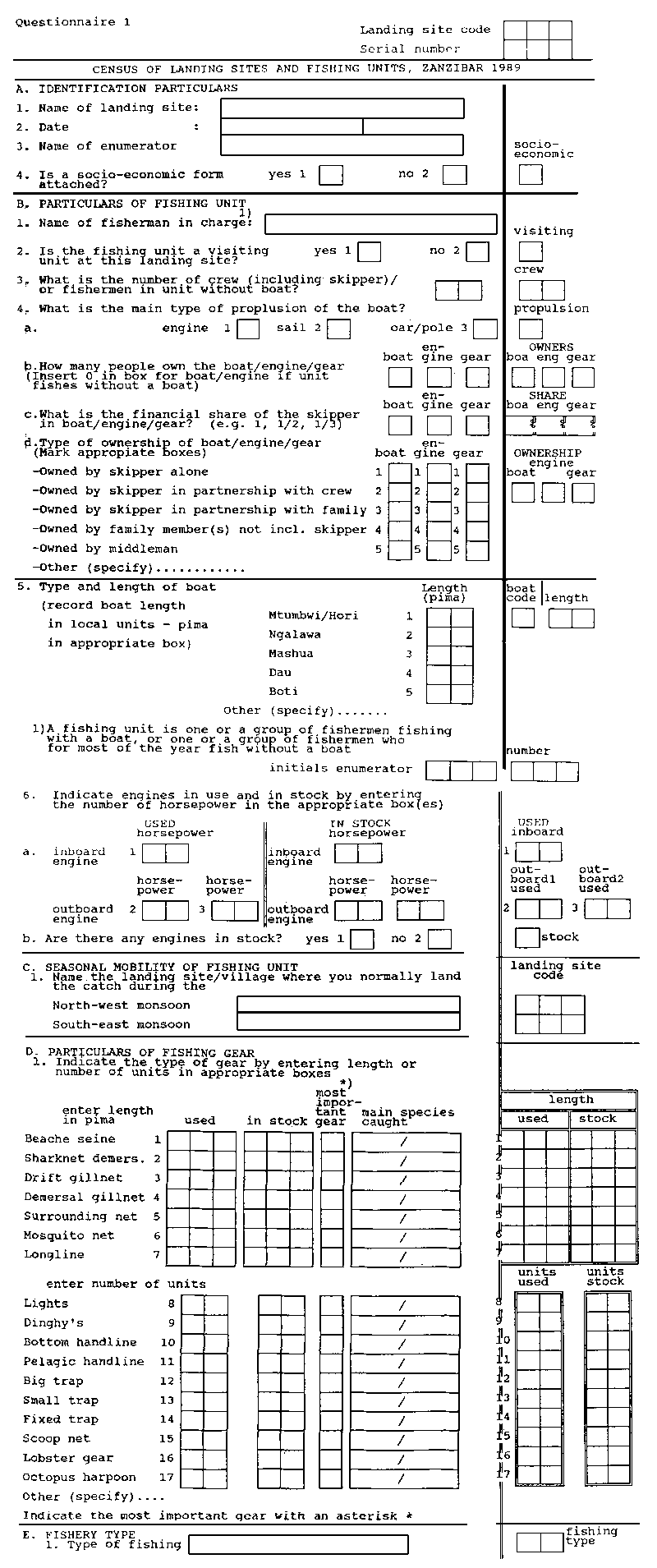
The unit of inquiry (fisherman or fishing unit) and the questions to be asked in a questionnaire depend on the objectives of the study. An example of an alternative questionnaire is provided in Annex 2. This questionnaire was used in a census of fishing units in Zanzibar. In this study (as can be seen from the questionnaire) the unit of inquiry was not the individual fisherman but the Fishing Economic Unit.
It is believed that a questionnaire like the one used in Zanzibar could (without many modifications) be applied to the fishery in Lamu to present an adequate quantitative image of the fishing sector in this district.
Clyde Surveys Limited, (___), Lamu District Planning Study, Ministry of Environment Planning and Natural Resources.
Hoekstra, T.M. (1990), Artisanal Fishery Census and Socio-Economic Study in Zanzibar, In: SWIOP/IFIP, 1990: Proceedings of the Workshop on Economic Aspects of Fisheries Development and Management. FAO/UNDP: RAF/87/008/WP/53/90/E: 208p.
Hoekstra, T.M. (1990), Conduct of Socio-Economic Baseline Studies, In: SWIOP/IFIP, 1990: Proceedings of the Workshop on Economic Aspects of Fisheries Development and Management. FAO/UNDP: RAF/87/008/WP/53/90/E: 208p.
National Environment Secretariat (1985), "Lamu District Environmental Assessment Report", Ministry of Environment and Natural Resources.
MINISTRY OF TOURISM & WILDLIFE
FISHERIES DEPARTMENT FISHERMEN RECORD
|
NO |
FISHERMAN'S NAME |
ID CARD NO |
DATE OF BIRTH |
RESIDENTIAL VILLAGE |
MARRIED |
NO. OF WIVES |
NO. OF CHILDREN |
NO. OF BOATS |
TYPE OF BOATS |
REGISTRATION NUMBERS |
TYPE OF FISHING |
FISHING EQUIP |
NO. OF FISHING EQUIPMENT |
NORMAL FISHING AREA |
EXPERIENCE IN YEARS |
OTHER ACTIVITIES |
WAS (IS) YOUR FATHER A FISHERMAN |
SOCIETY MEMBER |
|
|
|
|
|
|
|
|
|
|
|
|
|
|
|
|
|
|
|
|
|
|
|
|
|
|
|
|
|
|
|
|
|
|
|
|
|
|
|
|
|
|
|
|
|
|
|
|
|
|
|
|
|
|
|
|
|
|
|
|
|
|
|
|
|
|
|
|
|
|
|
|
|
|
|
|
|
|
|
|
|
|
|
|
|
|
|
|
|
|
|
|
|
|
|
|
|
|
|
|
|
|
|
|
|
|
|
|
|
|
|
|
|
|
|
|
|
|
|
|
|
|
|
|
|
|
|
|
|
|
|
|
|
|
|
|
|
|
|
|
|
|
|
|
|
|
|
|
|
|
|
|
|
|
|
|
|
|
|
|
|
|
|
|
|
|
|
|
|
|
|
|
|
|
|
|
|
|
|
|
|
|
|
|
|
|
|
|
|
|
|
|
|
|
|
|
|
|
|
|
|
|
|
|
|
|
|
|
|
|
|
|
|
|
|
|
|
|
|
|
|
|
|
|
|
|
|
|
|
|
|
|
|
|
|
|
|
|
|
|
|
|
|
|
|
|
|
|
|
|
|
|
|
|
|
|
|
|
|
|
|
|
|
|
|
|
|
|
|
|
|
|
|
|
|
|
|
|
|
|
|
|
|
|
|
|
|
|
|
|
|
|
|
|
|
|
|
|
|
|
|
|
|
|
|
|
|
|
|
|
|
|
|
|
|
|
|
|
|
|
|
|
|
|
|
|
|
|
|
|
|
|
|
|
|
|
|
|
|
|
|
|
|
|
|
|
|
|
|
|
|
|
|
|
|
|
|
|
|
|
|
|
|
|
|
|
|
|
|
|
|
|
|
|
|
|
|
|
|
|
|
|
|
|
|
|
|
|
|
|
|
|
|
|
|
|
|
|
|
|
|
|
|
|
|
|
|
|
|
|
|
|
|
|
|
|
|
|
|
|
|
|
|
|
|
|
|
|
|
|
|
|
|
|
|
|
|
|
|
|
|
|
|
|
|
|
|
|
|
|
|
|
|
|
|
|
|
|
|
|
|
|
|
|
|
|
|
|
|
|
|
|
|
|
|
|
|
|
|
|
|
|
|
|
|
|
|
|
|
|
|
|
|
|
|
|
|
|
|
|