
by
Michael J. Sanders
FAO Fishery Project
P.O. Box 487
VICTORIA, Seychelles
September, 1989
RAF/87/008/WP/46/89/E
SWIOP DOCUMENT OISO
RAF/79/065
REGIONAL PROJECT FOR THE DEVELOPMENT & MANAGEMENT OF FISHERIES IN THE SOUTHWEST INDIAN OCEAN
PROJET REGIONAL POUR LE DEVELOPPEMENT ET L'AMENAGEMENT DES PECHES DANS L'OCEAN INDIEN SUD-OCCIDENTAL
c/o UNITY HOUSE, P.O. BOX 487, VICTORIA, MAHE, SEYCHELLES
TELEPHONE: 23773
TELEX: 2254 SWIOP SZ
|
The designations employed and the presentation of material in this publication do not imply the expression of any opinion whatsoever by the Food and Agriculture Organization of the United Nations concerning the legal status of any country, territory, city or area or of its authorities or concerning the delimitation of its frontiers or boundaries. The views expressed are those of the authors. |
FOOD AND AGRICULTURE ORGANIZATION OF THE UNITED NATIONS UNITED NATIONS DEVELOPMENT PROGRAMME
|
ABSTRACT The assessment is based on the "swept area" method applied to the catch and effort data for 1988. The estimates of maximum sustainable yield (MSY) obtained when the trawl efficiency was assumed to be unity are 1,057 tonnes (when M = 2.4 annual), 1,232 tonnes (when M = 3.0) and 1,412 tonnes (when M = 3.6). The associated estimates for the standard fishing effort required to achieve MSY are respectively 4,859 standard days, 6,078 standard days and 7,286 standard days. These values compare with the observed catch in 1988 of 706 tonnes (whole weight) from an effort of 1,688 standard days. |
Acknowledgement:
The catch and effort data for 1988 used in the analysis were provided by the Department Fisheries in the Ministry of Lands, Natural Resources and Tourism.
Bibliographic Entry:
Sanders, M.J., 1989: Preliminary stock assessment for the shallow water shrimp trawl fishery of Tanzania based on catch and effort data for 1988.
FAO/UNDP: RAF/87/008/45/89/E: 23p.
This electronic document has been scanned using optical character recognition (OCR) software and careful manual recorrection. Even if the quality of digitalisation is high, the FAO declines all responsibility for any discrepancies that may exist between the present document and its original printed version.
1. Estimation of Relative Fishing Powers, Catches per Standard Fishing Effort and Efforts.
2. Estimation of Maximum Sustainable Yield
3. Forecasting Yields, Catches per Standard Fishing Effort Unit and Biomass for a range of Standard Fishing Efforts
4. Estimation of Fleet Engine Horsepower to achieve given levels of Yield.
Commercial trawling for shrimp in Tanzanian coastal waters commenced in 1969. This followed an exploratory fishing survey during June through December 1968 with the R/V Sagama Maru belonging to the Kanagawa Prefectural Government in Japan. The survey indicated productive grounds adjacent to the Rufiji River delta and to the coastal township of Bagamoyo; Kanagawa Prefectural Government (1969).
While the quality of the available fishery statistics is poor, it seems that the subsequent annual catches from trawling did not exceed 350 tonnes (whole weight) until recent years; FAO/IOP (1979, Appendix 7) and Killango and Mwamoto (1988). In 1987 following the licensing of additional trawlers, the catch is reported to have increased to at least 500 tonnes. The fleet was further expanded in 1988, resulting in the catch for that year being 706 tonnes.
In the light of this recent fishery expansion, the FAO/UNDP Regional Project for the Development and Management of Fisheries in the Southwest Indian Ocean was requested by the Fisheries Administration to assist with providing estimates of the potential yield and management advice. In response, an analysis based on the "swept area" method was undertaken using the trawl fleet catch and effort data for 1988. The results of this analysis are reported here.
The only previous assessment based on established methodology, also the "swept area" method, is that reported in FAO/IOP (1979, Appendix 7). In this, the catch and effort data for the fleet operating in 1969 through 1971 were used to estimate a potential yield of 1,830 tonnes (headless, equivalent to 3,049 tonnes whole weight).
1. Estimation of Relative Fishing Powers, Catches per Standard Fishing Effort and Efforts.
2. Estimation of Maximum Sustainable Yield
3. Forecasting Yields, Catches per Standard Fishing Effort Unit and Biomass for a range of Standard Fishing Efforts
4. Estimation of Fleet Engine Horsepower to achieve given levels of Yield.
Method: The purpose here was to estimate the mean catch per unit of standard fishing effort and the standard fishing effort for the fleet in each month, while taking due account of the differences in the fishing powers of the individual vessels. The data used for this were the observed catch weights and numbers of fishing days in each month for each vessel.
The fishing powers of the individual vessels were estimated relative to pre-chosen standard vessels. These were the F/V Mama Tafico and F/V Sadaani (both belonging to the parastatal TAFICO), which are of similar intermediate size. At least one of the vessels was operated in each month of 1988, and the catch and effort data available for each were thought to be of a reasonably high quality.
The equation used for estimating the mean relative fishing power (P) for each vessel was:
Equation 1.
Pi = (S Pim)/ni = (S fc ((c/x)im/(c/x)sm))/ni
In this, c/x represents the monthly catch weights per fishing day, the subscripts i and s denote the ith vessel and the standard vessels respectively, subscript m identifies the month, and n is the number of observations used in estimating the means.
The mean catch per standard fishing effort (c/x') for the fleet in each month was estimated using:
Equation 2.
(c/x')m = (S (c/x')im)/nm= (S (cim/(xim . Pi)))/nm
where c is the catch weight, x is the number of fishing days, and the other symbols are as previously defined. The resulting values were in turn used with the following equation to estimate the standard fishing effort (x') for the fleet in each month.
Equation 3.
x'm = (c/x')m/S cim
The S cim is the fleet catch in each month.
Results: The relative fishing powers determined for each vessel and the associated coefficients of variation are given in Table 1. The table also gives the length and horsepower of each vessel. The fishing power can be seen to increase with the size of the vessel. This relationship is examined further in a later section.
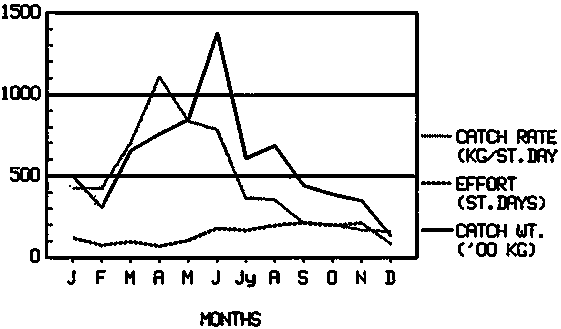
A plot of the mean catches per unit of standard fishing effort for each month is given in Figure 1. Values exceeding 500 kg/standard day were attained during the four months of March through June. The peak catch rate was in April at 1,109 kg/standard day, from which it declined progressively to 157 kg/standard day in December.
Also shown in Figure 1 is a plot of the standard fishing efforts for the fleet in each month. The values shown range mostly between 100 and 200 standard days, with the higher values tending to be during the second half of the year and reflecting the entry of additional vessels.
The observed catch weight in each month is also shown. The most productive months generally coincided with those when the catch rates were highest, although this is somewhat distorted due to the increasing fishing efforts during the second half of the year. The month of highest catch was June, when 138 tonnes were landed.
When considering all the months of 1988, the overall catch was 706 tonnes from 1,688 standard days at a mean catch rate of 418 kg/standard day.
Method: The standard fishing efforts in each month, determined as described in the previous section, were used with the fleet catch weights to provide estimates of the maximum sustainable yield (MSY).
The initial step in this was to obtain estimates of the annual mean biomass (B) of shrimp from the product of their mean density (d) and the area of the trawl grounds. The operative equation was:
Equation 4.
B = d.A = (S cm/S x'm).A/a
where S cm is the annual fleet catch, S x'm is the annual standard fishing effort, a is the "effective" area of seabed covered during a unit of standard fishing effort, and A is the area of the grounds.
In the prior estimation of a value for a, the speed of the standard vessels was taken as 3 knots, the horizontal width of the twin trawls used was assumed to be 14.66 m (35% of the headline lengths1) and the efficiency of the trawl nets as unity. The latter is equivalent to assuming that all the shrimp in the path of the net during a standard fishing effort unit are caught. The consequences of using a different value for the trawl efficiency are discussed in a later section.
1 The value of 35% of the headline length is from tank tests undertaken in Europe on trawl nets used from similar vessels operated in nearby Madagascar. The tank test results were provided to the author by the company Pêcheries de Nosy-Bé.
The biomass values so obtained were used to obtain estimates of MSY. The following equation from Garcia, Sparre and Csirke (1987) was used:
Equation 5.
MSY = M. B.exp ((Y/M.B)-1)
where M is the natural mortality coefficient and Y is the annual yield (equivalent to the previous S ci). This equation is based on the assumption that the stock follows the Fox (Production) Model. This model was judged as more appropriate than the alternative Schaefer Model for shrimp fishery assessments on the basis of the observed relationships between catch and effort.
Results: As indicated in Table 2, the estimates obtained for the MSY were:
|
MSY (Tonnes) |
|
|
1,057 |
(when M = 2.4 annual) |
|
1,232 |
(when M = 3.0 annual) |
|
1,412 |
(when M = 3.6 annual) |
The area of the trawl ground was taken as 1,977 km2 for all these estimates'
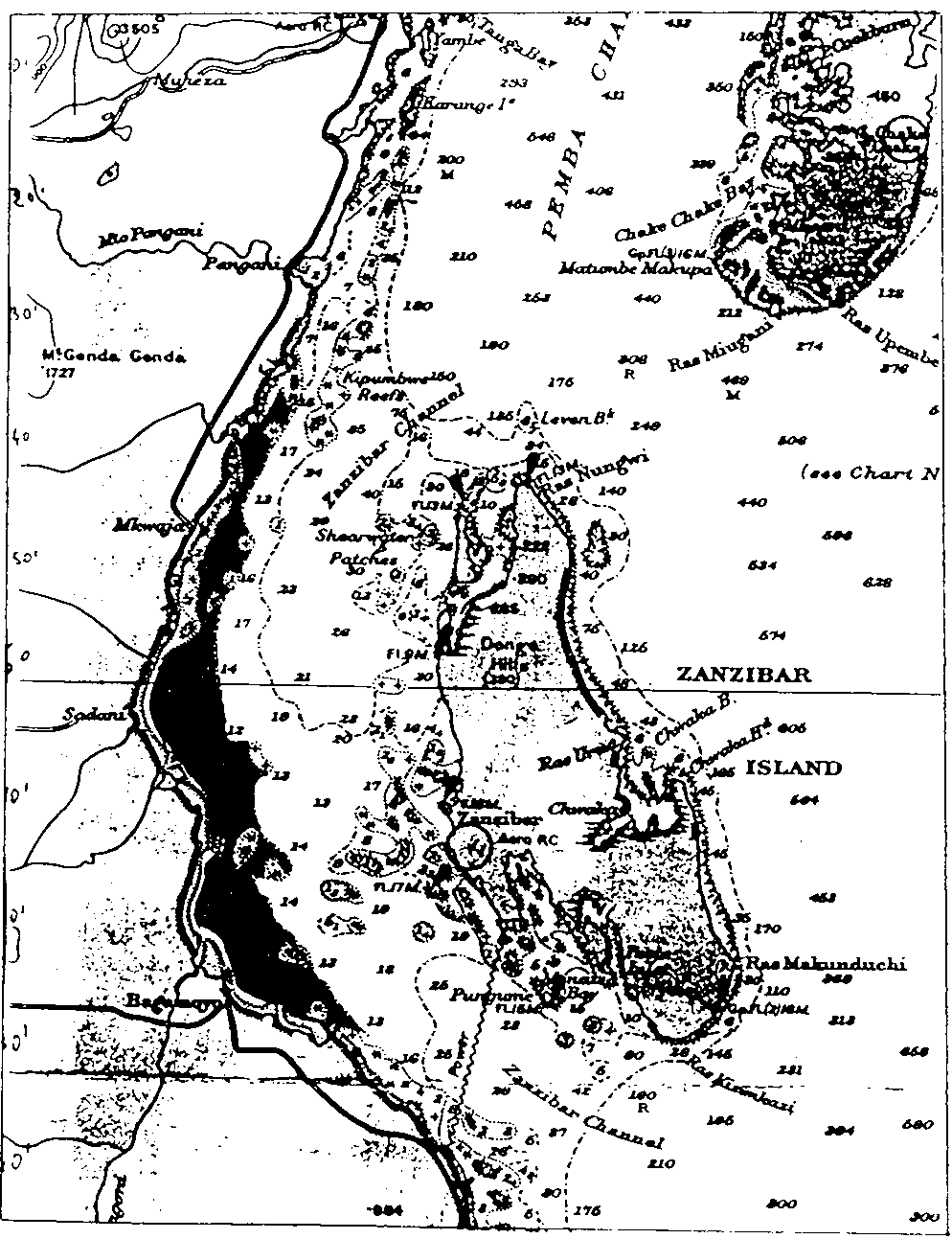
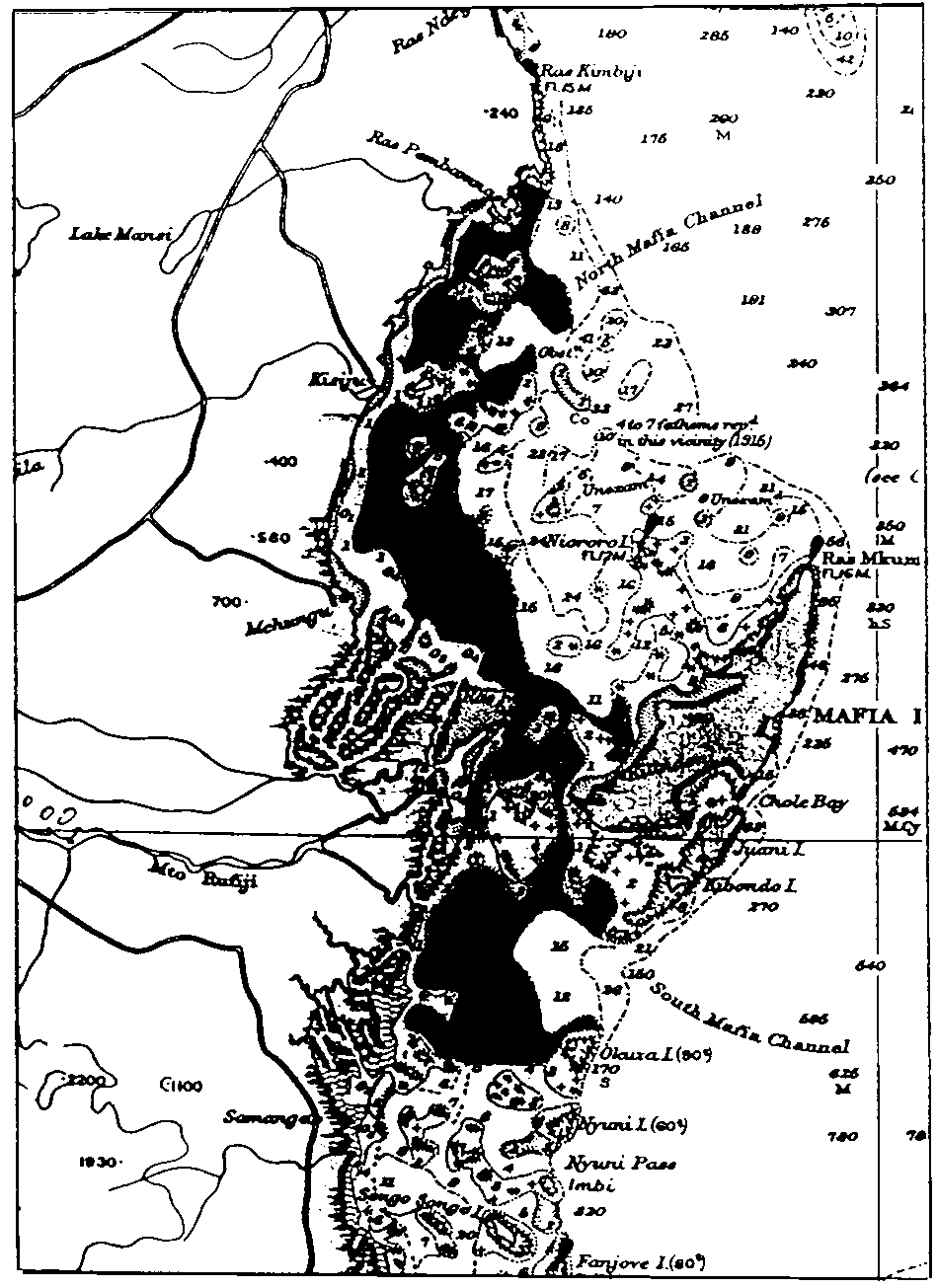
This area had been determined previously from the records of the fishing locations of the F/V Mama Tafico and F/V Sadaani during 1987 and 1988. These indicated that fishing was largely confined to the inshore waters between 1 and 10 fathoms depth at the two locations indicated in Figures 2 and 3. The areas were determined as 637 km2 for the Bagamoyo ground and 1,340 km2 for the Rufiji ground.
It proved possible, also, to obtain estimates of MSY for each of the two grounds using the more detailed data available for the F/V Mama Tafico and F/V Sadaani. These were the only vessels for which the catches and fishing efforts could be allocated between the two grounds.
The estimates of MSY obtained when considering the grounds separately are indicated in Tables 3 and 4. They are:
|
MSY (Tonnes) |
|
|
297 |
(when M = 2.4 annual) |
|
344 |
(when M = 3.0 annual) |
|
391 |
(when M = 3.6 annual) |
|
In respect to the Bagamoyo ground, and |
|
|
740 |
(when M = 2.4 annual) |
|
864 |
(when M = 3.0 annual) |
|
990 |
(when M = 3.6 annual) |
|
for the Rufiji ground. |
|
Method: The objective here was to obtain estimates for the annual yield, mean catch rates and biomass for a range of values for the fleet annual standard fishing effort. To a large extent, the approach is the reverse of that described in the previous section.
The procedure involved firstly using the MSY with Equation 5 with a range of assumed values for the biomass and natural mortality coefficient to obtain values for the annual yield. These were then used with the biomass values in Equation 4 to estimate the associated annual standard fishing efforts. Dividing these into the yields in turn provided estimates of the associated catches per standard fishing effort unit.
Results: The results given in Table 5 and Figures 4, 5 and 6 show the magnitudes of the expected changes in annual fleet yields, catch rates and biomass with increasing levels of fishing effort. As imposed by the form of the relationship between these parameters (i.e. Equation 5), the yield curves each have a maximum (MSY) and the catch rates and biomass decline exponentially with increasing fishing effort.
The results also show that the yields are similar for fishing efforts below 2,500 standard days and the catch rates and biomass are similar at fishing efforts between about 1,000 and 2,500 standard days, for each of the assumed values of M. The yields, catch rates and biomass are each almost identical at a fishing effort of 2,000 standard days for the assumed values of M.
The estimated fishing efforts required by the fleet to obtain MSY and 60% of MSY and the associated catch rates and biomass are provided below.
|
Yield (tonnes) |
|
Standard Fishing Effort (st. days) |
Catch weight per Standard Fishing Day (kg/st. day) |
Biomass (tonnes) |
|
|
1,057 |
(MSY) |
4,859 |
218 |
440 |
(when M = 2.4) |
|
634 |
(60% MSY) |
1,442 |
440 |
889 |
(when M = 2.4) |
|
1,232 |
(MSY) |
6,078 |
203 |
410 |
(when M = 3.0) |
|
739 |
(60% MSY) |
1,803 |
410 |
829 |
(when M = 3.0) |
|
1,412 |
(MSY) |
7,286 |
194 |
392 |
(when M = 3.6) |
|
847 |
(60% MSY) |
2,165 |
392 |
792 |
(when M = 3.6) |
As will be discussed later, 60% of MSY has been chosen here as the lowest yield likely to be considered justified (in the sense of economic performance) within any future management regime (applying to the trawlers).
Methods: The objective here is to demonstrate how to determine the number and power of the vessels required to achieve given levels of yield. It pre-supposes that a relationship exists between the fishing power of the vessels and their main engine horsepower.
The latter was tested by plotting the relative fishing powers against the engine horsepowers given previously in Table 1. A linear (least squares) regression analysis was then undertaken using all values except that for the largest vessel (which appeared to under-perform compared to the other vessels) and the four smallest vessels (which are fish trawlers with shrimp as an incidental by-catch). The results indicated a direct proportional relationship between fishing power and engine horsepower.
Next, it was necessary to derive a relationship between fleet engine horsepower and the annual standard fishing effort for the fleet. The one chosen is as follows:
Equation 6.
x' = x.b. S Hi
where x' is the annual standard fishing effort for the fleet, x is the pre-chosen annual nominal fishing effort per vessel, b is the slope in the proportional relationship between relative fishing power and engine horsepower, and S Hi is the fleet engine horsepower.
This relationship was used to estimate the fleet engine horsepowers required to achieve both the MSY and 60% of MSY for a range of assumed values for the annual nominal fishing effort per vessel (assuming the latter to be the same for all vessels).
Results: The plot of relative fishing power against engine horsepower is shown in Figure 7. The regression analysis provided a value for the correlation coefficient of r = 0.979 and supported the assumption of linearity. The values obtained for the y-intercept and slope were respectively a = 23.309 x 10⁻³ and b = 2.065 x 10⁻³.
The value for the y-intercept was subsequently determined as not significantly different from zero, hence allowing the relationship between relative fishing power and engine horsepower to be represented by:
Equation 7.
Pi = b.Hi
The slope in this relationship was determined as b = 2.115 x 10⁻³. A plot of this relationship is given in Figure 7.
The results from the estimation of the fleet engine horsepowers required to achieve the MSY and 60% of MSY are shown in Table 6 and Figures 8 and 9. Although of lesser interest, the associated annual catch weights per unit horsepower at MSY and 60% of MSY are also shown in Table 6.
A useful application of these results is in providing a basis for identifying the appropriate fleet composition required to achieve a pre-determined annual catch. This would be that number of vessels whose combined engine horsepower is equal to the estimated fleet engine horsepower.
e.g. In order to achieve MSY (i.e. 1,232 tonnes when M = 3.0) under a management regime whereby each vessel is operated for 240 fishing days per year, the fleet engine horsepower required is 11,974 Hp (see Table 6).One of the many fleet compositions to achieve this would be 25 vessels each of 479 Hp. In such a case, the expected mean annual catch per vessel and per fishing day would be 49.3 tonnes (= 479 x 103/1000) and 206 kg/day (= 49.3 x 1000/240). Another alternative would be 15 vessels of 798 Hp. .Here, the annual catch per vessel and per fishing day would be 82.2 tonnes and 343 kg/day.
Similarly, the results can be used to determine the number of fishing days per vessel per year required for an existing fleet to achieve a given annual catch.
e.g. In order to achieve the same MSY as in the previous example from a fleet whose combined horsepower is 15,965 Hp, and each vessel is being operated for the same number of fishing days, the required number of fishing days per vessel per year is 180 days. In such a case, the expected annual catch from a 400 Hp vessel and the catch per fishing day would be 31 tonnes and 17 1 kg/day, while from a 600 Hp vessel it would be 46 tonnes and 257 kg/day.
The results can also be used to determine the likely yield and catch rates from applying a given level of fishing effort.
e.g. In the event that the fleet is being managed at 2,000 standard days, the resulting yield would be 794 tonnes (when M = 3.0) at a mean catch rate of 397 kg/standard day (see Table 5). In such a case, if the fleet engine horsepower is 6,000 Hp, then it would be necessary for each vessel to be operated for 158 days (from Equation 6). Furthermore, a 500 Hp vessel operated for this number of days could be expected to produce a catch of 66.3 tonnes (158 x 2.115 x 10-3 x 500 x 397) at a catch rate of 420 kg/day (= 66.3 x 1000/158).
The above types of calculations can be done in respect to a hypothetical fleet as already shown or to the fleet operating in 1988.
e.g. In the event that the 1988 fleet is being managed at 2,500 standard days, the resulting yields (from Table 5) would be 884 tonnes (when M = 2.4), 914 tonnes (when M = 3.0) and 935 tonnes (when M = 3.6). The associated mean annual catch rates are 353 kg/standard day (when M = 2.4). 366 kg/standard day (when M = 3.0) and 374 kg/standard day (when M = 3.6). Estimates of the expected catch weights, fishing efforts and catches per fishing effort for each of the vessels in the fleet (whose combined engine horsepower is 6.103 Hp) are given in Table 7.
These types of calculations are obviously very useful to the process of deciding the most appropriate future management regime. In practice, it will be necessary that they relate to some definition (or at least a general understanding) of the management objectives for the fishery.
The most important finding from this assessment is that the potential yield (i.e. MSY) from the fishery may not be greater than about 1,400 tonnes (whole weight) and may possibly be as low as 1,000 tonnes. The estimated fishing effort required to achieve these MSY values ranges from 4,859 to 7,286 standard days (depending on the choice of M). In the author's view, the fleet effort should not be allowed to exceed the lower value, at least until a more comprehensive understanding of the fishery and resource situations are available.
The above comments are written in the context that the management objective for the fishery is to achieve the MSY. There is evidence (e.g. Willmann and Garcia, 1985) that it is usually more beneficial, particularly in terms of the profitability of the fishery, to manage at an annual catch level less than the MSY. Somewhat arbitrarily, it has been suggested earlier in this report that the lower limit of catch likely to be justified on economic grounds is 60% of MSY.
The annual catch at 60% of MSY was estimated at between about 630 tonnes and 850 tonnes, and the fishing efforts required to achieve these between 1,442 and 2,165 standard days respectively. These values are similar to the observed catch and effort in 1988, from which it might be concluded that the fishery is presently achieving close to 60% of MSY.
There are two aspects of the data analyses which require further comment. The first concerns the assumption used here that the efficiency of the trawls is unity (i.e. all the shrimp in the path of the nets during a standard fishing effort are caught).
In reality it is possible that the trawl efficiency is less than unity. This would cause the estimates of MSY and the fishing effort to achieve MSY both to be higher and the associated catch rates to be lower. This is demonstrated by a comparison of the following results (from using a value of 0.6 for the efficiency) with those given earlier (Page 8).
|
Yield |
|
Standard Fishing Effort |
Catch weight per Standard Fishing Day |
Biomass |
|
|
1,533 |
(MSY) |
8,075 |
190 |
640 |
(when M = 2.4) |
|
920 |
(60% MSY) |
2,405 |
383 |
1,290 |
(when M = 2.4) |
|
1,838 |
(MSY) |
10,091 |
182 |
614 |
(when M = 3.0) |
|
1,103 |
(60% MSY) |
3,005 |
367 |
1,237 |
(when M = 3.0) |
|
2,145 |
(MSY) |
12,153 |
176 |
595 |
(when M = 3.6) |
|
1,287 |
(60% MSY) |
3,606 |
357 |
1,203 |
(when M = 3.6) |
The second comment on the data analyses has relevance to the consideration of closed seasons as a method of controlling fishing effort. It should be noted that the results given earlier are based on the fishing effort being distributed throughout all months of the year. This is the direct consequence of having used catch and effort data for a year (1988) during which the fishing effort was distributed roughly equally in all months.
In the event that the management regime is changed to include a closed season, the forecasts of annual catches and catch rates for a range of fishing efforts given earlier will no longer be valid. Applying a closed season during those months when the catch rates are low and the shrimp are relatively small (e.g. December/January/ February) for example, would produce a slightly higher estimate of MSY, and higher estimates of annual catches and mean catch rates for given levels of fishing effort.
As a final comment, it seems relevant to provide some explanation for the estimates of MSY being substantially lower than the 3,049 tonnes (whole weight) from the analyses reported in FAO/IOP (1979, Appendix 7). As here, the "swept area" method was used, with the assumption that -the trawl efficiency was unity and a value for the natural mortality coefficient of M = 3.0.
In the earlier work, the area of the trawling grounds was taken as 3,830 km2 (without any explanation of how this was determined) and the speed of the vessels as 2 knots. These differ substantially from the values used here (1,977 km2 and 3 knots respectively) and this which provides much of the explanation for the differences in the estimates of MSY. Using the earlier values for the area of the trawl grounds and vessel speed with the catch and effort data for 1988 gives an estimate for the MSY of 2,984 tonnes (when M = 3.0).
FAO/IOP (1979): Report of the Workshop of fishery resources of the Western Indian Ocean South of the Equator, Mahé, Seychelles, 23 October - 4 November 1978. Dev. Rep. Indian Ocean Programme., (45): 102p.
Garcia, S., P. Sparre and J. Csirke (1987): A note on rough estimators of fishery resources potential. FISHBYTE. Vol. 5(2): 11-16.
Kanagawa Prefectural Government (1969): The report of survey on the prawn fishing grounds along the coast of Tanzania., Japan: 120p.
Killango, A.B.C. and B.A.S Mwamoto (1988): The shrimp fisheries in Tanzania. Presented to National Seminar of Fisheries Policy and Planning. University of Dar-es-Salaam. 2-4 May, 1988: lip.
Willmann, R. and S.M. Garcia (1985): A bio-economic model for the analysis of sequential artisanal and industrial fisheries for tropical shrimp (with a case study of Suriname shrimp fisheries). FAO Fish. Tech. Pap., (270): 49p.
Figure 1: Catch Weights, Standard Efforts and Catches per Standard Effort Unit for 1988
Figure 2: The Bagamoyo fishing ground
Figure 3: The Rufiji fishing ground
Figure 4: Estimates of fleet catch weights for a rnage of annual standard fishing efforts and a trawl efficiency of unity.
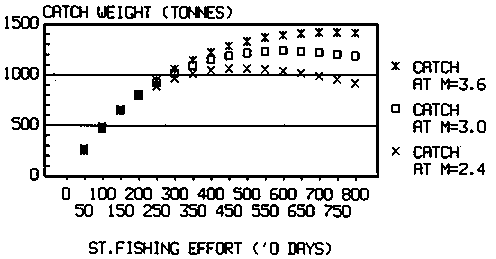
Figure 5: Estimates of catch per standard fishing effort unit for a range of annual standard fishing efforts and a trawl efficiency of unity.
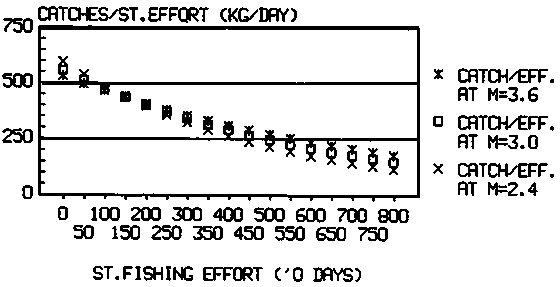
Figure 6: Estimates of biomass for a range of annual standard fishing efforts and a trawl efficiency of unity.
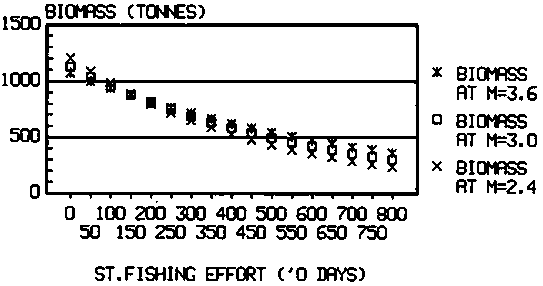
Figure 7: Estimates of relative fishing power plotted against engine horsepower.
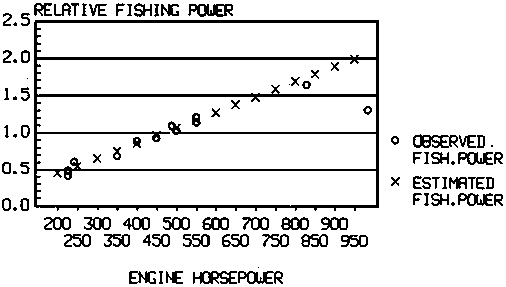
Figure 8: Estimates of fleet engine horsepower at MSY for a range of annual fishing efforts per vessel and M values as shown.
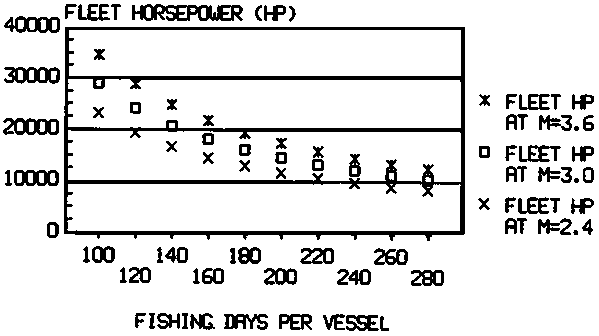
Figure 9: Estimates of fleet engine horsepower at 60% MSY, for a range of annual fishing efforts per vessel and M values as shown.
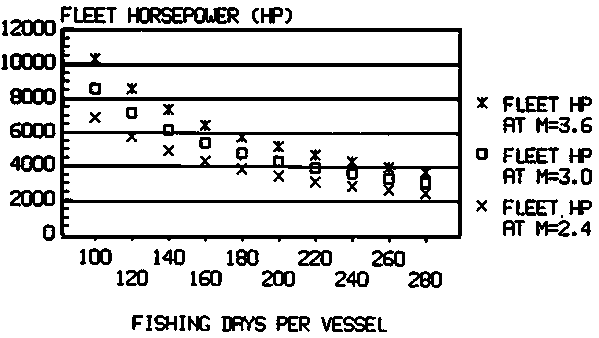
Table 1: Estimates of relative fishing power and size characteristics of esch vessel in 1988.
|
VESSEL NAME |
ENGINE HORSEPOWER |
VESSEL LENGTH |
RELATIVE FISHING POWER |
||
|
MEAN |
COEFFICIENT OF VARIATION |
COUNT |
|||
|
SANGARA |
|
|
0.069 |
149 |
12 |
|
MCHUNGU |
|
|
0.104 |
79 |
5 |
|
PANGANI |
|
|
0.054 |
201 |
6 |
|
TUMAINI |
|
|
0.323 |
89 |
4 |
|
SEASHORE I |
220 |
17.6 |
0.428 |
38 |
7 |
|
SEASHORE II |
220 |
17.6 |
0.358 |
40 |
4 |
|
HERO I |
225 |
24.6 |
0.583 |
36 |
6 |
|
MARIELENA |
390 |
26.0 |
0.791 |
53 |
6 |
|
SADAANI |
450 |
28.0 |
0.990 |
15 |
10 |
|
MAMA TAFICO |
500 |
30.0 |
1.010 |
14 |
11 |
|
ALPHA COMMANDER |
510 |
25.5 |
1.243 |
49 |
10 |
|
ALPHA CHALLENGE |
550 |
27.3 |
1.208 |
50 |
8 |
|
ALPHA MARINE |
624 |
26.6 |
1.327 |
63 |
12 |
|
ALPHA KILIMANJA |
624 |
27.0 |
1.282 |
n.a. |
1 |
|
HERA |
820 |
36.4 |
1.636 |
38 |
6 |
|
VENTURE II |
970 |
36.5 |
1.248 |
33 |
5 |
Table 2: Estimates of biomass and MSY for all grounds from catches and efforts of the trawl fleet in 1988 and other parameter values as shown.
|
TIME PERIOD |
SHRIMP CATCH WEIGHT |
STANDARD FISHING DAYS (ST. DAYS) |
BIOMASS |
MSY |
MSY |
MSY |
|
JANUARY |
50,148 |
118 |
|
|
|
|
|
FEBRUARY |
30,896 |
73 |
|
|
|
|
|
MARCH |
65,349 |
93 |
|
|
|
|
|
APRIL |
75,974 |
69 |
|
|
|
|
|
MAY |
84,806 |
101 |
|
|
|
|
|
JUNE |
137,783 |
176 |
|
|
|
|
|
JULY |
60,717 |
165 |
|
|
|
|
|
AUGUST |
68.553 |
194 |
|
|
|
|
|
SEPTEMBER |
44,283 |
211 |
|
|
|
|
|
OCTOBER |
38,880 |
195 |
|
|
|
|
|
NOVEMBER |
34,917 |
210 |
|
|
|
|
|
DECEMBER |
13,226 |
84 |
|
|
|
|
|
totals/means |
705,531 |
1,688 |
845 |
1,057 |
1,232 |
1,412 |
|
TRAWL EFFICIENCY |
1.00 |
|
ASSUMED HOURS/DAY |
12.00 |
|
VESSEL SPEED (run) |
3.00 |
|
(km/hr) |
5.56 |
|
WIDTH OF NETS (m) |
14.66* |
|
AREA OF GROUNDS |
1,977.00 |
* 35 % of mean headline lengths of nets used from SADAANI and MAMA TAFICO
Table 3: Estimates of biomass and MSY for the Bagamoyo ground from catches and efforts of the TAFICO vessels and other parameter values as shown.
|
TIME PERIOD |
SHRIMP CATCH HEIGHT |
STANDARD FISHING DAYS |
BIOMASS |
MSY |
MSY |
MSY |
|
JANUARY |
642 |
62 |
|
|
|
|
|
FEBRUARY |
1,503 |
52 |
|
|
|
|
|
MARCH 0 |
146 |
9 |
|
|
|
|
|
APRIL # |
4,967 |
58 |
|
|
|
|
|
MAY |
5,928 |
146 |
|
|
|
|
|
JUNE |
13,636 |
300 |
|
|
|
|
|
JULY |
9,797 |
296 |
|
|
|
|
|
AUGUST |
3,301 |
175 |
|
|
|
|
|
SEPTEMBER |
2,999 |
214 |
|
|
|
|
|
OCTOBER |
985 |
70 |
|
|
|
|
|
NOVEMBER |
784 |
106 |
|
|
|
|
|
DECEMBER # |
1,751 |
108 |
|
|
|
|
|
totals/means |
46,439 |
1,596 |
228 |
297 |
344 |
391 |
|
TRAWL EFFICIENCY |
1.00 |
|
VESSEL SPEED (nm) |
3.00 |
|
(km/hr) |
5.56 |
|
WIDTH OF NETS (m) |
14.66* |
|
AREA OF GROUNDS |
637.00 |
|
FLEET CATCH (TONNES) |
213.80** |
0 March values not used in estimation of mean density, biomass or potential yield.
# Catches and efforts distributed equally between Bagamoyo and Rufiji grounds.
* 35 % of mean headline lengths of nets used from SADAANI and MAMA TAFICO.
** Same proportional distribution between the two grounds as for the Tafico vessels.
Table 4: Estimates of biomass and MSY for the Rufiji ground from catches and efforts of the TAFICO vessels and other parameter values as shown.
|
TIME PERIOD |
SHRIMP CATCH WEIGHT |
STANDARD FISHING DAYS |
BIOMASS |
MSY |
MSY |
MSY |
|
JANUARY |
3,471 |
101 |
|
|
|
|
|
FEBRUARY |
12,087 |
261 |
|
|
|
|
|
MARCH |
15,778 |
230 |
|
|
|
|
|
APRIL # |
4,967 |
58 |
|
|
|
|
|
MAY |
17,365 |
316 |
|
|
|
|
|
JUNE |
11,181 |
203 |
|
|
|
|
|
JULY |
9,697 |
230 |
|
|
|
|
|
AUGUST |
11,948 |
398 |
|
|
|
|
|
SEPTEMBER |
7,088 |
313 |
|
|
|
|
|
OCTOBER |
7,250 |
498 |
|
|
|
|
|
NOVEMBER |
3,700 |
228 |
|
|
|
|
|
DECEMBER # |
1,751 |
108 |
|
|
|
|
|
totals/means |
106,283 |
2,944 |
594 |
740 |
864 |
990 |
|
TRAWL EFFICIENCY |
1.00 |
|
VESSEL SPEED (nm) |
3.00 |
|
(km/hr) |
5.56 |
|
WIDTH OF NETS (m) |
14.66* |
|
AREA OF GROUNDS |
1,340.00 |
|
FLEET CATCH (TONNES) |
491.59** |
# Catches and efforts distributed equally between Bagamoyo and Rufiji grounds.
* 35 % of mean headline lengths of nets used from SADAANI and MAMA TAFICO.
** Same proportional distribution between the two grounds as for the Tafico vessels.
Table 5: Estimates of fleet catch weight, biomass and caches per unit of fishing effort for a range of fishing efforts and other parameter values as shown.
|
STANDARD FISHING EFFORT |
CATCH WEIGHT |
CATCH WEIGHT PER STANDARD FISHING DAY |
BIOMASS |
CATCH WEIGHT |
CATCH WEIGHT PER STANDARD FISHING DAY |
BIOMASS |
CATCH WEIGHT |
CATCH WEIGH PER STANDARD FISHING DAY |
BIOMASS |
|
0 |
0.00 |
591.87 |
1,197.2 |
0.00 |
551.89 |
1,116.31 |
0.00 |
527.11 |
1,066.17 |
|
500 |
266.99 |
533.94 |
1,080.0 |
254.16 |
508.23 |
1,028.00 |
246.12 |
492.12 |
995.40 |
|
1,000 |
481.70 |
481.69 |
974.3 |
468.05 |
468.04 |
946.70 |
459.35 |
459.49 |
929.40 |
|
1,500 |
651.90 |
434.52 |
878.9 |
646.58 |
431.01 |
871.80 |
643.43 |
428.98 |
867.70 |
|
2,000 |
783.92 |
392.05 |
793.0 |
793.79 |
396.95 |
802.90 |
801.04 |
400.51 |
810.10 |
|
2,500 |
884.14 |
353.64 |
715.3 |
913.77 |
365.55 |
739.40 |
934.94 |
373.91 |
756.30 |
|
3,000 |
957.12 |
319.03 |
645.3 |
1,009.84 |
336.63 |
680.90 |
1,047.26 |
349.14 |
706.20 |
|
3,500 |
1,007.38 |
287.79 |
582.1 |
1,085.03 |
309.98 |
627.00 |
1,140.81 |
325.95 |
659.30 |
|
4,000 |
1,038.56 |
259.65 |
525.2 |
1,141.95 |
285.46 |
577.40 |
1,217.27 |
304.32 |
615.55 |
|
4,500 |
1,054.04 |
234.24 |
473.8 |
1,183.01 |
262.92 |
531.80 |
1,278.55 |
284.13 |
574.70 |
|
5,000 |
1,056.53 |
211.30 |
427.4 |
1,210.52 |
242.10 |
489.70 |
1,326.36 |
265.27 |
536.55 |
|
5.500 |
1,048.45 |
190.64 |
385.6 |
1,226.24 |
222.97 |
451.00 |
1,362.16 |
247.67 |
500.95 |
|
6,000 |
1,031.83 |
171.98 |
347.9 |
1,231.92 |
205.32 |
415.30 |
1,387.39 |
231.23 |
467.70 |
|
6,500 |
1,008.40 |
155.14 |
313.8 |
1,229.02 |
189.08 |
382.45 |
1,403.25 |
215.90 |
436.69 |
|
7,000 |
979.70 |
139.96 |
283.1 |
1,218.88 |
174.12 |
352.20 |
1,410.91 |
201.56 |
407.70 |
|
7,500 |
946.96 |
126.27 |
255.4 |
1,202.65 |
160.36 |
324.35 |
1,411.38 |
188.19 |
380.65 |
|
8,000 |
911.23 |
113.91 |
230.4 |
1,181.37 |
147.67 |
298.70 |
1,405.57 |
175.71 |
355.40 |
|
ASSUMED TRAWL EFFICIENCY |
1.00 |
|
ASSUMED HOURS/DAY |
12.00 |
|
VESSEL SPEED (nm) |
3.00 |
|
(km/hr) |
5.56 |
|
WIDTH OF NET (m) |
14.66* |
|
AREA OF GROUNDS |
1,977.00 |
* 35 % of headline length.
Table 6: Estimates of fleet engine horsepower and annual catch at MSY and 60% MSY, for a range of annual fishing efforts per vessel and M values as shown
|
ANNUAL FISHING EFFORT PER VESSEL |
ESTIMATED FLEET ENGINE HORSEPOWER AT MSY |
ESTIMATED FLEET ENGINE HORSEPOWER AT 60 % MSY |
ESTIMATED ANNUAL CATCH PER UNIT HORSEPOWER AT MSY |
ESTIMATED ANNUAL CATCH PER UNIT HORSEPOWER AT 60 % MSY |
|
M = 2.4 |
||||
|
100 |
22,974 |
6,818 |
46 |
93 |
|
120 |
19,145 |
5,682 |
55 |
112 |
|
140 |
16,410 |
4,870 |
64 |
130 |
|
160 |
14,359 |
4,261 |
74 |
149 |
|
180 |
12,763 |
3,788 |
83 |
167 |
|
200 |
11,487 |
3,409 |
92 |
186 |
|
220 |
10,443 |
3,099 |
101 |
205 |
|
240 |
9,572 |
2,841 |
110 |
223 |
|
260 |
8,836 |
2,622 |
120 |
242 |
|
280 |
8,205 |
2,435 |
129 |
260 |
|
M = 3.0 |
||||
|
100 |
28,738 |
8,525 |
43 |
87 |
|
120 |
23,948 |
7,104 |
51 |
104 |
|
140 |
20,527 |
6,089 |
60 |
121 |
|
160 |
17,961 |
5,328 |
69 |
139 |
|
180 |
15,965 |
4,736 |
77 |
156 |
|
200 |
14,369 |
4,262 |
86 |
173 |
|
220 |
13,063 |
3,875 |
94 |
191 |
|
240 |
11,974 |
3,552 |
103 |
208 |
|
260 |
11,053 |
3,279 |
111 |
225 |
|
280 |
10,263 |
3,045 |
120 |
243 |
|
M = 3.6 |
||||
|
100 |
34,449 |
10,236 |
41 |
83 |
|
120 |
28,708 |
8,530 |
49 |
99 |
|
140 |
24,607 |
7,312 |
57 |
116 |
|
160 |
21,531 |
6,398 |
66 |
132 |
|
180 |
19,138 |
5,687 |
74 |
149 |
|
200 |
17,225 |
5,118 |
82 |
165 |
|
220 |
15,659 |
4,653 |
90 |
182 |
|
240 |
14,354 |
4,265 |
98 |
199 |
|
260 |
13,250 |
3,937 |
107 |
215 |
|
280 |
12,303 |
3,656 |
115 |
232 |
Table 7: Estimation of catch weights and catch rates for the vessels comprising the 1988 fleet for a given fleet standard fishing effort.
|
VESSEL NAME |
ANNUAL FISHING DAYS |
CATCH WEIGHT PER VESSEL |
CATCH WT. PER FISHING DAY |
CATCH WEIGHT PER VESSEL |
CATCH WT. PER FISHING DAY |
CATCH. WEIGHT PER VESSEL |
CATCH WT. PER FISHING DAY |
|
M = 2.4 |
M = 3.0 |
M = 3.6 |
|||||
|
|
x |
c |
c/x |
c |
c/x |
c |
c/x |
|
SEASHORE I |
193.7 |
31.8 |
164 |
33.0 |
170 |
33.7 |
174 |
|
SEASHORE II |
193.7 |
31.8 |
164 |
33.0 |
170 |
33.7 |
174 |
|
HERO I |
193.7 |
32.5 |
168 |
33.7 |
174 |
34.5 |
178 |
|
MARIELENA |
193.7 |
56.4 |
291 |
58.5 |
302 |
59.7 |
308 |
|
SADAANI |
193.7 |
65.1 |
336 |
67.5 |
348 |
68.9 |
356 |
|
MAMA TAFICO |
193.7 |
72.3 |
373 |
75.0 |
387 |
76.6 |
396 |
|
ALPHA COMMANDER |
193.7 |
73.7 |
381 |
76.5 |
395 |
78.1 |
403 |
|
ALPHA CHALLENGE |
193.7 |
79.5 |
411 |
82.5 |
426 |
84.3 |
435 |
|
ALPHA MARINE |
193.7 |
90.2 |
466 |
93.6 |
483 |
95.6 |
494 |
|
ALPHA KILIMANJARO |
193.7 |
90.2 |
466 |
93.6 |
483 |
95.6 |
494 |
|
HERA |
193.7 |
118.6 |
612 |
122.9 |
635 |
125.6 |
649 |
|
VENTURE II |
193.7 |
140.3 |
724 |
145.4 |
751 |
148.6 |
767 |
|
totals/means |
2,324.2 |
882.5 |
380 |
915.0 |
394 |
935.0 |
402 |
|
FLEET ANNUAL STANDARD FISHING EFFORT (ST. DAYS) |
2,500 |
|
FLEET ENGINE HORSEPOWER (HP) |
6,103 |
|
FISHING POWER COEFFICIENT (b) |
0.002115 |
|
MEAN CATCH PER STANDARD FISHING DAY (KG/ST. DAY) |
353 (when M = 2.4) |
Equations:
x = x'/b. sum H. (from Eqtn. 6)
ci= x.b.Hi (c/x')
with symbols as defined in the text.