July 18-27, 1990
RESTRICTED DISTRIBUTION
October, 1990
RAF/87/008/DR/58/90/E
SWIOP
DOCUMENT
OISO
RAF 87 008
REGIONAL PROJECT FOR THE DEVELOPMENT & MANAGEMENT
OF FISHERIES IN THE SOUTHWEST INDIAN OCEAN
PROJET REGIONAL POUR LE DEVELOPPEMENT ET L'AMENAGEMENT
DES PECHES DANS L'OCEAN INDIEN SUD-OCCIDENTAL
c/o UNITY HOUSE P.O. BOX 487, VICTORIA, MAHE, SEYCHELLES
TELEPHONE: 23773
TELEX: 2254 SWIOP SZ
Co-sponsored by the
Regional Project for the Development and Management of
Fisheries in the Southwest Indian Ocean (RAF/87/008)
and the
Fisheries Division, Ministry of Natural Resources
and Tourism (Tanzania)
| The designations employed and the presentation of material in this publication do not imply the expression of any opinion whatsoever by the Food and Agriculture Organization of the United Nations concerning the legal status of any country, territory, city or area of its authorities or concerning the delimitation of its frontiers. The views expressed are those of the authors. |
FOOD AND AGRICULTURE ORGANIZATION OF THE UNITED NATIONS
UNITED NATIONS DEVELOPMENT PROGRAMME
This electronic document has been scanned using optical character recognition (OCR) software and careful manual recorrection. Even if the quality of digitalisation is high, the FAO declines all responsibility for any discrepancies that may exist between the present document and its original printed version.
1. Introduction
2. Summary of Workshop Findings
3. List of Participants
PART 2 - Fishery Situation Papers
4. Socio-economic survey of the artisanal shrimp fishery in Tanzania (Paper 1)
5. Collection and export of the shrimp caught by the artisanal fishermen (Paper 2)
6. Description of the industrial shrimp trawl fishery in Tanzania (Paper 3)
7. Management regime applying to the shrimp fishery in Tanzania (Paper 4)
8. Application of the "swept area" method with the trawl catch and effort data for 1989 (Paper 5)
9. Application of the "Fox Production Model" to the industrial shrimp trawl catch and effort data of Tanzania (Paper 6)
10. Stock assessment from applying length based cohort and catch curve analyses (Paper 7)
11. Costs and earnings analysis of the artisanal shrimp fishery (Paper 8)
12. Costs and earnings analysis for the collection and export of the shrimp caught by the artisanal fishermen (Paper 9)
13. Costs and earning analysis for the industrial shrimp trawl fishery (Paper 10)
Bio-economic modelling of the shrimp fishery of Tanzania (Paper 11)
The contents of this document include a summary of the Workshop findings together with eleven technical papers. They provide a description of the fishery and its management, the results of stock assessment and costs and earnings, analyses, and an assessment of the bio-economic benefits from the present and alternative management regimes. A description of the situations justifying additional research is also provided.
| Distribution | Bibliographic Entry |
| Member States of SWIOP | SWIOP/MNRT 1990: Proceedings of the |
| Participants of the Workshop | Workshop on the management of the shallow |
| UNDP | water shrimp fishery of Tanzania (co-sponsored |
| FAO Regional Fisheries Offices | by the Project for the Development and |
| FAO Fisheries Department | Management of Fisheries in the Southwest |
| SWIOP Mailing List | Indian Ocean (SWIOP) and the Ministry for |
| Others as Selected | Natural Resources and Tourism MNMRT). |
| FAO/UNDP RAF/87/008/DR/58/90/E: 94p. |
1. Introduction
2. Summary of Workshop Findings
3. List of Participants
Preamble
The Workshop on the Management of the Shallow Water Shrimp Fishery of Tanzania took place in Dar-es-Salaam from July 18-27, 1990. It was co-sponsored by the Regional Project for the Development and Management of Fisheries in the Southwest Indian Ocean (SWIOP) and the Fisheries Division, Ministry of Natural Resources and Tourism (MNRT). The FAO office in Dar-es-Salaam provided additional local support.
Purpose of the Workshop
The broad objective of the Workshop was to analyse the available fishery data and in so doing provide an assessment of the bio-economic benefits accruing from the existing and possible alternative management regimes applying to the fishery. It also provided an opportunity for further testing the existing stock assessment and bio-economic models designed largely to assist with shrimp fishery management.
The specific objectives included the following:
(i) to assess the current state of the fishery and evaluate the potential effects of modifications in fishing patterns;
(ii) to determine the extent of interaction between the industrial trawler and artisanal components of the fishery;
(iii) to analyse the extent and characteristics of the economic contribution from the fishery;
(iv) to provide experience training to national scientists in shrimp stock assessment, and in the application of bio-economic models using micro-computers;
(v) to identify the priority management-oriented research topics which might be the subject of study by national scientists.
Scope and Organisational Aspects
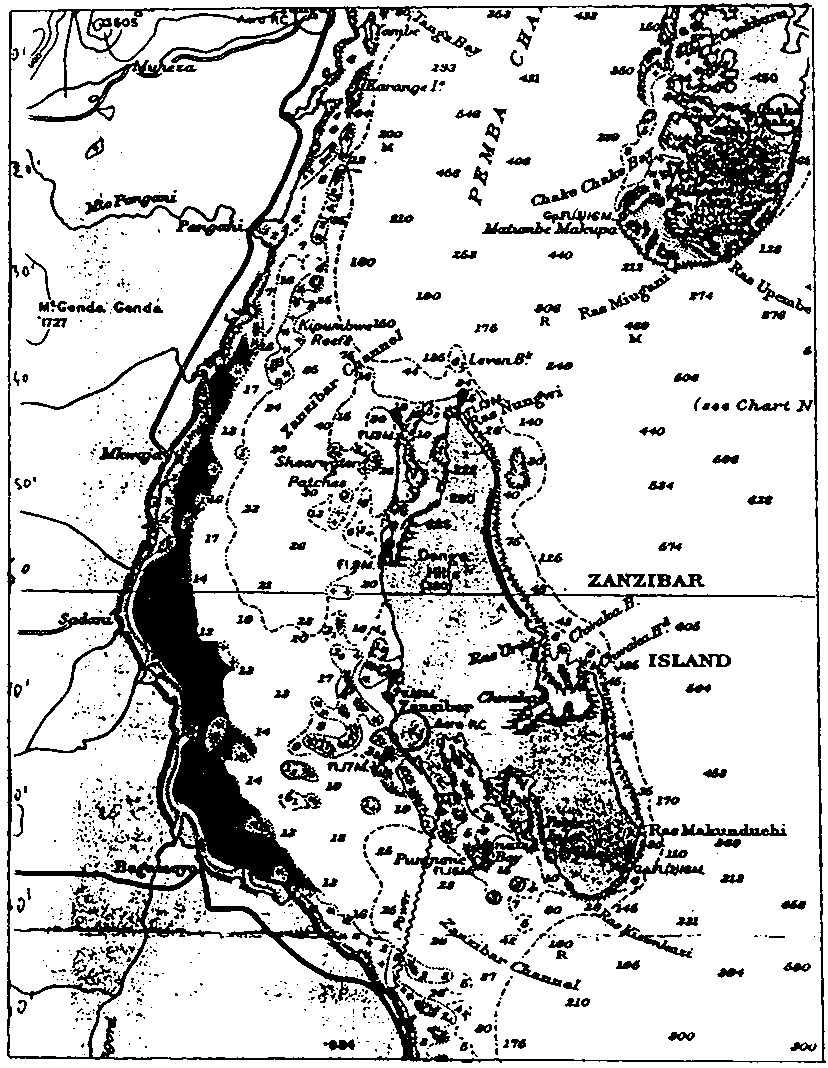
The exploitation of the shrimp occurs at two quite separate locations. The biggest and hence more productive fishing ground is adjacent to the Rufiji delta; the other ground is in the vicinity of the villages of Bagamoyo and Sadaani. As a consequence of the available data being of insufficient detail, the assessments were largely undertaken in respect to the data for the two grounds combined.
These data mainly consisted of the catch and effort statistics for each of the artisanal and trawler components of the fishery. Important additional data were collected during a census and socio-economic survey of the artisanal fishery undertaken shortly prior to the Workshop.
SWIOP also funded two authors' contracts in support of the Workshop. The recipients each produced a report, one giving a description of the present management regime applying to the fishery, the other dealing with the economics of the collection and export of shrimp caught by the artisanal fishermen.
Economic data for the trawler component of the fishery was provided by the parastatal Tanzania Fisheries Corporation. Some of the foreign joint venture trawler companies were also approached for economic data but proved to be largely uncooperative.
The Workshop provided the opportunity for further field testing of BEAM IV, the bio-economic model and associated micro-computer programmes developed by FAO staff in Rome. This was greatly facilitated by the author of the programmes being present at the Workshop.
An important feature of the model was that it readily allowed for many interlocking fishery components (eg. trawl and artisanal) and species. Furthermore the stock assessment parameters of recruitment, growth, mortality and fishing effort could be varied both spatially and across many time intervals.
The conduct of the Workshop involved the participants forming groups. Each was given responsibility for the analyses and reports preparation in respect to one or more of the topics given below.
General
Description of the fishery characteristics;
Description of the current management regime;
Stock Assessment
Stock assessment analyses including application of "swept area", "production" and "length based" methods;
Costs and earnings analyses of the various fishery components;
Bio-economic Modelling
Bio-economic performance of the fishery with present and alternative management regimes.
A full day seminar took place on July 27 at which each group presented its results and conclusions. Senior staff of the Fisheries Division and each of the Tanzania Fisheries Research Institute and Tanzania Fisheries Corporation participated during the Seminar.
Preamble:
The fishery is presently comprised of an industrial trawler component and an artisanal component. During 1989 there were sixteen trawlers engaged, two belonging to the parastatal Tanzania Fisheries Corporation (TAFICO) and the rest being foreign-owned. The landings from these vessels included 974 tonnes (whole weight) of shrimp and 1,069 tonnes of fish by-catch. Almost all the shrimp were exported. The wholesale (fob) value of the shrimp was probably in the order of US$ 5.5 million.
On the basis of data collected during a socio-economic study undertaken immediately prior to the Workshop, the estimated landings by the about 859 artisanal fishing units in 1989 was 1,212 tonnes of shrimp suitable for export, along with over 3,000 tonnes of fish. An estimate of the value of this shrimp on the export market, assuming a price 2/3rd that for the shrimp caught from trawlers, is about US$ 4.5 million. The quantity that was actually exported is not known.
As presently managed, the trawler component is subject to limitation on the number of participating vessels, zoning for the purpose of ensuring an appropriate spread of fishing effort over the productive grounds, a prohibition on trawling during the night-time, and the requirement to provide fishery statistics.
The foreign owned vessels are subject to additional controls including the requirement to provide for the on-board accommodation of observers, and a prohibition on the at-sea transshipment of catches. In respect to all the exporters there is a requirement that the Central Bank have access to 50 percent of the foreign currency derived from the export of shrimp.
Results from the bio-economic modelling:
In respect to all the management scenarios tested, the conclusion reached was that the economic performance of the fishery (ie. the artisanal and industrial trawler components combined) would be improved by a reduction in fishing effort. The criteria for measuring economic performance were wholesale value of catch, private profit, national net value added and net foreign exchange earnings.
In the underlying analyses it was assumed that the two components of the fishery were fully competitive (ie. the individual shrimp were vulnerable to capture by either trawling or the use of artisanal gears). Accordingly, any reduction in the fishing effort expended in one of the fishery components would result in a increase in catch in the other component, and vice versa.
The results in respect to most of the scenarios in fact suggest that maximum economic benefit would be achieved if the trawler component were completely (or almost completely) phased out. This was in part the consequence of the relatively low cost per unit weight of catch from artisanal fishing, and the near absence of a need for associated national expenditures in foreign currency.
This result is somewhat misleading, however, as in all the analyses it was assumed that the entire artisanal catch is exported and that the prices received are the same as for the industrial catch. In fact not all the artisanal catch is exported, nor are the same prices being received as for the industrial catch.
Furthermore, in the event that the two components of the fishery are not fully competitive as assumed, and a proportion of the shrimp are only vulnerable to capture from trawling, then phasing out this component of the fishery would be wasteful.
The results concerning whether applying a closed season to the trawler component of the fishery might lead to improved economic performance are somewhat ambiguous. In the event of the fishing effort in this component being substantially reduced, it seems that introducing a closed season would not lead to any improvement in performance.
If, however, the fishing effort in the trawler component is maintained at contemporary levels, a modest improvement in performance is likely to result from introducing a closed season.
Other results with implications for management:
According to the previously mentioned socio-economic study, the catching of shrimp by the artisanal fishermen is highly remunerative. This may lead in the coming years to an increase in the fishing effort (eg. from an influx of additional fishermen). Such an event would strengthen the justification for reducing the effort by the trawler component. (The alternative of controlling the effort of the artisanal fishermen is believed to be hardly practical).
The estimate obtained for the maximum sustainable yield (MSY) for the trawler component of the fishery was in the order of 1,000 to 1,100 tonnes. Three independent stock assessment methods and data sets were used and all provided very similar answers. These values are only marginally greater than the reported catch in 1989. As such, while the extent by which the fishing effort in the trawler component should be reduced is not clear, there appears to be strong justification for not allowing the effort to increase.
Concerning the financial performance of the TAFICO vessels, it seems that they are less profitable than the foreign owned vessels. While achieving almost identical catch rates (after adjustment for the different sized vessels) and hence gross earnings, the TAFICO vessels appear to be associated with higher costs. The latter was largely the consequence of excessive on-shore storage, processing and marketing capacity.
The alternative approaches identified for offsetting these higher costs were for TAFICO to discard some of this capacity or operate additional vessel(s). It was understood that the shortage of foreign currency had so far prevented the company implementing the second alternative.
The results from a costs and earnings analysis of the collection and export of the shrimp from the artisanal fishermen indicate that the profitability from these activities is small. This was suggested as having been partly compensated in the case of the exporters by virtue of them being able to gain access to foreign currency. The latter could be used to generate additional profits (in local currency) from the importation and resale of scarce commodities and possibly also from exchanging on the black market.
One implication from the above is that in the absence of being able to generate additional profit in the ways described, the shrimp prices and the associated earnings by the fishermen might be reduced. This in turn could act as a disincentive to an increase in fishing effort within the artisanal component.
Some Government priorities for management1:
1
The content of this sub-section is a summary of a statement to the Workshop by the Director of Fisheries (Mr W. Sichone).
The Government's policy in respect to the management of fisheries gives priority to maintaining socio-political stability and economic development, particularly with regard to the rural communities. It seeks to enhance the incomes of the rural people, even if this is in conflict with national economic objectives (eg. the maximisation of net foreign exchange earnings).
In the context of the shrimp fishery, the policy is reflected by the decision to restrict the number of trawlers, at least until the inter-relationship between trawling and the performance of the artisanal component of the fishery is known.
The Government is also aware that the catch from the trawlers is close to the estimated MSY. As such the decision to limit the number also seeks to avoid both over-investment and stock depletion, and in turn to assist TAFICO to operate profitably.
In respect to the implementation and enforcement of management, the Government's resources are recognised as being modest. Furthermore, to the present time the extent of the likely benefits from management were not well defined. It recognises, however, the need to improve the quality of reporting by the observers placed on-board the foreign owned vessels, and is hopeful that this can be achieved through the provision of additional training.
Some future research priorities:
In the context of the future workplan of the Fisheries Division and the Tanzania Fisheries Research Institute (TAFIRI), the following situations were identified by the Workshop as justifying additional research.
(i) As already mentioned, the data collected during the socio-economic survey undertaken prior to the Workshop was used to estimate the catch in 1989 for the artisanal component of the fishery. The estimate of 1,212 tonnes of shrimp suitable for export is some 3 times greater than the official estimates of the Fisheries Division. There is an obvious need to clarify this situation.
A feature of the socio-economic survey which may have contributed to the discrepancy was that the information provided was based on memory recall. The mean catch rates per fishing unit determined from the responses were 15 kg/day for shrimp (all species) and 10 kg/day for the exportable varieties. This could be readily checked by actually weighing catches at the landing sites.
(ii) Very few data were available to the Workshop concerning the size composition of the shrimp in the catches. In the case of the shrimp caught from trawling, the size compositions (for the sexes combined, not separately) were able to be estimated from information on the catch weights in each category of commercial size grade. No such information were provided in respect to the shrimp caught by the artisanal fishermen.
These were particularly serious shortcomings as size compositions by species and sex are highly valuable data for understanding the impact of fishing on the stocks, as well as the inter-relationship between the trawler and artisanal components of the fishery.
(iii) While not able to be established on the basis of the data provided to the Workshop, it is likely that certain of the gears (eg. mosquito nets) used by the artisanal fishermen are damaging in the sense of catching juveniles. It is also possible that fishing is sometimes taking place at localities where the juveniles are particularly abundant.
The capture of juveniles is wasteful, in that there are both yield and price gains to be made by allowing the shrimp to grow to a larger size before capture. As such it is highly desirable that their distribution and occurrence in the catches become better known. Ultimately this could lead to changes in the management of the fishery so as to minimise the capture of juveniles.
(iv) As previously mentioned, an element of the management regime applying to the trawler component of the fishery is the prohibition on fishing from 6.00 pm to 6.00 am. This was introduced as a contribution towards minimising the conflict with the artisanal fishermen operating on the same grounds.
In nearby Madagascar the catch rates applying to both the tiger and brown shrimp (but not the white shrimp) are highest at night-time, and it is only during the early months of each season that fishing occurs during day-time. It would therefore seem useful to investigate whether enhanced catch rates can be achieved from night-time fishing in Tanzania.
Most of the above situations relate to research activities of relatively short duration. The Workshop recognised the need to strengthen the existing long-term data collection systems. The Catch Assessment Survey (CAS) for the collection of catch and effort data was shown during the Workshop to be producing grossly inadequate statistics for the management of the shrimp fishery. In respect to the placement of observers on the foreign owned trawlers, negligible quantities of useful data are being generated.
Having in mind the great importance of the shrimp fishery, the Workshop considered that high priority should be given to providing the necessary financial and manpower support to research. Furthermore, that a mechanism be established to ensure coordination in the research and associated activities of the Fisheries Division and TAFIRI, as well as to ensure that the research undertaken is appropriate to the needs, both in quantity and type.
| Name | Address |
| KENYA | |
| Mr. Enoch WAKWABI (Fishery Biologist) |
Fishery Biologist Kenya Marine Fisheries Research Institute (KMFRI) P.O. Box 81651 MOMBASA Coast Province |
| TANZANIA | |
| Mr. Winfried HAULE (Fishery Biologist) |
Senior Fisheries Officer Fisheries Division P.O. Box 2462 DAR-ES-SALAAM |
| Mr. S.P.N. KIMARO (Fishery Biologist) |
Senior Fisheries Officer Kunduchi Fisheries Institute P.O. Box 60091 DAR-ES-SALAAM |
| Ms. Eronica LYIMO (Fishery Statistician) |
Senior Fisheries Officer Fisheries Division P.O. Box 2462 DAR-ES-SALAAM |
| Mr. Charles MAHIKA (Fishery Biologist) |
Research Officer Tanzania Fisheries Research Institute P.O. Box 9750 DAR-ES-SALAAM |
| Mr. B.S. MNGULWI (Fishery Economist) |
Fisheries Officer Fisheries Division P.O. Box 2462 DAR-ES-SALAAM |
| Mr. Sebastian MUMWI (Fishery Economist) |
Fisheries Officer Fisheries Division P.O. Box 2462 DAR-ES-SALAAM |
| Mr. Bakari MWAMOTO (Fishery Planner) |
Planning Officer Tanzania Fisheries Corporation P.O. Box 4296 DAR-ES-SALAAM |
| Mr. J.M. PUNGWE (Fishery Biologist) |
Senior Artisanal Fisheries Officer Regional Fisheries Office P.O. Box 30080 KIBAHA |
| Mr. Chikambi RUMISHA (Fishery Biologist) |
Fisheries Officer Fisheries Division P.O. Box 2462 DAR-ES-SALAAM |
| FAO Rome | |
| Ms. Erika SEKI (Fishery Socio-Economist) |
Associate Professional Officer FAO Headquarters Via delle Terme di Caracalla 00100 ROME Italy |
| Mr. Per SPARRE (Fishery Biologist) |
Fishery Resources Officer FAO Headquarters Via delle Terme di Caracalla 00100 ROME Italy |
| FAO SEYCHELLES | |
| Mr. David ARDILL (Fishery Biologist) |
Project Manager FAO Fishery Project P.O. Box 487 VICTORIA, Mahé Seychelles |
| Mr. Guido CARRARA (Fishery Biologist)* |
Fishery Statistician FAO Fishery Project P.O. Box 487 VICTORIA, Mahé Seychelles |
| Mr. Mark HOEKSTRA (Fishery Socio-Economist) |
Associate Professional Officer FAO Fishery Project P.O. Box 487 VICTORIA, Mahé Seychelles |
| Mr. Michael SANDERS (Fishery Biologist) |
Senior Fishery Development Specialist FAO Fishery Project P.O. Box 487 VICTORIA, Mahé Seychelles |
| CONSULTANT | |
| Mr Niels VESTERGAARD (Fishery Economist) |
Fishery Economist Danish Institute of Fisheries Economic Research Glentevy 7 6705 Esbjerg ø Denmark |
4. Socio-economic survey of the artisanal shrimp fishery in Tanzania (Paper 1)
5. Collection and export of the shrimp caught by the artisanal fishermen (Paper 2)
6. Description of the industrial shrimp trawl fishery in Tanzania (Paper 3)
7. Management regime applying to the shrimp fishery in Tanzania (Paper 4)
by
Erika SEKI
FAO Headquarters, ROME
and
Guido CARRARA
FAO Fisheries Project
P.O. Box 487, Victoria, SEYCHELLES
1. INTRODUCTION
The objective was to assess some of the socio-economic characteristics and performance of the artisanal shrimp fishery in Tanzania. In particular, the survey findings were to provide input to the bio-economic modelling of the fishery (see Paper 11 in these Proceedings). The survey, therefore, focused on obtaining information;
-to identify the characteristics of both the fishing and collecting units,
-to determine the magnitude and seasonality of the catch and effort, and
-to collect costs and earnings information.
In addition to the methodology, this report provides the results in respect to the first two of these items. The results from the analysis of the costs and earnings information are given in Paper 8 of the Proceedings.
2. DESIGN AND ORGANISATION OF THE SURVEY
2.1 Survey population
The units of enquiry were Shrimp Fishing Units (SFUs) and Shrimp Collecting Units (SCUs). An SFU was defined as the combination of fishing gear, crew and often although not always a fishing boat, targeting the shrimp stock on the shallow water fishing grounds. An SCU was defined as one or a group of operators engaged in purchasing shrimp directly from the SFUs.
In addition to interviewing persons in charge of SFUs and SCUs, village headmen were also interviewed in each village/fishing camp. This was in order to collect information on the characteristics of the survey area and shrimp fishery and to supplement information from the other sources.
2.2 Methodology of data collection
Formal interviews were conducted by enumerators using structured questionnaires. Different questionnaires were used for fishermen (SFUs) and for collectors (SCUs). Interview schedules including open ended questions were used when interviewing the village headmen.
The three types of questionnaire were prepared initially in English and then translated into Swahili. The latter were finalized in Dar-es-Salaam, after being edited and proof-read by research officers of the Fisheries Division, Ministry of Land, Natural Resources and Tourism (MLNRT).
2.3 Sampling procedure
There were two components in the survey of SFUs: a census and a sample survey. In the census an attempt was made at total enumeration of the SFUs engaged in shrimp fishing during the previous twelve months.
Interviews were held either at the landing sites, collecting points or village centres. In the few villages where the majority of SFUs were not engaged in shrimp fishing at the time of conducting interviews, due to other activities (eg. farming), representatives from each SFU were called for interview by the village headman, or enumerators made home visits.
With regard to the sample survey, interviews were conducted in respect of 20% (on a few occasions 10%) of the SFUs at each site. This was achieved by completing an additional questionnaire in respect to every fifth SFU encountered during the census survey. In the event that the fishermen in charge of the fifth SFU was not able to be interviewed, the sixth was chosen.
2.4 Data collection and processing
The survey team consisted of three supervisors and six enumerators. A two-day training course was conducted for these persons immediately prior to the survey. The six enumerators were officers normally responsible for the collection of fishery statistics: two from the regional fishery office in Kibaha, two from the district office in Bagamoyo, one from the district office in Rufiji and one from the headquarters of the Fisheries Division in Dar-es-Salaam.
Data collection was undertaken in respect to the Sadaani area in the period 27 to 28 May 1990 and for the Rufiji area from the 30 May to 12 June 1990. A total of 14 fishing villages and camps were visited and 804 SFUs were enumerated (see Annex).
In addition, 14 village headmen and the collectors in charge of 27 SCUs were interviewed.
2.5 Limitations of the survey
The survey may not have covered some of the part-time fishermen who are also engaged in rice farming, as this work is undertaken remote from the fishing villages. The survey period coincided with the rice harvest.
The survey data on catch rates may have been biased because the fishermen were requested to recall the mean catch per day in each of the seasons. It was observed that fishermen sometimes had difficulties to remember such data.
Sample weighing of a selection of catches at the time of the interviews might have facilitated data validation, although a more comprehensive weekly sample survey throughout the year would be the preferable approach (in respect to any future work).
There was also a misunderstanding with regard to the question about the estimated life span of fishing boats and gears. Some of the enumerators understood it as the remaining life of the asset while others understood it as the entire life span. As a consequence, the age structure of the boats had to be used to estimate their average life span.1
1
Mean boat life span = (S (Nt-1-Nt).(t-0.5))/(S (Nt-1-Nt)) where t is the boat age and N is the number of boats of specified age.
3. CHARACTERISTICS OF THE ARTISANAL SHRIMP FISHING UNITS (SFUS)
3.1 Crafts and crews
The dugout canoe called Mtumbwi is the most commonly used in the Rufiji fishing area other than at Mshindaji village (site code: 13) where all the SFUs were without canoes. Out of 726 SFUs in the Rufiji area, 608 were with Mtumbwi and one with a Mashua (Table 1). The Mashua was operated from Nyamisati (site code: 14)
Table 1: Number of SFUs, crew and boats by fishing village.
Fishing Village |
No. of SFUs |
No.of Crew |
Mean No. of Crew/SFU |
No.of Boats |
01 |
40 |
81 |
2.03 |
0 |
02 |
12 |
24 |
2.00 |
0 |
03 |
26 |
51 |
1.96 |
0 |
05 |
206 |
344 |
1.67 |
206 |
06 |
43 |
78 |
1.81 |
11 |
07 |
59 |
113 |
1.92 |
59 |
08 |
83 |
163 |
1.96 |
76 |
09 |
16 |
30 |
1.88 |
15 |
10 |
45 |
92 |
2.04 |
44 |
11 |
100 |
195 |
1.95 |
96 |
12 |
40 |
77 |
1.93 |
38 |
13 |
67 |
78 |
1.16 |
0 |
14 |
67 |
118 |
1.76 |
64 |
TOTAL |
804 |
1,444 |
1.80 |
609 |
In the Sadaani area (site code: 01, 02 and 03) all of the SFUs encountered were without a canoe, although in Kajanjo village (site code: 02) boats normally used for collection were occasionally used for transporting SFUs to and from the fishing ground.
The mean age of the dugout canoes was determined as four years, with most being of age less than five years. The longer lasting canoes were generally made from hard wood (rather than mango trees).
Mtumbwi are usually propelled by oars and poles. Only one outboard engine was observed which was attached to the planked boat at Nyamisati (site code: 14). Some Mtumbwi were equipped with sails, especially those operated in the open sea.
The mean number of crew per SFU (including fisherman in charge) was determined as 1.8 persons (Table 1). Some 71% of all the SFUs included two crew members, and 25% were with one crew (Table 2).
Table 2: Number of Crew per SFU.
Fishing Location |
Number of Crew |
Total No. of SFUs |
Total No. of Crew |
|||
1 |
2 |
3 |
>3 |
|||
| Sadaani | 1 |
76 |
1 |
0 |
78 |
156 |
| Rufiji | 204 |
496 |
15 |
11 |
726 |
1,285 |
| Total | 205 |
572 |
16 |
11 |
804 |
1,441 |
3.2 Type of gears
Mesh nets and seine nets were found to be the predominant gears used both in the Sadaani and Rufiji areas. In the Sadaani area, all the SFUs encountered were operated with one or more mesh nets. In the Rufiji area, 61.2% (445 out of 726 SFUs) were operated with mesh nets, and 26.7% (194 out of 726 SFUs) with seine nets.
Both the mesh nets and seine nets were found to be made of nylon yarn with mesh sizes ranging from 1 to 2 inches, and 1/16 to 1/2 inches respectively. The mesh nets were two ply and the seine nets ranged between six and eight ply.
A brief comment in respect of each gear is given below;
Uzio is a fixed trap consisting of long fenced screens made from poles cut from mangrove trees, narrowing into a gate-way leading to a catch chamber.
Uzio were particularly observed in the Msindaji village (Site code: 13) in the Rufiji area. In this village each fishing unit is allotted a specific space for setting uzio by the village headman. The rights to such fishing locations were claimed to be passed on through inheritance.
Wando is a fixed trap of the same design as the Uzio, but made of manufactured materials such as wire mesh or nylon netting.
The fixed traps (Uzio and Wando) are set on the seaward side of the inter-tidal zone for trapping shrimp during the outgoing tide.
Utanga is a barrier made of mangrove poles used in the small creeks and channels at the edges of the mangroves. Only in respect to seven SFUs were Utanga reported as the gear in use. The materials (remaining from dismantled Utanga) are more often used nowdays as platforms for smoking fish and shrimp.
Mesh nets are either set between mangrove poles, towed by two persons operating on foot (i.e. like a seine net), or drifted with one end of the net attached to the Mtumbwi. This latter operation was particularly observed at Kiasi (Sitecode: 08), Bundki (Sitecode: 10) and Kiomboni (Sitecode: 11).
Seine nets are most often operated by two persons either on foot or with Mtumbwi. Wooden bars are attached at each end and the fishermen drag the nets in the shallow waters during low tide.
Mosquito nets (Chandalua/Tandio) which are somewhat similar in design to beach seines although made of mosquito netting and generally much shorter in length, are commonly used by women for seining in the shallows during low tide.
3.3 Length of gears
The unit lengths reported for the different gears are summarized in Table 3. There were two types of mesh nets with different mean lengths of 113 yards (103 metres) and 378 yards (344 metres). The former were mainly operated from dugout canoes while drifting with one end attached. The latter is set across channels within the intertidal zone.
The small seine nets, called Kivaju, Chandalua or Tandio are only between 10 and 20 yards (9 and 18 metres) long, while the large seine nets (Nyavu) are often more than 50 yards (46 metres) long.
The lengths of uzio (total length of two arms) were reported as ranging between 100 to 400 yards (92 to 366 metres) with a mean length of 227 yards (207 metres). The mean length of a wando was determined as 120 yards (110 metres).
Table 3: Length of gears.
Gear Type |
Local Gear Name |
Mean Length |
|
(yard) |
(metre) |
||
| Mesh Net
|
Nyavu (short) | 113 |
103 |
| Nyavu (long) | 378 |
344 |
|
| Seine Net
|
Kijavu/Chandalua/Tandio (short) | 14 |
13 |
| Nyavu (long) | 130 |
118 |
|
| Fixed trap
|
Uzio (short) | 140 |
127 |
| Uzio (long) | 356 |
324 |
|
| Wando | 120 |
109 |
|
3.4. Ownership of boats and gears
Some 26 percent of the dugout canoes were hired while the rest were owned by the operators of the SFUs (Table 4). The owners of hired boats were often relatives or other fishermen. In the cases where the boat was owned by a close relative, there were minimal or no hiring charges.
There were three types of arrangements in the provision of gears by middlemen (SCUs). The first arrangement was to provide gears free of charge but with an obligation to sell produce to the middleman. This arrangement was widely observed in the Sadaani fishing ground (Site Code: 01, 02 and 03).
The second arrangement was to provide gear at actual cost, with the payment being effected during the fishing season from the sale of the catches. In this case, there was no obligatory arrangement to sell product to the provider of the gear.
The third type of arrangement was to provide gears with some interest being charged at the time of repayment. Eight to ten percent interest was charged in addition to the actual cost of the gears.
Table 4: Percentage of hired boats and gears.
Fishing Village Code |
Boat |
Mesh Net Small |
Mesh Net Large |
Seine Net Small |
Seine Net Large |
Uzio Small |
Uzio Large |
01 |
n.a. |
83.3 |
n.a. |
n.a. |
n.a. |
n.a. |
n.a. |
02 |
n.a. |
100.0 |
n.a. |
n.a. |
n.a. |
n.a. |
n.a. |
03 |
n.a. |
25.0 |
n.a. |
n.a. |
n.a. |
0.0 |
n.a. |
05 |
20.0 |
11.5 |
0.0 |
n.a. |
0.0 |
n.a. |
n.a. |
06 |
100.0 |
0.0 |
n.a. |
20.0 |
n.a. |
n.a. |
n.a. |
07 |
0.0 |
0.0 |
n.a. |
n.a. |
0.0 |
n.a. |
n.a. |
08 |
10.0 |
10.0 |
n.a. |
0.0 |
n.a. |
0.0 |
n.a. |
09 |
0.0 |
n.a. |
n.a. |
0.0 |
n.a. |
n.a. |
n.a. |
10 |
50.0 |
0.0 |
0.0 |
n.a. |
n.a. |
n.a. |
n.a. |
11 |
12.5 |
0.0 |
0.0 |
12.5 |
n.a. |
33.3 |
0.0 |
12 |
57.1 |
n.a. |
n.a. |
80.0 |
0.0 |
0.0 |
n.a. |
13 |
n.a. |
n.a. |
n.a. |
n.a. |
n.a. |
28.6 |
50.0 |
14 |
55.6 |
50.0 |
n.a. |
0.0 |
100.0 |
50.0 |
n.a. |
Means |
26.1 |
20.3 |
0.0 |
8.7 |
62.5 |
25.0 |
33.3 |
n.a. means not applicable.
4. CATCH AND EFFORT
4.1 Catch and effort
The annual mean number of fishing days per SFU was determined from the product of the mean number of months (during which the SFU made at least one shrimp fishing trip) and the mean number of fishing days per month. The mean number of fishing days per SFU so obtained is close to 160 days (Table 5). There was no significant difference between the estimates for the Rufiji and Sadaani grounds.
Table 5: Mean number of fishing months and days/month per SFU.
Item |
Long rain Period |
Short rain Period |
Inter-rain Period |
| No. of Months | 3.4 |
2.3 |
3.7 |
| No. of Days/Month | 17.0 |
16.5 |
16.6 |
| No. of Days/Year | 57.8 |
38.0 |
61.4 |
The mean catch of shrimp per fishing day was estimated for each period of the year from an adjusted database in which the catch per day values above 20 kg (all shrimp species combined) were excluded. The estimates, about 15 kg/day, included some 10 kg/day of white and tiger shrimp. There was no significant difference between the Rufiji and Sadaani grounds.
Table 6: Mean weight (kg) of shrimp and fish caught per SFU (in kg).
Item |
Long rain* |
Short rain* |
Inter-rain* |
Annual |
||||
/day |
/season |
/day |
/season |
/day |
/season |
/day |
/yr |
|
| White | 6.7 |
360 |
6.3 |
247 |
5.5 |
255 |
6.2 |
862 |
| Tiger | 4.1 |
202 |
4.5 |
177 |
4.3 |
170 |
4.3 |
549 |
| Small Quality | 4.9 |
279 |
5.6 |
270 |
5.1 |
279 |
5.2 |
828 |
| Fish | 6.6 |
380 |
8.0 |
354 |
8.3 |
475 |
7.7 |
1,209 |
| Other Fish | 14.6 |
877 |
16.1 |
747 |
13.3 |
1,006 |
14.5 |
2,630 |
| * | Long rain period: March-June |
| Short rain period: October-December | |
| Inter rain period: January-February, July-September |
The annual mean catch of shrimp per SFU was determined as 2,239 tonnes, and included 1,411 tonnes of white and tiger shrimp (Table 6). The proportion of shrimp in the total catch was 37 percent; with the rest being fish by-catch. The latter was categorised into Quality fish (having high value) and other types of fish.
4.2 Annual catch of shrimp and fish
The estimate of the number of SFUs operated during the twelve months was based on the information obtained from the village headmen. The number so obtained for the Sadaani and Rufiji areas combined is 859 SFUs. The product of this and the above catches per SFU provided the following estimates of the annual catch for the fishery;
| (tonnes) | |
| white shrimp | 740 |
| tiger shrimp | 472 |
| small shrimp | 711 |
| sub-total | 1,923 |
| quality fish | 1,039 |
| other fish | 2,259 |
| total | 5,221 |
4.3 Influence of mesh size on shrimp catch rates
It was found, through observation of the fishing gears and through interviews of village headmen in most of the villages, that the gear mesh size used are either in the range of 0.25 - 0.5 inches (site code: 06, 07, 08 and 12) or of 1.0 - 2.0 inches (site code: 01, 02, 03, 05, 09, 10 and 14). Table 7 shows the catch rate of shrimp for each of these ranges of mesh sizes. It is evident that the smaller the mesh size the greater the catch rate, and the greater the proportion of the small shrimp category.
Table 7: Catch rate (kg/day) of shrimp by gear mesh size
White |
Catch/day/SFU Tiger |
Small |
|
| Mesh size: 0.25 - 0.5" | |||
| Long rain period | 9.7 |
5.3 |
7.0 |
| Short rain period | 7.4 |
5.9 |
8.3 |
| Inter-rain period | 7.3 |
5.6 |
7.9 |
| Mesh size: 1.0 - 2.0" | |||
| Long rain period | 6.2 |
4.2 |
3.5 |
| Short rain period | 6.5 |
4.2 |
2.9 |
| Inter-rain period | 5.1 |
4.1 |
3.0 |
4.4 Shrimp catch rates by gear type and length
The shrimp catch rates and proportion of white, tiger and small shrimp by unit of gear are summarised in Table 8. The catch rates appear to be generally similar across gear types.
The shrimp species compositions seem to have been influenced by the gear type and fishing location. The proportion of white shrimp was greatest when using mesh nets. These are mainly Operated either in the inter-tidal zone or river mouths. The proportion of small shrimp was greatest when using Uzio. These are set along the outer edge of the inter-tidal zone.
Table 8: Daily catch rate (kg/day) of shrimp by gear type.
Mesh net long |
Mesh net short |
Seine net long |
Seine net short |
Uzio long |
Uzio short |
||
| Long rain (kg): | 13.8 |
16.0 |
24.1 |
16.8 |
17.3 |
16.9 |
|
| White shrimp (%) | 46 |
40 |
34 |
43 |
22 |
34 |
|
| Tiger shrimp (%) | 25 |
27 |
24 |
17 |
23 |
21 |
|
| Small shrimp (%) | 28 |
33 |
41 |
40 |
55 |
45 |
|
| Short rain (kg): | 14.7 |
17.6 |
23.5 |
14.9 |
7.8 |
18.3 |
|
| White shrimp (%) | 41 |
39 |
21 |
36 |
18 |
31 |
|
| Tiger shrimp (%) | 21 |
28 |
15 |
23 |
5 |
26 |
|
| Small shrimp (%) | 38 |
33 |
64 |
41 |
77 |
43 |
|
| Inter-rain (kg): | 19.3 |
15.3 |
n.a. |
18.9 |
10.0 |
12.5 |
|
| White shrimp (%) | 46 |
32 |
n.a. |
35 |
41 |
26 |
|
| Tiger shrimp (%) | 21 |
27 |
n.a. |
31 |
9 |
28 |
|
| Small shrimp (%) | 33 |
41 |
n.a. |
34 |
50 |
46 |
|
4.5 Marketing the catch
Almost all the white and tiger shrimp were sold as fresh product (Table 9). The small shrimp are often either auto-consumed, or dried or smoked for the local markets. In the vicinity of Nyamisati (Site code: 12, 13 and 14) there were also buyers of dried shrimp for sale in Dar-es-Salaam.
Table 9: Proportion of shrimp catch sold as fresh product.
White (%) |
Tiger (%) |
Small (%) |
|
| Long rain | 99 |
100 |
9 |
| Short rain | 99 |
100 |
11 |
| Inter-rain | 99 |
100 |
11 |
Around 50-60 percent of the quality fish and 31 percent of the other fish were auto-consumed. The rest were either smoked or dried for the local market (Table 10). Small bony fish were prefered as dried product rather than in fresh form, while large fish are often eaten fresh by the fishermen themselves (in the absence of local buyers).
Table 10: Mean weight (kg) of fish auto-consumed per day.
Fishing Village Code |
Long rain |
Short rain |
Inter-rain |
|||
Quality Fish |
Other Fish |
Quality Fish |
Other Fish |
Quality Fish |
Other Fish |
|
| 01 | 4.00 |
4.00 |
5.00 |
4.00 |
3.00 |
2.00 |
| 02 | 3.00 |
4.00 |
2.00 |
4.00 |
1.00 |
3.00 |
| 03 | 1.33 |
3.33 |
1.33 |
3.33 |
1.33 |
2.00 |
| 05 | 4.29 |
1.71 |
6.43 |
1.71 |
3.29 |
1.43 |
| 06 | 2.00 |
3.00 |
6.00 |
8.00 |
6.00 |
8.00 |
| 07 | 3.25 |
4.00 |
4.13 |
4.00 |
5.25 |
5.00 |
| 08 | 2.33 |
3.78 |
4.33 |
3.78 |
5.22 |
3.78 |
| 09 | 0.00 |
1.00 |
0.00 |
1.00 |
0.00 |
1.00 |
| 10 | 2.00 |
1.00 |
2.00 |
1.50 |
2.00 |
1.50 |
| 11 | 1.80 |
4.80 |
2.40 |
6.00 |
2.80 |
6.60 |
| 12 | 2.50 |
2.50 |
2.25 |
3.25 |
2.25 |
2.50 |
| 13 | 2.50 |
21.50 |
11.50 |
16.50 |
2.00 |
9.00 |
| 14 | 7.60 |
9.20 |
9.60 |
13.20 |
15.80 |
7.20 |
| Mean | 3.18 |
4.59 |
4.69 |
5.10 |
4.82 |
4.16 |
5. CHARACTERISTICS OF SHRIMP COLLECTING UNITS
5.1 Logistic and storage facilities
The operators of 27 SCUs were interviewed during the survey. Their means of transporting the Collected shrimp were Boti (52 %), Mashua (37 %) and bicycles (11 %). All boats were equipped with one or two outboard engines (usually one is kept as spare) with mean engine horsepower of 24 Hp (Table 11).
Some collectors' boats (29 % in Sadaani and 57 % in Rufiji) were owned by middlemen based either in Bagamoyo, Nyamisati, Mafia or Dar-es-Salaam.
Table 11: Length, engine horse-power, crew size and ownership of boats.
Fishing Ground |
Av. no. of crew per SCU |
Av. length of boat (yard) |
Av. Engine (Hp) |
Boat & engine owned by middleman (%) |
| Sadaani | 4.7 |
13.0 |
18.9 |
28.6 |
| Rufiji | 4.1 |
11.3 |
26.2 |
57.1 |
| Mean | 4.3 |
11.8 |
24.1 |
41.7 |
The mean number of ice boxes per SCU was found to be 2.3 and the mean storage capacity per box as 48 cu. ft. (Table 12). The boxes were made of local wood covered with metal, polyethylene or fibre-glass sheeting. The wooden boxes were insulated with cork.
Table 12: Average number of ice boxes and quantity of ice per trip.
Fishing Ground |
Av. no. of ice boxes |
Av. quantity of ice/SCU/trip (kg) |
Av. size of ice box (cubic feet) |
| Sadaani | 3.0 |
595 |
36.8 |
| Rufiji | 2.1 |
649 |
51.9 |
| Average | 2.3 |
638 |
48.0 |
The ice was often purchased from TAFICO in Dar-es-Salaam. In the case of the Rufiji area, the ice is transported by vehicle to Nyamisati and from there loaded on the collecting boats. The average amount of ice carried per SCU per trip was determined as 638 kg.
5.3 Shrimp collecting effort by season
The mean number of shrimp collecting trips made by a collecting unit in the long, short and inter-rain periods was 4.1, 3.1 and 2.8 respectively (Table 13). The duration of a collecting trip was about five days. It was often mentioned by the collectors, that collecting operations became more difficult during the inter-rain periods because of the unfavorable weather and sea condition.
Table 13: Mean number of collection trips, collection days and quantity of shrimp collected per ' SCU.
Season |
No. of Collection trips/mth. |
No. of Days/trip |
Shrimp collection per trip |
Shrimp Collection per year (kg) |
||
| White (kg) | Tiger (kg) | Small (kg) | ||||
| Long rain | 4.1 |
5.2 |
344.4 |
87.1 |
22.2 |
7,441 |
| Short rain | 3.1 |
5.2 |
251.7 |
81.9 |
22.9 |
3,315 |
| Inter-rain | 2.8 |
5.7 |
177.8 |
57.0 |
24.1 |
3,625 |
| Annual Mean | 14,381 |
|||||
Note: In the estimation of the annual quantity of shrimp collected, the number of months in each of the long rain, short rain and inter-rain periods was 4, 3 and 5 months respectively.
5.4 Quantity of shrimp collected
The quantity of shrimp collected during each season was determined as the product of the mean number of SCU trips/month, the number of months and the mean weight of shrimp collected per trip (Table 13). The annual quantity collected per SCU is 14.4 tonnes, of which 13.4 tonnes were of the white and tiger shrimp. The total number of SCUs in operation was unknown, hence precluding the use of these results to get an alternative estimate of the fishery catch.
On the basis that the annual catch of white and tiger shrimp was 1,212 tonnes (Section 4.2) and the SCUs sampled during the survey were representative of all the SCUs, there were 90 collecting units in operation during the study period. This value is not inconsistant with the number of registered shrimp exporters (see Paper 2 of these Proceedings).
6. CONCLUDING COMMENTS
The estimates for the annual catch of 1,923 tonnes for shrimp (all species) and 1,212 tonnes for the white and tiger shrimp are very much greater than had been anticipated. The official statistics of the Fisheries Division give the shrimp catch by the artisanal fishermen as 536 tonnes (1988) and the exports as 247 tonnes. There is an obvious need to clarify this situation.
As previously mentioned, one of the shortcomings of the present survey was that the information provided was based on memory recall. This applies especially to the determination of the number of fishing days and the catch weight per fishing day.
In respect to the number of fishing days, the annual mean of 160 days per SFU seems reasonable. The Fisheries Division in fact applies 250 fishing days per year as a raising factor in the analysis of the artisanal fishery statistics.
It was unfortunate that none of the catches observed during the survey were actually weighed. This might have helped to verify the estimates of 15 kg per day for shrimp (all species) and 10 kg per day for white and tiger shrimp.
The other possible source of error is in the number of SFUs. As indicated earlier, 859 was the value used in the calculations. This is comprised of 804 SFUs for which interviews were held with the fishermen, with the balance being identified through questioning the village headmen.
In the event that the estimates of catch weight determined from the survey are correct, then it means that the artisanal catch is roughly double that from the industrial shrimp trawlers (974 tonnes in 1989).
Annex - NUMBER OF SFU RESPONDENTS BY FISHING VILLAGE.
Fishing Ground |
Village Code |
Village Name |
No. of Census Respondents |
No. of Sample Respondents |
| Sadaani | 01 |
Sadaani | 40 |
6 |
02 |
Uvinje | 12 |
3 |
|
03 |
Kajanjo | 26 |
5 |
|
| sub-total | 78 |
14 |
||
| Rufiji
|
05 |
Nyandutu | 206 |
29 |
06 |
Ponbwe | 43 |
7 |
|
07 |
Jaja | 59 |
12 |
|
08 |
Kiaji | 83 |
16 |
|
09 |
Kibanjo | 16 |
3 |
|
10 |
Bunduki | 45 |
6 |
|
11 |
Kiomboni | 100 |
16 |
|
12 |
Mchungu | 40 |
8 |
|
13 |
Msindaji | 67 |
11 |
|
14 |
Nyamisati | 67 |
9 |
|
| sub-total | 726 |
117 |
||
| total | 804 |
131 |
||
by
Bakar MWAMOTO
Tanzania Fisheries Corporation
P.O. Box 4296, DAR ES SALAAM, Tanzania
INTRODUCTION
The commercial exploitation of shrimp commenced in 1969 with the involvement of shrimp trawlers from Japan. The resulting joint venture company, Mwananchi Ocean Products Ltd (MOP), established export markets, particularly in Japan and the Far East. Following its demise in the early 1970s the quantities of catch and exports remained low.
Prior to 1983 the annual export of shrimp did not exceed 200 tonnes. The principal exporters were Dar Ocean Products Ltd and the Tanzania Fisheries Corporation (TAFICO). They obtained most of their products through collections from the artisanal fishermen. TAFICO also obtained some products from inefficiently operated industrial trawlers.
The production of TAFICO increased substantially from 1983 as a consequence of technical assistance from the Japanese Government. This included the granting of a 30 m industrial trawler and the provision of senior crew members from Japan. A second 28 m trawler was provided through grant aid from the Japanese in 1985.
Another significant development occurred in 1987 when the Government agreed to the licensing of foreign shrimp trawlers. The exports of shrimp reached 1 400 tonnes in 1989. At the same time there was a considerable increase in the number of exporters and in the collection and export of shrimp caught by the artisanal fishermen.
Much of this increased interest in exporting was encouraged by changes to the retention rules under the country's Economic Recovery Programme (ERP). These changes allowed for 50 percent of the foreign currency earnings to be retained by the exporters.
FISHERY LOCATIONS
Fishing is undertaken principally adjacent to the outflows of the Pangani and Ruvu Rivers to the north of Dar-es-Salaam, and in the delta of the Rufiji River to the south.
On the Pangani River the main collecting centre is the township of Pangani, which receives the catches from each of the Buyumi, Mkwaja and Kipumbwe villages. Important collecting centres along the Ruvu River are Sadaani village and Bagamoyo town.
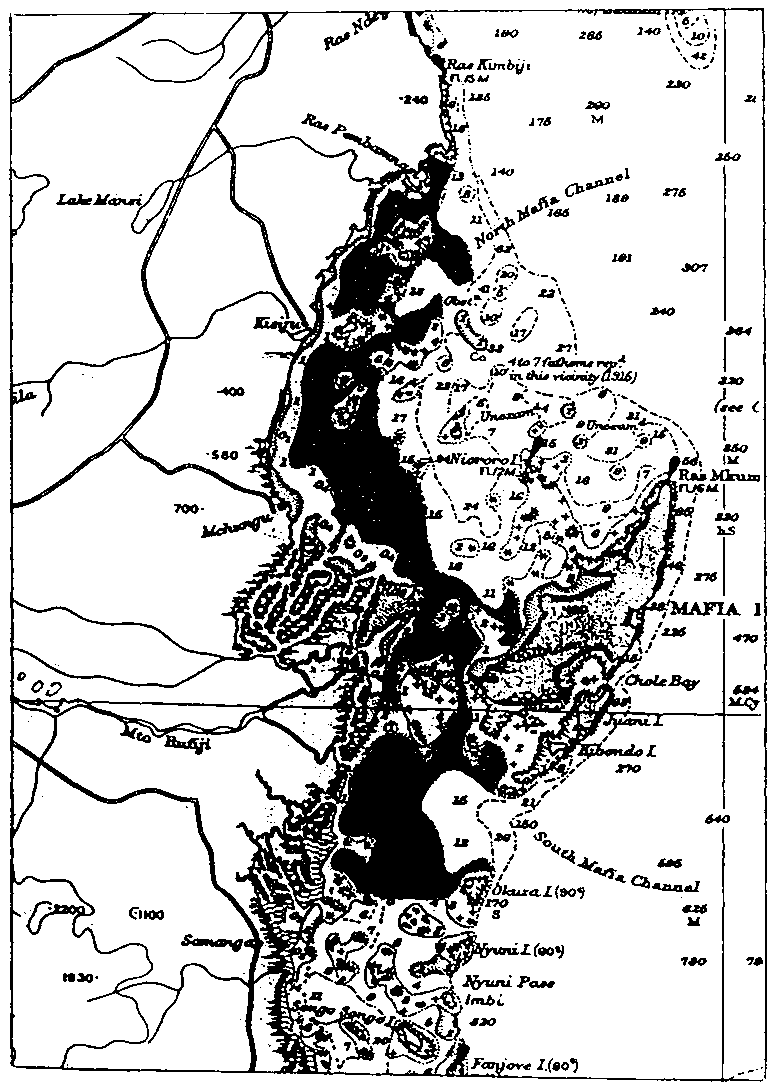
The main collecting centre in the Rufiji delta is Nyamisati village, which serves as the outlet for shrimp landed in the villages of Kiomboni, Twana, Mchungu Kibanjo, Kiasi, Msindaji and Bunduki. Kisiju is also an important supply village, although transport to the main road is only with the use of bicycles.
The other important collection centre in the delta is Ndundu Tawa village. Apart from the catches by its own fishermen, it receives shrimp from the villages of Ndutu, Muhora, Somanga Mbwera and Pombwe Jaja.
Other potential collecting centres exist outside the two areas so far mentioned. These are in Mafia and Kilwa. Transport links to both places are difficult, although both are accessible by boat.
SHRIMP EXPORTS AND PRODUCTION
The quantity of shrimp exported since the early 1980s has increased by ten-fold (see Table 1). Most of the increase has occurred from 1987, as the consequence of the licensing of foreign trawlers and the encouragement to exporters provided through the Economic Recovery Programme (see Table 2).
The estimated landings of shrimp in 1988 by the artisanal fishermen was 536 tonnes (source Fisheries Division, Statistics Section). This is certain to be an under-estimate having in mind the quantity exported (542 tonnes), the likelihood of additional quantities being exported without documentation and allowing for local consumption.
Table 1: Quantity of shrimp exports (tonnes)
Year |
1983 |
1984 |
1985 |
1986 |
1987 |
1988 |
1989 |
| Industrial | 109.3 |
117.1 |
89.9 |
142.4 |
421.8 |
788.9 |
930.7 |
| Artisanal | 32.4 |
36.6 |
35.0 |
73.6 |
133.1 |
542.0 |
502.1 |
| Totals | 141.7 |
153.7 |
124.9 |
216.0 |
554.9 |
1,330.9 |
1,432.8 |
| % Contribution (Artisanal) | 22.8% |
23.8% |
28.0% |
34.0% |
23.9% |
40.7% |
35.0% |
Source: Fisheries Division (Statistics Section)
Table 2: Number of shrimp exporters
Year |
1984 |
1985 |
1986 |
1987 |
1988 |
1989 |
| Registered | 5 |
7 |
208 |
144 |
345 |
142 |
| Operated | 3 |
4 |
113 |
68 |
102 |
62 |
| % Operated | 60% |
57.1% |
54.3% |
47.2% |
29.5% |
43.6% |
Source: Fisheries Division (Statistics Section)
COLLECTION OF THE CATCHES
The typical arrangement is through a two-step marketing channel involving fishermen, middlemen and exporters. The middlemen make arrangements with the fishermen in the villages whereby the latter receive fishing inputs (mainly nets), a number of ice boxes and a regular supply of ice. In the major centres like Nyamisati, Sadaani and Pangani the middlemen are required to pay taxes in support of local government and village development.
Agreements are reached between middlemen and fishermen, whereby the middlemen in return for the inputs they provide are promised they will receive whatever is caught. The cost of the nets supplied may be progressively deducted from the revenues to the fishermen. In many cases however, the inputs of the middlemen are regarded as capital investment and no direct reimbursement is sought from the fishermen.
The mode of operation of individual middlemen depends on the number and location of the collecting centres and the most convenient mode of transport available. The ice is supplied from Dar-es-Salaam by small truck and then by boat in the case of the Rufiji delta.
A return trip from Dar-es-Salaam is typically between 5-7 days, during which the ice boxes are re-filled with ice and shrimp are purchased from the fishermen.
In some locations within the Rufiji delta, the middlemen have established subsidiary collection centres in order to limit the duration of the trip from Dar-es-Salaam and increase the quantity of shrimp purchased. The transport from these sub-centres to the main collecting centre is usually by boat.
PRICES TO THE FISHERMEN
Prices are negotiated periodically between the middlemen and fishermen. Separate prices are offered for tiger shrimp and white shrimp. The average price during 1989 was between T.Sh. 650-750 for tiger shrimp and about T.Sh.200-250 for white shrimp (see Table 3).
Table 3: Indicative prices (T.Sh.) in 1989
Village |
Jan.-Mar. |
April-June |
July-Sept. |
Oct.-Dec. |
||||
Tiger |
White |
Tiger |
White |
Tiger |
White |
Tiger |
White |
|
| Nyamisati | 739 |
211 |
757 |
207 |
794 |
222 |
n.a. |
n.a. |
| Sadaani | 661 |
191 |
715 |
224 |
749 |
242 |
n.a. |
n.a. |
| Means | 700 |
201 |
736 |
215 |
771 |
232 |
n.a. |
n.a. |
INVESTMENT COSTS FOR COLLECTION
In the case of the few middlemen who choose to own their own boat and/or vehicle, the likely investment required to enable the collection of 500 kg of shrimp per trip was determined as T.Sh. 2 million (see Table 4).
Based on the interviews made however, the much more likely scenario is that the middlemen hire all the items except the ice boxes and the fishing nets to be provided to the fishermen.
Table 4: Indicative investment costs (T.Sh.) in 1989
Item |
Costs (T.Sh.) |
| Collecting Boat (wooden) 20-25 ft | 200 000 |
| Outboard motor 25 Hp engine | 350 000 |
| Ice Boxes (4) | 240 000 |
| One motor vehicle P/up or L/Rover | 1 240 000 |
| Total | 2 030 000 |
OPERATING COSTS FOR COLLECTION
The operating costs to the middlemen are those associated with the provision of ice, fuel and oil for running the boat and vehicle, capital to enable the purchase of shrimp, remuneration to the driver and boat crew and allowances for food, local taxes and levies, and the hire of a vehicle and/or boat.
On the basis of interviews made with three prominent middlemen, indicative costs per trip were determined as between T.Sh. 247-280 thousand (see Table 5).
Table 5: Indicative collection costs per trip (T.Sh.) in 1989
Item |
Costs (T.Sh.) |
||
Middleman A |
Middleman B |
Middleman C |
|
| Ice supplies* (50pc) | 15 000 |
15 000 |
15 000 |
| Fuel/Oils | 30 000 |
25 000 |
35 000 |
| Purchasing capital** (500kg) | 125 000 |
100 000 |
150 000 |
| Remuneration, food and allowances | 30 000 |
45 000 |
32 000 |
| Local taxes and levy | 5 000 |
7 000 |
8 000 |
| Motor vehicles/boat hiring and repair costs | 60 000 |
55 000 |
40 000 |
| Totals | 265 000 |
247 000 |
280 000 |
* Based on TAFICO price of T.Sh. 300 per block
** Based on 80% whole shrimp and 20% tiger shrimp
PRICES TO THE MIDDLEMEN
Most of the collectors are independent from the exporters. They sell their products to the exporters in Dar-es-Salaam. The average prices received by the middlemen in 1989 ranged from T.Sh. 450-500 for white shrimp and about T.Sh. 1 200 for tiger shrimp.
PROCESSING, GRADING AND STORAGE
A small number of exporters have their own processing plants. Those without plant are charged for the use of these facilities. Much of the product of the latter group is processed, graded and snored at the TAFICO plant at Kurasini and the nearby plant previously owned by the now defunct National Cold Chain Operation (NCCO).
The TAFICO plant is equipped with a shrimp grader, a contact plate freezer (capacity 360 kg/cycle), five containerised cold storages (-18 to -20°C storage temperature), two chill rooms, an ice plant and a processing room. Other shrimp processing premises, such as Dar Ocean Products Ltd and Shimo Ltd have similar although more modern machinery.
At the TAFICO plant the shrimp are washed in ice-chilled fresh water and then sorted into three categories: tiger shrimp, white shrimp and brown shrimp. Each category is then sorted into about five to seven size grades. Sometimes this grading is done by hand, particularly for the head-on shrimp.
The graded shrimp are then weighed and packed into 2 kg net weight waxed inners. Sometimes the shrimp are previously wrapped in thin polythene sheeting. Freezing is done either water imbedded or individual quick frozen using a plate or blast freezer. The packaging material and labour (for washing, sorting, grading, etc.) are provided by the exporter.
The cartons of frozen product are further packed into large outer cartons prior to storage and transportation. The size of the outer cartons varies depending on the destination of the export market. In the case of exports to neighbouring countries, especially Kenya, the product is transported by road in cartons containing 150 kg each. Exports by air are usually in packages of 12-16 kg in weight.
Indicative processing, packaging and storage costs (Table 6) and marketing costs (Table 7) were determined from discussions with industry personnel.
Table 6: Indicative processing packaging and storage costs (T.Sh.) in 1989.
Item |
Costs at TAFICO (T.Sh.) |
Costs at other premises (T.Sh.) |
| Grading & packaging | 15/kg |
100-150/kg |
| Storage charges per 24 hrs | 10/kg |
50/kg |
| Labour charges | 10 000/500 kg |
Inclusive |
| Packing materials | 40 000/500 kg |
8 000/500 kg |
Table 7: Indicative marketing costs (T.Sh.) in 1989.
Item |
Costs (T.Sh.) |
| Export Royalty | 2,500/500 kg |
| Health certificate clearance | Nil |
| Customs duty | Nil |
| Documentation cost | 1,000/500 kg |
| Deliveries to exit point | 10,000/500 kg |
| Total | 13,500/500 kg |
EXPORT MARKETS, PRICES AND SALES
The official statistics for 1989 indicate that shrimp from the artisanal fishermen were exported to more than 27 countries. Some 60 percent were destined for the neighbouring countries, mainly Kenya (24%), Botswana and Zimbabwe. The exports out of Africa were mainly to Singapore, the United Kingdom, Mauritius and Italy.
The relatively high proportion sold in Africa is probably associated with the easier and cheaper transport links and encouragements under the Preferential Trade Agreement (PTA).
Exporters are required to indicate the F.O.B. price when applying for export permits. In examining these data it appears that the exporters are generally reporting the minimum export price set by the Fisheries Department and not the real price. Likewise, there appears to be some biasing towards reporting the quantities exported as being only of the small size grades.
As an alternative to the prices as reported by the exporters, it was considered that the price actually recieved was more likely to be approximated by 75 percent of that received by TAFICO for shrimp caught with industrial trawlers. This price is US$.6.5 I/kg (see Appendix).
CONCLUDING COMMENTS
The above provides a general description of the collection and export of the shrimp caught by the artisanal fishermen. The quantitative data which is included was used with other data in the costs and earnings analysis described later in Paper 9 of these Proceedings.
Appendix - Estimation of mean F.O.B. price for shrimp
Type |
Size Grade (headless) |
Price (US$) |
Composition |
Value (US$) |
|
(%) |
(kg) |
||||
| Tiger | 4-20 |
10.5 |
14.0 |
70.0 |
735.0 |
21-30 |
9.5 |
5.0 |
25.0 |
237.5 |
|
| King | 16-20 |
8.5 |
3.5 |
17.5 |
148.7 |
21-25 |
8.0 |
4.0 |
20.0 |
160.0 |
|
26-30 |
7.5 |
7.0 |
35.0 |
262.5 |
|
| Queen | 31-40 |
6.0 |
30.5 |
152.5 |
915.0 |
41-50 |
5.5 |
15.5 |
77.5 |
426.0 |
|
51-60 |
4.0 |
10.5 |
52.5 |
210.0 |
|
| Jacks | 61-70 |
3.5 |
4.5 |
22.5 |
78.7 |
71-90 |
3.0 |
3.5 |
17.5 |
52.5 |
|
91-U |
3.0 |
2.0 |
10.0 |
30.0 |
|
| Totals | 100.0 |
500.0 |
3 255.9 |
||
| Mean | 6.51/kg |
||||
by
Chikambi RUMISHA
Fisheries Division,
P.O. Box 2462, DAR ES SALAAM, Tanzania
and
Michael J. SANDERS
FAO Fisheries Project
P.O. Box 487, VICTORIA, Seychelles
INTRODUCTION
Commercial trawling for shrimp in Tanzanian waters commenced in 1969. This followed an exploratory fishing survey during June through December 1968 with the R/V Sagama Maru belonging to the Kanagawa Prefectural Government of Japan. The survey indicated productive grounds adjacent to the Rufiji River delta and to the coastal townships of Bagamoyo and Sadaani; Kanagawa Prefectural Government (1969).
In the most recent years the trawler fleet has consisted of the two vessels provided under grant aid from the Japanese International Cooperation Agency (JICA) to the parastatal Tanzania Fisheries Corporation (TAFICO) and up to fifteen foreign owned vessls. The licensing of foreign trawlers was first permitted in 1987.
The annual catches from trawling are believed not to have exceeded 350 tonnes (whole weight) prior to 1987. In that year the reported catch was 502 tonnes, while in the subsequent two years the catches were 706 tonnes (1988) and 974 tonnes (1989). This report provides a more detailed account of the catches and efforts and associated statistics for the vessels operated in 1989.
SIZE CHARACTERISTICS OF THE FLEET
The engine horsepower, length and gross registered tonnage of each vessel in 1989 are given in Table 1. In respect to the former the vessels ranged from 220 hp to 992 Hp. The range of lengths was from 17.6 m to 38.1 m and the range of gross registered tonnage was 45 grt to 296 grt. The two vessels owned by TAFICO, the Sadaani and Mama Tafico were of intermediate size.
Table 1: Vessel size characteristics.
Vessel Name |
Engine Horsepower (hp) |
Vessel Length (m) |
Gross Registered Tonnage (grt) |
| Seashore I | 220 |
17.6 |
45 |
| Seashore II | 220 |
17.6 |
45 |
| Mariellena | 390 |
26.0 |
131 |
| Sadaani | 450 |
28.0 |
150 |
| Mama Tafico | 500 |
30.0 |
150 |
| Alpha Commander | 510 |
25.5 |
165 |
| Alpha Challenger | 550 |
27.3 |
152 |
| Alpha Marine | 624 |
27.0 |
166 |
| Alpha Kilimanjaro | 624 |
27.0 |
197 |
| Alpha Manyara | 800 |
27.0 |
197 |
| Alpha Serengeti | 800 |
27.0 |
197 |
| Hera | 820 |
36.4 |
268 |
| Katerina | 835 |
37.2 |
293 |
| Venturer II | 970 |
36.5 |
296 |
| Kirki | 992 |
38.1 |
256 |
| Aimilia | 992 |
38.1 |
256 |
Source: Statistics Section, Fisheries Department.
CATCH WEIGHTS AND FISHING EFFORTS
The catch weights, fishing efforts and catch rates for the sixteen vessels operated during 1989 are presented in Table 2. The fleet catch of 974 tonnes of shrimp was derived from a fishing effort of 2,585 fishing days at a mean annual catch rate of 377 kg/day. In addition to the shrimp some 1,069 tonnes of fish by-catch was landed, representing a ratio of fish to shrimp landed by the fleet of 1.1:1. This was generally consistent across all the vessels. In respect to none of the vessels was the ratio in excess of 2:1.
Within the table the vessels have been arranged in order of increasing horsepower. The more powerful boats were generally associated with higher annual catches and catch rates. (The relationship between catch rate and horsepower is further discussed in Paper 5 of these Proceedings). The annual mean fishing effort per vessel was 181 fishing days, after excluding the values for the Alpha Commander and Alpha Challenge. These vessels were operated for only one month.
The catch weights, fishing efforts and catch rates for the fleet in each month are given in Table 3. The months when the fleet catch was highest were April, May, June and July, and coincided with those for which the catch rates were also highest. The fishing effort was uniformly distributed over all months of the year.
The ratio of fish to shrimp was highest in the months at the beginning and end of the year, when the catch rates of shrimp were lowest. This probably relected a greater willingness by the crew members to retain by-catch at these times. The highest ratio was 2.1:1 in February and the lowest was 0.6:1 in June.
Table 2: Annual catch weights, fishing efforts and catch rates.
Vessel Name |
Shrimp Catch (kg) |
Fish Catch (kg) |
Fishing Effort (days) |
Shrimp Catch Rates (kg/day) |
| Seashore I | 43,498 |
67,217 |
180 |
242 |
| Seashore II | 42,978 |
80,250 |
224 |
192 |
| Mariellena | 34,037 |
25,310 |
111 |
307 |
| Sadaani | 86,021 |
124,640 |
222 |
387 |
| Mama Tafico | 58.155 |
54,973 |
154 |
378 |
| Alpha Commander | 7,634 |
13,770 |
22 |
347 |
| Alpha Challenge | 4,708 |
4,820 |
16 |
294 |
| Alpha Marine | 73,974 |
69,310 |
191 |
387 |
| Alpha Kilimanjaro | 60,436 |
57,848 |
190 |
318 |
| Alpha Manyara | 83,288 |
90,936 |
209 |
399 |
| Alpha Serengeti | 65,294 |
77,608 |
168 |
389 |
| Hera | 78,191 |
78,820 |
180 |
434 |
| Katerina | 76,220 |
84,732 |
181 |
421 |
| Venturer II | 67,464 |
32,386 |
112 |
602 |
| Kirki | 87,117 |
91,029 |
189 |
461 |
| Aimilia | 105,336 |
115,224 |
236 |
446 |
| Totals | 974,351 |
1,068,873 |
2,585 |
377 |
Source: Statistics Section, Fisheries Department.
Table 3: Monthly catch weights, fishing efforts and catch rates.
Month |
Shrimp Catch Weight (kg) |
Fish Catch Weight (kg) |
Fishing Effort (days) |
Shrimp Catch Rate (kg/day) |
| January | 42,521 |
64,359 |
141 |
302 |
| February | 51,610 |
109,992 |
206 |
251 |
| March | 92,883 |
147,935 |
257 |
361 |
| April | 129,650 |
128,581 |
220 |
589 |
| May | 140,927 |
102,459 |
267 |
528 |
| June | 100,370 |
64,527 |
173 |
580 |
| July | 99,399 |
77,464 |
241 |
412 |
| August | 97,995 |
97,579 |
279 |
351 |
| September | 79,792 |
89,252 |
230 |
347 |
| October | 51,589 |
62,754 |
180 |
287 |
| November | 57,724 |
87,561 |
240 |
241 |
| December | 29,891 |
36,410 |
151 |
198 |
| Totals | 974,351 |
1,068,873 |
2,585 |
377 |
Source: Statistics Section, Fisheries Department.
QUANTITIES AND VALUE OF EXPORTS
The weight and value of shrimp exported by the industrial trawler companies in 1989 are given in Table 4. It seems that some 931 tonnes were exported, which is in general agreement with the catch statistics. The wholesale (fob) value as reported by the companies is US$ 3.633 million. On this basis the average value per unit weight was US$ 3.90/kg. This is generally regarded to be an under-estimate as the consequence of mis-reporting by the companies.
The average value per unit weight reported by the parastatal TAFICO is US$ 8.09/kg. In contrast to the other companies, for which the quantities exported are as whole weight, most of the shrimp exported by TAFICO are as tails. After applying an appropriate conversion, the average value per unit (whole) weight for the shrimp exported by TAFICO becomes US$ 5.23/kg.
Table 4: Weight and value of the shrimp exported by the trawler companies.
Company Name |
Weight (kg) |
Wholesale Value (T.Sh.'000) |
Wholesale Value (US$) |
Royalty Payment (T.Sh.'000) |
| Alpha Enterprises | 320,650 |
148,432 |
1,032,724 |
5,545 |
| Cyprus Fishing Co. | 86,838 |
42,606 |
286,125 |
1,654 |
| Delta Fishing Co. | 80,016 |
42,384 |
297,473 |
1,437 |
| Hellas Fishing Co. | 110,060 |
58,635 |
393,877 |
1,952 |
| Hellenic Seafoods | 47,840 |
22,891 |
163,330 |
841 |
| Isahero Agrivet | 73,920 |
37,079 |
262,832 |
1,306 |
| Livo Enterprises | 81,408 |
45,667 |
329,730 |
1,435 |
| Seashore Marine | 62,405 |
54,850 |
319,814 |
312 |
| Tafico | 67,593 |
75,048 |
546,726 |
169 |
| Totals | 930,730 |
527,592 |
3,632,631 |
14,651 |
Source: Statistics Section, Fisheries Department.
| Note: | 1. The catch weights are as whole weight except for the TAFICO vessels. |
| 2. The ownership of vessels is as indicated in the Appendix. |
Also included in Table 4 are the amounts of export royalties paid by the companies. The basis for royalty payments is specified in the Fisheries Principal Regulations of 1989 and is the local currency equivalent of US$ 0.125/kg. The exports by TAFICO and to a lesser extent Seashore Marine were largely exempted from the requirement to pay royalties, as the consequence of their vessels being registered in Tanzania.
CATCH WEIGHTS BY SPECIES AND COMMERCIAL SIZE GRADES
These data for 1989 were available from the records provided by TAFICO. They are given in Table 5 for the two vessels combined, although separately in respect to the two main fishing grounds. The species groups identified within the table are defined as follows;
| white shrimp | Penaeus indicus |
| tiger shrimp | Penaeus monodon, and P. semisulcatus |
| flower shrimp | Penaeus japonicus |
| brown shrimp | Metapenaeus monoceros |
Those making the major contribution to the catches were the white shrimp (65.9%), brown shrimp (15.1%) and tiger shrimp (11.0%). The contribution by the flower shrimp was 6.7%.
Table 5: Catch (whole) weights by species group and commercial size grade.
Species Group |
Commercial Size Grade (No. of tails/lb) |
Catch Weight (kg) |
||
Rufiji delta |
Bagamoyo/Sadaani |
Grounds Combined |
||
| white (headless)
|
16/20 |
3,333 |
2,396 |
5,729 |
21/25 |
5,537 |
2,870 |
8,407 |
|
26/30 |
13,673 |
4,790 |
18,463 |
|
31/40 |
23,266 |
6,287 |
29,553 |
|
41/50 |
9,367 |
1,760 |
11,127 |
|
51/60 |
10,290 |
1,647 |
11,937 |
|
61/70 |
4,753 |
1,276 |
6,029 |
|
71/up |
2,400 |
1,093 |
3,493 |
|
mix |
134 |
73 |
207 |
|
72,753 |
22,193 |
94,946 |
||
| tiger (head-on)
|
L.K. |
4,764 |
440 |
5,204 |
L.L. |
2,206 |
218 |
2,424 |
|
L.M. |
2,158 |
206 |
2,364 |
|
L.S. |
4,348 |
584 |
4,932 |
|
13,476 |
1,448 |
14,924 |
||
| tiger (headless)
|
16/20 |
7 |
0 |
7 |
21/25 |
23 |
3 |
26 |
|
26/30 |
33 |
20 |
53 |
|
31/40 |
160 |
60 |
220 |
|
41/50 |
47 |
20 |
67 |
|
51/60 |
53 |
0 |
53 |
|
mix |
480 |
7 |
487 |
|
803 |
110 |
913 |
||
| flower (headless)
|
16/20 |
156 |
440 |
596 |
21/25 |
367 |
390 |
757 |
|
26/30 |
657 |
634 |
1,291 |
|
31/40 |
1,256 |
1,144 |
2,400 |
|
41/50 |
667 |
623 |
1,290 |
|
51/60 |
664 |
767 |
1,431 |
|
61/70 |
694 |
640 |
1,334 |
|
71/90 |
310 |
270 |
580 |
|
4,770 |
4,906 |
9,676 |
||
| brown (headless)
|
21/25 |
0 |
3 |
3 |
26/30 |
10 |
37 |
47 |
|
31/40 |
417 |
636 |
1,053 |
|
41/50 |
1,487 |
1,470 |
2,957 |
|
51/60 |
1,823 |
1,663 |
3,486 |
|
61/70 |
2,870 |
2,097 |
4,967 |
|
71/90 |
2,936 |
1,966 |
4,902 |
|
90/up |
3,036 |
1,360 |
4,396 |
|
12,580 |
9,234 |
21,813 |
||
| mix/broken | 1,200 |
703 |
1,903 |
|
| total shrimp | 105,583 |
38,595 |
144,177 |
|
The sizes of the shrimp appear to be similar between fishing grounds, although in the case of the white and brown shrimp the catches from the Bagamoyo/Sadaani ground have a slightly higher proportion of the larger sized shrimp than from the Rufiji delta.
CONCLUDING COMMENTS
A characteristic of the industrial trawler component of the fishery in 1989 was that most of the vessels were foreign owned. The exception was in respect to the two vessels belonging to TAFICO. These contributed 14.8 percent of the catch (whole) weight. Prior to 1987 there was no participation of foreign owned vessels. The annual catch during that time rarely reached a third of the 1989 level.
REFERENCE
Kanagawa Prefectural Government (1969): The report of survey on the prawn fishing grounds along the coast of Tanzania., Japan: 120p.
Appendix - OWNERSHIP OF VESSELS
Company Name |
Vessel Name |
Place of Registration |
| Alpha Enterprises
|
Alpha Commander |
Australia |
Alpha Challenger |
Australia |
|
Alpha Marine |
Australia |
|
Alpha Kilimanjaro |
Australia |
|
Alpha Manyara |
Australia |
|
Alpha Serengeti |
Australia |
|
| Cyprus Fishing Company | Kirki |
Greece |
| Delta Fishing Company | Katerina |
Greece |
| Hellas Fishing Company | Aimilia |
Greece |
| Hellenic Seafoods | Mariellena |
Greece |
| Isahero Agrivet | Hera |
Greece |
| Livo Enterprises | Venturer II |
Panama |
| Seashore Marine | Seashore I |
Tanzania |
Seashore II |
Tanzania |
|
| Tafico | Sadaani |
Tanzania |
Mama Tafico |
Tanzania |
by
Harold S. MONGI
Fisheries Division
P.O. Box 2462, DAR-ES-SALAAM, Tanzania
INTRODUCTION
The Kanagawa Prefectural Government of Japan undertook exploratory trawling for shrimp in Tanzanian waters during 1967 and 1968. This influenced the formation of the company New Mwananchi Ocean Products (NMOP) in 1969 as a joint venture between the Japanese private sector and the Tanzanian Government. NMOP ceased its operations in 1972.
In 1974 the parastatal Tanzania Fisheries Corporation (TAFICO) was formed to engage in commercial fishing. Its initial performance was poor mainly due to insufficient capitalisation and inadequate management. A large shrimp trawler was provided to TAFICO as grant aid by the Japanese Government in each of 1982 and 1986, and this has led to an improvement in catches during the most recent years.
The decision in 1987 to licence foreign trawlers led to three additional vessels entering the fishery in that year. In 1989 the number of licensed foreign trawlers totalled nine. In addition there were the two large trawlers of TAFICO and three local vessels.
The shrimp resource is also exploited by artisanal fishermen. Much of their catch, along with that from the trawlers, is exported. Implementation of the foreign trade liberalisation policy in 1985 led to a substantial increase in the number of exporters during the subsequent years.
The Fisheries Act of 1970 and its regulations and amendments were largely inadequate for managing the shrimp fishery. Consequently the management regime applying to the foreign shrimp trawlers has involved the use of contracts. A new Fisheries Act was very recently proclaimed, and draft regulations are under preparation.
MANAGEMENT OF THE INDUSTRIAL TRAWL FISHERY
The objectives of the management
The objectives reflected in the present management regime are the attainment of the maximum sustainable yield (MSY) and the maximisation of foreign currency earnings. The best estimate of MSY until recently was 1 830 tonnes (from FAO/IOP, 1977, Appendix 7), although it is not clear whether this was in respect to whole shrimp or tails.
In deciding the number of vessels to licence in 1986 and 1989 the MSY was presumed to be 2 000 tonnes of which some 1 300 tonnes were to be for exploitation by the trawler fleet. (The catch by the artisanal fishermen of the time was believed to be about 700 tonnes). It was further assumed that each vessel would be operated for 240 days and achieve an average catch rate of 400 kg/day (whole weight).
A revised estimate for the MSY available to the trawl fleet was determined in a joint exercise involving the Fisheries Division and the FAO Project (RAF/87/008) based in the Seychelles (see Sanders, 1989). The estimate was from an analysis of the trawl catch and effort data for 1988, from which it was concluded that the MSY was between 1 000 and 1 400 tonnes.
Controlling the number of vessels
The licensing of foreign trawlers has involved the use of contracts. Initially the term of each contract was unspecified. In 1988 contracts were issued and renewed with the intention of allowing a two year term in the case of those companies using existing shore based processing and storage facilities; and a five-year term for those installing their own facilities.
In 1989 the term in respect to all contracts was lowered to one year, to allow the possibility of quickly reducing the number of vessels in the event of stock over-exploitation.
Fishing licence and registration fees
The fees applying to each of the local and foreign trawlers (all with lengths greater than 20 m) as indicated in the Fisheries Principal Regulations of 1989 are as follows:
Local |
Foreign |
||
T.Sh. |
US $ |
||
(i) |
Fishing vessel registration (payable at time of registration) | 60 |
1 000 |
(ii) |
Fishing vessel licence (payable at time of registration) | 1 200 |
10/GRT |
(iii) |
licence to catch fish (annual) | 2 400 |
5/GRT |
(iv) |
Licence to catch crustacea (annual) | 3 000 |
10/GRT |
Accordingly the Government revenues from this source in 1989 was US$ 62 150 plus T.Sh. 19 980. The TAFICO vessels are not subject to the fees.
Retention of fish by-catch
The first contracts, applying to the foreign trawlers in 1987, specified that all the fish landed on board the vessels was to be retained for local sale. The same requirement was applied in respect to the local trawlers. This was relaxed in 1988 to the extent of requiring that the ratio of retained fish to shrimp should not be less than 3:1. This was based on the assumption that the ratio of fish to shrimp being landed on board the vessels was in the order of 4 or 5:1.
In 1989 the original requirement to retain all the fish was re-introduced.
Despite these requirements and the existence of national observers on the foreign vessels, the reported ratio of fish to shrimp retained in 1988 and 1989 was 1.5:1 and 1.1:1 respectively, and hence substantially less than the target.
Zoning
In each of 1987 and 1988 the foreign trawlers were confined to fishing on the principal trawl ground adjacent to the Rufiji delta. The TAFICO trawlers were also allowed to be operated on the smaller ground adjacent to Bagamoyo.
A more comprehensive zoning system was introduced in 1989 and subsequently modified in 1990. The underlying objectives were to more evenly spread the fishing effort, and to encourage the searching for additional trawl grounds.
The basis for deploying the individual vessels between the different zones in respect to the two years is given in Table 1. The TAFICO vessels were excluded from these zoning requirements.
Transshipment
All the contracts applying to the foreign vessels preclude the at-sea transfer of catch from one vessel to another without the authority of the Fisheries Division. They specify that all catch must be landed at one of the Tanzanian ports. Also, except in the case of force majeure, a vessel shall not leave the territorial waters of Tanzania without permission.
Observers
The first contracts in 1987 provided for officers of the Fisheries Division to be present during fishing at the expense of the vessel owners and subject to mutual consent. The principal purpose was to enable these officers to gain practical experience in fishing and to engage in scientific work.
The contracts also provided for automatic boarding and inspection for purposes of law enforcement.
The intention in respect to subsequent contracts has been to place an observer on board every vessel without specifying whether they were to engage in law enforcement or other activities.
Catch Statistics
All contracts require the compulsory submission of fisheries statistics including catch and effort data, fishing locations, etc., and special forms have been designed for this purpose. The validity of the catch weights are able to be verified by comparison with the relevant export statistics. In respect to each of 1988 and 1989 the extent of agreement has been good.
Prohibition on night-time fishing
The artisanal fishermen have traditionally set gillnets on the trawl grounds, and occasionally these are lost when fouled by the trawl gear. The Fisheries General Regulations of 1973 provide that the lost or damaged gears should be compensated, and that all gears be suitably marked to enhance visibility.
Despite these requirements some gears continue to be lost or damaged without compensation, while it was claimed that a few unethical fishermen have deliberately placed worn-out gillnets in the path of trawlers in the hope of gaining compensation.
In order to minimise the extent of this conflict there is now an additional requirement prohibiting trawling between 6.00 pm and 6.00 am.
Closed season
The introduction of a prohibition on trawling during December, January and February was introduced in 1990. These are the months when catch rates are low and the small post-juvenile shrimp are recruiting to the trawl grounds.
Cod-end mesh size
The introduction of a minimum cod-end mesh size is being considered as a means of allowing the small shrimp to escape capture. The underlying presumption is that greater yields could be achieved by re-capturing them when they are larger.
In practice it is possible that such a requirement may prove ineffective in allowing escapement. This would be the case if the meshes became clogged with debris, such as weed or mud. The Fisheries Division is therefore not intending to proceed with specifying a minimum cod-end mesh size at this stage.
Closed areas
A prohibition on trawling within 6 n. miles from shore has been proposed as a means of preserving an area with exclusive fishing rights to the artisanal fishermen. It was recognised however that the trawl ground, other than that adjacent to the Rufiji delta and north of Mafia Island, would no longer be accessible for trawling.
An alternative suggestion to restrict trawling to depths greater than 5 m has also been considered. The difficulties in avoiding shallower depths has been recognised by the trawl fishermen, while the Fisheries Division is aware of the practical problems in providing effective enforcement.
MANAGEMENT REGIME APPLYING TO ARTISANAL SHRIMP FISHERMEN
The objectives of management
The Government's broad objectives, as applying to the coastal communities generally, is the enhancement of the social and economic well-being of the inhabitants. This is considered important in the sense of maintaining social and political stability, preventing population drift to the urban areas of Dar-es-Salaam and provincial towns, as well as ensuring an equitable sharing of the benefits from the country's resources.
These broad objectives are seen by the Fisheries Division as compatible with the strictly fishery objectives of maximising sustainable yields and foreign currency earnings. The extent by which management might tend to favour the artisanal component of the fishery over the trawl component is as yet undetermined.
Absence of a management regime
At the present time the artisanal shrimp fishery is not subject to a management regime. The fishery did nevertheless benefit from the substantial increase in the number of shrimp exporters following implementation of the foreign trade liberalisation policy in 1985.
The consequence has been an increase in demand by the purchasers of the artisanal catch, a presumed associated increase in production and higher prices being offered to the fishermen. It remains to be established whether there has been any detrimental side-effect on the performance of the trawl component of the fishery, or vice versa in the context of the increased annual catch from the trawlers.
MANAGEMENT OF THE SHRIMP EXPORT TRADE
Administrative procedures applying to exporters
The prospective exporter is required to possess a general business licence from the Ministry of Trade, a current account in one of the local commercial banks, an export licence from the Fisheries Division and an Export Registration number from the Bank of Tanzania.
At the place of packaging it is necessary that the shrimp be inspected by a quality control officer, at which time a provisional health certificate will be issued (subject to the shrimp being of an acceptable quality). The exporter is then to file an export document (Form CD 3) with the commercial bank. Next the completed CD 3 form along with an invoice are presented to the Customs Department where another document (Form C 32) is filed.
All of these documents must then be presented to the Fisheries Division, where price quotations (received by the exporter) are certified, royalty fees collected and a final health certificate issued. The commercial bank that issued the CD 3 form is responsible for providing the Bank of Tanzania with copies of the documents.
Following the collection of the royalty it is the responsibility of the Customs Department and the Bank of Tanzania to ensure the product is exported, and in the case of the Bank of Tanzania, to ensure the foreign currency earnings are remitted back to Tanzania.
Export licence and royalty fees
The royalty fees specified in the Fisheries Principal Regulations of 1989 and applying to each of the local and foreign exporters are as follows:
Foreign |
||
(US$) |
||
| (i) | Licence to export Crustacea (payable at time of licensing) | 100.0 |
| (ii) | Licence to export fish (payable at time of licensing) | 100.0 |
| (iii) | Royalty to export Crustacea | 0.125* |
| (iv) | Royalty to export fish | 0.06* |
(* payable in equivalent local currency)
The royalties accruing to Government from the export of 1 177 868 kg of shrimp in 1989 was T.Sh.15 895 000.
Joint ventures and charter fees
All the foreign trawler companies are affiliated locally as joint ventures, with the joint venture entity engaged in chartering the vessel(s) and gear from the foreign partner. These arrangements are permitted by the Bank of Tanzania provided the charter fee does not exceed fifty percent of the gross foreign currency earnings.
The Government policy of encouraging joint ventures is in recognition that few local entrepreneurs have the necessary foreign currency resources to purchase a shrimp trawler. The requirement is that the local partner hold at least 51 percent of the shares which may be purchased in local currency. The equity held by the foreign partner must be purchased in foreign currency.
Foreign currency retention scheme
The retention scheme allows the Government, through the Bank of Tanzania to access fifty percent of the F.O.B. value of the shrimp being exported. In the case of the trawler companies and the larger exporters of the shrimp caught by the artisanal fishermen these foreign currency earnings are received on the basis of 60 days credit to their accounts in the National Bank of Commerce1.
1
The exceptions have been one consignment in 1987 against an irrevocable letter of credit, and another in 1989 against cash paid in advance.
Upon receipt, the bank credits the exporter with fifty percent of it in local currency, remits the charter fees to the foreign partner in the joint venture, and transfers the balance to the exporter's foreign currency account in the Bank of Tanzania.
In the case of the majority of exporters, those engaged in exporting small quantities of product purchased from the artisanal fishermen, these have not been required by the bank to use letters of credit.
Export price verification
In order to apply the foreign currency retention scheme it is necessary to assign an F.O.B. value to the shrimp being exported; see Table 2. This is done by the Fisheries Division at the time when the exporter is applying for an export permit. Minimum prices are set by the Division, based on information received from TAFICO and other market information systems (eg. INFOFISH).
Licence renewal procedures
All the export licences are valid for one calendar year. A review is made of performance prior to renewal for the following year. The Fisheries Division invites the participation of the Bank of Tanzania and Customs Department in these review exercises.
In lodging an application for renewal, the exporter is supposed to provide documentary evidence of having paid income tax for the current year as well as having remitted at least 75 percent of the F.O.B. value of the shrimps. In practice many of the smaller exporters fail to provide this information.
CONCLUDING COMMENTS
The present management regime has largely been implemented during the past three years. It seeks to achieve full exploitation of the resource, maximisation of foreign currency earnings, and an equitable distribution of the economic benefits arising from the fishery.
In considering modifications to the regime there are several key issues which remain to be addressed. Included is the matter of whether the foreign participants in the fishery are making adequate payment for the privilege of operating in Tanzanian waters.
There is also the related issue of how best to encourage more local participation in the trawl component of the fishery.
While there are preliminary estimates of the potential yield of shrimp available from trawling, no such estimates are yet available in respect to the artisanal component. There is even some doubt concerning the present level of production by the artisanal fishermen.
In the absence of this knowledge the managers are constrained in their ability to make certain important decisions, for example, whether the artisanal fishery should be further developed or alternatively confined to its present level of production.
Also of relevance is the extent of inter-relationship between the artisanal and trawler components of the fishery. It is presently unknown for example whether increasing the catch by the artisanal fishery would have a negative impact on the productivity of the trawl fishery, or vice versa.
REFERENCES
FAO/IOP, (1979) - Report of the workshop on the fishery resources of the western Indian Ocean south of the equator. Mahé, Seychelles, 23 October - 4 November 1978. Dev. Rep. Indian Ocean Programme, (45): 102 p.
Sanders, M.J. (1989) - Preliminary Stock Assessment for the Shallow Water Shrimp Trawl Fishery of Tanzania Based on Catch and Effort Data for 1988. FAO Report RAF/87/008/WP/45/89/E. 27 p.
Table 1: Allocation of foreign trawlers between fishing zones.
Month |
1989 |
1990 |
||||||
Zone |
Zone |
|||||||
I |
II |
III |
IV |
V |
I |
II |
Ill |
|
| January | A |
B |
C |
D |
E |
A |
B |
C |
| February | E |
A |
B |
C |
D |
C |
A |
B |
| March | D |
E |
A |
B |
C |
B |
C |
A |
| April. | C |
D |
E |
A |
B |
A |
B |
C |
| May | B |
C |
D |
E |
A |
C |
A |
B |
| June | A |
B |
C |
D |
E |
B |
C |
A |
| July | E |
A |
B |
C |
D |
A |
B |
C |
| August | D |
E |
A |
B |
C |
C |
A |
B |
| September | C |
D |
E |
A |
B |
B |
C |
A |
| October | B |
C |
D |
E |
A |
A |
B |
C |
| November | A |
B |
C |
D |
E |
C |
A |
B |
| December | E |
A |
B |
C |
D |
- |
- |
- |
| Vessel Key - 1989 | |
A = |
Alpha Kilimanjaro |
| Otan* | |
| Hera | |
| * Did not fish locally | |
B = |
Hero I |
| Alpha Challenger | |
| Kirki | |
C = |
Alpha Commander |
| Venturer II | |
| Alpha Marine Seven | |
D = |
Mariellena |
| Gulf* | |
| Sea Shore II | |
| * Did not fish locally | |
E = |
Sea Shore I |
| Aimilia | |
| Katerina | |
| Vessel Key - 1990 | |
A = |
Kirki |
| Arusha (replaced Mariellena) | |
| Oceanic (local) | |
B = |
Aimilia |
| Sea Shore I | |
| Sea Shore II | |
| Malkia wa Bahari (local) | |
C = |
Katerina |
| Otan | |
| Hero I |
| Zone Definitions | |||
1989 |
1990 |
||
| Zone I | 4°45'S - 5°40'S | Zone I | 5°25'S - 6°30'S |
| Zone II | 5°40'S - 6°30'S | Zone II | 7°00'S - 8°00'S |
| Zone III | 7°00'S - 7°30'S | Zone III | 8°00'S - 10°00'S |
| Zone IV | 7°30'S - 8°00'S | ||
| Zone V | 8°00'S - 10°25'S | ||
Table 2: Recommended grading schemes and export prices (FOB) for fishery products effective from 1st March 1990.
| Scheme I Headless Prawns (tails) | Scheme II Head-on Prawns | Scheme III Other Fishery Products | |||
Headless Count |
Price per kg (US$) |
Head-on Count |
Price per kg (US$) |
Product |
Price per kg (US$) |
1-15 |
14.30 |
1-9 |
8.75 |
1. Crabs | 5.00 |
16-25 |
12.30 |
10-15 |
8.40 |
||
26-40 |
9.50 |
16-24 |
7.50 |
2. Lobster head-on | 7.00 |
41-60 |
7.00 |
25-36 |
5.65 |
tails | 15.00 |
61-80 |
5.70 |
37-48 |
4.65 |
3. Frozen fish | 1.00 |
81-100 |
4.70 |
49-60 |
4.20 |
(whole) | |
101-150 |
4.00 |
61-90 |
4.10 |
4. Fish fillets | 1.50 |
151 |
3.70 |
91 |
3.40 |
5. Octopus | 2.50 |
| 6. Squid | 2.50 |
||||
| 7. Live fish (for aquarium) | 7.00 |
||||
| 8. Dried/smoked fish/dagaa | 0.50 |
||||
| 9. Bêche-de-mer | |||||
| Grade A, over 6" | 8.00 |
||||
| Grade B,3 to 6" | 6.00 |
||||
| Grade C, below 3" | 3.00 |
||||
| 10. Shark fins/jaws | 6.00 |
||||
| 11. Fish offal | 0.50 |
||||
| 12. Seaweed | 1.00 |
||||
8. Application of the "swept area" method with the trawl catch and effort data for 1989 (Paper 5)
9. Application of the "Fox Production Model" to the industrial shrimp trawl catch and effort data of Tanzania (Paper 6)
10. Stock assessment from applying length based cohort and catch curve analyses (Paper 7)
by
Michael J. SANDERS
FAO Fisheries Project
P.O. Box 487, VICTORIA, Seychelles
INTRODUCTION
Moderately detailed catch and fishing effort data were available for each month of 1989. These were used with the "swept area" method to estimate the maximum sustainable yield (= potential annual catch), the effort required to achieve given levels of catch, and the associated catch rates.
Another objective was to determine if the MSY estimates from this analysis were similar with those obtained from applying the same methodology to the catch and effort data for 1988 (see Sanders, 1989), and also whether the observed catch in 1989 was in agreement with what had been forecast from the analysis of the 1988 data.
METHOD
Data Requirements:
The data used in the analysis were the catch weights and fishing efforts for each month of 1989. The catch weights were the sum of the catches from the industrial trawlers. The efforts were standardized in units of days trawling, with the standard trawlers being the F/V Sadaani and F/V Mama Tafico belonging to the parastatal Tanzania Fishing Corporation (TAFICO). Additional data were the engine horsepower for each vessel.
Method of Analysis:
Estimation of Relative Fishing Powers, Catches per Unit of Standard Fishing Effort and Efforts
The purpose here was to estimate the mean catch per unit of standard fishing effort and the standard fishing effort for the fleet in each month, while taking due account of the differences in the fishing powers of the individual vessels.
The equation used for estimating the mean relative fishing power (P) for each vessel was:
| Pi | = (S Pim)/ni |
| = (S ((c/x)im/(c/x)sm))/ni |
In this, c/x represents the monthly catch weight per nominal fishing day, the subscripts i and s denote the i vessel and the standard vessels respectively, subscript m identifies the month, and n is the number of observations used in estimating the means.
The mean catch per standard fishing effort (c/x1) for the fleet in each month was estimated using:
| (c/x1)m | = (S (c/x1)im)/nm |
| = (S (cim/(xim.Pi)))/nm |
where c is the catch weight, x is the number of nominal fishing days and the other symbols are as previously defined.
The resulting values were in turn used with the following equation to estimate the standard fishing effort (x1) for the fleet in each month.
x1m = (c/x1)m/S cim
The S cim is the fleet catch in each month.
Estimation of Maximum Sustainable Yield (MSY)
The initial step here was to estimate the annual mean biomass (B) of shrimp on the trawl grounds from the product of their mean density (d) and the area of the grounds (A). The operative equation was:
| B | = S.A |
| = (S cm/S x1m).A/a |
where S cm is the annual fleet catch, S x1m is the annual standard fishing effort, and a is the "effective" area of seabed covered by the trawl during a unit of standard fishing effort.
In the prior estimation of a value for a, the speed of the standard vessels was taken as 3 knots, the horizontal width of the twin trawls used was assumed to be 14.66 m (35% of the headline lengths) and the efficiency of the trawl nets as unity. All these values are identical with those used in the earlier analysis of the catch and effort data for 1988.
The estimates of annual mean biomass so obtained were used with the following equation from Garcia, Sparre and Csirke (1987) to obtain estimates of MSY.
MSY = M.B. exp ((Y/M.B)-1)
The M is the natural mortality coefficient (for which three alternative values were assumed) and the Y is the annual yield (= S cm). This equation is based on the Fox (Production) Model.
Forecasting Annual Yields, Catches per Standard Fishing Effort and Biomass for a range of Standard Fishing Efforts.
The method used is as described in the previously mentioned reference, with the operative relationship being:
Y = q.f. exp (c - d.q.f)
where Y is the annual yield to be estimated for chosen levels of fishing effort (f).
The estimates for the catches per standard fishing effort were obtained simply by dividing the estimates of annual yield by the associated chosen fishing effort. The equation used to estimate biomass was:
B = Y/(q.f)
The q is the catchability coefficient, and the c and d are constants, all requiring prior determination.
The q was estimated using the equation:
q = a/A
with the symbols as previously defined. The equations for estimating c and d are:
c = ln (Y/(q.f)) + q.f/M
d = - (1/M)
The values used in place of Y and f were the annual fleet catch and standard fishing effort for 1989.
RESULTS AND DISCUSSION
The relative fishing powers determined for each vessel and the associated coefficients of variation are given in Table 1. The table also gives the lengths and horsepower of each vessel. The fishing power can, be seen to increase with the size of the vessel.
A plot of the mean catches per unit fishing effort for each month is given in Figure 1. Values of close to 500 kg/standard day were attained during April, May and June. The peak value was in May at 499 kg/standard day from which it declined to 178 kg/standard day in December.
Also shown in Figure 1 is a plot of the standard fishing efforts for the fleet in each month. They range between 144 standard days in January to 331 standard days in March. The mean over the whole year was 255 standard days per month.
The reported catch weight in each month is also shown. The most productive months were generally those in which the catch rates were highest. The highest monthly catch of 141 tonnes was in May. Some 68 percent of the annual catch was taken in the six months commencing in March.
When considering all the months of 1989, the overall fleet catch was 974 tonnes from 3 058 standard days at a catch rate of 319 kg/standard day. (By comparison, in 1988 the fleet catch was 706 tonnes from 1 688 standard days at a mean catch rate of 418 kg/standard day.)
As indicated in Table 2, the estimates obtained for the MSY were:
MSY (tonnes) |
|
1,068 |
(when M = 2.4 annual) |
1,177 |
(when M = 3.0 annual) |
1,299 |
(when M = 3.6 annual) |
In obtaining these estimates the area of the trawl grounds was taken as 1 977 km, which had been determined previously from the records of the fishing locations of the F/V Sadaani and F/V Mama Tafico during 1987 and 1988. This area is comprised of 637 km for the ground off Bagamoyo and 1 340 km2 for the ground off the Rufiji delta.
Separate estimates of MSY were also determined for each of the Bagamoyo and Rufiji grounds using the more detailed catch and effort data available for the F/V Sadaani and F/V Mama Tafico. These were the only vessels for which the catches and fishing efforts could confidently be allocated by fishing location.
The estimates of MSY obtained when considering the grounds separately are indicated in Tables 3 and 4, and summarized below:
MSY (Tonnes) |
|
| Bagamoyo ground | |
275 |
(when M = 2.4 annual) |
298 |
(when M = 3.0 annual) |
326 |
(when M = 3.6 annual) |
| Rufiji ground | |
932 |
(when M = 2.4 annual) |
1 068 |
(when M = 3.0 annual) |
1 209 |
(when M = 3.6 annual) |
In respect to forecasting of annual yields, catch rates and biomass for a range of fishing efforts the results are given in Table 5 and Figures 4, 5 and 6. It should be noted that these depict the values from the long term application of the chosen fishing efforts, that is, following the attainment of a new equilibrium.
As imposed by the form of the relationship between annual yield, catch rates and biomass (i.e. the Fox (Production) Model), the yield curves (Figure 4) each have a maximum (MSY) and the catch rates (Figure 5) and biomass (Figure 6) decline exponentially with increasing fishing effort.
The results show that, for each assumed value of M, the yields are very similar for fishing efforts below about 3 500 standard days. At a fishing effort of 3 500 standard days for all values of M each of the yields, catch rates and biomass are close to identical. The catch rates and biomass do not change with M at fishing efforts between about 2 000 and 4 500 standard days.
The estimated fishing efforts required by the fleet to obtain MSY and 60 percent of MSY1 and the associated catch rates and biomass are as follows:
Yield (Tonnes) |
Standard Fishing Effort (st. days) |
Catch Weight per Standard Fishing Effort (kg/st. day) |
Biomass (Tonnes) |
|
| 1 068 (MSY) | 4 860 |
220 |
445 (when M = 2.4) |
|
| 641 (60% MSY) | 1 440 |
445 |
899 (when M = 2.4) |
|
| 1 177 (MSY) | 6 000 |
196 |
397 (when M = 3.0) |
|
| 706 (60% MSY) | 1 800 |
392 |
793 (when M = 3.0) |
|
| 1 299 (MSY) | 7 360 |
176 |
357 (when M = 3.6) |
|
| 779 (60% MSY) | 2 160 |
360 |
729 (when M = 3.6) |
|
1
The 60 % of MSY has been chosen here as the lowest yield likely to be considered justified (in the sense of economic performance) within any future management regime applying to the trawlers.
All these estimates are very similar in magnitude and hence unlikely to be statistically different from those obtained from the analysis of the 1988 catch and effort data.
CONCLUDING COMMENTS
A gratifying aspect of the work was that the catch and catch rates observed in 1989 were close to those forecast from the analysis of the 1988 data. The forecast catch and catch rates from the application of a fishing effort of 3 000 standard days with the Catch and catch rates observed in 1989 (from a fishing effort of 3 058 standard days) is given as follows:
Catch Weight (Tonnes) |
Catch Weight per Standard Fishing Day (kg/st. day) |
|
| Forecast from analysis of the 1988 data, and | ||
957 |
319 |
(when M = 2.4) |
1 010 |
337 |
(when M = 3.0) |
1 047 |
349 |
(when M = 3.6) |
| values observed in 1989 | ||
974 |
319 |
(when M =???) |
It is tempting to conclude on the basis of the above comparison that the 'best choice' value of M is 2.4. At this value the forecast catch and catch rate from the 1988 data are in closest agreement with the catch and catch rate observed in 1989.
Further support is provided by the extent of agreement between the estimates of MSY etc. given at the end of the previous section and those given below from the analysis of the 1988 data. The closest agreement between the two sets of estimates occurs with M = 2.4.
Yield (Tonnes) |
Standard Fishing Effort (st. days) |
Catch Weight per Standard Fishing Effort (kg/st. day) |
Biomass (Tonnes) |
|
| 1 057 (MSY) | 4 859 |
218 |
440 (when M = 2.4) |
|
| 634 (60% MSY) | 1 442 |
440 |
889 (when M = 2.4) |
|
| 1 232 (MSY) | 6 078 |
203 |
410 (when M = 3.0) |
|
| 739 (60% MSY) | 1 803 |
410 |
829 (when M = 3.0) |
|
| 1 412 (MSY) | 7 286 |
194 |
392 (when M = 3.6) |
|
| 847 (60% MSY) | 2 165 |
392 |
792 (when M = 3.6) |
|
It is necessary, however, to appreciate that M and >the efficiency of the trawl nets (here assumed to be unity) are in fact correlated. That is, the 'best choice' value for M will be conditional on the value assumed for the trawl efficiency. If the trawl efficiency were assumed (or known) to have a value other than unity then the 'best choice' would be different from M = 2.4.
REFERENCES
Garcia, S., P. Sparre and J. Csirke (1989): Estimating Surplus Production and Maximum Sustainable Yield from Biomass Data when catch and effort time series are not available. Fisheries Research, 8: 13-23.
Sanders, M.J., (1989): Preliminary stock assessment for the shallow water shrimp trawl fishery of Tanzania based on catch and effort data for 1988. FAO/UNDP: RAF/87/008/45/89/E:23 p.
Figure 1: Catch weights, standard efforts and catches per standard effort for 1989.
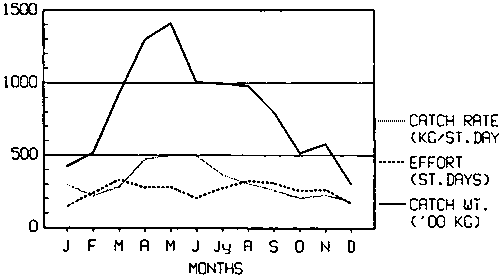
Figure 2: The Bagamoyo/Sadaani fishing ground.
Figure 3: The Rufiji fishing ground.
Figure 4: Estimates of fleet catch weight for a range of annual standard fishing efforts and trawl efficiency of unity.
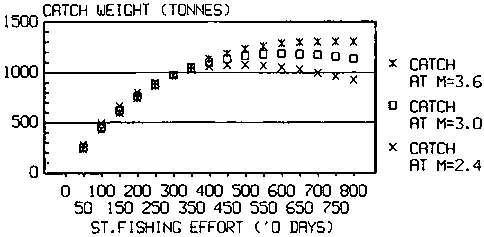
Figure 5: Estimates of catch per standard fishing effort for a range of annual fishing efforts and trawl efficiency of unity.
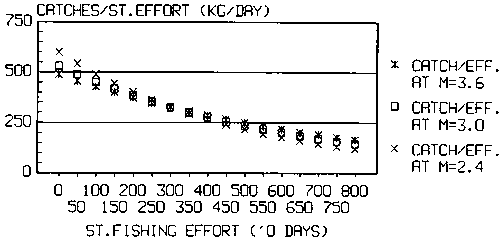
Figure 6: Estimates of biomass for a range of annual standard fishing efforts and trawl efficiency of unity.
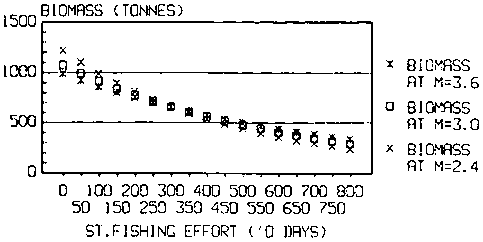
Table 1: Estimates of relative fishing power and size characteristics for each vessel in 1989.
Vessel Name |
Engine Horse-Power (Hp) |
Vessel Length (m) |
Relative Fishing Power |
||
Mean |
Coefficient of Variation |
Count |
|||
| Seashore I | 220 |
17.6 |
0.753 |
55 |
10 |
| Seashore II | 220 |
17.6 |
0.706 |
63 |
12 |
| Mariellena | 390 |
26.0 |
0.632 |
31 |
6 |
| Sadaani | 450 |
28.0 |
1.039 |
14 |
12 |
| Mama Tafico | 500 |
30.0 |
0.949 |
17 |
9 |
| Alpha Commander | 510 |
25.5 |
1.059 |
n.a. |
1 |
| Alpha Challenger | 550 |
27.3 |
0.898 |
n.a. |
1 |
| Alpha Marine | 624 |
26.6 |
1.277 |
61 |
9 |
| Alpha Kilimanjaro | 624 |
27.0 |
1.248 |
43 |
8 |
| Alpha Manyara | 800 |
25.0 |
1.489 |
48 |
8 |
| Alpha Serengeti | 800 |
25.0 |
1.908 |
58 |
7 |
| Hera | 820 |
36.4 |
1.366 |
55 |
8 |
| Katerina | 835 |
37.2 |
1.378 |
55 |
8 |
| Venture II | 970 |
36.5 |
1.673 |
74 |
5 |
| Kirki | 992 |
38.1 |
1.347 |
55 |
8 |
| Aimilia | 992 |
38.1 |
1.685 |
43 |
7 |
Table 2: Estimates of Biomass and MSY for all grounds from catches and efforts of trawl fleet in 1989 and other parameter values as shown.
Time Period |
Shrimp Catch Weight (kg) |
Standard Fishing Days (st. days) |
Biomass tonnes |
MSY tonnes when M=2.4 |
MSY tonnes when M=3.0 |
MSY tonnes when M=3.6 |
| January | 42,521 |
144 |
||||
| February | 51,610 |
237 |
||||
| March | 92,883 |
331 |
||||
| April | 129,650 |
276 |
||||
| May | 140,927 |
282 |
||||
| June | 100,370 |
202 |
||||
| July | 99,399 |
273 |
||||
| August | 97,995 |
321 |
||||
| September | 79,792 |
309 |
||||
| October | 51,583 |
253 |
||||
| November | 57,724 |
260 |
||||
| December | 29,891 |
168 |
||||
| Annual | 974,351 |
3,058 |
644 |
1,068 |
1,177 |
1,299 |
| Trawl Efficiency | = | 1.00 |
| Assumed Hours/Day | = | 12.00 |
| Vessel Speed (nm) | = | 3.00 |
(km/hr) |
= | 5.56 |
| Width of Nets (m) | = | 14.66 * |
| Area of Grounds (km2) | = | 1,977.00 |
*35% of mean headline lengths of nets used from SADAANI and MAMATAFICO.
Table 3: Estimates of biomass and MSY for the Bagamoyo ground from catches and efforts of the TAFICO vessels and other parameter values as shown.
Time Period |
Shrimp Catch Weight (kg) |
Standard Fishing Days (st. days) |
Biomass tonnes |
MSY tonnes when M=2.4 |
MSY tonnes when M=3.0 |
MSY tonnes when M=3.6 |
| January | 9,795 |
28 |
||||
| February | 11,572 |
33 |
||||
| March | 3,363 |
23 |
||||
| April | 1,010 |
7 |
||||
| May | 380 |
2 |
||||
| June | 727 |
3 |
||||
| July | 107 |
1 |
||||
| August | 5,048 |
16 |
||||
| September | 3,262 |
20 |
||||
| October | 390 |
5 |
||||
| November | 280 |
13 |
||||
| December | 2,661 |
13 |
||||
| Annual | 38,595 |
164 |
153 |
275 |
298 |
326 |
| Trawl Efficiency | = | 1.00 |
| Assumed Hours/Day | = | 12.00 |
| Vessel Speed (nm) | = | 3.00 |
(km/hr) |
= | 5.55 |
| Width of Nets (m) | = | 14.66* |
| Area of Grounds | = | 637.00 |
| Fleet Catch (tonnes) | = | 260.82** |
* 35 % of mean headline lengths of nets used from SADAANI and MAMA TAFICO.
** Same proportional distribution between the two grounds as for the TAFICO vessels.
Table 4: Estimates of biomass and MSY for the Rufiji ground from catches and efforts of the TAFICO vessels and other parameter values as shown.
Time Period |
Shrimp Catch Weight (kg) |
Standard Fishing Days (st. days) |
Biomass (tonnes) |
MSY tonnes when M=2.4 |
MSY tonnes when M=3.0 |
MSY tonnes when M=3.6 |
| January | 474 |
4 |
||||
| February | 698 |
3 |
||||
| March | 7,180 |
21 |
||||
| April | 15,530 |
29 |
||||
| May | 23,493 |
37 |
||||
| June | 22,986 |
33 |
||||
| July | 21,578 |
45 |
||||
| August | 7,376 |
19 |
||||
| September | 2,784 |
8 |
||||
| October | 619 |
3 |
||||
| November | 2,513 |
6 |
||||
| December | 350 |
4 |
||||
| Annual | 105,581 |
212 |
683 |
932 |
1,068 |
1,209 |
| Trawl Efficiency | = | 1.00 |
| Assumed Hours/Day | = | 12.00 |
| Vessel Speed (nm) | = | 3.00 |
(km/hr) |
= | 5.55 |
| Width of Nets (m) | = | 14.66* |
| Area of Grounds | = | 1,340.00 |
| Fleet Catch (tonnes) | = | 713.52 ** |
* 35 % of mean headline lengths of nets used from SADAANI and MAMA TAFICO.
** Same proportional distribution between the two grounds as for the TAFICO vessels.
Table 5: Estimates of fleet catch weight, biomass and catches per unit of fishing effort for a range of fishing efforts and other parameter values as shown.
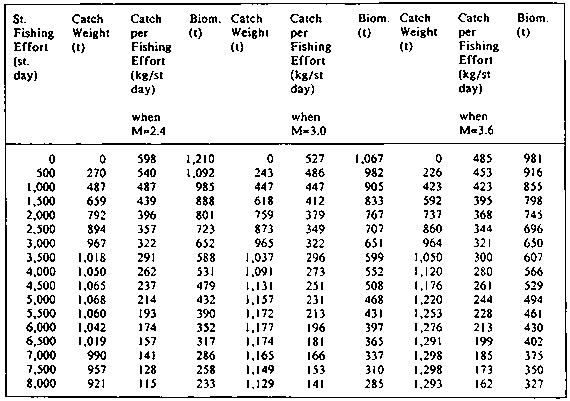
| Trawl Efficiency | = | 1 |
1 |
1 |
| Assumed Hours/Day | = | 12 |
12 |
12 |
| Vessel Speed (nm) | = | 3 |
3 |
3 |
(km/hr) |
= | 5.556 |
5.556 |
5.556 |
| Width of Nets (m) | = | 14.66 |
14.66 |
14.66 |
| Area of Grounds (km2) | = | 1,977 |
1,977 |
1,977 |
when M=2.4 |
when M=3.0 |
when M=3.6 |
||
| Est. q | = | 0.000494 |
0.000494 |
0.000494 |
| Est MSY (tonnes) | = | 1,068 |
1,177 |
1,299 |
| Obs. Catch (tonnes) | = | 974 |
974 |
974 |
| Obs. Effort (st. days) | = | 3,058 |
3,058 |
3,058 |
| Est. c | = | 7.0984 |
6.9724 |
6.8884 |
| Est. d | = | -0.4167 |
-0.3333 |
-0.2778 |
by
Guido CARRARA
FAO Fisheries Project
P.O. Box 487, VICTORIA, Seychelles
and
Eronica LYIMO
Fisheries Division
P.O. Box 2462, DAR-ES-SALAAM, Tanzania
INTRODUCTION
The shrimp trawl fishery of Tanzania developed largely from 1982 with the acquisition of the Mama Tafico by the Tanzania Fisheries Corporation. A second large trawler, the Sadaani, was added to the fleet of TAFICO in 1986.
In 1987 these two vessels were joined by three licensed foreign trawlers. An even more substantial influx of vessels occurred in 1988. In that year, as well as in 1989, the total number of trawlers in operation was sixteen.
METHOD
The annual catch weight and fishing effort data used in the analysis were for the four years 1986 to 1989 (see Table 1). The efforts were in units of standard fishing days with the standard vessels being the Mama Tafico and Sadaani (see Paper 5 of these Proceedings). All data were provided by the Statistics Section within the Fisheries Division.
Table 1: Catch weights and standard fishing efforts used in the analysis
Year |
Catch Weight (tonne) |
Fishing Effort (st. days) |
1986 |
223 |
375 |
1987 |
502 |
913 |
1988 |
706 |
1,688 |
1989 |
974 |
3,058 |
The production model used was that described in Fox (1970). The operative relationship is;
Ln(c/x) = a - b.x
Estimates of "a" and "b" were obtained from the linear (least squares) regression of the natural logarithm of the catch per unit effort (c/x) against the fishing effort (x) of the same year.
These were in turn used to estimate the maximum sustainable yield (MSY), the effort to attain MSY (Xmsy) and the catch per unit effort at MSY (C/Xmsy) using the relationships given below;
| Xmsy | = | 1/b |
| C/Xmsy | = | exp(a - b.Xmsy) |
| MSY | = | Xmsy.C/Xmsy |
RESULTS
The estimates obtained from the analysis are as follows:
| a | = | 6.489 | ± 0.172 | (95% conf. limits) |
| b | = | 2.41 x 10⁻⁴ | ± 0.95 x 10⁻⁴ | (95% conf. limits) |
| MSY | = | 1,001 tonne | ||
| Xmsy | = | 4,137 st. fishing days | ||
| C/Xmsy | = | 241 kg/st. fishing days | ||
The 'best fit' regression line along with the four data points are shown in Figure 1. The coefficient of determination was found to be high (R =0.984) and indicative that 98 percent of the variation in the In (c/x) values could be explained by variation in the effort levels.
The theoretical relationship between each of the catch per unit fishing effort and annual catch (yield) with fishing effort are shown in Figures 2 and 3.
DISCUSSION
An assumption underlying the analysis was that a functional relationship existed between the annual catch in a particular year and the fishing effort of the same year. This is likely to be valid, having in mind the generally short life-span of the shrimp.
It was also assumed that the recruitment of shrimp to the trawl grounds had remained constant during the four years in question. Whether this was valid is not known.
There is presently no knowledge of the extent, for example, by which changes in the effort exerted by the artisanal fishermen might affect recruitment to the trawl fishery. It is probably reasonable to presume that an expansion of the artisanal fishery would negatively affect recruitment, however this still remains to be established.
Notwithstanding these qualifications, it is comforting to note that the estimates obtained for the MSY etc, are in close agreement with those from applying the "swept area" method (Paper 5) and the "Thompson and Bell" method (Paper 11). Having in mind that the catch in 1989 was some 97 percent of the estimated MSY, it would seem that the shrimp are being fully exploited.
REFERENCE
Fox, W.W., 1970: An exponential yield model for optimising exploited fish populations. Trans. Am. Fish. Soc. 99: 80-88.
by
Enoch WAKWABI
Kenya Marine Fisheries Research institute
P.O. Box 81651, Mombasa, Kenya
INTRODUCTION
The purpose of this stock assessment is to provide the necessary input for the catch prediction model, i.e. the model by which alternative management strategies are evaluated. In the present case the catch predictions were made by the computer programme BEAM IV which is briefly introduced in Paper 11 of these Proceedings.
DESCRIPTION OF THE TANZANIAN SHRIMP FISHERIES
The Tanzania shrimp fishery is based on two main fishing grounds: the Bagamoyo ground to the North of Dar-es-Salaam, and the Rufiji ground to the South of Dar-es-Salaam. The Bagamoyo ground is on the mainland shelf of the Zanzibar Channel adjacent to the estuaries of the Pangani, Wami and Ruvu Rivers. The Rujiji ground is within the Mafia Channel and adjacent to the delta of the Rufiji River.
The shrimp fishery on both grounds is exploited by artisanal fishermen using traditional gears, as well as with industrial shrimp trawlers. The artisanal fishery is village based, while the industrial trawler fleet is operated from Dar-es-Salaam. All the shrimp caught is transported and landed at Dar-es-Salaam for processing and export.
The artisanal fishery was reported to land about twice the landings of the industrial fleet (see Paper 1 in these Proceedings). The shrimp in the artisanal catches are in the same commercial categories as for the industrial trawlers. It has not been established, however, whether the two fisheries interact, ie. whether the same stock is being exploited by both groups of fishermen.
Five penaeid species contribute to the Tanzania shrimp fishery, the white shrimp Penaeus indicus made up to 66% of the 1989 shrimp catch; the brown shrimp Metapenaeus monoceros was 15%; and the tiger shrimp P. semisulcatus, the flower shrimp P. japonicus and the jumbo shrimp P. monodon together made up to 18%. The rest, 1%, was made up of an unclassified group of mixed and broken shrimps.
METHOD AND INPUT DATA FOR STOCK ASSESSMENT.
For the purpose of this assessment, the industrial fleet was sub-divided into those vessels belonging to the parastatal TAFICO and those which were foreign owned. It was assumed that the shrimp populations on the two fishing grounds were the same, and that the artisanal fishing effort remained constant all along the coast and throughout the year.
Two methods were applied to estimate mortality rates for the two major species P. indicus, and M. monoceros, namely length converted catch curve analysis and Jones' length converted cohort analysis (see Jones, 1984, or Sparre et al., 1989). The input data required for these analyses are the von Bertalanffy growth parameters, the length/weight parameters and the number of shrimp caught by size group during (at least) one year.
No estimates of the growth parameters based on large data sets were available. The values used reflect the general knowledge on peneaid shrimp growth as well as estimates used in a similar excercise for the fishery in Madagascar (see SWIOP/CNRO, 1987). Thus the values shown in Table 1 are "qualified guesses".
Table 1: Growth parameters, L¥ (mm) carapace length, K per year, and length-weight relationship W = a*L^b, with W in grammes and L in mm carapace length.
Species |
Sex |
L¥ |
K |
a |
b |
| P. indicus | Female | 50 |
2.0 |
0.0023 |
2.68 |
| Male | 45 |
2.0 |
0.0023 |
2.68 |
|
| M. monoceros | Female | 40 |
2.0 |
0.0023 |
2.68 |
| Male | 35 |
2.0 |
0.0023 |
2.68 |
The computation procedure undertaken to estimate the catch number in each commercial size category is indicated in Table 2. The observed data are shown in the columns headed "Whole weight" and "Percent female". The "Number caught" are sexes combined, and were calculated according to the following:
Number caught = (Whole weight)/(Whole body weight)
Whole body weight (kg) = (1/(mean count)). 0.545/0.6
The catch numbers so obtained were then distributed by sex according to the observed "Percent female". The last two columns under the heading "Weight caught" contains the product of catch number and whole body weight.
The initial step in both the length converted catch curve and the length converted cohort analyses, is the conversion of commercial size categories into weight and then carapace length and age. The conversions were done with the assistance of the following relationships:
age = to - ln(L/L¥)/K
L =(W/a)^(1/b)
W = 0.454/(mean count)/0.6
The age by size categories are shown in Table 3.
Table 2: Estimated catch numbers and catch whole weights by commercial size categories for vessels Mama Tafico and Sadaani.
P. indicus |
|||||||
Mean count tails/pound |
Whole weight |
Number caught |
Percent female |
Number caught |
Weight caught |
||
male |
female |
male |
female |
||||
(kg) |
/1000 |
(%) |
/1000 |
(kg) |
|||
80.0 |
3,493 |
308 |
43.0 |
132 |
175 |
1,502 |
1,991 |
65.0 |
6,029 |
431 |
38.0 |
164 |
2671 |
2,291 |
3,738 |
55.0 |
11,937 |
723 |
43.0 |
311 |
412 |
5,133 |
6,804 |
45.0 |
11,127 |
551 |
64.0 |
353 |
198 |
7,121 |
4,006 |
35.0 |
29,553 |
1139 |
71.0 |
809 |
330 |
20,983 |
8,570 |
27.5 |
18,463 |
559 |
79.0 |
442 |
117 |
14,586 |
3,877 |
22.5 |
8,407 |
208 |
90.0 |
187 |
21 |
7,566 |
841 |
17.5 |
5,729 |
110 |
100.0 |
110 |
0 |
5,729 |
0 |
| total | 94,738 |
64,911 |
29,827 |
||||
M. monoceros |
|||||||
Mean count tails/pound |
Whole weight |
Number caught |
Percent female |
Number caught |
Weight caught |
||
male |
female |
male |
female |
||||
(kg) |
/1000 |
(%) |
/1000 |
(kg) |
|||
100.0 |
4,396 |
484 |
45.0 |
218 |
266 |
1,978 |
2,418 |
80.0 |
4,902 |
432 |
40.0 |
173 |
259 |
1,961 |
2,941 |
65.0 |
4,967 |
355 |
40.0 |
142 |
213 |
1,987 |
2,980 |
55.0 |
3,486 |
211 |
60.0 |
127 |
84 |
2,092 |
1,394 |
45.0 |
2,957 |
146 |
70.0 |
103 |
44 |
2,070 |
887 |
35.0 |
1,053 |
41 |
80.0 |
32 |
8 |
842 |
211 |
27.5 |
47 |
1 |
100.0 |
1 |
0 |
47 |
0 |
| total | 21,761 |
10,930 |
10,831 |
||||
Table 3: Estimates of age groups corresponding to commercial size grades.
P. indicus |
||||
Min. count tails/pound |
Whole weight (g) |
Carapace length (mm) |
Age female (yr) |
Age male (yr) |
90.0 |
10.09 |
22.86 |
0.31 |
0.35 |
70.0 |
12.98 |
25.11 |
0.35 |
0.41 |
60.0 |
15.14 |
26.59 |
0.38 |
0.45 |
50.0 |
18.17 |
28.46 |
0.42 |
0.50 |
40.0 |
22.71 |
30.94 |
0.48 |
0.58 |
30.0 |
30.28 |
34.44 |
0.58 |
0.72 |
25.0 |
36.33 |
36.87 |
0.67 |
0.86 |
20.0 |
45.42 |
40.07 |
0.81 |
- |
15.0 |
60.56 |
44.61 |
1.11 |
- |
M. monoceros |
||||
Min. count tails/pound |
Whole weight (g) |
Carapace length (mm) |
Age female (yr) |
Age male (yr) |
110.0 |
8.26 |
21.21 |
0.38 |
0.47 |
90.0 |
10.09 |
22.86 |
0.42 |
0.53 |
70.0 |
12.98 |
25.11 |
0.49 |
0.63 |
60.0 |
15.14 |
26.59 |
0.55 |
0.71 |
50.0 |
18.17 |
28.46 |
0.62 |
0.84 |
40.0 |
22.71 |
30.94 |
0.74 |
1.08 |
30.0 |
30.28 |
34.44 |
0.99 |
2.07 |
25.0 |
36.33 |
36.87 |
1.27 |
- |
LENGTH CONVERTED CATCH CURVE ANALYSIS
This method estimates the total mortality coefficient, Z, as the slope (with sign changed) in the regression analysis with x = Age (from Table 3) and y = ln(C/dt), where C is the number caught (from Table 2) and dt = the time taken to grow through a commercial size category (the differences between ages from Table 3). The assumption behind the method is that Z remains constant over size categories so only the sizes assumed to be under full exploitation are used in the regression analysis.
The results of the length converted catch curve analysis are shown in Tables 4 and 5.
It should be kept in mind that the input data derive from the activities of only the two TAFICO vessels. The catches from the foreign vessels and the artisanal fishermen are not covered by the samples. The estimates of Z are unbiased, only when the samples used in the regression analysis are representive of the stock in the sea. As the catch from the TAFICO vessels was some 15 percent of the catch from all the trawlers, it seems reasonable to presume that the estimates of Z are unbiassed.
Table 4: Results from length converted catch curve analysis for P. indicus.
P. indicus, female |
||||
Regression Analysis |
||||
Mean count |
x = Age |
y = ln(C/dt) |
dt |
|
1 |
80.00 |
0.327 |
8.0265 |
0.0432 |
2 |
65.00 |
0.364 |
8.5803 |
0.0308 |
3 |
> 55.00 |
0.400 |
8.9169 |
0.0417 |
4 |
45.00 |
0.452 |
8.6636 |
0.0610 |
5 |
35.00 |
0.533 |
8.9819 |
0.1016 |
6 |
27.50 |
0.626 |
8.5589 |
0.0847 |
7 |
22.50 |
0.738 |
7.2018 |
0.1397 |
8 |
> 17.50 |
0.961 |
5.8899 |
0.3054 |
Z = 5.64 per year (r = - 0.94) |
||||
P. indicus, male |
||||
Regression Analysis |
||||
Mean count |
x = Age |
y = ln(C/dt) |
dt |
|
1 |
80.00 |
0.381 |
8.0946 |
0.0535 |
2 |
65.00 |
0.428 |
8.8377 |
0.0388 |
3 |
> 55.00 |
0.474 |
8.9467 |
0.0536 |
4 |
45.00 |
0.541 |
7.8045 |
0.0809 |
5 |
35.00 |
0.653 |
7.7422 |
0.1434 |
6 |
> 27.50 |
0.790 |
6.8022 |
0.1305 |
Z = 5.90 per year (r = - 0.93) |
||||
Note: ">" indicates the range of points used in the regression analysis.
Table 5: Results from length converted catch curve analysis for M. monoceros.
M. monoceros, female |
||||
Regression Analysis |
||||
Mean count |
x = Age |
y = ln(C/dt) |
dt |
|
1 |
> 100.0 |
0.401 |
8.4642 |
0.0459 |
2 |
80.0 |
0.459 |
7.8070 |
0.0703 |
3 |
65.0 |
0.520 |
7.9027 |
0.0526 |
4 |
55.0 |
0.584 |
7.4290 |
0.0752 |
5. |
45.0 |
0.682 |
6.7459 |
0.1206 |
6 |
> 35.0 |
0.865 |
4.8885 |
0.2445 |
7 |
27.5 |
1.130 |
1.6025 |
0.2866 |
Z = 7.38 per year (r = - 0.98) |
||||
M. monoceros, male |
||||
Regression Analysis |
||||
| 1 | Mean count |
x = Age |
y = ln(C/dt) |
dt |
> 100.0 |
0.498 |
8.3380 |
0.0637 |
|
| 2 | 80.0 |
0.581 |
7.8364 |
0.1023 |
| 3 | 65.0 |
0.672 |
7.8709 |
0.0814 |
| 4 | 55.0 |
0.776 |
6.5078 |
0.1259 |
| 5 | > 45.0 |
0.958 |
5.2204 |
0.2376 |
| 6 | 35.0 |
1.573 |
2.1010 |
0.9927 |
Z = 6.93 per year (r = - 0.97) |
||||
Note: ">" indicates the range of points used in the repression analysis.
LENGTH CONVERTED COHORT ANALYSIS
This method does not assume the mortality to remain constant from size group to size group. Furthermore, if data for total catches are available, it also provides an estimate of the stock size. The assumption here is that the samples are representive of the entire catch. The results are shown in Tables 6 and 7. As the input data are for the two TAFICO boats only, the estimated stock numbers are the stock numbers required to produce the catches by the two TAFICO vessels. They are not the total stock numbers.
Table 6: Results from length converted cohort analysis for P. indicus.
P. indicus, female |
|||||||
Count tails/pound |
Number caught/1000 |
Stock number+/1000 |
Exploitation rate F/Z |
Fishing Mortality F |
Mean Length C.L. (mm) |
||
1 |
70.0 |
90.0 |
132 |
4,160 |
0.281 |
0.781 |
22.859 |
2 |
60.0 |
70.0 |
164 |
3,689 |
0.432 |
1.523 |
25.106 |
3 |
50.0 |
60.0 |
311 |
3,309 |
0.552 |
2.467 |
26.593 |
4 |
40.0 |
50.0 |
353 |
2,747 |
0.545 |
2.397 |
28.465 |
5 |
30.0 |
40.0 |
809 |
2,099 |
0.724 |
5.251 |
30.936 |
6 |
25.0 |
30.0 |
442 |
983 |
0.790 |
7.528 |
34.442 |
7 |
20.0 |
25.0 |
187 |
424 |
0.704 |
4.750 |
36.867 |
8 |
15.0 |
20.0 ' |
110 |
158 |
0.700 |
4.667 |
40.068 |
| M = 2.0 per year, Mean F = 4.51, Mean Z = 6.51 (range: 3-8) | |||||||
P. indicus, male |
|||||||
Count tails/pound |
Number caught/1000 |
Stock number+/1000 |
Exploitation rate F/Z |
Fishing Mortality F |
Mean Length C.L. mm |
||
1 |
70.0 |
90.0 |
175 |
2,257 |
0.444 |
1.594 |
22.859 |
2 |
60.0 |
70.0 |
267 |
1,862 |
0.675 |
4.149 |
25.106 |
3 |
50.0 |
60.0 |
412 |
1,465 |
0.764 |
6.461 |
26.593 |
4 |
40.0 |
50.0 |
198 |
926 |
0.617 |
3.228 |
28.465 |
5 |
30.0 |
40.0 |
330 |
605 |
0.756 |
6.197 |
30.936 |
6 |
25.0 |
30.0 |
117 |
168 |
0.700 |
4.667 |
34.442 |
| M = 2.0 per year, Mean F = 5.14, Mean Z = 7.14 (range: 3-6) | |||||||
Note: indicates that the stock number* are the numbers required to account for the catches of the two TAFICO vessels.
In order to run the BEAM IV catch prediction program, it was necessary to have estimates of recruitment, i.e. the number of shrimp that attain the age corresponding to the lower limit of the first size category. This number can be estimated by cohort analysis if estimates of the total catches are available.
In the present case the recruitment was estimated by an alternative approach, which involved tuning of the BEAM IV model to reproduce the observed catches in 1989, as explained in Part 11 of these Proceedings.
Table 7: Results from length converted cohort analysis for M. monoceros.
M. monoceros, female |
|||||||
Count tails/pound |
Number caught/1000 |
Stock number/1000 |
Exploitation rate F/Z |
Fishing Mortality F |
Mean Length C.L. mm |
||
1 |
90.0 1 |
10.0 |
218 |
1,093 |
0.717 |
5.057 |
21.210 |
2 |
70.0 |
90.0 |
173 |
789 |
0.653 |
3.766 |
22.859 |
3 |
60.0 |
70.0 |
142 |
524 |
0.759 |
6.310 |
25.106 |
4 |
50.0 |
60.0 |
127 |
337 |
0.770 |
6.681 |
26.593 |
5 |
40.0 |
50.0 |
103 |
173 |
0.802 |
8.092 |
28.465 |
6 |
30.0 |
40.0 |
32 |
45 |
0.760 |
6.319 |
30.936 |
7 |
25.0 |
30.0 |
1 |
2 |
0.700 |
4.667 |
34.442 |
| M = 2.0 per year, Mean F = 6.04, Mean Z = 8.04 (range: 1-6) | |||||||
M. monoceros, male |
|||||||
Count tails/pound |
Number caught/1000 |
Stock number/1000 |
Exploitation rate F/Z |
Fishing Mortality F |
Mean Length C.L. mm |
||
1 |
90.0 1 |
10.0 |
266 |
1,246 |
0.667 |
4.015 |
21.210 |
2 |
70.0 |
90.0 |
259 |
847 |
0.663 |
3.936 |
22.859 |
3 |
60.0 |
70.0 |
213 |
457 |
0.804 |
8.213 |
25.106 |
4 |
50.0 |
60.0 |
84 |
191 |
0.721 |
5.174 |
26.593 |
5 |
40.0 |
50.0 |
44 |
74 |
0.700 |
4.667 |
28.465 |
6 |
30.0 |
40.0 |
8 |
12 |
0.700 |
4.667 |
30.936 |
| M = 2.0 per year, Mean F = 5.20, Mean Z = 7.20 (range: 1-5) | |||||||
SUMMARY OF RESULTS FROM STOCK ASSESSMENT.
A summary of the findings from the stock assessment are given in Table 8. The growth parameters, the length/weight parameters and the natural mortalities given in Table 8 were used as input to the BEAM IV catch prediction (see Paper 11 in these Proceedings). A value for the fishing mortality coefficient of F = 5.5 was also used for each of the species, and somewhat reflects the findings from this assessment. The assessments were made on rather incomplete data, and missing data had to be replaced by "qualified guesses". Thus, the above results are only indicative.
Table 8: Summary results of the fish stock assessment for P. indicus and M. monoceros.
| Growth parameters | Catch curve |
Length converted cohort analysis |
||||||
L¥ |
K |
a |
b |
Z |
M |
F/Z |
Mean F |
|
| P. indicus, F | 50 |
2.0 |
.0023 |
2.68 |
5.6 |
2.0 |
0.7 |
4.5 |
| P. indicus, M | 45 |
2.0 |
.0023 |
2.68 |
5.9 |
2.0 |
0.7 |
5.1 |
| M. monoceros, F | 40 |
2.0 |
.0023 |
2.68 |
7.4 |
2.0 |
0.7 |
6.0 |
| M. monoceros, M | 35 |
2.0 |
.0023 |
2.68 |
6.9 |
2.0 |
0.7 |
5.2 |
DISCUSSION
The data available to the workshop was rather inadequate, hence a number of parameters were actually guessed parameters from other works within the region, especially from the Madagascar situation (SWIOP/CNRO, 1987). The decision on L¥ was based on the limited length frequency data made available on the two species, while the K and M values were those which gave reasonable estimates of the exploitation and growth patterns. Exploited shrimps have been shown to have a longevity of 12-16 months.
It was encouraging nevertheless that the two approaches for estimating Z gave very similar results. Furthermore, when used in the BEAM IV tuning with 1989 catch data, it was found to simulate values of MSY and Fmsy very close to those obtained by the swept area method (Paper 5 of these Proceedings) and the production model results (Paper 6 of these Proceedings). The use of BEAM IV, and predictions of MSY, Fmsy and effort at Fmsy under various assumptions concerning management strategies is reported in Paper 11 of these Proceedings.
CONCLUSIONS
Within the limits of the available data, the analyses reported in this paper show that at the estimated Z, only 1 % of the recruiting shrimps remain alive after 1 year, only 3 % after 6 months and only 17 % after 3 months. It is the nature of short lived species to have a high growth rate (K) and high natural mortality rate (M). The fishery must be managed within the limits of these parameters. A good database from which better estimates of these parameters can be made is therefore highly desirable.
REFERENCES
Jones, R. (1984): Assessing the effects of changes in exploitation pattern using length composition data (with notes on VPA and cohort analysis). FAO. Fish. Tech. Pap., (256): 118 p.
Sanders, M.J. (1990): Application of the "swept area" method with the trawl catch and effort data for 1989. In Proceedings of the Workshop on the management of the shallow water shrimp fishery of Tanzania. FAO/UNDP RAF/87/008/DR/58/90/E:94 p.
Sparre, P., E. Ursin and S. C. Venema (1989): Introduction to tropical fish stock assessment. Part 1. Manual. FAO. Fish. Tech. Pap. No. 306/1. Rome, FAO: 337 p.
SWIOP/CNRO (1987): Proceedings of the Workshop on the management of the shallow water shrimp fishery of Northwest Madagascar. FAO/UNDP RAF/87/008/DR/50/89/E:95 p.
11. Costs and earnings analysis of the artisanal shrimp fishery (Paper 8)
12. Costs and earnings analysis for the collection and export of the shrimp caught by the artisanal fishermen (Paper 9)
13. Costs and earning analysis for the industrial shrimp trawl fishery (Paper 10)
by
Erika SEKI
FAO Headquarters, Rome
1. INTRODUCTION
This report contains the results of a costs and earnings analysis undertaken as a component of the socio-economic study of the artisanal shrimp fishery of Tanzania. The data collection phase was undertaken in the period May 27-June 12, 1990, during which time 14 fishing villages and camps were visited and village headmen and fishermen in charge of shrimp fishing units (SFUs) were interviewed. The study locations were in respect to fishing in the vicinity of each of the Rufiji delta and the village of Sadaani.
It was estimated that the number of SFUs which had participated in the fishery during the previous twelve months was 859 units. The annual mean number of fishing days per SFU was determined as 160 days, and the weight of catch per fishing day as about 15 kg/day of shrimp, including about 10 kg/day of the more valuable white and tiger shrimp. The daily catches of quality fish were in the range of 6 and 8 kg and that of other types of fish between 13 and 16 kg.
The methodology and a more detailed description of the fishing results, boats and gears are given in Paper 1 of these Proceedings. The analysis reported here uses these and other data collected during the socio-economic study to investigate the financial performance of the fishing units. This was in turn used as input to the bio-economic modelling of the fishery reported in Paper 11 of these Proceedings.
2. SHRIMP PRICES
The mean prices obtained by the fishermen at or adjacent to the point of landing ranged around 200 T.Sh./kg for the white shrimp and 700 T.Sh./kg for the tiger shrimp (see Table 1). The prices were generally higher in the Sadaani area, presumably reflecting the closer proximity to Dar-es-Salaam. The journey to the Rufiji delta takes about 10 to 24 hours and is associated with substantially higher costs.
Table 1: Mean prices for white and tiger shrimp.
Fishing Ground |
Long Rain |
Short Rain |
Inter-Rain |
|||
White |
Tiger |
White |
Tiger |
White |
Tiger |
|
| Sadaani | 211 |
739 |
224 |
757 |
242 |
794 |
| Rufiji | 191 |
661 |
207 |
715 |
222 |
749 |
| Mean | 194 |
670 |
222 |
721 |
240 |
753 |
It seems also that the shrimp prices were lowest during the long rain period when catch rates were highest, and highest during the inter-rain periods when the lowest catch rates were reported.
In respect to the small shrimp, those sold as fresh product fetched around 80 T.Sh./kg and those sold dried around 50 T.Sh./kg (see Table 2).
Table 2: Mean prices for small shrimp.
Grounds Combined |
Long Rain |
Short Rain |
Inter-Rain |
|||
Small Fresh |
Small Dried |
Small Fresh |
Small Dried |
Small Fresh |
Small Dried |
|
| Mean | 73 |
44 |
78 |
43 |
83 |
59 |
3. FISH PRICES
In each of the two categories of quality and other fish the species and sizes being landed were reported as highly variable. As a consequence of this the prices given also varied widely. These were between 10 and 200 T.Sh./kg for quality fish and between 2 and 70 T.Sh./kg for other fish. The mean prices used in the costs and earnings analysis were around 30 T.Sh./kg and 20 T.Sh./kg for the two categories respectively (see Table 3).
Table 3: Mean prices for fish.
Grounds Combined |
Long Rain |
Short Rain |
Inter-Rain |
|||
Quality |
Other |
Quality |
Other |
Quality |
Other |
|
| Mean | 33 |
21 |
27 |
17 |
27 |
16 |
4. GROSS REVENUES
These have been estimated from the products of the annual catches per SFU and the relevant prices (see Table 4). An allowance was made for post-harvest losses of 4 percent in the case of the tiger and white shrimp and 10 percent for each of the small shrimp and the two categories of fish. The resultant annual mean gross revenue per SFU is T.Sh. 640,565. Some 93 percent of this derived from the sale of shrimp, with the contribution from the white and tiger shrimp being 29 percent and 61 percent respectively.
5. INVESTMENT, REPAIRS AND MAINTENANCE AND DEPRECIATION
Investment is shown here as the cost of replacement with a new item (see Table 5). Surprisingly, all items of gear were reported as being more expensive than the boat. Depreciation costs were estimated by dividing these investment costs by the relevant mean lifespan of each item. The costs have been determined on both a per unit and per SFU basis. The definition of an SFU in the latter case is artificial, in the sense of being the number of boats and gears divided by the number of SFUs.
Table 4: Gross revenues per SFU
|
Long Rain |
Short Rain |
Inter-Rain |
||||||
Catch (kg) |
Price (T.Sh.) |
G. Revenue (T.Sh.) |
Catch (kg) |
Price (T.Sh.) |
G. Revenue (T.Sh.) |
Catch (kg) |
Price (T.Sh.) |
G. Revenue (T.Sh.) |
|
| White | 360 |
194 |
69,840 |
247 |
222 |
54,834 |
255 |
240 |
61,200 |
| Tiger | 202 |
670 |
135,340 |
177 |
721 |
127,617 |
170 |
753 |
128,010 |
| Small Fresh | 40 |
73 |
2,920 |
32 |
78 |
2,496 |
36 |
83 |
2,988 |
| Small Dried | 239 |
44 |
3,505 |
238 |
43 |
3,411 |
243 |
59 |
4,779 |
| Q'ty Fish | 194 |
33 |
6,402 |
124 |
27 |
3,348 |
217 |
27 |
5,859 |
| Other Fish | 570 |
21 |
11,970 |
414 |
17 |
7,038 |
563 |
16 |
9,008 |
| Totals | 229,977 |
198,744 |
211,844 |
||||||
Table 5: Investment, repairs and maintenance and depreciation.
|
Mean No. of Units per SFU |
Repairs & maintenance costs |
Replacement costs |
Lifespan |
Depreciation costs |
||
per Unit |
per SFU |
per Unit |
per Unit |
per SFU |
|||
| Boat | 0.76 |
753 |
570 |
5,844 |
15.6(yr) |
375 |
283 |
| Meshnet | |||||||
| -Small | 0.91 |
1,865 |
6,922 |
26.1(mth) |
3,185 |
||
| -Long* | 0.06 |
1,533 |
1,689 86 |
7,340 |
13.2(mth) |
667 |
2,884 373 |
| Seine net | |||||||
| -Small | 0.20 |
2,071 |
8,213 |
34.5(mth) |
2,857 |
579 |
|
| -Long | 0.05 |
1,280 |
42059 |
12,150 |
28.5(mth) |
5,116 |
235 |
| Uzio | |||||||
| -Small | 0.09 |
1,833 |
164 |
6,781 |
3.1(mth) |
25,997 |
2,328 |
| -Long | 0.06 |
1,550 |
93 |
9,929 |
2.5(mth) |
47,659 |
3,023 |
| Wando | 0.03 |
0 |
0 |
7,333 |
13.5(mth) |
6,518 |
170 |
| Totals | 3,081 |
64,512 |
9,875 |
||||
* Many of these nets, imported from China, were made of very fine material (2 ply) and consequently were reported as having a short lifespan.
6. NET REVENUES
The basis for sharing the revenues was found to be variable between SFUs. The somewhat typical basis which is used here was for 20 percent of the gross revenue to go to the owner of the boat, 20 percent to the owner of the gear, and 60 percent to be shared equally by the crew (including skipper). Accordingly the mean net revenue per SFU was estimated as T.Sh. 627,309, comprised of T.Sh. 127,260 to the boat, T.Sh. 116,010 to the gear and T.Sh. 384,039 to the crew (see Table 6). In the event that the boat and gear are owned equally by the crew (a mean of 1.8 persons/SFU) the net revenue per crew member is T.Sh. 348,505.
Table 6: Net Revenues.
Item |
|
Revenues & Costs (T.Sh.) |
|
| Gross Revenues: | |||
| Share to boat owner (20%) | 128,113 |
||
| Share to gear owner (20%) | 128,113 |
||
| Share to crew (60%) | 384,339 |
||
total |
640,565 |
||
| Costs: | |||
| Boat costs | - R & M | 570 |
|
| - Depreciation | 283 |
||
| Gear costs | - R & M | 2,511 |
|
| - Depreciation | 9,592 |
||
| Crew costs* | - Fishing & boat licences | 300 |
|
total |
13,256 |
||
| Net Revenues: | |||
| Return to boat | 127,260 |
||
| Return to gear | 116,010 |
||
| Return to crew | 384,039 |
||
total |
627,309 |
||
* Food costs are not included.
7. CONCLUDING COMMENTS
On the basis of these results the fishing for shrimp by the artisanal fishermen seems highly remunerative. Measured in the context of return to investment, the mean net revenue per SFU is some ten times the cost of a new boat and gears. This conclusion should nevertheless be considered as tentative pending the conduct of follow-up studies. This is particularly necessary in respect to verifying the reported catch rates (see Paper 1 in these Proceedings) which were used to estimate the mean annual catch and hence gross revenue per SFU.
by
Bakar MWAMOTO
Tanzania Fisheries Corporation
P.O. Box 4296, DAR ES SALAAM, Tanzania
INTRODUCTION
The process which terminates in the export of the shrimp caught by the artisanal fishermen involves each of the fishermen, the collectors and the exporters. The analysis reported here deals with the costs and earnings of the latter two groups. The data used in the analysis are largely as reported in Paper 2 of these Proceedings.
COSTS AND EARNINGS
The following analysis is based on the collection of ten consignments per annum of 500 kg each, and its subsequent export after allowing for a post-harvest loss during processing of four percent (see Table 1). It is presumed there are no fixed assets except ice boxes, whose cost is recovered from the fishermen.
In respect to collection the total operating cost was determined as T.Sh. 3,389,000, of which 61 percent was the cost of purchasing the shrimp from the fishermen. The income generated from the resale of the shrimp was determined as T.Sh. 3,825,000, and the operating surplus as T.Sh. 436,000.
The total operating cost in processing and exporting the shrimp was determined as T.Sh. 4,715 thousand, almost 78 percent of which was for the purchase of the shrimp from the collectors. The income in local currency from the export of these shrimp was T.Sh. 5,645 thousand, hence leaving an operating surplus of T.Sh. 930 thousand.
The gross foreign currency earnings was determined as US$ 40,320 (based on an exchange rate of T.Sh. 140/US$ 1). Applying the 50 percent foreign currency retention rule and subtracting the foreign currency cost (US$ 2,857 for packaging materials) leaves US$ 17,303 as the net foreign currency earnings retained by the exporter.
The latter value is a substantial under-estimate having in mind that the declared f.o.b. price in 1989 was US$ 3.96/kg (which is much lower than the values shown in Table 1). If the retention rule is applied on the basis of this price, the estimate for the net foreign currency earnings retained by the exporter becomes US$ 27,959.
CONCLUDING COMMENTS
According to the analysis presented in the previous section, the financial gains from collecting and exporting shrimp are small, at least in local currency terms. This is partly compensated in the case of the exporters by virtue of them being able to gain access to foreign currency. This might be used to generate additional profits (in local currency) from the importation and resale of scarce commodities and possibly also from exchanging on the local black market. In the case of the collectors, they do not earn foreign currency, unless they are also exporters. These persons are, however, likely to be engaged in other income generating activities.
Table 1: Costs and earnings analysis
Items |
Costs/Earnings |
(T.Sh. '000) |
|
| Collection: | |||
| Costs | |||
| - Purchase of shrimp (300 kg x T.Sh. 215/kg x 10) | 645 (0) |
||
| (200 kg x T.Sh. 712/kg x 10) | 1 424 (0) |
||
| Costs Sub-Total | 2 069 |
||
| - Ice Supplies (T.Sh. 15 000 x 10) 150 | (0) |
||
| - Fuel and Oil (T.Sh. 30 000 x 10) | 300 (0) |
||
| - Remuneration, food and allowances | |||
| to Assistants (T.Sh. 30 000 x 10)300 | (0) |
||
| - Local Taxes and Levies (T.Sh. 7 000 x 10) | 70 (0) |
||
| - Hire of motor vehicle and boat (T.Sh. 50 000 x 10) | 500 (0) |
||
| Costs Sub-Total | 1 320 |
||
| Costs Total | 3 389 |
||
| Income | |||
| - Resale of Shrimp | (300 kg x T.Sh. 475 x 10) | 1 425 (0) |
|
| (200 kg x T.Sh. 1 200 x 10) | 2 400 (0) |
||
| Income Total | 3 825 |
||
| Operating Surplus | 436 |
||
| Export: | |||
| Costs | |||
| - Purchase of Shrimp (288* kg x T.Sh. 475 x 10) | 1 368 (0) |
||
| (*4% post harvest loss during processing) | (192* kg x T.Sh. 1 200 x 10) | 2 304 (0) |
|
| Costs Sub-Total | 3 672 |
||
| - Grading & packaging (T.Sh. 15/kg x 480 x 10) | 72 (0) |
||
| - Storage for 1 week (T.Sh. 10/kg x 480 x 10 x 7) | 336 (0) |
||
| - Labour | (T.Sh. 10 000 x 10) | 100 (0) |
|
| - Packing materials | (T.Sh. 40 000 x 10) | 400 (100) |
|
| - Export royalty | (T.Sh. 2 500 x 10) | 25 (0) |
|
| - Documentation cost (T.Sh. 1 000 x 10) | 10 (0) |
||
| - Transportation | (T.Sh. 10 000 x 10) | 100 (0) |
|
| Costs Sub-Total | 1 043 |
||
| Costs Total | 4 715 |
||
| Income | |||
| - Resale of Shrimp | (288 kg x US$ 10 x T.Sh. 140/US$ x 10) | ||
| (192 kg x US$ 6 x T.Sh. 140/US$ x 10) | |||
| Income Total | 5 645 (100) |
||
| Operating Surplus | 930 |
||
Note: The proportion in foreign currency is indicated in brackets.
by
Niels VESTERGAARD
Institute of Fisheries Economics Research,
University of South Jutland
Glentevej 7, DK-6705 Esbjerg, DENMARK
1. INTRODUCTION
In 1989 the industrial fleet was comprised of 16 vessels, of which 14 were operated for much of the year. The engine power of the vessels ranged from 220 to 992 Hp and the lengths from 17.6 to 38.1 m. The catch of shrimp was about 974 tonnes and the fish by-catch was 1,069 tonnes. The most productive months were from March/April to August/September, with catches of 90 to 140 tonnes. The catch rates in other months were in the range of 30 to 60 tonnes.
The catches were processed on-board, and included sorting by species and commercial size grades, packing into 2 kg boxes and freezing. All the shrimp were intended for export in contrast to the fish which were for local consumption. The latter were packed into 20 kg boxes and frozen prior to being landed.
The management of this component of the fishery included limiting the number of vessels, and further controlling the fishing effort by zoning and a prohibition on trawling between 6.00 pm and 6.00 am. There was also' an arbitration mechanism for resolving complaints by the artisanal fishermen of gear loss and damage resulting from the operation of the trawlers. There was no closed season although a closure of several months from about December through February is being contemplated.
2. COSTS AND EARNINGS FOR THE TAFICO VESSELS
Two of the trawlers were owned by the parastatal Tanzania Fisheries Corporation (TAFICO). Financial data were made available from which it was possible to undertake a costs and earnings analysis. The analysis utilised the accounts for the financial year 1988/89 and for the second half-year of 1989. The monthly distribution of fishing days and catch weights for each of 1988 and 1989 were used to split the account for 1988/1989 into two parts, one for the second half of 1988 and the other for the first half of 1989.
The results of the costs and earnings analysis averaged over the two vessels is shown in Table 1. They relate to the annual mean number of standard fishing days being 193 st. days and resulting in a catch of 72,078 kg of shrimp and 89,807 kg of fish by-catch. The prices used were US$ 5.23/kg for the shrimp and the local currency equivalent of US$ 0.61/kg for the fish. The mean exchange rate for 1989 was taken as 145.2 T.Sh./US$.
The two TAFICO vessels (hull, engine and gear) were given a value in the TAFICO accounts of US$ 1 million. On the basis of the costs and earnings analysis, the estimated mean profit was US$ 77,773 and hence representing some 7.8 percent of this valuation. The vessels were in fact provided at no cost to TAFICO by the Japan International Cooperation Agency (JICA). If they had been purchased by TAFICO it would have been necessary to" include interest charges, and the profitability would have been lower than indicated.
Table 1: Costs and earnings of the TAFICO vessels in 1989.
Total (US$) |
Foreign Exchange (US$) |
|
| Variable (boat) Costs: | ||
| Fuel and lubricants | 69,637 |
41,782 |
| Food | 8,171 |
0 |
| Ice and water | 77 |
0 |
| Repairs and maintenance | 18,203 |
14,562 |
| Harbour dues | 0 |
0 |
| Crew wages and incentives | 17,890 |
0 |
| Miscellaneous costs | 802 |
0 |
| Sub-totals | 114,779 |
56,345 |
| Fixed (boat) Costs: | ||
| Hull depreciation1 | 77,081 |
0 |
| Engine depreciation | 0 |
0 |
| Gear depreciation | 7,435 |
7,435 |
| Interest on capital | 0 |
0 |
| Insurance2 | 4,097 |
4,097 |
| Overhead salaries | 18,305 |
0 |
| Other overheads | 77,999 |
21,724 |
| Registration and licence fees | 34 |
0 |
| Sub-totals | 184,951 |
33,255 |
| Processing, Storage and Marketing Costs: | ||
| Transport and insurance | 918 |
0 |
| Packaging material | 33,563 |
33,563 |
| Power and water | 3,842 |
67 |
| Repairs and maintenance | 1,832 |
1,099 |
| Wages and incentives | 5,313 |
0 |
| Depreciation | 4,757 |
0 |
| Interest on capital | 0 |
0 |
| Miscellaneous overheads | 2,218 |
0 |
| Export tax | 1,803 |
0 |
| Sub-totals | 54,247 |
34,729 |
| Total Costs: | 353,977 |
124,329 |
| Gross Earnings: | 431,750 |
376,968 |
| Profit: | 77,773 |
252,639 |
1
Depreciation of the vessel (hull, engine and gear) has been determined as 8.5 percent of the vessel value.2 Insurance charges have been determined as 5 percent of the insured value.
3. SIMULATED COSTS AND EARNINGS FOR A FOREIGN OWNED VESSEL
The remaining vessels in the industrial fleet were all foreign owned. Relatively little information could be obtained for these vessels, hence the simulated costs and earnings have been based in part on an extrapolation from the data for the TAFICO vessels.
The estimates of costs and earnings given in Table 2 are in fact as if the TAFICO vessels were privately owned, having the same catch and effort performance as the foreign vessels, and with the same costs per unit fishing effort and receiving the same prices (for the shrimp and fish) as for the TAFICO vessels.
Major differences between the TAFICO and the foreign owned vessels which have been accounted for are as indicated below:
- it has been assumed that the latter were purchased and that the interest charge on borrowed funds in 1989 was 6 percent of the vessel value;
- registration and licence fees equivalent to US$ 25/GRT or US$ 11,875 per vessel were charged against the foreign owned vessels3 based on a mean displacement of 475 tonnes;
- crew wages and incentives were higher for the TAFICO vessels; the incentive was 10 percent of the transfer price of T.Sh. 400/kg;
- the overhead charges for the foreign owned vessels were much lower, particularly in respect to administration and other on-shore activities4 5;
- the on-shore component of the processing costs were also much lower for the foreign owned vessels, reflecting that the operators were transhipping the processed shrimp directly from the catching vessels (whereas TAFICO was utilising on-shore storage facilities).
3
The TAFICO vessels were subjected to much lower registration and licence fees; T.Sh. 5,000 (= US$ 34) in 1989.4 Increasing the number of vessels in the TAFICO fleet would enable these overhead costs per vessel to be reduced; as presently the shore facilities are in excess of that needed to service the present fleet.
5 In the case of some of the foreign owned vessels, one or more expatriates were employed to undertake on-shore administration. This has not been reflected in the contents of Table 2.
The mean fishing effort of the foreign owned vesels in 1989 was 205 st. days, resulting in a mean catch of 76,064 kg of shrimp and 81,478 kg of fish by-catch. These reflect catch (or retention) rates which are almost identical to the TAFICO vessels in the case of shrimp and lower in respect to the fish by-catch.
Concerning the financial performance, the profit for the (hypothetical) foreign owned vessel was determined as US$ 126,641, and hence equivalent to 12.7 percent of the value of the vessel. The latter is about double that estimated for the TAFICO vessels. This result is somewhat misleading, however, as the cost of employing expatriates has not been included against the foreign owned vessels.
Table 2: Simulated costs and earnings of a foreign owned vessel.
Total (US$) |
Foreign Exchange (US$) |
|
| Variable (boat) Costs: | ||
| Fuel and lubricants | 73,967 |
44,380 |
| Food | 8,679 |
0 |
| Ice and water | 81 |
0 |
| Repairs and maintenance | 19,335 |
17,401 |
| Harbour dues | 0 |
0 |
| Crew wages and incentives | 13,121 |
0 |
| Miscellaneous costs | 851 |
0 |
| Sub-total | 116,034 |
61,781 |
| Fixed (boat) Costs: | ||
| Hull depreciation6 | 75,000 |
75,000 |
| Engine depreciation | 0 |
0 |
| Gear depreciation | 8,333 |
8,333 |
| Interest on capital7 | 48,000 |
48,000 |
| Insurance | 4,098 |
4,098 |
| Overhead salaries | 11,529 |
0 |
| Other overheads | 11,515 |
0 |
| Registration and licence fees | 11,875 |
0 |
| Sub-totals | 170,350 |
135,431 |
| Processing, Storage and Marketing Costs: | ||
| Transport and insurance | 0 |
0 |
| Packaging material | 31,538 |
31,538 |
| Power and water | 0 |
0 |
| Repairs and maintenance | 0 |
0 |
| Wages and incentives | 0 |
0 |
| Depreciation | 0 |
0 |
| Interest on capital | 0 |
0 |
| Miscellaneous overheads | 0 |
0 |
| Export tax | 2,952 |
0 |
| Sub-total | 34,490 |
31,538 |
| Total Costs: | 320,875 |
228,751 |
| Gross Earnings: | 447,516 |
397,815 |
| Profit: | 126,641 |
169,064 |
6
Depreciation of the vessel (hull, engine and gear) has been determined as a linear 10 percent per year applied to the valuation of the TAFICO vessels.7 Interest on capital has been determined as 6 percent of the valuation of the TAFICO vessels.
4. CONTRIBUTION TO THE ECONOMY OF TANZANIA
Two measures are commonly used to evaluate the economic performance of an enterprise; the National Net Value Added (NNVA) and the Foreign Exchange Balance (FEB). The former is estimated as the sum of the profit, wages and incentives, interest charges, licence fees and taxes. The latter is the difference between the gross foreign exchange earnings and costs. The estimates obtained from the results given in Tables 1 and 2 are shown as follows;
Item |
TAFICO vessel (US$) |
Foreign-owned vessel (US$) |
| National Net Value Added | 105,951 |
214,085 |
| Foreign Exchange Balance | 252,639 |
169,064 |
The estimate for the FEB in the case of the foreign owned vessel is somewhat misleading in the sense that a proportion of the foreign exchange earnings is likely to be expatriated and hence not contributing to the economy of Tanzania.
It may well be that the FEB is approximated by the 50 percent of the gross foreign exchange earnings which is retained by the Central Bank as the consequence of the Government's foreign exchange retention rules (see Paper 4 in these Proceedings). The estimate of the FEB obtained on this basis is US$ 198,907 and hence not that much different from the previous estimate.
5. CONCLUDING COMMENTS
According to the available data the industrial trawl fishery is profitable and contributing substantially to the Tanzanian economy. This appears to be the case not only for the parastatal vessels but also for the foreign owned vessels. A more thorough study is needed, nevertheless, having in mind that the data available in respect to the latter vessels was substantially incomplete.
In view of the acute shortage of foreign exchange within Tanzania generally, the crucial indicator of economic performance is the Foreign Exchange Balance. In the case of the TAFICO vessels this is some 67 percent of the gross foreign exchange earnings. Depending on which of the previously mentioned criterea is used, the estimated FEB for the foreign owned vessels is 42 percent and 50 percent of their gross foreign exchange earnings.
Applying the price of US$ 5.23 to the industrial trawl fleet catch of 974 tonnes gives an estimate of the gross foreign exchange earnings of nearly US$ 5.1 million in 1989. The associated foreign exchange balance would be slightly more than US$ 2.5 million if it could be assumed that this is 50 percent of the gross foreign exchange earnings.
Concerning the financial performance of the TAFICO vessels, it seems that they are less profitable than the foreign owned vessels. The two groups achieved almost identical catch rates and hence gross earnings, but the TAFICO vessels appear to have higher operating costs. As indicated, this seems to be largely the consequence of excessive (and probably to some extent unecessary) onshore capacity associated with processing, storage and marketing the catches.
The alternative approaches to offsetting these higher costs would be for TAFICO to discard some of this capacity or operate additional vessel(s). The shortage of foreign exchange has so far constrained the company from realising the second alternative.
Bio-economic modelling of the shrimp fishery of Tanzania (Paper 11)
by
Per SPARRE
FAO Headquarters, Rome
and
Niels VESTERGAARD
Institute of Fisheries economic Research,
University of South Jutland,
Glentevej 7, DK-6705 Esbjerg, DENMARK
1. INTRODUCTION
The objective of the bio-economic analysis was to assess the economic performance of the fishery in response to various possible management measures, including different levels of fishing effort and seasonal closures. The analysis was done with BEAM IV which is a computerised bio-economic simulation model. A detailed description of the model is contained in a draft manual by Sparre and Willmann which was made available to the Workshop participants.
The BEAM IV model is derived from the yield model of Thompson and Bell (1934), extended to account for several fleets, fish stocks and fishing areas, and with an economics overlay based largely on that described in Willmann and Garcia (1985).
Amongst the possible criteria for evaluating performance, the report provides results in respect to each of the yield (of shrimp and fish), the associated gross foreign exchange earnings, the profitability to the private investor, and each of the net value added and net foreign exchange earnings to the national economy.
2. THE MODEL PARAMETERS
2.1 The biological and technical parameters
Based on the descriptions of the fishery given in the earlier papers in these Proceedings, the model was structured to contain the following characteristics:
| Six stocks: | |||
| 1. female | Penaeus indicus | (white shrimp) |
|
| 2. male | Penaeus indicus | (white shrimp) |
|
| 3. female | Metapenaeus monoceros | (brown shrimp) |
|
| 4. male | Metapenaeus monoceros | (brown shrimp) |
|
| 5. all sexes | Penaeus monodon | (jumbo shrimp) |
|
| Penaeus semisulcatus | (tiger shrimp) |
||
| Penaeus japonicus | (flower shrimp) |
||
| 6. fish by-catch | |||
Three fleets:
1. TAFICO industrial trawlers (2 vessels in 1989)
2. foreign owned industrial trawlers (12 in 1989)
3. artisanal fishing units (859 units in 1989)
Three processing plants:
1. TAFICO trawlers processing plant
2. foreign owned trawlers processing plants
3. artisanal fishing units processing plants (the latter refers only to the shrimp destined for export)
One fishing area:
1. The Rufiji and Sadaani fishing grounds were considered together.
The parameters describing growth (according to the von Bertalanffy equation), the relationships between length and weight, and the (annual) rate of natural mortality for the six stocks are given in Table 1.
Table 1: Growth, length-weight and natural mortality parameters.
Stock |
Time Step (yr) |
L¥ |
K (/yr) |
to (yr) |
a*) |
b *) |
M #) (/yr) |
| P. indicus female | 0.08333 |
50 +) |
2.0 |
0 |
0.0023 |
2.68 |
2.0 |
| P. indicus male | 0.08333 |
45 +) |
2.0 |
0 |
0.0023 |
2.68 |
2.0 |
| M. monoceros female | 0.08333 |
40 +) |
2.0 |
0 |
0.0023 |
2.68 |
2.0 |
| M. monoceros male | 0.08333 |
35+) |
2.0 |
0 |
0.0023 |
2.68 |
2.0 |
| other shrimp | 0.08333 |
70 +) |
2.0 |
0 |
0.0023 |
2.68 |
2.0 |
| fish by-catch | 0.50000 |
100 &) |
0.3 |
0 |
0.0100 |
3.00 |
0.2 |
*) parameters in equation W=aL^b when W in grams, L in mm carapace length for shrimp and cm whole length for fish;
+) mm carapace length;
&) cm whole length;
#) assumed to remain constant for all age groups.
The gear selection parameters for each combination of stock and fleet are given in Table 2. These were determined by simulation (trial and error) using a linearlised catch curve analysis. The best choice parameter values were chosen as those for which the observed (or assumed) and estimated size distributions were in closest agreement.
Table 2: Estimates of the gear selection parameters.
Stock |
Parameter Type |
TAFICO Vessels |
Foreign Owned Vessels |
Artisanal Fishing Units |
| P. indicus female +) | L50% |
25.5 |
25.5 |
24.0 |
L75% |
27.2 |
27.2 |
27.0 |
|
| P. indicus male +) | L50% |
25.5 |
25.5 |
24.0 |
L75% |
27.2 |
27.2 |
27.0 |
|
| M. monoceros female +) | L50% |
25.5 |
25.5 |
24.0 |
L75% |
27.2 |
27.2 |
27.0 |
|
| M. monoceros male +) | L50% |
25.5 |
25.5 |
24.0 |
L75% |
27.2 |
27.2 |
27.0 |
|
| other shrimp +) | L50% |
25.5 |
25.5 |
24.0 |
L75% |
27.2 |
27.2 |
27.0 |
|
| fish by-catch &) | L50% |
10.0 |
10.0 |
15.0 |
L75% |
15.0 |
15.0 |
27.0 |
+) mm carapace length;
&) cm whole length.
The observed fishing efforts in 1989 are given in Table 3. In the case of the TAFICO and foreign owned trawlers the units are as standard fishing days (see Paper 5 in these Proceedings). The units in respect to the artisanal component of the fishery are also as fishing days, being the sum of the number of fishing units (859 units) and the monthly mean number of fishing days per unit (16.7 days); see Paper 1 in these Proceedings.
Table 3: Observed fishing efforts for 1989.
Month |
TAFICO Vessels |
Foreign Owned Vessels |
Artisanal Fishing Units |
| January | 32.00 |
112.00 |
14,345 |
| February | 37.00 |
200.00 |
14,345 |
| March | 44.00 |
287.00 |
14,345 |
| April | 36.00 |
240.00 |
14,345 |
| May | 39.00 |
243.00 |
14,345 |
| June | 36.00 |
166.00 |
14,345 |
| July | 46.00 |
227.00 |
14,345 |
| August | 35.00 |
286.00 |
14,345 |
| September | 28.00 |
281.00 |
14,345 |
| October | 8.00 |
245.00 |
14,345 |
| November | 19.00 |
241.00 |
14,345 |
| December | 17.00 |
151.00 |
14,345 |
| Totals | 377.00 |
2,679 |
172,140 |
The catchability coefficients (defined as the coefficient of proportionality between the fishing effort X and the fishing mortality F, according to X = q.F) and the numbers of recruits (R) used in the analysis were estimated by simulation. This involved inputting the above fishing effort values into BEAM IV and determining those values for q and R which produce the observed catches and assumed fishing mortalities. The latter were taken as F = 5.5 for each category of shrimp (see Paper 7 in these Proceedings) and F = 0.7 for the fish by-catch. The estimates for the catchability coefficients and numbers of recruits are given in Tables 4 and 5. The observed catch (whole) weights for the TAFICO and foreign owned fleet are given in Table 6.
Table 4: Estimated catchability coefficients.
Stock i |
TAFICO Vessels |
Foreign Owned Vessels |
Artisanal Fishing Units |
| P. indicus female | 0.0105 |
0.0098 |
0.000208 |
| P. indicus male | 0.0095 |
0.0086 |
0.000229 |
| M. monoceros female | 0.0116 |
0.0095 |
0.000214 |
| M. monoceros male | 0.0143 |
0.0095 |
0.000230 |
| other shrimp | 0.0113 |
0.0102 |
0.000200 |
| fish by-catch | 0.0022 |
0.0015 |
0.000021 |
Note: The above q values convert monthly efforts into annual fishing mortalities.
Table 5: Estimated numbers of recruits.
Month |
P. indicus |
M. monoceros |
other shrimp |
fish by - catch |
||
female |
male |
female |
male |
|||
| January | 16,315 |
15,938 |
6,804 |
7,471 |
3,522 |
1,405 |
| February | 16,315 |
15,938 |
6,804 |
7,471 |
3,522 |
- |
| March | 10,877 |
10,625 |
6,804 |
7,471 |
3,522 |
- |
| April | 5,438 |
5,312 |
3,402 |
3,735 |
2,113 |
- |
| May | 0 |
0 |
3,402 |
3,735 |
0 |
- |
| June | 0 |
0 |
0 |
0 |
0 |
- |
| July | 0 |
0 |
0 |
0 |
0 |
1,405 |
| August | 0 |
0 |
0 |
0 |
0 |
- |
| September | 5,438 |
5,312 |
0 |
0 |
0 |
- |
| October | 10,877 |
10,625 |
3,402 |
3,735 |
0 |
- |
| November | 10,877 |
10,625 |
3,402 |
3,735 |
2,113 |
- |
| December | 16,315 |
15,938 |
5,103 |
5,603 |
3,522 |
- |
Table 6: Observed catch weights in 1989.
Month |
P. indicus |
M. monoceros |
other shrimp |
fish by - catch |
Totals |
||
female |
male |
female |
male |
||||
| TAFICO Vessels: | |||||||
| January | 3,389 |
2,259 |
1,348 |
899 |
2,279 |
16,617 |
26,791 |
| February | 4,202 |
2,801 |
1,689 |
1,129 |
2,268 |
15,171 |
27,260 |
| March | 4,578 |
3,052 |
822 |
548 |
1,412 |
23,871 |
34,283 |
| April | 5,907 |
3,938 |
590 |
393 |
5,550 |
17,399 |
33,777 |
| May | 10,228 |
6,818 |
1,353 |
920 |
4,345 |
11,962 |
35,626 |
| June | 9,870 |
6,580 |
1,797 |
1,198 |
3,990 |
15,361 |
38,796 |
| Sub-totals | 38,174 |
25,448 |
7,599 |
5,087 |
19,844 |
100,381 |
196,533 |
| July | 8,928 |
5,952 |
2,420 |
1,613 |
2,503 |
9,337 |
30,753 |
| August | 4,974 |
3,316 |
1,320 |
880 |
1,804 |
19,424 |
31,718 |
| September | 2,112 |
1,408 |
848 |
565 |
946 |
17,550 |
23,429 |
| October | 404 |
269 |
124 |
83 |
89 |
6,848 |
7,817 |
| November | 1,320 |
880 |
306 |
425 |
7 |
17,280 |
20,218 |
| December | 1,069 |
713 |
474 |
758 |
324 |
9,168 |
12,506 |
| Sub-totals | 18,807 |
12,538 |
5,492 |
4,324 |
5,673 |
79,607 |
126,441 |
| Totals | 56,981 |
37,986 |
13,091 |
9,411 |
25,517 |
179,988 |
322,974 |
| Foreign Owned Vessels: | |||||||
| January | 10,641 |
7,094 |
4,234 |
2,823 |
7,158 |
47,742 |
79,692 |
| February | 13,489 |
8,993 |
5,420 |
3,614 |
7,280 |
94,821 |
133,617 |
| March | 35,758 |
23,838 |
6,421 |
4,280 |
11,029 |
124,064 |
205,390 |
| April | 40,402 |
26,935 |
4,033 |
2,689 |
37,959 |
111,182 |
223,200 |
| May | 50,116 |
33,411 |
6,627 |
4,418 |
21,293 |
90,497 |
206,362 |
| June | 31,881 |
21,254 |
5,804 |
3,869 |
12,886 |
49,466 |
125,160 |
| Sub totals | 182,287 |
121,525 |
32,539 |
21,693 |
97,605 |
517,772 |
973,421 |
| July | 31,960 |
21,307 |
8,663 |
5,776 |
8,961 |
68,127 |
144,794 |
| August | 34,270 |
22,846 |
9,091 |
6,060 |
12,432 |
78,155 |
162,854 |
| September | 25,761 |
17,174 |
10,341 |
6,894 |
11,539 |
71,702 |
143,411 |
| October | 20,242 |
13,495 |
6,226 |
4,154 |
4,461 |
55,906 |
104,484 |
| November | 25,961 |
17,307 |
6,018 |
3,791 |
138 |
70,281 |
123,496 |
| December | 9,551 |
6,367 |
4,231 |
2,379 |
2,982 |
27,242 |
52,752 |
| Sub totals | 147,745 |
98,496 |
44,570 |
29,054 |
40,513 |
371,413 |
731,791 |
| Totals | 330,032 |
220,021 |
77,109 |
50,747 |
138,118 |
889,185 |
1,705,212 |
2.2 The economic data
The economic inputs required for BEAM IV include harvesting and processing, storage and transport costs for the various fleets and processing plants, ex-vessel and wholesale prices by commercial size categories, and taxes and subsidies on inputs and outputs. Further, the distribution of the catch over the different processing plants and final markets needs to be given.
In the case of the shrimp fishery of Tanzania, three fleets and three processing plants have been defined, as already indicated. In respect to final markets, the analyses have been undertaken with the assumption that all the shrimp catch is exported. In fact some of the artisanal catch is consumed locally.
BEAM IV requires ex-vessel prices as output for the harvesting sub-model and as input for the processing sub-model; and wholesale prices (eg. fob prices) as output for the processing sub-model. In respect to the industrial fleet, only the wholesale prices were available. In the various analyses this was assumed to be equal to the ex-vessel price.
The input prices for shrimp are as indicated in Table 7. These are based on the world market (fob) prices and are in units of US$/kg (tail weight) for each commercial size category. The latter are as numbers of shrimp tails per pound. The price applied in respect to the fish by-catch was US$ 0.6/kg.
Table 7: Shrimp prices by commercial size category.
| Category: | 1/3 |
4/5 |
6/8 |
9/10 |
11/15 |
16/20 |
21/25 |
| Price: | 21.0 |
21.0 |
20.0 |
19.5 |
19.0 |
18.5 |
17.0 |
| Category: | 26/30 |
31/40 |
41/50 |
51/60 |
61/70 |
71/90 |
91 up |
| Price: | 15.0 |
11.5 |
8.5 |
7.0 |
6.5 |
5.0 |
4.0 |
All prices were applied equally in respect to each of the fishery components. As such the differences in quality between the shrimp from the industrial trawlers and that from the artisanal fishing units, and between locally consumed and exported shrimp, were omitted. This will have caused some over-statement of the economic performance of the artisanal component of the fishery.
The economic data for the artisanal component of the fishery were derived from the contents of Papers 8 and 9 of these Proceedings; while that for the industrial fleets is from Paper 10. All the data were re-arranged to fit the model format and categories, and in units of US$ to make them more readily comparable with other fisheries, as well as to maintain their validity in a period of fast changing exchange rates. Summary input data on harvesting and processing costs are presented in Tables 8 and 9.
The harvesting costs given for the industrial fleet refer to a standard vessel. The latter was defined in relation to the performance of the two TAFICO vessels (see Paper 5 of these Proceedings). The Mama Tafico is of 30 m length and 500 HP and the Sadaani of 28 m length and 450 Hp. The harvesting costs for the artisanal component relate to the average fishing unit (see Paper 8 in these Proceedings). For each of the items of cost the foreign exchange component is also given.
Although not reflected in the tables the foreign exchange component for fuel and lubricants was given different values within the model. This was to reflect that this item was a local currency cost to the companies, but a largely foreign exchange cost for the country.
Table 8: Harvesting costs.
Items |
TAFICO Vessels |
Foreign Owned Vessels |
Artisanal Fishing Units |
|||
Total |
Foreign. Exch. |
Total |
Foreign. Exch. |
Total |
Foreign Exch. |
|
| Costs per unit fishing effort (US$/st. day): (variable costs) | ||||||
| Fuel & lubricants | 360.81 |
216.49 |
360.81 |
216.49 |
0 |
- |
| Food | 42.34 |
- |
42.34 |
- |
0 |
- |
| Ice & water | 0.40 |
- |
0.40 |
- |
0 |
- |
| Repairs & maintenance | 94.32 |
75.45 |
94.32 |
84.88 |
0.133 |
0.033 |
| Harbour dues | 0 |
- |
0 |
- |
0 |
- |
| Crew wages & incentives | 92.69 |
- |
64.00 |
- |
0 |
- |
| Miscellaneous costs | 4.15 |
- |
4.15 |
0 |
- |
|
| Sub-totals | 594.71 |
291.94 |
566.02 |
301.37 |
0.133 |
0.033 |
| Annual costs per vessel or fishing unit (US$/vessel or unit): (fixed costs) | ||||||
| Hull depreciation | 77,081 |
- |
75,000 |
75,000 |
1.95 |
- |
| Engine depreciation | (included in above) |
|||||
| Gear depreciation | 7,435 |
7,435 |
8,333 |
8,333 |
66.10 |
19.80 |
| Interest on capital | 0 |
- |
48,000 |
0 |
0 |
- |
| Insurance | 4,097 |
4,097 |
4,098 |
4,098 |
0 |
- |
| Overhead salaries | 18,305 |
- |
11,529 |
- |
0 |
- |
| Other overheads | 77,999 |
21,723 |
11,515 |
- |
0 |
- |
| Registration & licence fees | 34 |
- |
11,875 |
- |
2.07 |
- |
| Sub-totals | 184,951 |
33,255 |
170.350 |
87,431 |
70.12 |
19.8 |
| Costs depending on the value of catch (%): | ||||||
| Crew share | - |
- |
- |
- |
27% |
- |
| Employment (persons/vessel or unit): | ||||||
| Crew size | 15 |
15 |
1.8 |
|||
| Shore staff | 2 |
- |
0 |
- |
0.05 |
- |
| Investment (US$'000/vessel or unit): | ||||||
| Investment in hull | 750 |
750 |
750 |
750 |
0.03 |
|
| Investment in engine | (included in above) |
|||||
| Investment in gear | 50 |
50 |
50 |
50 |
0.07 |
- |
| Sub-total | 800 |
800 |
800 |
800 |
0.10 |
|
Table 9: Processing, storage and marketing costs.
Items |
TAFICO Vessels |
Foreign Owned Vessels |
Artisanal Fishing Units |
|||
Total |
Foreign Exch. |
Total |
Foreign Exch. |
Total |
Foreign Exch. |
|
| Costs per unit weight of shrimp and fish by-catch (US$/kg): | ||||||
| Transport and insurance | 0.006 |
- |
0 |
- |
0.050 |
0.022 |
| Packaging material | 0.207 |
0.207 |
0.200 |
0.200 |
0.230 |
0.230 |
| Power and water | 0.023 |
0 |
0 |
- |
0.590 |
0.147 |
| Repairs & maintenance | 0.011 |
0.007 |
0 |
- |
0 |
- |
| Wages and incentives | 0.033 |
- |
0 |
- |
0.103 |
- |
| Depreciation | 0.029 |
- |
0 |
- |
0.109 |
0.108 |
| Interest on capital | 0 |
- |
0 |
- |
0 |
- |
| Miscellaneous overheads | 0.014 |
- |
0 |
- |
0.234 |
- |
| Export tax | 0.011 |
- |
0.019 |
- |
0.049 |
- |
| Sub-total | 0.335 |
0.215 |
0.219 |
0.200 |
1.365 |
0.507 |
| Employment (persons/tonne): | ||||||
| On-shore staff | 0.0062 |
- |
0.0013 |
- |
0.04 |
- |
| Transfer abroad (%): | ||||||
| Wages and incentives | 0% |
0% |
0% |
0 |
||
| Interest on capital | 0% |
- |
100% |
100% |
0 |
- |
| Profit | 0% |
- |
31.1% |
31.1% |
0 |
- |
| Investment per unit of catch weight (US$/kg): | ||||||
| Plant | 0.18 |
- |
0.18 |
- |
0.3 |
- |
3. RESULTS OF THE BIO-ECONOMIC ANALYSIS
3.1 Results for the base year 0989)
The simulated catch (whole) weights and values for the base year are shown for each component of the fishery in Table 10. There is generally good agreement with the observed catches shown in Table 6 for the industrial trawler component of the fishery. The extent of agreement with the observed catches for the artisanal component as given in Paper 1 of these Proceedings is less although acceptable.
Table 10: Estimated catches and values for the base year.
Item |
Fishing Effort (st. days) |
Number of Vessels/Units |
Annual Catch (tonnes) |
Value of Catch (US$'000) |
| TAFICO Vessels: | 337 |
2 |
||
| P. indicus female | 45.8 |
276 |
||
| P. indicus male | 36.8 |
221 |
||
| M. monoceros female | 11.3 |
56 |
||
| M. monoceros male | 8.5 |
39 |
||
| other shrimp | 18.1 |
144 |
||
| fish by-catch | 208.9 |
125 |
||
| Sub-totals | 329.4 |
861 |
||
| Foreign Owned Vessels: | 2,679 |
12 |
||
| P. indicus female | 277.0 |
1,760 |
||
| P. indicus male | 214.4 |
1,340 |
||
| M. monoceros female | 70.0 |
361 |
||
| M. monoceros male | 45.0 |
206 |
||
| other shrimp | 103.4 |
843 |
||
| fish by-catch | 1,010.4 |
606 |
||
| Sub-totals | 1,720.2 |
5,115 |
||
| Artisanal Units: | 122,144 |
859 |
||
| P. indicus female | 400.7 |
2,382 |
||
| P. indicus male | 404.6 |
2,359 |
||
| M. monoceros female | 115.1 |
542 |
||
| M. monoceros male | 93.1 |
381 |
||
| other shrimp | 132.2 |
1,048 |
||
| fish by-catch | 868.1 |
521 |
||
| Sub-totals | 2,013.7 |
7,233 |
||
| Grand Totals | 4,063.3 |
13,209 |
Table 11 shows the summary bio-economic results for the fishery. The estimate of private profit is US$ 5.2 million and hence representing an average return on investment of 42 percent. Total incomes generated, ie. net value added (composed of profits, salaries and incentives, and interest payments) amounts to US$ 8.6 million. The estimate of national net value added, which is the above less that which is transferred abroad, is US$ 7.3 million.
The latter is likely to be an over-estimate, as it was assumed that no salaries and incentives were expatriated even though it was known that some of the companies employed foreigners. It is unclear whether these foreign exchange costs would have been met from the 31.1 percent of profit which was transferred abroad (see Table 8).
The net foreign exchange earnings amounted to US$ 9.3 million, that is, about 68 percent of the gross foreign exchange earnings. Again this is likely to be an over-estimate as the consequence of assuming no foreign exchange costs associated with the provision of salaries and incentives to foreign staff other than as might have been allowed from the expatriated profits.
Table 11: Estimates of the bio-economic parameters for the base year.
| Total investment | US$ | 12.2 |
million |
| Wholesale value | US$ | 14.8 |
million |
| Private profit | US$ | 5.2 |
million |
| Gross value added | US$ | 10.1 |
million |
| Net value added | US$ | 8.6 |
million |
| National net value added | US$ | 7.3 |
million |
| Net foreign exchange earnings | US$ | 9.3 |
million |
| Return on investment (%) | 42 |
||
| Employment (persons) | 1,505 |
3.2 Economic performance as a function of fishing effort
This section contains the results from analyses using BEAM IV in which different levels of annual fishing effort were applied from that of the base year. The following three scenarios were tested:
1. the fishing effort of the industrial component is varied, while that of the artisanal component is kept the same as in the base year;
2. the fishing effort of the industrial component is kept the same as in the base year, while that of the artisanal component is varied;
3. the fishing effort of each of the industrial and artisanal components are varied (by the same variation factor).
(in all scenarios the distribution of fishing effort between months was in the same proportions as in the base year; see Table 3)
The results from this work are shown in Table 12. They reflect the long-term consequences of the chosen effort level being applied over many years. The base year is depicted as variation factor 1.0, while a variation factor of 0.8 refers to the fishing effort being 80 percent of that in the base year.
It appears from these results that reducing the fishing effort of the industrial trawlers (Scenario 1), reducing the artisanal fishing effort (Scenario 2), or reducing the effort in respect to both components together (Scenario 3), would all lead to improvement in the economic performance of the fishery.
In the case of Scenarios 1 and 2 the economic performance is maximised when either the industrial or artisanal fishing efforts are reduced by between 0 to 40 percent of that in the base year. Scenario 1 appears more beneficial in terms of national net value added and net foreign exchange earnings, while Scenario 2 is more beneficial in respect to wholesale value and private profit.
Economic performance is maximised in the case of Scenario 3 when the industrial and artisanal fishing efforts are some 40 - 60 percent of that in the base year. Each of the wholesale value, private profit, national net value added and net foreign exchange earnings at this level of effort are very similar in magnitude to the maxima estimated in respect to the other two scenarios.
Table 12: Estimates of the bio-economic parameters when fishing effort is varied.
Variation Factor |
Total catch (tonnes) |
Wholesale value (US'000$) |
Private profit (US$'000) |
National net value added (US$'000) |
Net foreign exchange earnings (US$'000) |
| 1. Industrial fishing effort varied, artisanal effort as in base year: | |||||
0.0 |
4,598 |
16,806 |
6,029 |
11,147 |
13,931 |
0.2 |
4,605 |
16,625 |
6,622 |
10,526 |
12,837 |
0.4 |
4,516 |
16,260 |
6,683 |
9,777 |
11,836 |
0.6 |
4,381 |
15,802 |
6,388 |
8,962 |
10,915 |
0.8 |
4,229 |
15,304 |
5,856 |
8,117 |
10,063 |
1.0 |
4,075 |
14,797 |
5,164 |
7,266 |
9,270 |
1.2 |
3,927 |
14,300 |
4,366 |
6,421 |
8,530 |
1.4 |
3,789 |
13,824 |
3,498 |
5,589 |
7,835 |
1.6 |
3,662 |
13,373 |
2,584 |
4,776 |
7,181 |
1.8 |
3,547 |
12,950 |
1,641 |
3,982 |
6,562 |
2.0 |
3,443 |
12,555 |
680 |
3,011 |
5,778 |
| 2. Industrial fishing effort as in base year, artisanal effort varied: | |||||
0.0 |
4,326 |
17,509 |
12,378 |
8,735 |
8,582 |
0.2 |
4,366 |
17,392 |
10,523 |
8,935 |
9,486 |
0.4 |
4,337 |
16,910 |
8,888 |
8,729 |
9,802 |
0.6 |
4,267 |
16,254 |
7,465 |
8,316 |
9,783 |
0.8 |
4,176 |
15,530 |
6,231 |
7,808 |
9,577 |
1.0 |
4,075 |
14,797 |
5,164 |
7,266 |
9,270 |
1.2 |
3,969 |
14.087 |
4,240 |
6,726 |
8,916 |
1.4 |
3,863 |
13,415 |
3,437 |
6,207 |
8,544 |
1.6 |
3,760 |
12,790 |
2,738 |
5,718 |
8.174 |
1.8 |
3,661 |
12,212 |
2,126 |
5,148 |
7,700 |
2.0 |
3,567 |
11,680 |
1,589 |
4,591 |
7,223 |
| 3. Both industrial and artisanal fishing effort varied (equally): | |||||
0.0 |
0 |
0 |
0 |
0 |
0 |
0.2 |
3,369 |
13,604 |
8,215 |
8,817 |
9,418 |
0.4 |
4,365 |
16,983 |
9,475 |
10,503 |
11,526 |
0.6 |
4,493 |
17,023 |
8,527 |
9,926 |
11,306 |
0.8 |
4,324 |
16,026 |
6,914 |
8,667 |
10,370 |
1.0 |
4,075 |
14,797 |
5,164 |
7,266 |
9,270 |
1.2 |
3,825 |
13,615 |
3,457 |
5,908 |
8,198 |
1.4 |
3,600 |
12,565 |
1,846 |
4,575 |
7,140 |
1.6 |
3.405 |
11,658 |
338 |
3,021 |
5,852 |
1.8 |
3,239 |
10,884 |
-1,075 |
1,580 |
4,672 |
2.0 |
3,098 |
10,224 |
-2,407 |
238 |
3,586 |
| Note: | (a) maximum values are underlined. |
| (b) the fishing efforts in the base year in respect to the TAFICO fleet, the foreign owned fleet and the artisanal fishing units were 377 st. days, 2,679 st. days and 172,144 days respectively. |
3.3 Effect on economic performance of introducing a closed season
This section provides the results of testing the effect on fishery performance of introducing a closed season in respect to the industrial component of the fishery (only). In each of the analyses the fishing effort in respect of this component is varied, while that of the artisanal component is kept the same as in the base year. The following three seasonal closures were investigated:
1. a closure from October 1 to February 28;
2. a closure from November 1 to February 28;
3. a closure from December 1 to February 28. The results are shown in Table 13.
In the event of a closed season being introduced, it appears that there would still be benefit from further reducing the fishing effort. The economic performance is maximised when the effort in the industrial component is at 0 to 40 percent of the effort levels in the base year.
At these levels of effort the estimates of economic performance are very similar for each of the closed seasons tested. They are also very similar to the results from the analogous Scenario 1 of the previous section, in which there was no closed season.
4. MANAGEMENT IMPLICATIONS
The principal conclusion from the results is that the economic performance of the fishery is likely to be enhanced by a reduction in fishing effort. The magnitude of the potential benefit is roughly the same for each of the six scenarios tested.
As it would be extremely difficult (if not impossible) to administer a reduction in the fishing effort for the artisanal component, it seems that any future reduction in effort would need to be at the expense of industrial trawling.
In the earlier Paper 8 of these Proceedings, reference is made to the presently high levels of earnings of the artisanal fishermen. In the event that this encourages an increase in the number of these fishermen and hence an increase in fishing effort, it would become even more appropriate to consider reducing the fishing effort in the industrial component.
The results in respect to most of the scenarios in fact suggest that maximum economic benefit would be achieved if the industrial component were completely (or almost completely) phased out. This result may be somewhat misleading, however, as in all the analyses it was assumed that the entire artisanal catch was exported and that the prices received were the same as for the industrial catch. In fact not all the artisanal catch was exported, nor were the same prices received as for the industrial catch.
Even if there were no biassing of the results towards over-stating the economic performance of the artisanal component, it would be difficult to justify phasing out the industrial trawlers.
In using BEAM IV, for example, it has been assumed that the industrial and artisanal components are fully competitive, ie. the individual shrimp are vulnerable to being caught either by trawling or from the use of artisanal gears. If in fact a proportion of the shrimp are only vulnerable to capture from trawling, phasing out this component of the fishery would be wasteful.
Table 13: Estimates of the bio-economic parameters with various closed seasons.
Variation Factor |
Total catch (tonnes) |
Wholesale value (US'000$) |
Private profit (US$'000) |
National net value added (US$'000) |
Net foreign exchange earnings (US$'000) |
| 1. Industrial fishing effort varied, artisanal effort as in base year and industrial fishery closed from October 1 to February 28: | |||||
0.0 |
4,598 |
16,806 |
6,029 |
11,147 |
13,931 |
0.2 |
4,617 |
16,594 |
6,329 |
10,516 |
12,967 |
0.4 |
4,583 |
16,303 |
6,346 |
9,850 |
12,082 |
0.6 |
4,518 |
15,964 |
6,151 |
9,163 |
11,268 |
0.8 |
4,432 |
15,601 |
5,799 |
8,469 |
10,513 |
1.0 |
4,335 |
15,230 |
5,329 |
7,775 |
9,812 |
1.2 |
4,234 |
14,859 |
4,771 |
7,086 |
9,156 |
1.4 |
4,131 |
14,497 |
4,146 |
6,407 |
8,540 |
1.6 |
4,030 |
14,148 |
3,474 |
5,738 |
7,960 |
1.8 |
3,933 |
13,814 |
2,765 |
5,082 |
7,411 |
2.0 |
3,841 |
13,497 |
2,030 |
4,438 |
6,889 |
| 2. Industrial fishing effort varied, artisanal effort as in base year and industrial fishery closed from November 1 to February 28: | |||||
0.0 |
4,598 |
16,806 |
6,029 |
11,147 |
13,931 |
0.2 |
4,619 |
16,643 |
6,445 |
10,538 |
12,953 |
0.4 |
4,577 |
16,368 |
6,513 |
9,872 |
12,057 |
0.6 |
4,497 |
16,028 |
6,327 |
9,174 |
11,232 |
0.8 |
4,396 |
15,655 |
5,957 |
8,461 |
10,469 |
1.0 |
4,285- |
15,268 |
5,453 |
7,744 |
9,760 |
1.2 |
4,172 |
14,881 |
4,852 |
7,031 |
9,097 |
1.4 |
4,059 |
14,503 |
4,180 |
6,326 |
8,474 |
1.6 |
3,950 |
14,139 |
3,458 |
5,633 |
7,888 |
1.8 |
3,847 |
13,792 |
2,699 |
4,952 |
7,333 |
2.0 |
3,750 |
13,464 |
1,915 |
4,285 |
6,805 |
| 3. Industrial fishing effort varied, artisanal effort as in base year and industrial fishery closed from December 1 to February 28: | |||||
0.0 |
4,598 |
16,806 |
6,029 |
11,147 |
13,931 |
0.2 |
4,619 |
16,688 |
6,547 |
10,569 |
12,951 |
0.4 |
4,566 |
16,426 |
6,649 |
9,907 |
12,051 |
0.6 |
4,470 |
16,081 |
6,458 |
9,197 |
11,220 |
0.8 |
4,354 |
15,694 |
6,059 |
8,463 |
10,451 |
1.0 |
4,229 |
15,290 |
5,514 |
7,721 |
9,734 |
1.2 |
4,104 |
14,886 |
4,865 |
6,982 |
9,063 |
1.4 |
3,982 |
14,492 |
4,144 |
6,250 |
8,433 |
1.6 |
3,867 |
14,114 |
3,371 |
5,530 |
7,838 |
1.8 |
3,759 |
13,756 |
2,562 |
4,823 |
7,275 |
2.0 |
3,660 |
13,417 |
1,730 |
4,131 |
6,739 |
| Note: | (a) maximum values are underlined. |
| (b) in respect to the three scenarios respectively, the fishing efforts in the base year were as follows; TAFICO fleet (264, 272, 291 st. days), foreign owned fleet (1,730, 1,975, 2,216 st. days) and artisanal fishing units (172,144 days). |
The results concerning whether a seasonal closure might lead to improved economic performance are somewhat ambiguous. In the event of the fishing effort being substantially reduced, it seems that introducing a closed season would not lead to any improvement in fishery performance.
If, however, the fishing effort in the industrial component is kept at the level of the base year, a modest improvement in fishery performance would result from introducing a closed season. It seems that the extent of improvement would be about the same irrespective of which of the three alternative closed season regimes were introduced.
It is relevant here to note that according to the general experience world-wide, imposing a closed season in respect to the trawler component of a (shrimp) fishery is highly beneficial. As such, this aspect of the future management of the fishery in Tanzania deserves further attention. The most direct approach would be to actually introduce a seasonal closure (in respect to the trawler component) and monitor the subsequent performance of the fishery.
5. REFERENCES
Thompson, W.F. and F.H. Bell (1934): Biological statistics of the Pacific halibut fishery. 2. Effect of changes in intensity upon total yield and yield per unit of gear. Rep. Int. Fish. (Pacific Halibut) Comm. 8. 49p.
Willmann, R. and S.M. Garcia (1985): Bio-economics model for the analysis of sequential artisanal and industrial fisheries for tropical shrimp (with a case study of Suriname shrimp fisheries). FAO Fish. Tech. Pap., (270): 49p.