TCP/RER/2352-001/FIOD
Field Document
Report prepared for the Project 'Rationalization of the Distant-Water Fishing Fleets'
by
MATCON A/S
FOOD AND AGRICULTURE ORGANIZATION OF THE UNITED NATIONS Rome, 1995
|
Document No. |
: 38403-07 |
|
Issue No. |
: 01 |
|
Date of Issue |
: 30/4, 1995 |
|
Prepared |
: SSJ + OR/ |
|
Checked |
: SA/ |
|
Approved |
: JAa/ |
This report is one of a series of reports prepared during the course of the regional FAO technical co-operation project (TCP/RER/2352) 'Rationalization of the Distant-Water Fishing Fleets'. The objective of the project has been to provide the Governments of Estonia, Latvia and Lithuania with independent technical advice and information to be used for formulating plans of action for the rationalization of their distant-water fishing fleets and for the creation of employment opportunities for workers in the fisheries sector.
The present report analyses the Estonian distant-water fisheries and has been elaborated in a close co-operation with the National Estonian Board of Fisheries under the Ministry of the Environment, Estonia and the state-owned distant-water fishing company Ookean Ltd. The analysis is based on information collected through reviews of the Estonian fisheries sector, of the fish resources available for the sector, and of the market situation for its production. The details of the reviews are compiled in project working papers, the main contents of which are summarized in the present report.
During the project execution, the findings of the project have been currently presented to and discussed with the Estonian fisheries administration. The presentations and discussions have been catalytic in establishing an increased awareness of the situation, the prospects and the problems of the fisheries sector. This awareness has enabled the administration to take steps towards important policy decisions concerning a necessary restructuring of the national fisheries sector, which is a major direct output of the project.
The development during the project period, notably the discussions at the 'United Nations Conference on Straddling Fish Stocks and Highly Migratory Fish Stocks' and the 'Compliance Agreement on the Code of Conduct for Responsible Fisheries', have significantly reinforced the conclusions of the study that the potentials for a Estonian distant-water fishery are limited. Having regard to the risks involved and the more profitable use of capital elsewhere in the economy, for instance in the land-based fish processing sector, the Government should consider further investments in the distant-water subsector with great caution.
This electronic document has been scanned using optical character recognition (OCR) software and careful manual recorrection. Even if the quality of digitalisation is high, the FAO declines all responsibility for any discrepancies that may exist between the present document and its original printed version.
2.1 Historical Background
2.2 The Estonian Distant-Water Fishery
2.3 The Estonian Fish Processing Industry
2.4 Development Scenarios
3.0 THE DISTANT-WATER FISHERIES SECTOR
3.1 Sector Historical Background
3.2 Problems faced by the Distant-Water Fisheries Sector since Independence was regained
3.3 Fishing Fleet Technical Assessment
3.4 Prospects for Ookean Fleet Exploitation of Potential Distant-Water Fish Resources
3.5 Economic Assessment of Future Fishing Operations
3.6 Impact of Future Distant-Water Fisheries on Company Economic Situation and Performance
4.0 THE FISH PROCESSING SECTOR
4.1 Sector Historical Background
4.2 Present Situation in the Fish Processing Sector
4.3 Needs of the Sector
5.1 Ookean Distant-Water Fishing Fleet
5.2 The Land-Based Fish Processing Sector
|
CIS |
Commonwealth of Independent States |
|
DKK |
Danish Kroner |
|
EEK |
Estonian Kroner |
|
EEZ |
Exclusive Economic Zone |
|
EU |
European Union |
|
F.O.B. |
Free On Board |
|
GRT |
Gross Registered Tonnes |
|
H/G |
Headed and Gutted |
|
HP |
Horse Power |
|
IQF |
Individually Quick Frozen |
|
n.a. |
not available |
|
NAFO |
Northwest Atlantic Fisheries Organisation |
|
NEAFC |
Northeast Atlantic Fisheries Council |
|
TAC |
Total Allowable Catch |
|
UN |
United Nations Organisation |
This report presents an analysis of the problems related to the operations of the Estonian state-owned fishing enterprise Ookean and the future possibilities for the company to engage its distant-water fleet or a part of it in profitable fishing operations.
The problems faced by Ookean partly relate to the distant-water vessels' lack of access to fishing grounds in Exclusive Economic Zones (EEZs) of other countries to which the vessels had access in the past. The problems also relate to the transition of vessel and company operations from previously being determined by political decisions to now being determined by market profitability and company economic strength, only. This transition requires different managerial skills at all levels in the organization. Finally, the problems relate to the fact that the distant-water fleet in the past was an integral part of the much greater USSR distant-water fishing fleet, which had its own world wide logistic support system. This is reflected in the design features of the individual fleet units. These design features do not fit well with the logistic support system that the fleet will have to rely on now and in the future.
The report analyses the profitability of the various fisheries in which the different types of distant-water fishing vessels could be engaged. For those fisheries/combinations of fisheries which would sustain, on an annual basis, a profitable fishing operation, the number of vessels of each type that may be employed is identified. The impact of possible profitable fishing operations on overall company financial situation is finally analyzed.
The report also presents an analysis of the situation of the land-based fish processing industry as regards access to raw material and markets and company profitability.
The conclusions of the distant-water fisheries analysis are summarized in scenarios, where the continuation of profitable fishing operations could be compared to a situation where distant-water fishing is laid down altogether, the Ookean company liquidated, and the revenue from the liquidation, if any, made available for other public investments.
The conclusions as regards the land-based fish processing industry are summarized in scenarios which enable a comparison between a 'laissez-faire' situation and a situation, where the industry by means of an internally or externally funded development scheme is provided with the necessary capital and know-how to enable its transformation into a competitive and viable sector.
2.1 Historical Background
2.2 The Estonian Distant-Water Fishery
2.3 The Estonian Fish Processing Industry
2.4 Development Scenarios
Before Estonia regained independence in 1991, the distant-water fishing fleet based in the country was part of the former USSR distant-water fishing fleet. The fleet operation was the responsibility of the Western Fisheries Administration, ZAPRYBA, which was also in charge of the distribution of the products to USSR markets.
The ZAPRYBA fleet operated in the North, Central, and South Atlantic and the fleet units were designed specifically for trawl fishing in these areas. Many of the larger vessels undertook canning, freezing, salting, and fish meal production on board. In addition to the fishing fleet, ZAPRYBA also comprised a fleet of transportation vessels, which provided fuel, supplies, shift of crews and other transport services to seagoing vessels engaged in fishing operations. That made the fleet almost completely independent of port services from the coastal states near the fishing grounds.
Most of the fish caught and processed onboard ZAPRYBA vessels was supplied to the USSR market. When EEZs were established in the mid-1970ies and the fleet excluded from many traditional fishing grounds, particularly in the North Atlantic, fishing agreements were established among others with African countries bordering the Central Atlantic. This implied that the catches came to include low-value pelagic species, for which there was a limited market in the USSR. These catches were used in barter trades with African countries, as payment for access to EEZs and/or as food aid. High-value species were sold in West European markets to provide foreign exchange.
Before 1991, the Estonian fish processing industry included 1 state-owned company and 8 co-operatives. A major part of the production capacity was for canned products which could be easily distributed all over the USSR. Export markets in the USSR in 1990 counted for 71 % of total output. About 45% of the raw material for processing was supplied by the distant-water fleet, the remainder from the Baltic Sea fleet.
The fishing fleet as well as the processing industry was operating in a command economy context, where prices on inputs and final products were politically determined.
When Estonia regained independence in 1991, the ZAPRYBA fleet based in Tallinn and comprising distant-water as well as near-water fishing vessels was taken over by the Government of Estonia. When established, the Ookean fleet comprised 75 fishing, fish processing and other vessels. This number had been reduced to 45 by mid-1994.
The Republic of Estonia took over a part of the former USSR distant-water fishing fleet but did not get any share of the fisheries agreements that the USSR had established with other countries. Access to fish resources of relevance to the distant-water fleet has been a major problem for Ookean since the company was established. Access to EEZs of other nations has been hampered by the lack of governmental agreements and by Ookean's lack of funds to purchase fishing licences. Fishing in international waters outside EEZs has been hampered by Ookean's chronic shortage of funds to finance fishing operations on market conditions.
As a result, Ookean has had to charter its distant-water vessels to private parties from other countries, who have fishing licences and/or the funds to finance fishing operations. In many instances, the charter agreements have been loss-making to Ookean. This is to a large extent caused by the company managers' lack of experience, skills and incentives to manage the company under market conditions.
Some restructuring of Ookean has taken place since the company was established in 1991. Some 40% of the vessels have been disposed of together with company property. The workforce, numbering 6,500 in 1991, has been reduced by 55%. Irrespective of these measures, Ookean has constantly operated at a substantial loss, and the company debt by the end of 1993 came over the estimated market value of the assets.
Many of the Ookean distant-water fishing vessels, which range from 200 Gross Registered Tonnes (GRT) wet-fish trawlers to 13,000 GRT motherships, are old and have reached or are near the end of their useful working life. Therefore, only vessels younger than 15 years have been considered for future fishing operations. Of a total of 22 such vessels, 18 trawlers of 3 different types have been found suitable for distant-water fishing.
The fish resources which have been identified as the most promising for possible exploitation by these vessels include shrimp, Greenland halibut, redfish, grenadier, ling, and orange roughy in the North Atlantic, sardinella and horse mackerel in the Central Atlantic and horse mackerel in the South Atlantic. Of these potentials, only fishing for redfish, Greenland halibut, and shrimp will enable the vessels to make a profit in the North Atlantic. A profit can also be made from fishing horse mackerel in Namibian waters and from klondyking (buying fish from European Union (EU) vessels on the fishing ground for immediate processing on board) in EU waters. The minimum yearly gross profit for all 18 vessels, when engaged in such profitable fisheries, is calculated at approx. 10 million US$, the maximum profit at approx. 22 million US$.
Since the re-establishment of Estonia as an independent state, the situation of the processing industry has changed radically. The total annual production has dropped from approximately 130,000 t in 1990 to 30,000 t in 1993 mainly because of the loss of traditional export markets in the former USSR.
The processing industry is no longer dependent on the distant-water fleet for supplies of raw material. In 1990, the distant-water supplies were about 45% of total supplies. In 1993, this figure had dropped to approximately 7%, and 1994 saw a further decline in distant-water fleet supplies. In recent years, the industry has been increasingly dependant on raw material supplied from the Estonian Baltic Sea fishing fleet and also imported raw material is now of significant importance.
The profitability of the fish processing industry is very low due to a combination of low capacity utilization and high production costs caused by waste and high energy consumption, inefficient management, outdated production technology, and an oversized workforce. In addition, the industry is suffering from shortage of working capital and very limited access to credit.
The prospects for the processing industry are, however, quite encouraging provided that credit for investment in rehabilitation/upgrading of plants and working capital can be made available at reasonable costs. The Estonian quotas on herring and sprat in the Baltic Sea have been far from fully utilized in recent years and represent a resource, which could be readily exploited. The market outlook on the Commonwealth of Independent States (CIS) markets improved in 1994.
Two different scenarios for the possible future Estonian distant-water fisheries have e been considered. The liquidation scenario is based on the fact that Ookean is short of working capital and de facto bankrupt. If forced to liquidate in a 'bankruptcy' mode, the company may have to cease trading overnight and liquidate assets at 'forced sale' values. In this situation, debts would only be partially redeemed and many creditors, national and foreign, would be left with substantial losses. Also the social aspects of laying off at very short notice, making redundant thousands of Ookean employees, most of them seamen with few job alternatives in Estonia, would be very severe.
If liquidating voluntarily in a 'controlled liquidation' mode, it would be possible to sell the company assets over a period of time and realize their market values. In this case, most debts might be cleared, and it would be possible for the Government to consider, if some property or other Ookean assets could and should continue operation in a parastatal set-up rather than being privatized beyond any public control. There would also be some time left to plan for the possible alleviation of (some of) the social consequences of the liquidation.
In the other scenario, the 18 Ookean vessels qualified for future distant-water fishing are engaged in profitable fishing operations as identified above. This scenario would have as a precondition that a working capital of about 19 million US$ is made available e.g. from sale of vessels and other company assets. The profit made would allow for some investments in rehabilitation of existing vessels, but would not enable a long-term operation involving investments in new vessel capacity. Therefore, the time frame of this scenario does not extend beyond the short to medium term. The social implication is that some 900 seagoing and other jobs would be kept for a period of time.
The fish resources in those international waters that the vessels could exploit are most likely to come under much stricter management practices even in the short term as an outcome of the United Nations Organisation (UN) Conference on Straddling Fish Stocks and Highly Migratory Fish Stocks. This would most definitely result in a reduction in the fishing effort, which has for long been considered much too high. To which extent Estonia will continue to have access to the resources in international waters in the short, medium and longer term, nobody knows today. The time frame of this scenario should, therefore, from the resources availability point of view not extend beyond the short to medium term, either.
The scenarios for the land-based fish processing sector comprise a 'laissez-faire' situation where the sector development is left at the mercy of the market forces. As the industry is trapped in a series of vicious circles and is in no position to 'pull itself up by its own bootstraps', the development in this scenario will depend on the reaction of the surroundings. In a better case situation, part of the existing companies would be taken over by or engaged in joint ventures with foreign companies. This would happen over a period of time, during which the condition of the sector would continue to deteriorate and a number of companies go bankrupt.
In a worst case situation, a major part of the companies in the sector would become insolvent and liquidate. This would in particular hit the canning industry, whose markets would be taken over by international competitors. The less sophisticated part of the sector can still survive from supplying the home market with cheap fresh and smoked fish with limited storage life. Around 4,000 persons will lose employment in the canneries, and the Baltic Sea fishery will suffer from a reduced demand for herring and sprat.
An alternative scenario would see the result of an internally or externally funded development scheme aiming at the development of the fish processing sector. The objective of the scheme is to support a transformation of the industry into a competitive and viable fisheries sub-sector. The three main components of the scheme are:
· a credit line for working capital
· investment funds for rehabilitation of processing plants
· transfer of management and marketing skills
It is estimated that the transformation would require a credit and technical assistance of a magnitude of 60-70 million US$ and 1-2 million US$, respectively. In comparison, the cost of just one new distant-water trawler could easily reach 15-25 million US$. It is essential that the credit facility is offered at reasonable terms.
The social effects resulting from the scenario would be safe and stable employment for approximately 8,000 persons in the fisheries sector. The benefits would derive from the exploitation of larger volumes of the fish resources in the Estonian EEZ and the related generation of employment and income in the Baltic fleet. The value of the production could improve the balance of payment by 200 million US$ annually.
3.1 Sector Historical Background
3.2 Problems faced by the Distant-Water Fisheries Sector since Independence was regained
3.3 Fishing Fleet Technical Assessment
3.4 Prospects for Ookean Fleet Exploitation of Potential Distant-Water Fish Resources
3.5 Economic Assessment of Future Fishing Operations
3.6 Impact of Future Distant-Water Fisheries on Company Economic Situation and Performance
Before Estonia regained independence in 1991, the distant-water fishing fleet based in the country was part of the former USSR distant-water fishing fleet.
The USSR distant-water fishing fleet was directed by the Ministry of Fisheries located in Moscow. The responsibility for the operations of the fishing fleet was delegated to the following four fisheries administrations:
- Northern Fisheries Administration, SEVRYBA, based in Murmansk
- Eastern Fisheries Administration, DALRYBA, based in Vladivostok
- Southern Fisheries Administration, UGRYBA, based in Sevastopol
- Western Fisheries Administration, ZAPRYBA, based in Riga
The distant-water fishing fleet based in Tallinn, Estonia, together with the fleets based in Kaliningrad, Klaipeda, Liepaia, Riga, and St. Petersburg came under ZAPRYBA.
The range of the fishing operations of the four administrations was determined geographically. The operations of the ZAPRYBA fleet were confined to the North, Central and South Atlantic and the vessels of the ZAPRYBA fleet designed specifically for trawl fishing in these waters. All the catch was processed on board the trawlers or in factory vessels into block-frozen, salted, or canned products and fish meal.
In addition to fishing vessels, ZAPRYBA also comprised a fleet of transport and supply vessels which provided services to the distant-water fleet at sea. Such services included bunkers and supplies, shift of crew, unloading and transport offish products, minor repair works etc. These services enabled the fishing vessels to remain on the fishing grounds during extended periods of time and only call at the home port when maintenance and major repair work was required. The transport and supply services provided by ZAPRYBA made the fishing fleet totally independent of port services from the countries in whose EEZs fishing operations were undertaken.
Most of the fish caught and processed by the ZAPRYBA fleet was supplied to the domestic USSR market. However, as the catch composition changed significantly in the mid-1970ies in response to the establishment of EEZs and came to include species for which there was a limited domestic market, fish products were increasingly used in barter trades with other countries. This barter trade was centrally managed through the fish trading unit SOVRYBFLOT in Moscow. Barter trade arrangement would typically supply the USSR market with fish of species in high demand e.g. Atlantic mackerel caught by non-USSR vessels, whereas low-value species such as horse mackerel caught by ZAPRYBA vessels would typically be supplied to markets in e.g. West Africa. High-value catches such as shrimp would often be sold at West European markets and serve as an important source of foreign exchange earnings.
After the establishment of EEZs by most coastal nations in the mid-1970ies, the USSR entered into fishing agreements with a number of countries. Such agreements, which in the early 1980ies amounted to some 66 bilateral arrangements with 39 countries plus additional multilateral agreements, enabled USSR fishing vessels to continue operations in a number of fishing grounds traditionally exploited by them. In the case of the ZAPRYBA fleet, the fishing agreements between USSR and a number of African countries bordering the Central and South Atlantic were of particular importance.
In the five year plan 1985-90, it was estimated that the high seas beyond coastal state jurisdiction would provide some 35% of the USSR fish catch. About 16% of the catch would come from the coastal zones of countries with whom the USSR had entered into agreement. The EEZ of the Soviet Union would provide another 33% and inland seas and fresh water resources the remaining 16%.
When Estonia in 1991 regained independence, a sharing of the former USSR distant-water fishing fleet took place. However, no sharing took place of the fishing agreements entered into by the former USSR. All fishing rights established under such agreements were taken over by Russia.
When independence was regained in 1991, the distant-water fleet based in Estonia comprised a total of 95 vessels. 75 vessels were owned by ESTRYBPROM, the Estonian branch of ZAPRYBA, 20 vessels were owned by 5 co-operatives organized in ESTRYBKOLHOZSOIUZ, the Estonian Co-operative Fisheries Union. The ESTRYBPROM distant-water fleet was taken over by the Estonian Government and became the core business assets of a new parastatal fishing enterprise named Ookean.
From 1991 to 1994, the Estonian distant-water fishing fleet was reduced by 30% in number through sale and scrapping. By 1994, the fleet comprises a total of 64 vessels of which 45 belong to Ookean and 19 to private companies based on the former co-operatives.
The Ookean fleet comprises 42 fishing vessels and 3 support vessels. The private distant-water fleet includes 17 fishing vessels and 2 support vessels.
In addition to vessels, Ookean assets originally comprised also cold stores, ship repair and maintenance facilities, crew hotel etc. Many of these non-fishing assets have later been privatized.
3.2.1 Access to Fish Resources
When independence was regained, Estonia did not get any share in fishing agreements established between the former USSR and coastal states overseas. Estonia has not been in a position to establish distant-water fishing agreements with other countries at government level-except for reciprocal agreements with the Faroe Islands and Russia. Therefore, Ookean has only had the options either to exploit fishing grounds in international waters, or buy fishing permits in EEZs on commercial conditions, and/or engage charter or joint venture arrangements with second parties possessing fishing licenses in particular areas.
Primarily because of shortage of working capital, Ookean has been forced to concentrate on charter/joint venture arrangements, many of which have been poorly designed. Many charter/joint venture arrangements have been loss making and have even led to arrest of Ookean vessels. Loss making arrangements have drained the company of its scarce financial resources. By July 1994, only 18 Ookean fishing vessels were active. The remaining 24 were laid up, under repair or under arrest.
The logistic support system which was an integral part of the former USSR distant-water fishing fleet structure does not exist any longer to service the Ookean fleet. As already mentioned above, the USSR-owned fishing vessels were all designed to rely on this support service which was provided at subsidized prices without consideration to economic sustainability. Therefore, when not supported by supply and transport vessels, the Ookean fleet will have operational limitations due to the restricted capacity of fuel tanks, fish holds and spaces for stores and provisions. Such operational constraints, in addition to high fuel consumption and related costs, have a negative influence on the charter rates that can be obtained on the international market.
3.2.2 Financial and Managerial Problems
The financial performance of Ookean has been rather poor. The company has only to a very limited extent been capable of satisfying creditors, including staff members, which have been left without salary payment for extended periods of time. Funds have also been scarce for maintenance of vessels and property.
The poor financial performance of Ookean is not only a consequence of the structural mismatch of company assets to the prevailing fishing opportunities, logistic support system, and business possibilities. It is as much the consequence of management at all organizational levels not being adjusted to the changed conditions for company operations and of the failure to make a full restructuring of the company, which should have been initiated immediately after its establishment.
It should, however, be observed that the fixed assets owned by Ookean are not mortgaged. Nevertheless, with regard to the fleet, the types of fishing vessels in Ookean are in low demand on the international market for second hand vessels. Therefore, it should be considered possible that the scrap value of the vessels actually represents their real market value. What remains of Ookean property has a positive disposal value, not the least because these assets in most cases have an excellent location in relation to their specific purpose/use. On this background, it should be clear that the recurrent financial problem of Ookean up till now has been the generation of income to meet expenditure. The company was always solvent according to its own account, cf. table 3.2.2.1. However, the solvency is steeply declining in consequence of continued loss making operations and deteriorating assets.
Based on a recent valuation of a similar segment of the former ZAPRYBA fleet, the actual market value of the Ookean fleet is estimated at 23.2 million US$, which comes close to the company's own 'depreciated book value' of the fleet. The corresponding 'forced sale' value is estimated at 50% of the 'market value'. The 'scrap value' of the fleet is estimated at 6.3 million US$ only, cf. Annex 4.
The valuation data have been used to generate an Ookean 'Trial Balance Sheet' as per ultimo 1993, which may indicate 'Net Company Worth'. The balance sheet, which is shown in table 3.2.2.1, is based on the estimated market value of the fishing fleet and the following conservative valuation of other assets: 50% recovery on book value of property, 10% recovery on stocks and work in progress, and 5% recovery on debtors. Liabilities are set at book values. The balance sheet shows a value of liabilities over assets of about 4.8 million US$. B
Table 3.2.2.1: Ookean Trial Balance Sheet, Ultimo 1993. Estimated realizable Value of Assets and Liabilities.
|
|
Book value |
Book value |
Market value |
|
|
Assets |
||||
|
|
1 Liquid assets |
3,170 |
233 |
233 |
|
|
2 Debtors |
113,810 |
8,368 |
418 |
|
|
3 Stocks + Work in Progress |
56,685 |
4,168 |
417 |
|
|
4 Vessels |
318,569 |
23,424 |
23,200 |
|
|
5 Buildings |
24,753 |
1,820 |
910 |
|
|
6 Other production assets |
2,386 |
176 |
88 |
|
|
7 Non-production assets |
17,720 |
1,303 |
652 |
|
|
8 Other assets |
3,099 |
228 |
114 |
|
Total assets |
540,192 |
39,720 |
26,032 |
|
|
Liabilities |
||||
|
|
9 Short term liabilities |
6,147 |
452 |
452 |
|
|
10 Creditors |
395,366 |
29,071 |
29,071 |
|
|
11 Long term debts |
18,184 |
1,337 |
1,337 |
|
|
12 Equity |
120,495 |
8,860 |
(4,828) |
|
Total liabilities |
540,192 |
39,720 |
26,032 |
|
*) Exchange rate: 1 US$ = 13.6 EEK (December 1993).(The above represents only an approximation of the overall balance position).
3.2.3 Ookean Financial Status
The Ookean Annual Account 1993 summarized in table 3.2.3.1 shows a deficit on operations before financial entries and taxes of about 60.8 million EEK equivalent to 4.5 million US$. When taxes and extra income and expenses are included, the deficit rises to no less than 274.1 million EEK or 20.2 million US$. Of this, 13.5 million US$ refer to financial costs related to Ookean's take over in 1993 of a Finnish-Estonian joint venture fish processing company, ESVA, in which Ookean was a partner.
The financial position of Ookean indicates that the company is bankrupt de facto. Therefore, it is urgently needed that a decision be taken either to liquidate or restructure the company.
Table 3.2.3.1: Ookean Annual Account 1993.
|
|
|
000 EEK |
|
000 US$*) |
|
Net turnover |
|
334,047 |
|
24,562 |
|
Expenses: |
|
|
|
|
|
Goods |
25,364 |
|
1,865 |
|
|
Materials |
52,265 |
|
3,743 |
|
|
Fuel and energy |
115,919 |
|
8,523 |
|
|
Salaries |
75,941 |
|
5,584 |
|
|
Social costs |
12,716 |
|
935 |
|
|
Health tax |
8,247 |
|
606 |
|
|
Other expenses |
67,601 |
|
4,971 |
|
|
Expenditures |
40,207 |
|
2,956 |
|
|
Work in Progress |
(3,405) |
|
(250) |
|
|
|
394,855 |
394,855 |
29,033 |
29,033 |
|
Contribution margin 1 |
|
-60,808 |
|
-4,471 |
|
Other profit |
|
18,508 |
|
1,361 |
|
Other expenses |
8,737 |
8,737 |
642 |
642 |
|
Contribution margin 2 |
|
-51,037 |
|
-3,752 |
|
Financial income |
|
32,116 |
|
2,361 |
|
Financial costs |
227,336 |
227,336 |
16,716 |
16,716 |
|
Profit before taxes |
|
-246,257 |
|
-18,107 |
|
Taxes |
27,868 |
27,868 |
2,049 |
2,049 |
|
Net profit |
|
-274,125 |
|
-20,156 |
*) Exchange rate: 1 US$ = 13.6 EEK (December 1993).
3.2.4 Social Aspects
By the end of 1991, the total Ookean staff came close to 6,500. Three years later, in 1994, the number of employees had been reduced to 2,750. 65% of the staff is fishermen and workers, 27% is engineers, and 8% navigators. In addition to this comes administrative staff. 18% of the seagoing staff is more than 50 years old, 42% between 35 and 50, and 40% younger than 35 years.
The social implications of a possible dissolution of Ookean would be unfortunate, particularly if the work force is laid off overnight in consequence of a company bankruptcy. Estonia already saw a decrease in the employment in the fisheries sector from 1992 to 1993 by nearly 6,000 persons or 40%. This is almost 3 times the decrease of 14% in the total employment in Estonia during the same period. It should be noted, however, that the fishing industry in 1993 only counted for 1.7% of the total number of workplaces in Estonia of which only 0.6% in the distant-water fisheries.
The national importance of the distant-water fleet in employment terms is thus rather insignificant. In this context, is should be noted that Estonia has underexploited fishing opportunities (quotas) in the Baltic Sea. The full exploitation of these resources would create new workplaces, many of which would require qualifications possessed by Ookean employees. In addition, seamen at all qualification levels are in a better position to find jobs on the international market than many other workers.
The Ookean distant-water fishing fleet includes 11 different types of vessels ranging from fairly small wet-fish trawlers of approximately 200 GRT over long range freezer trawlers and freezer canning factory trawlers to fish processing vessels/motherships of 13,600 GRT. The composition of the fleet by number/types is shown in table 3.1.1.
Table 3.3.1: Distant-Water Fishing Vessels owned by Ookean.
|
Type |
Number |
GRT |
Remarks |
Building year |
|
Moonzund
|
6
|
7,704
|
Freezer and canning trawler |
1986-1990 |
|
(+ fishmeal prod.). |
|
|||
|
Prometey
|
13
|
3,017
|
Freezer trawler |
1973-77 (8) |
|
(+ fishmeal prod.) |
1981-83 (5) |
|||
|
Mayakovski
|
1
|
3,170
|
Freezer trawler |
1968 |
|
(+ fishmeal prod.). |
|
|||
|
Pioner Latvii
|
4
|
2,666
|
Freezer trawler |
1970-1973 |
|
(+ fishmeal prod.). |
|
|||
|
Luchegorsk |
2 |
2,973 |
Freezer and fishmeal trawler. |
1975 |
|
Krohnstadt
|
2
|
2,324
|
Freezer trawler |
1976 |
|
(+ fishmeal prod.). |
|
|||
|
Orlionok*
|
7
|
1,898
|
Freezer trawler |
1984-1986 |
|
(+ fishmeal prod.). |
|
|||
|
Laukuva |
2 |
359 |
Shrimp trawler, freezing (for sale to Mauritania). |
1990 |
|
Karelia |
2 |
187 |
Freezer trawler, short range. |
1975 |
|
Alpinist |
2 |
710 |
Freezer trawler/seiner. |
1982-1983 |
|
Pionersk |
1 |
13,600 |
Fish processing base and mothership. |
1965 |
|
Total |
42 |
139,185 |
|
1965-1990 |
|
of which |
39* |
133,491 |
Flying Estonian flag |
|
* 3 Orlionok trawlers are fishing in joint venture with Oceanic Products Ltd., flying Indian flag.
A breakdown of the fleet by age of the 42 vessels shows that 12 vessels are more than 20 years old, 8 between 15 and 20 years, and 22 less than 15 years old.
A technical assessment of 63 former non-Estonian ZAPRYBA vessels, including the Ookean types, was undertaken in 1994 by a British company, Marr Technical Services Limited, specialized in distant-water fishing vessels. The summary of the technical report includes the following statements, which in the opinion of Matcon A/S would apply to the Ookean fleet as well:
'A large number of vessels are in excess of 20 years old and have reached or are considered to be nearing the end of their useful working life, due to a variety of reasons including deterioration, over-capacity and lack of versatility. These include some of the motherships and dedicated processing vessels as well as 2 classes of long range freezer trawler'.'The general impression gained from inspection of the vessels is that they were designed and built as labour intensive units and, as such, relatively large volumes are devoted to accommodation. Automation, whether in processing or machinery areas, is minimal which, to a large extent, ties the vessels to a low cost labour force in the absence of significant investment in new or additional equipment'.
'It is generally considered that the fish hold capacities for all classes are disproportionately small, when compared with units designed and built for Western European owners'.
'A large proportion of the vessels inspected are restricted in their scope by lack of suitable versatile freezing equipment, which in many cases appears to have been directed specifically at small species or fully processed white fish fillet, being incapable of handling large or even medium sized whole fish'.
'A number of vessels have been laid up in the port for periods as long as 5 years awaiting completion of repairs, this due to the financial difficulties faced by the company. In some cases the outstanding work appears to be minimal, amounting perhaps to several man-weeks of work, whilst there are other cases in which the input required would need to be measured in tens of man-years.'
In table 3.3.2.2 below, 18 trawlers of three different types are identified as the potential core assets of a restructured Estonian distant-water fishing company. All the vessels are less than 15 years old. Their activities in recent years are summarized as follows:
- 6 Moonzund (freezing and canning supertrawler) are 5-8 years old. They have mostly been employed in horse mackerel fishery in Namibian EEZ and klondyking in UK waters.- 5 Prometey (long range freezing trawler, super Atlantic class) are 12-14 years old. They have been engaged in blue whiting and mackerel fishery in the North Atlantic and in fishery for small pelagics in Mauritanian EEZ.
- 7 Orlionok (trawler/seiner freezer) are approximately 8-10 years old. They have been engaged in mackerel fishery in North Atlantic international waters. Three of the vessels have been operating in Indian waters since 1993 in a joint venture arrangement with Fortune Oceanic Products Ltd.
The available information on the technical status of the vessels does not enable a quantification of the funds required for repair and upgrading. 2/3 of the vessels are presently engaged in active fishing, while the other 1/3 is in need of some investments to continue operations. When using 15 years of age as a limit, there seems to be some but no exceptional needs of investments for renovation of the trawlers. It should be noted, however, that they will then remain of a standard and operational efficiency as originally built for.
3.3.2 Criteria for Selection of Fishing Fleet Segment to be considered for Future Distant-Water Operations
The criteria established in this section are of a general character and do not, as would be preferable, consider the technical quality of the individual vessel units of the Ookean fleet beyond the very general statements given above. A technical assessment of the individual fleet units is beyond the scope of the present project.
Fishing vessels older than 20 years would normally have reached the end of their useful working life. Fishing vessels older than 15 years would be nearing the end, and vessels that have not been well maintained throughout their lifetime may often have reached the end as well.
For the above reasons, it has been decided, for the purpose of the project, only to consider vessels younger than 15 years for the future distant-water fishing operations.
The 22 vessels, which are less than 15 years old, are divided into two groups:
- 4 smaller trawlers of approximately 350 - 750 GRT.
- 18 larger trawlers of approximately 1900 - 7700 GRT.
The group of smaller vessels as listed in table 3.3.2.1 are suitable for fishery in non distant-waters (e.g. The Baltic Sea, The North Sea).
Table 3.3.2.1: Ookean Vessels for Near-Water Fishery.
|
Type name |
Number |
GRT |
HP |
|
Laukuva |
2 |
359 |
800 |
|
Alpinist |
2 |
710 |
1320 |
|
Total |
4 |
|
|
The 18 larger trawlers listed in table 3.3.2.2 are well suited for distant-water fishery and might form the core assets of a restructured Estonian distant-water fishing company.
Table 3.3.2.2: Ookean Vessels Selected for Possible Distant-Water Fishery.
|
Vessel type |
Type name |
Number |
GRT |
HP |
|
Freezer super trawler, canned fish producer |
Moonzund |
6 |
7656 |
7200 |
|
Long range freezer trawler (Super Atlantic) |
Prometey |
5 |
3910 |
3880 |
|
Trawler/seiner freezer |
Orlionok |
7 |
1513 |
2400 |
|
Total |
|
18 |
|
|
The fish resources technically available to the Ookean fleet have been identified in the project's 'Resources Availability Review'. These resources, specified by sea area, fish species and responsible authorities are presented and discussed in Annex 1.
For identifying the most promising resource potentials and fishing areas for the 18 distant-water fishing vessels mentioned above, the following questions have been considered:
- are the areas and the resources and their catchability known to the crew of the vessels and to the Ookean management?- are the vessels well suited to catch and process the fish species in question?
- is a reliable supporting infrastructure available?
Based on such considerations, it is recommended that the vessels should, in the short term, limit their range of operation to the Atlantic Ocean, particularly the North, Central East, and Southeast Atlantic. These are the waters where the vessels have traditionally been operating. However, the 3 Orlionok vessels fishing under joint venture agreement in Indian EEZ could remain in that fishery until the contract terminates in 1996.
In a long-term perspective, a restructured Ookean may look for complementary profitable fishing opportunities for its distant-water vessels in other waters e.g. the Central West and Southwest Atlantic, the Indian Ocean, and the Pacific. This would, however, require that the company has gained the financial strength to engage in highly risky business and established the necessary management capability.
The potential distant-water fisheries, which have been recommended for further investigation as to their profitability, are listed in table 3.4.1. In the following section, the profitability of the resource exploitation by different vessel types will be examined.
Table 3.4.1: Potential Distant-Water Fisheries.
|
Area |
Fish species |
Fishing season |
|
NAFO 3LMN |
Shrimp |
January-December |
|
NAFO 3LMN |
Greenland halibut |
January-December |
|
Irminger Sea |
Redfish |
April-September |
|
Klondyking |
Herring Mackerel |
January-March |
|
N.E. Atlantic |
Various species*) |
January-December |
|
Morocco |
Sardinella |
January-December |
|
Namibia |
Horse mackerel |
January-December |
*) Argentine, roundnose grenadier, ling, orange roughy.
The economic assessment of future fishing operations is based on the information on the composition of a possible future Estonian distant-water fishing fleet presented in table 3.3.2.2 and on the potential fishing areas and fish species identified in section 3.4.
Accordingly, the economic assessment comprises three vessel types and seven different fishing areas. Table 3.5.1 shows the combination of vessel types and fishing areas.
Table 3.5.1: Potential Distant-Water Fisheries by Vessel Type.
|
Fishing area and species |
UK |
Namibia |
N. Atlantic |
NAFO 3LMN |
E & C Atlantic |
NE Atlantic International waters |
NAFO 3LMN Flemish Cap |
|
Vessel type |
Klondyking |
Horse mackerel |
Redfish |
Greenland halibut |
Small pelagics |
Mix of species*) |
Shrimp |
|
Moonzund |
X |
X |
X |
X |
|
|
|
|
Prometey |
|
|
X |
X |
X |
X |
|
|
Orlionok |
|
|
X |
X |
|
|
X |
*) E.g. argentine, roundnose grenadier, ling, orange roughy.
3.5.1 Products, Markets and Sales Prices for Production
The three vessel types available for the future Estonian distant-water fleet (cf. table 3.5.1) are equipped for a main production of blockfrozen fish and for making fish meal from by-catch and waste. One of them (Moonzund) has also a medium-sized cannery onboard.
In selecting the product types to be included in the vessel performance calculations for the potential fisheries, the possibility of a canned fish production is disregarded, because such production does not find economically attractive market outlets. The reason is that only low price markets are available for the skin-on, bone-in products of an unattractive presentation, which can be made onboard.
Regarding the frozen fish production, it has been decided to focus on the product types, for which the trawlers are designed, i.e. frozen blocks of whole or headed and gutted (H/G) fish. Establishing a fillet production onboard is not considered a realistic option bearing in mind the investments needed and the economic situation and age of the fleet.
The markets available for the production of the fleet are influenced by the capability of the fleet to meet the quality demands of the markets. In this context, quality refers not only to 'eating quality' and hygiene but to a variety of specifications concerning, for instance, size, shape, cuts and trimming of the fish, intact layer of scales, colour and appearance, net weight, percentage of glazing layer, freezing and cold storage temperature, packaging, labelling. The best paying markets require the most detailed quality specifications to be met.
The vessel performance calculations for the potential fisheries are based on the present pattern of production and marketing applied by or immediately available for the fleet as discussed and presented in Annex 5. As it is described in the annex, there are possibilities of refining and adding value to the present production. This would require investments in, for instance, freezers, graders and packing lines and a considerable strengthening of the production and quality control onboard.
3.5.2 Profitability of Fishing Operations
The economic performance has been assessed for all the above mentioned combinations of fisheries and vessels (Annex 2). In order to compare the profitability of the various fisheries, the gross profit per day by vessel type and fishing area are summarized in table 3.5.2.1 below. The reason for focusing on the gross profit is to calculate the amount of funds that would be available as a contribution to the overall company cash flow. Depreciation and capital costs on possible new investments on board the vessels have, therefore, not been considered here. This issue will be taken up subsequently.
Table 3.5.2.1: Gross Profit per Day (in US$).
|
Fishing area and species |
UK |
Namibia |
N. Atlantic |
NAFO 3LMN |
E & C Atlantic |
NE Atlantic International waters |
NAFO 3LMN Flemish Cap |
|
Vessel type |
Klondyking |
Horse mackerel |
Redfish |
Greenland halibut |
Small pelagics |
Mix of species |
Shrimp |
|
Moonzund |
590 |
1020 |
3890 |
2330 |
|
|
|
|
Prometey |
|
|
3810 |
3890 |
-90 |
-1520 |
|
|
Orlionok |
|
|
2950 |
3740 |
|
|
560 |
Table 3.5.2.1 shows that fishing for Greenland halibut and redfish in the North Atlantic provides a daily gross profit in the range of 2,300-3,900 US$ depending on vessel type.
The Moonzund type vessel can also operate profitably by klondyking in UK waters or by fishing for horse mackerel in Namibian waters. The daily gross profit made is calculated at 590 US$ and 1020 US$, respectively. The Orlionok type vessel can also make a profit from shrimp fishing in the Northwest Atlantic. Daily gross profit in this activity is in the range of 560 US$.
Fishing for small pelagics in the Central Atlantic or for a mix of species in the Northeast Atlantic outside EEZs have not been found profitable.
In table 3.5.2.2, the days of operation in the profitable fisheries are summarized from the information given in Annex 2 in order to determine the yearly gross profit and examine the possibilities of combining various fisheries to increase vessels' capacity utilization.
Table 3.5.2.2: Days of Operation*) per Year in the various Fisheries by Vessel Type.
|
Fishing area and species |
UK |
Namibia |
N. Atlantic |
NAFO 3LMN |
NAFO 3LMN Flemish Cap |
|
Vessel type |
Klondyking |
Horse mackerel |
Redfish |
Greenland halibut |
Shrimp |
|
Moonzund |
330 |
279 |
240 |
360 |
|
|
Prometey |
|
|
240 |
360 |
|
|
Orlionok |
|
|
270 |
360 |
310 |
*) Includes fishing, sea passage, mooring, and port days.
The only way to improve the capacity utilization in the redfish fishery is to extend the season in both ends, even if the daily catch rates are smaller. The calculations made in Annex 2 show that catch rates can be reduced by up to 45-60%, and the vessels would still be able to generate a positive gross profit.
Table 3.5.2.3: Yearly Gross Profit in the various Fisheries by Vessel Type (in 1000 US$).
|
Fishing area and species |
UK |
Namibia |
N. Atlantic |
NAFO 3LMN |
NAFO 3LMN Flemish Cap |
|
Vessel type |
Klondyking |
Horse mackerel |
Redfish*) |
Greenland halibut |
Shrimp |
|
Moonzund |
194 |
284 |
934 |
839 |
|
|
Prometey |
|
|
914 |
1401 |
|
|
Orlionok |
|
|
798 |
1347 |
560 |
*) The yearly profit in the fishery for redfish may be underestimated, due to the fact that the capacity utilization can be improved by fishing also in the low season.
Table 3.5.2.3. shows that fishing for Greenland halibut and redfish in the North Atlantic could be a lucrative business for the Ookean fleet. The vessels participating in these fisheries can make a yearly gross profit in the range of 0.8-1.4 million US$. The Moonzund type vessel will make a lower yearly gross profit in the klondyking operation, namely 0.2 million US$. A gross profit of 0.3 million US$ can be made by Moonzund vessels from fishing horse mackerel in Namibian waters. The Orlionok vessels can obtain a yearly gross profit of 0.6 million US$ from shrimp fishing in the Northwest Atlantic.
Table 3.5.2.4: Range of Yearly Gross Profit in a Restructured Ookean Distant-Water Fleet* (in million US$).
|
Vessel type |
Minimum |
Maximum |
|
Moonzund |
1.2 |
5.6 |
|
Prometey |
4.5 |
7.0 |
|
Orlionok |
3.9 |
9.4 |
|
Total |
9.6 |
22.0 |
*) Includes the 3 Orlionok vessels presently fishing in Indian EEZ.
Table 3.5.2.4 shows that the expected yearly gross profit made by a possible future Ookean distant-water fishing fleet of 18 vessels as specified in table 3.3.2.2 could be in the range of 9.6-22.0 million US$ depending on which fisheries the vessels are engaged in.
3.5.3 Capital Requirements
A working capital equivalent to 6 months' operation costs would be necessary for running most of the distant-water fishing operations. For klondyking and horse mackerel fishing, the working capital requirements are lower and amount to two and three months operation costs, respectively.
Table 3.5.3.1: Requirements for Working Capital in the various Fisheries by Vessel Type (in million US$).
|
Fishing area and species |
UK |
Namibia |
N. Atlantic |
NAFO 3LMN |
NAFO 3LMN Flemish Cap |
|
Vessel type |
Klondyking |
Horse mackerel |
Redfish |
Greenland halibut |
Shrimp |
|
Moonzund |
0.93 |
1.17 |
1.52 |
1.38 |
|
|
Prometey |
|
|
1.00 |
0.98 |
|
|
Orlionok |
|
|
0.67 |
0.74 |
0.60 |
As shown in table 3.5.3.1, the working capital requirement for the Moonzund type vessel is lowest in the klondyking operation where the fish is not captured but bought directly from non-Estonian fishing vessels for processing on board. The capital requirement to participate in the horse mackerel fishery is somewhat higher, but less than the approximately 1.5 million US$ needed for fishing redfish and Greenland halibut. For the Prometey type vessel, the working capital requirement is approximately 1 million US$, and for the Orlionok type, it is in the range of 0.6 - 0.75 million US$.
The total working capital requirements for all 18 vessels would thus be in the range of 15 million US$ (minimum) to 19 million US$ (maximum).
Table 3.5.3.2: Maximum Investment that the Fishery can pay back* (in million US$)**.
|
Fishing area and species |
UK |
Namibia |
N. Atlantic |
NAFO 3LMN |
NAFO 3LMN Flemish Cap |
|
Vessel type |
Klondyking |
Horse mackerel |
Redfish |
Greenland halibut |
Shrimp |
|
Moonzund |
1.5 |
2.2 |
7.1 |
6.4 |
|
|
Prometey |
|
|
6.9 |
10.7 |
|
|
Orlionok |
|
|
6.1 |
10.2 |
4.3 |
*) In these calculations, it is assumed that the entire gross profit is used to amortize new investments. This, however, seems unrealistic, as the company needs funds to pay back other debts.**) 15 years pay back period. 10% interest rate.
To illustrate the long-term economic viability of the profitable fisheries, table 3.5.3.2. shows which maximum investments could be sustained from the gross profit made by the various vessel types in different fisheries, all other things being equal. Assuming a pay back period of 15 years and 10% interest per year, the klondyking in UK waters and horse mackerel fishing in Namibian waters could only sustain investments of 1.5 million US$ and 2.2 million US$, respectively. This is well below the price of a new vessel suited for such fishing activities.
Fishing for redfish in the North Atlantic would enable investments in the range of 6.1 to 7.1 million US$. This investment level is also below the actual construction price of a new vessel suitable for that particular fishery. This is also the case for shrimp fishing at Flemish Cap.
Even if the profitability of the above mentioned fisheries do not enable the deployment of new vessels, it would be financially viable to undertake (partial) rehabilitation of the existing vessels.
Fishing for Greenland halibut in NAFO area 3LMN is the only fishery which appears financially sustainable on a long-term basis. At a price of about 10.5 million US$, it would be possible to build a new vessel suitable for this fishery.
The possible gross profit calculated from the 18 vessels would have a significant positive impact on Ookean's economic performance, if the vessels were fishing on company account, only. The company accounts for 1993 in table 3.2.3.1 shows an operating deficit in the range of 3.8 million US$.
The minimum realistic gross profit generated from fishing was in table 3.5.2.4 estimated at 9.6 million US$. If such fishing activity would have been included in Ookean company account for 1993, some additional costs would have been incurred. These costs include first and foremost interest on the working capital needed to finance vessels operations. Interest cost is estimated at 10% of required working capital. Therefore, the company contribution margin in 1993 would, in this case, have been in the range of 7.7 million US$, only.
Some of the vessels which were actually chartered out in 1993 or fishing on joint venture basis would, in this case, have been employed 100% in fishing activities on Ookean account. The net charter profit that would be foregone is assumed to be minimal and, therefore, not set off against.
The maximum gross profit forecasted from fishing was estimated at 22.0 million US$ in table 3.5.2.4. Under the same assumptions as above, the 1993 company contribution margin would in this (best) case be 20.5 million US$.
Table 3.6.1 shows what would have been the net profit and the return on fixed assets at market value in 1993. The maximum gross profit case shows a positive profit of 16 million US$ after 15% depreciation and a return on fixed assets of 60%. The minimum gross profit case shows a profit of 3.2 million US$ and a return on fixed assets of 12%.
The above estimations illustrate the possible impact of having 18 vessels fishing on company account. The estimations do not assume any changes in the existing Ookean organization, staffing and asset portfolio. However, 3.5% of the turnover on fishing has been included in the vessel operation cost to cater for the hire of professional vessel management and administration.
The possible gross profit, which can be made by the 18 vessels in the fisheries mentioned in paragraph 3.5.2 would have had a significant impact on Ookean's economic performance, had the vessels been fishing on company account. The contribution margin of minus 3.75 million US$ would most likely have turned out positive. The size of the positive contribution margin would, as shown, depend on the fishing pattern.
Table 3.6.1: Return on Capital and Investments.
|
|
000 US$ Depreciated book value |
|
|
Fixed assets (ultimo 1993) |
26,723 |
|
|
Stocks + work in progress |
4,401 |
|
|
Debtors and other assets |
8,596 |
|
|
Total assets |
39,720 |
|
|
Creditors and loans |
30,860 |
|
|
Capital employed |
8,860 |
|
|
|
Minimum case |
Maximum case |
|
Contribution margin |
7,700 |
20,500 |
|
Depreciation (15%) |
4,460 |
4,460 |
|
Gross profit*) |
3,240 |
16,040 |
|
Return on capital employed |
37% |
181% |
|
Return on fixed assets |
12% |
60% |
*) Exclusive of financial income and costs.
4.1 Sector Historical Background
4.2 Present Situation in the Fish Processing Sector
4.3 Needs of the Sector
This section analyses the situation in the Estonian fish processing sector. It is included as a supplement to the analysis of the distant-water fisheries, which is the main purpose of this report.
Before the re-establishment of Estonia as an independent State in 1991, the Estonian fish processing industry consisted of 8 co-operatives and 1 State-owned company.
At that time, the ties between the fish processing industry and the distant-water fleet were very strong. The distant-water fleet supplied the fish processing industry with approximately 45% of its raw material.
Like the distant-water fleet, the Estonian fish processing industry was part of the huge Soviet fisheries complex. The role of the Estonian fish processing industry was to supply the Soviet home market with fish products. As the distribution chains for chilled and frozen products were not particularly well developed in the former USSR, the fish processing industry had to concentrate on products which could be distributed at ambient temperatures. As a result, a very large part of the capacity in the Estonian fish processing industry is geared towards the production of canned products.
The plants were designed according to Soviet standards and so was the production equipment.
Because of the integration in the Soviet fisheries complex, the fish processing industry operated under planned economy conditions and not on market economy conditions. In consequence, the prices of raw material, labour and energy were subsidized and much lower than the world market prices.
With the collapse of the USSR, and the re-establishment of Estonia as an independent State, the conditions under which the Estonian fish processing industry has to operate changed radically. The fish processing sector is no longer a part of a joint Soviet fisheries complex, which affects:
· the market situation
· the supply of raw material
· the production
4.2.1 Markets
In the days of the USSR, the Estonian fish processing industry was automatically ensured sale of its products at the Soviet market. This situation has changed after Estonia regained independence, and the fish processing industry is now forced to sell its products at the free market.
It has, however, been difficult for the industry to adjust to the new situation, and it is estimated that the total sale of Estonian fish products decreased from approximately 130,000 t in 1990 to approximately 30,000 t in 1993.
The Estonian fish processing industry was characterized by a high export ratio (i.e. sale outside of the Estonian Soviet Republic). After 1991, the export to the former main markets in the CIS countries declined drastically, cf. table 4.2.1.1.
Today, the export of Estonian fish products goes almost exclusively to the CIS countries, especially Russia, while exports to western countries are limited. This is primarily because the product quality and range are not suited for these markets.
Table 4.2.1.1: Home and Export Market Shares for Fish Products.
|
|
1990 |
1991 |
1992 |
1993 |
1994 |
|
Home market share |
29.4% |
35.0% |
66.1% |
68.0% |
52.4% |
|
Export market share |
70.6% |
65.0% |
33.9% |
32.0% |
47.6% |
Source: Estonian Fishery Association
Summary
In conclusion, the Estonian fish processing industry has faced major difficulties at its main markets in the CIS with drastically declining sales as a result. The situation has started improving in 1994, and the CIS markets are offering interesting potentials for a revived Estonian fish canning sector. Its product quality and range will, however, have to be improved, as competitive western products start to gain a foothold in the CIS and the Estonian home markets.
4.2.2 Raw Material Supply
Just like the Estonian fish processing industry now has to sell its products at the free market, a free market is also being established for raw material. The distant-water fleet no longer supplies the fish processing industry with inexpensive raw material, cf. table 4.2.2.1.
Table 4.2.2.1: Raw Material Supply to the Estonian Fish Processing Industry from various Sources in % of total Supply.
|
|
1990 |
1991 |
1992 |
1993 |
1994 |
|
Baltic Sea fleet |
55.4 |
66.8 |
80 |
84.1 |
60.5 |
|
Distant-water fleet |
44.6 |
33.2 |
20 |
7.2 |
5.3 |
|
Imports |
- |
- |
- |
8.7 |
34.2 |
Source: National Estonian Board of Fisheries
During the Soviet period, the distant-water fleet supplied approximately 45% of the raw material to the Estonian fish processing industry. Today, it supplies only approximately 5%. Instead, the Baltic Sea fleet has become the main supplier in spite of the fact that Estonia in 1994 will utilize only approximately 55% of its total quota of 129,000 t sprat and herring.
It is seen from table 4.2.2.1 that, in recent years, imported raw material has become of increasing importance. The imported raw material is primarily herring and mackerel from Norway.
Summary
In conclusion, sufficient raw material from the Baltic Sea and imported raw material is available for the Estonian fish processing industry, but the industry will have to pay world market prices for its future raw material supplies.
4.2.3 The Production and Production Facilities
This paragraph analyses the production of the sector. In order to understand the situation, it is necessary to bear in mind that the major part of the Estonian fish processing industry was established under the former Soviet period and developed to function as a part of the large Soviet fisheries complex.
Production Equipment and Machinery:
In general, the equipment and machinery available within the Estonian fish processing industry is old and worn down. It was mainly manufactured in the former USSR, and today it is difficult to get spare parts. Old age and insufficient maintenance result in frequent breakdowns.
Most of the equipment and machinery is outdated and does not meet today's standards as to:
· Performance as regards production efficiency and product quality.
· Hygiene.
· Energy and water consumption.
· Pollution.
· Work environment.
· Control of production.
Buildings and Technical Installations:
Similar to the production equipment and machinery, the buildings and technical installations are in most cases outdated, worn down and marked by insufficient maintenance with a need of:
· Rehabilitation and upgrading of premises.
· Improved hygiene.
· Improved layout of the production areas.
Production:
The physical conditions described above have a number of unfavourable consequences for the production:
There is a considerable loss of raw material, energy, and water resulting in high production costs and severe pollution. The product quality is low and fluctuating as a result of insufficient production control.
The major part of the production capacity is oriented towards processing of products like canned, skin-on, bone-in herring and mackerel, which can only be sold at non-western markets. Such product types are not in demand at western markets and it may become increasingly difficult to sell them at eastern markets as well. Therefore, the industry needs to invest in new products and processing lines.
The above mentioned conditions for production together with the difficult market situation and the industry's lack of working capital have lead to a steeply declining production (cf. table 4.2.3.1) and a decreasing utilization of the available production capacity.
Table 4.2.3.1: Production in the Estonian Fish Processing Industry in Tonnes.
|
|
1990 |
1991 |
1992 |
1993 |
|
Canned products |
83,302 |
68,299 |
29,536 |
21,196 |
|
All other products for human consumption |
46,683 |
41,251 |
10,174 |
9,251 |
|
Chilled products |
8,781 |
8,254 |
3,198 |
3,553 |
|
Smoked products |
6,468 |
4,122 |
1,470 |
2,355 |
|
Salted products |
177 |
162 |
180 |
1,208 |
|
All fish products for human consumption |
129,985 |
109,550 |
39,710 |
30,447 |
Source: National Estonian Board of Fisheries
Table 4.2.3.1 shows that the total production decreased by more than 75% from approximately 130,000 t in 1990 to approximately 30,000 t in 1993. The total annual capacity of the Estonian fish processing industry is estimated at approximately 150,000 t, which means that only approximately 20% of the capacity was utilized in 1993.
The number of employees in the Estonian fish processing industry has not decreased as much as the production. As a result, the productivity per employee has decreased considerably, from approximately 12 t of finished products/year in 1991 to approximately 6 t/year in 1993.
The economic situation of the Estonian fish processing industry is grave. The Estonian Ministry of Economy estimates that in recent years, the economic result of the major part of the industries has been close to zero or negative. This is partly due to missing sale, while costs have not decreased proportionally, partly because some products are being produced at a loss.
It is very difficult for the fish processing industry to obtain business credits and loans in Estonian banks. If a credit is obtained, it is at annual interest rates between 16 and 22% (September 1994).
Summary
The total annual capacity of the Estonian fish processing industry is approximately 150,000 tons of final products. Only approximately 20% of the capacity is utilized at the moment.
There is a considerable need of improving the present production and upgrading the production facilities.
The economic situation of the fish processing industries is very difficult. There is a strong need of working capital as well as investment capital.
4.2.4 Employment
The drastic changes, which the Estonian fish processing industry has undergone since the country regained independence in 1991, has influenced the employment situation as illustrated in table 4.2.4.1.
Table 4.2.4.1: Employment in the Estonian Fish Processing Industry and Total.
|
|
1991 |
1992 |
1993 |
|
Total number of employees |
812,300 |
601,753 |
516,519 |
|
Employees in the fish processing industry |
9,290 |
7,700 |
5,530 |
|
in % of total |
1.1% |
1.3% |
1.1% |
Source: Statistical Office of Estonia.
Table 4.2.4.1 shows that the total employment in the Estonian fish processing industry decreased by approximately 3,800 persons or approximately 40% from 1991 to 1993. It also shows that the fish processing industry's share of the total employment is approximately 1%.
4.2.5 Conclusion
Raw materials available for the Estonian fish processing sector, which is now relying on national supplies from the Baltic Sea and on imported fish, while landings from the distant-water fleet is of marginal importance. The raw material price to be paid by the sector will become similar or comparable to the price level at the world market.
The market situation for the sector is difficult with reduced exports to the important CIS markets as a major problem. The sector is well positioned as a supplier for its traditional markets, but it will gradually have to face increasing competition from international suppliers at these markets. The competition parameters will be quality, presentation, product types, dependability on supplies, sales promotion and price.
The production performance of the sector needs to be improved in order to reduce the costs of production and increase the profitability. The related problems to be solved are high production waste, low productivity, fluctuating quality and low capacity utilization. The industry is in urgent need of upgrading and modernizing the production machinery and facilities and of improving the management skills and tools to ensure competitiveness and viability.
The scarcity and cost of capital needed to finance operation costs and investments is a major constraint for the transformation and survival of the sector.
As it is described in paragraph 4.2, the fish processing sector is in urgent need of
· Renovation and modernization of the worn-down and outdated production facilities, machinery and equipment;· Getting access to sufficient working capital to enable a proper utilization of the production capacity;
· Improving the productivity and feasibility of the production;
· Modernizing the product assortment and presentation.
The overall aim of meeting the above mentioned needs is to gradually improve the competitiveness of the sector towards an international level.
The transformation of the sector, as it is described above; would have to be based on the provision of working capital and investment funds at a reasonable price/interest level and on the transfer of management and marketing know-how to the sector.
4.3.1 Working Capital
It is estimated that an Estonian cannery needs a working capital to finance 2 months' costs of operation.
The most important canned fish product, 160 g smoked sprat in oil, is sold at a price ex works of 0.40 US$/can. The production of canned sprat in oil leaves a contribution ratio of approximately 30%, cf. Annex 3. The variable production costs are consequently in the range of 70% x 0.40 = 0.28 US$/can.
The working capital needed by an Estonian cannery per ton of final product could, therefore, be estimated at being in the range of:
1000 : 0.160 x 0.28 : 12 = approximately 300 US$ pert of final product.
4.3.2 Investment Funds
The general need of upgrading and modernizing the Estonian fish processing sector could be met in two different ways:
· By renovating existing production facilities and/or
· By building completely new factories.
The following aims at assessing the magnitude of the related investments.
The most important segment of the sector is the canned fish production, which is by far the largest segment by volume, cf. table 4.2.3.1 above. From a value point of view, canned fish is even more dominant and also constitutes the major export commodity of the sector. As such, canned fish is likely to become the first product type, which will have to face the competition from international suppliers. It is, therefore, the canneries, which have the most urgent needs of improving their performance and standard, and consequently of investments for modernization.
As a method of estimating the costs of modernizing and renovating the Estonian fish canning sector, four existing canneries have been examined as to the needs and costs of upgrading their production facilities (buildings, machinery, equipment). The four plants are all producing canned sprat in oil and are also equipped for the traditional production of skin-on, bone-in products. The investments in production machinery and equipment aim at modernizing the smoked sprat production and at introducing a new process line for production of canned mackerel fillet in, for instance, tomato sauce. The mackerel line is chosen as an example of a new possible product type made from a well known and available raw material.
The four canneries are located in Estonia (one), Latvia (one), and Lithuania (two), respectively. In a random order, the canneries are referred to as A, B, C, and D. The size and production capacity of the four canneries vary, as does the standard of the buildings, machinery, and equipment. The aim of including four different canneries is to estimate an 'average cost of renovation and modernization' of an existing cannery.
The cost calculations are presented in table 4.3.2.1 together with the costs of establishing a new cannery (E) in new buildings and with brand new equipment and machinery. The E-factory is designed for export to the most demanding markets in, for instance, the EU.
Table 4.3.2.1: Investment Needs for Modernizing Fish Canneries.
|
|
Existing plants |
|
|
|
New plant |
|
A |
B |
C |
D |
E |
|
|
Production days per year |
225 days |
225 days |
225 days |
225 days |
225 days |
|
Nos. of shift per day |
2 shifts |
2 shifts |
2 shifts |
2 shifts |
2 shifts |
|
Total yearly raw material consumption |
6529 tons |
5553 tons |
7139 tons |
7749 tons |
6834 tons |
|
Total yearly production final product |
3846 tons |
3270 tons |
4206 tons |
4566 tons |
4188 tons |
|
Total yearly production in cans |
28 mio 160/125g can |
24 mio 160/125g can |
30 mio 160/125g can |
32 mio 160/125g can |
35 mio 115/12 |
|
Production area |
3800 m2 |
2700 m2 |
3000 m2 |
3300 m2 |
3500 m2 |
|
Total employed |
190 persons |
160 persons |
210 persons |
230 persons |
250 persons |
|
Employees per ton final product |
0,05 persons |
0,05 persons |
0,05 persons |
0,05 persons |
0,06 persons |
|
Investment per tons raw material |
333 US$ |
243 US$ |
301 US$ |
214 US$ |
583 US$ |
|
Investment per tons final product |
566 US$ |
412 US$ |
511 US$ |
362 US$ |
952 US$ |
|
Investment per 1000 cans |
78 US$ |
56 US$ |
72 US$ |
51 US$ |
114 US$ |
|
Building upgrading costs per m2 |
104 US$ |
106 US$ |
110 US$ |
62 US$ |
350 US$ |
|
Working capital per ton final product |
300 US$ |
300 US$ |
300 US$ |
300 US$ |
300 US$ |
|
Working capital |
1.154.000 US$ |
981.000 US$ |
1.262.000 US$ |
1.370.000 US$ |
1.256.000 US$ |
|
SMOKED SPRAT |
|||||
|
Production Capacity in kg raw mat/8h |
6508 kg |
4339 kg |
7864 kg |
9220 kg |
7188 kg |
|
Yearly raw material consumption in tons |
2929 tons |
1953 tons |
3539 tons |
4149 tons |
3234 tons |
|
Average yield |
59% |
59% |
59% |
59% |
64% |
|
Yearly production final product |
1728 tons |
1152 tons |
2088 tons |
2448 tons |
2070 tons |
|
Nos of cans per 8h |
24.000 cans |
16.000 cans |
29.000 cans |
34.000 cans |
40.000 cans |
|
Nos of cans |
10,8 mio 160g cans |
7,2 mio 160g cans |
13,1 mio 160g cans |
15,3 mio 160g cans |
18,0 mio 160g c |
|
COOKED AND FILLETED MACKEREL |
|||||
|
Production Capacity in kg raw mat/8h |
8000 kg |
8000 kg |
8000 kg |
8000 kg |
8000 kg |
|
Yearly raw material consumption in tons |
3600 tons |
3600 tons |
3600 tons |
3600 tons |
3600 tons |
|
Average yield |
59% |
59% |
59% |
59% |
59% |
|
Yearly production final product |
2118 tons |
2118 tons |
2118 tons |
2118 tons |
2118 tons |
|
Nos of cans per 8h |
75.294 cans |
75.294 cans |
75.294 cans |
75.294 cans |
75.294 cans |
|
Nos of cans |
16,9 mio 125g cans |
16,9 mio 125g cans |
16,9 mio 125g cans |
16,9 mio 125g cans |
16,9 mio 125g c |
|
BUILDINGS UPGRADING |
|||||
|
Painting |
8.000 US$ |
8.000 US$ |
0 US$ |
8.000 US$ |
- US$ |
|
Floors |
222.000 US$ |
158.000 US$ |
180.000 US$ |
88.000 US$ |
- US$ |
|
Drains |
10.000 US$ |
0 US$ |
14.000 US$ |
5.000 US$ |
- US$ |
|
Walls |
58.000 US$ |
33.000 US$ |
22.000 US$ |
15.000 US$ |
- US$ |
|
Lighting |
4.000 US$ |
4.000 US$ |
3.000 US$ |
3.000 US$ |
- US$ |
|
Misc. |
3.000 US$ |
5.000 US$ |
5.000 US$ |
5.000 US$ |
- US$ |
|
Technical installations |
17.000 US$ |
20.000 US$ |
40.000 US$ |
33.000 US$ |
- US$ |
|
Sanitation corridor |
4.000 US$ |
4.000 US$ |
5.000 US$ |
5.000 US$ |
- US$ |
|
Handwashing facilities |
4.000 US$ |
3.000 US$ |
4.000 US$ |
4.000 US$ |
- US$ |
|
Cleaning facilities |
13.000 US$ |
13.000 US$ |
13.000 US$ |
13.000 US$ |
- US$ |
|
Subtotal |
343.000 US$ |
248.000 US$ |
286.000 US$ |
179.000 US$ |
- US$ |
|
Contingencies 15% |
52.000 US$ |
38.000 US$ |
43.000 US$ |
27.000 US$ |
- US$ |
|
Total building costs |
395.000 US$ |
286.000 US$ |
329.000 US$ |
206.000 US$ |
1.225.000 US$ |
|
EQUIPMENT UPGRADING |
|||||
|
Thawing |
0 US$ |
0 US$ |
0 US$ |
0 US$ |
185.000 US$ |
|
Grading |
29.000 US$ |
29.000 US$ |
0 US$ |
3.000 US$ |
206.000 US$ |
|
Rodding |
75.000 US$ |
75.000 US$ |
75.000 US$ |
71.000 US$ |
179.000 US$ |
|
Smoking kilns |
267.000 US$ |
267.000 US$ |
267.000 US$ |
233.000 US$ |
300.000 US$ |
|
Headcutter |
63.000 US$ |
63.000 US$ |
63.000 US$ |
63.000 US$ |
0 US$ |
|
Packing in cans |
21.000 US$ |
21.000 US$ |
100.000 US$ |
8.000 US$ |
333.000 US$ |
|
Autoclaves |
267.000 US$ |
17.000 US$ |
267.000 US$ |
267.000 US$ |
367.000 US$ |
|
Seamers |
300.000 US$ |
25.000 US$ |
300.000 US$ |
58.000 US$ |
300.000 US$ |
|
Production control |
58.000 US$ |
58.000 US$ |
42.000 US$ |
114.000 US$ |
100.000 US$ |
|
Can washing |
21.000 US$ |
21.000 US$ |
21.000 US$ |
21.000 US$ |
0 US$ |
|
Packing line final products |
50.000 US$ |
50.000 US$ |
50.000 US$ |
50.000 US$ |
27.000 US$ |
|
Mackerel fillet line |
228.000 US$ |
228.000 US$ |
228.000 US$ |
228.000 US$ |
228.000 US$ |
|
Nobbing machine |
75.000 US$ |
0 US$ |
75.000 US$ |
75.000 US$ |
75.000 US$ |
|
Offal production |
50.000 US$ |
26.000 US$ |
50.000 US$ |
26.000 US$ |
58.000 US$ |
|
|
US$ |
US$ |
US$ |
US$ |
US$ |
|
Fish boxes |
18.000 US$ |
18.000 US$ |
18.000 US$ |
18.000 US$ |
18.000 US$ |
|
Forklifts |
25.000 US$ |
25.000 US$ |
25.000 US$ |
25.000 US$ |
25.000 US$ |
|
Subtotal |
1.547.000 US$ |
923.000 US$ |
1.581.000 US$ |
1.260.000 US$ |
2.401.000 US$ |
|
Contingencies 15% |
233.000 US$ |
139.000 US$ |
238.000 US$ |
189.000 US$ |
361.000 US$ |
|
Total equipment costs |
1.780.000 US$ |
1.062.000 US$ |
1.819.000 US$ |
1.449.000 US$ |
2.762.000 US$ |
|
Grand total |
2.175.000 US$ |
1.348.000 US$ |
2.148.000 US$ |
1.655.000 US$ |
3.987.000 US$ |
1 US$ = 6.00 DKK
Yearly production final product = nos. of cans produced per year x net weight
As it is shown in table 4.3.2.1, the total costs of renovation of the existing four canneries vary from 1.3 million US$ to 2.2 million US$, while the investment costs of a new cannery is in the range of 4 million US$. An additional 1-1.4 million US$ is required as working capital to finance the operation and utilize all available capacity of the canneries.
Table 4.3.2.2: Capital Requirements per Unit Production (cf. Table 4.3.2.1).
|
Cannery |
A* |
B* |
C* |
D* |
E" | |
|
Yearly production, t of final product |
3846 |
3270 |
4206 |
4566 |
4188 | |
|
Cost of buildings upgrading, US$/t of final product |
103 |
87 |
78 |
45 |
292 | |
|
|
Average |
78 |
292 | |||
|
Cost of equipment upgrading, US$/t of final product |
463 |
325 |
433 |
317 |
660 | |
|
|
Average |
385 |
660 | |||
|
Total investment costs, US$/t of final product |
566 |
412 |
511 |
362 |
952 | |
|
|
Average |
463 |
952 | |||
|
Working capital, US$/t of final product |
300 |
300 | ||||
*) Existing cannery
") New cannery
Table 4.3.2.2 presents key-figures concerning the capital requirements per unit production of 1 t of final product by the fish canning industry. The figures are extracted from table 4.3.2.1 assuming 225 production days per year in 2 shifts. They can be used to estimate the capital injection needed to upgrade, modernize and operate the Estonian fish canning industry.
4.3.3 Transfer of Management and Marketing Know-how.
There is a need of improving the productivity and feasibility of the production in the fish processing sector and of modernizing the product assortment and the product presentation. The related requirements as to working capital and hardware investments are estimated in paragraphs 4.3.1 and 4.3.2. Additional requirements include the transfer of know-how on management and marketing. Such transfer is a prerequisite for the sector's exploiting working capital and hardware investments to improve its competitiveness.
A successful operation in a competitive market economy system involves the proper application of management and marketing skills and tools aimed at meeting the demands of the customers and at maximizing the company profit from the production. Such skills and tools are, generally, in short supply in the Estonian fish processing sector, and a transfer of relevant know-how is, therefore, required.
Management improvements needed by the sector are, for instance, related to:
· The organizational structure regarding, for example, delegation of responsibility and authority, communication and feed-back procedures.· Control of production as regards resource exploitation, efficiency of production, capacity utilization, quality of production.
· Work arrangement, including instruction, motivation and supervision of employees.
· Control of liquidity, including financial costs and cash-flow.
· Product calculations, cost control and budgeting.
· Systems for and application of production planning.
· Maintenance of production facilities.
· Systems for and operation of stores and purchases.
Marketing improvements needed are, for instance, related to:
· Information on markets and market development.
· Commercial basics and practicalities in international trade.
· Know-how on product types, product presentation and product development.
· Marketing skills on promotion, calculation and negotiation techniques.
· Legal aspects in international trade.
· Foreign language communication capabilities.
· Market share and competition.
Transfer of the necessary management and marketing skills and tools could take place on a company-to-company basis or on a sector basis. The former would typically involve a commercial joint venture with a partner well acquainted with operational conditions under a market economy system. The latter could be structured around a programme specifically designed and implemented for the sector and aiming at training, demonstration and know-how transfer.
5.1 Ookean Distant-Water Fishing Fleet
5.2 The Land-Based Fish Processing Sector
5.1.1 General Criteria for the Development of Scenarios
As stated in the Trial Balance Sheet in chapter 3 (section 3.2.2), the estimated realizable value of Ookean assets net of liabilities is negative. According to the 1993 company accounts, Ookean has been operating at a loss throughout 1992 and 1993. As there is no indication that the company has fared any better in 1994, it would be realistic to assume that the company is on the verge of insolvency towards the end of 1994.
This in combination with the fact that the company has been suffering from a chronic shortage of working capital makes a company liquidation a realistic option for consideration. Therefore, one scenario will be a liquidation scenario.
It was, however, demonstrated in chapter 3 that fishing possibilities of relevance to the Ookean distant-water fleet exist and that it will be possible for a number of vessels to make a substantial profit from distant-water fishing. Assuming that Ookean within a fairly short period of time can generate sufficient working capital through, for instance, the-sale/scrapping of other assets, then another realistic option would be to engage a number (e.g. 18) of distant-water vessels in such profit making activities. Such engagement may be undertaken in the short and medium term. It is doubtful, however, for reasons to be discussed below, whether such activities could be undertaken on a long-term basis.
5.1.2 Scenario 1. Liquidation of the Ookean Distant-Water Fishing Fleet
In addition to assessing the market value of a segment of the former USSR distant-water fishing fleet, Marr Technical Services Limited has estimated the 'forced sale' value of the vessels. For vessels redundant for scrap, the two value assessments are identical, cf. Annex 4.
The forced sale value of the Ookean fleet can thus be estimated at about 12 million US$, which is half of the market value shown in the Trial Balance Sheet (table 3.2.2.1).
Liquidation of the fleet could take place in different modes. One mode would be the 'bankruptcy' mode implicating immediate cessation of trading, Ookean being declared insolvent and the entire company liquidated. Another mode is a 'controlled liquidation', where trading activities related to distant-water fishing would be ceased and debts cleared through the sale of company assets over a period of time.
In the case of 'bankruptcy liquidation', forced sale values of vessels and other assets will be realized. Ookean property would have to be disposed of at prices, which are even lower than the low market prices estimated in the Trial Balance Sheet. Given the estimated negative company net value at market prices, the implication would be that debts would only be partially redeemed and many creditors, foreign as well as national, left with significant losses.
The social implications of a 'bankruptcy liquidation' would be severe in the short run, as very few immediate job opportunities for Ookean staff exist in the local area or elsewhere in the country. Even if the payment presently received by many laid-off staff is low, it represents a minimal livelihood basis for a great number of families that would be lost almost overnight. The loss of social anchorage by many people may have even greater negative social implications in a country, where job security was for a very long time a non-issue.
The 'controlled liquidation' would enable a controlled winding-up of company affairs in distant-water fishing and the realization of distant-water vessels at market values or values close hereto. This would not only enable the satisfaction of creditors but also to some extent enable the planning and implementation of possible social schemes to support/retrain redundant Ookean staff.
5.1.3 Scenario 2. Distant-Water Fishing on Company Account
Most of the fish resources that are accessible for the Estonian distant-water fleet and which could be profitably exploited are found in international waters outside national EEZs. For some of the resources, e.g. the Greenland halibut, a Total Allowable Catch (TAC) of 25,000 t has been set for 1994. But as the resource is found outside the jurisdiction of any coastal state, no control is undertaken of the amount actually being caught. For other resources such as the Irminger Sea redfish, no TAC has been fixed.
It is well known that the fish resources in question are exploited by distant-water fleets from many countries, among them the former USSR republics and East and West European fishing nations. It is widely assumed that the resources are heavily exploited and that TACs, where set, are not complied with. This makes it difficult to estimate the fishing pressure that the resources can stand and thus how many vessels can, on a sustainable basis, be employed in the various fisheries in chapter 3, it was assumed that there would be profitable fishing opportunities for a total of 18 Estonian distant-water vessels. If the fishing effort on the same resources is simultaneously increased by other nations, this figure may be too high.
The over-fishing of resources in international waters adjacent to EEZs has over the last decade been considered an increasing problem, which needs urgent international attention and resolution. The severity of the high sea fishery management problem and the threat of coastal states to make unilateral extension of the sea territories under their jurisdiction has in recent years forced the United Nations Organisation to take action. Therefore, the UN in 1993 convened the UN Conference on Straddling Organisation Fish Stocks and Highly Migratory Fish Stocks. The conference, which has until now held three sessions, is expected to adopt a convention shortly, which will complement the existing Law of the Sea Convention. It is not at present known how the future regime for the management of straddling stocks will be, but it is obvious that much stricter management practices will be applied in the future to reduce the fishing effort.
To which extent Estonia will continue to have access to high sea fish resources and which quantities it may be allowed to harvest is, therefore, not known. However, the negotiation position of Estonia appears, for a number of reasons, to be rather weak. Therefore, the possibility of a future long-term Estonian distant-water fishery should be considered with caution.
Under such uncertainty and given the fact that the profitability of all but one of the fisheries in question do not allow for employment of new vessels, it would be realistic to consider an outphasing of the Ookean fleet mentioned within a 3-5 years time frame and the permanent cessation of distant-water fishing activities. Within this time frame, most if not all Ookean distant-water vessels would have come close to the end of their useful working life.
Assuming there is sufficient access to fish resources and working capital is available to employ 18 Ookean vessels, a highly optimistic assumption though, this scenario would in the short and medium term provide approximately 900 seagoing workplaces and an annual contribution margin before financial entries and taxes in the range of 8-20 million US$.
It is fairly unlikely that the present Ookean management will have all the skills and experience required to manage the future operations of an Estonian distant-water fishing fleet. It should, therefore, be considered that Ookean embarks on a management for hire arrangement, possibly with some expatriate partners with an established record in distant-water fisheries management.
There are various options as to how a state-run distant-water fishing operation could be organized. In one option, distant-water fisheries are kept the only future activity of the company, which will then cease all other activities and dispose of all assets not needed for the fishing operations. Another option could be to keep distant-water fishing one company commercial activity side by side with commercial operation of a near-water fleet. It may also be considered to invite private parties to invest in (parts of) the company on a joint venture basis. In any case, the injection of new capital is required to fund vessel operations and other expenses.
The various options and associated conditions for the restructuring of Ookean should be investigated by a team of consultants, experienced in distant-water fisheries and the related legal aspects.
5.2.1 General Background for Scenarios
Development scenarios for the Estonian land-based fish processing sector were originally assumed to be closely linked to scenarios for the distant-water fleet. The former interdependency between the processing sector and the distant-water fleet has, however, been replaced by a situation, where the fleet is only landing a marginal part of its catches for reprocessing in Estonia. And where the processing sector mainly relies on alternative suppliers of raw material. Consequently, the former supply link between the distant-water fleet and the processing sector no longer exists.
The scenarios to follow will, therefore, consider the land-based fish processing sector independently of the distant-water fleet. In principle, the sector is or will soon be operating under normal market conditions, i.e. paying world market prices for its supplies and facing international competition on the domestic market and the export markets.
As stated in chapter 4, the situation of the processing sector is grave in many respects. The sector is generating little if any profit, operates at low capacity utilization, efficiency and competitiveness, and has a production apparatus in need of upgrading and modernization. The scarcity and costs of capital leave very little room for manoeuvring for the sector, which also lacks the management and marketing skills available to its (potential) competitors.
For the fish processing sector, two scenarios are developed: 'The supported transformation scenario' and 'The laissez-faire scenario'. They are based on the not very detailed data made available during the review of the Estonian fisheries sector, which was deliberately focusing on the distant-water fleet. As a result, the scenarios will exemplify possible effects of development patterns based on certain assumptions as, for instance, those presented in paragraph 4.3. The figures used to illustrate the development effects should not be construed as accurate forecasts but rather as indications of a magnitude.
5.2.2 The Supported Transformation Scenario
In this scenario, an internally or externally funded development scheme is made available for the land-based fish processing industry in Estonia. The aim of the scheme is to support a transformation of the industry into a competitive and viable sector. In principle, the development scheme will meet the needs of the sector as they are described in paragraph 4.3. The three main components are
· a credit line for working capital;
· investment funds for modernization; and
· transfer of management and marketing skills.
The capital injection needed by the fish canning sector can be estimated from the cost calculations and figures presented in tables 4.3.2.1 and 4.3.2.2, as it is exemplified in table 5.2.2.1. The table shows the magnitude of capital required to modernize the Estonian fish canneries and boost their production to the 1990-level of approximately 80,000 t.
Table 5.2.2.1: Capital Requirements for Modernization of Fish Canning Sector.
|
Modernization of Existing Canneries | ||
|
|
Per 1 t final product |
Per 80,000 t final product |
|
Sales value |
2,500 US$ |
200,000,000 US$ |
|
Investment capital |
463 US$ |
37,000,000 US$ |
|
Working capital |
300 US$ |
24,000,000 US$ |
|
Net profit*) |
21 US$ |
1,680,000 US$ |
|
Employment |
0.05 persons |
4,000 persons |
|
Construction of New Canneries | ||
|
|
Per 1 t final product |
Per 15,000 t final product |
|
Sales value |
2,500 US$ |
37,500,000 US$ |
|
Investment capital |
952 US$ |
14,280,000 US$ |
|
Working capital |
300 US$ |
4,500,000 US$ |
|
Net profit*) |
164 US$ |
2,460,000 US$ |
|
Employment |
0.06 persons |
900 persons |
|
Combination of New and Modernized Canneries | |||
|
|
New canneries |
Mod. canneries |
Total |
|
Sales value |
37,500,000 US$ |
162,500,000 |
US$ 200,000,000 US$ |
|
Investment capital |
14,280,000 US$ |
30,095,000 |
US$ 44,375,000 US$ |
|
Working capital |
4,500,000 US$ |
19,500,000 |
US$ 24,000,000 US$ |
|
Net profit*) |
2,460,000 US$ |
1,365,000 |
US$ 3,825,000 US$ |
|
Employment |
900 persons |
3,250 persons |
4,150 persons |
*) The net profit calculations have used a 10% interest rate and are shown in Annex 3 together with the assumptions upon which they are based.
Table 5.2.2.2 shows the financial costs related to the provision of investment funds and working capital to the sector. The table compares the effect of a variation in the annual interest rate on the financial costs and the net profit for a modernized and a new cannery. The figures illustrate the importance for the sector of having credit facilities offered at reasonable terms.
Table 5.2.2.2: Financial Costs and Net Profit for a Modernized and New Cannery, US$ per Ton Production.
|
|
Capital requirements |
Financial costs at 5% interest |
Financial costs at 10% interest |
Financial costs at 20% interest |
|
Modernized cannery | ||||
|
Investment in buildings upgrading |
78 |
6 |
9 |
16 |
|
Investment in equipment upgrading |
385 |
50 |
63 |
92 |
|
Working capital |
300 |
15 |
30 |
60 |
|
Total yearly cost |
|
71 |
102 |
168 |
|
Net profit |
|
52 |
21 |
-45 |
|
New cannery | ||||
|
Investment in buildings |
292 |
23 |
34 |
60 |
|
Investment in equipment |
660 |
85 |
107 |
157 |
|
Working capital |
300 |
15 |
30 |
60 |
|
Total yearly cost |
|
123 |
171 |
277 |
|
Net profit |
|
212 |
164 |
58 |
A sector development scheme component aiming at the transfer of management and marketing skills to the sector would typically be structured as a technical assistance programme. It is roughly estimated that such a programme could be implemented for the 25 Estonian fish processing companies, of which 9 major, at a total cost of 1-2 million US$, depending on the scope, design and complexity of the programme.
In conclusion, the scenario foresees a transformation of the Estonian fish processing sector into a modern, competitive and viable industry. Such a transformation of the sector would require a credit line and a technical assistance programme of a magnitude of 60-70 million US$ and 1-2 million US$, respectively. In comparison, the cost of just one new distant-water trawler could reach 15-25 million US$.
The social effects resulting from the scenario would be safe and stable employment of approximately 4,000 persons directly engaged in the fish canneries plus probably a similar number in other areas of the sector. The additional benefits would derive from the exploitation of larger volumes of the fish resources in the national EEZ and the generation of employment and income in the Baltic Sea fleet. The value of the canned fish production, which could be approximately 200 million US$ annually, would improve the Estonian balance of payment by generating export earnings and import substitution.
5.2.3 The Laissez-Faire Scenario
In the laissez-faire scenario, the development of the Estonian land-based fish processing sector is left at the mercy of the market forces.
As of present, the sector could be considered trapped in a series of vicious circles. In one such circle, the industry operates at very low capacity and, therefore, generates insufficient contribution margin and cash flow. In order to expand the business and increase the contribution margin and cash flow, working capital is needed. But credit is, if at all available, so expensive that it would probably prevent profitable operations.
In another such circle, the sector operates at too high costs and too low profitability. An improved production performance and profitability will have to be based on better management and on changes in processing equipment and lines. But know-how on management in a market economy system is hardly available and neither is investment capital.
A third vicious circle is centred around the needs of a general rehabilitation and modernization of the sector's means of production and its product range and presentation. But funds for the necessary investments are not available, a situation which endangers the survival possibilities of the sector.
In a situation as described above, the fish processing industry is not in a position to 'pull itself up by its own bootstraps'. It will, therefore, have to rather passively wait for and depend on reactions of its surroundings. These may turn the development of the sector in different directions of which two, a better and a worst case, are described.
A better case might develop, if foreign investors take an interest in the Estonian fish processing sector and decide to engage in commercial ventures with some of the companies. The motivation for an investor to enter into serious and long-term business in Estonia could be the wish to establish a gateway to an interesting new market (e.g. the CIS) or to make use of an abundant, well educated and cheap labour force. In that case, he will consider Estonia together with alternative places like Poland, Latvia and Lithuania. And he would compare other factors of importance such as the business and political climate, currency regulations, infrastructure, tax exemptions, etc.
In the better case development, part of the existing fish processing industry, but hardly all of it, would be taken over by or engage in joint ventures with foreign companies. This would most likely happen over a period of time, during which the conditions of the sector would continue to deteriorate. Part of it would probably have gone bankrupt before being revived through a foreign owner/partner.
In a worst case development, the sector continues the trend of being trapped in the web of vicious circles described above, which leads to insolvency and liquidation of a major part of the companies. Their markets for canned products will be taken over by international competitors and what is then left of the sector in Estonia is the less sophisticated part, which can survive from supplying the home market with cheap fresh and smoked products of limited storage life.
The social implications of this scenario would be a loss of employment for around 4,000 persons in the cannery sector and a considerable decline in the utilization of Estonian fish quotas and in the related employment and income in the Baltic Sea fleet. The balance of payment could deteriorate by up to 200 million US$ annually as compared to the scenario presented in paragraph 5.2.2.
ANNEX 1 - Potential Fish Resources for the Estonian Distant-Water Fleet.
The technically available resources for the distant-water fleets of Estonia, Latvia and Lithuania as identified in the 'Resources Availability Review' are listed in table 1.
Table 1.: Technically Available Resources for the Estonian Distant-Water Fleet.
|
No. |
Area |
Species |
Negotiating partner |
Suggested Category* |
|
|
Northwest Atlantic |
|
|
|
|
1. |
NAFO subarea 5 + 6 |
Mackerel, herring |
USA |
C |
|
2. |
NAFO subarea 3 M + N |
Shrimp |
None |
A |
|
3. |
NAFO subarea 3 L + M + N |
Redfish |
NAFO |
A |
|
4. |
NAFO subarea 3 L + M + N |
Greenland halibut |
NAFO |
A |
|
5. |
NAFO subarea I (Greenland west coast EEZ) |
Greenland halibut |
Greenland Home Rule |
B |
|
|
Northeast Atlantic |
|
|
|
|
6. |
Greenland East Coast EEZ ICES XIVb |
Redfish |
Greenland Home Rule |
B |
|
7. |
Iceland EEZ |
Redfish, blue whiting |
Company-to-company |
B |
|
8. |
Norway EEZ |
Herring, mackerel |
Norway |
C |
|
9. |
The Atlantic Doughnut Hole |
Herring, mackerel |
None |
B |
|
10. |
Barents Sea Russian EEZ |
Cod, shrimp |
Company-to-company |
C |
|
11. |
Irminger Sea |
Redfish |
None |
A |
|
12. |
ED EEZ |
Blue whiting, klondyking herring and mackerel |
EU Commission, UK |
A |
|
13. |
International waters |
Blue whiting, ling, tusk, argentine, orange roughy, round-nose grenadier, black scabbard fish, goldeneye perch, red seabream |
None |
A |
|
14. |
The Loop Hole |
Cod, shrimp, other species |
Norway on behalf of Russia and Norway |
C |
|
15. |
Svalbard Protection Area |
Shrimp and cod |
Norway on behalf of the Svalbard Treaty |
B |
|
|
Western Central Atlantic |
|
|
|
|
16. |
Venezuela EEZ |
Shrimp |
Gov. of Venezuela or company-to-company |
B |
|
17. |
Guyana EEZ |
Shrimp |
Gov. of Guyana or company-to-company |
B |
|
|
Eastern Central Atlantic |
|
|
|
|
18. |
Morocco |
Sardinella |
Gov. of Morocco or company-to-company |
A |
|
19. |
Mauritania |
Horse mackerel, shrimp, mackerel, sardinella |
Gov. of Mauritania or company-to-company |
A |
|
20. |
Senegal |
Horse mackerel, mackerel, squid, sardinella |
Gov. of Senegal or company-to-company |
A |
|
|
Southeast Atlantic |
|
|
|
|
21. |
Angola |
Hake, horse mackerel, chub mackerel |
Gov. of Angola |
C |
|
22. |
Namibia |
Hake, horse mackerel, sardinella |
Company-to-company |
A |
|
23. |
South Africa |
Hake, mackerel |
Company-to-company |
C |
|
|
Southwest Atlantic |
|
|
|
|
24. |
Argentina |
Hake, squid, anchoveta |
Gov. of Argentina or company-to-company |
C |
|
25. |
International waters off Uruguay and Argentina |
Hake, squid, southern blue whiting and anchoveta |
None |
C |
|
26. |
Falkland Islands (Malvinas) |
Southern blue whiting, squid |
Govenor of Falkland Islands |
C |
|
27. |
Uruguay |
Anchoveta |
Company-to-company |
C |
* Categories:A: primary fishing opportunities
B: secondary fishing opportunities
C: tertiary fishing opportunities
As it is seen, the 27 fisheries listed in table 1 have been subdivided into three different categories, as follows:
|
Category A: |
The fisheries which have been identified as offering the most obvious opportunities for the Ookean fleet, provided the fisheries are feasible. |
|
Category B: |
The fisheries, which offer secondary opportunities for some vessels of the Ookean fleet. |
|
Category C: |
The fisheries, which are considered unrealistic at present. |
All the category A - fisheries will be examined as to their profitability.
Category A - fisheries.
The 10 fisheries listed in table 2 have been identified as category A. The resources in the Northwest and Northeast Atlantic are easily accessible for the Ookean fleet. But there are limitations as to the quantities available for the fisheries.
Access to the four fisheries off Morocco, Mauretania, Senegal and Namibia is not as easily obtained as compared to the six North Atlantic fisheries. But the Ookean fleet has experience from many years of involvement here.
Table 2: Category A - Fisheries
|
No. |
Area |
Species |
Negotiating partner |
|
|
Northwest Atlantic |
|
|
|
2. |
NAFO subarea 3 M + N |
Shrimp |
None |
|
3. |
NAFO subarea 3 L + M+ N |
Redfish |
NAFO |
|
4. |
NAFO subarea 3 L + M+ N |
Greenland halibut |
NAFO |
|
|
Northeast Atlantic: |
|
|
|
11. |
Irminger Sea |
Redfish |
None |
|
12. |
EU EEZ |
Blue whiting, klondyking herring and mackerel |
EU Commission, UK |
|
13. |
International waters |
Blue whiting, ling, tusk, argentine, orange roughy, roundnose grenadier, black scabbard fish, goldeneye perch, red seabream |
None |
|
|
Eastern Central Atlantic |
|
|
|
18. |
Morocco |
Sardinella |
Gov. of Morocco or company-to-company |
|
19. |
Mauritania |
Horse mackerel, shrimp, mackerel, sardinella |
Gov. of Mauritania or company-to-company |
|
20. |
Senegal |
Horse mackerel, mackerel, squid, sardinella |
Gov. of Senegal or company-to-company |
|
|
Southeast Atlantic |
|
|
|
22. |
Namibia |
Hake, horse mackerel, sardinella |
Company-to-company |
Category B - fisheries.
The 7 fisheries listed in table 3 have been nominated category B, because they offer only secondary fishing opportunities for some Ookean vessels as compared to the bigger and more obvious category A - fisheries.
The three fisheries in Greenland and Iceland EEZs for Greenland halibut (klondyking) and redfish are considered secondary opportunities because of the limited fishing seasons and quantities and because of the costs involved.
The fishery for mackerel in the Atlantic Doughnut Hole north of Iceland is an alternative opportunity, but in a very short season.
The Svalbard Protection Area could offer very interesting fishing opportunities, but it is a complicated political problem to gain access. However, having ratified the Treaty of 9 February, 1920, relating to Spitzbergen (Svalbard) and having historical fishing rights in the area dating from the USSR period, Estonia may be in a better position to gain access to this fishing area.
The fishery for shrimp in Venezuela and Guyana could be an interesting alternative, but only for the smaller-sized trawlers.
Table 3: Category B - Fisheries
|
No. |
Area |
Species |
Negotiating partner |
|
|
Northwest Atlantic |
|
|
|
5. |
NAFO subarea 1 (Greenland west coast EEZ) |
Greenland halibut |
Greenland Home Rule |
|
|
Northeast Atlantic |
|
|
|
6. |
Greenland East Coast EEZ ICES XIVb |
Redfish |
Greenland Home Rule |
|
7. |
Iceland EEZ |
Redfish, blue whiting |
Company-to-company |
|
9. |
The Atlantic Doughnut Hole |
Herring mackerel |
None |
|
15. |
Svalbard Protection Area |
Shrimp and cod |
Norway on behalf of the Svalbard Treaty |
|
|
Western Central Atlantic |
|
|
|
16. |
Venezuela EEZ |
Shrimp |
Gov. of Venezuela or company-to-company |
|
17. |
Guyana EEZ |
Shrimp |
Gov. of Guyana or company-to-company |
Category C - fisheries
For the following reasons, the 10 fisheries listed in table 1 under category C are not considered realistic opportunities for the fleet as of present.
It would be very difficult to negotiate an access to the fisheries nos. 1 (mackerel/herring, USA), 8 (mackerel/herring, Norway) and 14 (cod/shrimp, Loop Hole-Norway).
Fishery no. 10 (cod/shrimp, Barents Sea-Russia) might be problematic for vessels formerly belonging to the Soviet distant-water fleet.
Fishery no. 21 (hake/mackerel, Angola) is presently difficult as to accessibility and shore-based infrastructure because of the civil war in Angola.
Fishery no. 23 (hake/mackerel, South Africa) is not considered a realistic possibility as of present in spite of the fact that the South African legislation is open for company-to-company fishing arrangements. Such arrangements might, however, be a future opportunity.
The fisheries nos. 24-27 off Uruguay, Argentina and Falkland Islands (Malvinas) are considered difficult and risky as they are located far away and involve migrating and/or highly variable stocks.
Economic Performance of Ookean Distant-Water Fishing Vessels in Various Potential Fisheries (in 1000 USD)
|
Area |
UK |
Namibia |
North Atlantic |
NAFO 3LMN |
|
Fishery |
Klondyking |
H. Mackrel |
Redfish |
Greenland Halibut |
|
Type of vessel |
Moonzund |
Moonzund |
Moonzund |
Moonzund |
|
Days of operation |
330 |
279 |
240 |
360 |
|
Fishing |
265 |
231 |
150 |
250 |
|
In port |
18 |
12 |
30 |
30 |
|
Sea passage |
28 |
23 |
30 |
50 |
|
Mooring at Sea |
19 |
13 |
30 |
30 |
|
Daily fish production in tonnes |
50 |
53 |
10 |
4 |
|
Daily fishmeal production in tonnes |
|
|
10 |
2 |
|
Total fish production in tonnes |
13250 |
12243 |
1500 |
1000 |
|
Total fishmeal production in tonnes |
|
|
1500 |
500 |
|
Sales price per tonne fish |
0.4 |
0.32 |
1.5 |
3.36 |
|
Sales price per tonne fishmeal |
|
|
0.48 |
0.48 |
|
Sales revenue |
5,300 |
3,918 |
2,966 |
3,599 |
|
Expenditures |
|
|
|
|
|
Fuel |
539 |
1,200 |
943 |
1,483 |
|
Fish supply for processing |
1,988 |
|
|
|
|
Packaging and production costs |
1,060 |
588 |
25 |
25 |
|
Fishing gear |
0 |
157 |
119 |
144 |
|
Wages |
530 |
392 |
297 |
360 |
|
Food |
66 |
56 |
48 |
72 |
|
Travel |
0 |
65 |
0 |
0 |
|
Maintenance |
530 |
392 |
297 |
360 |
|
Fishing licence |
0 |
300 |
0 |
0 |
|
Port expenditures |
25 |
200 |
75 |
50 |
|
Variable costs |
4,738 |
3,348 |
1,803 |
2,493 |
|
Contribution margin |
562 |
569 |
1,162 |
1,105 |
|
Insurance |
50 |
50 |
50 |
50 |
|
Administration |
186 |
137 |
104 |
126 |
|
Social costs |
133 |
98 |
74 |
90 |
|
Fixed cost |
368 |
285 |
228 |
266 |
|
Gross profit |
194 |
284 |
934 |
839 |
|
Gross profit per day |
0.59 |
1.02 |
3.89 |
2.33 |
|
Working capital |
928 |
1,172 |
1,523 |
1,380 |
|
Maximum investment |
1,478 |
2,163 |
7,107 |
6,384 |
|
Horsepower |
7,200 |
7,200 |
7,200 |
7,200 |
|
Insurance value |
2,500 |
2,500 |
2,500 |
2,500 |
|
Area |
E & C Atlantic |
N.E Atlantic international waters |
North Atlantic |
NAFO 3LMN |
|
Fishery |
Small Pelagic |
Mix |
Redfish |
Greenland Halibut |
|
Type of vessel |
Prometey |
Prometey |
Prometey |
Prometey |
|
Days of operation |
259 |
360 |
240 |
360 |
|
Fishing |
158 |
240 |
150 |
250 |
|
In port |
3 |
60 |
30 |
30 |
|
Sea passage |
5 |
60 |
30 |
50 |
|
Mooring at Sea |
93 |
|
30 |
30 |
|
Daily fish production in tonnes |
39 |
5 |
10 |
4 |
|
Daily fishmeal production in tonnes |
|
|
|
|
|
Total fish production in tonnes |
6162 |
1200 |
1500 |
1000 |
|
Total fishmeal production in tonnes |
|
|
|
|
|
Sales price per tonne fish |
0.32 |
0.38 |
1.5 |
3.36 |
|
Sales price per tonne fishmeal |
|
|
|
|
|
Sales revenue |
1,972 |
450 |
2,250 |
3,360 |
|
Expenditures |
|
|
|
|
|
Fuel |
620 |
726 |
508 |
799 |
|
Fish supply for processing |
|
|
|
|
|
Packaging and production costs |
95 |
|
25 |
25 |
|
Fishing gear |
79 |
18 |
90 |
134 |
|
Wages |
197 |
45 |
225 |
336 |
|
Food |
52 |
72 |
48 |
72 |
|
Travel |
32 |
0 |
0 |
0 |
|
Maintenance |
197 |
45 |
225 |
336 |
|
Fishing licence |
400 |
0 |
0 |
0 |
|
Port expenditures |
200 |
60 |
75 |
50 |
|
Variable costs |
1,872 |
966 |
1,196 |
1,752 |
|
Contribution margin |
100 |
(516) |
1,054 |
1,608 |
|
Insurance |
5 |
5 |
5 |
5 |
|
Administration |
69 |
16 |
79 |
118 |
|
Social costs |
49 |
11 |
56 |
84 |
|
Fixed cost |
123 |
32 |
140 |
207 |
|
Gross profit |
(23) |
(548) |
914 |
1,401 |
|
Gross profit per day |
(0.09) |
(1.52) |
3.81 |
3.89 |
|
Working capital |
1,387 |
499 |
1,002 |
979 |
|
Maximum investment |
(177) |
(4,171) |
6949 |
10,656 |
|
Horsepower |
3.880 |
3.880 |
3,880 |
3,880 |
|
Insurance value |
250 |
250 |
250 |
250 |
|
Area |
NAFO 3LMN Flemish Cap |
NAFO 3LMN |
North Atlantic |
|
Fishery |
Shrimp |
Greenland Halibut |
Redfish |
|
Type of vessel |
Orlionok |
Orlionok |
Orlionok |
|
Days of operation |
310 |
360 |
270 |
|
Fishing |
200 |
240 |
150 |
|
In port |
30 |
50 |
60 |
|
Sea passage |
50 |
70 |
30 |
|
Mooring at Sea |
30 |
|
30 |
|
Daily fish production in tonnes |
4 |
3.5 |
8 |
|
Daily fishmeal production in tonnes |
|
|
|
|
Total fish production in tonnes |
800 |
840 |
1200 |
|
Total fishmeal production in tonnes |
|
|
|
|
Sales price per tonne fish |
2 |
3.36 |
1.5 |
|
Sales price per tonne fishmeal |
|
|
|
|
Sales revenue |
1,600 |
2,822 |
1,800 |
|
Expenditures |
|
|
|
|
Fuel |
419 |
464 |
314 |
|
Fish supply for processing |
|
|
|
|
Packaging and production costs |
30 |
25 |
25 |
|
Fishing gear |
64 |
113 |
72 |
|
Wages |
160 |
282 |
180 |
|
Food |
62 |
72 |
54 |
|
Travel |
0 |
0 |
0 |
|
Maintenance |
160 |
282 |
180 |
|
Fishing licence |
0 |
|
0 |
|
Port expenditures |
40 |
59 |
60 |
|
Variable costs |
935 |
1,297 |
885 |
|
Contribution margin |
665 |
1,525 |
915 |
|
Insurance |
9 |
9 |
9 |
|
Administration |
56 |
99 |
63 |
|
Social costs |
40 |
71 |
45 |
|
Fixed cost |
105 |
178 |
117 |
|
Gross profit |
560 |
1,347 |
798 |
|
Gross profit per day |
1.81 |
3.74 |
2.95 |
|
Working capital |
604 |
738 |
668 |
|
Maximum investment |
4,257 |
10,243 |
6,066 |
|
Horsepower |
2,400 |
2,400 |
2,400 |
|
Insurance value |
450 |
450 |
450 |
Catch calculations are based on the following assumptions:
1. Operation
Days of operation
Fishery
In port
Sea passage
Mooring
are calculated on the basis of information about actual fishery in the specific areas and fishery of the different species.
2 years fishing plans have been worked out in some of the cases.
2. Fish Resources
|
Redfish:
|
NEAFC Division V and Sub-areas XIV and XII: NAFO Division 3 M: NAFO Division 3 LN: |
|
Shrimp: |
NAFO Division 3 (Flemish Cap): |
|
Greenland halibut: |
NAFO Sub-areas 2 + 3: |
|
Small pelagics: |
East and Central Atlantic: |
|
Horse mackerel: |
Namibia: |
. Fish Production and Fishing Fees
The daily fish production is calculated from daily catch figures collected from NAFO and fishing companies from Estonia, Latvia, Lithuania, Iceland, Greenland, Russia and Namibia as follows:
|
Horse mackerel: |
Namibia. |
|
Redfish: |
Irminger Sea. |
|
Greenland halibut: |
NAFO. |
|
Small pelagics: |
East and Central Atlantic. |
|
Atlantic mix: |
North Atlantic. |
|
Shrimp: |
Flemish Cap. |
4. Sales Price per Ton Fish
All prices are from the Market Review except the Atlantic mix, cf. the following comments:
|
Greenland halibut: |
The catch consists mainly of small Greenland halibut, which influences the (conservative) price estimate used. |
|
Shrimp: |
The main part of the shrimp catch at Flemish Cap is traded for shore-based processing. |
|
Mackerel and small pelagics: |
Are sold as whole frozen fish in blocks. |
|
Atlantic mix: |
Consists mainly of roundnose grenadier, which can be caught throughout the year, and of argentine. The prices of this mix are collected in the UK (January 1995) and are estimated at 38 cent per kg H/G. |
|
Klondyking UK: |
The calculation is based on mackerel, as follows: |
Cost calculation is based on the following assumptions:
1. Fuel costs are calculated using the following formula:Fuel costs = 0.16 I/HP x HP x 24 x vessel days at sea x HP utility % x price per litre diesel.The HP utility % is estimated at 25% in klondyking operation and 65% in fishing operation.
The price of diesel is 0.25 US$ per litre.
2. Fishing gear cost is estimated at 4% of turnover in fishing operation and 0 in klondyking operation.
3. Wages cost is estimated at 10% of turnover.
4. Food cost is estimated at 200 US$ per day of operation.
5. Maintenance cost is estimated at 10% of turnover.
6. Port cost is estimated at 50 US$ per ton for fishing operation in the North Atlantic area.
7. Insurance cost is estimated at 2% of insurance value.
8. Administration cost is estimated at 3.5% of turnover.
9. Social cost is estimated at 2.5% of turnover.
10. Insurance value is estimated at vessel market value as assessed by MARR Technical Services Limited.
11. Interest rate is estimated at 10% per year.
12. Depreciation period is estimated at 15 years.
Profit and Loss Accounts for Canneries
A modernization programme for the Estonian fish canning sector will add to the financial costs of the companies and thereby influence their economic results. The effect of the rate of interest on the profit and loss account of a modernized and a new cannery is illustrated below.
The calculations are based on the following assumptions:
|
Annual interest rate: |
5%, 10%, 20% |
|
Sales: |
0.40 US$/160 g can (Market Review) |
|
Variable costs:
|
(Index sales price = 100) |
|
Raw material 18.1 |
|
|
Wages 7.5 |
|
|
Energy 16.7 |
|
|
Packing 16.4 |
|
|
Other 11.4 |
|
|
Variable costs 70.1 |
|
|
Sales price 100 |
|
|
Contribution ratio 29.9 |
|
|
Overheads: |
|
|
Production overheads: |
8% of turnover |
|
Maintenance:
|
10% of turnover for modernized cannery |
|
4% of investment for new cannery |
|
|
Adm. overheads:
|
5% of turnover |
|
Marketing overheads: 2% of turnover |
|
|
Financial costs: |
|
|
Buildings: |
Depreciation over 20 years |
|
Equipment: |
Depreciation over 10 years |
|
Working capital: |
2 months' costs of operation, or 300 US$ per ton final product |
A. Profit and Loss Account for Modernized Cannery per Ton Production at 5%, 10% and 20% Interest Rate.
|
Interest rate |
5% |
10% |
20% |
|
|
Sales |
2500 US$ |
2500 US$ |
2500 US$ |
|
|
Variable costs |
||||
|
|
Raw material |
453 US$ |
453 US$ |
453 US$ |
|
|
Wages |
188 US$ |
188 US$ |
188 US$ |
|
|
Energy |
418 US$ |
418 US$ |
418 US$ |
|
|
Packing |
410 US$ |
410 US$ |
410 US$ |
|
|
Other |
285 US$ |
285 US$ |
285 US$ |
|
|
Total variable costs |
1753 US$ |
1753 US$ |
1753 US$ |
|
Contribution margin |
748 US$ |
748 US$ |
748 US$ |
|
|
Overheads |
||||
|
|
Production overheads |
200 US$ |
200 US$ |
200 US$ |
|
|
Maintenance |
250 US$ |
250 US$ |
250 US$ |
|
|
Adm. overheads |
125 US$ |
125 US$ |
125 US$ |
|
|
Marketing overheads |
50 US$ |
50 US$ |
50 US$ |
|
|
Total overheads |
625 US$ |
625 US$ |
625 US$ |
|
Financial costs |
||||
|
|
Investment |
56 US$ |
72 US$ |
108 US$ |
|
|
Working capital |
15 US$ |
30 US$ |
60 US$ |
|
|
Total financial costs |
71 US$ |
102 US$ |
168 US$ |
|
Net profit |
52 US$ |
21 US$ |
-45 US$ |
|
B. Profit and Loss Account for new Cannery per Ton Production at 5%, 10% and 20% Interest Rate.
|
Interest rate |
5% |
10% |
20% |
|
|
Sales |
2500 US$ |
2500 US$ |
2500 US$ |
|
|
Variable costs |
||||
|
|
Raw material |
453 US$ |
453 US$ |
453 US$ |
|
|
Wages |
188 US$ |
188 US$ |
188 US$ |
|
|
Energy |
418 US$ |
418 US$ |
418 US$ |
|
|
Packing |
410 US$ |
410 US$ |
410 US$ |
|
|
Other |
285 US$ |
285 US$ |
285 US$ |
|
|
Total variable costs |
1753 US$ |
1753 US$ |
1753 US$ |
|
Contribution margin |
748 US$ |
748 US$ |
748 US$ |
|
|
Overheads |
||||
|
|
Production overheads |
200 US$ |
200 US$ |
200 US$ |
|
|
Maintenance |
38 US$ |
38 US$ |
38 US$ |
|
|
Adm. overheads |
125 US$ |
125 US$ |
125 US$ |
|
|
Marketing overheads |
50 US$ |
50 US$ |
50 US$ |
|
|
Total overheads |
413 US$ |
413 US$ |
413 US$ |
|
Financial costs |
||||
|
|
Investment |
108 US$ |
141 US$ |
217 US$ |
|
|
Working capital |
15 US$ |
30 US$ |
60 US$ |
|
|
Total financial costs |
123 US$ |
171 US$ |
277 US$ |
|
Net profit |
212 US$ |
164 US$ |
58 US$ |
|
Value of Ookean Vessels, in Million US$
|
Type |
Number |
Estimated unit market value |
Forced sale value |
Scrap value |
|
Moonzund |
6 |
2.5 |
1.2 |
0.28 |
|
Prometey |
13 |
0.2 |
0.125 |
0.1 |
|
Mayakovski |
3 |
0.12 |
0.08 |
0.08 |
|
Pioner Latvii |
4 |
0.1 |
0.08 |
0.08 |
|
Luchegorsk |
2 |
0.1 |
0.08 |
0.08 |
|
Krohnstadt |
2 |
0.1 |
0.08 |
0.08 |
|
Orlionok |
7 |
0.4 |
0.2 |
0.08 |
|
Laukuva |
2 |
0.15 |
0.07 |
0.02 |
|
Karelis |
2 |
0.02 |
0.01 |
0.01 |
|
Alpinist |
2 |
0.15 |
0.06 |
0.04 |
|
Pionersk |
1 |
1.0 |
0.5 |
0.4 |
|
Tauringa |
1 |
0.12 |
0.08 |
0.08 |
Distant-Water Fleet Production. Products, Markets, Sales Prices.
The following potential fisheries have been identified for the future Estonian distant-water fleet and included in the economic analyses for the different vessel types (cf. Annex 2):
1. Redfish in Northeast and Northwest Atlantic.
2. Shrimp in Northwest Atlantic (Flemish Cap).
3. Greenland halibut in Northwest Atlantic.
4. Horse mackerel in Southeast Atlantic (Namibia).
5. Small pelagics in Eastern Central Atlantic (Morocco, Mauritania, Senegal).
6. Atlantic mix in Northeast Atlantic.
7. Mackerel in UK-waters (Klondyking).
A. Fleet design and product range.
The three trawler types available for a future Estonian distant-water fleet are listed below together with their production facilities.
|
Type |
Production |
Capacity |
|
Moonzund
|
10 kg frozen fish block* |
60 t/24 h* |
|
fishmeal |
10 t/24 h |
|
|
Prometey
|
10 kg frozen fish block |
50 t/24 h |
|
fishmeal |
10 t/24 h |
|
|
Orlionok
|
10 kg frozen fish block |
30 t/24 h |
|
fishmeal |
2 t/24 h |
* plus 26,000 cans (250 g)/24 h.
The trawlers are equipped for a main production of blockfrozen fish and for making fishmeal from by-catch and waste. The Moonzund trawler has also a medium-sized cannery onboard.
In selecting the product types to be included in the vessel performance calculations for the potential fisheries, it was decided to disregard the possibilities of a canned fish production. The product types and quality, which can be made onboard, do not find economically attractive market outlets, and a canned fish production onboard has not been undertaken for a period of time.
Regarding the frozen fish production, it was chosen to focus on the product types, for which the trawlers are designed, i.e. frozen blocks of whole, gutted or H/G fish.
Establishing a frozen fillet production onboard would require major investments in upgrading of factory decks, in new equipment and in new freezing systems, which are hardly realistic considering the economic situation and age of the fleet.
Having made the above choice of focusing on frozen fish blocks in the calculations, it should be remembered that there might be possibilities of refining and, thereby, adding value to the production onboard. It could be achieved through a combination of relatively minor investments (e.g. in freezers, graders, packing lines) and a strengthening of the production/quality control. Such possibilities will be considered in the following.
B. Products, markets and sales prices from different fisheries.
The review of prices, products and markets presented below is based on information available from the FAO Globefish Data Base, Infofish Trade News, European Fish Price Report and Foreign Trade Statistics, supplemented by interviewing selected fishing and fish trading companies in Canada, Denmark, Greenland, Holland, Namibia, South Africa, Sweden and UK.
B.1 Redfish.
Frozen blocks of redfish are traded as
- whole frozen fish.
- H/G frozen fish.
Major markets for whole frozen redfish are found in Korea, Greece and, particularly, Germany where the product is auctioned in Cuxhaven for reprocessing.
Prices of graded fish would often be somewhat higher than of ungraded fish. Redfish from the Irminger Sea would typically have an average weight of approximately 450 g, for which the following two grades apply:
- 300 - 400 g/fish.
- over 400 g/fish.
The product would normally be packed in frozen and glazed blocks of 10 kg net weight.
The price of redfish fluctuates considerably. By the end of the 1994-season, frozen blocks of whole redfish was sold at approximately 0.70 US$/kg F.O.B. Europe. This price level is unchanged by early 1995.
The major markets for H/G frozen redfish are Japan and Europe (e.g. Germany and France), but also Taiwan and Korea are important buyers.
The fish is headed and gutted by means of a J-cut ('J' for Japan) as illustrated in fig. 1.1.
Fig. 1.1 J-Cut of a Redfish.
For the best-paying market segments, typically in Japan, it is essential that the product is completely free of any guts and blood and that the scales are intact to protect the red colour. For the same reason, the fish is treated with antioxidant(s) prior to packing and freezing into the following 5 grades:
- 150 - 200 g/fish
- 200 - 300 g/fish
- 300 - 500 g/fish
- 500 - 800 g/fish
- over 800 g/fish
The redfish caught in the Irminger Sea are relatively small and would normally be packed in the three lower grades, the majority as 200-300 g/fish.
H/G frozen redfish would typically be packed in 10 kg blocks and glazed. But certain buyers may demand and pay extra for other packaging specifications e.g. 7 kg packed differently, tail towards tail, according to the grade of the product as illustrated in fig. 1.2.
For longer periods, the price of H/G redfish in Europe has been very stable, like in 1989-1991 when it remained at a level around US$ 1.50/kg F.O.B. Europe. The price has later fluctuated somewhat. By the end of the 1994-season, it hit a low of US$ 1.00/kg but has risen again to US$ 1.41/kg and US$ 1.46/kg F.O.B. Europe in February and March 1995.
The heads of redfish and/or the cheek-meat sometimes find interested buyers, but in recent years the prices have not enabled a profitable production.
The highest prices of redfish may be obtained at special segments of the Japanese market by meeting very specific demands on production performance, packaging and product quality and most often based on a longer period of business relationship and proven capacity of meeting the demands of the buyer. Access to the 'standard' markets, for instance in Europe, is easier, and the analysis is, therefore, based on price levels at such markets.
Fig. 1.2 Example of Packaging Specification for H/G Redfish.
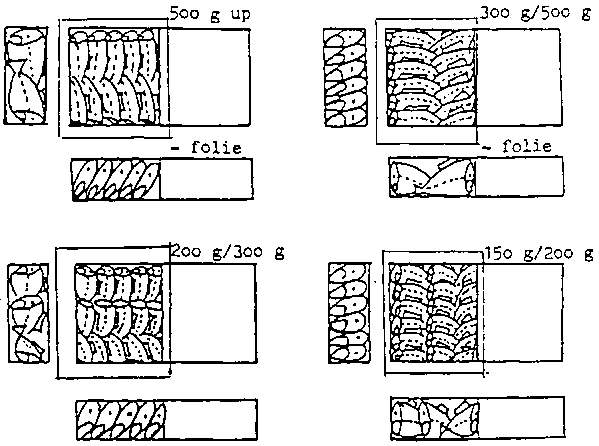
B.2 Shrimp.
All trawlers from the Baltic countries presently engaged in shrimp fishery at Flemish Cap are freezing the shrimp raw without prior grading as a raw material for reprocessing at shore-based industries into cooked and peeled frozen shrimp.
Increasing shrimp catches in Greenland and Iceland have been more than balanced by decreasing catches elsewhere, e.g. in the Barents Sea. As a result, there is a strained supply situation for cold water shrimp raw material for shore-based processing. This has in 1994 caused an increase in the price level F.O.B. Halifax from approximately 1.10 US$/kg to approximately 2.00 US$/kg. This price level, which is also obtained by vessels from Baltic countries, is unchanged by early 1995. The product is packed either as 10 kg blocks in cartons or 20 kg Individually Quick Frozen (IQF) in bags.
The above mentioned product and price level is used in the analysis.
There are different possibilities of adding value to the shrimp production at Flemish Cap. They are all based on introducing a grading of the shrimp.
A typical size distribution of shrimp from Flemish Cap could be:
|
30 - 40% |
70-90 |
pieces per kg |
|
40% |
90-120 |
pieces per kg |
|
20 - 30% |
over 120 |
pieces per kg. |
The trend is towards smaller sizes as a result of the increasing exploitation of the resource.
In general, the larger sized shrimp are the more valuable and there are two products of potential interest:
- Japan shrimp.
- Cooked-at-sea shrimp.
Japan shrimp are whole, raw shrimp packed in 1 kg cartons in different grades after antioxidant treatment and platefrozen to a core temperature of -30°C. There are very strict quality demands for Japan shrimp, for instance as regards bruised shrimp, uniformity of size, colour and percentage of glazing layer, net weight, product colour and appearence, coldstorage temperature, packaging and labelling. A specific quality assurance system must be applied, and a Japanese inspector is normally onboard to control that the specifications are complied with. In return, Japan shrimp fetch top prices. The price level early 1995 F.O.B. Halifax is:
|
50 - 70 pieces/kg |
approximately 23 US$/kg |
|
70 - 90 pieces/kg |
approximately 12 US$/kg |
|
90 - 120 pieces/kg |
approximately 7 US$/kg |
Cooked-at-sea shrimp are whole shrimp cooked in brine no later than 3 hours after catching, chilled in seawater, packed in 5 kg, 10 kg or 20 kg cartons in different grades and frozen IQF. The quality demands for cooked-at-sea shrimp are strict, for instance as regards colour and shape of the shrimp, bruised shrimp, uniformity of size, glazing layer, net weight, 'free flow' of product, absence of 'black heads', packaging and labelling. The main market is in Europe, and the price level early 1995 F.O.B. Halifax for prime quality cooked-at-sea shrimp is:
|
70 - 90 pieces/kg |
4.35 US$/kg |
|
90 - 120 pieces/kg |
3.85 US$/kg |
Smaller shrimp over 120 pieces/kg are presently not in demand as a cooked-at-sea product and are sold as frozen raw shrimp for shore-based reprocessing at a price level of 2.00 US$/kg F.O.B. Halifax.
Shrimp from Flemish Cap share an intrinsic problem of being more pale than generally preferred by the market, which favours an intensive red colour. As a result, they might not always be able to fetch the full price of prime quality cooked-at-sea shrimp.
B.3 Greenland halibut.
Frozen Greenland halibut is traded as an H/G product applying different cuts and trimming for different markets as illustrated in fig. 3.1 and fig. 3.2. As it is seen, the head and tail are cut differently for the two markets. Additionally, the Japanese market wants the scales to remain on the fish, which is not an issue on the European market. The European cut includes a trimming of the fish for all fins and bellyflaps.
Fig. 3.1 H/G Greenland Halibut. Japanese Cut.
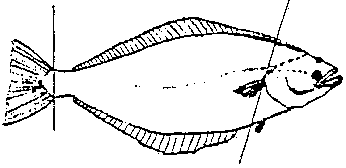
Fig. 3.2 H/G Greenland Halibut. European Cut.
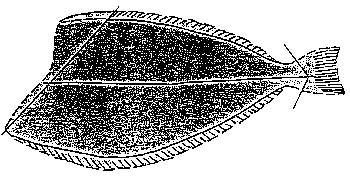
The product is packed in 10 or 20 kg cartons or IQF in bags. It is sometimes blockfrozen, but many buyers prefer a layer-pack type of packing with plast foil to enable separation of individual fish in the frozen state.
Vessels from the Baltic countries have traditionally been freezing ungraded Greenland halibut just like they are freezing ungraded shrimp. It is a known trading to buy such ungraded products and repack and sell them at a higher price after grading.
The grades and preferred fish sizes vary among the markets. In the most simple grading, the H/G fish is divided into smaller fish (below 2 kg/piece) and bigger fish (over 2 kg/piece). A more refined grading is illustrated below together with the related prices F.O.B. Europe early 1995.
|
0.5 - 1.0 |
kg/fish |
3.50 US$/kg |
|
1.0 - 2.0 |
kg/fish |
3.60 US$/kg |
|
2.0 - 3.0 |
kg/fish |
3.70 US$/kg |
|
3.0 - 5.0 |
kg/fish |
3.75 US$/kg |
|
over 5.0 |
kg/fish |
3.90 US$/kg |
A price level for ungraded fish as of mid 1994 is used in the analysis of the Greenland halibut fishery. It reflects the fact that the catch mainly consists of smaller sized fish.
B.4 Horse mackerel.
Horse mackerel caught off Namibia is traded as blockfrozen whole fish in 10 kg cartons. The main market is Africa South of Sahara, particularly Nigeria and Zaire. Alternative market opportunities are found in the CIS, where the price level is generally higher than in Africa.
In South Africa, where the horse mackerel is bigger than in Namibia, a frozen H/G product is also made.
The development of the horse mackerel price for the African market is illustrated in table 4.1. The price fluctuates considerably. It is linked to the price of Atlantic mackerel and would normally be minimum 50 US$/t lower.
Horse mackerel is either sold ungraded with a minimum weight of 200 g/fish or graded as follows:
200 - 400 g/fish
400 - 600 g/fish
over 600 g/fish
The price level of graded horse mackerel early 1995 is exceptionally high, from 0.45 to 0.55 US$/kg, but it is expected to fall in the nearest future.
Table 4.1 Price of Whole Frozen Horse Mackerel. US$/kg F.O.B. Dakar.
|
Month |
1991 |
1992 |
1993 |
1994 |
1995 |
|
January |
0.36 |
0.71 |
0.51 |
0.32 |
0.43 |
|
February |
0.36 |
0.47 |
0.35 |
0.32 |
0.43 |
|
March |
0.34 |
0.47 |
0.45 |
0.32 |
|
|
April |
0.25 |
n.a. |
0.45 |
0.36 |
|
|
May |
0.24 |
0.70 |
0.45 |
n.a. |
|
|
June |
0.24 |
0.70 |
n.a. |
n.a. |
|
|
July |
0.31 |
0.45 |
n.a. |
n.a. |
|
|
August |
0.34 |
0.51 |
n.a. |
0.35 |
|
|
September |
0.35 |
0.52 |
0.42 |
0.35 |
|
|
October |
0.40 |
0.51 |
0.35 |
0.35 |
|
|
November |
0.40 |
0.51 |
0.32 |
0.35 |
|
|
December |
0.43 |
n.a. |
0.32 |
0.35 |
|
The price level at the African market early 1994 is used in the analysis of the horse mackerel fisheries.
B.5 Small pelagics.
The catch of small pelagics off Morocco, Mauretania and Senegal includes species like sardinella, horse mackerel and mackerel. In the analysis, an average price level corresponding to that of horse mackerel is applied.
B.6 Atlantic mix.
The Atlantic mix, which can be caught in international waters of the Northeast Atlantic, includes a variety of species like blue whiting, ling, tusk, argentine, orange roughy, roundnose grenadier, black scabbard fish, goldeneye perch and red seabream. The main part of the catch is roundnose grenadier, which can be caught throughout the year, and argentine. The fishery is relatively new, and the markets are in the process or being tested. The price in UK early 1995 is approximately 0.38 US$/kg H/G.
B.7 Atlantic mackerel.
Atlantic mackerel is mostly traded as whole fish, IQF or blockfrozen, but also to some extent as a frozen H/G product. All the mackerel produced onboard the distant-water fleets of the Baltic States are frozen whole and normally ungraded.
Markets for mackerel are found around the world, from Japan, through the CIS to Western Europe and Africa. The African market mainly buys an ungraded product and for a long period, the price has remained stable at a level of 0.38 - 0.40 US$/kg, cf. table 7.1.
Table 7.1 Price F.O.B. Norway of Whole, Frozen Mackerel for African Market, in US$/kg.
|
Month |
1991 |
1992 |
1993 |
1994 |
1995 |
|
January |
0.45 |
0.38 |
0.38 |
0.38 |
n.a. |
|
February |
0.46 |
0.37 |
0.38 |
0.39 |
0.47 |
|
March |
0.46 |
0.37 |
0.38 |
0.39 |
|
|
April |
0.45 |
0.38 |
0.37 |
n.a. |
|
|
May |
0.45 |
0.38 |
n.a. |
n.a. |
|
|
June |
0.45 |
n.a. |
n.a. |
n.a. |
|
|
July |
n.a. |
n.a. |
n.a. |
n.a. |
|
|
August |
0.39 |
n.a. |
n.a. |
n.a. |
|
|
September |
n.a. |
0.41 |
0.39 |
0.43 |
|
|
October |
n.a. |
0.40 |
0.39 |
0.42 |
|
|
November |
0.39 |
0.40 |
0.39 |
0.43 |
|
|
December |
0.39 |
0.38 |
0.38 |
0.43 |
|
Other markets are paying higher prices in return for higher quality. The Japanese market wants the bigger fish with a minimum size of 700 g/fish and would often insist on having an inspector onboard. The price in Japan is high but has declined for a period of time, cf. table 7.2.
Table 7.2 Danish Prices for Export of Frozen Mackerel to Japan, in US$/kg.
|
1991 |
1992 |
1993 |
1994 |
|
1.59 |
0.98 |
0.94 |
0.75 |
The price level for whole mackerel in the CIS early 1995 is indicated below for the various grades:
|
Ungraded |
0.45 US$/kg (minimum 200 g/fish) |
|
200 - 400 g/fish |
0.45 US$/kg |
|
400 - 600 g/fish |
0.52 US$/kg |
|
over 600 g/fish |
0.55 US$/kg |
The normal price of ungraded ('Ocean Run') mackerel is 0.41 - 0.42 US$/kg, and the price is expected to fall to this level in the near future.
For the purpose of the analysis, a price level of 0.40 US$/kg for Atlantic mackerel is applied.
C. Products, markets and prices applied in the analysis of the different fisheries.
In summarizing the above paragraphs A and B, the following products, markets and prices are used in the analysis of the different fisheries. The choices are based on the present pattern of production and marketing applied by or immediately available for the fleet. As it is described above, there are opportunities of refining and adding value to the production. This will require investments in hardware and in strengthening of the production/quality control.
|
Fishery |
Product |
Market |
Price, in US$/kg |
|
Redfish |
Frozen H/G |
Europe |
1.50 |
|
Shrimp |
Frozen raw ungraded for processing (peeling) |
Canada |
2.00 |
|
Greenland halibut |
Frozen H/G, ungraded |
Europe |
3.36 |
|
Horse mackerel |
Frozen, whole ungraded |
Africa |
0.32 |
|
Small pelagics |
Frozen, whole ungraded |
Africa |
0.32 |
|
Atlantic mix |
Frozen H/G |
UK |
0.38 |
|
Atlantic mackerel |
Frozen, whole ungraded |
Africa/CIS |
0.40 |

