
Nigeria Agriculture at a Glance
Between January and March 2021, the agriculture contributed to 22.35 percent of the total Gross Domestic Product. (https://www.statista.com/statistics/1165865/contribution-of-oil-sector-to-gdp-in-nigeria/). Over 70 percent [1] of Nigerians engage in the agriculture sector mainly at a subsistence level.
Despite the contribution to the economy, Nigeria’s agricultural sector faces many challenges which impact on its productivity. These include; poor land tenure system, low level of irrigation farming, climate change and land degradation. Others are low technology, high production cost and poor distribution of inputs, limited financing, high post-harvest losses and poor access to markets.
These challenges have stifled agricultural productivity affecting the sector’s contribution to the country’s GDP as well as increased food imports due population rise hence declining levels of food sufficiency. For instance, between 2016 and 2019[2] Nigeria’s cumulative agricultural imports stood at N3.35 trillion, four times higher than the agricultural export of N803 billion within the same period.
The Government has implemented several initiatives and programmes to address the situation including the Agriculture Promotion Policy (APP), Nigeria–Africa Trade and Investment Promotion Programme, Presidential Economic Diversification Initiative, Economic and Export Promotion Incentives and the Zero Reject Initiative, Reducing Emission from Deforestation and Forest Degradation (REDD+); Nigeria Erosion and Watershed Management Project (NEWMAP); Action Against Desertification (AAD) Programme, among others.
All these efforts aim to increase agricultural productivity in order to provide sufficient quantities of food to meet domestic demand as well as an abundance of commodity crops for export in the international market. Besides, they aim at reversing forest loss and degradation; promoting sustainable management of natural resources; rehabilitation of degraded lands and reducing erosion and climate vulnerability.
Nigeria has 70.8 million hectares of agriculture land area with maize, cassava, guinea corn, yam beans, millet and rice being the major crops. Nigeria’s rice production rose from 3.7 million metric tons in 2017 to 4.0 million metric tons in 2018. Inspite of this, only 57percent of the 6.7 million metric tons of rice consumed in Nigeria annually is locally produced leading to a deficit of about 3 million metric tons, which is either imported or smuggled into the country illegally. To stimulate local production, the Government banned importation of rice in 2019.
As for cassava, Nigeria produced 59 million[3] tons in 2017, making it the world’s largest producer (approximately 20 percent of global production). The economic potentials are enormous, with high revenue yields from both domestic value addition and derived income as well as revenues for the government[4]. With improved varieties and production techniques, production is anticipated to increase.
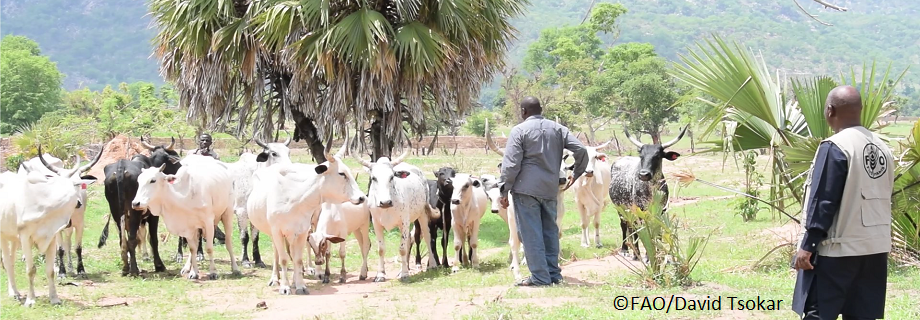
Animal production has remained underexploited. Livestock mostly reared by farm families in Nigeria are the small ruminants like goats (76 million), sheep (43.4million), and cattle (18.4 million). The ecology in the northern part of the country makes it famous for livestock keeping. In addition to small and large ruminants, poultry population stands at 180 million poultry (FMARD, 2017). Here too domestic demand outweighs production despite several interventions by development partners to improve production and safeguard against diseases including transboundary animal diseases.
Nigeria is the largest fish consumer in Africa and among the largest fish consumers in the world with about 3.2 million metric tons of fish consumed annually. Its fisheries and aquaculture are among the fastest growing subsectors in the country. With a coastline of 853km and over 14 million hectares of inland waters, total fish production per year is close to 1 million metric tons (313,231 metric tons from aquaculture and 759,828 metric tons from fisheries). Fishing is a vital livelihood for the poor as well as an important protein source at the household level in Nigeria.[5] The aquaculture sub-sector is considered a very viable alternative to meeting the nation's need for self-sufficiency in fish production and nutritional needs.
The contribution of forestry to agriculture and development in general cannot be overstressed. Nigeria’s forest ecosystems are threatened by rapid population growth and economic activities with annual deforestation rate ranging between 0.72 and 2.38percent, according to FAO 2018 report. Agricultural expansion, heavy reliance on firewood and charcoal for energy, unsustainable timber extraction, urbanization, grazing, bush fires, infrastructure development are among the factors behind this trend.
With the increasing population, estimated to reach 400 million by 2050, enhanced agriculture productivity through adaptation of new technologies and innovations is necessary to ensure food security and nutrition. Support from all partners to the efforts by the federal and state governments is central for achieving this goal
[2] https://www.pwc.com/ng/en/assets/pdf/afcfta-agribusiness-current-state-nigeria-agriculture-sector.pdf
[5] Payne I. The changing role of fisheries in development policy. Natural Resource Perspectives, ODI/DFID. 2000