•The recently ended year of 1997 brought many uncertainties with unpredictable consequences caused basically by the Asian crisis. It hit the Brazilian economy in a very vulnerable moment, because of its dependence on international financing together with the slow progress of our fiscal reforms, currently being discussed in congress.
The development of the Asian crisis, forced the Brazilian government to adopt fast economical measures as the interest index raise, some emergency fiscal adjustment measures together with some important projects.
The vigorous fiscal adjustment measures imposed by the government, cooled down the economical activity at year’s end, which reflects will mainly arise during 1998.
•The fiscal policy in 1997, was less expansionist than in previous years. The forecasted nominal deficit of 4.6 percent of the GDP, in spite of being lower than in the years 1995 and 1996, did not promote a better control of the public finances. The fact is that government, without a structural reform, did not count on other efficient instruments to assure a greater fiscal discipline.
•During the beginning of 1997, government, considering the deterioration of the external accounts, interrupted the policy of gradual interest rates reduction which began an year earlier, by establishing a basic rate by the Central Bank, as reference for all further interest rates. Between October and November, with the Asia’s crisis, which caused a loss of US$ 10 billion from the Brazilian currency reserves, the monetary authorities fixed a basic interest rate of 43 percent per annum, nearly the double of the previous year. The disturbance of the international finance market also imposed the change of strategies to roll over public debt, with the Central Bank placing its bonds in the market, with shorter terms attached to currency changes.
•During 1997, many measures were introduced, aiming the balance payment, mainly the commercial. Most measures introduced in the export area, were meant to improve the export credit.
New criteria and operational conditions were defined, granting more flexibility to the Export Finance Programme. The National Development and Social Bank (BNDES) enlarged the list of financed products, with reduced expenses, and greater financing terms.
As far as imports are concerned, many measures were adopted, because cheaper international financing terms and costs, encouraged imports and some were considered unfair competition to the domestic products.
•The revision of the import duties by the government, used to benefit the import of capital goods, with no domestic production, was slightly reduced in terms, number of items and the once exempt of import duties, are currently at 5 percent.
•The Central Bank’s activity in the exchange rate market, carried on the rules of a monthly devaluation, generally a little above the domestic inflation rate.
During 1997, the nominal exchange rate to the American dollar had a 7.4 percent devaluation and the actual exchange rate devaluated 4.6 percent
Even though several measures to avoid deterioration of the Trade Balance were adopted, 1997 showed a negative balance of US$ 8.4 billion, 50.7 percent higher than previous year. Exports reached US$ 53 billion, showing an increase of 11 percent, while imports rose 15.1 percent, reaching US$ 61.4 billion.
•The Payment Balance was negative by US$ 33.8 billion, 39 percent higher than in 1996.
87 percent of the deficit was represented by the rise of profit and dividends transfer, transport and international travel expenses, and pay interest.
According to preliminary data, the total production of chemical, mechanical and thermomechanical pulp reached 6.3 million tons, 2.3 percent higher than the previous year. The operation rate for chemical pulp was 92 percent and the mechanical and thermomechanical pulp, reached 61 percent.
The main contribution to the increased production, was Eucalyptus chemical pulp, which showed a gain of 6.1 percent, or 248 000.
The domestic pulp market consist of domestic sales and used on-site by the integrated paper mills increased by 4 percent, reaching 4.1 million tons, 65 percent of the total pulp production.
It has to be pointed-out that the temporary shut down of the Jari pulp mill, affected mainly the bleached softwood pulp production.
The paper sector produced 6.5 million tons, 5 percent higher than 1996 and operating at 86 percent of its installed capacity. The main contribution to this increase came from the printing and writing papers, which production rose by 10.5 percent.
Packaging kraft paper’s production of 2.9 million tons and printing and writing paper’s production of 2.0 million tons, reached a share of 45 percent and 31 percent respectively, from the total production.
The use of papers for on-site convertion increased by 6.7 percent, compared to 1996, reaching 1.3 million tons, 95 percent of which being packaging kraft paper.
Total domestic sales rose by 2.9 percent, reaching 3.8 million tons. In total, printing and writing, wrapping and packaging papers represented 63 percent of domestic volumes sold.
The consumption of recycled papers by the industry, totalling 2.2 million tons, kept the same market share as in 1996. It corresponds to 36 percent of the apparent paper consumption.
In 1997, the total apparent consumption of pulp rose by 1.5 percent, reaching 4.3 million tons and of paper, rose by 4 percent, reaching 6.1 million tons. The per capita consumption of paper was 3 percent higher than in 1996, reaching 38 kg per inhabitant, the largest ever recorded.
The Brazilian Government, worried about the deterioration of its commercial balance and adopted measures aiming to increase the competitiveness and to improve the official export credits.
During 1997, the pulp (2.2 million tons) and paper (1.2 million tons) exports totalled US$ 2 billion of income a rise of 2.9 percent when compared to the previous year. Nevertheless with the international depressed prices, the financial results, even with an additional volumes of 11.8 percent in exported pulp and 7.7 percent of paper volume, rose only 2.5 percent for pulp and 3.3 percent for paper.
Indirect exports and the form of packaging (multiwall) paper bags, corrugated containers pallets and skids amongs others) evaluated at some US$ 1,0 billion were exported to protect all sorts of goods but are not credited to forest products industry, as they were sold in the domestic markets to serve other segments exports.
Imports of pulp, almost all bleached softwood, reached 318 thousand tons, while paper imports mainly newsprint and printing paper totallized 978 thousand tons, accumulating outlays of US$ 1.1 billion, an increase of 8.7 percent.
During the period of 1993-1997, paper imports had a yearly average increase of 33 percent, raising its share on the apparent consumption, from 7 percent to 16 percent.
Nevertheless, the sector’s direct balance for 1997 had still a positive surplus of US$ 928 million, exactly the same as in 1996.
The most difficult access to a competitive financing, is still the biggest barrier for the increase of the forest industry base expansion.
Pulpwood consumption during 1997, is estimated at 31 million m3, with bark.
Due to the lack of an efficient forest expansion policy, there is a risk of farmed wood deficit already in the next decade.
The pulp and paper sector, worried about this scenario, projects the need of new plantings for a total of 350 000 ha of new forests and reform another 650 000 ha till the year 2005.
The forest plantations areas belonging to the pulp sector incorporate modern silvicultural practices, mainly in biotechnology, reaching a yearly average productivity of 30 m3/ha for eucalyptus and 23 m3/ha for pine, with expected increases for the future.
Considering the gradual adjustment of the world economy, the performance of the Brazilian economy will still heavily depend on the international scenario.
The economic policy will be of gradually adjustment in the monetary and a fiscal area going further with needed administrative reforms and privatization.
Hopefully the public sector will show a better performance, as the result of the emergency fiscal adjustment introduced in November 1997, equivalent to 2.5 percent of the GDP and of the inflow of funds resulting from the privatization programmes.
The exchange rates will show a continuing monthly correction, slightly higher than the domestic inflation. At the beginning of 1998, the Central bank increased to 7 percent, the floating exchange rate range, removing the risk of eventual speculative movements.
In a scenario of moderate economic grow, the GDP shall rise between 1 and 2 percent per annum.
This scenario should also show an improvement of the trade balance, reducing the deficit to US$ 4.5 billion and the yearly inflation should stay between 3 and 4 percent.
The crisis in Asia will certainly upset and bring down the pulp and paper prices because, on the one side, due to the decrease of local demand and on the other hand, by the oversupply from the newly installed local mills.
1998 is the election year in Brazil for president and state governors. There is a great probability of presidential reelection, which enable us to forecast the next economic steps.
The pulp and paper industry investment programme is showing some delays as a result of lack of industrial and forestry policy and to the changes of the economic policy.
The industry, considering the implementation of its investment programme to be imperative to secure the competitiveness and the expansion of the production capacity, continues to advance with its essential pleads, crucial for its cost competitiveness.
Sustainable forest management has emerged as a sensitive global issue mainly since 1992 after the World Summit/UNCED held in Rio de Janeiro.
Brazil possess a great percentage of the world forest’s. However, the wood in use for pulping and paper production are from farmed exotic forests, mainly eucalyptus and pines. Native forest of high biodiversity, such as the tropical rain forests, are not used for pulping in Brazil.
Brazilian forest-based industries are very well concerned about developing forestry principles, criteria and indicators of sustainability, using preferably with the implementation of EMS - Environmental Management System, according to ISO 14001.
Brazil, the leading Latin America country in farmed forests, is moving very fast in the implementation of ISO 14001. Some companies have already achieved this certification, such as Bahia Sul, Cenibra and Riocell. Many others are close to this achievement.
It is important to mention a participation of Brazilian delegates in ISO TC207/Working Group 2, to develop a technical document to assist the forestry organizations in the use of ISO 14001 and ISO 14004 standards.
In December 1996, in a meeting held in Rio de Janeiro, Brazil, delegates from several Latin American countries (Brazil, Chile, Uruguay, Argentina, Mexico, Colombia, Peru, etc.) had an opportunity to hear and to contribute to the findings of the International Institute for Environmental and Development (IIED), London (UK). Experts from this well-known scientific institute were responsible to the study on "Sustainable Paper Cycle", a worldwide study sponsored by the Business Council for Sustainable Development. From the discussions, it became clear that forestry, paper recycling and globalization could be regarded as the most critical issues to Latin American countries. Both forestry and paper recycling had the social issues considered to be the most sensitive ones, due to globalization, reduction of job offer, technological development, automation and population growth.
Although the FSC (Forest Stewardship Council) meetings have already started to define local criteria in separate for farmed forests and Amazon native forests, the forest labeling system is also being considered in Brazil. FSC is a viable alternative, but success is very much dependent on the level of maturity among the players on the table of discussions. Till now, the indications are for good willing by all participants.
Parallel to FSC, the Brazilian Standard Association (ABNT), similary to the Canadian Standard Association, has revitalizad the forest certification project called CERFLOR. This system was originally developed by the Brazilian Forestry Society (SBS). In the later stage of development, the process was offered to ABNT, the most reliable certification agency in Brazil. ABNT has the mission to hear the interested parties, to adapt principles, criteria and indicators, in an open and transparent process.
The Brazilian Pulp and Paper Association (BRACELPA) has a special task force, comprising members of the leading pulp and paper companies. This task force is responsible for the follow-up and participation in the most important certification and labelling forums, including: FCS, ABNT/CERFLOR, ISO 14001 SFM, International Forestry Roundtable BCSD (Business Council for Sustainable Development), and European Union eco-label.
The large continental area of Brazil, allow itself with a imense array of potential opportunities. Different climates, soils and favourable conditions and land availability, including technical "know how" and "know who" contributes imensely to the potential alternatives.
Currently some 16.6 million ha of forests are considered protected under the federal government rulings. An additional 1.5 million ha of native forests, considered as "preservation" are spread among the "farmed forests" managed by the private enterprises.
The private forest base for the industry, accumulates some 6.3 million ha of commercial forest of the socalled "farmed forests", being 4.6 million ha in the form of eucalyptus and 1.7 million ha of pines (tropical and non-tropical).
The forest products industry, during 1997, used some 300 million cubic meters (m3) of roundwood generating revenues of some US$ 17 billion, being US$ 4 billion in exports sales. Among these segmentes, using wood, the following comments are in order.
As stated before, this industrial segment owns some 1.4 million ha of "farmed forests", mainly with eucalyptus and pines. For the 1997 production of 6.3 million metric tons of its output, some 31 million m3 of roundwood were used. To enable to keep up with its planned expansions, the increase of 170 000 ha/a of its forest base are expected during the next decade.
Estimated 29 million m3 of roundwood from "farmed forests" were used into the production of the 31 million m3 of chacoal consumed. There is, however, a deficit of wood from "farmed forests" for this continuous used product and the trend is to replace a large portion of the future needs with mineral coal (coke), thus preserving more native forests areas.
Within this group of products, sawnwood, plywood, particleboard, hardboard and other fiber boards are included. The total usage of woods for these segments where 54 million m3 for a final production, estimated of 22 million m3 of products.
There is a trend for continuous utilization of roundwood from "farmed forests" which currently is already 32 percent of the total volume used.
While the current scenario is positive, on the medium and long term basis, there are expected difficulties. There are strong indications showing "deficit" of wood availabilities from man made forests, with important economic implications to the industry.
The competitiveness and sustainability of the various segments of the forest base industry are directly related to the expansion of the usable forest base, be it native or "farmed forests".
The implementation of new mechanisms to generate new forests will be crucial for the future, and to assure sustainability of the variuos players.
The expansion of new "farmed forest" of already proven species will be important, but also new tecnology applicable, to existing forests and their renewals with improved seed sources and cloning will constitutes important management tools and possible increased wood availability to the users.
It has also being noted that preliminary introduction of new forest species, (like teak) and the use of existing plantation to multiuse purposes are becoming a trend. The use of large eucalyptus forest for furniture purposes are already a reality, and their exports are already significant.
Also the increase of manufacturers of MDF (Medium Density Fiberboard) and OSB (Oriented Stranded Board) are also a reality, using farmed forests unreachable by the Pulp and Paper Industry, due to its distances. It is forcasted that solid wood products will reach some for 4.7 million m3 by the year 2001, a 35 percent increase in volume over the currently estimated production.
Drop in prices on international market forces revision of Brazilian timber industry: Brazil can pass from an exporting country to an importing one.
As a consequence of the Asiatic economic crisis at the end of 1997 that lead to a significant drop in prices on the international market, the Brazilian timber industry has been forced to review its plans. In the plywood area, projections of exports of US$ 450 million for 1998 have been reduced to US$ 300 million.
ABIMCI, the Brazilian Plywood Association, considers this the worst crisis ever faced, especially due to the cancellation of orders from Korea, one of the major markets for Brazilian plywood, and the drop in prices of up to 40 percent of plywood produced by Indonesia and Malaysia, the two main competitors of Brazil for tropical plywood.
The difficulties with exports has a direct reflection on the Brazilian domestic market, which cannot absorb all production. Worse than that is the fact that low prices on the international market are attracting Brazilian consumers and imports in this area, having been non-existent before, are now starting. In the opinion of the President of ABIMCI, Mr Isac Chami Zugman, if nothing positive happens, this might turn Brazil into an importing country for plywood, instead of being an exporting country.
In 1994 there were around 400 plywood mills in Brazil, reduced to around 250 in 1997, but could reach only 70 in the near future.
Brazilian plywood production (1000 m3)
Year 1992 1993 1994 1995 1996 1997 1998* Installed capacity 1 950 2 000 2 200 2 500 2 700 2 700 2 700 Production 1 250 1 600 1 900 1 600 1 700 1 600 1 900 Unused 700 400 300 900 1.000 1.100 800
Source: ABIMCI
Strong point:
•Availability of large forest areas
•Markets with great potential for consumption
•Perfect knowledge of silvicultural techniques in plantations
•Good knowledge of silvicultural techniques in native tropical forests
•Good know-how on industrial production
Weak points:
•High production costs, comparing with other producing countries
•Lack of specific financing credit lines for mechanical wood processing
•Quality cost control and selection of raw material
•Brazil cost (cost of Brazilian bureaucracy and poor existing infrastructures, such as ports, roads, energy supply, and so on)
Strangling points:
•Lack of a well-defined and structured industrial policy
•Lack of a defined forest policy
•High investment cost for intense capital activities
•Low labour qualification for both forest and industrial operation
•Marketing problems (long distances to consumers)
•Expensive logistics for exports
•High social and fiscal costs
•Environmental cost due to emotional focus on issue
Evolution of Brazilian plywood exports
|
1973 |
US$ 8 971 000 |
|
1983 |
US$ 48 410 000 |
|
1993 |
US$ 274 122 000 |
|
1995 |
US$ 259 992 728 |
|
1996 |
US$ 247 669 877 |
|
1997 |
US$ 265 000 000 |
|
1998* |
US$ 300 000 000 |
* Estimates
Source: DECEX-Brazilian Dept. of Foreign Trade
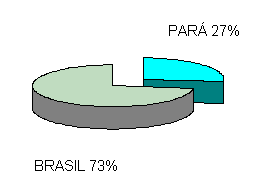
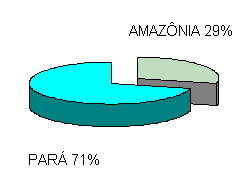
The President of Aimex, the Association of Plywood and Lumber Exporters from the State of Pará, Mr Roberto Pupo, has the same view as ABIMCI related to projections for 1998. The Asiatic crisis is affecting the exports from Pará that represent around 27 percent of Brazilian exports, and a reduction of 20 percent is expected for 1998. (See the figures for 1997 in the attached table.) For instance, Philippines and Thailand were two excellent markets for Pará. They imported 100 000 m3 of sawn lumber in 1996, representing about 15 percent of Brazilian exports, almost all Pará production. Now they are not buying anymore.
The devaluation of Asiatic currencies is making their products more competitive, which will decrease Brazil’s exports.
Brazilian sawn lumber exports
|
1995 |
US$ 379 816 218 |
|
1996 |
US$ 344 745 905 |
|
1997 |
US$ 410 999 756 |
Source: DECEX-Brazilian Dept. of Foreign Trade
AIMEX Statistics and own documents
The socio-economic importance of the forest industry &endash; ABIMCI
BRAZILIAN WOOD EXPORTS &endash; CHAPTER 44 OF HARMONIZED SYSTEM (NBM/SH), 1997 (JAN TO DEC)
AMAZON REGION COMPARISON (US$ FOB)
|
STATES |
44.07 |
44.08 |
44.09 |
44.10 |
44.12 |
OTHER |
TOTAL |
% AMAZ. |
% BRASIL |
|
|
|
ACRE |
88.302 |
0 |
20.796 |
0 |
0 |
0 |
109.098 |
0,02 |
0 |
|
A |
AMAPÁ |
0 |
0 |
0 |
0 |
0 |
27.264.725 |
27.264.725 |
5,86 |
2,24 |
|
M |
AMAZONAS |
2.138.192 |
16.802.780 |
231.872 |
0 |
18.832.954 |
211.027 |
38.216.825 |
8,21 |
3,14 |
|
A |
MARANHÃO |
168.262 |
0 |
0 |
0 |
52.779 |
2.028.948 |
2.249.989 |
0,48 |
0,18 |
|
Z |
MATO GROSSO |
12.999.350 |
5.683.490 |
1.281.746 |
0 |
16.289.366 |
1.016.197 |
37.270.149 |
8,00 |
3,06 |
|
Ô |
PARÁ |
199.282.374 |
26.825.559 |
8.389.899 |
2.579 |
77.767.277 |
18.272.653 |
330.540.341 |
71,02 |
27,14 |
|
N |
RONDONIA |
12.153.098 |
9.225.261 |
597.118 |
0 |
5.778.836 |
1.183.529 |
28.937.842 |
6,22 |
2,38 |
|
I |
RORAIMA |
456.068 |
3.000 |
90.858 |
0 |
122.143 |
10.160 |
682.229 |
0,15 |
0,06 |
|
A |
TOCANTINS |
0 |
89.013 |
0 |
0 |
50.105 |
24.607 |
163.725 |
0,04 |
0,02 |
|
|
SUB TOTAL |
227.285.646 |
58.629.103 |
10.612.289 |
2.579 |
118.893.460 |
50.011.846 |
465.434.923 |
100 |
38,22 |
|
|
|
|
|
|
|
|
|
|
|
|
|
OTHER STATES |
183.714.110 |
38.142.398 |
39.184.960 |
20.588.496 |
145.331.183 |
325.475.605 |
752.436.752 |
|
61,78 |
|
|
|
|
|
|
|
|
|
|
|
|
|
|
GENERAL TOTAL |
410.999.756 |
96.771.501 |
49.797.249 |
20.591.075 |
264.224.643 |
375.487.451 |
1.217.871.675 |
|
100 |
|
|
HARMONIZED SYSTEM (NBM/SH) POSITION 44.00 = WOOD PRODUCTS |
44.07 44.08 44.09 44.10 44.12 OTHER |
SAWN LUMBER VENEER WOOD FLOORING/PANEL PARTICLE BOARD PLYWOOD 44.01; 44.02; 44.03; 44.04; 44.05; 44.06; 44.11; 44.13; 44.14; 44.15; 44.16; 44.17; 44.18; 44.19; 44.20 E 44.21 |
|
SOURCE: |
DECEX - BRAZILIAN DEPARTAMENT OF FOREIGN TRADE |
|
|
PREPARED BY |
AIMEX / SINDIMAD |
|
|
FORESTER |
GUILHERME DOS SANTOS CARVALHO |
|