 |
|
|
Joint meeting of the Seventy-eighth Session of the Progamme Committee and the Eighty-eighth Session of the Finance Committee |
|
25 September 1997 |
|
POSSIBLE REVISIONS TO THE PROGRAMME BUDGET PROCESS AND THEIR IMPLICATIONS, INCLUDING THE MEDIUM TERM PLANNING PROCESS |
III. The Possible Components of a Strengthened Planning Process
VI. Programme of Work and Budget
VII. Programme Evaluation Report (PER)
1. This document responds to the Programme and Finance Committees' request at their April 1997 joint meeting report (Para. 1.4):
"During the discussion, the Committees recalled that the Finance Committee had recommended further examination of several features of the Programme of Work and Budget process, at the next joint session of September 1997. The Committees agreed that aspects of current practices to be revisited included: the usefulness of the January Joint Meeting in the second year of the biennium, the eventual rearrangement of the timetable for intergovernmental review of PWB proposals, including the contributions of the Technical Committees of the Council; and streamlining of supportive documentation, also taking account of the incipient new programming framework, if approved by the Conference. The Committees stressed that eventual changes should seek to meet effective requirements for information at each stage and maximize economies. The Committees agreed, therefore, that a document on the subject be prepared by the Secretariat, outlining various options and associated costs and/or potential savings."
2. Similarly, at the conclusion of its discussion of the Medium-term Plan 1998-2003 in April 1997, the Programme Committee stressed "the desirability of revisiting the medium-term planning process in FAO, to make it fully responsive to the needs of Governing Bodies, avoiding at the same time unnecessary duplication". This was echoed and amplified by the subsequent session of the Council in June which "requested the Secretariat to prepare a paper for the Programme Committee at its September 1997 session which reviewed and discussed the options for an adapted medium-term planning process. The Programme Committee would then put proposals to the Council at its session, immediately before the FAO Conference; and the Council would put a recommendation to the Conference."
3. Given the inter-relationships between the medium-term planning and programme-budgeting processes, the two subjects are addressed in this document.
4. The review of FAO's planning and budgeting processes takes account of other observations and proposals for improvement made by members in recent meetings. For instance the Programme Committee's requests for more transparency and a clearer justification of PWB proposals led it to endorse the testing of a revised programming framework in September 1996, which is being done for one selected programme (2.1.1: Natural Resources).
5. Similarly, the need to streamline approval of the Programme of Work and Budget proposals, which now involves a costly and repetitive three-stage process, and to ensure more meaningful involvement of the Technical Committees, has been a long-standing concern. This culminated in the June 1997 Council: "welcoming the recommendations that Technical Committee Sessions should be held earlier in Conference years, and that the January Joint Session of Programme and Finance Committees in Conference years be eliminated" during its discussion on the review of statutory bodies and panels of experts in June 1997.
6. Ways to facilitate decision-making by the Governing Bodies on programme and budgetary issues have been explored since the Organization came into being. Changes have taken place over the years to arrive at the current arrangements, from the early days of PWB documents focusing almost exclusively on objects of expenditure, through the adoption of programme-budgeting methodologies, the introduction and progressive refinement of ex-post facto accountability reports, the reintroduction of a rolling medium-term plan (in 1989) and, more recently, the greater specification of outputs and the use of criteria for priority setting in the Programme of Work and Budget.
7. Many features of the current processes are either explicitly mentioned in the Basic Texts, or were introduced by writ of Conference decisions or Resolutions, implying a possible need for formal action should substantial changes be introduced.
8. The Director-General seeks open dialogue at all levels with both governments and staff on strategic priorities and programme objectives. At the same time, the Director-General looks forward to streamlining in governance which will allow the maximum of resources to be deployed at the cutting edge, for international policy dialogue, standard setting and capacity development at national level.
9. This document therefore reviews the current programme and budgeting process with a view to identifying the changes which should:
10. In this light, the present document examines the rationale for a more effective programme-budget process, including its medium-term component, and submits proposals and options for consideration, so as to assist the Committees in formulating their own recommendations to the Council.
11. FAO's effectiveness depends, above all, on its ability to adjust the focus of its programmes to ensure that they address issues which are critical to the achievement of national and global food security and sustainable rural development goals. Such adjustments are only possible if the Organization has a long term vision of the directions of future agricultural development, natural resources management and food security, within which it can identify priority claims on its limited resources.
12. Many elements of such a vision have been available in the periodic assessments and outlooks produced by the Organization, including reports for the FAO Conference, SOFA and especially AT 2010, but linkages with the planning and budgeting system may not have been sufficiently explicit in the past. There appears to be, therefore, a need to add a stronger strategic dimension to FAO's planning system, as priorities may have tended hitherto to be set by reference more to precedent and as a reaction to current problems, rather than in the context of periodically revised strategic objectives. Thus the priorities for action by FAO in the last years of this century must be set in the context of a vision or framework extending well into the next.
13. For FAO, setting priorities is particularly difficult because of:
14. In establishing priorities for action by FAO, resource limitations impose a need to focus on the Organization's main mandates and roles, as well as comparative advantage, including :
15. These advantages have been reinforced by the recent restructuring which has strengthened the Organization's capacity for high quality normative work and improved its competitiveness as a source of effective technical assistance .
16. The following table and analysis substantiate a modified process which would have five main elements, each with separate supporting documents:
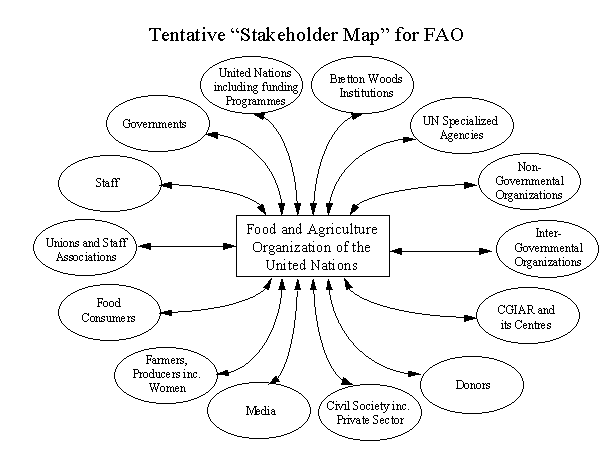
| Document | Period | Frequency | Next Cycle |
| Strategic Framework 2000 - 2015 | 10-15 years | 6 years | PC/FC May 1998 CL November 1998 C November 1999 |
| Medium Term Plan 2000 - 2005 | 6 years | 2 years | PC/FC September 1998 CL November 1998 C November 1999 |
| Programme of Work and Budget 2000 - 2001 | 2 years | 2 years | PC/FC May 1999 CL June 1999 C November 1999 |
| Programme Evaluation Report 2000 - 2001 | 6+ years | 2 years | PC/FC May 2001 CL June 2001 C November 2001 |
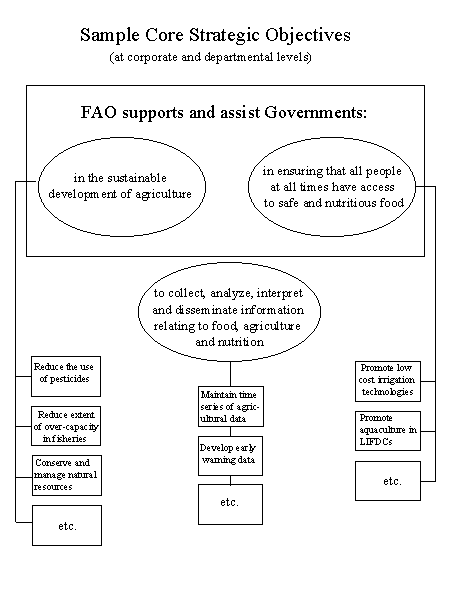
| Programme Implementation Report 2000 - 2001 | 2 years | 2 years | PC/FC May 2002 CL November 2002 C November 2003 |
17. Under the proposal the programme planning and budgetary process would start with the formulation of a long-term Strategic Framework containing inter-alia an agreed definition of priority areas of action for FAO. In this context, the Medium Term Plan could assume a new and central importance in the Organization's planning system, establishing the link between its programme activities (e.g. technical projects, etc.) and its strategic objectives. It becomes FAO's Corporate Plan, drawing together the strategic implementation plan - defining subsidiary objectives, outputs and inputs - for each of its major activities, and setting out related measures for enhancing the Organization's comparative advantage and effectiveness. The biennial process of updating the Medium Term Plan, adjusting the relative importance given to different programmes, dropping some and introducing others, would become a central feature in the deliberations of the Governing Bodies.
18. The attention of the Committees need to be brought to the fact that implementation of the new programme model, on which the modified Medium Term Plan relies, represents a major commitment of staff time. Of necessity, the process results in much discussion and analysis before the first set of projects and agreements emerge it therefore is the view of the Secretariat that the September 1998 date is too early to allow it to be completed for all FAO technical programmes. As the later submission of the Medium Term Plan to the Governing Bodies would disrupt the remainder of the proposed calendar, it is suggested that the new model, if approved, be introduced in a phased manner.
19. The Programme of Work and Budget would essentially become FAO's short term Business Plan. Rather than serving as at present as the principal foundation of the planning and budgeting system of the Organization, it would represent the detailed implementation plan of a two year time-slice of the Medium Term Plan, and, as such becomes a vehicle for fine tuning agreed activities to match available budgetary resources. As such, the PWB will have to reconcile the strategic and medium-term orientations accepted by the membership with the realities of their financial commitments.
20. The first two documents, the Strategic Framework and the Medium Term Plan, are examined below (see sections 4 and 5 respectively) in some detail in terms of both process and content. The remaining documents are only briefly addressed pending further guidance from the Committees.
21. This section addresses the process for the preparation of the Strategic Framework and tentatively outlines its contents.
22. The process consists of a series of steps drawn from accepted strategic planning methodologies.
23. This step will involve examining all of the authoritative sources for FAO's mandate. These will naturally commence with the Constitution, Conference resolutions and decisions dealing with questions of mandate. It will also look at the decisions of major international conferences which have assigned certain roles to the Organization, e.g. Rio, Beijing, Cairo, Kyoto, Rome. While such assignments should always be for tasks or responsibilities which already lie within the Constitutional mandate, they are important as they can further define and clarify FAO's role in relation to those of other institutions particularly, although not exclusively, within the UN family.
Box 1: FAO's Constitutional Mandate
|
24. As an illustration, the basic mandate summarized in Box 1 is further clarified through the outcome of UNCED, as a result of which FAO was assigned Task Manager for certain Chapters of Agenda 21 (see Box 2). Clearly, this provides a highly authoritative source for FAO action in a number of clearly defined priority areas which have been recognized by the community of nations.
Box 2. UNCED Agenda 21 AssignmentsTask Manager for:
|
25. Task Manager roles for Chapters 10, 12 and 13 clearly fall within the third constitutional mandate in Box 1, whereas Task Manager for Chapter 14 cuts across several of the basic mandates - perhaps even all of them. This is important in that the contribution of external fora in determining FAO's mandate should be limited to emphasizing particular aspects which are already implied by the constitutional mandate. Thus, while an international conference may call upon FAO to address an area of concern, it would not be appropriate for it to extend the mandate, a matter which lies solely with the FAO Conference.
26. Similarly, the assignment of responsibilities to other organizations and their capability to execute them has implications for FAO's effective mandate. This has been particularly evident in the growth of the CGIAR system, and the incorporation of agricultural trade in WTO responsibilities.
27. The output from this step will be a comprehensive and up-to-date statement of the Organization's current mandate and key roles.
28. "Stakeholders" are defined as any person, group, or organization that can place a claim on the Organization's attention, resources, or output or is affected by that output.1 This is considered to be a very important step in that the prerequisite to success for public institutions such as FAO is the satisfaction of key stakeholders. It represents one of the ways in which the political realities are brought into the strategic planning process, thus increasing the realism of the resulting plan or framework.
29. The first aspect is to identify FAO's stakeholders. An attempt at this can be seen on the following chart, recogniziong that ome stakeholders are more important to the work of FAO than others.
30. The analysis should then try and recognize the criteria by which the stakeholders judge the Organization's performance and how well the Organization performs in the perception of the stakeholders. Clearly, the value of the analysis would be enhanced if there is some dialogue with the stakeholders and the following approaches might be considered:
31. In emphasizing stakeholder analysis, it is noted that this does not imply that all stakeholders are given equal weight, nor that the consultation process, which should be wide, will be confused with the decision-making process, which is the prerogative of the Governing Bodies.
32. On the other hand, the wider the analysis the more likely it is that a comprehensive view of needs and expectations will be derived.
33. This step flows out of the previous two steps and should be the distillation of mandate and stakeholders requirements. It may be in the form of four or five core objectives reflecting priorities to which the large majority of stakeholders can subscribe
34. Once corporate core objectives have been defined, the next level of objectives needs to be delineated for substantive programmes by FAO departments and divisions. The following chart indicates how this might build up:
35. At this stage of the process, any such mission statement must be seen as tentative and be open to review and revision as the subsequent analysis provides reason to adjust it to reflect the impact of, for example, changes in the external environment.
36. In FAO's situation, this analysis has two distinct aspects, both based upon trying to examine what changes will occur in the future period under review and how they might impact upon the Organization and its work.
37. The first concerns the need to foresee new developments and trends in world agricultural development and in the food security situation. Much of this already occurs in the development of existing studies or reviews such as AT 2010 and the State of Food and Agriculture. However, as already indicated under The Setting above, these assesment provide the framework for the strategic planning process.
38. The second concerns the impact of a broader range of elements not limited to agricultural and rural development but of major political, economic, social or technological factors which may either offer opportunities to the organization or present hazards for it.
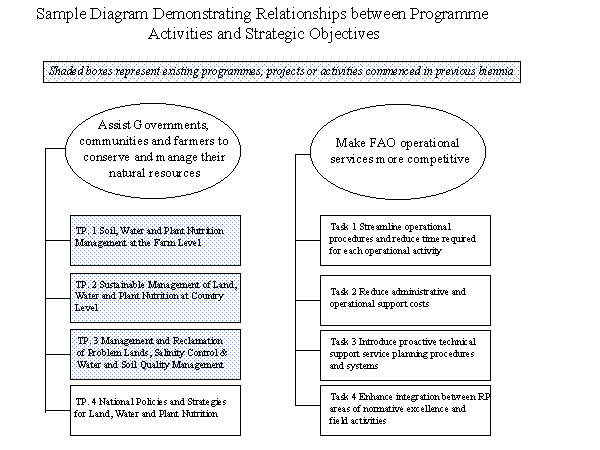
| Category | Future Trends | |
| Opportunities | Hazards | |
| Political | Globalization and the need for international institutions | Decline in support for multi-lateralism |
| Public perception of UN/FAO | ||
| United Nations Track II Reform Proposals | ||
| Increasing trend for the public sector to be policy oriented and not to be service providers | ||
| Economic | Strong economic growth and availability of resources for investment | Declining public sector resource allocations |
| Trend towards privatization | ||
| Social | Increasing concerns by the public for the environment | Movement away from large public institutions |
| Increasing supply of technical capacity | ||
| Growing number and diversity of stakeholders and therefore in the complexity of requirements to be met | ||
| Technological | Scientific advances (e.g. telecommunications capacity, video conferencing - critical to global institutions, etc.) | |
| Opportunities for efficiency savings | ||
39. The two questions to be addressed in this step are:
40. The analysis is effectively an inward looking evaluation of the Organization which should, as far as possible, rely on hard data beyond the perceptions of individual managers. The lack of such data is one of the gaps that will need to be attended to, if this exercise is to be effective and if stakeholders are to be convinced of its seriousness.
41. It is important that this part of the analysis does not stray into areas which are not within the scope of the exercise. Thus, for example, the first full round of structured strategic planning for FAO should probably not set out to address the issues of governance or organizational structure. Neither is it likely to address entitlements, the remuneration of staff or any other matters which are subject to the rules of the common system. Given the statements contained in the reports of the various Governing Bodies and their Committees, as quoted in the Introduction to this document, the emphasis of the first strategic planning exercise would be on the programme policy and priorities and the cost effectiveness and efficiency with which they are implemented.
42. In effect, the responses to the two questions in each eligible area directly lead into key strategic issues. Thus for example, in answer to the first question, a serious constraint to FAO's role in enhancing food security is the constrained flow of extra-budgetary resources and the perception by certain stakeholders that UN agencies are expensive service providers. This will lead to the issue of support costs and how to reduce them Similarly, in answer to the second question, there is no doubt that one of the core competencies of the Organization is the support to, and management of international fora aimed at agreeing on approaches to policy questions. This might lead to an examination the types of resources which need to be applied to improve competitiveness in this area.
43. The output of this step should be a listing under each heading for use in the next step.
44. These are the fundamental policy questions, critical challenges or opportunities which face the Organization. They can involve its mandate, mission, the level and mix of services it produces, the clients it serves, those who fund it or general issues concerning costs and management.
45. They can be identified directly from the analyses already undertaken or they might also be approached indirectly, by attempting to identify what issues need to be addressed in order to achieve the goals of the Organization. The important point is not to miss any major strategic issue and therefore the use of more than one means of identifying them is a valid way to assist in ensuring that the final outcome is comprehensive.
46. The output from this step is a summary for each identified issue containing:
47. For each strategic issue, it will be necessary to identify whether the Organization is in the best position to respond or, alternatively, whether it is a matter which is best left to other international actors or to countries themselves.
48. Having identified those issues which the Organization is in the best position to address, it remains to define precisely the course of action to be undertaken.
49. The analytical work described above will, when completed, allow the preparation of the Strategic Framework document. The steps described above should, however, be seen as being iterative, in that as each one is completed it adds new understanding that can affect the conclusions of the previous step. Thus for example, the initial mission statement may be subject to several revisions.
50. It is envisaged that the Strategic Framework would have a time horizon of 10 to 15 years and that it would usually be revisited every 6 years, in line with the time horizon for the preparation of FAO prospective studies and successive revisions.
51. It would consist of the following:
52. Medium Term Planning would take on a rather different meaning if the above-described Strategic Framework is to be adopted. The purpose of the plan would change from a conceptual document to more of a strategic implementation or "corporate" plan for the medium-term.
53. While the process would continue to follow the general methodologies for strategic management, the identification of activities which would best meet the Strategic Objectives (be they founded on core objectives or on the specific strategic issues), would tend to be in terms of the concept of the technical projects, continuing programme activities and service agreements as envisaged under the new programme model which is currently being tested for programme 2.1.1.
54. The Annex to this document describes the objectives of the new programme model and gives an account of the experience of its trial application. Should it be decided to adopt it, the first session of the Programme Committee in 1998 would be presented with more specific implementation proposals.
55. Assuming that the programme model is adopted across the Organization, the process envisaged is one of a rolling Medium Term Plan, which would need to be revised every two years as earlier projects are modified or completed and new projects brought on stream.
56. Thus, while the Medium Term Plan would present the new projects or agreements which are proposed to be brought on stream, the Programme of Work and Budget would concentrate on the two year time slice of the Medium Term Plan enveloping all projects and outputs which are expected to be in operation or produced in the biennium.
57. Each project or agreement would be assessed in terms of the contribution to one or more strategic objectives as set out in the Strategic Framework; this would also involve using the Council Criteria (repeated below but probably to be revised) to distinguish between priorities for action vis-à-vis these objectives.
58. The criteria approved by the Council as regards priority activities are recalled below:
59. As projects can be for any period up to six years, only one third will, on average, be "new" in any one biennium, thus reducing the volume of work involved in reviewing the Plan. The graphic below might assist in explaining the proposed approach.

60. The Medium Term Plan would have a horizon of six years and would form the bridge between the Strategic Framework and the Programme of Work and Budget. It would address each strategic objective and map the programmes, technical projects, continuing programme activities and service agreements to the core objective or strategic issue being addressed. As foreseen in the design of the new model, these would be accompanied by information on the results planned to be achieved, milestones and performance indicators.
61. The document would concentrate on justifying the "new" entities proposed to be introduced in the upcoming biennium, while at the same time presenting the complete picture for each strategic objective. The drawing below provides a sample of the sorts of relationships which it should be possible to demonstrate.
62. Each of the new entities would be accompanied by a more detailed explanation of the objectives, outputs, related time-frames, inputs and estimated lifetime costs. Regional differentiations of objectives and the related outputs would be highlighted where practicable.
63. However, further work needs to be done to identify the extent of detail that would be appropriate. Clearly, there needs to be sufficient information to allow the Governing Bodies to determine goals and priorities but not so much that they become submerged in a mass of detail.
64. The Medium Term Plan would be a rolling plan which would be updated every two years by deleting completed programmes, projects and activities and including new projects which are proposed to be commenced in the new planning period. The revision would also take account of the outcome of evaluations and programme implementation reporting although it would not, in the interest of economy, seek to replicate these reports.
65. Given the successful introduction of a Strategic Framework and the modified Medium Term Plan, the nature of the PWB would change to being more of a "budget" and not so much of a programme statement, the principle elements of which should have been made in the Medium Term Plan.
66. Thus, for example, there would be no need to repeat the objectives of each major programme and programme. The question arises as to whether the rather detailed lists of outputs now included in the PWB are appropriate. The main advantage is enhanced transparency but the extent of detail is such that these lists account for a very large proportion of the document. Consideration could be given to making such data available in WAICENT.
67. At this stage of the discussion, it is not considered productive to attempt to present a new format for the PWB, until clearer views are obtained from the Governing Bodies as to their preference for the Strategic Framework and Medium Term Planning documents.
68. No substantial change in content or approach is proposed at this stage. This will continue to be a report produced by FAO's Evaluation Service, including responses from the relevant programme managers and Senior Management as appropriate.
69. The coverage will tend, however, to be driven more by the new cycle inherent in the Strategic Framework and the Medium Term Plan. Every six years, the PER could include an assessment of implementation results towards achieving the strategic objectives during the previous six years.
70. The new Programming Model, if adopted, would eventually allow the Programme Evaluation Report to focus on projects or agreements under selected Programmes, with particular regard to their effect, impact and implications for the design of future projects under these
71. The general feeling is that this now needs to be redesigned and integrated with the hitherto separately issued Certified Audited Accounts and FAO Annual Review to produce an FAO Biennial Report. This would both avoid duplication and reduce overall costs. It also implies a somewhat more concise and attractive document. The preliminary thoughts are that this might best be accomplished by putting the quantitative data concerning outputs achieved on WAICENT, rather than by including them in the document itself.
72. The present document offers for the Committees' consideration the basic elements of a revised programme budget process. Given that Member Nations are the key stakeholders of the Organization, it is important that any change in the planning process have the full endorsement of the Governing Bodies. The proposals in the form of essential issues or options are set out below for consideration:
73. In the time available and given the wish not to prejudge the outcome of the Committees' deliberations and ultimately the Conference decisions, it is not yet feasible to evaluate the impact of the modified programme-budget process in terms of precise costs and eventual savings. This will be done at further stages of inter-governmental discussions.
1 Bryson, Strategic Planning for Public and Nonprofit Organizations, Jossey Bass, San Fransisco, 1995