
- International Year of Quinoa 2013 >
- What is quinoa? >
- Cultivation
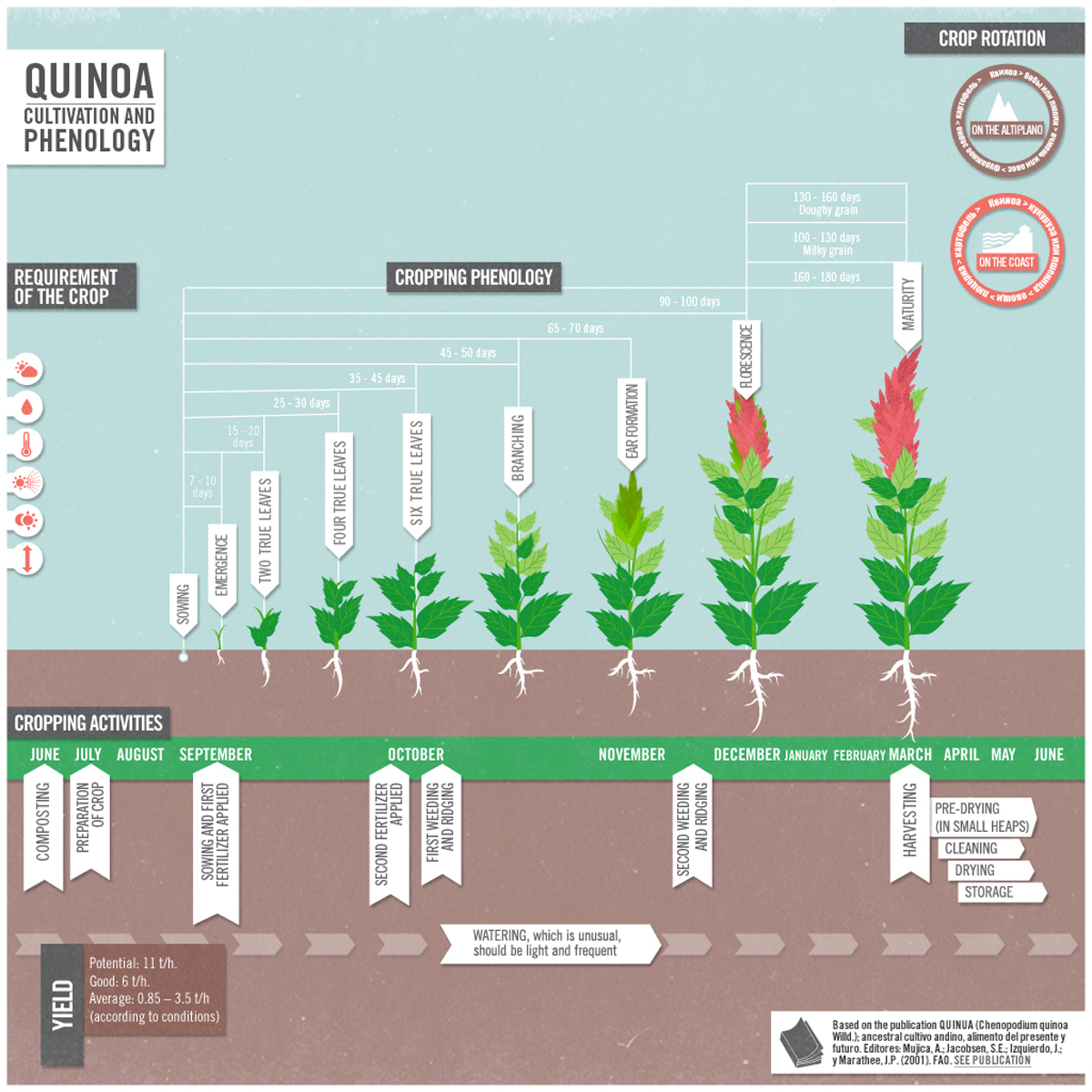
Soil – loam soil with good drainage and high organic matter content, with moderate slopes and average nutrient content. It prefers neutral soils although it is usually grown on alkaline (up to pH 9) and acid soils (up to pH 4.5).
Climate – desert, warm and dry, cold and dry, temperate and rainy, temperate with high relative humidity, and puna and high mountain areas. There are varieties or ecotypes adapted to each climate.
Water – it is efficient in water use despite being a C3 plant, as it has physiological mechanisms that enable it to avoid moisture deficits and to tolerate and resist a lack of soil moisture.
Temperature – the ideal average temperature is around 15- 20ºC, although it withstands temperature extremes ranging from 38ºC to -8ºC.
Radiation – it withstands intense solar radiation enabling it to gain the hours of heat needed to complete its growth and productive period.
Photoperiod – there are varieties or ecotypes that are short-day, long-day or insensitive to photoperiod.
Altitude – it grows from sea level up to about 4000 metres.