


In charts 1 and 2 it is very clearly demonstrated that the graduation of forestry technicians has dropped drastically, especially after 1995, mainly due to low enrolment. This is clearly linked to the adoption of Structural Adjustment Programmes (SAPs) in many countries. These programmes discouraged the government support for the training of technicians in forestry and agriculture. The government actions have been either closure of technician training programmes or drastic reductions in the number of students supported by governments. The impact is seen directly in the quality and amount of technical services provided to forests, especially plantations. Many forest plantations are very poorly maintained, especially regarding survival, pruning, thinning and quality harvesting management.
Another disturbing observation is the drop in the number of female students taking up forestry technician training. The female enrollment seemed to take an upward trend starting in 1994 but suffered a serious fall from 1998 and has not been able to recover. This is particularly bad news as we move towards greater participation of women in development activities, and especially tree planting by farmers. The clear conclusion from this analysis is that we are entering the 21st century with less technical capacity in forestry and drastically reduced female capacity. Yet we are expecting tree planting to be scaled up and out. The success of such ambitions will be strongly undermined by weaknesses in our training policies and low investment in technician training.
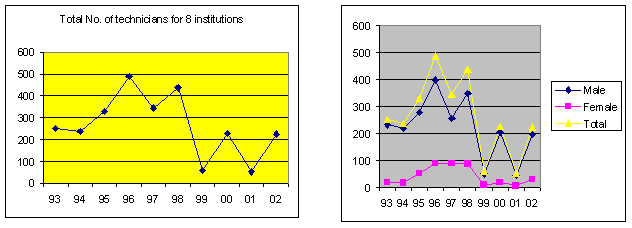
Chart 1. Forestry technicians by year Chart 2. Forestry technicians by gender
Recommendation 1: Governments need to review their decisions regarding support for training technicians in forestry. It is necessary in this consideration to link such review with decisions on technician training in agriculture, so that a broader strategy for natural resources management on farm and in forestry areas can be articulated. In my view, technician training in these areas should be integrated and coordinated to clearly define the role of agricultural and natural resource technicians in rural development and natural resource conservation.
Recommendation 2: The involvement of women should be taken up very seriously at this stage. Considering that women constitute a huge majority of the African on-farm labour force, it is necessary to take a pro-active step by training more female technicians.
Recommendation 3: The role of NGOs and the private sector in technician raining should be identified and encouraged.
Reccommendation 4: There is a need to develop policies that will help to control the ratio of professionals to technicians to avoid the trend developing now, where the number of professionals is going to be disproportionately high.
It is very interesting to study the certificate and diploma graduations separately, as presented in charts 3 and 4 below. In chart 3, the huge variations in graduation are symptomatic of inconsistencies in policies and funding of forestry technician training. Some of the colleges even close down periodically to minimize expenses, and re-open when funds become available.

Chart 3. Variations in technician training output
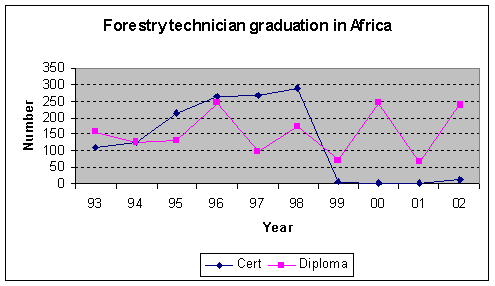
Chart 4. Technician graduates segregated by certificate and diploma
From Chart 4 it is evident that since 1998, the number of certificate holders being trained is negligible! On interviewing some colleges on this, I was made to understand that in some cases, certificate holders are registering for diploma courses to upgrade themselves for promotional reasons but at the same time, no further recruitments were being made at certificate level. The long-term consequence of this is a very abnormal staff structure, with more professionals than technicians. This trend is very likely to worsen, given the slight rise in undergraduate enrolment depicted in Chart 6.
grevious consequences are being experienced in many government-managed forests as the number of technicians had dropped drastically. Many forests are very poorly maintained. This is also impacting adversely on forestry extension services.
Professional degree programmes seem to have increased, and along with that the number of graduates. However, the increases are marginal in relation to the total needs. This view is true for all countries surveyed except Sudan and Nigeria. A cursory look at many countries not included in the survey tends to confirm this picture, with West Africa being particularly worse off. Many countries indicate that although the number of forestry graduates is small, government employment opportunities have been diminishing. Some graduates are able to find employment in private institutions and NGOs, but the majority ends up doing non-forestry jobs. Sudan and Nigeria have for some unclear reason been able to establish several forestry schools, despite the fact that they too face a very serious problem of employment of forestry graduates.
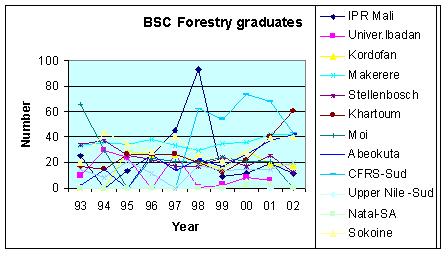
Chart 5: BSc Forestry graduates by institution
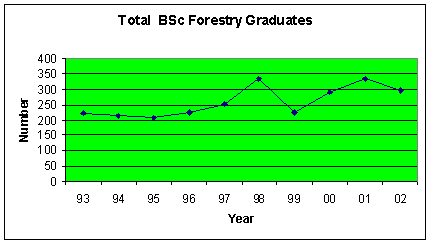
Chart 6. BSc Forestry Graduates for 12 universities
In charts 5 and 6, I have presented the graduation by institution and the overall trend respectively. The institutional presentation clearly demonstrates the uncertainty under which the professional programmes are managed. It is clear that each institution suffers from major annual variations in student enrolment. This has a devastating impact on planning and implementing programmes. It is clear therefore, that the overall slightly upward trend shown in chart 6 is an outcome of several random events rather than planned. Considering that the capital investments (staff, classrooms, laboratories, equipment, field training facilities etc.) have already been made, there is a case here of poor utilization of capacity and facilities as well. Outside this survey, I have had the opportunity to visit many schools of forestry. It is disheartening to see that some of them are closed part of the year, and they only run when resources become available. This is true for some colleges as well as universities.
Recommendation 5. Forestry education needs are not properly identified, and therefore forestry education plans are very poorly articulated. Much is left to the teaching institutions to lobby with their governments and operate according to resources obtained. There is a need to improve forestry education planning. Forestry authorities, private sector and schools of forestry should engage in a multi-logue towards this end. International institutions like FAO, CIFOR, ICRAF, UNEP and IUFRO should assist in this effort.
Recommendation 6. A strategic plan is needed to make better use of forestry training capacity already available in some countries. The rush to have national schools of forestry needs to be controlled. A regional and sub-regional approach to forestry education is essential.
Recommendation 7. There is a need to evaluate and help to standardize forestry curricula in Africa. There is a tremendous variation in the content and depth of coverage among the schools. There may also be a need to develop an accreditation system for forestry education. This would help to establish and maintain minimum teaching and learning standards.
Only a few universities have the capacity to deliver postgraduate education in forestry, and most of them can only take in small numbers at a time. There is a need to help build up this capacity. Africa does have opportunities to send its students to foreign universities for this type of education, although scholarships to fund such programmes are increasingly limited. Besides, the foreign programmes may have limited relevance to Africa's needs, especially if thesis research is not done in an African environment.
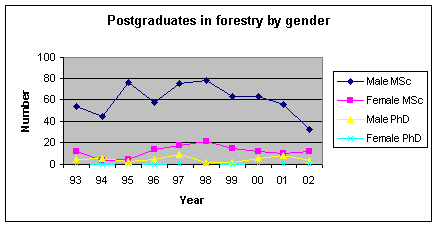
Chart 7. Forestry postgraduates by level and Gender
In Chart 7, I have presented the postgraduates by level and gender. As expected, the number of MSc graduates exceeds that of PhDs. The gender balance is quite satisfactory, because it reflects a higher percentage of women than the general proportion of women in the forestry sector. From my own experience, the relatively reasonable number of women in postgraduate education is a result of two strategies adopted by governments and donors:
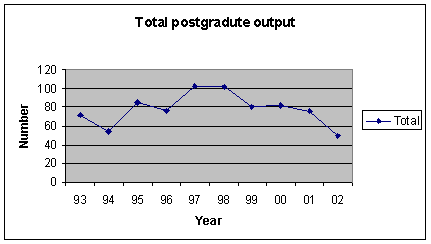
Chart 8. Forestry postgraduates, trend
In chart 8, the overall trend in postgraduate education clearly shows a dive since 1998. This is a very serious trend, given the increase in the number of institutions teaching forestry and the emergence of research needs. No wonder forestry research output in Africa is weak.
Recommendation 8. There is a need to establish the graduate training needs, especially the requirements of research institutes, universities and colleges, private sector, NGOs as well as policy-making bodies. From this it would be possible to develop a strategy for meeting the needs from both regional and extra-regional resources.
Recommendation 9. It is necessary to monitor the content and quality of postgraduate education in Africa, with a view to improving the capacity to deliver it and opportunities for regional collaboration.
Over the last ten years, there have been major changes on policies and attitudes towards forestry as a whole and foresters in particular. Although a cause-effect relationship is hard to establish, it is apparent that these changes have influenced investment in forestry and subsequently in forestry education. The policy changes may be characterized as:
In addition to above changes, Africa has not embraced properly the advances in information and communication technologies. Because of their remote location, forestry institutions are particularly left behind. Many curricula are old and wanting in terms of new approaches such as community forestry, biodiversity, integrated natural resources management and agroforestry.
All these changes have resulted in declining employment opportunities in government, reduced government investment in forestry teaching and research capital (staff, facilities, equipment, books etc) and subsequently declining enrolment into forestry programmes. The result is brain drain - able educators and researchers find greener pastures outside forestry or in other countries. Some NGOs and private sector have absorbed foresters in jobs that are generally speaking peripheral to mainstream forestry but nonetheless relevant.
Recommendation 10. All college curricula should be reviewed and lecturers trained to understand and apply modern thinking to forestry. This includes the application of modern information and communication technologies.
Recommendation 11. Serving officers need re-training to develop skills and attitudes suitable for working with local communities and on farm
Recommendation 12. Mechanisms should be sought to increase the participation of foresters in global and regional forums on agriculture, forestry and environment.
Recommendation 13. To reinstate the status of forestry, and give a human face to forest managers, it is necessary to launch well-coordinated action campaigns that contextualize the roles of forestry in development.
Recommendation 14. Libraries need special attention. With the recent changes into digital products, forestry libraries are at a loss. There is a need to re-charge them with forestry books and especially with locally relevant materials.
All institutions included in the survey indicated that funding was intermittent, declining and largely from national resources. Donor funds are unpredictable, often depending on political environment, among other factors.
It is not meaningful to develop a list of priorities based on the results of this survey. The most logical process would be a participatory one for all stakeholders and especially policy makers, where the results of the survey can be presented, discussed and distilled to produce a future agenda for forestry education in Africa. This is important because there are many factors external to forestry that have not been captured in by survey.
Recommendation 15. It is strongly recommended that FAO take the initiative to organize forums of stakeholders at regional or sub-regional levels to expand and discuss the findings of this survey. The objectives of such forums would be:
