


This paper is for people engaged in the planning and implementation of Natural Resource Management programs and projects. These are the people who need to find ways to approach natural resource management from a different perspective. In the past, western society emphasized the scientific side of resource management, but today the field is the meeting ground of several different disciplines. People are at the center of the debate as human activity is seen as central to the management of the ecosystem.
With people at the center of natural resource management, communication becomes important. We are talking about the planned communication that must be factored in to facilitate program/project implementation.
If you try doing a search using “Natural Resource Management” through your preferred Internet search engine, chances are you will find a web-site like NRM-Changelinks at the top of the list -“an on-line resource guide for those seeking to improve the use of collaborative and learning-based approaches.” The major issues listed in Natural Resource Management include:
Sustainable development and the environment
Capacity building (especially social capital)
Learning and change
Adaptive management
Collaborative planning and management
Participatory monitoring and evaluation
Knowledge and information management
Integrated models
Conflict management action research
Individual growth and change
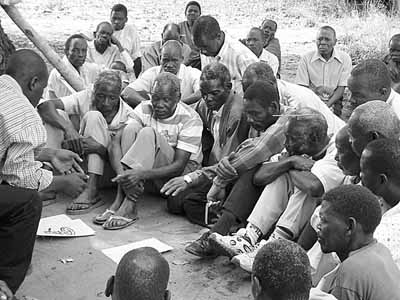
We are no longer talking about individual sectors of forestry, agriculture, or fisheries... These fields have been merged into an approach that is fundamentally different from the past.
We are living a shift...
from the recent focus on specific natural resources - to an acknowledgment that people are part of the ecosystem. This means that now we have to learn to engage many parties in deciding how to manage our relationships with each other, with our policies and with our use of natural resources.
It is clear that...
Natural Resource Management (NRM) has become a common label. Agencies have renamed their former departments of forestry, agriculture, water and irrigation, fisheries and conservation into NRM; they are all now part of the new trend.
What is less clear is...
whether the thinking by the people working in the agencies has changed. Are they ready to embrace collaborative management[3] and other emerging approaches?
Natural Resource Managers today face unprecedented challenges:
|
|
IN THE PAST |
TODAY AND TOMORROW |
|
Assumptions |
People could control nature. |
Nature is too complex to be controlled, so we aim to manage change - hence the emphasis on collaborative management approaches. |
|
Specialist knowledge |
Solutions were developed by specialized experts and passed on to passive users. |
We integrate local and external knowledge and expertise - interdisciplinary thinking is a must. |
|
Power balance |
Managers used to have the power to impose ‘solutions’. |
We need to engage many stakeholders and negotiate ways forward - hence the popularity of community participation. |
|
Global and local context |
The regional and local context was sufficient for intervention planning. |
Global forces have direct impact at all levels (privatization, liberalization, trade agreements, global warming, etc.) - hence the need to engage partners at all levels and to recognize that they all use different ‘languages’. |
|
Privatization and liberalization |
Governments designed and implemented. |
Private-public partnerships and demand-based approaches are the norm - hence the importance of making the rules relevant and applying negotiation skills. |
|
Communication and information tools |
Only the elite had access to these tools. |
The growing spread of these tools puts pressure on NRM managers to be accountable - hence the importance of harnessing the tools. |
This means that NR managers’ mindsets are shifting from expecting to control nature, to recognizing that they have no choice but to engage others in negotiation and to make ongoing adaptation a part of NR management.
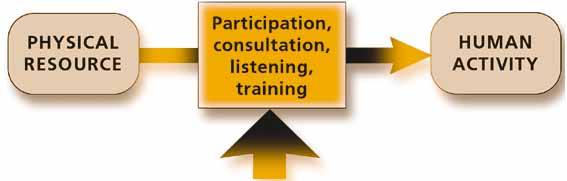
One of the implications of this shift is the emphasis on: participation, consultation, listening, and training. These are tasks where communication excels and provides practical support to NR decision-makers.
This shift means moving away from an emphasis on managing physical resources to understanding human activity as part of the natural resource systems.
In making this shift natural resource management organizations cannot “go at it alone”; they need new policies, new disciplines, new linkages, and new staff expertise.
|
The following process skills are needed to facilitate a more people-centered approach. |
· to involve people in
decision-making; |
|
NONE OF THIS CAN BE TAKE PLACE WITHOUT COMMUNICATION. |
|
|
[3] Borrini-Feyerabend et al.,
2000. Co-management of natural resources: Organizing, negotiating and
learning by doing. IUCN and GTZ. |
