


The only way we can work for a common cause, for common interest, to improve our condition, is really through communication. Basically, it has to do with democracy, with participation, with spreading of knowledge and insight and ability to take care of our own future. Gro Brundtland
Strategic Communication, Development Communication or Communication for Development are the words that communication professionals use to indicate planned communication strategies that are applied to development programmes or projects.
Your organization may be using different titles for the same concept:
Social mobilization
Participatory approaches
Management plans
Change management
When we talk about Communication, we are referring to a planned communication approach that can support a range of programme implementation needs through several complementary functions.
We stress the word planned to emphasize the importance of being proactive in plotting out carefully constructed communication inputs to enhance program/project implementation.
There is a wide range of communication functions that cross the development spectrum -information, public relations, social marketing, community voice and so on.
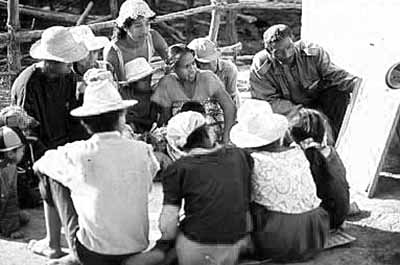
FAO, Madagascar, 1994
For the purpose of this paper we focus on three major communication functions:
1. Making policies known and relevant
Increasingly there is a trend towards interactive policy-making. This move away from a persuasive advertising approach demands careful communication planning -for public meetings, consultations, and round tables for stakeholder engagement.
2. Communication for sharing knowledge
Explaining scientific information with the aim of creating new perspectives rather than transferring pre-packaged solutions.
3. Participatory communication
Giving a voice to different stakeholders to engage in platforms where negotiation among different parties can take place with regard to natural resources.[6]
These communication functions have emerged from decades of applied work in development; that is why they fit rather nicely with the new development challenges listed in the box below:
|
Development challenges (from page 6) |
Communication Functions |
|
Nature is too complex to be controlled - we aim to manage change; hence the emphasis on collaborative management approaches; |
Participatory communication |
|
We integrate local and external knowledge and expertise; interdisciplinary thinking is a must; |
Communication for sharing knowledge |
|
We need to engage many stakeholders and negotiate ways forward - hence the popularity of community participation; |
Participatory communication |
|
Global forces have direct impact at all levels (privatization, liberalization, trade agreements, global warming, etc.), hence the need to engage partners at all levels; |
Participatory communication |
|
Private-public partnerships and demand-based approaches are the norm, hence the importance of making the rules relevant and applying negotiation skills; |
Making policies known and relevant |
|
The growing spread of these tools puts pressure on NRM managers to be accountable - hence the importance of harnessing the tools. |
All three functions |
Planning should be done at the outset of any program or project design. This makes it possible for planners to set aside time and budget for the communication activities. Communication strategies that are brought in after a program has run into roadblocks are far more difficult to manage.
If, in designing any program or project, we leave out an essential communication plan and assume that communication will take place naturally, we will be missing one of the most important opportunities to ensure that true communication actually does take place.
There are several steps in the planning process:
Communication mapping to identify areas where planned communication inputs will help;
Identification of key communication issues and their functions;
Identification of different stakeholder (audience) groups involved, and of the channels of communication they utilize and trust;
Research with stakeholder groups to gain understanding of how the issue impacts on the group (and how "each" group best manages communication); and
Matching communication functions to methodologies.
Linkage map prepared with the frames of barangay Mamala, Region IV, the Phillipines

FAO. 1995. Understanding farmers’ communication networks.
Communication for Development Case Study, no. 14, Rome.
|
[6] These categories are
adapted from the original source: Röling, N., 1994. |
