There is no recipe or model for a participatory process or a participatory communication approach. Approaches will vary according to different geographic conditions, societies, cultures and environmental conditions. Silvia Balit [7]
We have established that there are several Communication Functions. In addition, there are communication approaches (or methodologies) and communication tools.
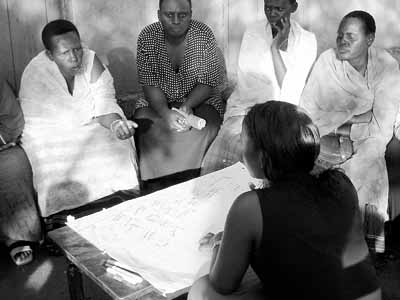
Photo by Ricardo Ramírez, Uganda, 2003.
Many of the more common communication approaches stem from the field of health communication. Agricultural extension has adapted some of these approaches to disseminate technology to farmers, with mixed results.
The point is that different approaches are used to facilitate different functions. For example, the policy function is often approached through public meetings, consultations, and public forums. This function can also be approached through campaigns, social marketing, and advertising. Sometimes the same approach can be adapted for different functions. For example, radio can be used to convey information but can also be used as a platform for dialogue and discussion.
When we talk about tools we include a wide variety of media: posters, pamphlets, radio, televisions, drama, songs, public meetings, e-mail, electronic file exchanges, and Internet websites.
The approaches used to articulate this communication function are the most generic. They can include information promotion and media advocacy, and are often programmed into campaigns that combine public forums, consultations, and round tables.
The approaches used to articulate this communication function can include information - education and communication (IEC), social marketing, and media campaigns.
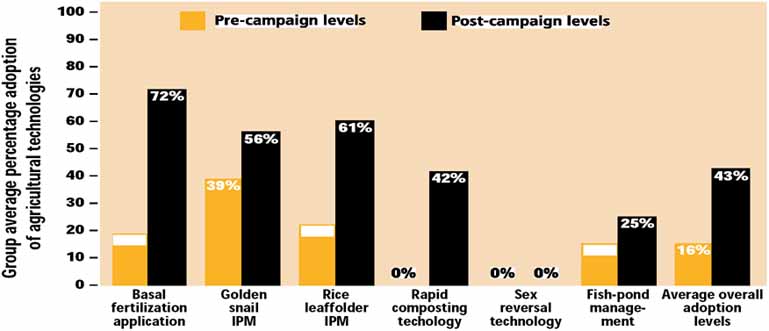
Many of the ideas for this communication function originally came from the health communication field. The work is usually centered on the need to bring about some form of behavioral change (mothers immunizing their children, promoting the use of condoms and so on). The large amount of innovative work around HIV/AIDS has contributed greatly to new ideas and applications for this area of communication approach. These methodologies have been adapted for a wider use in a variety of applications. The community audio tower experience in the Philippines is one example of a communication campaign where the impact was measured in terms of change awareness about agricultural technologies, knowledge and adoption. A key to the success was the involvement of farmers in all stages of the process.
The approaches used to articulate this communication function are varied. They can include: participatory appraisal; multi-stakeholder consultations; collaborative learning; collaborative management; and rights-based communication.
Participatory communication gets at the root of development. It is a methodology that can facilitate people’s inclusion in decision-making, access people’s voices, and expose many of the power issues inherent in under-development. The Fogo Island example on the next page is a well-known case of participatory communication.
|
Multi-media Campaign Propels Record Rice Harvest in the Philippines[8] The community of Tulungatung in Southwestern Mindanao is classified as an agriculturally depressed area. Prior to a multi-media agricultural communication campaign, the average rice yields were 46 cavans/ha. (44kgs/cavan), compared with the 77 cavans/ha. in the surrounding Ayala District. In preparation for the communication campaign, farmers were involved in rural appraisals about their farming system. As part of this analysis, they defined the agricultural technologies that they felt were most urgently needed. They also determined what media they wanted to use and the times and places when they could get together and learn. The communities planned how to set up a community-owned and operated audio tower system, which was the main media used in the campaign. The 1993 communication campaign covered an area with 94 hectares of rice. It included a four-month "School on the Air" with three broadcasts per week using the community audio towers. Print-support materials accompanied the airing along with field demonstrations. Knowledge level scores among the rice farmers on the technologies rose from an average of 55% prior to the campaign to 92% following it. Adoption of technologies increased from 46% to 68%; adoption was high when the technologies promoted were low-cost and simple. There was an "informed non-adoption" of those technologies that turned out to be unreliable or difficult, as was the case with sex reversal technology for tilapia fish farming. The rice yield increases for the wet season in 1992 were 43 cavans/ha., whereas after the campaign the 1994 wet season yields more than doubled to 90 cavans/ha. Translated into monetary terms, at the selling rate of 3.5 pesos/kg, the wet season harvest increase amounted to Ps 7,238/ha (US$290). Project implementers pointed out that the yield increases were due to the adoption of low-cost practices, especially those related to integrated pest management. Of equal significance to the yield increases is the fact that the community radio tower system remains community, owned and operational ten years later.
Fogo Island - Feedback to Decision-Makers - An innovative Use of Film In the late 1960s, the Premier of Newfoundland (Canada), Joey Small-wood, decided to move the people from Fogo Island to the mainland. The fishing industry, the main source of income for the islanders, had run dry. Smallwood felt that moving the people off Fogo was the only thing to do to save the islanders. This decision was made without any consultation with the islanders. The National Film Board (NFB) of Canada decided to choose this time to come to Newfoundland to film a series on poverty in Canada. To do this, the NFB joined with the Extension Department of Newfoundland's Memorial University to make a documentary film on the lives of the islanders. For reasons that he later found difficult to explain, the filmmaker (Colin Low) decided to shoot "one-on-one" films which allowed plenty of time for individuals to tell the full story of their lives on the island. At the end of the shoot, Low found that the individual tapes had an incredible power as stand-alone pieces. He was reluctant to edit them into the usual documentary form. But what, he wondered, could be done with these long, individual life stories? A group of filmmakers, Memorial University personnel, and journalists met in Montreal to try to decide what to do with the films. After long discussion, someone suggested that the films be shown to Joey Smallwood and his Cabinet. The Chancellor of Memorial University tried to veto this idea, fearing political repercussions from the controversial nature of the material. Nevertheless, those in favour won the day and a series of the films were screened for the Newfoundland Cabinet in 1972. So powerful was the impact of the Fogo voice to the Cabinet that the Fisheries Minister, Aiden Powell, asked to go on film to explain the government's reasons for evacuation to the people of Fogo. The film carrying Mr. Powell’s address to Fogo was taken to the island and shown to the people. Aseries of film discussions took place culminating in a joint decision. The Fogo Islanders were allowed to remain in their birthplace and the government assisted in the search for alternative industry. To this day, the Fogo Islanders remain on the island. This was the beginning of what is now widely known as "the Fogo Process." Film was used as a vehicle to transfer ideas back and forth between disparate groups, enabling a form of discussion that could never take place in a ‘face-to-face’ situation. Film later gave way to video (see Kaminiuriak) and began to be used as a vehicle for planning, conflict resolution and discussion all over the world. In Mexico, a communication practitioner heard about Fogo and adapted the idea in over 20 projects in his region. Today, the hand-held video camera is widely used as a development communication tool all over the world. |
The shift from the old to the new development approach is also evident in that the participatory communication function is gaining prominence. This is the area of greatest focus now for development practitioners and managers. In the past there was more emphasis on the first two (more uni-directional) communication approaches. While these approaches remain important, the more participatory approaches to communication we have been discussing here are generally better-suited to meeting today’s development challenges.[9]
Institutions have affinities for different communication functions.
In the Proderith example discussed earlier, the Mexican government and the World Bank began using video to facilitate the participatory approach to access farmer’s voice in irrigation planning. During the years following the donor’s departure, however, the government gradually turned away from participatory communication-focusing instead on producing information packages for technology transfer. This is not really surprising. Most governments are comfortable with the communication functions related to policy and information. Participatory communication is different and best facilitated through intermediaries or third parties (such as NGOs or private consultants) as opposed to government functionaries.
Communication strategies in support of programmes will often borrow elements from several of the communication functions. Each project context will require a different mix of communication functions and approaches; giving each mix a methodological ‘label’ will become increasingly difficult in that each combination will reflect a local adaptation as an integration of disciplines and stakeholders. It is clear that this is a fertile ground for innovation.
In planning a communication strategy, it is important to understand and acknowledge that different institutions are comfortable with different types of communication interventions. As noted, it is not always practical to try and get a government body to implement a participatory process. It may, however, be useful to help government develop their awareness programs and to encourage government to work with intermediary groups (NGOs) to implement the participatory approaches.
|
[7] Former Chief of the
Communication for Development Group, FAO, Rome. [8] Coldevin, G. 1995. Farmer-first approaches to communication: A case study from the Philippines. FAO: Rome. [9] The publication listed at this end of this paper by Coldevin and FAO is an excellent example of this shift. |