


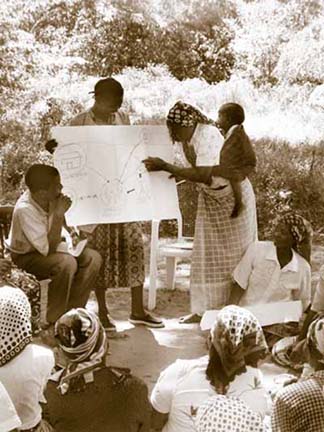
Photo by Ricardo Ramírez, Mozambique, 2001.
Whether the [Millenium] Goals succeed partly depends on the local political environment -on whether there are avenues for citizens to participate in decision making through formal democratic structures or through direct collective mobilization and action. UNDP Human Development Report 2003, p. 134
What is it that allows some organizations to build development communication into their organizational structure while others seem indifferent to the idea?
We asked this question when interviewing various institutional “decision-makers” in preparation for this paper. We learned that:
Most organizations value communication in one form or another, particularly in its role as outreach or public relations - external communication.
Many value the role that communication can play for internal issues such as knowledge management and internal policy development.
Some value the growing role of information, communication technologies (ICT) though they often mistake the tool for the programme;
A small, but growing, group of organizations, has acknowledged the supporting role of communication in programme development and implementation. Some have had communication units within their organizations for at least a decade (UNICEF, FAO, UNFPA, UNESCO); others are now in the process of building communication units into their organizational structures (DANIDA, DFID and SIDA).
What brought this about?
DANIDA recognized the large amount of attention that was paid to its own organizational need for communication (public relations and relationship with Danish taxpayers). This demonstration of the importance of communication to the organization opened the door to decision-makers’ realization that communication would also be important for the implementation of the DANIDA Partnership 2000 strategy.
DFID came at it differently. They began with a discussion group on ICTs, which led to an ICT Think Study in 2000. However, work in this area was fragmented into different sectors (Health, Agriculture, Infrastructure etc.) and was not generally given a high priority within these departments. DFID next undertook a major reorganization leading to the development of policy teams. This time, a new Director of Information post was established and the newly recruited Director recognized the importance of delivering the Millennium Development Goals. He championed the work put forward by the policy group, bringing this group and it's agenda into DFID's Information Division and establishing a significant programme budget for it’s operation. The unit is called the Information and Communication for Development Team (ICD). This group is now developing a strategy, and its programme is likely to combine information and communication to support programme implementation. It will aim to develop evidence-based policy in the area of Information and Communication for Development (ICD), provide advice to DFID's country programmes, and act as an advocacy group within the international system for ICD teams advocating for the poor.
The DFID ICT Think Study recognized that ICTs, while important, are not a panacea. Rather. they are tools that need to be put to work and fully integrated into Poverty Reduction Strategies to respond to the type of communication needs addressed in this paper. Infrastructure, access and use are still limited in developing areas.
Traditional media are still important, and a mix of the two media will probably yield the best results. (Balit)
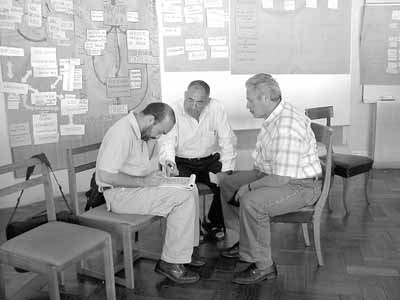
Collaborative fishery management workshop, Chile, 2002.
Consider a Project Experience from Kenya:
The project realized that poor urban women, apart from needing information for their development activities, also need to feed back into policy by way of communicating their development needs and requirements to policy-makers at the top. The project strove to create a two-way information flow system between poor urban women on the one hand and policy makers on the other.
The pilot phase of the project involved the production of an interactive video by the women. The video was aimed at preserving their spoken words and addressing policy-makers on issues of importance to them. The project also undertook a literature survey assessing the relevance of ICTs in strengthening poor urban women’s participation and knowledge and identifying methods for reducing the barriers women experience when accessing information.
Among the project’s most important outputs are two fifteen-minute videos produced by women from Mathare and Redemeed villages and a third video clearly showing the process. Another is the literature search to access the relevance of ICTs in strengthening poor urban women’s participation and knowledge and methods for reducing the barriers women experience when accessing ICTs.
One of the project’s most important long-term impacts has been the development of the women’s ability to utilize and appreciate more information and communications technologies. The women have gained a new skill that they are putting to very good use. They have been actively involved in the documentation of their activities and participation in key events such as the Women’s Day celebrations in 2001 and 2002, World AIDS (2001) Day and several documentaries. Using the video, they want to ensure that accurate information gets to everyone on what is going on in the informal settlements. They appreciate their new, more powerful role in society. In cases of unrest, they are often conferred with and even called upon to offer advice.
The case study is significant in many ways:
Women were given focal attention as a sector of the population that is less powerful (gender dimension).
The women had power over the media; they controlled the tools; they controlled the message; they began accessing information (power dimension).
Video materials were produced, and they were seen as intermediary products to empower women, provide them with skills and pride, get their message out, and get them engaged in public events (media products as intermediary products leading to people’s accomplishments).
Simple group media remain relevant and can be treated as another ICT (ICTs are not just computers and Internet).
The project embraced the three communication functions: influencing policy-making, informing people about HIV/AIDS, and putting communication tools into the hands of the users (integration of communication functions).
The content of the video was of priority to the women (HIV/AIDS).
A third video was produced to show the process of producing the videos (organizational learning).
Community media served as a tool for empowerment, giving the poor a chance to speak and be heard as opposed to relying on mainstream media (ownership over the media).
|
Are any of these eight significant issues NOT relevant to a host of development management challenges? |
While we acknowledge that the question is rhetorical, we want to highlight the difficulty organizations encounter when trying to change rhetoric to practice.
The Development Bank of Southern Africa, for example, readily accepts that participation and participatory communication are integral elements of the development process. The problem, they admit, is that they have not figured out how to change their corporate structure to meet the challenges posed by participation.
Organizational mission statements and brochures often espouse the importance of participation but fail dismally in the implementation. Budget shortfalls, unrealistic time-frames and the need to disburse funds quickly can all be serious obstacles to the creation of an enabling environment for participative development. More often than not, the preprogrammed expectations of the donor-agency pre-ordain the focus, scope, timing and budget of the so-called participatory project.
There are some examples, however, where communication approaches have been used to facilitate open discussion, needs analysis and program identification by the “host” country without surrender to a donor-imposed agenda. The instances are rare but could point the way to future practice offering potential for sustainability.
Communication as catalyst
So far, we have been talking about communication as a support to development programmes and challenges. Sometimes communication approaches are being used to stimulate discussion and debate around development issues unrelated to program-me implementation. Recently in the Central Asian Republics, the World Bank has instigated a range of studies, dialogues and consultations around various themes confronting the area. Government, civil society and communities have been brought together to assess issues of HIV/AIDS, governance, income support and so on. Other studies from countries with a similar context have been used to help participants understand the issues and learn how others have confronted the problem. These discussion groups have acted as a catalyst to help affected groups search for solutions for their own development challenges.
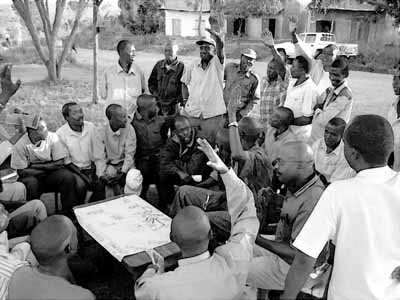
Photo by Ricardo Ramírez, Uganda, 2003.
