

Chulalongkorn University Social Research Institute. Pongsapich, Amara. 2000. Cultural Diversity: Vision and Status of Civil Society. Bangkok
Department of Agricultural Extension. 1996. Highland Agriculture from the Past to the Present. Bangkok. (Thai language)
Department of Agricultural Extension. 1999. Highland Agriculture for the Next Century. Bangkok. (Thai language)
Department of Agricultural Extension. 1999. Annual Report. Bangkok. (Thai language)
Department of Agricultural Extension. 2000. Annual Report. Bangkok. (Thai language)
Department of Agricultural Extension. 2000. Seminar Report on Highland Agriculture in the 21st Century. Bangkok. (Thai language)
Department of Agricultural Extension. 2000. Department of Agricultural Extension. Bangkok
Department of Non-formal Education. 2001. Department of Non-formal Education. Bangkok
Department of Non-formal Education. 2000. Department of Non-formal Education. Bangkok
Department of Non-formal Education. 2001. Basic Information for Establishment of Community Colleges in Thailand. Bangkok
Department of Public Welfare. 1995. The Survey of Hill Tribe Villages in Chiang Mai Province. Bangkok
Department of Public Welfare. 1998. Annual Report. Bangkok
Department of Public Welfare. 1999. Annual Report. Bangkok
Department of Public Welfare. 2000. Annual Report. Bangkok
Faculty of Agriculture, Chiang Mai University. 1999. Sustainable Highland Agricultural Development. Eds. Angkasith, Pongsak and Apichatpongchai, Rampaipan. Chiang Mai, Thailand
Gasperini, Lavinia (FAO Extension, Education and Communications Service). 2001. Targeting the Rural Poor: The Role of Education and Training. Presented at the International Working Group on Education. Lisbon
Hilltribe Welfare Division, Department of Public Welfare. 2000. Hilltribe Welfare and Development in Thailand. Bangkok
International Institute for Environment and Development. Kanok Rerkasem and Benjavan Rerkassem. 1999. Shifting Cultivation in Thailand: Its Current Situation and Dynamics in the Context of Highland Development. London
Janapiraganit, Damri (DNFE). 1998. Case Study: The Hill-tribe Community Learning Centre Mae Fa Luang. Presented at UNESCO Community Learning Centre Review Meeting. Chiang Mai, Thailand
Krachangvei, Montip (DOAE). 2001. Thailand's Experience with Lifelong Learning via Community Agricultural Services and Technology Transfer Centres. Presented at UNESCO Meeting on Lifelong Learning. Chiang Mai, Thailand
Manaphong, Methee (DOAE). 2001. Country Reports for Study Meeting on Sustainable Farming Systems in Upland Areas. Bangkok
National Economic and Social Development Board. 2000. The National Gross Domestic Product of Thailand, 1998 Version. Bangkok
National Economic and Social Development Board. 1997. The Second Master Plan on Community Development, Environment and Narcotic Crops Control in Highland Areas. Bangkok. (Thai language)
National Economic and Social Development Board. 2001. The Report on Monitoring of the Second Master Plan on Community Development, Environment and Narcotic Crops Control in Highland Areas. Bangkok. (Thai language)
National Economic and Social Development Board. 2000. News Bulletin. Volume 15, Number 8: August 2000. Bangkok
National Economic and Social Development Board. 2001. News Bulletin. Volume 18, Number 10: October 2001. Bangkok
National Economic and Social Development Board. 2001. Indicators of Well-being and Policy Analysis. Volume 3, Number 2: April 1999. Bangkok
Office of the National Education Commission. Office of the Prime Minister. 2001. Education in Thailand 2000/2001. Bangkok
Punyasaranai, Panadda. 2000. Hill Tribe Language Radio Programmes: Communication Process for Highland Development. Chiang Mai, Thailand. (Thai language)
Tribal Research Institute. 1997. Highland Development in Thailand: A Selected Bibliography. Edited by Mongkol Chantrabumrung and Twaworn Foofoung. Chiang Mai, Thailand
Tribal Research Institute. 1999. Tribal Population Summary in Thailand. By Data Processing & Analysis. Chiang Mai, Thailand
Brochures
Department of Public Welfare. Chiang Rai Hill Tribe Welfare and Development Centre. 2001. Data on hill tribes in Thailand. Chiang Rai, Thailand. (Thai language)
Department of Agricultural Extension. 1999. Highland Agricultural Technology Transfer Centre. Chiang Mai, Thailand. (Thai language)
Department of Non-formal Education. 2001. Somdet Ya Project. Chiang Mai, Thailand. (Thai language)
Department of Public Welfare. 2001. Chiang Mai Hill Tribe Welfare and Development Centre. Chiang Mai, Thailand. (Thai language)
Department of Public Welfare. 2001. Tribal Research Institute. Chiang Mai, Thailand
FAO. 2001. Rome
FAO Extension, Education and Communications Service, Sustainable Development Group. 2001. Strengthening Capacity through Knowledge and Information for Sustainable Rural Development. Rome
Inter Mountain Peoples Education and Culture in Thailand Association. 2001. Chiang Mai, Thailand
Handouts
Department of Non-formal Education. 1998. Hill Area Education Project. Bangkok
Department of Non-formal Education. 1998. Functional Literacy for Indigenous Peoples in Thailand. Bangkok
Department of Agricultural Extension. 1999. Getting to know Agricultural Technology Transfer Centre. Bangkok
Newspaper
Bangkok Post. “Poor kids to pay price of progress.” 23 September 2001
Websites
FAO (http://www.fao.org)
Hilltribe Research Institute (http://www.chmai.com/tribal/)
International Year of Mountains (http://www.mountains2002.org)
National Economic and Social Development Board (http://www.nesdb.go.th)
Royal project (http://www.kanchanapisek.or.th/index.en.html)
Ministry of Education
Dr Kla Somtrakool, Advisor to the Ministry of Education (Former Deputy Director-General of the Department of Non-Formal Education)
Mr Damri Janapiraganit, Head of the Educational Promotion Section
DNFE, Chiang Rai Office
Mr Sriton Boonsom, supervisor of Wavi Group
Ms Praiwan Meewang, Librarian
Mr Pitak Pomlom, Volunteer Teacher
HCLC, Mae Suai District, Chiang Rai
Mr Wichai Lovilers, Director
Ms Aporn Wanachuck
DNFE, Chiang Mai Office
Ms Yupin Buakom, Head
Ms Wilailak Suksai
Mae Chaem Non-Formal Education Centre
Mr Suphakorn Srisakda, Deputy Director
DNFE Northern Regional Centre
Ministry of Agriculture and Cooperatives
Mr Methee Manaphong
Highland Agricultural Extension Sub-Division, Horticultural Crop Promotion Division
Mr Udom Promtan, Subject Matter Specialist (Agriculture)
Chiang Mai Agricultural Extension Office
Mr Somsak Pimsaengjan, Agricultural Officer
Ms Nognuch Puranapan, Director
Mr Surapong Intakheha, Chief, Production Promotion
Mr Wasanai Phusadee, Public Information Officer
Chiang Mai Provincial Agricultural Office, Community Agricultural Services and Technology
Transfer Centre (ATTC), San Sai District, Chiang Mai
Ms Suparp Uttradian, Residential Extension Officer
ATTC, Hang Dong and Samoeng Districts, Chiang Mai
Mr Songkot Khunnara, Extension officer
ATTC, Hang Dong District, Chiang Mai
Ministry of Labour and Social Welfare
Ms Amonrat Jeerapanya, Hilltribe Welfare Division, Department of Public Welfare (DPW), Bangkok
Ms Malana Maneeprasert, Ethnography Expert
Mr Manus Manneprasert, Land Use Expert
Tribal Research Institute, DPW, Chiang Mai
Mr Sakda Novrasaksilp, Assistant to Director
Mr Sawat Choosuk, Assistant to Director
Mr Chatcharate Chareonrong, Chief, Social Development
Mr Sorasak Ruschapanya, Chief, Vocational Development
Mr Sonthaya Houdchareun, Education Officer
Mr Tongin Maihaew, Permanent Staff
Ms. Nonut Tamnawonpo, Permanent Staff
Hill Tribe Welfare and Development Centre, DPW, Chiang Mai
Mr Yasuo Oura, Japan Overseas Cooperation Volunteers
Hill Tribe Welfare and Development Centre, DPW, Chiang Rai
NESDB Chiang Mai
Mr Sopon Thangphet, Policy and Plan Analysis Officer
NESDB Bangkok
Mr Kampanat Pensupar, Policy and Plan Analyst, Security Area Development
Inter Mountain Peoples Education and Culture in Thailand Association (IMPECT)
Mr Prasert Trajabsyohajin, Director
Mr Songphon Ratanavilailack
Mr Sawang Saeyang
Mr Kittisak Rattanakuajangsri
Social Research Institute, Chiang Mai University
Ms Panadda Punyasaranai, Researcher
Field visits
DNFE (Community Learning Centres)
Somdet Ya Project, Mae Chem District, Chiang Mai Province
DOAE (ATTCs)
Samoeng District, Chiang Mai Province (Hmong community)
DPW
Hill Tribe Museum, Chiang Mai Province
IMPECT
 | Provinces that have hill tribe population |
 | Provinces where the research was conducted |

Following the Cabinet resolution of 7 February 1989 on hill tribes and narcotic crops, the First Master Plan (1992–1996) was formulated to serve as a framework among the concerned government agencies in preparing their own operational plans. The Second Master Plan (1997–2001) was drawn up to solve problems in highland areas, with special emphasis on the integration of hill tribe people into the national administration system. In line with the main objectives of the second plan,89 the report highlights issues related to (1) monitoring the government implementation projects/programmes; and (2) field data collection for future policy formulation.
Government implementation of the master plans
About B 1 793.44 million was needed to implement the projects and programmes proposed in the Second Master Plan. Due to the economic crisis, the government could allocate only B259.95 million, which was the main constraint in implementing the plan. Nevertheless, the plan's main objectives were achieved, especially the individual identification of hill tribe people. The survey was carried out for identification, to enable the granting of citizenship by the end of 2001. However, limited success was reported concerning natural resource conservation. This was related to the Cabinet resolution on 30 June 1998 on strategies to solve problems of land use and resource management in forest areas, which led to a delay in implementation. During the second plan, the Royal Forest Department completed the land use survey in the forest areas, to be followed by land right identification. The department will then be able to allocate the land for cultivation and residence in the highland areas. As for the establishment of legal administrative villages90, the second plan could implement only 16.33 percent of all target villages proposed in the plan.
Overall highland development in the second plan - field data collection
Based on the field data collection on highland administrative villages, 22.5 percent of the villages were classified as Level 1 (least developed), down from 61.1 percent in the first plan. Overall 59.2 percent of highland communities were upgraded to Level 2 (medium level of development). Most of the hill tribe people were granted Thai citizenship. In border areas, due to frequent migration, only a few obtained citizenship.
The main problems in highland areas are limited cultivation land and low productivity followed by health care problems, drug problems, education and citizenship. People's awareness on the importance of natural resource conservation varies from one area to another.
Concerning education, the majority of highland people have completed the primary level and there is a tendency to continue to the high-school level. About 24.5 percent of highland people cannot communicate in the Thai language. As for health care, most highland communities have access to health care services, except for remote villages. The main health problem in highland areas is diarrhoea, followed by stomach problems and malaria. People in remote villages have very limited information on heath and sanitation, although most of them know how to store food, go to latrines and use contraceptives.
In terms of occupation, agriculture is the main economic activity of highland people. The cultivation pattern changed from slash-and-burn to dry and wet rice production, due mainly to the scarcity of slashable land. The average size of land holding is 18 rai per household. Most agricultural areas have no land rights, as they are located in forest reserve areas. The average annual income per household is B31 126 and the average income per head B7 323. Hill tribe people have low income, due to the fact that their production is only for self-consumption and not for sale. Most of them do not dispose of any financial means to change their occupation.
Concerning participation, most hill tribe people participate in political and development activities. They have become aware of the significance of natural resource conservation. For language reasons, village leaders are the key actors in communicating with the government. As for narcotic issues, the narcotic crop cultivation area is declining rapidly, owing largely to government initiatives. However, the drug problem remains widespread in highland communities.
Recommendations
The implementation of the Second Master Plan looks closely at the target population. Past development efforts had achieved the concrete results in hill tribe people identification. It is expected that implementation under the normal system91 can be achieved in the future. The natural resource conservation has not yet been achieved due to the limitations of the Cabinet resolution of 30 June 1998. To hasten the process of highland development, there are some recommendations:
The Royal Forest Department should carry out the land allocation scheme in highland areas. An effective development strategy needs to be defined in terms of agriculture and infrastructure in the forest areas, along with the promotion of local participation in natural resource conservation.
Continuous efforts are required to establish legally administrative villages under the cooperation of the Department of Local Administration (DOLA) and the forest department. DOLA should adjust some regulations related to village settlement in highland areas in reference to the resolution of 30 June 1998.
Future development should focus on the main problems in highland areas, i.e. education and health, especially in Mae Hong Son, Chiang Rai, Tak and Chiang Mai provinces. Formal and non-formal education should be promoted. Vocational opportunities should be explored to enable additional income and prevent forest encroachment by the hill tribe people.
About 2 387 village compounds, not legally established, receive no government development assistance. To facilitate access to social services by these village compounds, DPW should be the key agency to carry out development activities. Level 2 villages should be targeted first, before expanding to Level 3 villages. External assistance (from organizations outside of the Thai government) should focus on social services, occupational skills and natural resource conservation.
88 The report was prepared in 2001 by NESDB as the Secretariat of the National Committee for the Solution of National Security Involving Hill Tribes and Control of Narcotic Crops. The Third Master Plan will not be formulated; instead, a guideline on highland development 2002–2006 (the nature of which is similar to the master plan) is being prepared as a reference to the line agencies concerned (interview, NESDB, 29/11/01)
89 The objectives include (1) citizenship issue, (2) natural resource conservation, (3) permanent settlement and (4) quality of life improvement and preparation for integrating into the normal development system without affecting the natural resources.
90 An administrative village refers to a village legally recognized and numbered accordingly by the government. In highland areas, due to geographical isolation, many villages remain unregistered (they are called pok ban, meaning village compound). The aim in the long run is to integrate these village compounds into administrative villages.
91 “Normal system” here refers to the situation where the support activities of highland development will be transferred to relevant line agencies, instead of DPW mobile teams or special development projects taking care of a wide area concerning development and welfare.
Structure and management
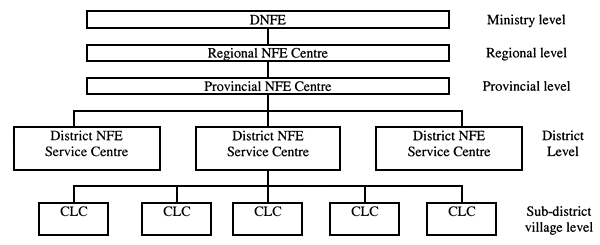
Administration at community level
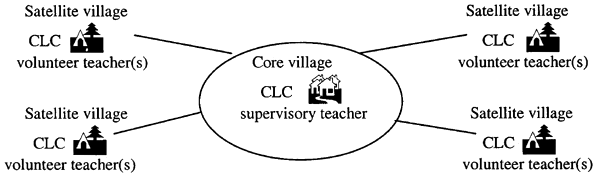
Source: Case study: The hill-tribe community learning centre “Mae Fa Luang”
CLC model

Source: Department of Non-Formal Education, 2000
| Contents | Credit hours | Objectives* | ||
| BASIC SKILLS (2 100 credit hours: 391 objectives) | ||||
| Thai language (1 400 hours: 191 objectives) | ||||
| Thai I (includes preparatory Thai) | 700 | 36 | ||
| Thai II | 400 | 79 | ||
| Thai III | 300 | 76 | ||
| Mathematics (700 hours: 200 objectives) | ||||
| Mathematics I | 268 | 74 | ||
| Mathematics II | 212 | 60 | ||
| Mathematics III | 220 | 66 | ||
| LIFE AND SOCIAL EXPERIENCE (3 900 hours: 505 objectives) | ||||
| 1. | The home | 189 | 41 | |
| 2. | The community | 127 | 16 | |
| 3. | Food | 125 | 16 | |
| 4. | Illness | 340 | 46 | |
| 5. | Mother and child | 88 | 7 | |
| 6. | Crops | 238 | 20 | |
| 7. | Land | 142 | 22 | |
| 8. | Forest | 80 | 21 | |
| 9. | Opium | 64 | 12 | |
| 10. | Domestic animals | 69 | 15 | |
| 11. | Merchants | 286 | 53 | |
| 12. | Non-agricultural occupations | 137 | 22 | |
| 13. | Local handicrafts | 318 | 70 | |
| 14. | Local technology | 122 | 19 | |
| 15. | Natural phenomena | 252 | 47 | |
| 16 | Tribal identity | 175 | 17 | |
| 17 | Thai citizenship | 272 | 43 | |
| 18 | Information and communication | 54 | 12 | |
| 19 | Contacting agencies | 42 | 6 | |
| 20 | “Local curriculum” | 780 | - | |
Notes: • The curriculum may be adopted to meet the special conditions and needs of particular communities. This
includes making changes in content, teaching/learning methods, study time, and learner evaluation.
• “Objectives” here indicates the number of criteria that students need to clear in order to pass the course.
Source: Department of Non-formal Education
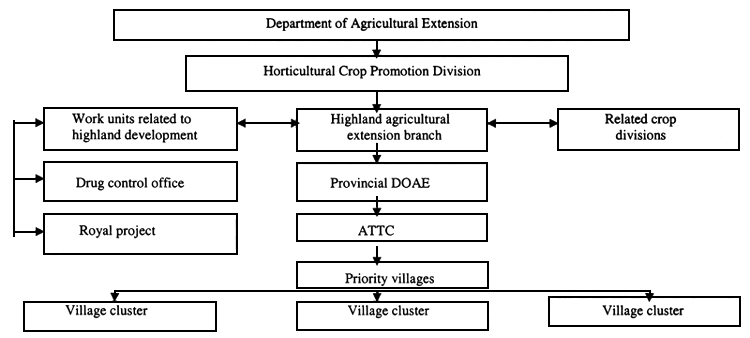
Source: Highland agriculture from the past to present
Highland agriculture extension (officers) according to the 1995–1999 plan
| Title | Subject matter specialist | Agricultural officer | Home economics officer | Total | ||
| Grade | 7 | 6 | 3–5 | 2–4/5 | 2–4 | |
| Central Region | ||||||
| Highland agriculture extension branch | 1 | 1 | 1(a) | 1 | - | 5 |
| Field offices | ||||||
| Chiang Mai | - | 1 | 10 | 11 | 3 | 25 |
| Chiang Rai | - | 1 | 3 | 3 | 1 | 8 |
| Lamphun | - | - | 1 | 1 | - | 2 |
| Loei | - | 1(b) | - | 1(b) | - | 2 |
| Kanchanaburi | - | 1(c) | - | 1(c) | - | 2 |
| Mae Hong Son | - | 1(d) | - | 1(d) | - | 2 |
| Total | 1 | 6 | 16 | 19 | 4 | 46 |
* Holding concurrent posts at provincial DOAE offices in
(a) Chiang Mai and Chiang Rai;
(b) Loei;
(c) Kanchanaburi; and
(d) Mae Hong Son
Highland agriculture staff (Temporary Employee, FY1999)
| General adm officer | Agri officer | Agri staff | Home eco. staff | Data recorder | Driver | Daily worker | Planting staff | Guard | Temp worker | Total | |
| Central region | |||||||||||
| Highland agri. ext. branch | 1 | 3 | - | - | 2 | 2 | 1 | - | - | - | 9 |
| Field office | |||||||||||
| Chiang Mai | - | 6 | 5 | 8 | - | 1 | 2 | 4 | 4 | 50 | 76 |
| Chiang Rai | - | 3 | 5 | 3 | - | 1 | 4 | 4 | 2 | 20 | 42 |
| Lamphun | - | 2 | 1 | 1 | - | - | 1 | 2 | 1 | 5 | 13 |
| Highland ext centre | |||||||||||
| Doi Tung | 1 | 5 | 5 | 2 | 1 | 2 | 5 | 4 | 2 | - | 27 |
| Loei | - | 1 | 2 | 1 | - | - | 1 | 2 | 1 | 10 | 18 |
| Kanchanaburi | - | 1 | 2 | 1 | - | - | 1 | 2 | 1 | 10 | 18 |
| Mae Hong Song | - | 1 | 2 | 1 | - | - | 1 | 2 | 1 | 10 | 18 |
| Tak provincial DOAE | - | 1 | 2 | 1 | - | - | - | - | - | - | 4 |
| Han provincial DOAE | - | 1 | 2 | 1 | - | - | - | - | - | - | 4 |
| Total | 2 | 23 | 24 | 18 | 3 | 7 | 16 | 21 | 12 | 105 | 229 |
Source: Highland agriculture in the next century
Agricultural extension (rice, vegetables, horticulture, fruit, flowers, etc)
Upstream water management
Natural resource conservation
Provision of seeds to extension areas
Soil conservation
Reforestation
Social forestry project
Paddy rice foundation in villages
Promotion of medicine funds
Training on agricultural product processing and preservation
Training on upstream water management
Training on handicraft making
Advice on nutrition
Agricultural production experimentation
Research on highland crops
Collection of information on highland/tropical crop species
Source: Highland ATTC brochure

Source: Summary Report, Hill Tribe Development and Welfare, DPW, 2000
Collaboration structure

Source: Brochure, Hill Tribe development and welfare centre, Chiang Mai
| Activity | Amount | |||
|---|---|---|---|---|
| 1999 | 2000 | |||
| 1. | Development of quality of life | |||
| 1.1 | Hill tribe occupational development | |||
| Maintenance and demonstration | 1 738 rai | 1 532 rai | ||
| Promotion of crop cultivation | 31 798 rai | 22 197 rai | ||
| Promotion of conservative crop cultivation | 5 055 rai | 3 910 rai | ||
| Prevention of deforestation (1999)/promotion of reforestation (2000) | 500 rai | 275 rai | ||
| Vocational and environmental conservation training | 2 020 persons | 1,360 persons | ||
| Income upgrading (B1 200/person/year in the past in 1999)/(B2 500/person/year in the past in 2000) | B2 500/person/yr | B3 900/person/yr | ||
| 1.2 | Social development in hill tribe community | |||
| Support of child development centres | 117 centres | 121 centres | ||
| Preparedness of pre-school hill tribe children | 3 732 persons | 3 800 persons | ||
| Support of audio-visual aids and equipment to the child development centres | 127 centres | 121 centres | ||
| Support of temporary schools | 12 schools | 18 schools | ||
| Support of stationery and equipment to the hill tribe school | 36 schools | 36 schools | ||
| Support of Buddhist ordination for hill tribe people | 372 persons | 300 persons | ||
| Support of Buddhist monks' activities | 1 838 villages | 1 838 villages | ||
| Training on prevention and solving of drug users | 665 persons | 665 persons | ||
| Provision of welfare services for drug users | 770 persons | 770 persons | ||
| Provision of family welfare and occupational assistance revolving fund for persons affected by HIV/AIDS | 500 families | 500 families | ||
| Provision of social welfare services for hill tribe families | 550 families | 550 families | ||
| 1.3 | Basic public utility development | |||
| Maintenance of laterite road | 931 km | 550 km | ||
| 1 080 villages | 1 100 villages | |||
| Improvement of drinking water and consumption water resources | 931 resources | 194 resources | ||
| 1 035 villages | 900 villages | |||
| 2. | Politics and administration | |||
| Coordination with the Department of Local Administration in allocation of Thai nationality to the hill tribe | 284 790 persons | 284 790 persons | ||
| 3. | Conservation of natural resources and environment | |||
| Promotion of conservative crops cultivation | 36 790 rai | 36 790 rai | ||
| 4. | Promotion of highland ecotourism project | |||
| 4.1 | Construction of hill tribe cultural centres | 13 provinces | - | |
| 36 centres | ||||
| 4.2 | Construction of accommodations in local style | 16 accommodations | - | |
| 4.3 | Setting up of hill tribe open markets | 2 markets | - | |
| 4.4 | Improvement and maintenance of laterite road | 339 km | - | |
| 4.5 | Training for officers and hill tribe people | - | 8 courses | |
| - | 365 persons | |||
| 5. | Project of eco-development for hill tribes | |||
| 5.1 | Conservation and restoration of forestry | |||
| Forestry conservation | 78 344 rai | 78 344 rai | ||
| Restoration of forestry areas at Royal Initiation | 14 134 rai | 14 134 rai | ||
| Reforestation | 3 899 rai | 8 221.5 rai | ||
| 5.2 | Soil and water conservation by promotion of conserved crop cultivation | 3 462 rai | 3 462 rai | |
| 5.3 On-farm/off-farm occupational development, potential development of community organization and provision of social welfare for the disadvantaged | 72 villages | 72 villages | ||
| 5.4 Promotion of village revolving fund for social and occupational development | B 1 521 478 | B1 600 000 | ||
| 6. | Project of wellbeing families model village | |||
| Development of the target village to attain a higher level of wellbeing | 27 villages | 28 villages | ||
| 10 311 persons | 10 311 persons | |||
| 7. Project of eco-development for the hill tribes in celebration of the 72nd birthday anniversary of HM the King | ||||
| Promotion of occupational development of hill tribes | - | 14 provinces | ||
| 72 villages | ||||
| 5 990 families | ||||
| 30 940 persons | ||||
| 8. | The Royal project | |||
| Encouragement to cultivate preserved crops and crop growing in cool weather as substitution to narcotic plants | - | 8 provinces | ||
| 82 villages | ||||
| 16 050 persons | ||||
Source: DPW Annual Report 1999/2000

