1. A U.S. Non-Paper prepared for the International Expert Meeting on Monitoring, Assessment and Reporting on the Progress toward Sustainable Forest Management Yokohama, Japan, 5-8 November 2001
2. Anonymous 2001: Using Criteria and Indicators Processes to Report on the Proposals for Action. U.S. Non-Paper prepared for the International Expert Meeting on Monitoring, Assessment and Reporting on the Progress toward Sustainable Forest Management. Yokohama, Japan, 5-8 November 2001. 9p.
3. Braatz S. 2001. Use of criteria and indicators for monitoring, assessment and reporting on progress towards sustainable management in the United Nations Forum on Forests. International Expert meeting on monitoring, assessment and reporting on the progress towards sustainable forest management. Yokohama, Japan, 5-8 November 2001. 38p. URL:
http://www.rinya.maff.go.jp/mar/Ms.%20Susan%20Paper.pdf
4. Braatz S. 2002. National reporting to forest-related international instruments: mandates, mechanisms, overlaps and potential synergies. Unasylva. Vol. 53 2002/3. FAO: Rome URL: http://www.fao.org/docrep/005/y4001e/Y4001E10.htm#P2_47
5. CIFOR (Centre for International Forestry Research) 1999. The CIFOR Criteria and Indicators Generic Template. The Criteria and Indicators Toolbox Series 2. CIFOR: Bogor.
6. DFID - Department for International Development, United Kingdom, EC - Directorate General for Development, European Commission, UNDP - United Nations Development Programme and The World Bank. 2002. Linking poverty reduction and environmental management. Policy Challenges and Opportunities. Discussion paper prepared for the world summit on sustainable development Process. 58p.
7. ECOSOC – Economic and Social Council of the United Nations 2003. Approaches and mechanisms for monitoring, assessment and reporting. UNFF, Ad hoc Expert Group on Approaches and Mechanisms for Monitoring, Assessment and Reporting. Note by the Secretariat. 23p.
8. FAO 2001. Evaluación de Recursos Forestales Mundiales 2000 – informe principal. Estudio FAO Montes Nº 140: FAO: Roma.
9. FAO 2002: Segunda reunión de expertos sobre armonización de definiciones relacionadas con el bosque para su uso por los diversos interesados. Actas. FAO: Roma. URL: http://www.fao.org/DOCREP/005/Y4171E/y4171e00.htm#TopOfPage
10. Hendricks R. 2003: Fortalecimiento de la elaboración y aplicación de criterios e indicadores para la ordenación forestal sostenible. Documento de Información presentado en la Conferencia Internacional sobre la Contribución de los Criterios e Indicadores en la Ciudad de Guatemala. FAO: Roma. URL http://www.fao.org/DOCREP/005/J0077E/J0077E04.htm#P0_0
11. Koehl M. 2000. Reliability and comparability of TBFRA 2000 results. In TBFRA 2000. Ginebra, UN-ECE/FAO. pp. 27-61.
12. Matthews E. 2001: Understanding the FRA 2000. Forest Briefing No. 1. World Resource Institute: Washington.12p.
13. Nunan F., U. Grant, G. Bahiigwa, T. Muramira, P. Bajracharya, D. Pritchard and M.J. Vargas. 2002. Poverty and the environment: Measuring the links. A Study of Poverty-Environment Indicators with Case Studies from Nepal, Nicaragua and Uganda. Environment Policy Department. Issue Paper No. 2. DFID. 78p.
14. OECD - Organisation for Economic Co-operation and Development 2001. Kyoto mechanisms, monitoring and compliance. From Kyoto to The Hague. A selection of recent OECD and IEA analyses on the Kyoto Protocol. OECD and IEA - International Energy Agency. COM/ENV/EPOC/IEA/SLT(2001) 9. 56p.
15. OECD - Organisation for Economic Co-operation and Development 2003. Forestry projects: lessons learned and implications for CDM modalities. OECD and IEA (International Energy Agency). Information Paper. 49p.
16. Pokorny B. and Adams M. 2003b: What do criteria and indicators assess? An analysis of five C&I sets relevant for forest management in the Brazilian Amazon. International Forestry Review 5 (1). 20-28.
17. Pokorny B., Sabogal C., Natalino J.M.S., Lima J., Bernardo P. 2004: C&I para el monitoreo de operaciones forestales. Un caso en Brasil. Revista Forestal Centroamericana.
18. Prabhu R., Ruitenbeek H.J., Boyle T.J.B. and Colfer C.J.P. 1998. Between voodoo science and adaptive management: the role and research needs for indicators of sustainable forest management. Paper presented at the IUFRO Conference, 24-28 August, Melbourne, Australia. CABI-IUFRO Publication/Monograph.
19. Prabhu R., P. Abbot, D. Blay, K. Buchanan, F. Castañeda, A. Danso, M. Dudley, J.M. Kim, A. Marjokorpi, M. Nkosi, B. Pokorny, R. Prasad, H. Seppanen, H. Thiel, D. Wijewardena, P. Wright. 2003. Fortalecimiento de la capacidad institucional y socios interesados para la aplicación de criterios e indicadores y facilitar el intercambio de información entre todos los interesados. Documento de Información presentado en la Conferencia Internacional sobre la contribución de criterios e indicadores en la Ciudad de Guatemala City. FAO: Roma. URLhttp://www.fao.org/DOCREP/005/J0077E/J0077E08.htm
20. Schanz H. 1996. Forstliche Nachhaltigkeit. Dissertation. Schriften aus dem Institut für Forstökonomie der Universität Freiburg 4. 131p.
21. Schoene D. 2002. Assessing and reporting forest carbon stock changes: a concerted effort? Unasylva. Vol. 53 2002/3. FAO: Rome. 8p. URL: http://www.fao.org/docrep/005/y4001e/Y4001E11.htm#P0_0
22. UNDP – United Nations Development Program 2003. Human Development Report 2003. Millennium Development Goals: A compact among nations to end human poverty. New York Oxford: Oxford University Press. 367p.
23. UN-DSD – Division on Sustainable Development 2002. Country experiences with national reporting to the United Nations Commission on Sustainable Development. UN-DSD: New York.
24. UNEP 2001: Harmonization of information management and reporting for biodiversity-related treaties. Background paper presented at the third Meeting of the Environmental Management Group, Geneva, 10 October 2001 URL: http://www.unep-wcmc.org/conventions/harmonization/emg_img.htm
25. UNFF – United Nations Forum on Forests 2001: Informal consultations on the multi-year programme of work (MYPOW), New York, 13-16 February 2001. Informal Information and Background Notes from the Secretariat. UNFF. URL:
http://www.un.org/esa/forests/documents-unff.html#org
26. WCMC – World Conservation Centre 2000: Towards the harmonization of national reporting. Workshop report. UNEP/WCMC, Cambridge, UK, 30-31 October, 2000. URL: http://www.unep-wcmc.org/conventions/harmonization/workshop/intro.pdf
27. Puustjärvi E. and Simula M. 2002. Development of common framework for forest-related definitions. Discussion Paper. IN: FAO 2002: Second expert meeting on harmonizing forest related definitions for use by various stakeholders. Proceedings. FAO: Rome.
Cuadro 1: Iniciativas y Procesos Internacionales sobre Criterios e Indicadores
Iniciativa/proceso |
Nº de países participantes |
Región (zona de vegetación/área geográfica) |
CMPBE (Proceso Pan-Europeo) |
41 |
Bosques europeos boreales y templados |
Proceso de Montreal |
12 |
Bosques templados de América, Asia, Pacífico |
OIMT |
31 |
Bosques tropicales naturales |
Propuesta de Tarapoto |
8 |
Cuenca Amazónica |
Organización Africana de la Madera |
14 |
Bosques tropicales de África |
Proceso de la Zona Seca Africana |
30 |
África Sub-Sahariana |
Proceso del Cercano Oriente |
30 |
Cercano Oriente |
Iniciativa del Bosque Seco de Asia |
9 |
Sur de Asia y Mongolia, China, Myanmar, Tailandia |
Proceso de Lepaterique |
7 |
América Central |
Total |
149 |
Mundial |
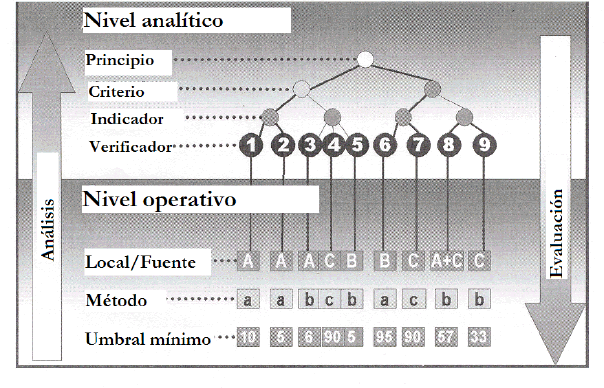
Figura 1: Los dos niveles de los instrumentos CeI: el nivel analítico conformado por una serie de CeI como base para el análisis y comprensión del objetivo de la evaluación (sostenibilidad), y el nivel operativo que contiene métodos y umbrales mínimos para cada verificador necesario para la evaluación e interpretación de los resultados relacionados con los verificadores. (modificada por Pokorny et al. 2004)