Module 3 - How to conduct NFPE lessons
Lesson 1 - Appreciating women's roles in the family and the community
Lesson 2 - Pregnancy and spacing of births
Lesson 3 - Providing for the children's future
Purpose:
* This Module offers suggestions as to which step-by-step procedures could be applied in conducting each session.
* For each session, sample teaching procedures are illustrated.
1. Title : Appreciating Women's Roles in the Family and the Community
2. Message : Women have significant roles to play in the family and community as environmental resource managers; as producers of agricultural products; as educators; as care-givers or healers.
3. Objectives: Explain the roles of women as:
* environmental/resource managers
* producers of agricultural products
* educators
* care-givers or healers
4. Teaching Procedures: The facilitator will ask the participants to divide themselves into four groups.
- The facilitator will then ask each group to pick up one of the four sheets of paper describing (or depicting) the above mentioned "women's roles".
- Each of the four groups will be asked to depict or dramatize for three to five minutes the role they have extracted.
Figure
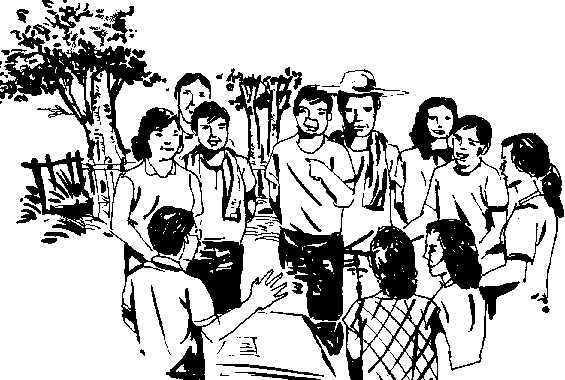
The rest of the participants will guess the roles of women, that have been acted out.
After all the roles have been presented, enumerate and group the roles of women, according to the following classifications:
- environment and resource managers
- agricultural producers
- educators
- care-givers or healers
The participants will be asked to discuss the significance or importance of each role to the development of the community.
The facilitator will summarize the role of women through the following statements:
- Women complement men's perspectives (different but equal).
- Women's roles in the family and society are as important as those of men.
- Women contribute significantly to improving the quality of life of the family and community through their roles as environment and resource managers.
- Women's roles determine the health and well-being of the family.
Figure
1. Title : Pregnancy and Spacing of Births
2. Message : Pregnancies should be avoided below the age of 18 and above 35. Pregnancies should be at least two years apart.
3. Objectives:
* Discuss the most appropriate ages for women to be pregnant.
* Discuss the proper spacing between pregnancies.
* Discuss the health center services and facilities to space/avoid pregnancies.
4. Teaching Procedure: Storytelling
* The facilitator will ask the group to listen to the story of Dolores in Module 5.
* The facilitator will ask the group what they think is the right age to be pregnant and the right spacing of births.
* The facilator will then ask the participants to complete this statement: Pregnancy should start at the right age, otherwise:
___________________________________________________________________________
___________________________________________________________________________
___________________________________________________________________________
___________________________________________________________________________
___________________________________________________________________________
___________________________________________________________________________
___________________________________________________________________________
___________________________________________________________________________
___________________________________________________________________________
___________________________________________________________________________
___________________________________________________________________________
___________________________________________________________________________
* The participants may be asked to cite their own experiences as the basis for filling up the above statement. The facilitator can also ask the first question (at what age did you have your first child) to set the participants on track.
* The facilitator will explain the reasons why pregnancy should not occur below the age of 18 and above 35, and also why pregnancies should be spaced 2 years apart.
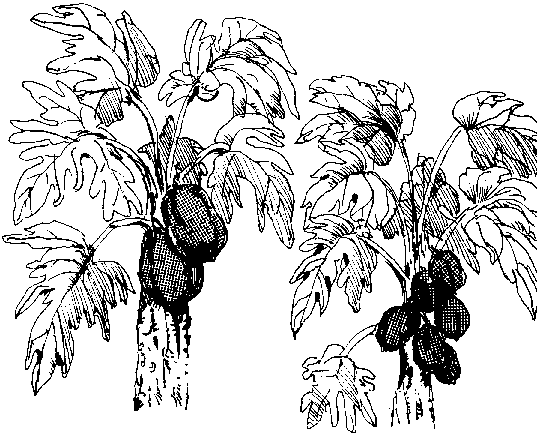
* The facilitator will make a synthesis using the analogy of the papaya tree (the more fruits in the tree, the smaller they are; the closely spaced the fruits, the smaller they are).
N.B. Facilitators may find some useful reference readings on this subject in Module 4.
1. Title : Providing for the Children's Future
2. Message: We should balance the need for having more children to help us on the farm and in the house, with our capacity to provide for their basic needs and their future.
3. Objectives:
* Discuss the advantages of not having more than three children.
* Discuss the financial, emotional and other requirements for bringing up the children until they become economically productive adults.
4. Teaching Procedure: Group Discussion
* The facilitator will introduce the topic by asking the participants to state how many children they prefer and why.
* The facilitator will make a tally on the board for each reply, as shown below:
No. of Children |
No. who Chose |
Reasons |
1 |
2 |
security/helper at home |
2 |
2 |
|
3 |
4 |
|
4 |
2 |
|
5 |
1 |
etc. |
* The facilitator will then ask the group to divide themselves into four groups to answer the following exercise on the next page.
* The facilitator will compare the economic contribution of a child working at home or on the farm against his/her needs.
* The facilitator will make a synthesis of the insights based on the lessons reamed.
EXERCISE
Discuss and answer the following questions as a group:
1. What do you think are our obligations to our children? Based on our present resources, how many children can we effectively support?
2. How much would it cost for one child to reach 20 years of age for the following items? Please make a rough estimate.
Items |
Amount | |
+ Food | ||
+ Clothing | ||
+ Schooling (including books and school supplies) | ||
- Elementary |
||
- High School |
||
- College |
||
+ Medical care | ||
+ Others | ||
3. What are our alternatives to child labor at home and on the farm if we choose to have fewer children?
N.B. Facilitators may find some useful reference reading on this subject in Module 4.
* The facilitator will compare the economic contribution of a child working at home or in the field against his needs.
* The facilitator will make a synthesis of the insights based on the lessons reamed.
Figure
1. Title : Women in Decision-Making
2. Message: There is a need to involve women in decision-making, particularly for such important concerns as:
* childbearing
* child-rearing
* family health
* disposition of family income
* employment/participation in the labor force
* management of environment/natural resources
3. Objectives: Enumerate the advantages of involving women in decision-making in childbearing, child-rearing, family health, disposition of family income, employment] participation in the labor force, management of environment/natural resources.
* Identify ways of enhancing the decision-making capability of women.
* Suggest ways of improving the capacity of men and women to consult each other in decision-making.
4. Teaching Procedure: Simulation/Role Playing
* The participants will be divided into six groups.
* The facilitator will ask the participants to simulate discussions where decisions are to be made for the following:
- whether they will have another child
- whether the child will be allowed to plow the field
- whether to bring a sick child for consultation
- where to spend the income from the sale of coffee
- whether the wife will work in the community
- whether a deep well shall be dug near the house
* For each situation above, the participants will be given two minutes to simulate actual discussion and the decision that will be made. For each discussion, the husband and wife will be the main characters.
* For each decision, the participants will be asked to enumerate the merits/ negative aspects of the decision.
* The participants will be asked to review the stand made by the wife (woman) and its implications.
* After the simulation activities, the participants will be asked to comment on:
- the quality of the decision
- how binding the decision is
1. Title : Providing Women with Technology
2. Message: Women should have access to technologies that would make the work at home and agricultural production more efficient and reduce the need for her and her children's labor, time and inputs.
3. Objectives:
* Identify work where technology can ease the physical burden among women.
* Identify where technology can reduce time inputs needed by women.
* Enumerate ways by which such technology can benefit women.
* Discuss ways by which women's physical and economic access to technology can be improved.
4. Teaching Procedure: Demonstration/Return Demonstration
* The facilitator will invite a resource person who will demonstrate low-cost appropriate technology among the participants.
* The participants will be asked to use the technologies themselves.
* The participants will then enumerate other types of work/activities where technology can aid them.
* An open forum will follow so that the resource person can answer questions raised by the participants.
* The participants will enumerate ways by which their access to technology can be improved.
* The facilitator will synthesize the session through the use of a diagram highlighting the importance of technology and how it can be brought closer to the women.
Demonstration of Appropriate Technologies